

The DOI matches its Crossref record; 50 of the 50 references it cites were found in a registry or an index.
miRNA-Mediated Priming of Macrophage M1 Differentiation Differs in Gram-Positive and Gram-Negative Settings
Abstract
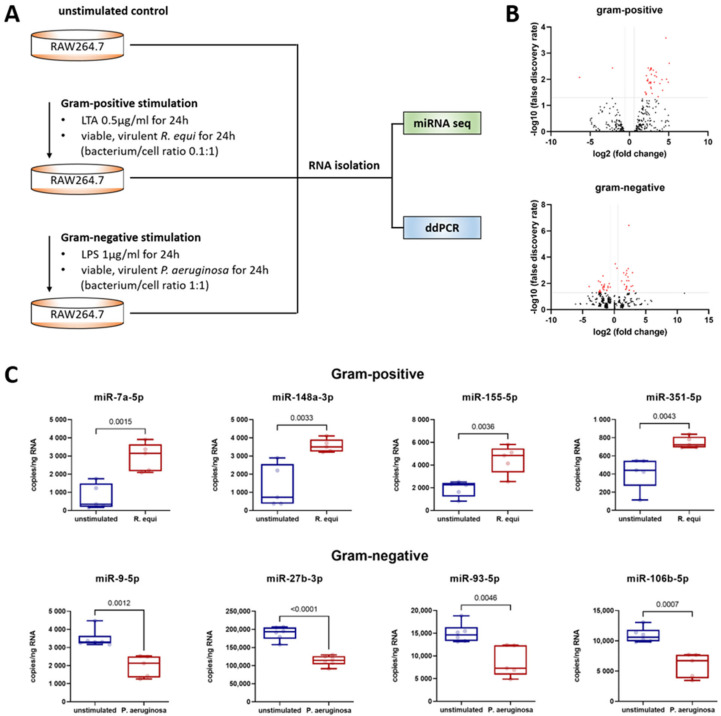
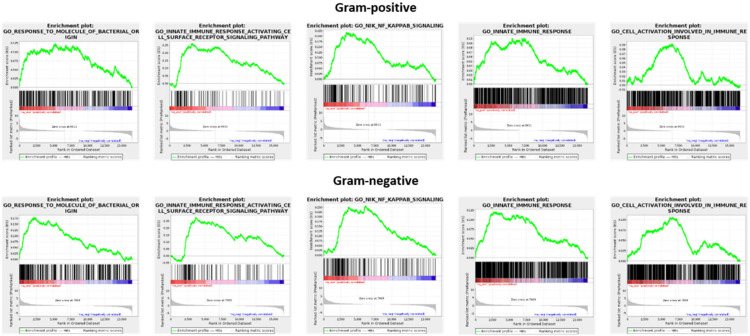
A proper regulation of macrophage polarization is essential for the organism’s health and pathogen control. Differentiation control is known to occur at the transcriptional as well as the posttranscriptional levels. The mechanisms involved, however, have not yet been fully elucidated. In this study, we co-cultured macrophages with viable Gram-positive and Gram-negative bacteria to mimic macrophage differentiation to the M1-like type in an inflammatory milieu. We found that Gram-positive stimulation resulted in increased expressions of miR-7a-5p, miR-148a-3p, miR-155-5p, and miR-351-5p. Of note, these miRNAs were found to target inhibitory mediators of the Rac1-PI3K-Akt pathway and the MyD88-dependent pathway. In contrast, Gram-negative stimulation-induced downregulation of miR-9-5p, miR-27b-3p, miR-93-5p, and miR-106b-5p is known to target key members of the Rac1-PI3K-Akt pathway and the MyD88-dependent pathway. These results, taken together, point to a fine-tuning of macrophage polarization by TLR-induced changes in macrophage miRNA profiles. Here, the miRNA-mediated priming of M1 differentiation seems to differ in the Gram-positive and Gram-negative settings in terms of the mechanism and miRNAs involved.
Overview
The claims and statistics of this paper haven’t been checked yet.
Run the check — free, no account needed. It reads the open-access text and checks the sources it cites.
Integrity signals
Registry
Cites
Statistics
Figures
Verification
Claims the paper makes
The claims and statistics of this paper haven’t been checked yet.
Run the check — free, no account needed. It reads the open-access text and checks the sources it cites.
Claims other papers make about this one
Each is checked against this paper’s own text: does it say what the citing paper says it does?
The source backs part of the claim, not all of it — or backs it for a different population, condition or comparison.
In the citing paper
“Previous research has established miR-155-5p as a key regulator of macrophage activation, immune cell function, and inflammation in peripheral tissues [21–23].”
From The Resistin/TLR4/miR-155-5p axis: a novel signaling pathway in the onset of hypothalamic neuroinflammation (2025) · cites this paper as [22]
Experimental — accuracy not yet measured
Self-check
Percentages, sums and reported differences re-computed from the paper’s own numbers.
The self-check needs the paper’s full text.
Citations
Cites
The Sequence Alignment/Map format and SAMtools
Li, H., Handsaker, B., Wysoker, A., Fennell, T., Ruan, J., Homer, N., Marth, G., Abecasis, G., Durbin, R., & 1000 Genome Project Data Processing Subgroup (2009) · Bioinformatics · doi:10.1093/bioinformatics/btp352 · Cited by 62,041
Fast gapped-read alignment with Bowtie 2
Langmead, B., & Salzberg, S. L. (2012) · Nature Methods · doi:10.1038/nmeth.1923 · Cited by 56,400
Subramanian, A., Tamayo, P., Mootha, V. K., Mukherjee, S., Ebert, B. L., Gillette, M. A., Paulovich, A., Pomeroy, S. L., Golub, T. R., Lander, E. S., et al. (2005) · Proceedings of the National Academy of Sciences · doi:10.1073/pnas.0506580102 · Cited by 53,625
Robinson, M. D., McCarthy, D. J., & Smyth, G. K. (2010) · Bioinformatics · doi:10.1093/bioinformatics/btp616 · Cited by 41,364
KEGG: Kyoto Encyclopedia of Genes and Genomes
Ogata, H., Goto, S., Sato, K., Fujibuchi, W., Bono, H., & Kanehisa, M. (1999) · Nucleic Acids Research · doi:10.1093/nar/27.1.29 · Cited by 31,232
featureCounts: an efficient general purpose program for assigning sequence reads to genomic features
Liao, Y., Smyth, G. K., & Shi, W. (2014) · Bioinformatics · doi:10.1093/bioinformatics/btt656 · Cited by 27,219
HISAT: a fast spliced aligner with low memory requirements
Kim, D., Langmead, B., & Salzberg, S. L. (2015) · Nature Methods · doi:10.1038/nmeth.3317 · Cited by 24,112
The Molecular Signatures Database Hallmark Gene Set Collection
Liberzon, A., Birger, C., Thorvaldsdóttir, H., Ghandi, M., Mesirov, J. P., & Tamayo, P. (2015) · Cell Systems · doi:10.1016/j.cels.2015.12.004 · Cited by 13,807
A scaling normalization method for differential expression analysis of RNA-seq data
Robinson, M. D., & Oshlack, A. (2010) · Genome Biology · doi:10.1186/gb-2010-11-3-r25 · Cited by 7,876
Macrophage plasticity and polarization: in vivo veritas
Sica, A., & Mantovani, A. (2012) · Journal of Clinical Investigation · doi:10.1172/jci59643 · Cited by 6,335
Cited by
Prévost, M., Crépin, D., Rifai, S. A., Poizat, G., Gonçalves, M., van Barneveld, F., Shadpay, R., Taouis, K., Riffault, L., Benomar, Y., et al. (2025) · Journal of Neuroinflammation · doi:10.1186/s12974-025-03522-3 · Cited by 19
Metadata
- Authors
- Riechert, G., Maucher, D., Schmidt, B., & Schumann, J.
- Affiliations
- University Clinic and Outpatient Clinic for Anesthesiology and Operative Intensive Care, University Medicine Halle (Saale), Franzosenweg 1a, 06112 Halle (Saale), Germany
- ORCID
- Schumann, Julia
- Venue
- Genes
- Publisher
- MDPI AG
- Published
- 2022-01-24
- Volume
- 13
- Issue
- 2
- Pages
- 211
- ISSN
- 2073-4425
- PMC
- PMC8871789
- Cited by
- 10
- References
- 50
- Language
- en
About these checks
Registry, retraction, Cites and statistics results are computed, not judged, with one exception: a printed reference that no index lists is read once by a model before it counts as a citation error. Claims are extracted by a model and kept only when their quote appears verbatim in the text; each cited source is then checked, with a model’s help, for whether it says what the claim relies on. Those verdicts can be wrong — read the claim’s quote and the cited source before relying on one.
Statistics and arithmetic are recomputed, not judged.
Confidence bands are shown only for fields calibrated on our annotated test set. None is calibrated yet, so no band is shown.
What counts as a claim ›How we measure confidence ›How we check this ›
Are you an author, or do you see a problem with this page? Request a review
How to cite
Cite CoChat for the checks on this page, and the paper for its own findings.
- This page
- CoChat. (2026). Citation check: miRNA-Mediated Priming of Macrophage M1 Differentiation Differs in Gram-Positive and Gram-Negative Settings. https://app.cochat.ai/papers/10.3390/genes13020211
- The paper
- Riechert, G., Maucher, D., Schmidt, B., & Schumann, J. (2022). miRNA-Mediated Priming of Macrophage M1 Differentiation Differs in Gram-Positive and Gram-Negative Settings. Genes. https://doi.org/10.3390/genes13020211
Data sources
Bibliographic data: Semantic Scholar, OpenAlex, Crossref.
Contains information from the Semantic Scholar Academic Graph Datasets, made available under the ODC Attribution License (ODC-BY 1.0).
Semantic Scholar’s data is described in: Kinney, R., et al. (2023). The Semantic Scholar Open Data Platform. arXiv:2301.10140.
