

The DOI matches its Crossref record; 3 of the 3 references it cites were found in a registry or an index.
Reassessing Domain Architecture Evolution of Metazoan Proteins: Major Impact of Gene Prediction Errors
Abstract
In view of the fact that appearance of novel protein domain architectures (DA) is closely associated with biological innovations, there is a growing interest in the genome-scale reconstruction of the evolutionary history of the domain architectures of multidomain proteins. In such analyses, however, it is usually ignored that a significant proportion of Metazoan sequences analyzed is mispredicted and that this may seriously affect the validity of the conclusions. To estimate the contribution of errors in gene prediction to differences in DA of predicted proteins, we have used the high quality manually curated UniProtKB/Swiss-Prot database as a reference. For genome-scale analysis of domain architectures of predicted proteins we focused on RefSeq, EnsEMBL and NCBI’s GNOMON predicted sequences of Metazoan species with completely sequenced genomes. Comparison of the DA of UniProtKB/Swiss-Prot sequences of worm, fly, zebrafish, frog, chick, mouse, rat and orangutan with those of human Swiss-Prot entries have identified relatively few cases where orthologs had different DA, although the percentage with different DA increased with evolutionary distance. In contrast with this, comparison of the DA of human, orangutan, rat, mouse, chicken, frog, zebrafish, worm and fly RefSeq, EnsEMBL and NCBI’s GNOMON predicted protein sequences with those of the corresponding/orthologous human Swiss-Prot entries identified a significantly higher proportion of domain architecture differences than in the case of the comparison of Swiss-Prot entries. Analysis of RefSeq, EnsEMBL and NCBI’s GNOMON predicted protein sequences with DAs different from those of their Swiss-Prot orthologs confirmed that the higher rate of domain architecture differences is due to errors in gene prediction, the majority of which could be corrected with our FixPred protocol. We have also demonstrated that contamination of databases with incomplete, abnormal or mispredicted sequences introduces a bias in DA differences in as much as it increases the proportion of terminal over internal DA differences. Here we have shown that in the case of RefSeq, EnsEMBL and NCBI’s GNOMON predicted protein sequences of Metazoan species, the contribution of gene prediction errors to domain architecture differences of orthologs is comparable to or greater than those due to true gene rearrangements. We have also demonstrated that domain architecture comparison may serve as a useful tool for the quality control of gene predictions and may thus guide the correction of sequence errors. Our findings caution that earlier genome-scale studies based on comparison of predicted (frequently mispredicted) protein sequences may have led to some erroneous conclusions about the evolution of novel domain architectures of multidomain proteins. A reassessment of the DA evolution of orthologous and paralogous proteins is presented in an accompanying paper [1].
Overview
The claims and statistics of this paper haven’t been checked yet.
Run the check — free, no account needed. It reads the open-access text and checks the sources it cites.
Integrity signals
Registry
Cites
Statistics
Figures
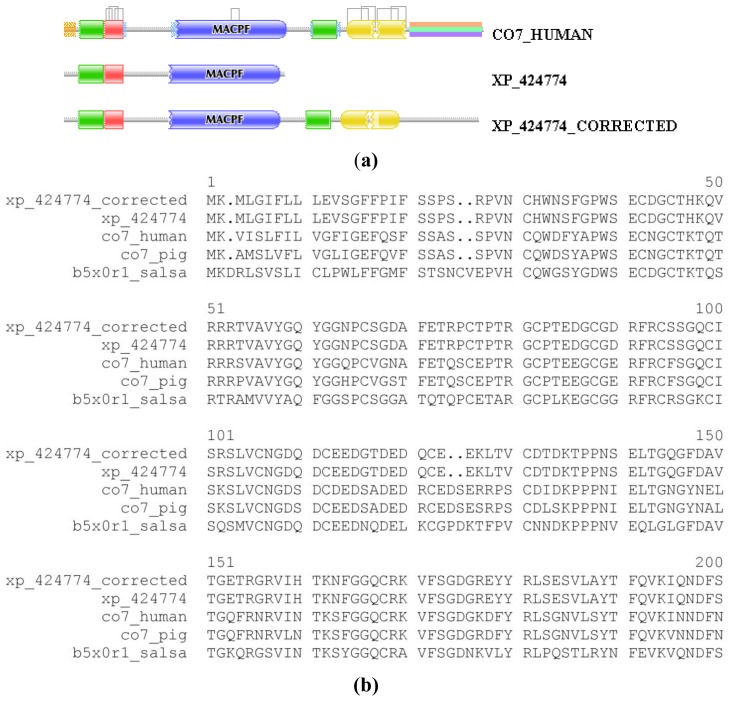
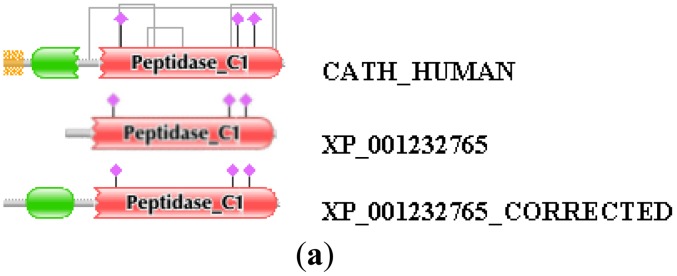
Verification
Claims the paper makes
The claims and statistics of this paper haven’t been checked yet.
Run the check — free, no account needed. It reads the open-access text and checks the sources it cites.
Claims other papers make about this one
Each is checked against this paper’s own text: does it say what the citing paper says it does?
In the citing paper
“Such erroneous gene calls may (i) become the cause of downstream gene-prediction or annotation errors, (ii) generate false positive predictions for gene/protein associations and (iii) hinder large-scale genome evolution studies (115,116).”
From Tandem repeats lead to sequence assembly errors and impose multi-level challenges for genome and protein databases (2019) · cites this paper as [115]
Self-check
Percentages, sums and reported differences re-computed from the paper’s own numbers.
The self-check needs the paper’s full text.
Citations
Cites
NCBI Reference Sequences: current status, policy and new initiatives
Pruitt, K. D., Tatusova, T., Klimke, W., & Maglott, D. R. (2009) · Nucleic Acids Research · doi:10.1093/nar/gkn721 · Cited by 736
Ruan, J., Li, H., Chen, Z., Coghlan, A., Coin, L. J. M., Guo, Y., Heriche, J.-K., Hu, Y., Kristiansen, K., Li, R., et al. (2007) · Nucleic Acids Research · doi:10.1093/nar/gkm1005 · Cited by 332
Modular Assembly of Genes and the Evolution of New Functions
Patthy, L. (2003) · Genetica · doi:10.1023/a:1024182432483 · Cited by 166
Self-citation
Research works printed but not linked: 60
- Nagy, A., and Patthy, L. (2011). Reassessing Domain Architecture Evolution of Metazoan Proteins: Contribution of Different Evolutionary Mechanisms. Genes, submitted for publication. · DOI
- Tordai, 2005, Modules, multidomain proteins and organismic complexity, FEBS J., 272, 5064, 10.1111/j.1742-4658.2005.04917.x · DOI
- Nagy, 2008, Identification and correction of abnormal, incomplete and mispredicted proteins in public databases, BMC Bioinf., 9, 353, 10.1186/1471-2105-9-353 · DOI
- Weiner, 2006, Domain deletions and substitutions in the modular protein evolution, FEBS J., 273, 2037, 10.1111/j.1742-4658.2006.05220.x · DOI
- Harrow, 2009, Identifying protein-coding genes in genomic sequences, Genome Biol., 10, 201, 10.1186/gb-2009-10-1-201 · DOI
- Bernal, 2007, Global discriminative learning for higher-accuracy computational gene prediction, PLoS Comput. Biol., 3, e54, 10.1371/journal.pcbi.0030054 · DOI
- Finn, 2010, The Pfam protein families database, Nucleic Acids Res., 38, D211, 10.1093/nar/gkp985 · DOI · Paper page
- Fong, 2008, Protein subfamily assignment using the conserved domain database, BMC Res. Notes, 1, 114, 10.1186/1756-0500-1-114 · DOI
- Homepage of Conserved Domains Database. Available online: http://www.ncbi.nlm.nih.gov/sites/entrez?db=cdd (accessed on 04 May 2011).
- Greene, 2007, The CATH domain structure database: New protocols and classification levels give a more comprehensive resource for exploring evolution, Nucleic Acids Res., 35, D291, 10.1093/nar/gkl959 · DOI
- Andreeva, 2008, Data growth and its impact on the SCOP database: New developments, Nucleic Acids Res., 36, D419, 10.1093/nar/gkm993 · DOI
- Wang, 2006, Global phylogeny determined by the combination of protein domains in proteomes, Mol. Biol. Evol., 23, 2444, 10.1093/molbev/msl117 · DOI
- Gough, 2005, Convergent evolution of domain architectures (is rare), Bioinformatics, 21, 1464, 10.1093/bioinformatics/bti204 · DOI
- Lin, 2006, An initial strategy for comparing proteins at the domain architecture level, Bioinformatics, 22, 2081, 10.1093/bioinformatics/btl366 · DOI
- Lee, 2008, DAhunter: a web-based server that identifies homologous proteins by comparing domain architecture, Nucleic Acids Res., 36, W60, 10.1093/nar/gkn172 · DOI
- Kawashima, 2007, Comparative pair-wise domain-combinations for screening the clade specific domain-architectures in metazoan genomes, Genome Inform., 19, 50
- Przytycka, 2006, Graph theoretical insights into evolution of multidomain proteins, Comput. Biol., 13, 351, 10.1089/cmb.2006.13.351 · DOI
- Kawashima, 2009, Domain shuffling and the evolution of vertebrates, Genome Res., 19, 1393, 10.1101/gr.087072.108 · DOI
- Basu, 2008, Evolution of protein domain promiscuity in eukaryotes, Genome Res., 18, 449, 10.1101/gr.6943508 · DOI
- Forslund, 2008, Domain tree-based analysis of protein architecture evolution, Mol. Biol. Evol., 25, 254, 10.1093/molbev/msm254 · DOI
- Zhang, 2010, Domain architecture evolution of pattern-recognition receptors, Immunogenetics, 62, 263, 10.1007/s00251-010-0428-1 · DOI
- Ekman, 2007, Quantification of the elevated rate of domain rearrangements in metazoa, J. Mol. Biol., 372, 1337, 10.1016/j.jmb.2007.06.022 · DOI
- Koonin, 2000, The impact of comparative genomics on our understanding of evolution, Cell, 101, 573, 10.1016/S0092-8674(00)80867-3 · DOI
- Ponting, 2002, The natural history of protein domains, Annu. Rev. Biophys. Biomol. Struct., 31, 45, 10.1146/annurev.biophys.31.082901.134314 · DOI
- Patthy, 1985, Evolution of the proteases of blood coagulation and fibrinolysis by assembly from modules, Cell, 41, 657, 10.1016/S0092-8674(85)80046-5 · DOI
- Li, 2003, OrthoMCL: Identification of ortholog groups for eukaryotic genomes, Genome Res., 13, 2178, 10.1101/gr.1224503 · DOI · Paper page
- Chen, 2007, Assessing performance of orthology detection strategies applied to eukaryotic genomes, PLoS One, 2, e383, 10.1371/journal.pone.0000383 · DOI
- Buljan, 2009, The evolution of protein domain families, Biochem. Soc. Trans., 37, 751, 10.1042/BST0370751 · DOI
- Buljan, 2010, Quantifying the mechanisms of domain gain in animal proteins, Genome Biol., 11, R74, 10.1186/gb-2010-11-7-r74 · DOI · Paper page
- Fong, 2007, Modeling the evolution of protein domain architectures using maximum parsimony, J. Mol. Biol., 366, 307, 10.1016/j.jmb.2006.11.017 · DOI
- Moore, 2008, Arrangements in the modular evolution of proteins, Trends Biochem. Sci., 33, 444, 10.1016/j.tibs.2008.05.008 · DOI
- Nagy, A., Banyai, L., and Patthy, L. (2011). Reassessing Domain Architecture Evolution of Metazoan Proteins: Major Impact of Errors Caused by Confusing Paralogs and Epaktologs. Genes, submitted for publication. · DOI
- Yu, 2005, Nested genes in the human genome, Genomics, 86, 414, 10.1016/j.ygeno.2005.06.008 · DOI
- Assis, 2008, Nested genes and increasing organizational complexity of metazoan genomes, Trends Genet., 24, 475, 10.1016/j.tig.2008.08.003 · DOI
- Kumar, 2009, An overview of nested genes in eukaryotic genomes, Eukaryotic Cell, 8, 1321, 10.1128/EC.00143-09 · DOI
- Kaplan, 1999, A novel developmentally regulated gene in lung mesenchyme: homology to a tumor-derived trypsin inhibitor, Am. J. Physiol., 276, L1027
- Trexler, 2000, The LCCL module, Eur. J. Biochem., 267, 5751, 10.1046/j.1432-1327.2000.01641.x · DOI
- Hedges, 2006, TimeTree: A public knowledge-base of divergence times among organisms, Bioinformatics, 22, 2971, 10.1093/bioinformatics/btl505 · DOI · Paper page
- Neumann, 2001, An alternative amino-terminus expressed in the central nervous system converts agrin to a type II transmembrane protein, Mol. Cell. Neurosci., 17, 208, 10.1006/mcne.2000.0932 · DOI
- Ip, 2000, Cloning and characterization of muscle-specific kinase in chicken, Mol. Cell. Neurosci., 16, 661, 10.1006/mcne.2000.0892 · DOI
- Xu, 2005, Genetic evidence of a strong functional constraint of neurotrypsin during primate evolution, Cytogenet Genome Res., 108, 303, 10.1159/000081523 · DOI
- UniProt Consortium (2010). The Universal Protein Resource (UniProt) in 2010. Nucleic Acids Res., 38, D142–D148. · DOI
- Homepage of RefSeq database. Available online: http://www.ncbi.nlm.nih.gov/RefSeq/ (accessed on 04 May 2011).
- Hubbard, 2009, Ensembl 2009, Nucleic Acids Res., 37, D690, 10.1093/nar/gkn828 · DOI
- Sayers, 2010, Database resources of the National Center for Biotechnology Information, Nucleic Acids Res., 38, D5, 10.1093/nar/gkp967 · DOI
- Homepage of the National Center for Biotechnology Information. Available online: http://www.ncbi.nlm.nih.gov/ (accessed on 04 May 2011).
- Homepage of Gnomon, the NCBI eukaryotic gene prediction tool. Available online: http://www.ncbi.nlm.nih.gov/genome/guide/gnomon.shtml (accessed on 04 May 2011).
- Anderson, 2009, CDD: Specific functional annotation with the conserved domain database, Nucleic Acids Res., 37, D205, 10.1093/nar/gkn845 · DOI
- Letunic, 2009, SMART 6: Recent updates and new developments, Nucleic Acids Res., 37, D229, 10.1093/nar/gkn808 · DOI
- Stanke, 2005, AUGUSTUS: A web server for gene prediction in eukaryotes that allows user-defined constraints, Nucleic Acids Res., 33, W465, 10.1093/nar/gki458 · DOI
- Birney, 2004, GeneWise and Genomewise, Genome Res., 14, 988, 10.1101/gr.1865504 · DOI · Paper page
- Yeh, 2001, Computational inference of homologous gene structures in the human genome, Genome Res., 11, 803, 10.1101/gr.175701 · DOI
- Salamov, 2000, Ab initio gene finding in Drosophila genomic DNA, Genome Res., 10, 516, 10.1101/gr.10.4.516 · DOI
- Li, 2003, OrthoMCL: Identification of ortholog groups for eukaryotic genomes, Genome Res., 13, 2178, 10.1101/gr.1224503 · DOI · Paper page
- Chen, 2007, Assessing performance of orthology detection strategies applied to eukaryotic genomes, PLoS One, 2, e383, 10.1371/journal.pone.0000383 · DOI
- Wu, 2006, Combining bioinformatics and phylogenetics to identify large sets of single-copy orthologous genes (COSII) for comparative, evolutionary and systematic studies: A test case in the euasterid plant clade, Genetics, 174, 1407, 10.1534/genetics.106.062455 · DOI
- Vallender, 2009, Bioinformatic approaches to identifying orthologs and assessing evolutionary relationships, Methods, 49, 50, 10.1016/j.ymeth.2009.05.010 · DOI
- Clamp, 2007, Distinguishing protein-coding and noncoding genes in the human genome, Proc. Natl. Acad. Sci. USA, 104, 19428, 10.1073/pnas.0709013104 · DOI · Paper page
- Berglund, 2008, In Paranoid 6: Eukaryotic ortholog clusters with inparalogs, Nucleic Acids Res., 36, D263, 10.1093/nar/gkm1020 · DOI
- Heinicke, 2007, The Princeton Protein Orthology Database (P-POD): A comparative genomics analysis tool for biologists, PLoS One, 2, e766, 10.1371/journal.pone.0000766 · DOI
Cited by
Sorted by citations
Tørresen, O. K., Star, B., Mier, P., Andrade-Navarro, M. A., Bateman, A., Jarnot, P., Gruca, A., Grynberg, M., Kajava, A. V., Promponas, V. J., et al. (2019) · Nucleic Acids Research · doi:10.1093/nar/gkz841 · Cited by 347
Metadata
- Authors
- Nagy, A., Szláma, G., Szarka, E., Trexler, M., Bányai, L., & Patthy, L.
- Affiliations
- Institute of Enzymology, Biological Research Center, Hungarian Academy of Sciences, H-1113 Budapest, Hungary
- Venue
- Genes
- Publisher
- MDPI AG
- Published
- 2011-07-13
- Volume
- 2
- Issue
- 3
- Pages
- 449-501
- ISSN
- 2073-4425
- PMC
- PMC3927609
- Cited by
- 22
- References
- 3
- Language
- en
- Update notices
- correction (2011-07-13)
About these checks
Registry, retraction, Cites and statistics results are computed, not judged, with one exception: a printed reference that no index lists is read once by a model before it counts as a citation error. Claims are extracted by a model and kept only when their quote appears verbatim in the text; each cited source is then checked, with a model’s help, for whether it says what the claim relies on. Those verdicts can be wrong — read the claim’s quote and the cited source before relying on one.
Statistics and arithmetic are recomputed, not judged.
Confidence bands are shown only for fields calibrated on our annotated test set. None is calibrated yet, so no band is shown.
What counts as a claim ›How we measure confidence ›How we check this ›
Are you an author, or do you see a problem with this page? Request a review
How to cite
Cite CoChat for the checks on this page, and the paper for its own findings.
- This page
- CoChat. (2026). Citation check: Reassessing Domain Architecture Evolution of Metazoan Proteins: Major Impact of Gene Prediction Errors. https://app.cochat.ai/papers/10.3390/genes2030449
- The paper
- Nagy, A., Szláma, G., Szarka, E., Trexler, M., Bányai, L., & Patthy, L. (2011). Reassessing Domain Architecture Evolution of Metazoan Proteins: Major Impact of Gene Prediction Errors. Genes. https://doi.org/10.3390/genes2030449
