

In Situ Cosmogenic 10Be Dating of Laurentide Ice Sheet Retreat from Central New England, USA
Open accessThe DOI matches its Crossref record; 77 of the 78 references it cites were found in a registry or an index, and 1 are not checked yet; none of the 59 sources its claims cite is checked for support yet.
Abstract
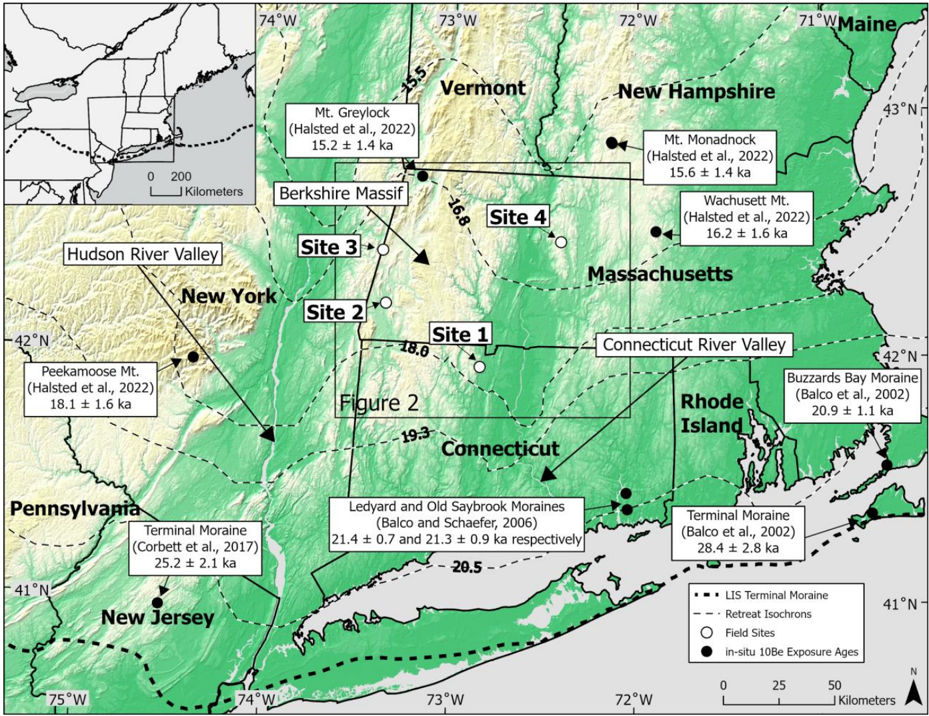
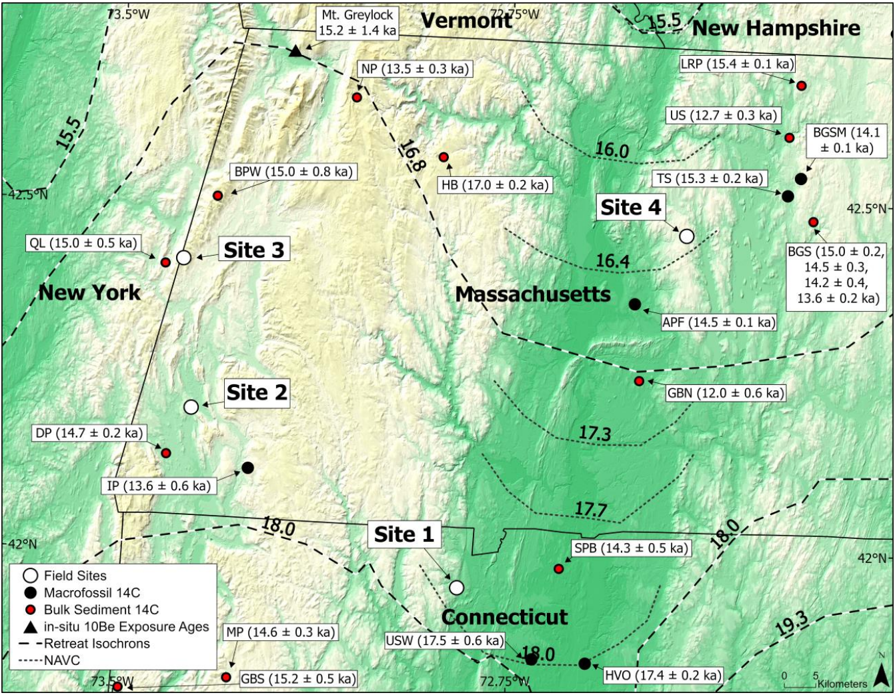
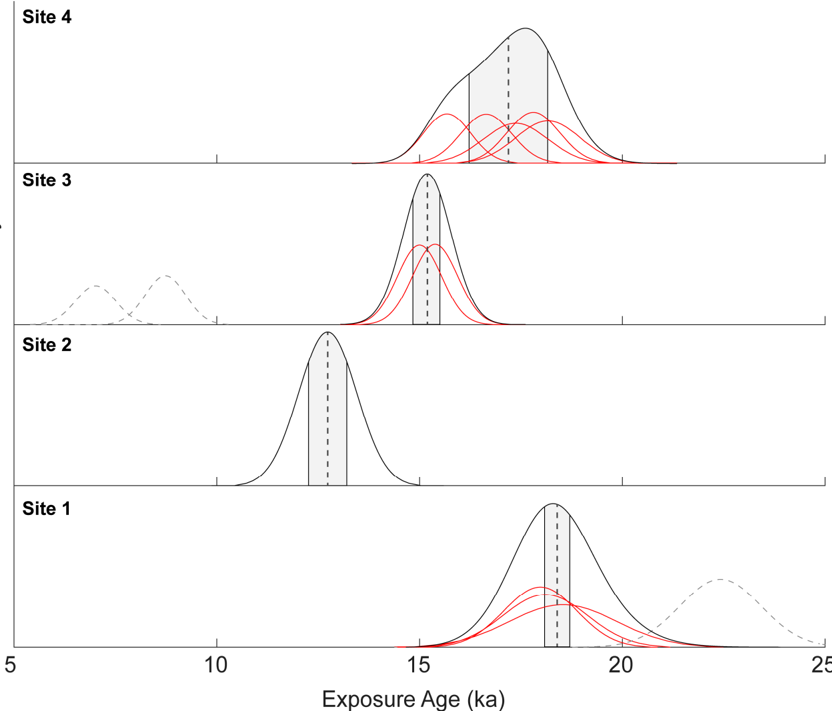
Constraining the timing and rate of Laurentide Ice Sheet (LIS) retreat through the northeastern United States is important for understanding the co-evolution of complex climatic and glaciologic events that characterized the end of the Pleistocene epoch. However, no in situ cosmogenic 10Be exposure age estimates for LIS retreat exist through large parts of Connecticut or Massachusetts. Due to the large disagreement between radiocarbon and 10Be ages constraining LIS retreat at the maximum southern margin and the paucity of data in central New England, the timing of LIS retreat through this region is uncertain. Here, we date LIS retreat through south-central New England using 14 new in situ cosmogenic 10Be exposure ages measured in samples collected from bedrock and boulders. Our results suggest ice retreated entirely from Connecticut by 18.3 ± 0.3 ka (n = 3). In Massachusetts, exposure ages from similar latitudes suggest ice may have occupied the Hudson River Valley up to 2 kyr longer (15.2 ± 0.3 ka, average, n = 2) than the Connecticut River Valley (17.4 ± 1.0 ka, average, n = 5). We use these new ages to provide insight about LIS retreat timing during the early deglacial period and to explore the mismatch between radiocarbon and cosmogenic deglacial age chronologies in this region.
Checked 2026-11-25 · 1 reference not checked yet
Overview
CoChat Summary
TL;DR
Fourteen new in situ cosmogenic 10Be exposure ages from Connecticut and Massachusetts fill a gap in the Laurentide Ice Sheet retreat chronology, indicating ice retreated from Connecticut by 18.3 ± 0.3 ka and from central Massachusetts by 17.4 ± 1.0 ka, while the Hudson River Valley lobe persisted until 15.2 ± 0.3 ka at a similar latitude. The 10Be ages align better with the North American Varve Chronology than with organic radiocarbon ages and suggest active retreat during a cold stadial period.
Key findings
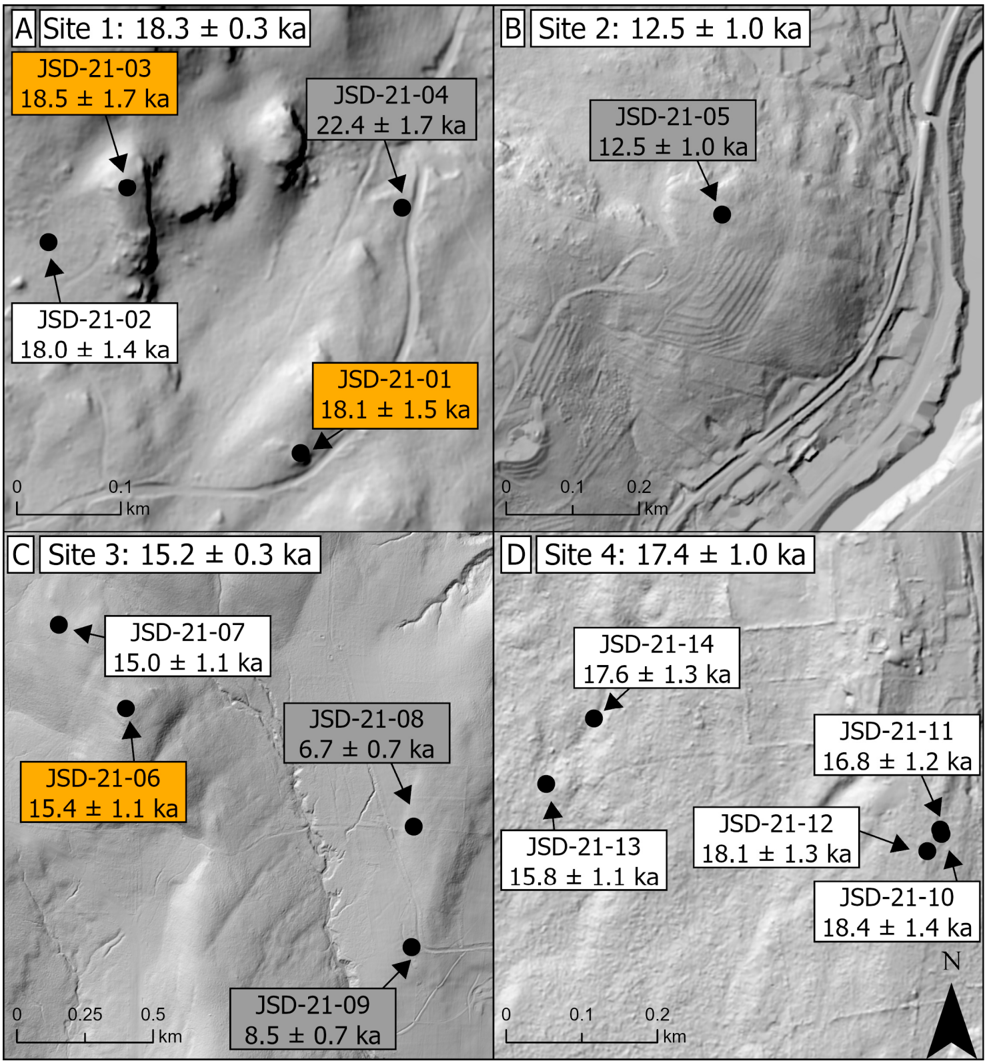
- In northern Connecticut (Site 1, Connecticut River Valley), the average exposure age is 18.3 ± 0.3 ka (n = 3); bedrock averages 18.3 ± 0.3 ka (n = 2) and boulders average 20.2 ± 3.1 ka (n = 2). If outlier JSD-21-04 is included, the Site 1 average becomes 19.3 ± 2.1 ka (n = 4).
- In central Massachusetts (Site 4, Connecticut River Valley), ~60 km north, the average exposure age is 17.4 ± 1.0 ka (n = 5).
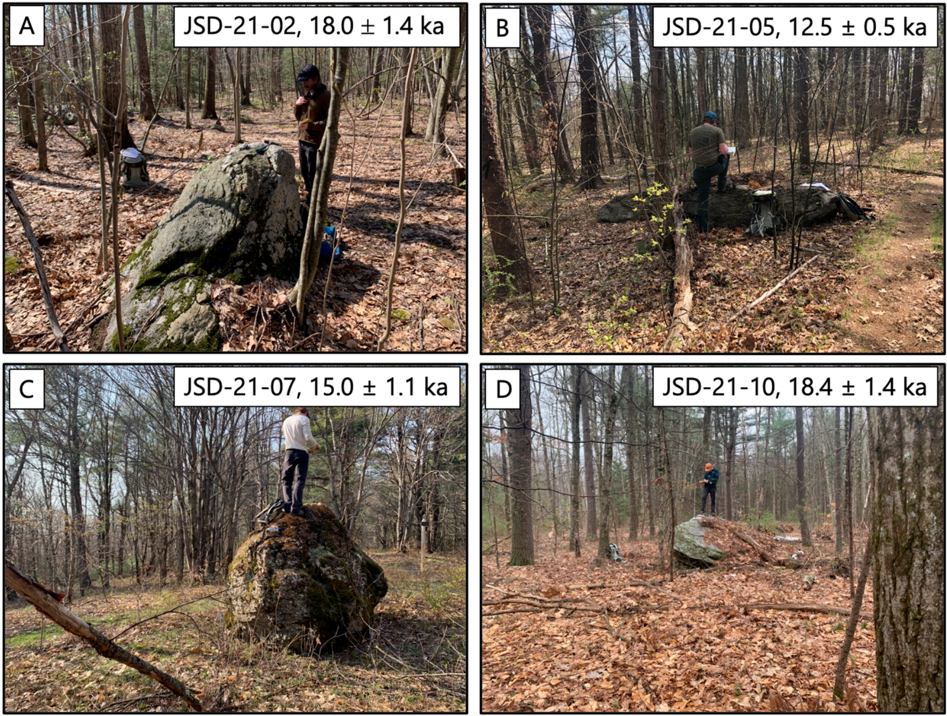
- In western Massachusetts on the Hudson River Valley drainage divide (Site 3), the average exposure age is 15.2 ± 0.3 ka (n = 2), approximately 2 kyr later than Site 4 at a similar latitude. A single Site 2 sample gave 12.5 ± 0.7 ka and was excluded as implausibly young.
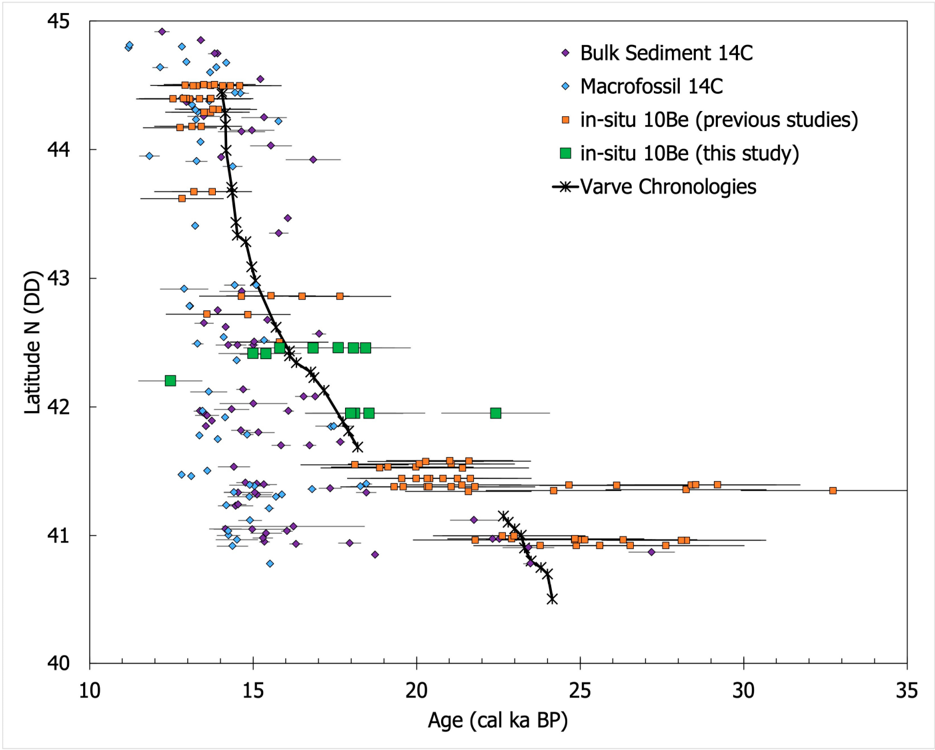
- The authors calculate a most-likely retreat rate of 67 m yr⁻¹ north through the Connecticut River Valley (range: 27 to >100 m yr⁻¹), compared with 30–40 m yr⁻¹ estimated by the NAVC; 10Be ages agree better with the varve chronology than with organic radiocarbon ages.
Methods
- Collected 14 samples—11 boulders and 3 bedrock—from four sites in Connecticut and Massachusetts in April 2021, all above glaciolacustrine limits; recorded location, elevation, sample thickness, and topographic shielding.
- Isolated quartz and beryllium at the University of Vermont, then measured 10Be/9Be by accelerator mass spectrometry at the Purdue Rare Isotope Measurement (PRIME) Laboratory, normalized to standard 07KNSTD3110 and corrected for blanks.
- Calculated exposure ages using Version 3 of the Balco et al. online calculator with the global production rate from Borchers et al., the LSDn scaling scheme, and a quartz density of 2.65 g cm⁻³; assessed outliers with the iceTEA “Remove Outliers” tool.
Limitations
- The paper states that the small number of samples at each site limits the ability to reliably constrain retreat-timing differences between the two lobes; Site 2 has only one sample and Site 3 has n = 2 after exclusions.
- Exposure ages assume no nuclide inheritance from previous exposure and no shielding or erosion since deglaciation; the paper notes that inheritance would overestimate deglaciation age, while disturbance or shielding could cause underestimates. Three young samples were excluded as possibly disturbed by anthropogenic boulder movement or partially shielded by soil.
- The paper notes that the choice of global production rate calibration could explain why exposure ages are slightly older than NAVC-based retreat dates; the global calibration implies ~4% lower 10Be production rates and ~0.7 kyr older ages than a regional NAVC-based calibration.
Model-written summary. Check it against the paper before relying on it.
Integrity signals
Registry
Cites
Statistics
Figures
Verification
Claims the paper makes
0 Valid · 1 Not valid · 30 Not checked · 40 Own results and interpretations
A result the paper reports from its own data — it cites no other source for it, so there is none to check. The quote shows it is in the paper.
In the paper
“Despite the differences in deglacial ages between chronologies in the Connecticut River Valley, radiocarbon ages agree better at Site 3 in Western Massachusetts.”
§ In Situ Cosmogenic 10 Be Dating of Laurentide Ice Sheet Retreat from Central New England, USA > 6.2. Comparison to Other Regional LIS Retreat Chronologies
plainstates an association- Asserted: passes — The authors put it forward as true.
- Checkable: passes — It can be checked against evidence.
- Load-bearing: unclear — It is unclear whether the paper’s conclusions depend on it.
- Based: passes — The paper gives a reason why it holds.
A result the paper reports from its own data — it cites no other source for it, so there is none to check. The quote shows it is in the paper.
In the paper
“Although these new cosmogenic ages align reasonably with NAVC-based retreat dates, they do not always agree well with existing core bottom radiocarbon ages (Figures 2 and 6).”
§ In Situ Cosmogenic 10 Be Dating of Laurentide Ice Sheet Retreat from Central New England, USA > 6.2. Comparison to Other Regional LIS Retreat Chronologies
plain- Asserted: passes — The authors put it forward as true.
- Checkable: passes — It can be checked against evidence.
- Load-bearing: passes — The paper’s conclusions depend on it.
- Based: passes — The paper gives a reason why it holds.
A result the paper reports from its own data — it cites no other source for it, so there is none to check. The quote shows it is in the paper.
In the paper
“We determined that ice in the Connecticut River Valley retreated from Connecticut by approximately 18.3 ka and retreated ~60 km north through central Massachusetts by 17.4 ka.”
§ In Situ Cosmogenic 10 Be Dating of Laurentide Ice Sheet Retreat from Central New England, USA > 7. Conclusions
plain- Asserted: passes — The authors put it forward as true.
- Checkable: passes — It can be checked against evidence.
- Load-bearing: passes — The paper’s conclusions depend on it.
- Based: passes — The paper gives a reason why it holds.
A result the paper reports from its own data — it cites no other source for it, so there is none to check. The quote shows it is in the paper.
In the paper
“In western Massachusetts, ice from the Hudson Valley lobe reached a similar latitude by 15.2 ka.”
§ In Situ Cosmogenic 10 Be Dating of Laurentide Ice Sheet Retreat from Central New England, USA > 7. Conclusions
plain- Asserted: passes — The authors put it forward as true.
- Checkable: passes — It can be checked against evidence.
- Load-bearing: passes — The paper’s conclusions depend on it.
- Based: passes — The paper gives a reason why it holds.
A result the paper reports from its own data — it cites no other source for it, so there is none to check. The quote shows it is in the paper.
In the paper
“Near Site 1 in the Connecticut River Valley near the Connecticut-Massachusetts border, the oldest calibrated radiocarbon ages from macrofossils are 17.5 ± 0.6 ka (USW) and 17.4 ± 0.2 ka (HVO), nearly 1 ka younger than exposure ages slightly farther north (Table 1; Figure 2).”
§ In Situ Cosmogenic 10 Be Dating of Laurentide Ice Sheet Retreat from Central New England, USA > 6.2. Comparison to Other Regional LIS Retreat Chronologies
plainstates an association- Asserted: passes — The authors put it forward as true.
- Checkable: passes — It can be checked against evidence.
- Load-bearing: passes — The paper’s conclusions depend on it.
- Based: passes — The paper gives a reason why it holds.
40 more claims
Create a free account to see all 71 claims and to verify the 57 references still open.
- It may state two separate claims as one. 21
- Probably not a substantial claim. 11
Self-check
Percentages, sums and reported differences re-computed from the paper’s own numbers.
Each contradiction between two passages listed here was confirmed by an independent check.
Rated major: it would touch a result — a value a result rests on, reported and recomputed p-values on opposite sides of the significance level, two passages that conflict with no sign which is right, or a cited work retracted before this paper was published.
In the paper
“Additionally, we find exposure ages from central Massachusetts, 60 km north, 2 kyr later, suggesting that during this period the LIS in New England was actively retreating.”
§ In Situ Cosmogenic 10 Be Dating of Laurentide Ice Sheet Retreat from Central New England, USA > 6.3. Possible Paleoclimate Forcings on LIS retreat
Reported 2 · recomputed 0.9
Rated minor: it would not touch a result — a value no result rests on, a p-value that stays on the same side of the significance level, or a conflict that is clerical, resolved elsewhere in the paper, or outside its own findings.
In the paper
§ In Situ Cosmogenic 10 Be Dating of Laurentide Ice Sheet Retreat from Central New England, USA > 5. Results
“we exclude three implausibly young values (JSD-21-07 from Site 2, and JSD-21-08 and JSD-21-09 from Site 3; Table 4; Figure 5).”
§ In Situ Cosmogenic 10 Be Dating of Laurentide Ice Sheet Retreat from Central New England, USA > 7. Conclusions
“| JSD-21-05 | Boulder | 2 | 12.5 | 0.7 | 1.0 | | JSD-21-06 | Bedrock | 3 | 15.4 | 0.6 | 1.1 | | JSD-21-07 | Boulder | 3 | 15.0 | 0.6 | 1.1 |”
Rated minor: it would not touch a result — a value no result rests on, a p-value that stays on the same side of the significance level, or a conflict that is clerical, resolved elsewhere in the paper, or outside its own findings.
In the paper
§ In Situ Cosmogenic 10 Be Dating of Laurentide Ice Sheet Retreat from Central New England, USA > 6.1. Regional Significance of Exposure Ages
“with the LIS margin reaching central Massachusetts by 17.4 ± 1.0 ka (Site 1, n = 5).”
§ In Situ Cosmogenic 10 Be Dating of Laurentide Ice Sheet Retreat from Central New England, USA > 5. Results
“Site 4 in the Connecticut River Valley has an average exposure age of 17.4 ± 1.0 ka (n = 5).”
Rated minor: it would not touch a result — a value no result rests on, a p-value that stays on the same side of the significance level, or a conflict that is clerical, resolved elsewhere in the paper, or outside its own findings.
In the paper
§ In Situ Cosmogenic 10 Be Dating of Laurentide Ice Sheet Retreat from Central New England, USA > 4.1. Field Sampling
“We recorded site parameters for 10 Be production rate estimation, including latitude, longitude, elevation, rock surface strike and dip at the sampled location, and the azimuth and elevation of local topography for shielding calculations using the online topographic shielding calculator described in Balco et al. [72].”
§ In Situ Cosmogenic 10 Be Dating of Laurentide Ice Sheet Retreat from Central New England, USA > References
“72. Kelley, G.C.; Newman, W.S. Boulder Trains in Western Massachusetts-Revisited; NEIGC Trips: New York, NY, USA, 1975.”
Rated minor: it would not touch a result — a value no result rests on, a p-value that stays on the same side of the significance level, or a conflict that is clerical, resolved elsewhere in the paper, or outside its own findings.
In the paper
§ In Situ Cosmogenic 10 Be Dating of Laurentide Ice Sheet Retreat from Central New England, USA > 5. Results
“Cosmogenic exposure ages range from 12.5 ± 0.7 ka to 22.4 ± 1.7 ka (Table 4; Figures 4 and 5; internal uncertainties).”
§ In Situ Cosmogenic 10 Be Dating of Laurentide Ice Sheet Retreat from Central New England, USA > 7. Conclusions
“| JSD-21-08 | Boulder | 3 | 6.7 | 0.5 | 0.7 | | JSD-21-09 | Boulder | 3 | 8.5 | 0.5 | 0.7 |”
Citations
Cites
The IntCal20 Northern Hemisphere Radiocarbon Age Calibration Curve (0–55 cal kBP)
Reimer, P. J., Austin, W. E. N., Bard, E., Bayliss, A., Blackwell, P. G., Bronk Ramsey, C., Butzin, M., Cheng, H., Edwards, R. L., Friedrich, M., et al. (2020) · Radiocarbon · doi:10.1017/rdc.2020.41 · Cited by 7,900
Sea level and global ice volumes from the Last Glacial Maximum to the Holocene
Lambeck, K., Rouby, H., Purcell, A., Sun, Y., & Sambridge, M. (2014) · Proceedings of the National Academy of Sciences · doi:10.1073/pnas.1411762111 · Cited by 2,922
Cosmic ray labeling of erosion surfaces: in situ nuclide production rates and erosion models
Lal, D. (1991) · Earth and Planetary Science Letters · doi:10.1016/0012-821x(91)90220-c · Cited by 2,612
Balco, G., Stone, J. O., Lifton, N. A., & Dunai, T. J. (2008) · Quaternary Geochronology · doi:10.1016/j.quageo.2007.12.001 · Cited by 2,247
Collapse and rapid resumption of Atlantic meridional circulation linked to deglacial climate changes
McManus, J. F., Francois, R., Gherardi, J.-M., Keigwin, L. D., & Brown-Leger, S. (2004) · Nature · doi:10.1038/nature02494 · Cited by 2,234
Terrestrial in situ cosmogenic nuclides: theory and application
Gosse, J. C., & Phillips, F. M. (2001) · Quaternary Science Reviews · doi:10.1016/s0277-3791(00)00171-2 · Cited by 2,051
Absolute calibration of 10Be AMS standards
Nishiizumi, K., Imamura, M., Caffee, M. W., Southon, J. R., Finkel, R. C., & McAninch, J. (2007) · Nuclear Instruments and Methods in Physics Research Section B: Beam Interactions with Materials and Atoms · doi:10.1016/j.nimb.2007.01.297 · Cited by 1,581
Self-citationGlobal warming preceded by increasing carbon dioxide concentrations during the last deglaciation
Shakun, J. D., Clark, P. U., He, F., Marcott, S. A., Mix, A. C., Liu, Z., Otto-Bliesner, B., Schmittner, A., & Bard, E. (2012) · Nature · doi:10.1038/nature10915 · Cited by 1,497
Chemical isolation of quartz for measurement of in-situ -produced cosmogenic nuclides
Kohl, C. P., & Nishiizumi, K. (1992) · Geochimica et Cosmochimica Acta · doi:10.1016/0016-7037(92)90401-4 · Cited by 1,288
La2010: a new orbital solution for the long-term motion of the Earth
Laskar, J., Fienga, A., Gastineau, M., & Manche, H. (2011) · Astronomy & Astrophysics · doi:10.1051/0004-6361/201116836 · Cited by 978
Lifton, N., Sato, T., & Dunai, T. J. (2014) · Earth and Planetary Science Letters · doi:10.1016/j.epsl.2013.10.052 · Cited by 948
Geological calibration of spallation production rates in the CRONUS-Earth project
Borchers, B., Marrero, S., Balco, G., Caffee, M., Goehring, B., Lifton, N., Nishiizumi, K., Phillips, F., Schaefer, J., & Stone, J. (2016) · Quaternary Geochronology · doi:10.1016/j.quageo.2015.01.009 · Cited by 669
Self-citationCosmic ray production rates of 10Be and 26Al in quartz from glacially polished rocks
Nishiizumi, K., Winterer, E. L., Kohl, C. P., Klein, J., Middleton, R., Lal, D., & Arnold, J. R. (1989) · Journal of Geophysical Research: Solid Earth · doi:10.1029/jb094ib12p17907 · Cited by 588
Globally resolved surface temperatures since the Last Glacial Maximum
Osman, M. B., Tierney, J. E., Zhu, J., Tardif, R., Hakim, G. J., King, J., & Poulsen, C. J. (2021) · Nature · doi:10.1038/s41586-021-03984-4 · Cited by 574
Dyke, A. S., Moore, A., & Robertson, L. (2003) · doi:10.4095/214399 · Cited by 434
Accuracy of cosmogenic ages for moraines
Putkonen, J., & Swanson, T. (2003) · Quaternary Research · doi:10.1016/s0033-5894(03)00006-1 · Cited by 423
Balco, G. (2011) · Quaternary Science Reviews · doi:10.1016/j.quascirev.2010.11.003 · Cited by 415
Regional beryllium-10 production rate calibration for late-glacial northeastern North America
Balco, G., Briner, J., Finkel, R. C., Rayburn, J. A., Ridge, J. C., & Schaefer, J. M. (2009) · Quaternary Geochronology · doi:10.1016/j.quageo.2008.09.001 · Cited by 391
Dalton, A. S., Margold, M., Stokes, C. R., Tarasov, L., Dyke, A. S., Adams, R. S., Allard, S., Arends, H. E., Atkinson, N., Attig, J. W., et al. (2020) · Quaternary Science Reviews · doi:10.1016/j.quascirev.2020.106223 · Cited by 374
Patterns and rates of vegetation change during the deglaciation of eastern North America
Jacobson, G. L., Webb, T., & Grimm, E. C. (2015) · North America and Adjacent Oceans During the Last Deglaciation · doi:10.1130/dnag-gna-k3.277 · Cited by 305
Climatic Changes in Southern Connecticut Recorded by Pollen Deposition at Rogers Lake
Davis, M. B. (1969) · Ecology · doi:10.2307/1933891 · Cited by 260
Ice sheet sources of sea level rise and freshwater discharge during the last deglaciation
Carlson, A. E., & Clark, P. U. (2012) · Reviews of Geophysics · doi:10.1029/2011rg000371 · Cited by 249
An approach for optimizing in situ cosmogenic 10Be sample preparation
Corbett, L. B., Bierman, P. R., & Rood, D. H. (2016) · Quaternary Geochronology · doi:10.1016/j.quageo.2016.02.001 · Cited by 222
Self-citationStuiver, M. (1975) · Quaternary Research · doi:10.1016/0033-5894(75)90027-7 · Cited by 209
Radiocarbon Isochrones on the Disintegration of the Laurentide Ice Sheet
Bryson, R. A., Wendland, W. M., Ives, J. D., & Andrews, J. T. (1969) · Arctic and Alpine Research · doi:10.1080/00040851.1969.12003535 · Cited by 194
The magnitude of error in conventional bulk-sediment radiocarbon dates from central North America
Grimm, E. C., Maher, L. J., & Nelson, D. M. (2009) · Quaternary Research · doi:10.1016/j.yqres.2009.05.006 · Cited by 176
Long‐Term Vegetation Dynamics and Disturbance History of a Tsuga‐Dominated Forest in New England
Foster, D. R., & Zebryk, T. M. (1993) · Ecology · doi:10.2307/1940468 · Cited by 146
Ridge, J. C., Balco, G., Bayless, R. L., Beck, C. C., Carter, L. B., Dean, J. L., Voytek, E. B., & Wei, J. H. (2012) · American Journal of Science · doi:10.2475/07.2012.01 · Cited by 136
U. S. Geological Survey Radiocarbon Dates V
Rubin, M., & Alexander, C. (1960) · American Journal of Science. Radiocarbon Supplement · doi:10.1017/s1061592x00020652 · Cited by 121
Stone, B. D., & Borns, H. W. (1986) · Quaternary Science Reviews · doi:10.1016/0277-3791(86)90172-1 · Cited by 120
U.S. Geological Survey Radiocarbon Dates IV
Rubin, M., & Alexander, C. C. (1958) · Science · doi:10.1126/science.127.3313.1476 · Cited by 109
Integrating lateral expansion into models of peatland development in temperate New England
Anderson, R. L., Foster, D. R., & Motzkin, G. (2003) · Journal of Ecology · doi:10.1046/j.1365-2745.2003.00740.x · Cited by 104
MatCal: Open Source Bayesian 14C Age Calibration in Matlab
Lougheed, B. C., & Obrochta, S. (2016) · Journal of Open Research Software · doi:10.5334/jors.130 · Cited by 101
Glacier Change and Paleoclimate Applications of Cosmogenic-Nuclide Exposure Dating
Balco, G. (2020) · Annual Review of Earth and Planetary Sciences · doi:10.1146/annurev-earth-081619-052609 · Cited by 99
Cosmogenic Nuclides: Dates and Rates of Earth-Surface Change
von Blanckenburg, F., & Willenbring, J. K. (2014) · Elements · doi:10.2113/gselements.10.5.341 · Cited by 97
Geologic features of the Connecticut Valley, Massachusetts as related to recent floods
Jahns, R. H. (1947) · doi:10.3133/wsp996 · Cited by 90
Closing the sea level budget at the Last Glacial Maximum
Clark, P. U., & Tarasov, L. (2014) · Proceedings of the National Academy of Sciences · doi:10.1073/pnas.1418970111 · Cited by 88
The Quaternary glaciation of western New England with correlations to surrounding areas
Ridge, J. C. (2004) · Developments in Quaternary Sciences · doi:10.1016/s1571-0866(04)80196-9 · Cited by 87
Final report on the geology of Massachusetts
Hitchcock, E., & Hitchcock, O. W. (1841) · Biodiversity Heritage Library (Smithsonian Institution) · doi:10.5962/bhl.title.139900 · Cited by 84
Jones, R. S., Small, D., Cahill, N., Bentley, M. J., & Whitehouse, P. L. (2019) · Quaternary Geochronology · doi:10.1016/j.quageo.2019.01.001 · Cited by 78
Cosmogenic-nuclide and varve chronologies for the deglaciation of southern New England
BALCO, G., & SCHAEFER, J. (2006) · Quaternary Geochronology · doi:10.1016/j.quageo.2006.06.014 · Cited by 72
Balco, G., Stone, J. O. H., Porter, S. C., & Caffee, M. W. (2002) · Quaternary Science Reviews · doi:10.1016/s0277-3791(02)00085-9 · Cited by 70
Self-citationBedrock geologic map of Massachusetts
Ratcliffe, N. M., Robinson, P., Stanley, R. S., Hatch, N. L., Shride, A. F., Weed, E. G. A., & Wones, D. R. (1983) · doi:10.3133/70046713 · Cited by 66
Emerson, B. K. (1898) · Monographs of the United States Geological Survey · doi:10.3133/m29 · Cited by 65
Late-Glacial and Postglacial Vegetational History of the Berkshires, Western Massachusetts
Whitehead, D. R. (1979) · Quaternary Research · doi:10.1016/0033-5894(79)90033-4 · Cited by 62
Post‐glacial changes in spatial patterns of vegetation across southern New England
Wyatt Oswald, W., Faison, E. K., Foster, D. R., Doughty, E. D., Hall, B. R., & Hansen, B. C. S. (2007) · Journal of Biogeography · doi:10.1111/j.1365-2699.2006.01650.x · Cited by 61
Southern Laurentide ice-sheet retreat synchronous with rising boreal summer insolation
Ullman, D. J., Carlson, A. E., LeGrande, A. N., Anslow, F. S., Moore, A. K., Caffee, M., Syverson, K. M., & Licciardi, J. M. (2015) · Geology · doi:10.1130/g36179.1 · Cited by 59
Self-citationBriner, J. P., Goehring, B. M., Mangerud, J., & Svendsen, J. I. (2016) · Geophysical Research Letters · doi:10.1002/2016gl070100 · Cited by 54
Report on the geology of Vermont; descriptive, theoretical, economical, and scenographical
Vermont., Billings, E., Hager, A. D., Hitchcock, C. H., Hitchcock, E., Hitchcock, E., & Lesquereux, L. (1861) · Biodiversity Heritage Library (Smithsonian Institution) · doi:10.5962/bhl.title.31803 · Cited by 45
Dating Disappearing Ice with Cosmogenic Nuclides
Ivy-Ochs, S., & Briner, J. P. (2014) · Elements · doi:10.2113/gselements.10.5.351 · Cited by 43
Rapid thinning of the Laurentide Ice Sheet in coastal Maine, USA, during late Heinrich Stadial 1
Koester, A. J., Shakun, J. D., Bierman, P. R., Davis, P. T., Corbett, L. B., Braun, D. D., & Zimmerman, S. H. (2017) · Quaternary Science Reviews · doi:10.1016/j.quascirev.2017.03.005 · Cited by 38
Self-citationRepeated century-scale droughts over the past 13,000 yr near the Hudson River watershed, USA
Newby, P. E., Shuman, B. N., Donnelly, J. P., & MacDonald, D. (2011) · Quaternary Research · doi:10.1016/j.yqres.2011.01.006 · Cited by 35
Bromley, G. R. M., Hall, B. L., Thompson, W. B., Kaplan, M. R., García, J., & Schaefer, J. M. (2015) · Quaternary Research · doi:10.1016/j.yqres.2015.02.004 · Cited by 32
Johnson, K. M., & Ouimet, W. B. (2016) · Anthropocene · doi:10.1016/j.ancene.2016.07.001 · Cited by 31
Peteet, D. M., Beh, M., Orr, C., Kurdyla, D., Nichols, J., & Guilderson, T. (2012) · Geophysical Research Letters · doi:10.1029/2012gl051884 · Cited by 27
Deglaciation and late-glacial climate change in the White Mountains, New Hampshire, USA
Thompson, W. B., Dorion, C. C., Ridge, J. C., Balco, G., Fowler, B. K., & Svendsen, K. M. (2017) · Quaternary Research · doi:10.1017/qua.2016.4 · Cited by 26
Corbett, L. B., Bierman, P. R., Stone, B. D., Caffee, M. W., & Larsen, P. L. (2017) · Quaternary Research · doi:10.1017/qua.2017.11 · Cited by 24
Self-citationA late-glacial transition from Picea glauca to Picea mariana in southern New England
Lindbladh, M., Oswald, W. W., Foster, D. R., Faison, E. K., Hou, J., & Huang, Y. (2007) · Quaternary Research · doi:10.1016/j.yqres.2007.01.010 · Cited by 23
The recession of the last ice sheet in New England,
Antevs, E. (1922) · doi:10.5962/bhl.title.61917 · Cited by 23
The Portwashingtonian warm interval in the northern Atlantic coastal plain
SIRKIN, L., & STUCKENRATH, R. (1980) · Geological Society of America Bulletin · doi:10.1130/0016-7606(1980)91<332:tpwiit>2.0.co;2 · Cited by 20
Corbett, L. B., Bierman, P. R., Wright, S. F., Shakun, J. D., Davis, P. T., Goehring, B. M., Halsted, C. T., Koester, A. J., Caffee, M. W., & Zimmerman, S. R. (2019) · Quaternary Science Reviews · doi:10.1016/j.quascirev.2018.12.014 · Cited by 19
Self-citationHall, B. L., Borns, H. W., Bromley, G. R. M., & Lowell, T. V. (2017) · Quaternary Science Reviews · doi:10.1016/j.quascirev.2017.06.011 · Cited by 19
Chronology of Laurentide glaciation in New Jersey and the New York City area, United States
Stanford, S. D., Stone, B. D., Ridge, J. C., Witte, R. W., Pardi, R. R., & Reimer, G. E. (2021) · Quaternary Research · doi:10.1017/qua.2020.71 · Cited by 18
The paleolimnology of North Pond: watershed-lake interactions
Huvane, J. K., & Whitehead, D. R. (1996) · Journal of Paleolimnology · doi:10.1007/bf00207576 · Cited by 18
Emerson, B. K. (1898) · Monographs of the United States Geological Survey · doi:10.5962/bhl.title.45682 · Cited by 17
Corbett, L. B., Bierman, P. R., Woodruff, T. E., & Caffee, M. W. (2019) · Nuclear Instruments and Methods in Physics Research Section B Beam Interactions with Materials and Atoms · doi:10.1016/j.nimb.2019.05.051 · Cited by 16
Self-citationHalsted, C. T., Bierman, P. R., Shakun, J. D., Davis, P. T., Corbett, L. B., Drebber, J. S., & Ridge, J. C. (2024) · Journal of Quaternary Science · doi:10.1002/jqs.3563 · Cited by 15
Self-citationNewman, W. S. (1977) · Annals of the New York Academy of Sciences · doi:10.1111/j.1749-6632.1977.tb33642.x · Cited by 15
Koester, A. J., Shakun, J. D., Bierman, P. R., Davis, P. T., Corbett, L. B., Goehring, B. M., Vickers, A. C., & Zimmerman, S. H. (2020) · Geological Society of America eBooks · doi:10.1130/2020.2548(15 · Cited by 14
Self-citationBromley, G. R. M., Hall, B. L., Thompson, W. B., & Lowell, T. V. (2019) · Quaternary Research · doi:10.1017/qua.2019.66 · Cited by 13
University of Wisconsin Radiocarbon Dates XVIII
Bender, M. M., Baerreis, D. A., Bryson, R. A., & Steventon, R. L. (1981) · Radiocarbon · doi:10.1017/s0033822200037504 · Cited by 13
Munroe, J. S., Perzan, Z. M., & Amidon, W. H. (2016) · Journal of Quaternary Science · doi:10.1002/jqs.2913 · Cited by 10
University of Wisconsin Radiocarbon Dates XX
Steventon, R. L., & Kutzbach, J. E. (1983) · Radiocarbon · doi:10.1017/s0033822200005348 · Cited by 10
University of Texas at Austin Radiocarbon Dates XIV
Valastro, S., Davis, E. M., Varela, A. G., & Ekland-Olson, C. (1980) · Radiocarbon · doi:10.1017/s0033822200011590 · Cited by 7
Halsted, C. T., Bierman, P. R., Shakun, J. D., Davis, P. T., Corbett, L. B., Caffee, M. W., Hodgdon, T. S., & Licciardi, J. M. (2022) · GSA Bulletin · doi:10.1130/b36463.1 · Cited by 3
Self-citationThe Ivory Pond Mastodon Project
Moeller, R. W. (1984) · North American Archaeologist · doi:10.2190/mgxq-q56f-klhu-wkql · Cited by 2
Bedrock geology of the Bristol quadrangle, Hartford, Litchfield, and New Haven Counties, Connecticut
Simpson, H. E. (1990) · doi:10.3133/b1573 · Cited by 2
Miller, N. G. (1989) · New England Botanical Club [etc.] · doi:10.5281/zenodo.16131214
Research works printed but not linked: 4
- Rittenour, T.M. Drainage History of Glacial Lake Hitchcock, Northeastern USA. Master's Thesis, University of Massachusetts, Amherst, MA, USA, 1999.
- Ruddiman, W.F., Wright, H.E., Jr., Eds.; Geological Society of America: Boulder, CO, USA, 1987; Volume K-3, pp. 277-288; ISBN 9780813754628.
- Bierman, P.R.; Dethier, D.P. Lake Bascom and the Deglaciation of Northwestern Massachusetts. Northeast. Geol. 1986, 8, 32-43.
- Goldthwait, J.W. The Sand Plains of Glacial Lake Sudbury. Bull. Mus. Comp. Zool. 1905, 42, 263-301.
Cited by
Balter‐Kennedy, A., Schaefer, J. M., Balco, G., Kelly, M. A., Kaplan, M. R., Schwartz, R., Oakley, B. A., Young, N. E., Hanley, J., & Varuolo‐Clarke, A. M. (2024) · Climate of the past · doi:10.5194/cp-20-2167-2024 · Cited by 15
Labarca, R., Frugone‐Álvarez, M., Vilches, L., Blanco, J. F., Peñaloza, Á., Godoy-Aguirre, C., Lizama-Catalán, Á., Oyarzo, C., Tornero, C., González-Guarda, E., et al. (2024) · PLoS ONE · doi:10.1371/journal.pone.0302465 · Cited by 12
Cuzzone, J., Barth, A. M., Barker, K., & Morlighem, M. (2025) · The Cryosphere · doi:10.5194/tc-19-1559-2025 · Cited by 3
Balter-Kennedy, A., Schaefer, J. M., Balco, G., et al. (2024) · doi:10.5194/egusphere-2024-241-rc1
Balter‐Kennedy, A. (2024) · doi:10.5194/egusphere-2024-241-ac1
Metadata
- Authors
- Drebber, J. S., Halsted, C. T., Corbett, L. B., Bierman, P. R., & Caffee, M. W.
- Affiliations
- University of Vermont (US)
- Purdue University West Lafayette (US)
- Corresponding author
- Bierman, Paul R.
- Venue
- Geosciences
- Publisher
- MDPI AG
- Published
- 2023-07-15
- Volume
- 13
- Issue
- 7
- Pages
- 213
- ISSN
- 2076-3263 (ISSN-L)
- OpenAlex
- W4384525565
- Cited by
- 8
- References
- 78
- Citations by year
- 2026: 1 · 2025: 2 · 2024: 5
- FWCI
- 0.70
- Type
- journal article
- Language
- en
- Open access
- gold
- doi.org
- Licence
- Locations
- Geosciences (publishedVersion, cc-by)
- DOAJ (DOAJ: Directory of Open Access Journals) (submittedVersion, cc-by-sa)
- Funders
- University of Vermont (UVM) Geology Department, Hawley Mudge grant (NSF-EAR-1735676, NSF-EAR-1602280)
- UVM College of Arts and Sciences, APLE Award (NSF-EAR-1735676, NSF-EAR-1602280)
- Geological Society of America Northeastern Section, Stephen G. Pollock Undergraduate Student Research Grant (NSF-EAR-1735676, NSF-EAR-1602280)
- UVM Summer Undergraduate Research Fellowship, Sustainability Summer Fellowship (NSF-EAR-1735676, NSF-EAR-1602280)
- National Science Foundation (NSF-EAR-1735676, NSF-EAR-1602280)
- Topics
- Physical Sciences › Earth and Planetary Sciences › Atmospheric Science › Geology and Paleoclimatology Research
- Physical Sciences › Earth and Planetary Sciences › Atmospheric Science › Cryospheric studies and observations
- Physical Sciences › Earth and Planetary Sciences › Earth-Surface Processes › Geological formations and processes
- Keywords
- Laurentide Ice Sheet, ice sheet retreat, cosmogenic beryllium-10, surface exposure dating, deglacial chronology, Pleistocene deglaciation, Hudson Valley, Connecticut Valley, New England, glacial boulders, bedrock
About these checks
Registry, retraction, Cites and statistics results are computed, not judged, with one exception: a printed reference that no index lists is read once by a model before it counts as a citation error. Claims are extracted by a model and kept only when their quote appears verbatim in the text; each cited source is then checked, with a model’s help, for whether it says what the claim relies on. Those verdicts can be wrong — read the claim’s quote and the cited source before relying on one.
A language model drew the claims from the paper on 2026-11-21, under version 3 of the claim definition (model deepseek-v4.1-flash, prompt extract-v3).
A second model labelled each claim on 2026-11-21 (model jev-1.13-20260917, definition revision gold-guideline-v0.2).
Statistics and arithmetic are recomputed, not judged.
Confidence bands are shown only for fields calibrated on our annotated test set. None is calibrated yet, so no band is shown.
What counts as a claim ›How we measure confidence ›How we check this ›
Are you an author, or do you see a problem with this page? Request a review
Data sources
Bibliographic data: Semantic Scholar, OpenAlex, Crossref.
Contains information from the Semantic Scholar Academic Graph Datasets, made available under the ODC Attribution License (ODC-BY 1.0).
Semantic Scholar’s data is described in: Kinney, R., et al. (2023). The Semantic Scholar Open Data Platform. arXiv:2301.10140.
