

The DOI matches its Crossref record; 16 of the 16 references it cites were found in a registry or an index.
Privacy Protection in Using Artificial Intelligence for Healthcare: Chinese Regulation in Comparative Perspective
Open accessAbstract
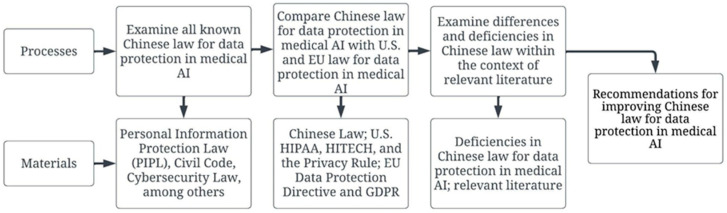
Advanced artificial intelligence (AI) technologies are now widely employed in China’s medical and healthcare fields. Enormous amounts of personal data are collected from various sources and inserted into AI algorithms for medical purposes, producing challenges to patient’s privacy. This is a comparative study of Chinese, United States, and European Union operational rules for healthcare data that is collected and then used in AI functions, particularly focusing on legal differences and deficiencies. The conceptual boundaries of privacy and personal information, the influence of technological development on the informed consent model, and conflicts between freedom and security in rules of cross-border data flow were found to be key issues requiring consideration when regulating healthcare data used for AI purposes. Furthermore, the results indicate that the appropriate balance between privacy protections and technological development, between individual and group interests, and between corporate profits and the public interest should be identified and observed. In terms of specific rule-making, it was found that China should establish special regulations protecting healthcare information, provide clear definitions and classification schemas for different types of healthcare information, and enact stricter accountability mechanisms. Examining and contrasting operational rules for AI in health care promotes informed privacy governance and improved privacy legislation.
Overview
The claims and statistics of this paper haven’t been checked yet.
Run the check — free, no account needed. It reads the open-access text and checks the sources it cites.
Integrity signals
Registry
Cites
Statistics
Figures
Verification
Claims the paper makes
The claims and statistics of this paper haven’t been checked yet.
Run the check — free, no account needed. It reads the open-access text and checks the sources it cites.
Claims other papers make about this one
Each is checked against this paper’s own text: does it say what the citing paper says it does?
In the citing paper
“The risk of privacy infringement due to the misuse of pseudo-anonymized patient data [7,8] is a primary concern.”
From Balancing Privacy and Progress: A Review of Privacy Challenges, Systemic Oversight, and Patient Perceptions in AI-Driven Healthcare (2024) · cites this paper as [7]
In the citing paper
“Sophisticated techniques can potentially re-engineer anonymized data to identify individuals, thus breaching patient confidentiality.”
From Balancing Privacy and Progress: A Review of Privacy Challenges, Systemic Oversight, and Patient Perceptions in AI-Driven Healthcare (2024) · cites this paper as [7]
In the citing paper
“Moreover, blockchain can be integrated with other technologies, such as AI and IoT devices, to enable secure and real-time monitoring of patient health data, providing healthcare professionals with reliable data for decision-making while preserving patient privacy [7,12].”
From Balancing Privacy and Progress: A Review of Privacy Challenges, Systemic Oversight, and Patient Perceptions in AI-Driven Healthcare (2024) · cites this paper as [7]
In the citing paper
“Blockchain technology provides a secure, decentralized method for storing and managing healthcare data, utilizing a distributed ledger system to ensure that patient records are immutable and verifiable, thereby thwarting unauthorized access and potential data breaches.”
From Balancing Privacy and Progress: A Review of Privacy Challenges, Systemic Oversight, and Patient Perceptions in AI-Driven Healthcare (2024) · cites this paper as [7]
In the citing paper
“Mishandling such data could result in significant privacy violations and misuse [7,12].”
From Balancing Privacy and Progress: A Review of Privacy Challenges, Systemic Oversight, and Patient Perceptions in AI-Driven Healthcare (2024) · cites this paper as [7]
In the citing paper
“Additionally, the authors of [7,8] emphasize the essential role of data integrity in ensuring reliable healthcare outcomes.”
From Balancing Privacy and Progress: A Review of Privacy Challenges, Systemic Oversight, and Patient Perceptions in AI-Driven Healthcare (2024) · cites this paper as [7]
Self-check
Percentages, sums and reported differences re-computed from the paper’s own numbers.
The self-check needs the paper’s full text.
Citations
Cites
I.—COMPUTING MACHINERY AND INTELLIGENCE
TURING, A. M. (1950) · Mind · doi:10.1093/mind/lix.236.433 · Cited by 10,290
A Proposal for the Dartmouth Summer Research Project on Artificial Intelligence, August 31, 1955
McCarthy, J., Minsky, M., Rochester, N., et al. (2006) · The AI Magazine · doi:10.1609/aimag.v27i4.1904 · Cited by 2,029
Privacy in the age of medical big data
Price, W. N., & Cohen, I. G. (2019) · Nature Medicine · doi:10.1038/s41591-018-0272-7 · Cited by 1,522
General Data Protection Regulation (GDPR)
Deaves, M. (2017) · Cited by 815
Healthcare Data Breaches: Insights and Implications
Seh, A. H., Zarour, M., Alenezi, M., Sarkar, A. K., Agrawal, A., Kumar, R., & Ahmad Khan, R. (2020) · Healthcare · doi:10.3390/healthcare8020133 · Cited by 600
From individual to group privacy in big data analytics
Mittelstadt, B. (2017) · Philosophy & Technology · doi:10.1007/s13347-017-0253-7 · Cited by 184
Zeng, D., Cao, Z., & Neill, D. B. (2021) · Artificial Intelligence in Medicine · doi:10.1016/b978-0-12-821259-2.00022-3 · Cited by 183
Gostin, L. O. (2001) · JAMA · doi:10.1001/jama.285.23.3015 · Cited by 165
Kulikowski, C. A. (2019) · Yearbook of Medical Informatics · doi:10.1055/s-0039-1677895 · Cited by 144 · cited 2×
“The digitizing of medical data, fundamental for medical AI growth, originated in the 1960s with the development of the Medical Literature Analysis and Retrieval System (MEDLARS) and other search engines produced by the National Library of Medicine (NLM) [17].”
MethodAvi Goldfarb, B., & Tucker, C. E. (2012) · Innovation Policy and the Economy · doi:10.1086/663156 · Cited by 137
Research works printed but not linked: 5
- McCarthy, 2006, A proposal for the Dartmouth summer research project on artificial intelligence, AI Mag., 27, 12
- Buchanan, B.G., and Shortliffe, E.H. (1984). Rule-Based Expert Systems: The MYCIN Experiments of the Stanford Heuristic Programming Project, Addison Wesley.
- Cheng, 2021, On personal consent in the processing of personal information, Glob. Law Rev., 43, 40
- Lu, 2019, The normative construction of “consent” rules in personal information protection, J. Wuhan Univ., 72, 119
- Zhang, 2015, From privacy to personal information: The theory of interest remeasurement and institutional arrangement, China Legal Sci., 3, 38
Cited by
Sorted by citations
Items 101–115 of 115
Umamaheswari, B., & Sivaraman, K. (2025) · IEEE International Conference on ICT in Business Industry & Government (ICTBIG) · doi:10.1109/ictbig68706.2025.11323843
Privacy at Scale in Networked Healthcare
Rahimian, M. A., Panny, B., & Joshi, J. B. D. (2025) · IEEE International Conference on Trust, Privacy and Security in Intelligent Systems and Applications (TPS-ISA) · doi:10.1109/tps-isa67132.2025.00067
AI and Mental Health Innovations in Detection, Prevention, and Support for Learners
Murshidi, G. H. A., Munir, S., Munir, Z., Opoku, M. P., Nuryana, Z., & Zaabi, A. A. (2026) · Advances in computational intelligence and robotics book series · doi:10.4018/979-8-3373-4222-1.ch019
Chaos theory in AI-driven healthcare systems: Unraveling complex data patterns
Baghdadi, G., & Jafari, S. (2026) · Elsevier eBooks · doi:10.1016/b978-0-443-36554-6.00014-3
Challenges, risks, and future prospects of AI
Rathi, K., Ranazunjare, R., Kulkarni, S., Firdous, S. M., & Rathi, G. (2026) · Elsevier eBooks · doi:10.1016/b978-0-443-40501-3.00002-9
Ethical and Legal Implications in Medical AI
Khullar, S., Ahmed, I., Kapoor, S. K., Joshi, M. L., & Arora, A. (2026) · Advances in computational intelligence and robotics book series · doi:10.4018/979-8-2600-2173-6.ch005
Mazrouei, N. A., Alhosani, A., Almutairi, A., Alghunaiman, A., Ibrahim, R. M., Ali, W. K. A., Al-Kubaissi, K. A., Ibrahim, O. M., Abdel‐Qader, D. H., Saeed, A. A., et al. (2026) · Discover Artificial Intelligence · doi:10.1007/s44163-026-01680-8 · Cited by 1
Zhou, P., Lau, P. W. C., Lu, N., & Ma, M. (2026) · Springer eBooks · doi:10.1007/978-981-95-2175-3_59
Challenges of AI for cost-effectiveness in health: a hybrid MCDM model
Uslu, Y. D., Gedıklı, E., & Yılmaz, E. (2026) · Health Economics Review · doi:10.1186/s13561-026-00821-0
Beta, K., & Mushtaq, S. (2026) · Business, management and economics · doi:10.5772/intechopen.1016214
Privacy and vulnerable populations: A 20-year bibliometric analysis
Ntlatywa, P., & van Greunen, D. (2026) · South African journal of information management · doi:10.4102/sajim.v28i1.2146
Musa, M. K. (2026) · Research Square · doi:10.21203/rs.3.rs-11104161/v1
Applications of artificial intelligence in personalized nutrition interventions
Zhang, Y., Feng, M., Xue, Q., Ma, R., & Liu, F. (2026) · Frontiers in Nutrition · doi:10.3389/fnut.2026.1974199
Privacy-Preserving Data Sharing Using Federated Learning in Enterprise Database Systems
Bheemreddy, R. S. R., Mittal, T., Peddireddy, H., Madupati, B., Srivastava, S., & Kapila, D. (2026) · Technology and Innovation Conference (TIC) · doi:10.1109/tic68483.2026.11702811
Mao, Y., 陈宝莹, & Liu, M. (2026) · International Medical Education · doi:10.3390/ime5040105
Metadata
- Authors
- Wang, C., Zhang, J., Lassi, N., & Zhang, X.
- Affiliations
- Zhejiang University (CN)
- Corresponding author
- Zhang, Xiaohan
- Venue
- Healthcare
- Publisher
- MDPI AG
- Published
- 2022-09-27
- Volume
- 10
- Issue
- 10
- Pages
- 1878
- ISSN
- 2227-9032 (ISSN-L)
- PMC
- PMC9601726
- OpenAlex
- W4297539945
- Cited by
- 115
- References
- 15
- Citations by year
- 2026: 24 · 2025: 43 · 2024: 30 · 2023: 18
- FWCI
- 140.53
- Type
- journal article
- Language
- en
- Open access
- gold
- doi.org
- Licence
- Locations
- Healthcare (publishedVersion, cc-by)
- PubMed Central (publishedVersion, cc-by)
- PubMed (publishedVersion)
- DOAJ (DOAJ: Directory of Open Access Journals) (submittedVersion, cc-by-sa)
- Funders
- Fundamental Research Funds for the Central Universities (22LLXC02Z)
- Cross-Disciplinary Research Project of Zhejiang University (22LLXC02Z)
- Digital Silk Road Research Project of Zhejiang Province (22LLXC02Z)
- Topics
- Social Sciences › Law › Digitalization, Law, and Regulation
- Health Sciences › Health Professions › Health Information Management › Thoreau and American Literature
- Health Sciences › Medicine › Health Informatics › Artificial Intelligence in Healthcare and Education
- Keywords
- artificial intelligence in healthcare, patient privacy, personal data protection, informed consent, cross-border data flows, China, United States, European Union, comparative privacy law, accountability mechanisms
About these checks
Registry, retraction, Cites and statistics results are computed, not judged, with one exception: a printed reference that no index lists is read once by a model before it counts as a citation error. Claims are extracted by a model and kept only when their quote appears verbatim in the text; each cited source is then checked, with a model’s help, for whether it says what the claim relies on. Those verdicts can be wrong — read the claim’s quote and the cited source before relying on one.
Statistics and arithmetic are recomputed, not judged.
Confidence bands are shown only for fields calibrated on our annotated test set. None is calibrated yet, so no band is shown.
What counts as a claim ›How we measure confidence ›How we check this ›
Are you an author, or do you see a problem with this page? Request a review
