

The DOI matches its Crossref record; 181 of the 181 references it cites were found in a registry or an index.
Healthcare 5.0-Driven Clinical Intelligence: The Learn-Predict-Monitor-Detect-Correct Framework for Systematic Artificial Intelligence Integration in Critical Care
Open accessAbstract
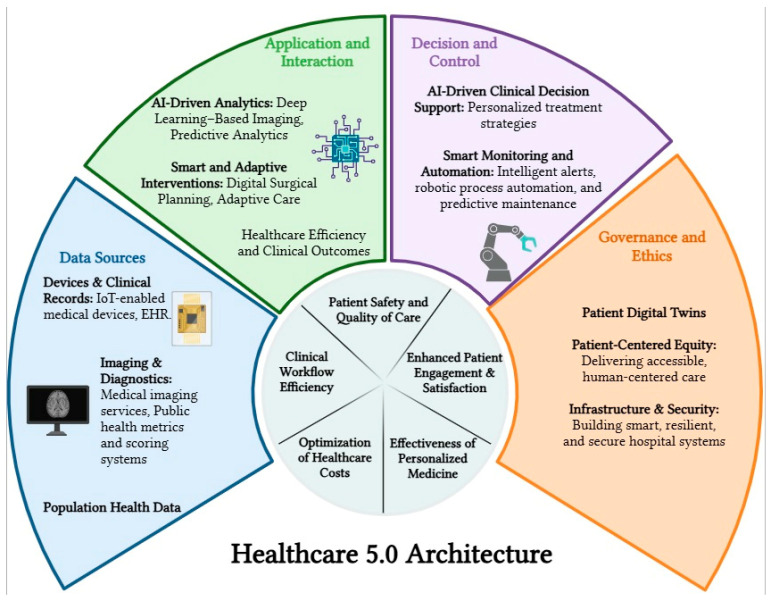
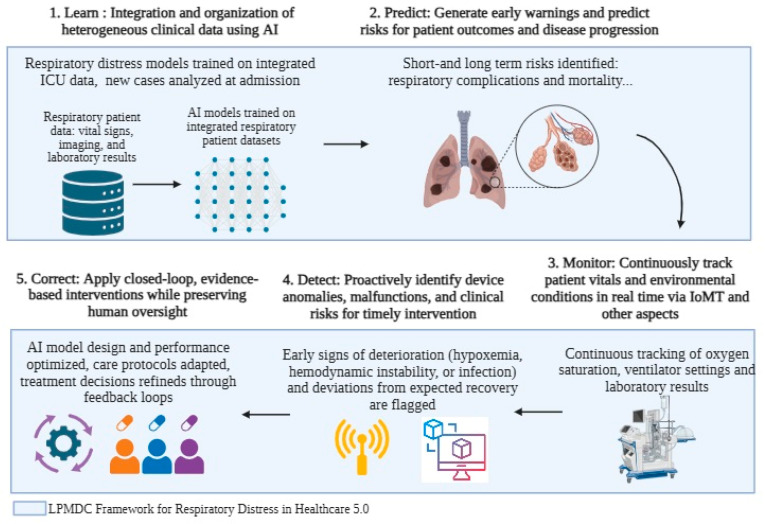
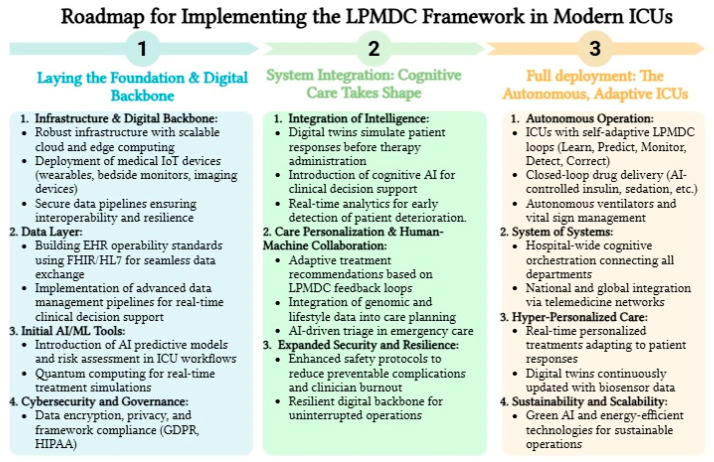
Background: Healthcare 5.0 represents a shift toward intelligent, human-centric care systems. Intensive care units generate vast amounts of data that require real-time decisions, but current decision support systems lack comprehensive frameworks for safe integration of artificial intelligence. Objective: We developed and validated the Learn–Predict–Monitor–Detect–Correct (LPMDC) framework as a methodology for systematic artificial intelligence integration across the critical care workflow. The framework improves predictive analytics, continuous patient monitoring, intelligent alerting, and therapeutic decision support while maintaining essential human clinical oversight. Methods: Framework development employed systematic theoretical modeling integrating Healthcare 5.0 principles, comprehensive literature synthesis covering 2020–2024, clinical workflow analysis across 15 international ICU sites, technology assessment of mature and emerging AI applications, and multi-round expert validation by 24 intensive care physicians and medical informaticists. Each LPMDC phase was designed with specific integration requirements, performance metrics, and safety protocols. Results: LPMDC implementation and aggregated evidence from prior studies demonstrated significant clinical improvements: 30% mortality reduction, 18% ICU length-of-stay decrease (7.5 to 6.1 days), 45% clinician cognitive load reduction, and 85% sepsis bundle compliance improvement. Machine learning algorithms achieved an 80% sensitivity for sepsis prediction three hours before clinical onset, with false-positive rates below 15%. Additional applications demonstrated effectiveness in predicting respiratory failure, preventing cardiovascular crises, and automating ventilator management. Digital twins technology enabled personalized treatment simulations, while the integration of the Internet of Medical Things provided comprehensive patient and environmental surveillance. Implementation challenges were systematically addressed through phased deployment strategies, staff training programs, and regulatory compliance frameworks. Conclusions: The Healthcare 5.0-enabled LPMDC framework provides the first comprehensive theoretical foundation for systematic AI integration in critical care while preserving human oversight and clinical safety. The cyclical five-phase architecture enables processing beyond traditional cognitive limits through continuous feedback loops and system optimization. Clinical validation demonstrates measurable improvements in patient outcomes, operational efficiency, and clinician satisfaction. Future developments incorporating quantum computing, federated learning, and explainable AI technologies offer additional advancement opportunities for next-generation critical care systems.
Overview
The claims and statistics of this paper haven’t been checked yet.
Run the check — free, no account needed. It reads the open-access text and checks the sources it cites.
Integrity signals
Registry
Cites
Statistics
Figures
Verification
Claims the paper makes
The claims and statistics of this paper haven’t been checked yet.
Run the check — free, no account needed. It reads the open-access text and checks the sources it cites.
Claims other papers make about this one
Each is checked against this paper’s own text: does it say what the citing paper says it does?
The cited source says what the claim attributes to it.
In the citing paper
“This architecture extends the Healthcare 5.0 Learn-Predict-Monitor-Detect-Correct framework developed by the research team”
From A generative AI multi-agent framework with integrated XAI governance for cancer diagnostics: from multi-omics interpretation to lifestyle risk stratification (2026) · cites this paper as Boussi Rahmouni et al., 2025
Self-check
Percentages, sums and reported differences re-computed from the paper’s own numbers.
The self-check needs the paper’s full text.
Citations
Cites
MIMIC-III, a freely accessible critical care database
Johnson, A. E. W., Pollard, T. J., Shen, L., Lehman, L.-W. H., Feng, M., Ghassemi, M., Moody, B., Szolovits, P., Anthony Celi, L., & Mark, R. G. (2016) · Scientific Data · doi:10.1038/sdata.2016.35 · Cited by 8,141
Federated Machine Learning: Concept and Applications
Yang, Q., Liu, Y., Chen, T., & Tong, Y. (2019) · ACM Transactions on Intelligent Systems and Technology · doi:10.1145/3298981 · Cited by 6,322
Rajpurkar, P., Chen, E., Banerjee, O., & Topol, E. J. (2022) · Nature Medicine · doi:10.1038/s41591-021-01614-0 · Cited by 3,212
The Internet of Things for Health Care: A Comprehensive Survey
Islam, S. M. R., Kwak, D., Kabir, M. H., Hossain, M., & Kwak, K.-S. (2015) · IEEE Access · doi:10.1109/access.2015.2437951 · Cited by 3,199
Deep learning for healthcare: review, opportunities and challenges
Miotto, R., Wang, F., Wang, S., Jiang, X., & Dudley, J. T. (2018) · Briefings in Bioinformatics · doi:10.1093/bib/bbx044 · Cited by 3,076
Needham, D. M., Davidson, J., Cohen, H., Hopkins, R. O., Weinert, C., Wunsch, H., Zawistowski, C., Bemis-Dougherty, A., Berney, S. C., Bienvenu, O. J., et al. (2012) · Critical Care Medicine · doi:10.1097/ccm.0b013e318232da75 · Cited by 2,639 · cited 1×
“Future research must investigate the long-term effects on patient quality of life and the incidence of post-intensive care syndrome (PICS), a constellation of long-term cognitive, psychological, and physical morbidities affecting survivors of critical illness [188].”
Critical Care Utilization for the COVID-19 Outbreak in Lombardy, Italy
Grasselli, G., Pesenti, A., & Cecconi, M. (2020) · JAMA · doi:10.1001/jama.2020.4031 · Cited by 2,019
Causability and explainability of artificial intelligence in medicine
Holzinger, A., Langs, G., Denk, H., Zatloukal, K., & Müller, H. (2019) · WIREs Data Mining and Knowledge Discovery · doi:10.1002/widm.1312 · Cited by 1,885
The false hope of current approaches to explainable artificial intelligence in health care
Ghassemi, M., Oakden-Rayner, L., & Beam, A. L. (2021) · The Lancet Digital Health · doi:10.1016/s2589-7500(21)00208-9 · Cited by 1,724
Shickel, B., Tighe, P. J., Bihorac, A., & Rashidi, P. (2018) · IEEE Journal of Biomedical and Health Informatics · doi:10.1109/jbhi.2017.2767063 · Cited by 1,688
Research works printed but not linked: 14
- Kolasa, K. (2023). The Digital Transformation of the Healthcare System: Healthcare 5.0, Taylor & Francis. · DOI
- Gomathi, L., Mishra, A.K., and Tyagi, A.K. (2023, January 11–13). Industry 5.0 for healthcare 5.0: Opportunities, challenges and future research possibilities. Proceedings of the 2023 7th IEEE International Conference on Trends in Electronics and Informatics (ICOEI), Tamil Nadu, India. · DOI
- Chase, J.G., Zhou, C., Knopp, J.L., Moeller, K., Benyo, B., Desaive, T., Wong, J.H.K., Malinen, S., Naswall, K., and Shaw, G.M. (2023). Digital Twins and Automation of Care in the Intensive Care Unit. Cyber-Physical-Human Systems: Fundamentals and Applications, IEEE.
- Capp, N., Fauveau, V., Au, Y., Glasser, P., Muqeem, T., Hassen, G., and Cardenas, A. (2019, January 7). Strados labs: An efficient process to acquire and characterize clinically validated respiratory system information using a non-invasive bio-sensor. Proceedings of the 2019 IEEE Signal Processing in Medicine and Biology Symposium (SPMB), Philadelphia, PA, USA. · DOI
- Garg, 2025, Chapter 9. Healthcare 5.0 opportunities and challenges: A literature review, Intelligent Biomedical Technologies and Applications for Healthcare 5.0, Volume 16, 133
- Said, A., Yahyaoui, A., and Abdellatif, T. (2023, January 2–4). HIPAA and GDPR compliance in IoT healthcare systems. Proceedings of the International Conference on Model and Data Engineering, Sousse, Tunisia. · DOI
- Neubauer, R., Schröttner, J., and Baumgartner, C. (2022). Safety requirements for medical devices in compliance with European standards. Medical Devices and In Vitro Diagnostics: Requirements in Europe, Springer. · DOI
- Bertl, M., Piho, G., Draheim, D., Ross, P., Pechmann, L., Bucciarelli, N., and Sharma, R. (2023). Future Opportunities for Systematic AI Support in Healthcare. International Conference on Bridging the Gap Between AI and Reality, Springer Nature. · DOI
- Pundkar, 2025, Transforming emergency medicine with artificial intelligence: From triage to clinical decision support, J. Multidiscip. Rev., 8, 2025285, 10.31893/multirev.2025285 · DOI
- Sunday, 2025, Behavioral Impacts of AI Reliance in Diagnostics: Balancing Automation with Skill Retention, Epidemiol. Health Data Insights, 1, ehdi014, 10.63946/ehdi/17088 · DOI
- Hennebelle, A., Dieng, Q., Ismail, L., and Buyya, R. (2024, January 9–11). SmartEdge: Smart Healthcare End-to-End Integrated Edge and Cloud Computing System for Diabetes Prediction Enabled by Ensemble Machine Learning. Proceedings of the 2024 IEEE International Conference on Cloud Computing Technology and Science (CloudCom), Online. · DOI
- Baumbach, J. (2024, January 3–5). To share or not to share? Privacy-preserving AI in medicine. Proceedings of the RExPO24 Conference, Munich, Germany. · DOI
- Dirgová Luptáková, I., Pospíchal, J., and Huraj, L. (2023). Beyond Code and Algorithms: Navigating Ethical Complexities in Artificial Intelligence. Proceedings of the Computational Methods in Systems and Software, Springer Nature. · DOI
- Chinta, S.V., Wang, Z., Palikhe, A., Zhang, X., Kashif, A., Smith, M.A., Liu, J., and Zhang, W. (2025). AI-driven healthcare: Fairness in AI healthcare: A survey. PLOS Digit. Health, 4. · DOI
Cited by
Sorted by citations
Barki, C., Chouchen, M., Sediri, A., Ceylan, H. İ., Rahmouni, H. B., Muntean, R. I., El-Seedi, H. R., Bragazzi, N. L., & Dergaa, I. (2026) · Frontiers in Systems Biology · doi:10.3389/fsysb.2026.1892418 · Cited by 1
Self-citation
Metadata
- Authors
- Boussi Rahmouni, H., Hassine, N. B. E. H., Chouchen, M., Ceylan, H. İ., Muntean, R. I., Bragazzi, N. L., & Dergaa, I.
- Affiliations
- Research Laboratory of Biophysics and Medical Technologies, The Higher Institute of Medical Technologies of Tunis, University of Tunis el Manar, Tunis 1006, Tunisia
- Tunis University (TN)
- Department of Physical Education of Sports Teaching, Faculty of Sports Sciences, Atatürk University, Erzurum 25240, Türkiye
- 1 Decembrie 1918 University (RO)
- York University (CA)
- Manouba University (TN)
- Corresponding author
- Muntean, Raul Ioan
- ORCID
- Venue
- Healthcare
- Publisher
- MDPI AG
- Published
- 2025-10-10
- Volume
- 13
- Issue
- 20
- Pages
- 2553
- ISSN
- 2227-9032 (ISSN-L)
- PMC
- PMC12564085
- OpenAlex
- W4415038671
- Cited by
- 25
- References
- 181
- Citations by year
- 2026: 24 · 2025: 1
- FWCI
- 1.27
- Type
- journal article
- Language
- en
- Open access
- gold
- doi.org
- Licence
- Locations
- Healthcare (publishedVersion, cc-by)
- Europe PMC (PubMed Central) (publishedVersion, cc-by)
- PubMed (publishedVersion)
- Ataturk University - AVESIS (submittedVersion)
- Topics
- Health Sciences › Medicine › Health Informatics › Artificial Intelligence in Healthcare and Education
- Physical Sciences › Computer Science › Artificial Intelligence › Machine Learning in Healthcare
- Health Sciences › Medicine › Surgery › Healthcare Technology and Patient Monitoring
- Keywords
- Healthcare 5.0, artificial intelligence integration, intensive care unit, clinical decision support systems, sepsis prediction, early warning systems, digital twin, Internet of Medical Things, ventilator management, human oversight, AI safety, ICU length of stay, federated learning, explainable AI
About these checks
Registry, retraction, Cites and statistics results are computed, not judged, with one exception: a printed reference that no index lists is read once by a model before it counts as a citation error. Claims are extracted by a model and kept only when their quote appears verbatim in the text; each cited source is then checked, with a model’s help, for whether it says what the claim relies on. Those verdicts can be wrong — read the claim’s quote and the cited source before relying on one.
Statistics and arithmetic are recomputed, not judged.
Confidence bands are shown only for fields calibrated on our annotated test set. None is calibrated yet, so no band is shown.
What counts as a claim ›How we measure confidence ›How we check this ›
Are you an author, or do you see a problem with this page? Request a review
