

Can Decision Biases Improve Insurance Outcomes? An Experiment on Status Quo Bias in Health Insurance Choice
Open accessThe DOI matches its Crossref record; 65 of the 65 references it cites were found in a registry or an index.
Abstract
Rather than conforming to the assumption of perfect rationality in neoclassical economic theory, decision behavior has been shown to display a host of systematic biases. Properly understood, these patterns can be instrumentalized to improve outcomes in the public realm. We conducted a laboratory experiment to study whether decisions over health insurance policies are subject to status quo bias and, if so, whether experience mitigates this framing effect. Choices in two treatment groups with status quo defaults are compared to choices in a neutrally framed control group. A two-step design features sorting of subjects into the groups, allowing us to control for selection effects due to risk preferences. The results confirm the presence of a status quo bias in consumer choices over health insurance policies. However, this effect of the default framing does not persist as subjects repeat this decision in later periods of the experiment. Our results have implications for health care policy, for example suggesting that the use of non-binding defaults in health insurance can facilitate the spread of co-insurance policies and thereby help contain health care expenditure.
Overview
The claims and statistics of this paper haven’t been checked yet.
Free: it reads the open-access text and checks the first 5 claims that cite a source we can check. Create a free account to check every claim.
Integrity signals
Registry
Cites
Statistics
Figures

Verification
Claims the paper makes
The claims and statistics of this paper haven’t been checked yet.
Free: it reads the open-access text and checks the first 5 claims that cite a source we can check. Create a free account to check every claim.
Claims other papers make about this one
Each is checked against this paper’s own text: does it say what the citing paper says it does?
The cited source says what the claim attributes to it.
In the citing paper
“Similarly, the choice of health insurance plans can be influenced towards a specific beneficial option (Krieger and Felder 2013).”
From How to measure the status quo bias? A review of current literature (2023) · cites this paper as Krieger and Felder 2013
Self-check
Percentages, sums and reported differences re-computed from the paper’s own numbers.
The self-check needs the paper’s full text.
Citations
Cites
Prospect Theory: An Analysis of Decision under Risk
Kahneman, D., & Tversky, A. (1979) · Econometrica · doi:10.2307/1914185 · Cited by 48,524
Prospect theory: An analysis of decision under risk
Kahneman, D., & Tversky, A. (1988) · Decision, Probability and Utility · doi:10.1017/cbo9780511609220.014 · Cited by 32,474
Tversky, A., & Kahneman, D. (1974) · Science · doi:10.1126/science.185.4157.1124 · Cited by 28,810 · cited 2×
““Zero” is always a special reference point in a decision situation [24,54].”
Judgment under Uncertainty: Heuristics and Biases
Tversky, A., & Kahneman, D. (1975) · Utility, Probability, and Human Decision Making · doi:10.1007/978-94-010-1834-0_8 · Cited by 22,650
z-Tree: Zurich toolbox for ready-made economic experiments
Fischbacher, U. (2007) · Experimental Economics · doi:10.1007/s10683-006-9159-4 · Cited by 9,510
Loss aversion in riskless choice: A reference-dependent model.
Tversky, A., & Kahneman, D. (1991) · The Quarterly Journal of Economics · doi:10.2307/2937956 · Cited by 6,432 · cited 1×
“These include loss aversion [23], anchoring and incomplete adjustment [24], sunk cost fallacy [25], regret aversion [26], and avoiding cognitive dissonance [2], to name but a few.”
BackgroundRisk Aversion and Incentive Effects
Holt, C. A., & Laury, S. K. (2002) · American Economic Review · doi:10.1257/000282802762024700 · Cited by 5,939
Status quo bias in decision making
Samuelson, W., & Zeckhauser, R. (1988) · Journal of Risk and Uncertainty · doi:10.1007/bf00055564 · Cited by 5,897 · cited 5×
“Two studies using field data on health plan selection by university employees find that choices differ significantly between new and old enrollees, indicating status quo inertia [2,28].”
BackgroundInfluentialToward a positive theory of consumer choice
Thaler, R. (1980) · Journal of Economic Behavior & Organization · doi:10.1016/0167-2681(80)90051-7 · Cited by 5,505 · cited 1×
“However, ample evidence for systematic deviations of decision behavior from this notion has challenged the validity of homo economicus as a comprehensive descriptive model [1].”
BackgroundAnomalies: The Endowment Effect, Loss Aversion, and Status Quo Bias
Kahneman, D., Knetsch, J. L., & Thaler, R. H. (1991) · Journal of Economic Perspectives · doi:10.1257/jep.5.1.193 · Cited by 5,019 · cited 1×
“In the vein of libertarian paternalism [20,21], status quo bias could be harnessed to facilitate welfare-enhancing choices, e.”
Background
Cited by
How to measure the status quo bias? A review of current literature
Godefroid, M.-E., Plattfaut, R., & Niehaves, B. (2023) · Management Review Quarterly · doi:10.1007/s11301-022-00283-8 · Cited by 101
“Similarly, the choice of health insurance plans can be influenced towards a specific beneficial option (Krieger and Felder 2013).”
BackgroundMol, J. M., Botzen, W. J. W., & Blasch, J. (2019) · Journal of Behavioral and Experimental Economics · doi:10.1016/j.socec.2019.101500 · Cited by 82
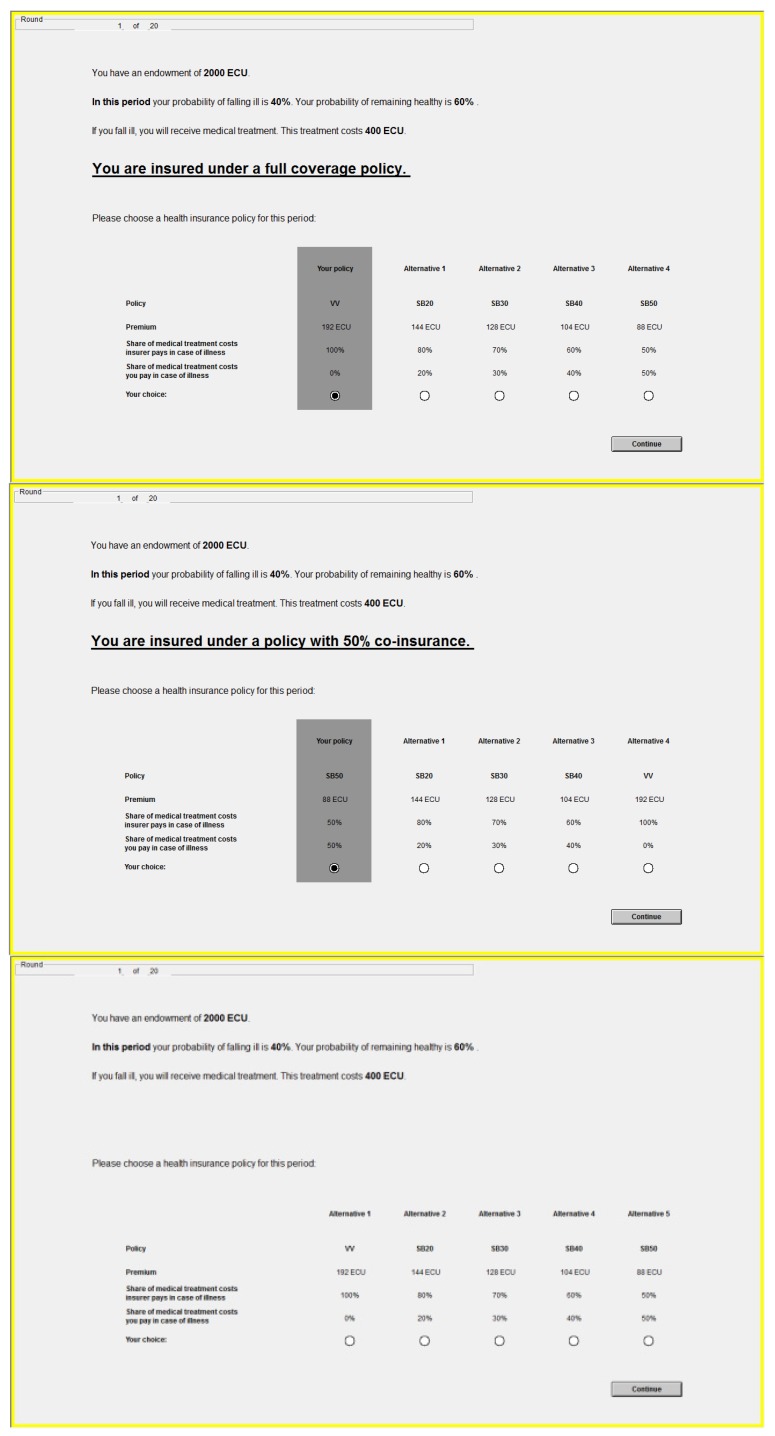
“Krieger and Felder (2013) conducted an experiment in the health insurance domain, where participants could select different levels of deductibles (full coverage, 20%, 30%, 40%, and 50”
BackgroundNatural Disasters and Governmental Aid: Is there a Charity Hazard?
Andor, M., Osberghaus, D., & Simora, M. (2019) · Ecological Economics · doi:10.1016/j.ecolecon.2019.106534 · Cited by 56
van Winssen, K. P. M., van Kleef, R. C., & van de Ven, W. P. M. M. (2015) · The European Journal of Health Economics · doi:10.1007/s10198-015-0745-2 · Cited by 46
“According to the literature, this strategy is expected to increase the number of insured opting for a voluntary deductible [25, 31, 36, 60, 61] since it potentially affects three determinants from the theoretical framework.”
BackgroundRobinson, P. J., & Botzen, W. J. W. (2019) · Journal of Economic Surveys · doi:10.1111/joes.12332 · Cited by 35
Metadata
- Authors
- Krieger, M., & Felder, S.
- Affiliations
- University of Duisburg-Essen (DE)
- University of Basel (CH)
- Corresponding author
- Felder, Stefan
- ORCID
- Felder, Stefan
- Venue
- International Journal of Environmental Research and Public Health
- Publisher
- MDPI AG
- Published
- 2013-06-19
- Volume
- 10
- Issue
- 6
- Pages
- 2560-2577
- ISSN
- 1660-4601 (ISSN-L)
- PMC
- PMC3717752
- OpenAlex
- W2144849441
- Cited by
- 31
- References
- 65
- Citations by year
- 2026: 1 · 2025: 2 · 2024: 3 · 2023: 4 · 2022: 5 · 2021: 3 · 2020: 3 · 2019: 4 · 2018: 1 · 2017: 1 · 2015: 3
- FWCI
- 0.73
- Type
- journal article
- Language
- en
- Open access
- gold
- doi.org
- Licence
- Locations
- International Journal of Environmental Research and Public Health (publishedVersion, cc-by)
- Europe PMC (PubMed Central) (publishedVersion, cc-by)
- PubMed Central (publishedVersion, cc-by)
- PubMed (publishedVersion)
- RePEc: Research Papers in Economics (submittedVersion)
- DOAJ (DOAJ: Directory of Open Access Journals) (submittedVersion)
- Funders
- Deutsche Forschungsgemeinschaft (FOR‐655)
- Topics
- Social Sciences › Decision Sciences › General Decision Sciences › Decision-Making and Behavioral Economics
- Social Sciences › Economics, Econometrics and Finance › Economics and Econometrics › Experimental Behavioral Economics Studies
- Social Sciences › Economics, Econometrics and Finance › Economics and Econometrics › Healthcare Policy and Management
- Keywords
- status quo bias, health insurance choice, default effects, framing effects, behavioral economics, purchase decision, coinsurance, health policy, risk preferences
- MeSH terms
- Choice Behavior, Decision Making, Humans, Insurance, Health, Insurance Selection Bias, Case-Control Studies, Risk Assessment
About these checks
Registry, retraction, Cites and statistics results are computed, not judged, with one exception: a printed reference that no index lists is read once by a model before it counts as a citation error. Claims are extracted by a model and kept only when their quote appears verbatim in the text; each cited source is then checked, with a model’s help, for whether it says what the claim relies on. Those verdicts can be wrong — read the claim’s quote and the cited source before relying on one.
Statistics and arithmetic are recomputed, not judged.
Confidence bands are shown only for fields calibrated on our annotated test set. None is calibrated yet, so no band is shown.
What counts as a claim ›How we measure confidence ›How we check this ›
Are you an author, or do you see a problem with this page? Request a review
Data sources
Bibliographic data: Semantic Scholar, OpenAlex, Crossref.
Contains information from the Semantic Scholar Academic Graph Datasets, made available under the ODC Attribution License (ODC-BY 1.0).
Semantic Scholar’s data is described in: Kinney, R., et al. (2023). The Semantic Scholar Open Data Platform. arXiv:2301.10140.
