

Physiological Effects of Touching the Wood of Hinoki Cypress (Chamaecyparis obtusa) with the Soles of the Feet
Open accessThe DOI matches its Crossref record; 54 of the 55 references it cites were found in a registry or an index.
Abstract
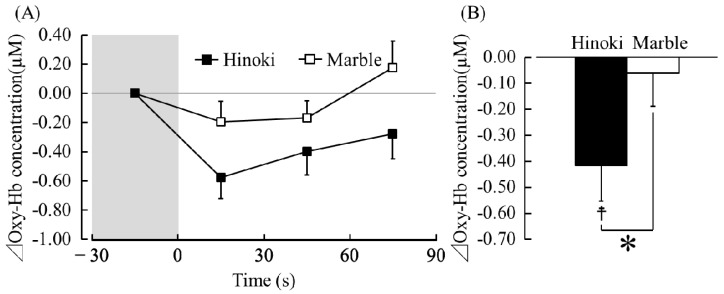
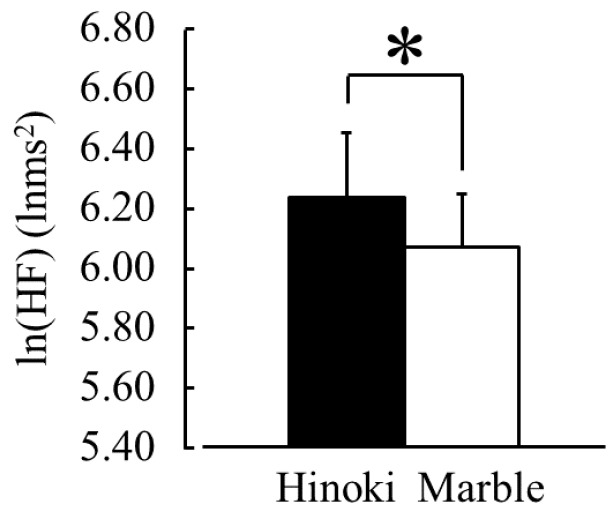
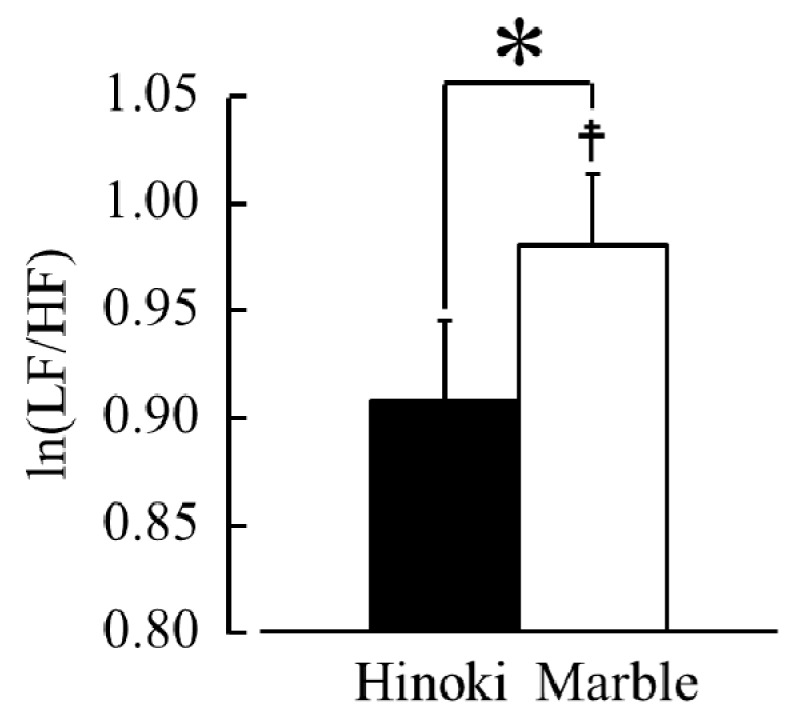
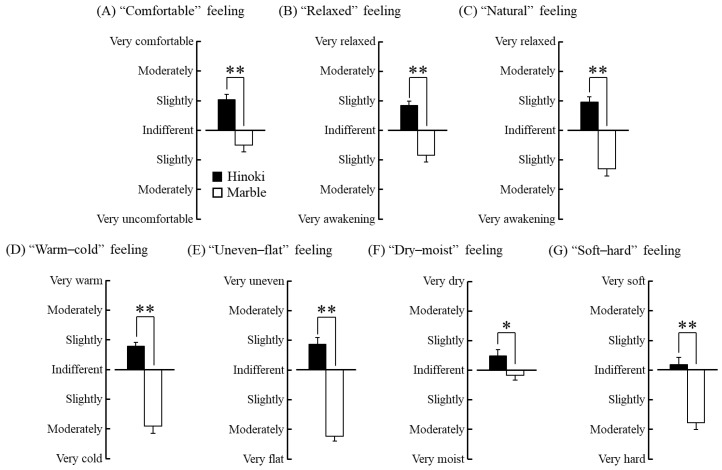
We clarified the physiological effects of tactile stimulation of the soles of the feet with the wood of the Hinoki cypress (Chamaecyparis obtusa) based on measurements of prefrontal cortex and autonomic nervous activities. Nineteen female university-attending students (age: 21.2 ± 0.3 years) were included. Oxy-hemoglobin (oxy-Hb) concentrations in the prefrontal cortex were determined by using near-infrared time-resolved spectroscopy. The high frequency (HF) indicating parasympathetic nervous activity and the ratio of low frequency (LF)/HF indicating sympathetic nervous activity were measured using heart rate variability. To evaluate the psychological effects caused by contact with the materials, the modified semantic differential method was used. The soles of the participants’ feet were touched to a 600 × 600-mm plate made of Hinoki, which was finished in non-coating and brushing for 90 s. A marble plate served as the control. Next, subjective evaluation tests were administered to the participants. Compared with touching marble, touching Hinoki significantly (1) decreased the oxy-Hb concentrations in the left and right prefrontal cortices, which indicates decreased prefrontal cortex activity, (2) increased ln(HF), which indicates increased parasympathetic nervous activity, (3) decreased ln(LF/HF) ratio, which indicates decreased sympathetic nervous activity. Additionally, (4) according to subjective evaluations, the participants perceived themselves as being more “comfortable,” “relaxed,” “natural,” “warm,” “uneven,” “dry,” and “soft” after touching Hinoki. Thus, our cumulative findings indicate that touching Hinoki with the soles of the feet induces physiological relaxation.
Overview
The claims and statistics of this paper haven’t been checked yet.
Free: it reads the open-access text and checks the first 5 claims that cite a source we can check. Create a free account to check every claim.
Integrity signals
Registry
Cites
Statistics
Figures
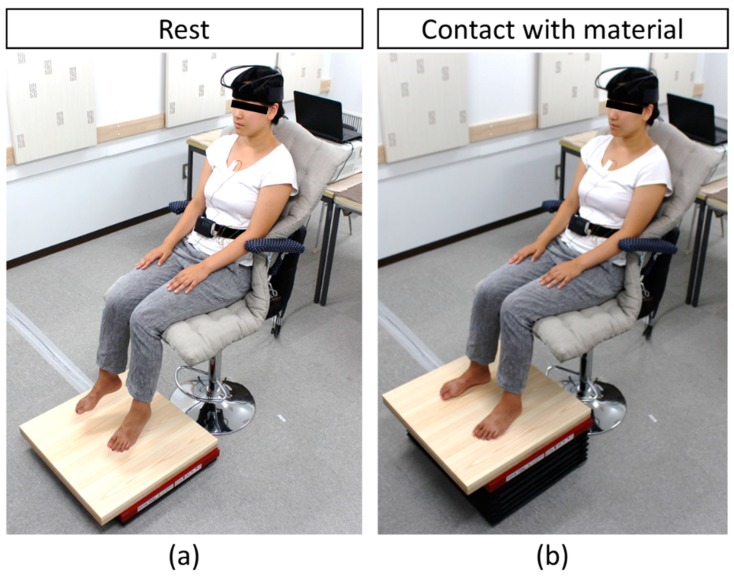
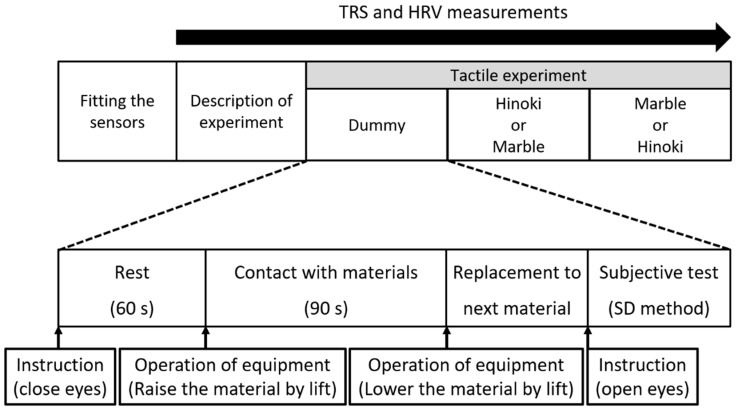
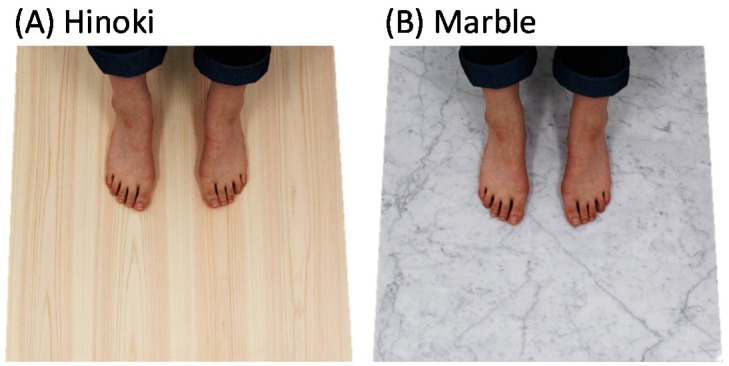
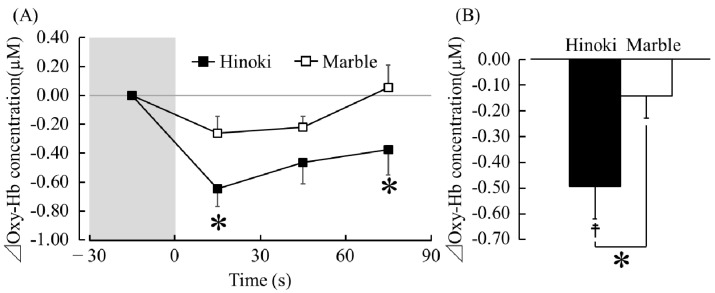
Verification
Claims the paper makes
The claims and statistics of this paper haven’t been checked yet.
Free: it reads the open-access text and checks the first 5 claims that cite a source we can check. Create a free account to check every claim.
Claims other papers make about this one
Each is checked against this paper’s own text: does it say what the citing paper says it does?
The cited source says what the claim attributes to it.
In the citing paper
“touching wood induced feelings of comfort (compared with marble; Ikei et al., 2018).”
From Exploring the role of exposure to green and blue spaces in preventing anxiety and depression among young people aged 14–24 years living in urban settings: A systematic review and conceptual framework (2022) · cites this paper as Ikei et al., 2018
The cited source says what the claim attributes to it.
In the citing paper
“| | | | | | | Touching Hinoki | | |”
From Exploring the role of exposure to green and blue spaces in preventing anxiety and depression among young people aged 14–24 years living in urban settings: A systematic review and conceptual framework (2022) · cites this paper as Ikei et al. (2018)
Self-check
Percentages, sums and reported differences re-computed from the paper’s own numbers.
The self-check needs the paper’s full text.
Citations
Cites
Heart Rate Variability: Standards of Measurement, Physiological Interpretation, and Clinical Use
Electrophysiology, T. F. O. T. E. S. O. C. T. N. A. (1996) · Circulation · doi:10.1161/01.cir.93.5.1043 · Cited by 17,159
Heart rate variability: Standards of measurement, physiological interpretation, and clinical use
Malik, M., Bigger, J. T., Camm, A. J., Kleiger, R. E., Malliani, A., Moss, A. J., & Schwartz, P. J. (1996) · European Heart Journal · doi:10.1093/oxfordjournals.eurheartj.a014868 · Cited by 15,289
Pagani, M., Lombardi, F., Guzzetti, S., Rimoldi, O., Furlan, R., Pizzinelli, P., Sandrone, G., Malfatto, G., Dell'Orto, S., & Piccaluga, E. (1986) · Circulation Research · doi:10.1161/01.res.59.2.178 · Cited by 4,130 · cited 1×
“The HF power was considered to indicate the parasympathetic nervous activity while the LF/HF power ratio was considered to indicate the sympathetic nervous activity [27,28].”
Ferrari, M., & Quaresima, V. (2012) · NeuroImage · doi:10.1016/j.neuroimage.2012.03.049 · Cited by 2,274
City living and urban upbringing affect neural social stress processing in humans
Lederbogen, F., Kirsch, P., Haddad, L., Streit, F., Tost, H., Schuch, P., Wüst, S., Pruessner, J. C., Rietschel, M., Deuschle, M., et al. (2011) · Nature · doi:10.1038/nature10190 · Cited by 1,584 · cited 2×
“In the social stress task, the activity of the amygdala, which is involved in stress processing, was higher in urban residents than in rural residents, which indicates that urban residents excessively react to stress [2].”
BackgroundPark, B. J., Tsunetsugu, Y., Kasetani, T., Kagawa, T., & Miyazaki, Y. (2010) · Environmental Health and Preventive Medicine · doi:10.1007/s12199-009-0086-9 · Cited by 1,116
Self-citationA new hominid from the Upper Miocene of Chad, Central Africa
Brunet, M., Guy, F., Pilbeam, D., Mackaye, H. T., Likius, A., Ahounta, D., Beauvilain, A., Blondel, C., Bocherens, H., Boisserie, J.-R., et al. (2002) · Nature · doi:10.1038/nature00879 · Cited by 1,075 · cited 1×
“Humans started evolving into their current form approximately 6 to 7 million years ago [38] and have spent more than 99.”
BackgroundBrain activity during transient sadness and happiness in healthy women
(1995) · American Journal of Psychiatry · doi:10.1176/ajp.152.3.341 · Cited by 737 · cited 1×
“[33] reported that pleasant feelings cause a significant decrease in the cerebral blood flow.”
BackgroundShinrin-Yoku (Forest Bathing) and Nature Therapy: A State-of-the-Art Review
Hansen, M. M., Jones, R., & Tocchini, K. (2017) · International Journal of Environmental Research and Public Health · doi:10.3390/ijerph14080851 · Cited by 652 · cited 1×
“Humans, therefore, enter into a relaxed state when exposed to the natural environment or a nature-derived stimulation, which brings them closer to their original proper state as human beings [6,39,40].”
BackgroundSalanova, M., Llorens, S., & Cifre, E. (2013) · International Journal of Psychology · doi:10.1080/00207594.2012.680460 · Cited by 604 · cited 1×
““Technostress,” [3] caused by information and communication technology such as computers, smartphones, and social media also elevates contemporary stress [4].”
Background
Research works printed but not linked: 3
- Brod C. Technostress: The Human Cost of the COMPUTER Revolution Addison Wesley Press Boston, MA, USA 1984 242 9780201112115
- Berger G. Katz H. Petutschnigg A.J. What consumers feel and prefer: Haptic perception of various wood flooring surface For. Prod. J. 2006 56 42 47
- Osgood C.E. Suci G.J. Tannenbaum P. The Measurement of Meaning University of Illinois Press Urbana, IL, USA 1957
Cited by
Physiological benefits of viewing nature: a systematic review of indoor experiments
Jo, H., Song, C., & Miyazaki, Y. (2019) · International Journal of Environmental Research and Public Health · doi:10.3390/ijerph16234739 · Cited by 234
Self-citationBray, I., Reece, R., Sinnett, D., Martin, F., & Hayward, R. (2022) · Environmental Research · doi:10.1016/j.envres.2022.114081 · Cited by 124
Jo, H., Song, C., Ikei, H., Enomoto, S., Kobayashi, H., & Miyazaki, Y. (2019) · International Journal of Environmental Research and Public Health · doi:10.3390/ijerph16152649 · Cited by 114
Self-citationEffects of forest-derived visual, auditory, and combined stimuli
Song, C., Ikei, H., & Miyazaki, Y. (2021) · Urban forestry & urban greening · doi:10.1016/j.ufug.2021.127253 · Cited by 49
Self-citationNAKAMURA, M., Ikei, H., & Miyazaki, Y. (2019) · Journal of Wood Science · doi:10.1186/s10086-019-1834-0 · Cited by 35
Self-citationNakanishi, E. Y., Poulin, P., Blanchet, P., Dubuis, M.-È., Drouin, M., Rhéaume, C., & Goupil‐Sormany, I. (2024) · Building and Environment · doi:10.1016/j.buildenv.2024.111527 · Cited by 31
Positive physiological effects of touching sugi (Cryptomeria japonica) with the sole of the feet
Ikei, H., & Miyazaki, Y. (2020) · Journal of Wood Science · doi:10.1186/s10086-020-01876-1 · Cited by 27
Self-citationSari, M., Fatimah, I. S., Pratiwi, P. I., & Sulistyantara, B. (2023) · Journal of Contemporary Urban Affairs · doi:10.25034/ijcua.2023.v7n1-1 · Cited by 27
A review on time domain diffuse optics: principles and applications on human biological tissues
Re, R., Spinelli, L., Martelli, F., Sieno, L. D., Bargigia, I., Amendola, C., Maffeis, G., & Torricelli, A. M. (2025) · Rivista Del Nuovo Cimento · doi:10.1007/s40766-025-00067-2 · Cited by 26
A Study of Visual Perception Based on Colour and Texture of Reconstituted Decorative Veneer
Huang, T., Zhou, C., Wang, X., & Kaner, J. (2023) · Coatings · doi:10.3390/coatings14010057 · Cited by 21
Imamura, C., Sakakibara, K., Arai, K., Ohira, H., Yamaguchi, Y., & Yamada, H. (2022) · International Journal of Environmental Research and Public Health · doi:10.3390/ijerph19116672 · Cited by 20
Physiological Effects of Visual Stimulation Using Knotty and Clear Wood Images among Young Women
Ikei, H., NAKAMURA, M., & Miyazaki, Y. (2020) · Sustainability · doi:10.3390/su12239898 · Cited by 20
“The results showed that the use of Japanese cypress (Chamaecyparis obtusa) as an olfactory stimulus [18–21] and wood as a tactile stimulus for the palm [22–25] and soles [26,27] induced a physiological relaxing effect, such as sedated prefrontal cortex activity, enhanced parasympathetic nerve activity, which increases…”
Self-citationPhysiological effects of touching sugi (Cryptomeria japonica) with the palm of the hand
Ikei, H., Song, C., & Miyazaki, Y. (2019) · Journal of Wood Science · doi:10.1186/s10086-019-1827-z · Cited by 16
Self-citationGrote, V., Frühwirth, M., Lackner, H. K., Goswami, N., Köstenberger, M., Likar, R., & Moser, M. (2021) · International Journal of Environmental Research and Public Health · doi:10.3390/ijerph18189749 · Cited by 18
“, the Hinoki cypress (Chamaecyparis obtusa)) with the palms [13] or the soles of the feet [14] results in similar effects.”
BackgroundRaha, S., Kim, S. M., Lee, H., Lee, S. K., Heo, J., Saralamma, V. V. G., Ha, S., Kim, E. S., Mun, S. P., & Kim, G. S. (2018) · International Journal of Molecular Medicine · doi:10.3892/ijmm.2018.3966 · Cited by 22
Kang, H. Y., & Chae, Y. (2021) · International Journal of Environmental Research and Public Health · doi:10.3390/ijerph18041701 · Cited by 13
“Although few studies exist on tactile stimulation, touching wood with feet has been shown to have a positive impact on brain activity and to promote physiological relaxation [28].”
BackgroundGórski, K. M., Kowalczyk, T., Picot, L., Rijo, P. M., Ghorbanpour, M., & Sitarek, P. (2024) · International Journal of Molecular Sciences · doi:10.3390/ijms25052723 · Cited by 13
NAKAMURA, M., Ikei, H., & Miyazaki, Y. (2022) · Wood Science and Technology · doi:10.1007/s00226-022-01419-5 · Cited by 11
Self-citationPsychophysiological Impact of Touching Landscape Grass among Older Adults
Hassan, A., & Deshun, Z. (2024) · Journal of Urban Health · doi:10.1007/s11524-024-00875-7 · Cited by 11
“For example, tactile stimulation triggers the release of serotonin and oxytocin in the brain [49].”
Huntsman, D. D., & Bulaj, G. W. (2025) · International Journal of Environmental Research and Public Health · doi:10.3390/ijerph22020225 · Cited by 11
Longman, D. P., Hedger, S. C. V., McEwan, K., Griffin, E., Hannon, C., Harvey, I., Kikuta, T., Nickels, M., O’Donnell, E., Pham, V. A., et al. (2025) · Scientific Reports · doi:10.1038/s41598-025-11469-x · Cited by 17
“Indeed, a number of investigators have adopted a sense-based approach to examine the effects of acoustic 30–33 , visual 34–36 , tactile 37,38 and olfactory 39,40 elements of natural environments on health biomarkers previously shown to respond positively to whole-body nature exposure (see 41 for a…”
Hassan, A., & Deshun, Z. (2024) · Journal of Health Population and Nutrition · doi:10.1186/s41043-024-00514-6 · Cited by 10
“It is projected that cities will host 66% of the world population by 2050 [4].”
BackgroundRelaxation Effect of Nature Sound Exposure on Gambling Disorder Patients: A Crossover Study
Ochiai, H., Ikei, H., Jo, H., Ohishi, M., & Miyazaki, Y. (2023) · Journal of Integrative and Complementary Medicine · doi:10.1089/jicm.2022.0611 · Cited by 11
Self-citationIkei, H., Song, C., & Miyazaki, Y. (2023) · Frontiers in Psychology · doi:10.3389/fpsyg.2023.1159458 · Cited by 10
Self-citationIkei, H., Jo, H., & Miyazaki, Y. (2023) · International Journal of Environmental Research and Public Health · doi:10.3390/ijerph20146351 · Cited by 8
Self-citationCavaliere, G., Calvano, S., Molina, P., & Negro, F. (2025) · Building and Environment · doi:10.1016/j.buildenv.2025.114188 · Cited by 6
Psychological and physiological effects of sole contact with oil-finished wood
Ikei, H., Jo, H., & Miyazaki, Y. (2024) · Journal of Wood Science · doi:10.1186/s10086-024-02134-4 · Cited by 6
“3B), which is consistent with previous studies on feet contact with Japanese cypress wood [9].”
BackgroundResultInfluentialSelf-citationThe Effects of Prolonged Indoor Inhalation of Nature-Derived Odors on Menopausal Women
Kim, C., Lee, G., & Song, C. (2024) · Healthcare · doi:10.3390/healthcare12161667 · Cited by 5
Self-citationNurrohimah, I., Fatimah, I. S., & Pratiwi, P. I. (2023) · Jurnal Lanskap Indonesia · doi:10.29244/jli.v15i2.42211 · Cited by 4
Impact of Hinoki Cypress Wood on Diversity of Microflora: A Case Study from Owase City Hall
Tanaka, D., Uei, D., Matsui, J., Matsunaga, M., Morimoto, M., & Maruyama, F. (2021) · Diversity · doi:10.3390/d13100473 · Cited by 6
“This species shows durability against termites and wood decay causing-fungi; thus, it has been used since ancient times in Japan as a construction material to build temples and shrines [3,4].”
BackgroundAoyagi, Y., Furuya, R., Kawasaki, M., Takenouchi, M., Ohashi, M., & Li, Q. (2026) · Environmental Health and Preventive Medicine · doi:10.1265/ehpm.25-00319 · Cited by 2
“It has been reported that touching hinoki wood or smelling hinoki cypress essential oil increases the high-frequency component of heart rate variability, indicating an increase in parasympathetic nervous activity [26, 27].”
Li, J., Luo, X., & Zhou, X. (2026) · Energy and Buildings · doi:10.1016/j.enbuild.2026.117396 · Cited by 2
Munir, M. T. (2021) · theses.fr (ABES) · doi:10.70675/02eb7282zeda4z492ez828cz8db7a0231e3e · Cited by 2
Tao, R., Long, D., Zhang, J., Long, R., & Cao, Y. (2026) · Frontiers in Psychology · doi:10.3389/fpsyg.2026.1734650 · Cited by 2
Growth Performance Assessment of Chamaecyparis obtusa Stand in Gyeongnam Province, S. Korea
Shik, M. H., Woon, K. T., & Solomon, T. (2020) · Agriculture Forestry and Fisheries · doi:10.11648/j.aff.20200905.11 · Cited by 1
“obtusa has therapeutic potential against respiratory inflammation related disease; suppresses proliferation of breast cancer cells; constitutes source of anti-inflammatory drugs; and touching Hinoki with the soles of the feet induces physiological relaxation [4-7].”
BackgroundAmbientes saudáveis: a contribuição da madeira para a qualidade do ambiente interno
Shigue, E. K. (2024) · Digital Library of Theses and Dissertations (Universidade de São Paulo) · doi:10.11606/t.102.2024.tde-08042025-113924 · Cited by 1
Oboshi, Y., Tamura, K., Fukushi, Y., & Yamamoto, S. (2025) · IBRO Neuroscience Reports · doi:10.1016/j.ibneur.2025.06.009
Die Stress-Touchpoint-Interaktion in der Customer Journey
Paul, S. (2026) · Springer eBooks · doi:10.1007/978-3-658-46709-8_112-1
Shimada, S. (2026) · International Multidisciplinary Research Journal · doi:10.47722/imrj.2001.78
Huntsman, D. D., Jenkinson, D., & Bulaj, G. W. (2026) · Healthcare · doi:10.3390/healthcare14091123
Seravalle, V., Barbierato, E., & Sacchelli, S. (2026) · L’Italia forestale e montana · doi:10.36253/ifm-1242
Ikei, H., Jo, H., & Miyazaki, Y. (2026) · Journal of Wood Science · doi:10.1186/s10086-026-02305-5
“However, since 2017, more systematic approaches have been conducted by Ikei et al. [9–12], using randomized crossover designs and simultaneous measurements of prefrontal cortex activity and autonomic nervous activity, and this line of research was extended to plantar (sole) contact in 2018 [13–15].”
Self-citation
Metadata
- Authors
- Ikei, H., Song, C., & Miyazaki, Y.
- Affiliations
- Forestry and Forest Products Research Institute (JP)
- Chiba University (JP)
- Corresponding author
- Miyazaki, Yoshifumi
- Venue
- International Journal of Environmental Research and Public Health
- Publisher
- MDPI AG
- Published
- 2018-09-28
- Volume
- 15
- Issue
- 10
- Pages
- 2135
- ISSN
- 1660-4601 (ISSN-L)
- PMC
- PMC6210085
- OpenAlex
- W2893085627
- Cited by
- 41
- References
- 54
- Citations by year
- 2026: 6 · 2025: 5 · 2024: 6 · 2023: 6 · 2022: 3 · 2021: 6 · 2020: 3 · 2019: 4 · 2018: 2
- FWCI
- 1.85
- Type
- journal article
- Language
- en
- Open access
- gold
- dx.doi.org
- Licence
- Locations
- International Journal of Environmental Research and Public Health (publishedVersion, cc-by)
- Europe PMC (PubMed Central) (publishedVersion, other-oa)
- PubMed Central (publishedVersion, cc-by)
- PubMed (publishedVersion)
- RePEc: Research Papers in Economics (submittedVersion)
- DOAJ (DOAJ: Directory of Open Access Journals) (submittedVersion)
- Funders
- Japan Society for the Promotion of Science (JP16K18200)
- Topics
- Social Sciences › Urban Studies › Urban Green Space and Health
- Health Sciences › Medicine › Cardiology and Cardiovascular Medicine › Heart Rate Variability and Autonomic Control
- Health Sciences › Medicine › Complementary and alternative medicine › Biofield Effects and Biophysics
- Keywords
- Chamaecyparis obtusa, prefrontal cortex activation, oxyhemoglobin, heart rate variability, parasympathetic activity, sympathetic activity, autonomic nervous system, relaxation
- MeSH terms
- Adult, Female, Heart Rate, Humans, Relaxation, Students, Wood, Prefrontal Cortex, Therapeutic Touch, Chamaecyparis, Young Adult
About these checks
Registry, retraction, Cites and statistics results are computed, not judged, with one exception: a printed reference that no index lists is read once by a model before it counts as a citation error. Claims are extracted by a model and kept only when their quote appears verbatim in the text; each cited source is then checked, with a model’s help, for whether it says what the claim relies on. Those verdicts can be wrong — read the claim’s quote and the cited source before relying on one.
Statistics and arithmetic are recomputed, not judged.
Confidence bands are shown only for fields calibrated on our annotated test set. None is calibrated yet, so no band is shown.
What counts as a claim ›How we measure confidence ›How we check this ›
Are you an author, or do you see a problem with this page? Request a review
Data sources
Bibliographic data: Semantic Scholar, OpenAlex, Crossref.
Contains information from the Semantic Scholar Academic Graph Datasets, made available under the ODC Attribution License (ODC-BY 1.0).
Semantic Scholar’s data is described in: Kinney, R., et al. (2023). The Semantic Scholar Open Data Platform. arXiv:2301.10140.
