

The DOI matches its Crossref record; 19 of the 21 references it cites were found in a registry or an index.
Children’s Improvement of a Motor Response during Backward Falls through the Implementation of a Safe Fall Program
Open accessAbstract
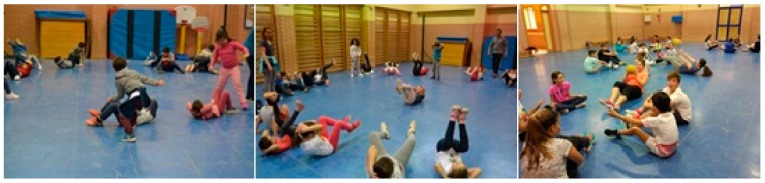
The World Health Organization has warned that, in children, the second cause of death from unintentional injuries are falls. The objective of this study was to analyze the motor response of primary schoolchildren when a backwards fall occurs. These analyses occurred before and after interventions of the Safe Fall program, which aims to teach safe and protected ways of backward falling. A quasi-experimental research design was used, with a sample of 122 Spanish (Sevillian) schoolchildren in the 10–12 age bracket. The INFOSECA ad-hoc observation scale was used for data collection: this scale registers 5 essential physical reactions throughout the process of a safe and protected backwards fall. After that, a number of descriptive, correlational and contrast statistics were applied. The value used in the McNemar test to establish statistical significance was p < 0.05. Results showed that over 85% of students had developed the competence to correctly perform all five physical motions that allow for a safer backward fall. The teaching of safe and protected techniques for falling backwards in child population in Primary Education is possible through the implementation of the Safe Fall program in Physical Education classes, which can help making falls safer, diminishing the risk and severity of the injuries they cause.
Overview
The claims and statistics of this paper haven’t been checked yet.
Run the check — free, no account needed. It reads the open-access text and checks the sources it cites.
Integrity signals
Registry
Cites
Statistics
Figures
Verification
Claims the paper makes
The claims and statistics of this paper haven’t been checked yet.
Run the check — free, no account needed. It reads the open-access text and checks the sources it cites.
Claims other papers make about this one
Each is checked against this paper’s own text: does it say what the citing paper says it does?
The source backs part of the claim, not all of it — or backs it for a different population, condition or comparison.
In the citing paper
“In contrast, trained children execute a more decisive lowering of the Center of Mass (CoM)—typically through a squatting motion—to initiate the Ukemi roll [3].”
From Safe Fall: Use of Predictive Modeling and Machine Vision Techniques for Fall Analysis and Fall Quality (2026) · cites this paper as [3]
Experimental — accuracy not yet measuredThe source backs part of the claim, not all of it — or backs it for a different population, condition or comparison.
In the citing paper
“This multidimensional validation confirms that the intervention successfully overwrote the natural “stiffening” reflex with a trained, energy-dissipating motor habit [3].”
From Safe Fall: Use of Predictive Modeling and Machine Vision Techniques for Fall Analysis and Fall Quality (2026) · cites this paper as [3]
Experimental — accuracy not yet measured
Self-check
Percentages, sums and reported differences re-computed from the paper’s own numbers.
The self-check needs the paper’s full text.
Citations
Cites
Lamb, S. E., Jørstad‐Stein, E. C., Hauer, K. A., Becker, C., & on behalf of the Prevention of Falls Network Europe and Outcomes Consensus Group (2005) · Journal of the American Geriatrics Society · doi:10.1111/j.1532-5415.2005.53455.x · Cited by 2,148
Common protective movements govern unexpected falls from standing height
Hsiao‐Wecksler, E. T., & Robinovitch, S. N. (1997) · Journal of Biomechanics · doi:10.1016/s0021-9290(97)00114-0 · Cited by 269
Feldman, F., & Robinovitch, S. N. (2007) · Journal of Biomechanics · doi:10.1016/j.jbiomech.2007.01.019 · Cited by 172
A 10-year review of child injury hospitalisations, health outcomes and treatment costs in Australia
Mitchell, R. J., Curtis, K. A., & Foster, K. (2017) · Injury Prevention · doi:10.1136/injuryprev-2017-042451 · Cited by 83
Levels and Characteristics of Physical Activity among a College Student Cohort
Miller, K. H., Staten, R. R., Rayens, M. K., & Noland, M. P. (2005) · American Journal of Health Education · doi:10.1080/19325037.2005.10608187 · Cited by 38
Variability in Pediatric injury patterns by age and ethnic groups in Israel
Savitsky, B., Aharonson‐Daniel, L., Giveon, A., The Israel Trauma Group, & Peleg, K. (2007) · Ethnicity and Health · doi:10.1080/13557850601002171 · Cited by 28
Epidemiología y factores de riesgo de las lesiones por caídas en niños menores de un año
de Domingo, A. J., García, E. R., Pardillo, R. M., Constantí, V. A., Haiek, L. A. F., Arola, M. S., Oliveras, F. R., García, C. R., Ferrer, G. E., & Romero, J. L. (2016) · Anales de Pediatría · doi:10.1016/j.anpedi.2015.12.004 · Cited by 22
JUDO TRAINING AS A MEANS OF REDUCING SUSCEPTIBILITY TO INJURY DURING FALLS
Boguszewski, D., & Kerbaum, K. (2011) · Polish Journal of Sports Medicine · doi:10.5604/1232406x.971228 · Cited by 19
Accidentes de bicicleta atendidos en los Servicios de Urgencias. Estudio multicéntrico
González‐Pacheco, N., Pardillo, R. M., Storch-de-Gracia, P., Calleja, C. C., Muñoz, E. M., Sáez, M. J. R., Rupérez, E. C., Occhiuzzo, F. P., Sáez, C. D., Martínez-Páis, V. B., et al. (2013) · Anales de Pediatría · doi:10.1016/j.anpedi.2013.05.031 · Cited by 14
Prevention of death and disability from injuries to children and adolescents
Rivara, F. P. (2012) · International Journal of Injury Control and Safety Promotion · doi:10.1080/17457300.2012.686919 · Cited by 14
Research works printed but not linked: 2
- 2017, Necesidades en formación del profesorado en enseñanza de técnicas seguras y protegidas de caer (Safe Fall)./Need to introduce teaching of safe and protected teacher training techniques (Safe Fall), J. Sport Health Res., 9, 115
- Kalina, 2010, The effectiveness of two methods of teaching safe falls to physiotherapy students, Arch. Budo, 6, 63
Cited by
Invernizzi, P. L., Signorini, G., Colella, D., Raiola, G., Bosio, A., & Scurati, R. (2020) · International Journal of Environmental Research and Public Health · doi:10.3390/ijerph17238803 · Cited by 25
Campbell-Pierre, D., & Rhea, D. J. (2023) · Frontiers in Sports and Active Living · doi:10.3389/fspor.2023.1133379 · Cited by 24
Liu, W., Tung, T., Zhou, Y., Gu, D., & Chen, H. Y. (2022) · Frontiers in Public Health · doi:10.3389/fpubh.2022.848122 · Cited by 15
Risk factors for falls among children aged 0–18 years: a systematic review
Wang, L., Qian, M., Shan, X., & Liu, X. (2022) · World Journal of Pediatrics · doi:10.1007/s12519-022-00556-y · Cited by 12
Educational strategies for preventing accidents in childhood: a systematic review
Laguna, G. G. D. C., Gusmão, A. L. F., Marques, B. O., Bragas, N. B. D. S., Assis, G. A. D. S., Evangelista, K. D. C., & Silva, N. O. E. (2024) · Cadernos de Saúde Pública · doi:10.1590/0102-311xen036224 · Cited by 10
Metadata
- Authors
- DelCastillo-Andrés, Ó., Toronjo-Hornillo, L., Rodríguez-López, M., Castañeda-Vázquez, C., & Campos-Mesa, M. D. C.
- Affiliations
- Physical Education and Sports Department, University of Seville, 41013 Seville, Spain
- Universidad de Sevilla (ES)
- Venue
- International Journal of Environmental Research and Public Health
- Publisher
- MDPI AG
- Published
- 2018-11-27
- Volume
- 15
- Issue
- 12
- Pages
- 2669
- ISSN
- 1660-4601 (ISSN-L)
- PMC
- PMC6313405
- OpenAlex
- W2903031502
- Cited by
- 14
- References
- 21
- Citations by year
- 2026: 1 · 2025: 1 · 2024: 2 · 2023: 2 · 2022: 3 · 2021: 1 · 2020: 3 · 2019: 1
- FWCI
- 1.19
- Type
- journal article
- Language
- en
- Open access
- gold
- dx.doi.org
- Licence
- Locations
- International Journal of Environmental Research and Public Health (publishedVersion, cc-by)
- Europe PMC (PubMed Central) (publishedVersion, cc-by)
- PubMed Central (publishedVersion, cc-by)
- PubMed (publishedVersion)
- idUS (Universidad de Sevilla) (submittedVersion, cc-by-nc-nd)
- RePEc: Research Papers in Economics (submittedVersion)
- LA Referencia (Red Federada de Repositorios Institucionales de Publicaciones Científicas) (submittedVersion, cc-by-nc-nd)
- DOAJ (DOAJ: Directory of Open Access Journals) (submittedVersion)
- Topics
- Health Sciences › Medicine › Public Health, Environmental and Occupational Health › Injury Epidemiology and Prevention
- Social Sciences › Psychology › Developmental and Educational Psychology › Children's Physical and Motor Development
- Social Sciences › Safety Research › Education, Safety, and Science Studies
- Keywords
- backward falls, motor response, children, unintentional injuries, fall prevention, physical education, elementary school students, injury risk reduction
- MeSH terms
- Accidental Falls, Child, Female, Health Education, Humans, Male, Physical Education and Training, Risk Management, Spain, Safety Management
About these checks
Registry, retraction, Cites and statistics results are computed, not judged, with one exception: a printed reference that no index lists is read once by a model before it counts as a citation error. Claims are extracted by a model and kept only when their quote appears verbatim in the text; each cited source is then checked, with a model’s help, for whether it says what the claim relies on. Those verdicts can be wrong — read the claim’s quote and the cited source before relying on one.
Statistics and arithmetic are recomputed, not judged.
Confidence bands are shown only for fields calibrated on our annotated test set. None is calibrated yet, so no band is shown.
What counts as a claim ›How we measure confidence ›How we check this ›
Are you an author, or do you see a problem with this page? Request a review
How to cite
Cite CoChat for the checks on this page, and the paper for its own findings.
- This page
- CoChat. (2026). Citation check: Children’s Improvement of a Motor Response during Backward Falls through the Implementation of a Safe Fall Program. https://app.cochat.ai/papers/10.3390/ijerph15122669
- The paper
- DelCastillo-Andrés, Ó., Toronjo-Hornillo, L., Rodríguez-López, M., Castañeda-Vázquez, C., & Campos-Mesa, M. D. C. (2018). Children’s Improvement of a Motor Response during Backward Falls through the Implementation of a Safe Fall Program. International Journal of Environmental Research and Public Health. https://doi.org/10.3390/ijerph15122669
Data sources
Bibliographic data: Semantic Scholar, OpenAlex, Crossref.
Contains information from the Semantic Scholar Academic Graph Datasets, made available under the ODC Attribution License (ODC-BY 1.0).
Semantic Scholar’s data is described in: Kinney, R., et al. (2023). The Semantic Scholar Open Data Platform. arXiv:2301.10140.
