

Exposure Characterization of Haloacetic Acids in Humans for Exposure and Risk Assessment Applications: An Exploratory Study
Open accessThe DOI matches its Crossref record; 68 of the 71 references it cites were found in a registry or an index.
Abstract
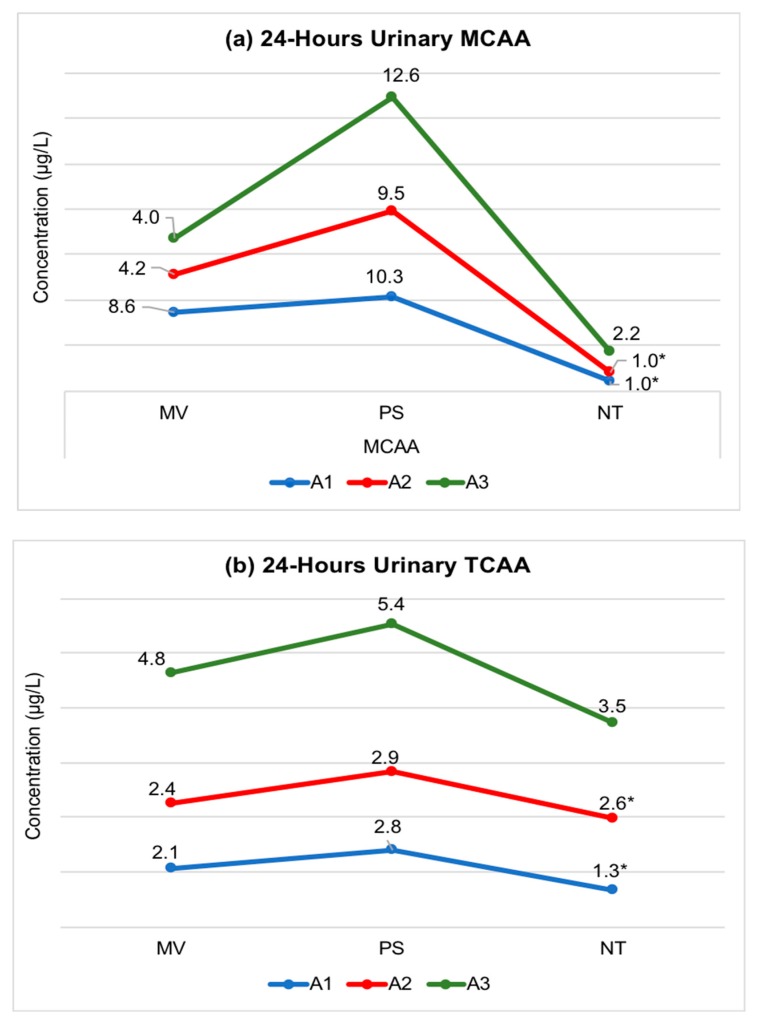
Disinfected water is the major source of haloacetic acids (HAAs) in humans, but their inter- and intra-individual variability for exposure and risk assessment applications is under-researched. Thus, we measured HAAs in cross-sectional and longitudinal urine and water specimens from 17 individuals. Five regulated HAAs—mono-, di-, and trichloroacetic acid (MCAA, DCAA, and TCAA) and mono- and dibromoacetic acid (MBAA and DBAA)—and one unregulated HAA—bromochloroacetic acid (BCAA)—were measured. Urinary DCAA, MBAA, DBAA, and BCAA levels were always below the limits of detection (LOD). Measured levels and interindividual variability of urinary MCAA were higher than urinary TCAA. Longitudinal urinary specimens showed MCAA levels peaked in after-shower specimens, while TCAA levels remain unchanged. Correlation between urinary MCAA and TCAA was moderate but statistically significant. The prevalence of MCAA and TCAA in urine suggest they can be considered as biomarkers of HAA. Peak urinary MCAA in post-shower specimens suggest MCAA captures short-term exposure via dermal and/or inhalation, while urinary TCAA captures long-term exposure via ingestion. However, further research is warranted in a large pool of participants to test the reliability of MCAA as exposure biomarker.
Overview
The claims and statistics of this paper haven’t been checked yet.
Free: it reads the open-access text and checks the first 5 claims that cite a source we can check. Create a free account to check every claim.
Integrity signals
Registry
Cites
Statistics
Figures
Verification
Claims the paper makes
The claims and statistics of this paper haven’t been checked yet.
Free: it reads the open-access text and checks the first 5 claims that cite a source we can check. Create a free account to check every claim.
Claims other papers make about this one
Each is checked against this paper’s own text: does it say what the citing paper says it does?
The check wasn’t confident either way, so it gives no verdict — never disputed.
In the citing paper
“Nephrotoxity and urogenital tract dysfunction are established pathological outcomes of chlorination stress.”
From Hypochlorous Acid: From Innate Immune Factor and Environmental Toxicant to Chemopreventive Agent Targeting Solar UV-Induced Skin Cancer (2022) · cites this paper as [165]
Experimental — accuracy not yet measuredThe check wasn’t confident either way, so it gives no verdict — never disputed.
In the citing paper
“Among other pathologies, acute kidney injury, glomerulonephritis, diabetic nephropathy, and bladder cancer have been associated with exposure to pathological chlorination stress (110, 162–166).”
From Hypochlorous Acid: From Innate Immune Factor and Environmental Toxicant to Chemopreventive Agent Targeting Solar UV-Induced Skin Cancer (2022) · cites this paper as [165]
Experimental — accuracy not yet measured
Self-check
Percentages, sums and reported differences re-computed from the paper’s own numbers.
The self-check needs the paper’s full text.
Citations
Cites
Estimation of Average Concentration in the Presence of Nondetectable Values
Hornung, R. W., & Reed, L. D. (1990) · Applied Occupational and Environmental Hygiene · doi:10.1080/1047322x.1990.10389587 · Cited by 3,495
RICHARDSON, S., PLEWA, M., WAGNER, E., SCHOENY, R., & DEMARINI, D. (2007) · Mutation Research/Reviews in Mutation Research · doi:10.1016/j.mrrev.2007.09.001 · Cited by 3,317
Self-citationThe Occurrence of Disinfection By‐products in US Drinking Water
Krasner, S. W., McGuire, M. J., Jacangelo, J. G., Patania, N. L., Reagan, K. M., & Aieta, E. M. (1989) · Journal AWWA · doi:10.1002/j.1551-8833.1989.tb03258.x · Cited by 794 · cited 10×
“It also does not account for toxicokinetic mechanisms or intra- and interindividual variability due to behavior differences in water use activities and water source characteristics, which could potentially change HAA exposure [1,6,28,33,34].”
BackgroundInfluentialComparison of disinfection byproduct formation from chlorine and alternative disinfectants
Hua, G., & Reckhow, D. A. (2007) · Water Research · doi:10.1016/j.watres.2007.01.032 · Cited by 737 · cited 1×
“It also does not account for toxicokinetic mechanisms or intra- and interindividual variability due to behavior differences in water use activities and water source characteristics, which could potentially change HAA exposure [1,6,28,33,34].”
BackgroundLiang, L., & Singer, P. C. (2003) · Environmental Science & Technology · doi:10.1021/es026230q · Cited by 694 · cited 2×
“…in drinking water, due to differences in source water characteristics (dissolved organic carbon concentrations and composition of natural organic matter-NOM), seasons (summer vs. winter), disinfectant type (e.g., chlorine, chloramine, chlorine dioxide, and ozone), and disinfectant doses [3,6–9].”
BackgroundNieuwenhuijsen, M. J., Toledano, M. B., Eaton, N. E., Fawell, J., & Elliott, P. (2000) · Occupational and Environmental Medicine · doi:10.1136/oem.57.2.73 · Cited by 591
Mammalian cell cytotoxicity and genotoxicity analysis of drinking water disinfection by‐products
Plewa, M. J., Kargalioglu, Y., Vankerk, D., Minear, R. A., & Wagner, E. D. (2002) · Environmental and Molecular Mutagenesis · doi:10.1002/em.10092 · Cited by 405 · cited 4×
“While DCAA, TCAA, and unregulated BCAA were detected in all water specimens (Table 3), of these, only TCAA was found in the corresponding urine specimens. composition of individual HAAs in drinking water was very different from that Mean levels of DCAA (15.9 ± 4.9 µg/L) were higher than TCAA (6.6 ± 3.4 µg/L) and BCAA…”
BackgroundInfluentialVickers, A. J. (2005) · BMC Medical Research Methodology · doi:10.1186/1471-2288-5-35 · Cited by 397
Plewa, M. J., Simmons, J. E., Richardson, S. D., & Wagner, E. D. (2010) · Environmental and Molecular Mutagenesis · doi:10.1002/em.20585 · Cited by 343
Self-citationDrinking water contaminants and adverse pregnancy outcomes: a review.
Bove, F., Shim, Y., & Zeitz, P. (2002) · Environmental Health Perspectives · doi:10.1289/ehp.02110s161 · Cited by 315 · cited 1×
“Millions of people worldwide, including sensitive subpopulations (e.g., pregnant women and children) with potential increased risk of experiencing reproductive and developmental health effects, consume disinfected water [21–27].”
Background
Research works printed but not linked: 3
- Dad A. Pals J. Wagner E. Plewa M.J. Genotoxic Mechanism of Haloacetic Acid Drinking Water Disinfection Byproducts Environ. Mol. Mutagen. 2011 52 S69
- Jeong C.H. Anduri S. Richardson S.D. Nieuwenhuijsen M.J. Kogevinas M. Wagner E.D. Plewa M.J. Cytotoxicity and Genotoxicity of Disinfection By-Products in Drinking Water in Europe: HIWATE Environ. Mol. Mutagen. 2011 52 S69
- Maksimov G.G. Dubinina O.N. Materials of experimental substantiation of maximally permissible concentration of monochloroacetic acid in the air of production area Gig. Tr. Prof. Zabol. 1974 9 32 35 4465199
Cited by
Ahmad, H. A., Ahmad, S., Cui, Q., Wang, Z., Wei, H., Chen, X., Ni, S.-Q., Ismail, S., Awad, H. M., & Tawfik, A. (2022) · Science of The Total Environment · doi:10.1016/j.scitotenv.2021.151926 · Cited by 101
Chen, B., Jiang, J., Yang, X., Zhang, X., & Westerhoff, P. K. (2021) · Water Research · doi:10.1016/j.watres.2021.117265 · Cited by 95
“To the best of our knowledge, only regulated DBPs have been measured in tap water in limited epidemiological studies aiming to link their exposures with adverse outcomes (Jeong et al., 2012; Legay et al., 2010; Parvez et al., 2019; Wang et al., 2019).”
BackgroundSnell, J. A., Jandova, J., & Wondrak, G. T. (2022) · Frontiers in Oncology · doi:10.3389/fonc.2022.887220 · Cited by 37
Meta-analysis of small for gestational age births and disinfection byproduct exposures
Summerhayes, R. J., Rahman, B., Morgan, G. G., Beresin, G., Moreno, C., & Wright, J. M. (2020) · Environmental Research · doi:10.1016/j.envres.2020.110280 · Cited by 37
Shi, Y., Ma, W., Han, F., Geng, Y., Yu, X., Wang, H., Kimura, S. Y., Wei, X., Kauffman, A. E., Xiao, S., et al. (2019) · Journal of Hazardous Materials · doi:10.1016/j.jhazmat.2019.121810 · Cited by 38
Self-citationZhang, J., Li, X., Lei, H., Zhao, R., Gan, W., Zhou, K., & Li, B. J. (2021) · Journal of Hazardous Materials · doi:10.1016/j.jhazmat.2021.128101 · Cited by 29
Redondo‐Hasselerharm, P. E., Cserbik, D., Flores, C., Farré, M. J., Sanchís, J., Alcolea, J. A., Planas, C., Caixach, J., & Villanueva, C. M. (2022) · Journal of Exposure Science & Environmental Epidemiology · doi:10.1038/s41370-022-00453-6 · Cited by 31
“3 μg/L) [49] and in a sample of Chinese pregnant women (2.”
BackgroundResultWang, F., Wang, W.-K., Wang, H., Zhao, Z., Zhou, T., Jiang, C., Li, J., Zhang, X., Liang, T., & Dong, W. (2023) · The Science of The Total Environment · doi:10.1016/j.scitotenv.2023.163610 · Cited by 27
Zhang, M., Deng, Y.-L., Liu, C., Lu, W., & Zeng, Q. (2023) · Chemosphere · doi:10.1016/j.chemosphere.2023.138808 · Cited by 26
Liu, C., Deng, Y.-L., Yuan, X.-Q., Chen, P., Yu, M., Luo, Q., Zhang, M., Cui, F., Yao, W., Zeng, J.-Y., et al. (2022) · Environmental Research · doi:10.1016/j.envres.2022.112863 · Cited by 26
Deng, Y.-L., Liu, C., Yuan, X.-Q., Luo, Q., Yu, M., Chen, P., Cui, F., Zhang, M., Zeng, J.-Y., Shi, T., et al. (2023) · Environmental Health Perspectives · doi:10.1289/ehp12447 · Cited by 20
Zhang, M., Liu, C., Cui, F., Chen, P., Deng, Y.-L., Luo, Q., Yu, M., Sun, S., Li, Y., Lu, W., et al. (2020) · Chemosphere · doi:10.1016/j.chemosphere.2020.128856 · Cited by 20
Rychlewska, K., & Wodzisławska-Pasich, K. (2024) · Desalination and Water Treatment · doi:10.1016/j.dwt.2024.100355 · Cited by 19
Franco, E. S., de Pádua, V. L., Rodríguez, M., Silva, D. F., Libânio, M., Pereira, M. C., Silva, P. H. G., Júnior, I. C. S., Rocha, B. A., Camargo, J. A., et al. (2019) · Microchemical Journal · doi:10.1016/j.microc.2019.104088 · Cited by 19
Zhang, M., Liu, X., Deng, Y.-L., Liu, C., Zeng, J.-Y., Miao, Y., Wu, Y., Li, C., Li, Y.-J., Liu, A.-X., et al. (2023) · Journal of Hazardous Materials · doi:10.1016/j.jhazmat.2023.132638 · Cited by 16
Deng, Y.-L., Luo, Q., Yuan, X.-Q., Liu, C., Lu, T., Shi, T., Zeng, J.-Y., Cui, F., Miao, Y., Zhang, M., et al. (2022) · International Journal of Hygiene and Environmental Health · doi:10.1016/j.ijheh.2022.113931 · Cited by 16
Chlorine Disinfection Byproducts: A Public Health Concern Associated with Dairy Food Contamination
Slattery, M. A., & Garvey, M. (2025) · Dairy · doi:10.3390/dairy6020018 · Cited by 15
Liu, J., Han, X., Zhang, J., Wang, H., Zhou, M.-X., Li, S., Ma, X., Wang, Y., & Liu, A. (2021) · Chemosphere · doi:10.1016/j.chemosphere.2021.132541 · Cited by 17
Liu, X., Zhang, M., Gu, X., Deng, Y.-L., Liu, C., Yu, M., Wu, Y., Li, C.-R., Zeng, J.-Y., Li, Y.-J., et al. (2023) · The Science of The Total Environment · doi:10.1016/j.scitotenv.2023.168729 · Cited by 17
Deng, Y.-L., Lu, T., Hao, H., Liu, C., Yuan, X.-Q., Yu, M., Zhang, M., Zeng, J.-Y., Li, Y., Lu, W., et al. (2024) · Environmental Health Perspectives · doi:10.1289/ehp13386 · Cited by 15
Tian, M., Li, H., Wu, S., Xi, H., Wang, Y., Lu, Y.-Y., Wei, L., & Huang, Q. (2024) · Journal of Hazardous Materials · doi:10.1016/j.jhazmat.2024.133796 · Cited by 12
Pyrogenic carbon-promoted haloacetic acid decarboxylation to trihalomethanes in drinking water
Samonte, P. R. V., Zhao, L., Mao, J., Chaplin, B. P., & Xu, W. (2021) · Water Research · doi:10.1016/j.watres.2021.117988 · Cited by 11
Allometric Scaling of Force-velocity Test Output Among Pre-pubertal Basketball Players
Martinho, D. V., Baptista, R., Teixeira, A. S., Duarte, J. P., Valente‐dos‐Santos, J., Coelho-e-Silva, M. J., Santos, A. M., & Armstrong, N. (2021) · International Journal of Sports Medicine · doi:10.1055/a-1327-2727 · Cited by 9
Xiang, Y., & Xu, H. Y. (2023) · Chemosphere · doi:10.1016/j.chemosphere.2023.140182 · Cited by 8
Evaluation of disinfection byproducts for their ability to affect mitochondrial function
Kajjumba, G. W., Bokota, R. E., Attene‐Ramos, M. S., & Marti, E. (2022) · Journal of Environmental Sciences · doi:10.1016/j.jes.2022.05.014 · Cited by 7
Shi, Y., Wan, Y., Wang, D., Liu, J., Zong, Y., Zhao, X., & Xia, W. (2023) · The Science of The Total Environment · doi:10.1016/j.scitotenv.2023.168379 · Cited by 7
Chetwynd, A. J., Louyer, M.-V., Mercier, F., Bessonneau, V., & David, A. (2024) · TrAC Trends in Analytical Chemistry · doi:10.1016/j.trac.2024.117816 · Cited by 7
Bai, X., Liu, L., Qian, J., Liu, R., Du, Z., Ni, R., Chen, T., & Zheng, W. (2025) · Analytical Methods · doi:10.1039/d4ay02254h · Cited by 6
Malik, N., & Kumar, R. (2024) · Springer eBooks · doi:10.1007/978-3-031-49047-7_4 · Cited by 7
The disinfection by-products are in the air: Aerosol measurements in the urban area of Venice
Feltracco, M., Barbaro, E., Formenton, G., Mazzi, G., Striuli, S., Bragato, C., Piazza, R., Barbante, C., & Gambaro, A. (2023) · Atmospheric Environment · doi:10.1016/j.atmosenv.2023.120224 · Cited by 5
“…the inhalation exposure for HAAs and most of them are focused on indoor exposure during swimming or showering (Car-dador and Gallego, 2011; Levesque et al., 2006; Parvez et al., 2019; Xu and Weisel, 2003), while HAAs exposure in aquatic environment have been widely investigated (Li et al., 2022).”
Roshid, M. H. O., Moraskie, M., O’Connor, G., Dikici, E., Zingg, J.-M., Deo, S. K., Bachas, L. G., & Daunert, S. (2024) · Journal of Water Process Engineering · doi:10.1016/j.jwpe.2024.105789 · Cited by 5
Yamilova, O. Y., & Kovalchuk, V. K. (2021) · doi:10.24075/rbh.2021.022 · Cited by 3
“Based on the results of toxicological Chinese trials, influence of drinking water chlorination by-products can pose a threat to male health [15], has mutagenic, cytotoxic and genotoxic properties [12,16].”
Fellalaga, N. K. W., Mensah, L., Agbekey, B. K., Bentil, E., Waaley, L., & Anornu, G. K. (2024) · Water · doi:10.3390/w16213089 · Cited by 2
Liu, A.-X., Miao, Y., Zhang, M., Liu, X., Deng, Y.-L., Zeng, J.-Y., Li, Y.-J., Lu, W., Liu, C., & Zeng, Q. (2025) · Environmental Pollution · doi:10.1016/j.envpol.2025.126799 · Cited by 1
Baroi, A. M., Chican, I. E., Mănăilă-Maximean, D., Fierăscu, I., Matei, R. I., Fistoș, T., & Fierăscu, R. C. (2026) · Sustainability · doi:10.3390/su18136782 · Cited by 1
Bannon, E. B., Lieberman‐Cribbin, W., Spriggs, R., Adkins‐Jackson, P. B., Horne, Y. O. V., Parks, R. M., Prins, S. J., & Nigra, A. E. (2026) · Environmental Justice · doi:10.1177/19394071261437035 · Cited by 1
Liu, R., Bai, X., Qian, J., Ni, R., Liu, L., & Zheng, W. (2025) · Analytical Letters · doi:10.1080/00032719.2025.2586667
“The persistent focus on HAAs stems from their frequent detection in aquatic environments and the possible adverse health effects linked to them (Parvez et al. 2019; Kali et al. 2021; Kalita et al. 2024).”
Weeks, D. (2024) · eScholarship (California Digital Library)
Controlo operacional de águas para consumo humano e águas residuais na Penafiel Verde, E.M.
Ferreira, V. R. D. S. (2022) · Portuguese National Funding Agency for Science, Research and Technology (RCAAP Project by FCT)
Liu, P.-H., Zhang, Y.-C., Miao, Y., Zhang, M., Zhu, J.-Q., Zeng, J.-Y., Liu, A.-X., Li, Y.-J., Ge, L., Liu, X.-Y., et al. (2026) · Environmental Chemistry and Ecotoxicology · doi:10.1016/j.enceco.2026.02.019
Louyer, M.-V., Bonvallot, N., JABALOT, C., & Thomas, M.-F. (2026) · Exposure and Health · doi:10.1007/s12403-026-00770-3
Melo, A., Ferreira, I. M. P. L. V. O., & Mansilha, C. (2026) · Advances in Science, Technology & Innovation/Advances in science, technology & innovation · doi:10.1007/978-3-032-06709-8_26
Rizki, W. O. S., Jordy, D., Khoerunnisa, I., Setiawan, A. G., Rizarullah, R., Trinugroho, J. P., & Ratnaningsih, E. (2026) · Chemistry Africa · doi:10.1007/s42250-026-01667-z
“…the haloacetic acids 5 (HAA5) group was classified by the Environmental Protection Agency (EPA) as serious contaminants, which includes monochloroacetic acid (MCA), dichloroacetic acid (DCA), trichloroacetic acid (TCA), monobromoacetic acid (MBA), and dibromoacetic acid (DBA) [15, 16].”
Modularni fotokatalitski reaktor za odstranjevanje obstojnih, mobilnih in toksičnih spojin iz vode
Jamil, Q. (2026) · Repository of the University of Ljubljana (University of Ljubljana)
Urinary haloacetic acid concentrations and asthenozoospermia risk: a case–control study in China
Ge, L., Zhang, M., Deng, Y.-L., Liu, X.-Y., Zeng, J.-Y., Zhu, J.-Q., Liu, P.-H., Miao, Y., Li, Y.-J., Liu, A.-X., et al. (2026) · Journal of Exposure Science & Environmental Epidemiology · doi:10.1038/s41370-026-00997-x
Metadata
- Authors
- Parvez, S., Ashby, J. L., Kimura, S. Y., & Richardson, S. D.
- Affiliations
- Indiana University Indianapolis (US)
- University of South Carolina (US)
- Corresponding author
- Parvez, Shahid
- Venue
- International Journal of Environmental Research and Public Health
- Publisher
- MDPI AG
- Published
- 2019-02-06
- Volume
- 16
- Issue
- 3
- Pages
- 471
- ISSN
- 1660-4601 (ISSN-L)
- PMC
- PMC6388255
- OpenAlex
- W2913462050
- Cited by
- 40
- References
- 71
- Citations by year
- 2026: 5 · 2025: 4 · 2024: 7 · 2023: 8 · 2022: 5 · 2021: 7 · 2020: 2 · 2019: 2
- FWCI
- 1.73
- Type
- journal article
- Language
- en
- Open access
- gold
- dx.doi.org
- Licence
- Locations
- International Journal of Environmental Research and Public Health (publishedVersion, cc-by)
- Europe PMC (PubMed Central) (publishedVersion, other-oa)
- PubMed Central (publishedVersion, cc-by)
- PubMed (publishedVersion)
- Scholar Commons (University of South Carolina) (submittedVersion, cc-by)
- RePEc: Research Papers in Economics (submittedVersion)
- DOAJ (DOAJ: Directory of Open Access Journals) (submittedVersion, cc-by-sa)
- IUScholarWorks (Indiana University) (submittedVersion, cc-by)
- Purdue University Indianapolis (Indiana University) (submittedVersion, cc-by)
- Publisher
- Topics
- Physical Sciences › Environmental Science › Health, Toxicology and Mutagenesis › Water Treatment and Disinfection
- Physical Sciences › Environmental Science › Health, Toxicology and Mutagenesis › Toxic Organic Pollutants Impact
- Physical Sciences › Environmental Science › Health, Toxicology and Mutagenesis › Effects and risks of endocrine disrupting chemicals
- Keywords
- haloacetic acids, human exposure, urinary biomarkers, chloroacetic acid, trichloroacetic acid, dibromoacetic acid, disinfection by-products, drinking water, interindividual variability, exposure assessment, risk assessment, showering, oral exposure
- MeSH terms
- Acetates, Cross-Sectional Studies, Disinfectants, Environmental Monitoring, Humans, Indiana, Water Pollutants, Chemical, Reproducibility of Results, Risk Assessment, Drinking Water
About these checks
Registry, retraction, Cites and statistics results are computed, not judged, with one exception: a printed reference that no index lists is read once by a model before it counts as a citation error. Claims are extracted by a model and kept only when their quote appears verbatim in the text; each cited source is then checked, with a model’s help, for whether it says what the claim relies on. Those verdicts can be wrong — read the claim’s quote and the cited source before relying on one.
Statistics and arithmetic are recomputed, not judged.
Confidence bands are shown only for fields calibrated on our annotated test set. None is calibrated yet, so no band is shown.
What counts as a claim ›How we measure confidence ›How we check this ›
Are you an author, or do you see a problem with this page? Request a review
Data sources
Bibliographic data: Semantic Scholar, OpenAlex, Crossref.
Contains information from the Semantic Scholar Academic Graph Datasets, made available under the ODC Attribution License (ODC-BY 1.0).
Semantic Scholar’s data is described in: Kinney, R., et al. (2023). The Semantic Scholar Open Data Platform. arXiv:2301.10140.
