

Does Perceived Green Space Quality Matter? Linking Norwegian Adult Perspectives on Perceived Quality to Motivation and Frequency of Visits
Open accessThe DOI matches its Crossref record; 49 of the 49 references it cites were found in a registry or an index.
Abstract
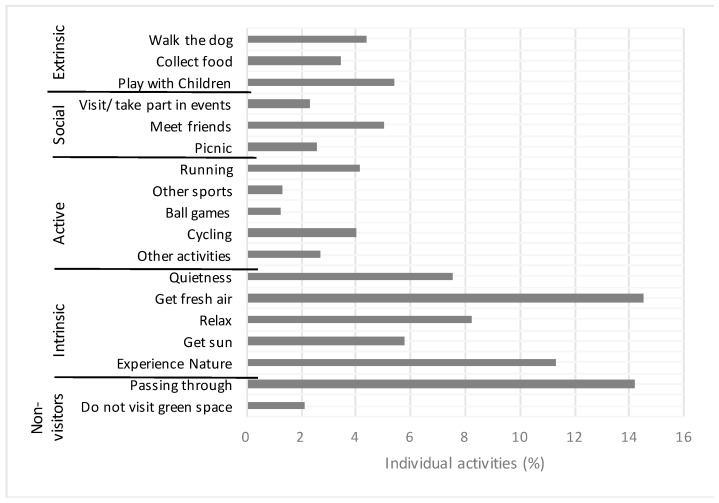
Individual perceptions of green space quality are essential when a user considers engaging in activities. This national-scale study provides insights into Norwegians’ quality perceptions of municipal green space, visit frequency and motivations for engaging in different activities. We applied regression analysis to investigate how various factors affect the outcome variables, quality perceptions and visit frequency from a sample of the Norwegian adult population. Results reveal that Norwegians perceive their green spaces as having good quality, and higher quality perceptions have a positive influence on green space visits. Half of the respondents visited green spaces out of intrinsic motives in high-quality environments providing fresh air, experiences of nature and quietness. It is essential, however, to take into account that less reported activity mirrors groups of respondents who least often visit green spaces.
Overview
The claims and statistics of this paper haven’t been checked yet.
Free: it reads the open-access text and checks the first 5 claims that cite a source we can check. Create a free account to check every claim.
Integrity signals
Registry
Cites
Statistics
Figures
Verification
Claims the paper makes
The claims and statistics of this paper haven’t been checked yet.
Free: it reads the open-access text and checks the first 5 claims that cite a source we can check. Create a free account to check every claim.
Claims other papers make about this one
Each is checked against this paper’s own text: does it say what the citing paper says it does?
The source backs part of the claim, not all of it — or backs it for a different population, condition or comparison.
In the citing paper
“green space use includes aspects such as frequency of visits to green spaces, accessibility, and duration of visits, which have been demonstrated to be associated (45–47)”
From The health perception of urban green spaces and its emotional impact on young adults: an empirical study from three cities in China (2023) · cites this paper as [45]
Experimental — accuracy not yet measured
Self-check
Percentages, sums and reported differences re-computed from the paper’s own numbers.
The self-check needs the paper’s full text.
Citations
Cites
The theory of planned behavior
Ajzen, I. (1991) · Organizational Behavior and Human Decision Processes · doi:10.1016/0749-5978(91)90020-t · Cited by 90,587
The Theory of Planned Behavior
Ajzen, I. (2012) · Handbook of Theories of Social Psychology: Volume 1 · doi:10.4135/9781446249215.n22 · Cited by 5,350
Twohig-Bennett, C., & Jones, A. (2018) · Environmental Research · doi:10.1016/j.envres.2018.06.030 · Cited by 1,766 · cited 1×
“Studies have shown that human interactions with nature provide well-being and many desirable health outcomes [6,7], and overall policy visions aim to achieve well-being and quality of life through quality green space [8–10].”
BackgroundGiles-Corti, B., Broomhall, M. H., Knuiman, M., Collins, C., Douglas, K., Ng, K., Lange, A., & Donovan, R. J. (2005) · American Journal of Preventive Medicine · doi:10.1016/j.amepre.2004.10.018 · Cited by 1,518 · cited 3×
“[16] explored perceived quality attributes and activities in green spaces, using a composite index of park attractiveness (describing quality green space), incorporating environmental quality, three amenity factors and two safety factors as indicators.”
BackgroundThe significance of parks to physical activity and public health
Bedimo-Rung, A. L., Mowen, A. J., & Cohen, D. A. (2005) · American Journal of Preventive Medicine · doi:10.1016/j.amepre.2004.10.024 · Cited by 1,351
Life between buildings: Using public space
Gehl, J. (1980) · Cited by 1,154
McCormack, G. R., Rock, M., Toohey, A. M., & Hignell, D. (2010) · Health & Place · doi:10.1016/j.healthplace.2010.03.003 · Cited by 1,032 · cited 2×
“[18] found that quality measures such as lack of maintenance influenced park use, especially dirty un-kept areas, the presence of litter and overfull rubbish bins were mentioned.”
BackgroundEnvironmental Correlates of Physical Activity: A Review of Evidence about Parks and Recreation
Kaczynski, A. T., & Henderson, K. A. (2007) · Leisure Sciences · doi:10.1080/01490400701394865 · Cited by 793
Association of Park Size, Distance, and Features With Physical Activity in Neighborhood Parks
Kaczynski, A. T., Potwarka, L. R., & Saelens, B. E. (2008) · American Journal of Public Health · doi:10.2105/ajph.2007.129064 · Cited by 758 · cited 1×
“Past research has also shown that, given the large diversity of features available, parks with more features are more likely to be used [16,23,26].”
BackgroundA monitoring tool for the provision of accessible and attractive urban green spaces
Van Herzele, A., & Wiedemann, T. (2003) · Landscape and Urban Planning · doi:10.1016/s0169-2046(02)00192-5 · Cited by 717
Research works printed but not linked: 5
- Konijnendijk C.C. Annerstedt M. Nielsen A.B. Maruthaveeran S. Benefits of Urban Parks-A Systematic Review Ifpra Copenhagen, Denmark Alnarp, Sweden 2013
- Oxford University Press English Oxford Living Dictionaries Available online: https://en.oxforddictionaries.com/definition/quality (accessed on 6 November 2018)
- Stryhn H. Christensen J. Confidence intervals by the profile likelihood method, with applications in veterinary epidemiology Proceedings of the 10th International Symposium on Veterinary Epidemiology and Economics Vina del Mar, Chile 30 November 2003 208
- Gundersen V.S. Urbant skogbruk: Forvaltning av skog i by- og tettstedkommuner (Urban forest use: Management of forests in urban- and metropolitan-municipalities) Aktuelt fra Skogforsk. 2004 3 1 33
- Frøyen Y.K. Medalen T. Skjeggedal T. Å gå-transport, rekreasjon eller folkehelse? (Walking-transport, recreation or public health?) Plan 2015 3–4 38 43
Cited by
The association between green space and adolescents' mental well-being: a systematic review
Zhang, Y., Mavoa, S., Zhao, J., Raphael, D., & Smith, M. (2020) · International Journal of Environmental Research and Public Health · doi:10.3390/ijerph17186640 · Cited by 240
Usage and perception of urban green space of older adults in the high-density city of Hong Kong
Lau, K. K., Yung, C. C.-Y., & Tan, Z. (2021) · Urban forestry & urban greening · doi:10.1016/j.ufug.2021.127251 · Cited by 139
Pinto, L. V., Ferreira, C., & Pereira, P. (2021) · The Science of The Total Environment · doi:10.1016/j.scitotenv.2021.148293 · Cited by 127
Song, Y. H., Newman, G., Huang, X., & Ye, X. (2022) · Sustainable Cities and Society · doi:10.1016/j.scs.2022.103815 · Cited by 99
Chen, C., Luo, W., Li, H., Zhang, D., Kang, N., Yang, X., & Xia, Y. (2020) · International Journal of Environmental Research and Public Health · doi:10.3390/ijerph17155560 · Cited by 106
Luque-García, L., Corrales, A., Lertxundi, A., Díaz, S., & Ibarluzea, J. M. (2021) · Environmental Research · doi:10.1016/j.envres.2021.112599 · Cited by 99
Zhang, J., Cheng, Y., & Zhao, B. (2020) · Ecological Indicators · doi:10.1016/j.ecolind.2020.107263 · Cited by 78
Kajosaari, A., Hasanzadeh, K., Fagerholm, N., Nummi, P., Kuusisto-Hjort, P., & Kyttä, M. (2023) · Landscape and Urban Planning · doi:10.1016/j.landurbplan.2023.104952 · Cited by 79
Ochoa-Rico, M.-S., Vergara-Romero, A., Subia, J. F. R., & del Río, J. A. J. (2022) · PLoS ONE · doi:10.1371/journal.pone.0263331 · Cited by 78
“; services that together make up the perceived quality of a reception comfortable and safe city where to establish residence [9, 10, 32, 33].”
BackgroundYañez, D. V., Barboza, E. P., Cirach, M., Daher, C., Nieuwenhuijsen, M. J., & Mueller, N. (2023) · Environment International · doi:10.1016/j.envint.2023.107880 · Cited by 83
Is the green inequality overestimated? Quality reevaluation of green space accessibility
Wu, J., Peng, Y., Liu, P., Weng, Y., & Lin, J. (2022) · Cities · doi:10.1016/j.cities.2022.103871 · Cited by 66
How well do NDVI and OpenStreetMap data capture people’s visual perceptions of urban greenspace?
Teeuwen, R., Milias, V., Bozzon, A., & Psyllidis, A. (2024) · Landscape and Urban Planning · doi:10.1016/j.landurbplan.2024.105009 · Cited by 68
Analyzing spatial inequalities in use and experience of urban green spaces
Phillips, A., Canters, F., & Khan, A. Z. (2022) · Urban forestry & urban greening · doi:10.1016/j.ufug.2022.127674 · Cited by 63
Juul, V., & Nordbø, E. C. A. (2023) · BMC Public Health · doi:10.1186/s12889-023-15170-4 · Cited by 63
“In a Dutch [77] and Norwegian study [78], perceptions of green space were found to be a stronger predictor for usage than objective measures, such as NDVI.”
BackgroundPutra, I. G. N. E., Astell‐Burt, T., Cliff, D. P., Vella, S. A., & Feng, X. (2021) · Urban forestry & urban greening · doi:10.1016/j.ufug.2021.127264 · Cited by 60
Li, H., Browning, M. H. E. M., Dzhambov, A. M., Zhang, G., & Cao, Y. (2022) · Land · doi:10.3390/land11081128 · Cited by 59
Song, Y. H., Fernandez, J. C., & Wang, T. (2020) · Sustainability · doi:10.3390/su12198036 · Cited by 47
Chen, L., Liu, L., Wu, H., Peng, Z., & Sun, Z. (2022) · Land · doi:10.3390/land11071051 · Cited by 47
Zhang, B., Song, Y. H., Liu, D., Zeng, Z., Guo, S., Yang, Q., Wen, Y., Wang, W., & Shen, X. (2023) · Land · doi:10.3390/land12071403 · Cited by 46
Analyze the usage of urban greenways through social media images and computer vision
Song, Y. H., Ning, H., Ye, X., Chandana, D., & Wang, S. (2022) · Environment and Planning B Urban Analytics and City Science · doi:10.1177/23998083211064624 · Cited by 42
“While these features and attributes are essential, the subjective factors and direct experiences were found to be stronger indications for successful parks and public spaces (Fongar et al., 2019).”
BackgroundKyttä, M., Randrup, T. B., Sunding, A., Rossi, S., Harsia, E., Palomäki, J., & Kajosaari, A. (2023) · Landscape and Urban Planning · doi:10.1016/j.landurbplan.2023.104868 · Cited by 38
Self-citationFian, L., White, M. P., Arnberger, A., Thaler, T., Heske, A., & Pahl, S. (2024) · Health & Place · doi:10.1016/j.healthplace.2024.103175 · Cited by 35
Perceived urban green and residents’ health in Beijing
Xu, J., Wang, F., Chen, L., & Zhang, W. (2021) · SSM - Population Health · doi:10.1016/j.ssmph.2021.100790 · Cited by 39
“However, in order to cultivate the health benefits of green space, residents need to develop a positive perception of green space so that they can consciously engage with it (Bloemsma et al. 2018; Fongar et al. 2019).”
BackgroundCrossley, A. J., & Russo, A. (2022) · Sustainability · doi:10.3390/su14137946 · Cited by 36
Aamodt, G., Nordh, H., & Nordbø, E. C. A. (2023) · Urban forestry & urban greening · doi:10.1016/j.ufug.2023.127894 · Cited by 33
Self-citationUrban Green Spaces and Healthy Living: A Landscape Architecture Perspective
Russo, A. (2024) · Urban Science · doi:10.3390/urbansci8040213 · Cited by 33
Wu, Y., Clare, L., Jones, I. R., Nelis, S. M., Quinn, C., Martyr, A., Victor, C. R., Lamont, R. A., Rippon, I., Matthews, F. E., et al. (2021) · Social Psychiatry and Psychiatric Epidemiology · doi:10.1007/s00127-021-02030-y · Cited by 33
“This includes individual factors such as lack of motivation and physical fitness and environmental issues such as safety concerns, accessibility, quality of green spaces and lack of dementia-friendly awareness [27, 39, 43].”
BackgroundLi, H., Luo, W., Hou, Y., Xia, Y., Yao, J., Kang, N., Deng, C., Hu, S., & Chen, C. (2021) · Frontiers in Public Health · doi:10.3389/fpubh.2021.759444 · Cited by 35
“In addition, many studies have demonstrated the role of perceived health benefits in behavioral intention regarding green spaces (30–32).”
BackgroundLegg, R., & Kabisch, N. (2024) · Urban forestry & urban greening · doi:10.1016/j.ufug.2024.128204 · Cited by 26
Comparison of urban green space usage and preferences: A case study approach of China and the UK
Ma, Y., Brindley, P., & Lange, E. (2024) · Landscape and Urban Planning · doi:10.1016/j.landurbplan.2024.105112 · Cited by 31
Yeshitela, K. (2020) · Land · doi:10.3390/land9110450 · Cited by 31
Wang, J., Liu, N., Zou, J., Guo, Y., & Chen, H. (2023) · Frontiers in Public Health · doi:10.3389/fpubh.2023.1232216 · Cited by 24
“…mood and self-esteem (43), stress reduction motivation and increased emotional well-being are the strongest associations (44); green space use includes aspects such as frequency of visits to green spaces, accessibility, and duration of visits, which have been demonstrated to be associated (45–47).”
BackgroundKodali, H., Ferris, E., Wyka, K., Evenson, K. R., Dorn, J. M., Thorpe, L. E., & Huang, T. T. ‐. (2023) · Frontiers in Public Health · doi:10.3389/fpubh.2023.1038288 · Cited by 26
“On one hand, some research has shown that park perception is correlated with park use (56).”
BackgroundFu, Y., Yang, J., Wang, Z., Zhang, B., Xue, J., Zeng, Y., & Li, F. (2024) · Urban forestry & urban greening · doi:10.1016/j.ufug.2024.128446 · Cited by 28
Bergtold, J. S., Caldas, M. M., Ramsey, S. M., Sanderson, M. R., Granço, G., & Mather, M. E. (2022) · Journal of Environmental Management · doi:10.1016/j.jenvman.2022.115186 · Cited by 22
Akaraci, S., Feng, X., Suesse, T., Jalaludin, B. B., & Astell‐Burt, T. (2022) · Urban forestry & urban greening · doi:10.1016/j.ufug.2022.127726 · Cited by 23
Campbell, A., Chanse, V., & Schindler, M. (2024) · Sustainability · doi:10.3390/su16093847 · Cited by 23
Grace, M. J., Dickie, J., Brown, C., Bartie, P., & Oliver, D. M. (2023) · Landscape and Urban Planning · doi:10.1016/j.landurbplan.2023.104904 · Cited by 23
“Fresh air has been shown to be a strong motivator for accessing natural environments (Fongar et al., 2019; Smith et al., 2022; Guzmán et al., 2021).”
BackgroundDuku, E., Mensah, C. A., Amadu, I., & Adzigbli, W. K. (2023) · Geo Geography and Environment · doi:10.1002/geo2.119 · Cited by 26
Zhang, D., Ling, G. H. T., Misnan, S. H., & Fang, M. (2023) · Sustainability · doi:10.3390/su15065235 · Cited by 26
Zwierzchowska, I., & Lupa, P. (2021) · Urban forestry & urban greening · doi:10.1016/j.ufug.2021.127346 · Cited by 24
Wang, R., Jiang, Y., Liu, D., Peng, H., Cao, M., & Yao, Y. (2025) · Wellbeing Space and Society · doi:10.1016/j.wss.2025.100247 · Cited by 18
“Following previous studies (Campagnaro et al., 2020; Fermino et al., 2013; Fisher et al., 2021; Fongar et al., 2019; Groshong et al., 2020; Hong et al., 2018; Jansson et al., 2013; Li et al., 2015; Mouratidis, 2019; Sang et al., 2016; Tzoulas and James, 2010), several built environment covariates…”
Lin, B. B., & Andersson, E. (2023) · BioScience · doi:10.1093/biosci/biad009 · Cited by 16
“It is also important to note that the environmental quality of a green space must be managed through appropriate lighting and cleanliness to make it a safe and attractive space in which to spend time (Fongar et al. 2019, Yeshitela 2020, Zhang et al. 2021).”
BackgroundPerceived urban green spaces and youth mental health in the post-COVID-19 era
Mollaesmaeili, M., Hakimian, P., & Lak, A. (2024) · Frontiers in Public Health · doi:10.3389/fpubh.2024.1265682 · Cited by 14
Nordbø, E. C. A., & Nordh, H. (2025) · Urban forestry & urban greening · doi:10.1016/j.ufug.2025.128777 · Cited by 15
Besser, L. M., Meyer, O. L., Streitz, M. L., Farias, S. T., Olichney, J., Mitsova, D., & Galvin, J. E. (2023) · Health & Place · doi:10.1016/j.healthplace.2023.103008 · Cited by 12
Huerta, C. M. (2023) · PLoS ONE · doi:10.1371/journal.pone.0295013 · Cited by 11
dos Santos, E. B., Nogueira, F. M., & Talgatti, D. M. (2021) · Sustainability · doi:10.3390/su131810332 · Cited by 11
Olsen, J. R., Nicholls, N., Panter, J., Burnett, H., Tornow, M., & Mitchell, R. (2022) · Environmental Research · doi:10.1016/j.envres.2022.113610 · Cited by 11
Are Cities Decisive for Life Satisfaction? A Structural Equation Model for the European Population
Martínez, C. N., Pérez‐Cárceles, M. C., Perea, P. J. R., & Verde-Martín, C. M. (2024) · Social Indicators Research · doi:10.1007/s11205-024-03423-7 · Cited by 14
“This is because public services, such as the quality of transportation, security, public lighting, water and sewage quality, burial services, fire extinguishing service, etc., make citizens perceive urban quality in their city (Fongar et al., 2019; García Lirios et al., 2015).”
Nelson, J. R., Won, Y., Kim, J., Stuhlmacher, M., & Kim, Y. (2024) · Urban forestry & urban greening · doi:10.1016/j.ufug.2024.128325 · Cited by 10
Zhang, L., & Wu, Y. (2022) · Land · doi:10.3390/land11081261 · Cited by 11
Huang, L., & Wu, Z. (2025) · Trees Forests and People · doi:10.1016/j.tfp.2025.100907 · Cited by 9
Li, M., Li, F., & Shan, X.-Z. (2023) · Building and Environment · doi:10.1016/j.buildenv.2023.110768 · Cited by 9
Lu, J., Maruthaveeran, S., Shahidan, M. F., & Liu, Q. (2025) · Land · doi:10.3390/land14091799 · Cited by 8
Jansson, M., & Schneider, J. (2023) · Land · doi:10.3390/land12112021 · Cited by 8
Živojinović, I., Ivanović, S., Tošković, O., Pülzl, H., Vreese, R. D., Davies, C., Roitsch, D., Winkel, G., Tyrväinen, L., Kronenberg, J., et al. (2026) · People and Nature · doi:10.1002/pan3.70257 · Cited by 10
“Norwegian women are more motivated by extrinsic activities such as walking the dog, collecting food items and playing with their children (Fongar et al., 2019 ).”
InfluentialRelevant landscape components in a large urban green space in Oporto (Portugal)
Pinto, L. V., & Pereira, P. (2024) · Urban forestry & urban greening · doi:10.1016/j.ufug.2024.128421 · Cited by 7
Grau-Ruiz, R., & Løvoll, H. S. (2024) · Journal of Adventure Education & Outdoor Learning · doi:10.1080/14729679.2024.2412081 · Cited by 7
“In fact, Fongar et al. (2019) found that only about 2% of Norwegian residents don’t visit such areas at all, and proximity was their strongest predictor of greenspace visitation frequency.”
Interplay between greenspace interactions and sense of place in Seoul City
Kim, L., & Li, C. L. (2024) · Frontiers in Sustainable Cities · doi:10.3389/frsc.2024.1343373 · Cited by 7
Attraction and Retention Green Place Images of Taipei City
Kim, L., & Li, C. L. (2024) · Forests · doi:10.3390/f15040710 · Cited by 6
Stanley, C., Hecht, R., Cakir, S., & Brzoska, P. (2022) · One Ecosystem · doi:10.3897/oneeco.7.e83325 · Cited by 8
Crop diversification and multidimensional poverty in rural Ghana: the empirical linkages
Danso-Abbeam, G. (2025) · Sustainable Futures · doi:10.1016/j.sftr.2025.101122 · Cited by 5
Kjellesvig, H., Atique, S., Böcker, L., & Aamodt, G. (2024) · Spatial and Spatio-temporal Epidemiology · doi:10.1016/j.sste.2024.100699 · Cited by 4
Self-citationMogra, S., Khamidi, M. F., & Fadli, F. (2023) · Landscape Online · doi:10.3097/lo.2023.1108 · Cited by 4
Zhou, K., Gong, Y., Sun, Y., & Lee, T. M. (2025) · Landscape Ecology · doi:10.1007/s10980-024-02009-5 · Cited by 4
“…incidental green space exposure and higher perceived green spaces level (more abundant and higher-quality green spaces) can encourage visit frequency (Flowers et al. 2016; Fongar et al. 2019), where they then further promote the formation of pro-environmental norms and recycling behaviour (Fig.”
Huang, L., Wu, Z., & Kang, N. (2025) · Sustainability · doi:10.3390/su17083751 · Cited by 3
Arts-Aided Recognition of Citizens’ Perceptions for Urban Open Space Management
Suomalainen, S., Kahiluoto, H., Pâssilä, A., Owens, A., & Holtham, C. (2021) · Sustainability · doi:10.3390/su14010135 · Cited by 3
Li, Y., Du, C., & Li, B. (2025) · Annals of the New York Academy of Sciences · doi:10.1111/nyas.70027 · Cited by 3
“Improving the environment (E1) is more important, consistent with studies from developed countries 70,71 that have reported that nature is the strongest predictor of autonomy need fulfilment in older adults.”
Willdan, M., Kresnanto, N. C., Ramadhan, R. I., Said, N., & Putri, W. H. (2023) · E3S Web of Conferences · doi:10.1051/e3sconf/202344803028 · Cited by 2
A health relevant approach for assessing urban green spaces
Lilli, A., Tsekeri, E., & Kolokotsa, D. D. (2024) · Discover Cities · doi:10.1007/s44327-024-00029-z · Cited by 3
“…and facilities provided (KPI 2.4), attractiveness in terms of aesthetics, colors, smells, sound (KPI 2.5) and presence of environmental incivilities (such as maintenance issues, cleanliness, graffiti, and other potential hazards) [49, 50] (KPI 2.6) and perceptions of safety (KPI 2.7) [51].”
InfluentialArdian, S., & Abadi, F. (2025) · Reslaj Religion Education Social Laa Roiba Journal · doi:10.47467/reslaj.v7i1.5073 · Cited by 1
Zhang, X., Yang, Z., Cheng, S., & Chen, S. (2026) · Environmental Impact Assessment Review · doi:10.1016/j.eiar.2026.108451 · Cited by 1
李建伟, Cai, X., Cui, X., Zhai, J., Chen, L., Wang, G., Zhao, D., & Shen, L. (2026) · Humanities and Social Sciences Communications · doi:10.1057/s41599-026-07357-y · Cited by 2
“Such inequities deepen social divisions and hinder the attainment of public health and environmental justice objectives (Fongar et al., 2019).”
Tailoring Engagement with Urban Nature for University of Sheffield Students’ Wellbeing
Boyd, F. (2020) · White Rose eTheses Online (University of Leeds, The University of Sheffield, University of York) · Cited by 3
Green and blue space quality metrics scoping review
Roberts, M., Nicholson, H., Li, K.-H., & Irvine, K. N. (2023) · Zenodo (CERN European Organization for Nuclear Research) · doi:10.5281/zenodo.8107160
de Castro, G. M., & Martel, M. F. R. (2024) · Universidad Peruana de Ciencias Aplicadas (UPC) · doi:10.19083/tesis/676129
Do Teenagers Visit Urban Green Areas? A Case Study in Southern BrazilPreprint
Majewski, A. S., Vendruscolo, G. S., & Zakrzevski, S. B. B. (2025) · SSRN Electronic Journal · doi:10.2139/ssrn.5258452
Jahr, E., Ihle, T., Finkhäuser, M., Schmidt, S., & Muehlan, H. (2025) · Sustainability · doi:10.3390/su17219841
Ormeño Sartori, A. (2023) · Universidad de Chile · doi:10.58011/y6at-ef56
O papel dos espaços verdes no envelhecimento saudável em Coimbra
Palos, E. A. (2022) · Portuguese National Funding Agency for Science, Research and Technology (RCAAP Project by FCT)
Compendium Forested Landscapes
(2024) · Epsilon Open Archive (Sveriges lantbruksuniversitet biblioteket (Swedish University of Agricultural Sciences))
Toward citizen-centered urban green
Phillips, A. (2023) · VUBIR (Vrije Universiteit Brussel)
Pathways to wellbeing: Residential nature, physical activity, and place-belongingness
Grau-Ruiz, R., Ulset, V. S., Dyrdal, G. M., & Løvoll, H. S. (2026) · International Journal of Wellbeing · doi:10.5502/ijw.v16i1.4841
A research framework for studying the motivations and obstructions of exposure to urban green spaces
Yue, W., Nan, X., Kang, Y., Zhang, X., Olszewska-Guizzo, A., Zhang, L., & Qi, J. (2026) · International Journal of Environmental Health Research · doi:10.1080/09603123.2026.2659267
“…studies have investigated various factors affecting UGS exposure and preliminary classified those factors (Irvine et al. 2013; Bloemsma et al. 2018; Fongar et al. 2019; Taylor et al. 2020; Vierikko et al. 2020), the mechanisms by which these factors motivate (Lee and Kim 2015; Bloemsma et al.…”
More urban greenness associated with flying less among Nordic urbanites
Kinnunen, A., Raudsepp, J., & Heinonen, J. T. (2026) · Environmental Research Communications · doi:10.1088/2515-7620/ae7306 · Cited by 1
“Although the metric for urban greenness used in this study combines aspects of accessibility, connectivity and quantity, studies have suggested that the quality of the green spaces could play a key role in reducing long-distance leisure travel [36, 37, 52, 132, 133].”
Esperón‐Rodríguez, M., Schifanella, R., Russo, A., Rodríguez, D. E., Sharmin, M., Jeffries, P., & Tjoelker, M. G. (2026) · Regional Environmental Change · doi:10.1007/s10113-026-02619-6
“…2020; Onder and Dursun 2011; Ordóñez and Duinker 2014), which may be influenced by socioeconomic and environ‑ mental variables, or the quality or health of urban green spaces (Esperon‑Rodriguez et al. 2025c; Fongar et al. 2019; Russo 2024) that significantly influence their usability and benefits.”
(196018), B. J., & Shuduo, L. U. (2026) · Landscape Architecture · doi:10.3724/j.fjyl.la20260127
Li, X., Zheng, J., Park, J. M., & Mitchell, J. (2026) · Societies · doi:10.3390/soc16060191
Wang, Y. (2026) · Water Economics and Policy · doi:10.1142/s2382624x26500128
The Perceived Health Benefits of Urban Green Spaces During Post-Pandemic Period
Jia, C., & Wu, L. (2026) · Applied Spatial Analysis and Policy · doi:10.1007/s12061-026-09938-5
“Residents’ perceived health benefits strongly influence their behaviors and intentions regarding the use of green spaces (Fongar et al., 2019 ; Wan et al., 2018 ; Zhang & Tan, 2019 ), thereby affecting the ways in which the natural environment influences their health status (Bratman et al., 2012;…”
Transformative Service Research and Well-being in Urban Collective Spaces: Testing a New Model
Gosling, M. (2026) · Tourism & Management Studies · doi:10.18089/tms.20260304
Li, K., Liang, L., Mao, Y., Dong, H., & Wang, X. (2026) · Building and Environment · doi:10.1016/j.buildenv.2026.115185
Abuhayya, M. (2026) · 4D Tájépítészeti és Kertművészeti Folyóirat · doi:10.56617/4d.79.7344
Permatasari, G. P., & Sugiama, A. G. (2026) · Jurnal Kajian Ruang · doi:10.30659/jkr.v6i1.46969
Hernández, P., Pinilla-Rodríguez, D. E., Moyon-Chavez, A., & Argüello-Tapia, D. (2026) · Journal of Urban Design · doi:10.1080/13574809.2026.2741280
Metadata
- Authors
- Fongar, C., Aamodt, G., Randrup, T. B., & Solfjeld, I.
- Affiliations
- Norwegian University of Life Sciences (NO)
- Swedish University of Agricultural Sciences (SE)
- Corresponding author
- Fongar, Claudia
- Venue
- International Journal of Environmental Research and Public Health
- Publisher
- MDPI AG
- Published
- 2019-07-01
- Volume
- 16
- Issue
- 13
- Pages
- 2327
- ISSN
- 1660-4601 (ISSN-L)
- PMC
- PMC6651101
- OpenAlex
- W2954317597
- Cited by
- 85
- References
- 49
- Citations by year
- 2026: 12 · 2025: 10 · 2024: 17 · 2023: 18 · 2022: 13 · 2021: 10 · 2020: 5
- FWCI
- 3.02
- Type
- journal article
- Language
- en
- Open access
- gold
- dx.doi.org
- Licence
- Locations
- International Journal of Environmental Research and Public Health (publishedVersion, cc-by)
- PubMed Central (publishedVersion, cc-by)
- PubMed (publishedVersion)
- RePEc: Research Papers in Economics (submittedVersion)
- DOAJ (DOAJ: Directory of Open Access Journals) (submittedVersion, cc-by-sa)
- Topics
- Social Sciences › Urban Studies › Urban Green Space and Health
- Social Sciences › Business, Management and Accounting › Tourism, Leisure and Hospitality Management › Recreation, Leisure, Wilderness Management
- Physical Sciences › Environmental Science › Management, Monitoring, Policy and Law › Urban Arborization and Environmental Studies
- Keywords
- urban green space, visit frequency, intrinsic motivation, outdoor recreation, nature experience, fresh air, stillness, Norwegian adults
- MeSH terms
- Parks, Recreational, Adolescent, Adult, Environment, Female, Humans, Male, Middle Aged, Motivation, Norway, Space Perception, Young Adult
About these checks
Registry, retraction, Cites and statistics results are computed, not judged, with one exception: a printed reference that no index lists is read once by a model before it counts as a citation error. Claims are extracted by a model and kept only when their quote appears verbatim in the text; each cited source is then checked, with a model’s help, for whether it says what the claim relies on. Those verdicts can be wrong — read the claim’s quote and the cited source before relying on one.
Statistics and arithmetic are recomputed, not judged.
Confidence bands are shown only for fields calibrated on our annotated test set. None is calibrated yet, so no band is shown.
What counts as a claim ›How we measure confidence ›How we check this ›
Are you an author, or do you see a problem with this page? Request a review
Data sources
Bibliographic data: Semantic Scholar, OpenAlex, Crossref.
Contains information from the Semantic Scholar Academic Graph Datasets, made available under the ODC Attribution License (ODC-BY 1.0).
Semantic Scholar’s data is described in: Kinney, R., et al. (2023). The Semantic Scholar Open Data Platform. arXiv:2301.10140.
