

The DOI matches its Crossref record; 53 of the 53 references it cites were found in a registry or an index; none of the 13 sources its claims cite is checked for support yet.
Changes in Undergraduate Students’ Psychological Well-Being as They Experience University Life
Open accessAbstract
The onset of most lifetime mental disorders occurs during adolescence, and the years in college, as the final stage of adolescence in a broad sense, deserve attention in this respect. The psychological well-being of undergraduate students can influence not only their academic and professional success, but also the development of society as a whole. Although previous studies suggested psychiatric disorders are common in the adult population, there was little consistent information available about undergraduate students’ mental health problems. This research aimed to describe the changes in depression, anxiety, and stress of Chinese full-time undergraduate students as they experienced university life using the Depression Anxiety Stress Scales-21 (DASS-21). The main conclusions of our study were as follows: (1) on average, students’ severity scores of depression during the four academic years varied between 7.22 and 7.79, while stress scores ranged from 9.53 to 11.68. However, the anxiety scores of college students in the first three years turned out to be 7.40, 7.24 and 7.10, respectively, slightly overtaking the normal threshold of 7. These results indicated that Chinese college students, in general, were mentally healthy with regard to depression and stress, but their average anxiety levels were beyond normal in the first three years. (2) As for the proportions of students with different degrees of severity, approximately 38% to 43% of college students were above the normal level of anxiety, about 35% above the normal level of depression, and around 20% to 30% above the normal level of stress. (3) There were significant differences in the psychological health states of students of different years, especially among the sophomores, juniors, and seniors; the highest score of depression, anxiety, and stress all appeared in the first or second year on average, but some improvements were achieved in the third and last years. The findings suggested that colleges and universities need to pay special attention to psychologically unhealthy students, and with concerted efforts by the government, formulate mental health policies in the prevention, detection, and treatment of students’ psychiatric disorders, rather than just focusing on their average levels of mental health.
Overview
AI snapshot
Written from the paper’s full text.
TL;DR
This longitudinal panel study tracked a 2008 cohort of Chinese undergraduates across four years and found average depression and stress within normal ranges, but average anxiety above the normal threshold in the first three years. It also found significant differences in psychological well-being across academic years, with the highest depression, anxiety, and stress scores generally appearing in the first or second year and some improvement later.
Key findings
- Average depression scores varied between 7.22 and 7.79 across the four academic years, and stress scores ranged from 9.53 to 11.68, both within normal cutoffs; anxiety scores were 7.40, 7.24, and 7.10 in the first three years, slightly above the normal threshold of 7, then fell to 6.63 in the senior year.
- Approximately 38% to 43% of students were above the normal level of anxiety, about 35% above the normal level of depression, and around 20% to 30% above the normal level of stress.
- The highest average scores of depression, anxiety, and stress all appeared in the first or second year; sophomores had relatively high depression and stress, while freshmen had relatively high anxiety.
- Multiple group analysis showed significant differences in psychological well-being across years: no significant difference between freshman and sophomore years, but significant differences between sophomore and junior years and between junior and senior years (p < 0.05 for the structural covariances and measurement residuals models in the sophomore–junior comparison, and p < 0.05 for all three models in the junior–senior comparison).
Methods
- Data came from the Beijing College Student Panel Survey (BCSPS) of the China Education Panel Survey; the 2008 cohort was randomly chosen from students admitted to 15 Beijing universities and tracked for four consecutive years from June 2009 to June 2012. The effective sample size was 1401 (650 females, 751 males), with follow-up rates of 95.27%, 94.66%, and 90.58% in the latter three rounds.
- Psychological well-being was measured with the Depression Anxiety Stress Scales-21 (DASS-21), a self-report measure of depression, anxiety, and stress; scores were multiplied by two to compare with conventional severity cutoffs. Scale reliability coefficients were 0.813 for depression, 0.766 for anxiety, and 0.812 for stress.
- Analyses used descriptive statistics and multiple group analysis, including unconstrained, factor-loading, structural-covariance, and measurement-residual invariance models to test differences across academic years.
Limitations
- Stated limitations: Not stated in the paper.
- Evident from the text: the sample is a single 2008 cohort of full-time undergraduates from 15 Beijing universities, so findings may not generalize to other regions, cohorts, or non-full-time students.
- Evident from the text: DASS-21 is a self-report symptom-severity measure rather than a clinical diagnosis, and the fourth wave was conducted entirely online, which may affect response conditions.
Model-written summary. Check it against the paper before relying on it.
Integrity signals
Registry
Cites
Statistics
Figures
Verification
Claims the paper makes
47 Own result · 20 Own interpretation · 10 Not checked yet · 5 No basis given · 2 Own method
A result the paper reports from its own data — it cites no other source for it, so there is none to check. The quote shows it is in the paper.
In the paper
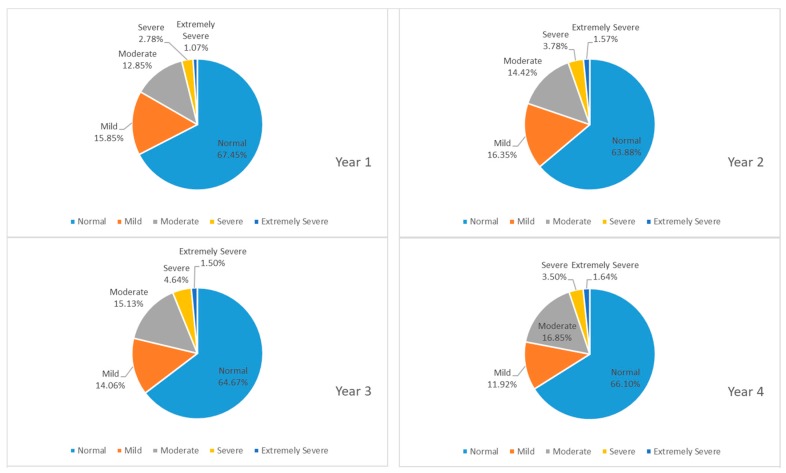
“while around 35 percent had above the normal levels of depression.”
- Also stated in: § Abstract · plain
“about 35% above the normal level of depression”
§ Changes in Undergraduate Students’ Psychological Well-Being as They Experience University Life > 3. Results > 3.2. Proportion of Students’ Depression, Anxiety, and Stress
plain- Asserted: passes — The authors put it forward as true.
- Checkable: passes — It can be checked against evidence.
- Load-bearing: passes — The paper’s conclusions depend on it.
- Based: passes — The paper gives a reason why it holds.
- Rests on an assumption: Students lost to follow-up do not differ systematically in mental health from those retained.
- Also stated in: § Abstract · plain
A result the paper reports from its own data — it cites no other source for it, so there is none to check. The quote shows it is in the paper.
In the paper
“We noticed that more than 60 percent of students had a normal level of depression in the four years of college, while 12 to 17 percent of students suffered from moderate depression.”
§ Changes in Undergraduate Students’ Psychological Well-Being as They Experience University Life > 3. Results > 3.2. Proportion of Students’ Depression, Anxiety, and Stress
plain- Asserted: passes — The authors put it forward as true.
- Checkable: passes — It can be checked against evidence.
- Load-bearing: unclear — It is unclear whether the paper’s conclusions depend on it.
- Based: passes — The paper gives a reason why it holds.
- Rests on an assumption: Students lost to follow-up do not differ systematically in mental health from those retained.
A result the paper reports from its own data — it cites no other source for it, so there is none to check. The quote shows it is in the paper.
In the paper
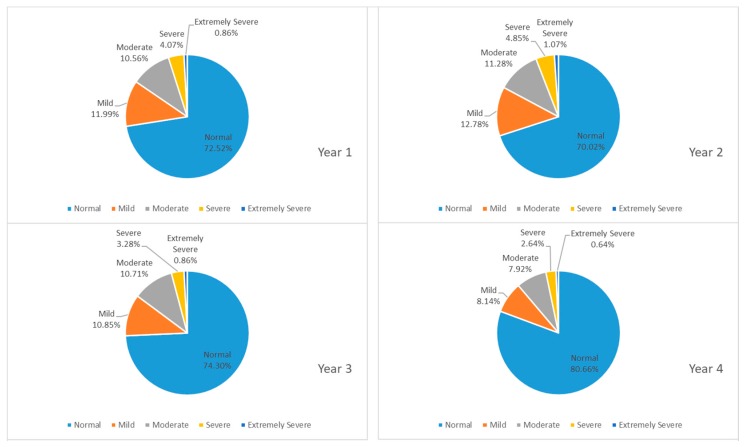
“Students who suffered from moderate stress accounted for approximately 7 percent to 12 percent, while two to five percent struggled with severe stress on campus, and less than 1.1 percent had extremely severe stress.”
§ Changes in Undergraduate Students’ Psychological Well-Being as They Experience University Life > 3. Results > 3.2. Proportion of Students’ Depression, Anxiety, and Stress
plain- Asserted: passes — The authors put it forward as true.
- Checkable: passes — It can be checked against evidence.
- Load-bearing: unclear — It is unclear whether the paper’s conclusions depend on it.
- Based: passes — The paper gives a reason why it holds.
- Rests on an assumption: Students lost to follow-up do not differ systematically in mental health from those retained.
A result the paper reports from its own data — it cites no other source for it, so there is none to check. The quote shows it is in the paper.
In the paper
“There were significant differences in the psychological health states of students of different years, especially among the sophomores, juniors, and seniors; the highest score of depression, anxiety, and stress all appeared in the first or second year on average, but some improvements were achieved in the third and last years.”
§ Changes in Undergraduate Students’ Psychological Well-Being as They Experience University Life > Abstract
plaincorrelational- Asserted: passes — The authors put it forward as true.
- Checkable: passes — It can be checked against evidence.
- Load-bearing: passes — The paper’s conclusions depend on it.
- Based: passes — The paper gives a reason why it holds.
- Rests on an assumption: Students lost to follow-up do not differ systematically in mental health from those retained.
A result the paper reports from its own data — it cites no other source for it, so there is none to check. The quote shows it is in the paper.
In the paper
“The results showed that there was no significant difference in students’ psychological well-being in the freshman and sophomore years, indicated by the measurement weights model, structural covariances model, and measurement residuals complete invariance model (p > 0.05).”
§ Changes in Undergraduate Students’ Psychological Well-Being as They Experience University Life > 3. Results > 3.3. Multiple Group Analysis
plain- Asserted: passes — The authors put it forward as true.
- Checkable: passes — It can be checked against evidence.
- Load-bearing: passes — The paper’s conclusions depend on it.
- Based: passes — The paper gives a reason why it holds.
A result the paper reports from its own data — it cites no other source for it, so there is none to check. The quote shows it is in the paper.
In the paper
“The χ2 difference test between the structural covariances model and the measurement residuals complete invariance model was significant (χ2 (9) = 169.996, p < 0.05).”
§ Changes in Undergraduate Students’ Psychological Well-Being as They Experience University Life > 3. Results > 3.3. Multiple Group Analysis
plain- Asserted: passes — The authors put it forward as true.
- Checkable: passes — It can be checked against evidence.
- Load-bearing: passes — The paper’s conclusions depend on it.
- Based: passes — The paper gives a reason why it holds.
A result the paper reports from its own data — it cites no other source for it, so there is none to check. The quote shows it is in the paper.
In the paper
“revealing that there were significant differences in psychological well-being among different years in college.”
§ Changes in Undergraduate Students’ Psychological Well-Being as They Experience University Life > 3. Results > 3.3. Multiple Group Analysis
plaincorrelational- Asserted: passes — The authors put it forward as true.
- Checkable: passes — It can be checked against evidence.
- Load-bearing: passes — The paper’s conclusions depend on it.
- Based: passes — The paper gives a reason why it holds.
A result the paper reports from its own data — it cites no other source for it, so there is none to check. The quote shows it is in the paper.
In the paper
“The χ2 difference test between these two constrained models was also significant (χ2 (3) = 47.522, p < 0.05). This suggested that, apart from the factor loadings, unique variances of each item were also different in different academic years.”
§ Changes in Undergraduate Students’ Psychological Well-Being as They Experience University Life > 3. Results > 3.3. Multiple Group Analysis
hedgedcorrelational- Asserted: passes — The authors put it forward as true.
- Checkable: passes — It can be checked against evidence.
- Load-bearing: unclear — It is unclear whether the paper’s conclusions depend on it.
- Based: passes — The paper gives a reason why it holds.
A result the paper reports from its own data — it cites no other source for it, so there is none to check. The quote shows it is in the paper.
In the paper
“The second model, holding all factor loading invariants, proved to be acceptable (χ2 (6) = 43.823, p < 0.05; NFI = 0.995; NNFI = 0.991; CFI = 0.995; RMSEA = 0.034).”
§ Changes in Undergraduate Students’ Psychological Well-Being as They Experience University Life > 3. Results > 3.3. Multiple Group Analysis
plain- Asserted: passes — The authors put it forward as true.
- Checkable: passes — It can be checked against evidence.
- Load-bearing: passes — The paper’s conclusions depend on it.
- Based: passes — The paper gives a reason why it holds.
A result the paper reports from its own data — it cites no other source for it, so there is none to check. The quote shows it is in the paper.
In the paper
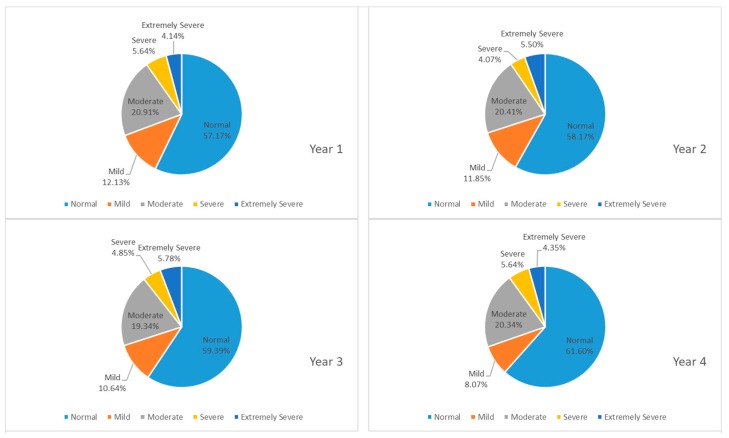
“The percentage of students experiencing anxiety was noticeably high in their freshmen year while a larger ratio of junior students had extremely severe anxiety.”
§ Changes in Undergraduate Students’ Psychological Well-Being as They Experience University Life > 3. Results > 3.2. Proportion of Students’ Depression, Anxiety, and Stress
plain- Asserted: passes — The authors put it forward as true.
- Checkable: passes — It can be checked against evidence.
- Load-bearing: unclear — It is unclear whether the paper’s conclusions depend on it.
- Based: passes — The paper gives a reason why it holds.
- Rests on an assumption: Students lost to follow-up do not differ systematically in mental health from those retained.
- It may state two separate claims as one. 14
- The quote only partly states this claim. 1
- Probably not a substantial claim. 11
A result the paper reports from its own data — it cites no other source for it, so there is none to check. The quote shows it is in the paper.
In the paper
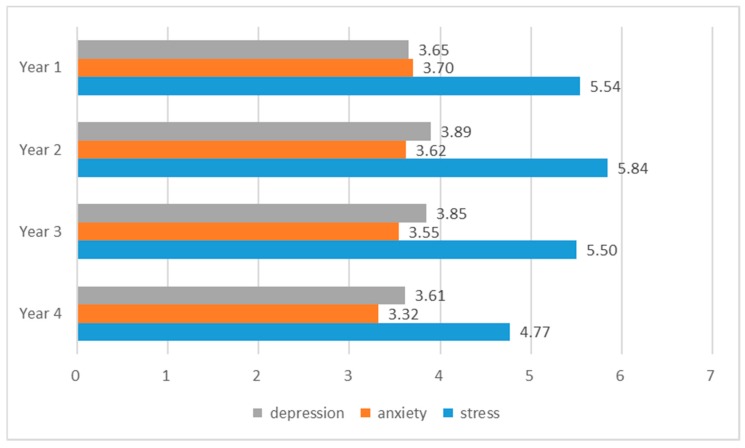
“Nevertheless, the anxiety scores in the first three years turned out to be 7.40, 7.24 and 7.10, respectively, slightly overtaking the normal threshold of 7.”
§ Changes in Undergraduate Students’ Psychological Well-Being as They Experience University Life > 3. Results > 3.1. Average Scores in Depression, Anxiety, and Stress
plain- Asserted: passes — The authors put it forward as true.
- Checkable: passes — It can be checked against evidence.
- Load-bearing: passes — The paper’s conclusions depend on it.
- Based: passes — The paper gives a reason why it holds.
It may state two separate claims as one.
- Rests on an assumption: Students lost to follow-up do not differ systematically in mental health from those retained.
A result the paper reports from its own data — it cites no other source for it, so there is none to check. The quote shows it is in the paper.
In the paper
“For the anxiety scale, freshman students scored 3.70 on average, and the scores decreased gradually from year one to year four, indicating that this situation improved over time.”
§ Changes in Undergraduate Students’ Psychological Well-Being as They Experience University Life > 3. Results > 3.1. Average Scores in Depression, Anxiety, and Stress
hedgedcorrelational- Asserted: passes — The authors put it forward as true.
- Checkable: passes — It can be checked against evidence.
- Load-bearing: passes — The paper’s conclusions depend on it.
- Based: passes — The paper gives a reason why it holds.
It may state two separate claims as one.
- Rests on an assumption: Students lost to follow-up do not differ systematically in mental health from those retained.
A result the paper reports from its own data — it cites no other source for it, so there is none to check. The quote shows it is in the paper.
In the paper
“A larger proportion of students reported having mild depression in their sophomore year while moderate depression was more likely to be seen in the senior year.”
§ Changes in Undergraduate Students’ Psychological Well-Being as They Experience University Life > 3. Results > 3.2. Proportion of Students’ Depression, Anxiety, and Stress
plaincorrelational- Asserted: passes — The authors put it forward as true.
- Checkable: passes — It can be checked against evidence.
- Load-bearing: unclear — It is unclear whether the paper’s conclusions depend on it.
- Based: passes — The paper gives a reason why it holds.
It may state two separate claims as one.
- Rests on an assumption: Students lost to follow-up do not differ systematically in mental health from those retained.
A result the paper reports from its own data — it cites no other source for it, so there is none to check. The quote shows it is in the paper.
In the paper
“Overall, these results indicated that the factor loadings, unique variances, and factor variances were different across years”
§ Changes in Undergraduate Students’ Psychological Well-Being as They Experience University Life > 3. Results > 3.3. Multiple Group Analysis
hedged- Asserted: passes — The authors put it forward as true.
- Checkable: passes — It can be checked against evidence.
- Load-bearing: passes — The paper’s conclusions depend on it.
- Based: passes — The paper gives a reason why it holds.
It may state two separate claims as one.
A result the paper reports from its own data — it cites no other source for it, so there is none to check. The quote shows it is in the paper.
In the paper
“Sophomore students endured relatively high levels of depression and stress, with mean scores reaching up to 5.84 and 3.89, respectively.”
§ Changes in Undergraduate Students’ Psychological Well-Being as They Experience University Life > 3. Results > 3.1. Average Scores in Depression, Anxiety, and Stress
plain- Asserted: passes — The authors put it forward as true.
- Checkable: passes — It can be checked against evidence.
- Load-bearing: passes — The paper’s conclusions depend on it.
- Based: passes — The paper gives a reason why it holds.
It may state two separate claims as one.
- Rests on an assumption: Students lost to follow-up do not differ systematically in mental health from those retained.
A result the paper reports from its own data — it cites no other source for it, so there is none to check. The quote shows it is in the paper.
In the paper
“the highest score of depression, anxiety, and stress all appeared in the first or second year on average, but some improvements were achieved in the third and last years.”
§ Changes in Undergraduate Students’ Psychological Well-Being as They Experience University Life > Abstract
plaincorrelational- Asserted: passes — The authors put it forward as true.
- Checkable: passes — It can be checked against evidence.
- Load-bearing: passes — The paper’s conclusions depend on it.
- Based: passes — The paper gives a reason why it holds.
It may state two separate claims as one.
- Rests on an assumption: Students lost to follow-up do not differ systematically in mental health from those retained.
A result the paper reports from its own data — it cites no other source for it, so there is none to check. The quote shows it is in the paper.
In the paper
“This indicated that strictly speaking, i.e., by holding factor loadings, variances and residuals as invariant, there were statistically significant differences between the latter three years.”
§ Changes in Undergraduate Students’ Psychological Well-Being as They Experience University Life > 3. Results > 3.3. Multiple Group Analysis
hedged- Asserted: passes — The authors put it forward as true.
- Checkable: passes — It can be checked against evidence.
- Load-bearing: passes — The paper’s conclusions depend on it.
- Based: passes — The paper gives a reason why it holds.
It may state two separate claims as one. The quote only partly states this claim.
In the paper
“Indeed, depression, anxiety, and stress are deemed as significant indicators of psychological well-being [13].”
§ Changes in Undergraduate Students’ Psychological Well-Being as They Experience University Life > 1. Introduction
What the sources say
- Not checked yetcites [13] Teh, 2015, Depression, anxiety and stress among undergraduate students: A cross sectional study, Open J. Epidemiol. source
plaincorrelational- Asserted: passes — The authors put it forward as true.
- Checkable: passes — It can be checked against evidence.
- Load-bearing: passes — The paper’s conclusions depend on it.
- Based: passes — The paper gives a reason why it holds.
Probably not a substantial claim.
None of the sources cited for this claim have been checked yet.
In the paper
“The widely recognized Depression Anxiety Stress Scales-21 (DASS-21) is an effective measure of negative emotions in Chinese people [10,11].”
§ Changes in Undergraduate Students’ Psychological Well-Being as They Experience University Life > 1. Introduction
What the sources say
- Not checked yetcites [10] Quek, T., Ho, C., Choo, C., Nguyen, L., Tran, B., and Ho, R. (2018). Misophonia in Singaporean psychiatric patients: A cross-sectional study. Int. J. Environ. Res. Public Health, 15. source
- Not checked yetcites [11] Ho, C.S., Tan, E.L., Ho, R., and Chiu, M.Y. (2019). Relationship of anxiety and depression with respiratory symptoms: Comparison between depressed and non-depressed smokers in Singapore. Int. J. Environ. Res. Public Health, 16. source
boosted- Asserted: passes — The authors put it forward as true.
- Checkable: passes — It can be checked against evidence.
- Load-bearing: passes — The paper’s conclusions depend on it.
- Based: passes — The paper gives a reason why it holds.
Probably not a substantial claim.
A conclusion the paper draws from its own results — it cites no other source for it, so there is none to check. The quote shows it is in the paper.
In the paper
“Descriptive statistics showed that students in their first year of college tended to suffer more from anxiety, while in the sophomore year they experienced relatively high levels of stress and depression.”
§ Changes in Undergraduate Students’ Psychological Well-Being as They Experience University Life > 3. Results > 3.2. Proportion of Students’ Depression, Anxiety, and Stress
hedgedcorrelational- Asserted: passes — The authors put it forward as true.
- Checkable: passes — It can be checked against evidence.
- Load-bearing: passes — The paper’s conclusions depend on it.
- Based: passes — The paper gives a reason why it holds.
It may state two separate claims as one.
The paper states this without a source or data behind it here, so there is nothing to check it against. The quote shows it is in the paper.
In the paper
“In general, existing literature regarding the psychological distress of college students mainly used cross-sectional data, and the few longitudinal studies often had a small sample size, with participants mostly from a single university.”
§ Changes in Undergraduate Students’ Psychological Well-Being as They Experience University Life > 1. Introduction
plain- Asserted: passes — The authors put it forward as true.
- Checkable: passes — It can be checked against evidence.
- Load-bearing: passes — The paper’s conclusions depend on it.
- Based: fails — The paper may give no reason why it holds.
Probably not a substantial claim. The paper may give no reason why it holds. It may state two separate claims as one.
The paper states this without a source or data behind it here, so there is nothing to check it against. The quote shows it is in the paper.
In the paper
“Although previous studies suggested psychiatric disorders are common in the adult population, there was little consistent information available about undergraduate students’ mental health problems.”
§ Changes in Undergraduate Students’ Psychological Well-Being as They Experience University Life > Abstract
plain- Asserted: passes — The authors put it forward as true.
- Checkable: passes — It can be checked against evidence.
- Load-bearing: passes — The paper’s conclusions depend on it.
- Based: passes — The paper gives a reason why it holds.
Probably not a substantial claim.
A conclusion the paper draws from its own results — it cites no other source for it, so there is none to check. The quote shows it is in the paper.
In the paper
“Moreover, given the curriculum organization in Chinese universities, which usually set general courses in the first year and introduce more specialized courses from the second year, sophomores may be confronted with intense pressure from study compared to the previous semesters. This may inevitably lead to higher stress and even depression.”
§ Changes in Undergraduate Students’ Psychological Well-Being as They Experience University Life > 4. Discussion
hedgedconditional- Asserted: passes — The authors put it forward as true.
- Checkable: passes — It can be checked against evidence.
- Load-bearing: unclear — It is unclear whether the paper’s conclusions depend on it.
- Based: passes — The paper gives a reason why it holds.
It may state two separate claims as one.
- Rests on an assumption: Chinese universities usually set general courses in the first year and introduce more specialized courses from the second year.
In the paper
“The onset of most lifetime mental disorders occurs before young adulthood [46], and the main groups at this age are college students in many countries.”
§ Changes in Undergraduate Students’ Psychological Well-Being as They Experience University Life > 3. Results > 3.2. Proportion of Students’ Depression, Anxiety, and Stress
What the sources say
- Not checked yetcites [46] Kessler, 2007, Age of onset of mental disorders: A review of recent literature, Curr. Opin. Psychiatry source
plain- Asserted: passes — The authors put it forward as true.
- Checkable: passes — It can be checked against evidence.
- Load-bearing: fails — The paper’s conclusions may not depend on it.
- Based: passes — The paper gives a reason why it holds.
Probably not a substantial claim. The paper’s conclusions may not depend on it.
A conclusion the paper draws from its own results — it cites no other source for it, so there is none to check. The quote shows it is in the paper.
In the paper
“For freshman students, their anxiety may be partly caused by adjustment disorders, especially when students are separated from their parents and friends and have to orient themselves to new environments.”
§ Changes in Undergraduate Students’ Psychological Well-Being as They Experience University Life > 4. Discussion
hedgedconditional- Asserted: passes — The authors put it forward as true.
- Checkable: passes — It can be checked against evidence.
- Load-bearing: fails — The paper’s conclusions may not depend on it.
- Based: passes — The paper gives a reason why it holds.
Probably not a substantial claim. The paper’s conclusions may not depend on it.
A conclusion the paper draws from its own results — it cites no other source for it, so there is none to check. The quote shows it is in the paper.
In the paper
“On average, Chinese college students suffered from above-normal levels of anxiety in the first three years, but they stayed mentally healthy with mean scores of depression and stress in the normal range.”
- Also stated in: § Abstract · hedged
“These results indicated that Chinese college students, in general, were mentally healthy with regard to depression and stress, but their average anxiety levels were beyond normal in the first three years.”
§ Changes in Undergraduate Students’ Psychological Well-Being as They Experience University Life > 3. Results > 3.1. Average Scores in Depression, Anxiety, and Stress
plain- Asserted: passes — The authors put it forward as true.
- Checkable: passes — It can be checked against evidence.
- Load-bearing: passes — The paper’s conclusions depend on it.
- Based: passes — The paper gives a reason why it holds.
It may state two separate claims as one.
- Rests on an assumption: The 2008 cohort of students from 15 Beijing universities is representative of Chinese full-time undergraduate students generally.
- Also stated in: § Abstract · hedged
None of the sources cited for this claim have been checked yet.
In the paper
“The DASS-21 has been widely recognized for its reliability and different forms of validity in a range of studies from different countries with different samples [42,43].”
§ Changes in Undergraduate Students’ Psychological Well-Being as They Experience University Life > 2. Methods > 2.2. Measure
What the sources say
- Not checked yetcites [42] Osman, 2012, The depression anxiety stress Scales—21 (DASS-21): Further examination of dimensions, scale reliability, and correlates, J. Clin. Psychol. source
- Not checked yetcites [43] Oei, 2013, Using the depression anxiety stress scale 21 (DASS-21) across cultures, Int. J. Psychol. source
boosted- Asserted: passes — The authors put it forward as true.
- Checkable: passes — It can be checked against evidence.
- Load-bearing: fails — The paper’s conclusions may not depend on it.
- Based: passes — The paper gives a reason why it holds.
Probably not a substantial claim. The paper’s conclusions may not depend on it.
What the paper did — it cites no source for this, so there is none to check. The quote shows it is in the paper.
In the paper
“For this study, the scale reliability coefficients of depression, anxiety, and stress were 0.813, 0.766, and 0.812, respectively, indicating good validity of the DASS measurement.”
§ Changes in Undergraduate Students’ Psychological Well-Being as They Experience University Life > 2. Methods > 2.2. Measure
hedged- Asserted: passes — The authors put it forward as true.
- Checkable: passes — It can be checked against evidence.
- Load-bearing: unclear — It is unclear whether the paper’s conclusions depend on it.
- Based: passes — The paper gives a reason why it holds.
It may state two separate claims as one.
A conclusion the paper draws from its own results — it cites no other source for it, so there is none to check. The quote shows it is in the paper.
In the paper
“In sum, the mental states of college students deteriorated from the freshman to sophomore year, with some improvements in the last two years.”
§ Changes in Undergraduate Students’ Psychological Well-Being as They Experience University Life > 3. Results > 3.1. Average Scores in Depression, Anxiety, and Stress
plaincorrelational- Asserted: passes — The authors put it forward as true.
- Checkable: passes — It can be checked against evidence.
- Load-bearing: passes — The paper’s conclusions depend on it.
- Based: passes — The paper gives a reason why it holds.
It may state two separate claims as one.
In the paper
“The onset of most lifetime mental disorders occurs before young adulthood [46], and the main groups at this age are college students in many countries.”
§ Changes in Undergraduate Students’ Psychological Well-Being as They Experience University Life > 3. Results > 3.2. Proportion of Students’ Depression, Anxiety, and Stress
What the sources say
- Not checked yetcites [46] Kessler, 2007, Age of onset of mental disorders: A review of recent literature, Curr. Opin. Psychiatry source
plain- Asserted: passes — The authors put it forward as true.
- Checkable: passes — It can be checked against evidence.
- Load-bearing: fails — The paper’s conclusions may not depend on it.
- Based: passes — The paper gives a reason why it holds.
Probably not a substantial claim. The paper’s conclusions may not depend on it.
What the paper did — it cites no source for this, so there is none to check. The quote shows it is in the paper.
In the paper
“Participants of the survey were randomly chosen from students admitted to 15 universities in the years of 2006 and 2008, and these two cohorts were tracked for four consecutive years from June 2009 to June 2012.”
§ Changes in Undergraduate Students’ Psychological Well-Being as They Experience University Life > 2. Methods > 2.1. Participants and Procedure
plain- Asserted: passes — The authors put it forward as true.
- Checkable: passes — It can be checked against evidence.
- Load-bearing: fails — The paper’s conclusions may not depend on it.
- Based: passes — The paper gives a reason why it holds.
Probably not a substantial claim. The paper’s conclusions may not depend on it.
In the paper
“the follow-up rate of the latter three rounds was 95.27%, 94.66%, and 90.58%, respectively, with very few sample losses [41].”
§ Changes in Undergraduate Students’ Psychological Well-Being as They Experience University Life > 2. Methods > 2.1. Participants and Procedure
What the sources say
- Not checked yetcites [41] Liu, X., Gao, X., and Ping, S. (2019). Post-1990s College Students Academic Sustainability: The Role of Negative Emotions, Achievement Goals, and Self-efficacy on Academic Performance. Sustainability, 11. source
plain- Asserted: passes — The authors put it forward as true.
- Checkable: passes — It can be checked against evidence.
- Load-bearing: passes — The paper’s conclusions depend on it.
- Based: passes — The paper gives a reason why it holds.
Probably not a substantial claim.
A conclusion the paper draws from its own results — it cites no other source for it, so there is none to check. The quote shows it is in the paper.
In the paper
“With the above analysis, we can conclude that Chinese college students were mentally healthy on average, while the psychological health states of freshmen and sophomores warrants more attention.”
§ Changes in Undergraduate Students’ Psychological Well-Being as They Experience University Life > 3. Results > 3.2. Proportion of Students’ Depression, Anxiety, and Stress
plain- Asserted: passes — The authors put it forward as true.
- Checkable: passes — It can be checked against evidence.
- Load-bearing: passes — The paper’s conclusions depend on it.
- Based: passes — The paper gives a reason why it holds.
It may state two separate claims as one.
- Rests on an assumption: The 2008 cohort of students from 15 Beijing universities is representative of Chinese full-time undergraduate students generally.
A conclusion the paper draws from its own results — it cites no other source for it, so there is none to check. The quote shows it is in the paper.
In the paper
“Furthermore, it is worth noting that the overall optimistic situation of the psychological state of colleges students may be due to their weak perception about changes in their external social environment.”
§ Changes in Undergraduate Students’ Psychological Well-Being as They Experience University Life > 5. Conclusions
hedgedconditional- Asserted: passes — The authors put it forward as true.
- Checkable: fails — It may be too vague to check against evidence.
- Load-bearing: fails — The paper’s conclusions may not depend on it.
- Based: fails — The paper may give no reason why it holds.
Probably not a substantial claim. It may be too vague to check against evidence. The paper’s conclusions may not depend on it. The paper may give no reason why it holds.
The paper relies on this without support.
The 2008 cohort of students from 15 Beijing universities is representative of Chinese full-time undergraduate students generally.
“On average, Chinese college students suffered from above-normal levels of anxiety in the first three years, but they stayed mentally healthy with mean scores of depression and stress in the normal range.”
The paper relies on this without support.
Students lost to follow-up do not differ systematically in mental health from those retained.
“the follow-up rate of the latter three rounds was 95.27%, 94.66%, and 90.58%, respectively, with very few sample losses [41].”
The paper relies on this without support.
The 2009-2012 cohort's experiences are generalizable to current Chinese college students.
“These results indicated that Chinese college students, in general, were mentally healthy with regard to depression and stress, but their average anxiety levels were beyond normal in the first three years.”
The paper relies on this without support.
Chinese universities usually set general courses in the first year and introduce more specialized courses from the second year.
“given the curriculum organization in Chinese universities, which usually set general courses in the first year and introduce more specialized courses from the second year”
The paper relies on this without support.
Chinese college students usually pay much lower tuition for undergraduate study compared to their counterparts in the UK.
“Chinese college students usually pay much lower tuition for undergraduate study compared to their counterparts in the UK”
The paper relies on this without support.
Economic aids in China are relatively more accessible regarding both its simpler application process and also its better chance of success.
“the economic aids in China are relatively more accessible regarding both its simpler application process and also its better chance of success”
The paper relies on this without support.
Chinese parents are more commonly seen to pay the costs of higher education of their children, while UK students have to bear the financial burden mostly by themselves.
“Chinese parents are more commonly seen to pay the costs of higher education of their children, while UK students have to bear the financial burden mostly by themselves.”
The paper relies on this without support.
Most Chinese universities have strict requirements for students’ national college entrance examination scores, while in the US, college students face intense pressure on meeting graduation requirements, rather than admission thresholds.
“most Chinese universities have strict requirements for students’ national college entrance examination scores, while in the US, college students face intense pressure on meeting graduation requirements, rather than admission thresholds”
The paper relies on this without support.
Previous literature on college students’ psychological well-being was generally based on cross-sectional data.
“Previous literature on college students’ psychological well-being was generally based on cross-sectional data”
The authors state this as an assumption.
The DASS-21 can be applied to examine students in different years.
“First, the DASS-21 enjoys worldwide recognition in measuring levels of depression, anxiety, and stress, so we assume that it can be applied to examine students in different years [50,51,52,53,54].”
Claims other papers make about this one
Each is checked against this paper’s own text: does it say what the citing paper says it does?
The source backs part of the claim, not all of it — or backs it for a different population, condition or comparison.
In the citing paper
“University students represent a particularly vulnerable group prone to adopting unhealthy lifestyles that increase the risk of developing NCDs [9, 10].”
From Psychometric validation and measurement invariance of the Health-Promoting Lifestyle Profile II in Honduran university students (2025) · cites this paper as [9]
Experimental — accuracy not yet measured
Statistics recomputed
Every reported test result, recomputed from its test statistic and degrees of freedom. A result shows as not adding up only once an independent check has confirmed it.
- Consistentχ²(6) = 43.823reported p < .05 · recomputed p < .001
“χ2 (6) = 43.823, p < .05”
- Consistentχ²(9) = 91.346reported p < .05 · recomputed p < .001
“χ2 (9) = 91.346, p < .05”
- Consistentχ²(3) = 47.522reported p < .05 · recomputed p < .001
“χ2 (3) = 47.522, p < .05”
- Consistentχ²(18) = 261.342reported p < .05 · recomputed p < .001
“χ2 (18) = 261.342, p < .05”
- Consistentχ²(9) = 169.996reported p < .05 · recomputed p < .001
“χ2 (9) = 169.996, p < .05”
Self-check
Percentages, sums and reported differences re-computed from the paper’s own numbers.
Each contradiction between two passages listed here was confirmed by an independent check.
Rated minor: it would not touch a result — a value no result rests on, a p-value that stays on the same side of the significance level, or a conflict that is clerical, resolved elsewhere in the paper, or outside its own findings.
In the paper
§ Changes in Undergraduate Students’ Psychological Well-Being as They Experience University Life > 3. Results > 3.1. Average Scores in Depression, Anxiety, and Stress
“Sophomore students endured relatively high levels of depression and stress, with mean scores reaching up to 5.84 and 3.89, respectively.”
§ Changes in Undergraduate Students’ Psychological Well-Being as They Experience University Life > 3. Results > 3.1. Average Scores in Depression, Anxiety, and Stress
“students’ severity scores of depression during the four academic years varied between 7.22 and 7.79, while the stress scores ranged from 9.53 to 11.68.”
Citations
Cites
Lovibond, P. F., & Lovibond, S. H. (1995) · Behaviour Research and Therapy · doi:10.1016/0005-7967(94)00075-u · Cited by 14,523
Henry, J. D., & Crawford, J. R. (2005) · British Journal of Clinical Psychology · doi:10.1348/014466505x29657 · Cited by 5,801
Sawyer, S. M., Azzopardi, P. S., Wickremarathne, D., & Patton, G. C. (2018) · The Lancet Child & Adolescent Health · doi:10.1016/s2352-4642(18)30022-1 · Cited by 3,666
Age of onset of mental disorders: a review of recent literature
Kessler, R. C., Amminger, G. P., Aguilar-Gaxiola, S., Alonso, J., Lee, S., & ??st??n, T. B. (2007) · Current Opinion in Psychiatry · doi:10.1097/yco.0b013e32816ebc8c · Cited by 3,457
(2011) · Cited by 2,664
Depression Anxiety Stress Scales
Lovibond, S. H., & Lovibond, P. F. (2011) · PsycTESTS Dataset · doi:10.1037/t01004-000 · Cited by 2,416
Structural Equation Modeling with Mplus: Basic Concepts, Applications, and Programming
Byrne, B. M. (2013) · doi:10.4324/9780203807644 · Cited by 2,063
The prevalence and correlates of depression, anxiety, and stress in a sample of college students
Beiter, R., Nash, R., McCrady, M., Rhoades, D., Linscomb, M., Clarahan, M., & Sammut, S. (2015) · Journal of Affective Disorders · doi:10.1016/j.jad.2014.10.054 · Cited by 2,030 · cited 4×
“Beiter et al. (2015) found that compared with freshmen, juniors and seniors scored higher on depression, anxiety and stress scales [26].”
BackgroundResultInfluentialMental health problems and help-seeking behavior among college students
Hunt, J., & Eisenberg, D. (2010) · Journal of Adolescent Health · doi:10.1016/j.jadohealth.2009.08.008 · Cited by 1,949
Prevalence of Depression in the Community from 30 Countries between 1994 and 2014
Lim, G. Y., Tam, W. W., Lu, Y., Ho, C. S., Zhang, M. W., & Ho, R. C. (2018) · Scientific Reports · doi:10.1038/s41598-018-21243-x · Cited by 1,557
Research works printed but not linked: 1
- Wei, 2017, Research progress on family factors of depression for college students, China J. Health Psychol., 25, 1752
Cited by
Sorted by citations
Gao, W., Ping, S., & Liu, X. (2020) · Journal of Affective Disorders · doi:10.1016/j.jad.2019.11.121 · Cited by 851
Self-citationBarbayannis, G., Bandari, M., Zheng, X., Baquerizo, H., Pecor, K. W., & Ming, X. (2022) · Frontiers in Psychology · doi:10.3389/fpsyg.2022.886344 · Cited by 923
Ma, Z., Zhao, J., Li, Y., Chen, D., Wang, T., Zhang, Z., Chen, Z., Yu, Q., Jiang, J., Fan, F., et al. (2020) · Epidemiology and Psychiatric Sciences · doi:10.1017/s2045796020000931 · Cited by 437
Self-citationFaisal, R. A., Jobe, M. C., Ahmed, O., & Sharker, T. (2022) · International Journal of Mental Health and Addiction · doi:10.1007/s11469-020-00458-y · Cited by 275
Rogowska, A. M., Павлова, Ю., Kuśnierz, C., Ochnik, D., Боднар, І., & Petrytsa, P. (2020) · Journal of Clinical Medicine · doi:10.3390/jcm9113494 · Cited by 179
Metadata
- Authors
- Liu, X., Ping, S., & Gao, W.
- Affiliations
- Peking University (CN)
- Department of Public Policy & Management, Guangzhou Administration School, Guangzhou 510070, China
- Corresponding author
- Gao, Wenjuan
- Venue
- International Journal of Environmental Research and Public Health
- Publisher
- MDPI AG
- Published
- 2019-08-10
- Volume
- 16
- Issue
- 16
- Pages
- 2864
- ISSN
- 1660-4601 (ISSN-L)
- PMC
- PMC6719208
- OpenAlex
- W2969073395
- Semantic Scholar
- e8fa0f322cb4ddaa886981f06afab8dcd7e605e5
- Cited by
- 261
- References
- 53
- Citations by year
- 2026: 31 · 2025: 44 · 2024: 55 · 2023: 41 · 2022: 48 · 2021: 28 · 2020: 13 · 2019: 1
- FWCI
- 40.98
- Type
- journal article
- Language
- en
- Open access
- gold
- dx.doi.org
- Licence
- Locations
- International Journal of Environmental Research and Public Health (publishedVersion, cc-by)
- PubMed Central (publishedVersion, cc-by)
- PubMed (publishedVersion)
- OSTI OAI (U.S. Department of Energy Office of Scientific and Technical Information) (submittedVersion)
- RePEc: Research Papers in Economics (submittedVersion)
- DOAJ (DOAJ: Directory of Open Access Journals) (submittedVersion)
- Funders
- Planning Project of Guangdong Philosophy and Social Science (GD18XGL60)
- Topics
- Social Sciences › Psychology › Developmental and Educational Psychology › Student Stress and Coping
- Social Sciences › Psychology › Clinical Psychology › Health and Well-being Studies
- Health Sciences › Health Professions › General Health Professions › Healthcare professionals’ stress and burnout
- Keywords
- psychological well-being, undergraduate students, college student life, depression, anxiety, stress, mental health, Chinese university students, academic year differences, DASS-21, mental health policy
- MeSH terms
- Anxiety, China, Depression, Female, Humans, Male, Mental Health, Stress, Psychological, Students, Universities
About these checks
Registry, retraction, Cites and statistics results are computed, not judged, with one exception: a printed reference that no index lists is read once by a model before it counts as a citation error. Claims are extracted by a model and kept only when their quote appears verbatim in the text; each cited source is then checked, with a model’s help, for whether it says what the claim relies on. Those verdicts can be wrong — read the claim’s quote and the cited source before relying on one.
A language model drew the claims from the paper on 2026-10-10, under version 3 of the claim definition (model deepseek-v4.1-flash, prompt extract-v3).
A second model labelled each claim on 2026-10-10 (model jev-1.13-20260917, definition revision gold-guideline-v0.2).
Statistics and arithmetic are recomputed, not judged.
Confidence bands are shown only for fields calibrated on our annotated test set. None is calibrated yet, so no band is shown.
What counts as a claim ›How we measure confidence ›How we check this ›
Are you an author, or do you see a problem with this page? Request a review
