

The DOI matches its Crossref record; 3 of the 3 references it cites were found in a registry or an index.
Investigating the Relationship between Work-To-Family Conflict, Job Burnout, Job Outcomes, and Affective Commitment in the Construction Industry
Open accessAbstract
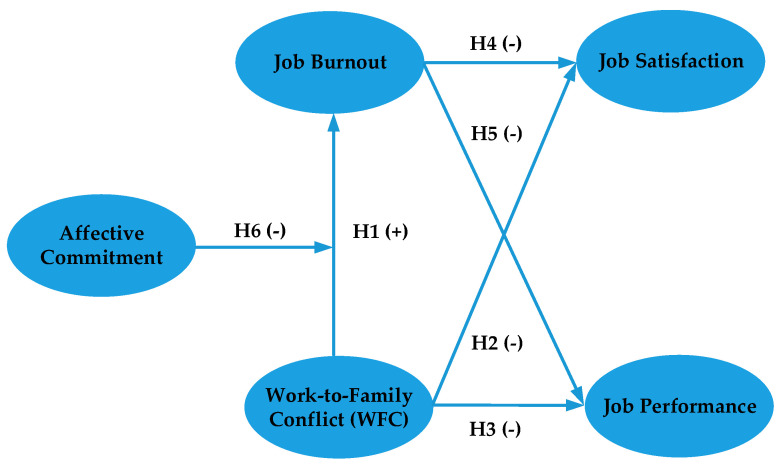
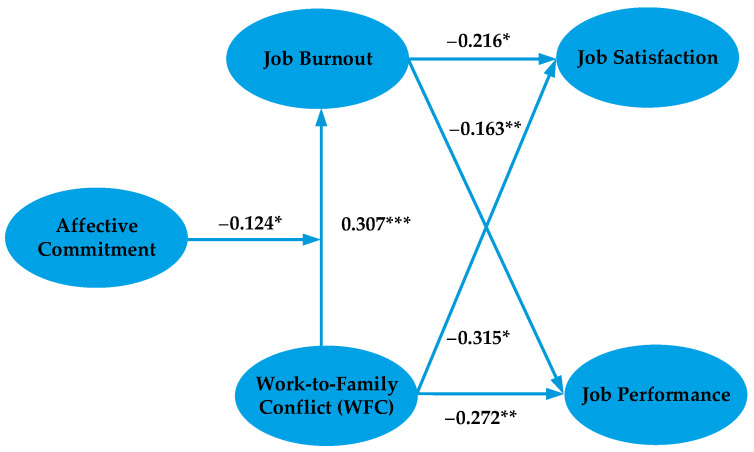
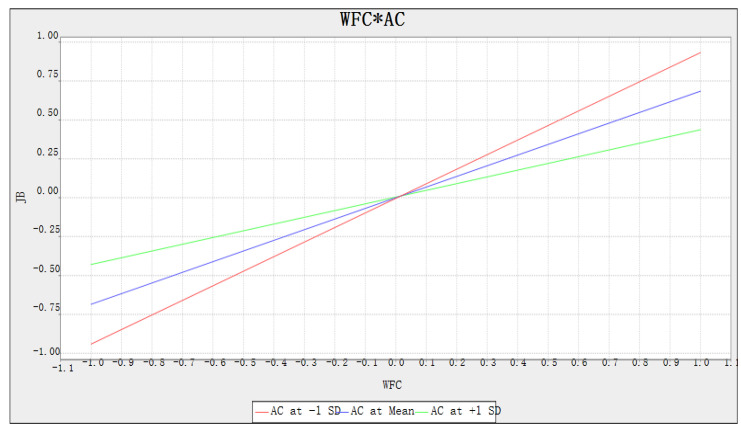
This study explored the effects of work-to-family conflict on job burnout and job outcomes in the construction industry, focusing on the moderating effects of affective commitment. Based on the conservation of resources theory, a theoretical model introducing affective commitment as a moderating variable was established. A structured questionnaire survey was then implemented among construction professionals in China. A total of 376 valid responses were obtained. Structural equation modeling was used to analyze the valid data. The results revealed the following: (i) work-to-family conflict has a significant positive impact on job burnout, but a significant negative impact on job satisfaction and job performance; (ii) job burnout negatively affects job satisfaction and job performance; (iii) affective commitment negatively moderates the effects of work-to-family conflict on job burnout. This study provides a reference for construction companies to manage work-to-family conflict and job burnout of employees, while also improving their affective commitment and job outcomes.
Overview
The claims and statistics of this paper haven’t been checked yet.
Run the check — free, no account needed. It reads the open-access text and checks the sources it cites.
Integrity signals
Registry
Cites
Statistics
Figures
Verification
Claims the paper makes
The claims and statistics of this paper haven’t been checked yet.
Run the check — free, no account needed. It reads the open-access text and checks the sources it cites.
Self-check
Percentages, sums and reported differences re-computed from the paper’s own numbers.
The self-check needs the paper’s full text.
Citations
Cites
Fredrickson, B. L. (2001) · American Psychologist · doi:10.1037//0003-066x.56.3.218 · Cited by 18,025
The broaden–and–build theory of positive emotions
Fredrickson, B. L. (2004) · Philosophical Transactions of the Royal Society of London. Series B: Biological Sciences · doi:10.1098/rstb.2004.1512 · Cited by 4,214
Consequences associated with work-to-family conflict: A review and agenda for future research.
Allen, T. D., Herst, D. E. L., Bruck, C. S., & Sutton, M. (2000) · Journal of Occupational Health Psychology · doi:10.1037/1076-8998.5.2.278 · Cited by 2,767
Research works printed but not linked: 46
- Cao, J., Liu, C., Wu, G., Zhao, X., and Jiang, Z. (2020). Work-family conflict and job outcomes for construction professionals: The mediating role of affective organizational commitment. Int. J. Environ. Res. Public Health, 17. · DOI
- Oyekunle, 2019, Influence of organizational commitment on work-life balance and organizational performance of female construction professionals, Eng. Constr. Archit. Manag., 26, 2243, 10.1108/ECAM-07-2018-0277 · DOI
- Zheng, J., and Wu, G. (2018). Work-family conflict, perceived organizational support and professional commitment: A mediation mechanism for chinese project professionals. Int. J. Environ. Res. Public Health, 15. · DOI
- Wu, 2017, Relationship between project’s added value and the trust-conflict interaction among project teams, J. Manag. Eng., 33, 04017011, 10.1061/(ASCE)ME.1943-5479.0000525 · DOI
- Lingard, 2007, The experience of burnout among future construction professionals: A cross-national study, Constr. Manag. Econ., 25, 345, 10.1080/01446190600599145 · DOI
- Mostert, 2011, Job characteristics, work-home interference and burnout: Testing a structural model in the South African context, Int. J. Hum. Resour. Manag., 22, 1036, 10.1080/09585192.2011.556777 · DOI
- Enshassi, 2016, Investigating common causes of burnout in the construction industry, Int. J. Constr. Proj. Manag., 8, 43
- Yip, 2009, Job burnout among construction engineers working within consulting and contracting organizations, J. Manag. Eng., 25, 122, 10.1061/(ASCE)0742-597X(2009)25:3(122) · DOI
- Liu, B., Wang, Q., Wu, G., Zheng, J., and Li, L. (2020). How family-supportive supervisor affect Chinese construction workers’ work-family conflict and turnover intention: Investigating the moderating role of work and family identity salience. Constr. Manag. Econ., 1–17. · DOI
- Lingard, 2006, Does a supportive work environment moderate the relationship between work-family conflict and burnout among construction professionals?, Constr. Manag. Econ., 24, 185, 10.1080/14697010500226913 · DOI
- Kaur, 2020, Meaningfulness of work and employee engagement: The role of affective commitment, Open Psychol. J., 13, 115, 10.2174/1874350102013010115 · DOI
- Liu, 2019, Effect of workplace incivility on OCB through burnout: The moderating role of affective commitment, J. Bus. Psychol., 34, 657, 10.1007/s10869-018-9591-4 · DOI
- Mohamed, 2016, The importance of supervisor support for employees’ affective commitment: An analysis of job satisfaction, Int. J. Sci. Res. Publ., 6, 435
- Young, 2019, Does work-family conflict vary according to community resources?, Fam. Relat., 68, 197, 10.1111/fare.12348 · DOI
- Halbesleben, 2014, Getting to the “COR” understanding the role of resources in conservation of resources theory, J. Manag., 40, 1334
- Lin, 2019, The dark side of transformational leader behaviors for leaders themselves: A conservation of resources perspective, Acad. Manag. J., 62, 1556, 10.5465/amj.2016.1255 · DOI
- Trzebiatowski, 2020, Family responsibility discrimination, power distance, and emotional exhaustion: When and why are there gender differences in work–life conflict?, J. Bus. Ethics, 162, 15, 10.1007/s10551-018-4000-5 · DOI
- Guan, 2019, Explaining supervisor-subordinate guanxi and subordinate performance through a conservation of resources lens, Hum. Relat., 72, 1752, 10.1177/0018726718813718 · DOI
- Zhou, 2018, Empowering supervision and service sabotage: A moderated mediation model based on conservation of resources theory, Tour. Manag., 64, 170, 10.1016/j.tourman.2017.06.016 · DOI
- Hobfoll, 1989, Conservation of resources: A new attempt at conceptualizing stress, Am. Psychol., 44, 513, 10.1037/0003-066X.44.3.513 · DOI · Paper page
- Bowen, 2020, Cross-Boundary Contact, Work-family conflict, antecedents, and consequences: Testing an integrated model for construction professionals, J. Constr. Eng. Manag., 146, 4020005, 10.1061/(ASCE)CO.1943-7862.0001784 · DOI
- Srivastava, 2020, Workplace bullying and job burnout, Int. J. Organ. Anal., 28, 183, 10.1108/IJOA-02-2019-1664 · DOI
- Lubbadeh, 2020, Job burnout: A general literature review, Int. Rev. Manag. Mark., 10, 7
- McCormick, 2019, Antecedents of affective and normative commitment of organisational volunteers, Int. J. Hum. Resour. Manag., 30, 2581, 10.1080/09585192.2016.1166388 · DOI
- Ribeiro, 2020, How authentic leadership promotes individual creativity: The mediating role of affective commitment, J. Leadersh. Organ. Stud., 27, 189, 10.1177/1548051819842796 · DOI
- Odoardi, 2019, Affective commitment, participative leadership, and employee innovation: A multilevel investigation, J. Work Organ. Psychol., 35, 103
- Saetang, 2010, Factors affecting perceived job performance among staff: A case study of Ban Karuna Juvenile Vocational Training Centre for boys, J. Behav. Sci., 5, 33
- 2020, Job satisfaction of construction professionals: Case study in eastern Mexico, J. Constr., 14, 62
- Owolabi, 2018, Job satisfaction of female construction professionals in male dominated fields, Int. J. Mech. Eng. Technol., 9, 732
- Chiu, 2000, Does perception of pay equity, pay satisfaction, and job satisfaction mediate the effect of positive affectivity on work motivation?, Soc. Behav. Personal. Int. J., 28, 177, 10.2224/sbp.2000.28.2.177 · DOI
- Kalliath, 2013, Does job satisfaction mediate the relationship between work–family conflict and psychological strain? A study of Australian social workers, Asia Pac. J. Soc. Work Dev., 23, 91, 10.1080/02185385.2013.793019 · DOI
- Witt, 1991, Moderating effect of job satisfaction on the relationship between equity and extra-role behaviors, J. Soc. Psychol., 131, 247, 10.1080/00224545.1991.9713847 · DOI
- Tabor, 2019, The effects of spiritual leadership in family firms: A conservation of resources perspective, J. Bus. Ethics, 163, 1
- Wang, 2012, Work-family conflict and burnout among Chinese doctors: The mediating role of psychological capital, J. Occup. Health, 54, 232, 10.1539/joh.11-0243-OA · DOI
- Rupert, 2009, Work-family conflict and burnout among practicing psychologists, Prof. Psychol. Res. Pract., 40, 54, 10.1037/a0012538 · DOI
- Lizano, 2014, Support in the workplace: Buffering the deleterious effects of work–family conflict on child welfare workers’ well-being and job burnout, J. Soc. Serv. Res., 40, 178, 10.1080/01488376.2013.875093 · DOI
- Singh, 2012, Antecedents, work-related consequences, and buffers of job burnout among Indian software developers, J. Leadersh. Organ. Stud., 19, 83, 10.1177/1548051811429572 · DOI
- Obrenovic, 2020, Work-family conflict impact on psychological safety and psychological well-being: A job performance model, Front. Psychol., 11, 00475, 10.3389/fpsyg.2020.00475 · DOI
- Wijayati, 2020, Emotional intelligence, work family conflict, and job satisfaction on junior high school teacher’s performance, Int. J. High. Educ., 9, 179, 10.5430/ijhe.v9n1p179 · DOI
- Zainal, 2020, Work-family conflict and job performance: Moderating effect of social support among employees in malaysian service sector, Int. J. Bus. Soc., 21, 79, 10.33736/ijbs.3224.2020 · DOI
- Zain, 2019, Influence of work family conflict and job satisfaction on medical employee performance through organizational commitment, Rev. Integr. Bus. Econ. Res., 8, 1
- Cohn, 2006, Beyond the moment, beyond the self: Shared ground between selective investment theory and the broaden-and-build theory of positive emotions, Psychol. Inq., 17, 39
- Waugh, 2006, Nice to know you: Positive emotions, self–other overlap, and complex understanding in the formation of a new relationship, J. Posit. Psychol., 1, 93, 10.1080/17439760500510569 · DOI
- An, J., Liu, Y., Sun, Y., and Liu, C. (2020). Impact of work-family conflict, job stress and job satisfaction on seafarer performance. Int. J. Environ. Res. Public Health, 17. · DOI
- Wu, G., Duan, K., Zuo, J., Yang, J., and Wen, S. (2016). System dynamics model and simulation of employee work-family conflict in the construction industry. Int. J. Environ. Res. Public Health, 13. · DOI
- Wu, G., Zuo, J., and Zhao, X. (2017). Incentive model based on cooperative relationship in sustainable construction projects. Sustainability, 9. · DOI
Cited by
Sorted by citations
Impact of ergonomics on work performance in the manufacturing industry: A systematic review
Campos-Naval, J. E., Castañeda-López, V. A., & Aparicio-Ballena, J. A. (2025) · Proceedings of the 23rd LACCEI International Multi-Conference for Engineering, Education and Technology (LACCEI): "Engineering, Artificial Intelligence, and Sustainable Technologies in service of society" · doi:10.18687/laccei2025.1.1.802
Metadata
- Authors
- Liu, C., Cao, J., Zhang, P., & Wu, G.
- Affiliations
- Tongji University (CN)
- Chongqing University (CN)
- Corresponding author
- Zhang, Peng
- Venue
- International Journal of Environmental Research and Public Health
- Publisher
- MDPI AG
- Published
- 2020-08-18
- Volume
- 17
- Issue
- 16
- Pages
- 5995
- ISSN
- 1660-4601 (ISSN-L)
- PMC
- PMC7460137
- OpenAlex
- W3064814833
- Cited by
- 39
- References
- 3
- Citations by year
- 2026: 2 · 2025: 5 · 2024: 10 · 2023: 6 · 2022: 7 · 2021: 9
- FWCI
- 7.36
- Type
- journal article
- Language
- en
- Open access
- gold
- doi.org
- Licence
- Locations
- International Journal of Environmental Research and Public Health (publishedVersion, cc-by)
- PubMed Central (publishedVersion, cc-by)
- PubMed (publishedVersion)
- RePEc: Research Papers in Economics (submittedVersion)
- DOAJ (DOAJ: Directory of Open Access Journals) (submittedVersion)
- Funders
- National Natural Science Foundation of China (71561009 and 71972018)
- Topics
- Social Sciences › Sociology and Political Science › Work-Family Balance Challenges
- Social Sciences › Business, Management and Accounting › Organizational Behavior and Human Resource Management › Job Satisfaction and Organizational Behavior
- Social Sciences › Psychology › Social Psychology › Stress and Burnout Research
- Keywords
- work-to-family conflict, burnout, affective commitment, job satisfaction, employee performance, construction industry employees, conservation of resources theory, moderating effect, occupational stress
- MeSH terms
- Burnout, Professional, China, Humans, Job Satisfaction, Surveys and Questionnaires, Family Conflict, Construction Industry
About these checks
Registry, retraction, Cites and statistics results are computed, not judged, with one exception: a printed reference that no index lists is read once by a model before it counts as a citation error. Claims are extracted by a model and kept only when their quote appears verbatim in the text; each cited source is then checked, with a model’s help, for whether it says what the claim relies on. Those verdicts can be wrong — read the claim’s quote and the cited source before relying on one.
Statistics and arithmetic are recomputed, not judged.
Confidence bands are shown only for fields calibrated on our annotated test set. None is calibrated yet, so no band is shown.
What counts as a claim ›How we measure confidence ›How we check this ›
Are you an author, or do you see a problem with this page? Request a review
