

The DOI matches its Crossref record; 41 of the 41 references it cites were found in a registry or an index.
Effects of 16 Weeks of Resistance Training on Muscle Quality and Muscle Growth Factors in Older Adult Women with Sarcopenia: A Randomized Controlled Trial
Open accessAbstract
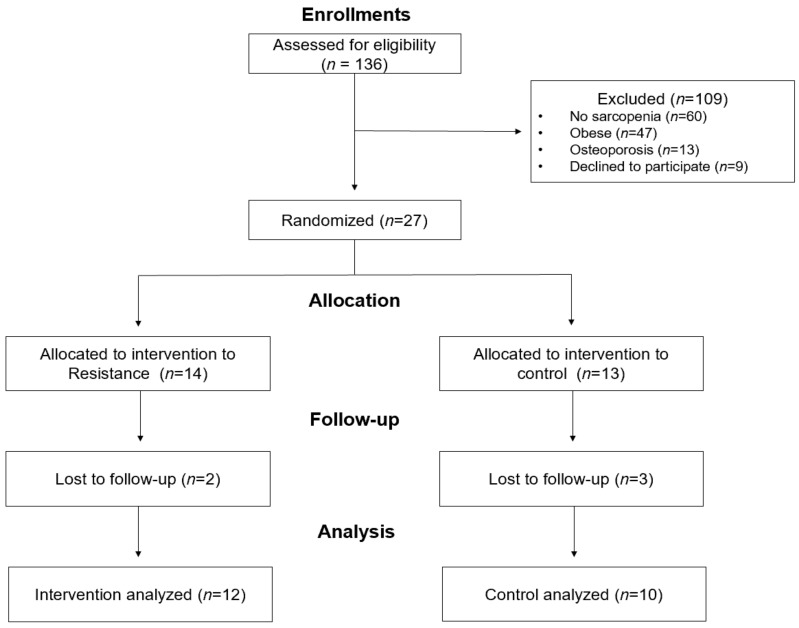
This study examined the effects of resistance training on muscle quality, muscle growth factors, and functional fitness in older adult women with sarcopenia. Twenty-two older adult women aged over 65 with sarcopenia were randomly assigned to either resistance training (RT, n = 12) or non-exercise control group (CG, n = 10). The body weight-based and elastic band RT were performed three times a week, 60 min per session, for 16 weeks. Body composition and thigh muscle quality were estimated by dual-energy X-ray absorptiometry (DEXA) and computed tomography (CT), respectively. The muscle growth factors, including growth differentiation factor-8 (GDF-8), growth differentiation factor-15 (GDF-15), activin A, and follistatin, were analyzed via blood samples. Statistical analyses were performed using repeated measures multivariate analysis of variance (MANOVA), analysis of variance (ANOVA), and effect size (i.e., cohen’s d, partial eta square), and the significance level was set at 0.05. The RT group improved their functional fitness, grip strength, gait speed, and isometric muscle strength (p < 0.01, d > 0.99; large), while these variables did not change in the CG. An increase in intramuscular fat was only observed in the CG (p < 0.01, 1.06; large). Muscle growth factors such as follistatin were significantly increased in the RT (p < 0.05, 0.81; large), but other variables did not change following resistance training. Sixteen weeks of resistance training improved functional fitness and prevented age-related increases in intramuscular fat in the thigh area. However, there were only some changes in muscle growth factors, such as follistatin, suggesting that the effectiveness of resistance training on muscle growth factors is limited. Body weight-based and elastic band resistance training is an alternative training method for sarcopenia to minimize the age-related adverse effects on muscle function and quality.
Overview
The claims and statistics of this paper haven’t been checked yet.
Run the check — free, no account needed. It reads the open-access text and checks the sources it cites.
Integrity signals
Registry
Cites
Statistics
Figures
Verification
Claims the paper makes
The claims and statistics of this paper haven’t been checked yet.
Run the check — free, no account needed. It reads the open-access text and checks the sources it cites.
Claims other papers make about this one
Each is checked against this paper’s own text: does it say what the citing paper says it does?
In the citing paper
“in both humans97–99 and mouse models100, acute exercise97,100 and chronic exercise98 increase liver-secreted follistatin, which has been reported to antagonize the effects of myostatin99.”
From Exerkines in health, resilience and disease (2022) · cites this paper as [98]
In the citing paper
“In humans, both acute exercise97 and chronic exercise98 increase circulating levels of follistatin.”
From Exerkines in health, resilience and disease (2022) · cites this paper as [98]
Self-check
Percentages, sums and reported differences re-computed from the paper’s own numbers.
The self-check needs the paper’s full text.
Citations
Cites
Yeung, S. S. Y., Reijnierse, E. M., Pham, V. K., Trappenburg, M. C., Lim, W. K., Meskers, C. G. M., & Maier, A. B. (2019) · Journal of Cachexia Sarcopenia and Muscle · doi:10.1002/jcsm.12411 · Cited by 1,115
Rikli, R. E., & Jones, C. J. (2012) · The Gerontologist · doi:10.1093/geront/gns071 · Cited by 1,107 · cited 2×
“4 m up and go, and arm curl, were used to measure the participants’ functional fitness [24].”
BackgroundMethodShafiee, G., Keshtkar, A., Soltani, A., Ahadi, Z., Larijani, B., & Heshmat, R. (2017) · Journal of Diabetes & Metabolic Disorders · doi:10.1186/s40200-017-0302-x · Cited by 1,076
Hughes, L., Paton, B. M., Rosenblatt, B., Gissane, C., & Patterson, S. D. (2017) · British Journal of Sports Medicine · doi:10.1136/bjsports-2016-097071 · Cited by 859 · cited 1×
“Resistance training has been recommended for older individuals to prevent degenerate muscle mass and muscle function [19].”
BackgroundBauer, J. M., Verlaan, S., Bautmans, I., Brandt, K., Donini, L. M., Maggio, M., McMurdo, M. E. T., Mets, T., Seal, C., Wijers, S. L., et al. (2015) · Journal of the American Medical Directors Association · doi:10.1016/j.jamda.2015.05.021 · Cited by 670 · cited 1×
“Muscle quality, generally defined as muscle strength per unit of muscle mass, is the substantial determinant of muscle function, and it decreases with aging and affects quality of life in older adults with sarcopenia [36].”
BackgroundIntermuscular fat: a review of the consequences and causes
Addison, O., Marcus, R. L., LaStayo, P. C., & Ryan, A. S. (2014) · International Journal of Endocrinology · doi:10.1155/2014/309570 · Cited by 656 · cited 1×
“, heart failure, diabetes, and cancer) [37,38].”
Batsis, J. A., Mackenzie, T. A., Barre, L. K., Lopez-Jimenez, F., & Bartels, S. J. (2014) · European Journal of Clinical Nutrition · doi:10.1038/ejcn.2014.117 · Cited by 479 · cited 2×
“Additionally, different sex-specific mechanisms such as hormone response and absolute muscle mass influence age-related muscle disease [5,6].”
BackgroundRondanelli, M., Klersy, C., Terracol, G., Talluri, J., Maugeri, R., Guido, D., Faliva, M. A., Solerte, B. S., Fioravanti, M., Lukaski, H., et al. (2016) · The American Journal of Clinical Nutrition · doi:10.3945/ajcn.115.113357 · Cited by 412 · cited 1×
“, whey protein, essential amino acids, vitamin D) improved fat-free mass compared with the placebo group in older adults [29], and combined interventions with exercise and dietary intake have been shown to induce a positive change in the muscle mass of older adults with sarcopenia [30,31].”
BackgroundImaging of sarcopenia: old evidence and new insights
Albano, D., Messina, C., Vitale, J. A., & Sconfienza, L. M. (2019) · European Radiology · doi:10.1007/s00330-019-06573-2 · Cited by 400 · cited 1×
“Previous studies suggested that muscle density and intermuscular fat at the quadriceps using CT scans were recommended because they can provide precise clinical diagnosis, evaluation, and degree of disease advancement in sarcopenia [10,11].”
BackgroundBiomarkers for physical frailty and sarcopenia: state of the science and future developments
Calvani, R., Marini, F., Cesari, M., Tosato, M., Anker, S. D., von Haehling, S., Miller, R. R., Bernabei, R., Landi, F., & Marzetti, E. (2015) · Journal of Cachexia Sarcopenia and Muscle · doi:10.1002/jcsm.12051 · Cited by 275
Cited by
Sorted by citations
Exerkines in health, resilience and disease
Chow, L. S., Gerszten, R. E., Taylor, J. M., Pedersen, B. K., van Praag, H., Trappe, S., Febbraio, M. A., Galis, Z. S., Gao, Y., Haus, J. M., et al. (2022) · Nature Reviews Endocrinology · doi:10.1038/s41574-022-00641-2 · Cited by 927
Molecular mechanisms of exercise contributing to tissue regeneration
Chen, J., Zhou, R. J., Ye, F., & Cheng, L. (2022) · Signal Transduction and Targeted Therapy · doi:10.1038/s41392-022-01233-2 · Cited by 185
Liu, D., Wang, S., Liu, S., Wang, Q., Che, X., & Wu, G. (2024) · Molecular Aspects of Medicine · doi:10.1016/j.mam.2024.101270 · Cited by 157
Zhao, H., Cheng, R., Song, G., Teng, J., Shen, S., Fu, X., Yan, Y., & Liu, C. (2022) · International Journal of Environmental Research and Public Health · doi:10.3390/ijerph192315491 · Cited by 102
Wang, H., Huang, W. Y., & Zhao, Y. (2022) · International Journal of Environmental Research and Public Health · doi:10.3390/ijerph19138212 · Cited by 99
Metadata
- Authors
- Seo, M.-W., Jung, S.-W., Kim, S.-W., Lee, J.-M., Jung, H. C., & Song, J.-K.
- Affiliations
- Kyung Hee University (KR)
- Corresponding author
- Song, Jong-Kook
- Venue
- International Journal of Environmental Research and Public Health
- Publisher
- MDPI AG
- Published
- 2021-06-23
- Volume
- 18
- Issue
- 13
- Pages
- 6762
- ISSN
- 1660-4601 (ISSN-L)
- PMC
- PMC8267934
- OpenAlex
- W3176042879
- Cited by
- 130
- References
- 41
- Citations by year
- 2026: 29 · 2025: 38 · 2024: 25 · 2023: 25 · 2022: 12 · 2021: 1
- FWCI
- 9.90
- Type
- journal article
- Language
- en
- Open access
- gold
- doi.org
- Licence
- Locations
- International Journal of Environmental Research and Public Health (publishedVersion, cc-by)
- PubMed Central (publishedVersion, cc-by)
- PubMed (publishedVersion)
- RePEc: Research Papers in Economics (submittedVersion)
- DOAJ (DOAJ: Directory of Open Access Journals) (submittedVersion)
- Funders
- Ministry of Education of the Republic of Korea and the National Research Foundation of Korea (NRF-2018S1A5A2A03035186)
- Topics
- Health Sciences › Medicine › Physiology (medical) › Nutrition and Health in Aging
- Life Sciences › Biochemistry, Genetics and Molecular Biology › Molecular Biology › Muscle Physiology and Disorders
- Health Sciences › Nursing › Nutrition and Dietetics › Muscle metabolism and nutrition
- Keywords
- resistance training, sarcopenia, older women, muscle quality, functional fitness, intramuscular fat, thigh muscle, follistatin, growth differentiation factor 15, activin A, myostatin, resistance band training, grip strength, walking speed, muscle strength
- MeSH terms
- Aged, Body Composition, Female, Humans, Exercise, Muscle, Skeletal, Muscle Strength, Resistance Training, Sarcopenia
About these checks
Registry, retraction, Cites and statistics results are computed, not judged, with one exception: a printed reference that no index lists is read once by a model before it counts as a citation error. Claims are extracted by a model and kept only when their quote appears verbatim in the text; each cited source is then checked, with a model’s help, for whether it says what the claim relies on. Those verdicts can be wrong — read the claim’s quote and the cited source before relying on one.
Statistics and arithmetic are recomputed, not judged.
Confidence bands are shown only for fields calibrated on our annotated test set. None is calibrated yet, so no band is shown.
What counts as a claim ›How we measure confidence ›How we check this ›
Are you an author, or do you see a problem with this page? Request a review
