

The DOI matches its Crossref record; 111 of the 111 references it cites were found in a registry or an index.
Green Space Quality and Health: A Systematic Review
Open accessAbstract
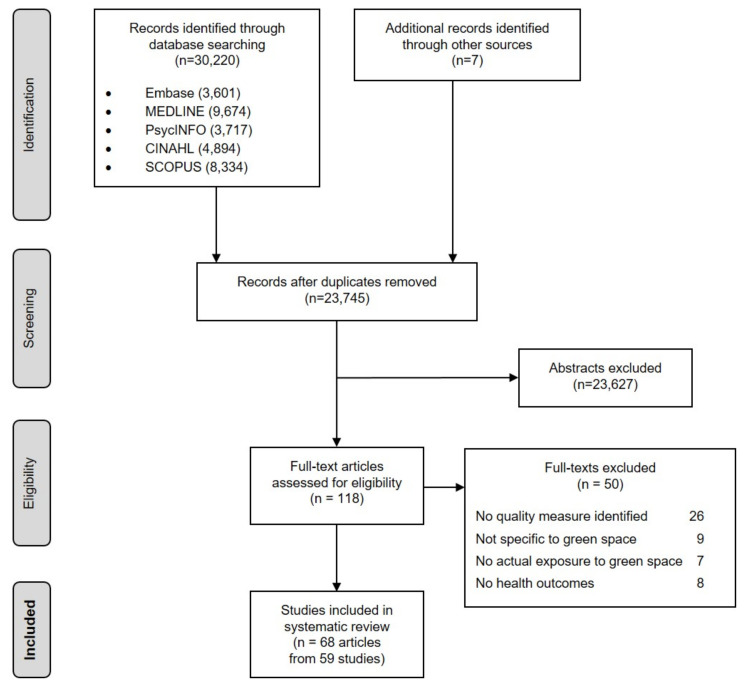
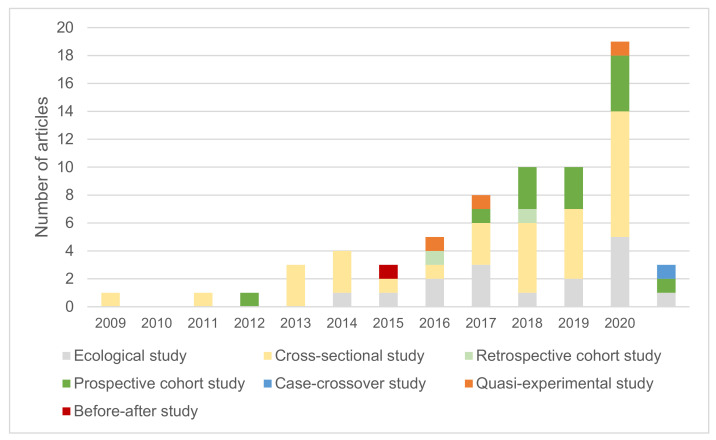
(1) Background: As cities densify, researcher and policy focus is intensifying on which green space types and qualities are important for health. We conducted a systematic review to examine whether particular green space types and qualities have been shown to provide health benefits and if so, which specific types and qualities, and which health outcomes. (2) Methods: We searched five databases from inception up to June 30, 2021. We included all studies examining a wide range of green space characteristics on various health outcomes. (3) Results: 68 articles from 59 studies were found, with a high degree of heterogeneity in study designs, definitions of quality and outcomes. Most studies were cross-sectional, ecological or cohort studies. Environment types, vegetation types, and the size and connectivity of green spaces were associated with improved health outcomes, though with contingencies by age and gender. Health benefits were more consistently observed in areas with greater tree canopy, but not grassland. The main outcomes with evidence of health benefits included allergic respiratory conditions, cardiovascular conditions and psychological wellbeing. Both objectively and subjectively measured qualities demonstrated associations with health outcomes. (4) Conclusion: Experimental studies and longitudinal cohort studies will strengthen current evidence. Evidence was lacking for needs-specific or culturally-appropriate amenities and soundscape characteristics. Qualities that need more in-depth investigation include indices that account for forms, patterns, and networks of objectively and subjectively measured green space qualities.
Overview
The claims and statistics of this paper haven’t been checked yet.
Run the check — free, no account needed. It reads the open-access text and checks the sources it cites.
Integrity signals
Registry
Cites
Statistics
Figures
Verification
Claims the paper makes
The claims and statistics of this paper haven’t been checked yet.
Run the check — free, no account needed. It reads the open-access text and checks the sources it cites.
Claims other papers make about this one
Each is checked against this paper’s own text: does it say what the citing paper says it does?
The source backs part of the claim, not all of it — or backs it for a different population, condition or comparison.
In the citing paper
“Nature exposure (ie, exposure to green and blue spaces) is thought to be beneficial, especially for mental, cardiovascular and respiratory health.1–4”
From Cross-sectional associations of different types of nature exposure with psychotropic, antihypertensive and asthma medication (2023) · cites this paper as [1]
Experimental — accuracy not yet measured
Self-check
Percentages, sums and reported differences re-computed from the paper’s own numbers.
The self-check needs the paper’s full text.
Citations
Cites
The PRISMA 2020 statement: An updated guideline for reporting systematic reviews
Page, M. J., McKenzie, J. E., Bossuyt, P. M., Boutron, I., Hoffmann, T. C., Mulrow, C. D., Shamseer, L., Tetzlaff, J. M., Akl, E. A., Brennan, S. E., et al. (2021) · BMJ · doi:10.1136/bmj.n71 · Cited by 108,283
The PRISMA 2020 statement: an updated guideline for reporting systematic reviews
Page, M. J., McKenzie, J., Bossuyt, P., Boutron, I., Hoffmann, T., mulrow, C., Shamseer, L., Tetzlaff, J., Akl, E., Brennan, S. E., et al. (2020) · doi:10.31222/osf.io/v7gm2 · Cited by 5,177
Exploring pathways linking greenspace to health: theoretical and methodological guidance
Markevych, I., Schoierer, J., Hartig, T., Chudnovsky, A., Hystad, P., Dzhambov, A. M., de Vries, S., Triguero-Mas, M., Brauer, M., Nieuwenhuijsen, M. J., et al. (2017) · Environmental Research · doi:10.1016/j.envres.2017.06.028 · Cited by 2,543
Self-citationTwohig-Bennett, C., & Jones, A. (2018) · Environmental Research · doi:10.1016/j.envres.2018.06.030 · Cited by 1,766
The significance of parks to physical activity and public health
Rung, A. L., Mowen, A. J., & Cohen, D. A. (2005) · American Journal of Preventive Medicine · doi:10.1016/j.amepre.2004.10.024 · Cited by 1,372
Gascon, M., Triguero-Mas, M., Martínez, D., Dadvand, P., Forns, J., Plasència, A., & Nieuwenhuijsen, M. (2015) · International Journal of Environmental Research and Public Health · doi:10.3390/ijerph120404354 · Cited by 1,171
McCormack, G. R., Rock, M. J., Toohey, A. M., & Hignell, D. (2010) · Health & Place · doi:10.1016/j.healthplace.2010.03.003 · Cited by 1,094
Streetscape greenery and health: Stress, social cohesion and physical activity as mediators
de Vries, S., van Dillen, S. M. E., Groenewegen, P. P., & Spreeuwenberg, P. (2013) · Social Science & Medicine · doi:10.1016/j.socscimed.2013.06.030 · Cited by 991
Association of Park Size, Distance, and Features With Physical Activity in Neighborhood Parks
Kaczynski, A. T., Potwarka, L. R., & Saelens, B. E. (2008) · American Journal of Public Health · doi:10.2105/ajph.2007.129064 · Cited by 796
Wood, L. J., Hooper, P., Foster, S. A., & Bull, F. (2017) · Health & Place · doi:10.1016/j.healthplace.2017.09.002 · Cited by 723
Research works printed but not linked: 1
- US National Research Council Committees on Environmental Epidemiology and Life Science (2021, September 15). Environmental-Epidemiology Studies: Their Design and Conduct, Available online: https://www.ncbi.nlm.nih.gov/books/NBK233644/.
Cited by
Sorted by citations
Astell‐Burt, T., Hartig, T., Putra, I. G. N. E., Walsan, R., Dendup, T., & Feng, X. (2022) · The Science of The Total Environment · doi:10.1016/j.scitotenv.2022.157521 · Cited by 232
Self-citationWhite, M. P., Hartig, T., Martin, L., Pahl, S., den Berg, A. E. V., Wells, N. M., Costongs, C., Dzhambov, A. M., Elliott, L. R., Godfrey, A., et al. (2023) · Environment International · doi:10.1016/j.envint.2023.108234 · Cited by 203
Advancing urban green and blue space contributions to public health
Hunter, R. F., Nieuwenhuijsen, M. J., Fabian, C., Murphy, N. M., O’Hara, K., Rappe, E., Sallis, J. F., Lambert, E. V., Sarmiento, O. L., Sugiyama, T., et al. (2023) · The Lancet Public Health · doi:10.1016/s2468-2667(23)00156-1 · Cited by 157
How do different types and characteristics of green space impact mental health? A scoping review
Beute, F., Marselle, M. R., Olszewska-Guizzo, A., Andreucci, M. B., Lammel, A., Davies, Z. G., Glanville, J., Keune, H., O’Brien, L., Remmen, R., et al. (2023) · People and Nature · doi:10.1002/pan3.10529 · Cited by 140
Urban Green Space and Subjective Well-Being of Older People: A Systematic Literature Review
Xu, T., Nordin, N. A., & Aini, A. M. (2022) · International Journal of Environmental Research and Public Health · doi:10.3390/ijerph192114227 · Cited by 100
Metadata
- Authors
- Nguyen, P.-Y., Astell-Burt, T., Rahimi-Ardabili, H., & Feng, X.
- Affiliations
- UNSW Sydney (AU)
- Population Wellbeing and Environment Research Lab (PowerLab), Wollongong, NSW 2522, Australia
- School of Population Health, University of New South Wales, Sydney, NSW 2033, Australia
- University of Wollongong (AU)
- Corresponding author
- Feng, Xiaoqi
- Venue
- International Journal of Environmental Research and Public Health
- Publisher
- MDPI AG
- Published
- 2021-10-20
- Volume
- 18
- Issue
- 21
- Pages
- 11028
- ISSN
- 1660-4601 (ISSN-L)
- PMC
- PMC8582763
- OpenAlex
- W3206924707
- Cited by
- 420
- References
- 111
- Citations by year
- 2026: 109 · 2025: 117 · 2024: 85 · 2023: 66 · 2022: 42 · 2021: 1
- FWCI
- 4.61
- Type
- journal article
- Language
- en
- Open access
- gold
- doi.org
- Licence
- Locations
- International Journal of Environmental Research and Public Health (publishedVersion, cc-by)
- Europe PMC (PubMed Central) (publishedVersion, other-oa)
- PubMed Central (publishedVersion, cc-by)
- PubMed (publishedVersion)
- Research Online (University of Wollongong) (submittedVersion)
- RePEc: Research Papers in Economics (submittedVersion)
- DOAJ (DOAJ: Directory of Open Access Journals) (submittedVersion, cc-by-sa)
- Figshare (submittedVersion)
- Funders
- National Health and Medical Research Council (1140317, 1148792, 1101065)
- Green Cities Fund (GC15005)
- Topics
- Social Sciences › Urban Studies › Urban Green Space and Health
- Physical Sciences › Environmental Science › Management, Monitoring, Policy and Law › Urban Arborization and Environmental Studies
- Social Sciences › Sociology and Political Science › Environmental Justice and Health Disparities
- Keywords
- green space quality, urban green space, health benefits, tree canopy, grassland, cardiovascular conditions, psychological well-being, age and gender differences, soundscape
- MeSH terms
- Parks, Recreational, Cities, Humans, Longitudinal Studies, Cohort Studies
About these checks
Registry, retraction, Cites and statistics results are computed, not judged, with one exception: a printed reference that no index lists is read once by a model before it counts as a citation error. Claims are extracted by a model and kept only when their quote appears verbatim in the text; each cited source is then checked, with a model’s help, for whether it says what the claim relies on. Those verdicts can be wrong — read the claim’s quote and the cited source before relying on one.
Statistics and arithmetic are recomputed, not judged.
Confidence bands are shown only for fields calibrated on our annotated test set. None is calibrated yet, so no band is shown.
What counts as a claim ›How we measure confidence ›How we check this ›
Are you an author, or do you see a problem with this page? Request a review
