

The DOI matches its Crossref record; 51 of the 52 references it cites were found in a registry or an index.
Prevalence, Risk Factors and Burnout Levels in Intensive Care Unit Nurses: A Systematic Review and Meta-Analysis
Open accessAbstract
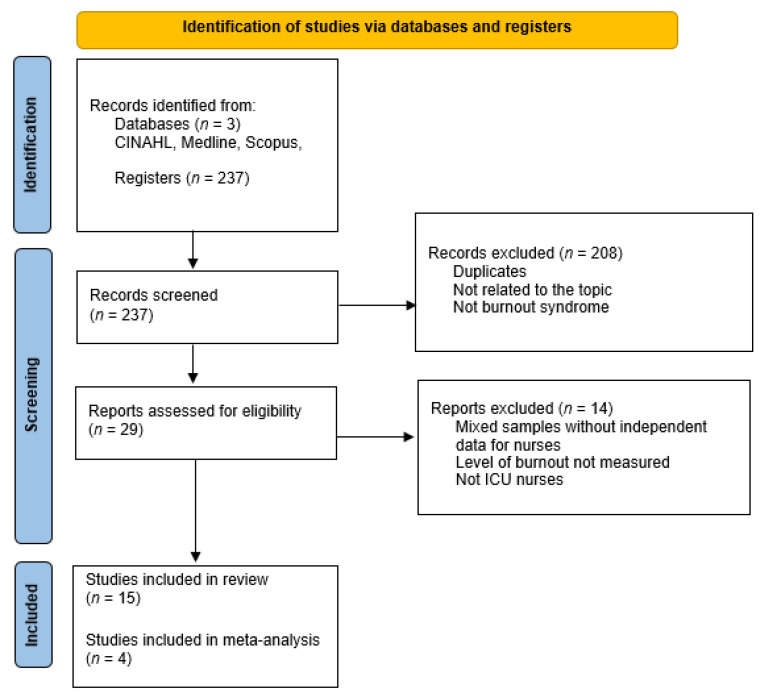
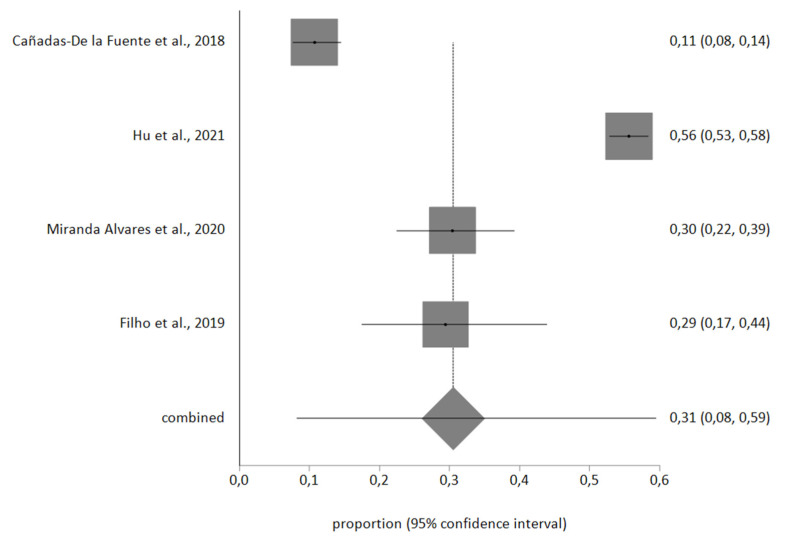
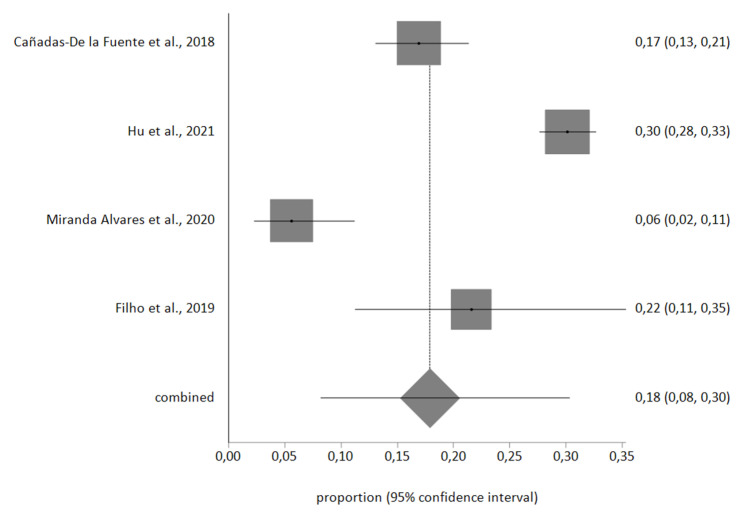
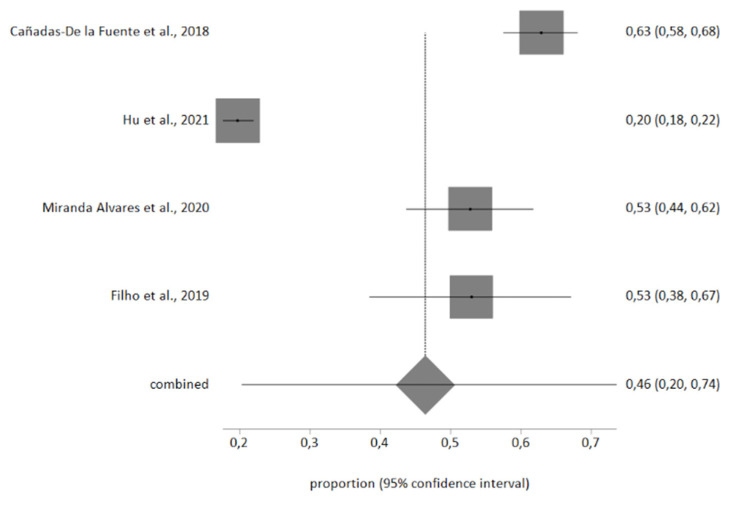
Nursing is considered to be an at-risk profession of burnout due to daily exposure to difficult situations such as death and pain care. In addition, some units such as the intensive care unit (ICU), can be stressful due to high levels of morbidity and mortality and ethical dilemmas. Burnout causes a deterioration in quality of care, increasing the risk of mortality in patients due to poor performance and errors in the healthcare environment. The aim of this study was to analyse the levels, prevalence and related factors of burnout in ICU nurses. A systematic review and meta-analysis were carried out in the Medline, Scopus and CINAHL databases. Fifteen articles were found for the systematic review and four for the meta-analysis. With a sample of n = 1986 nurses, the meta-analytic estimate prevalence for high emotional exhaustion was 31% (95% CI, 8–59%), for high depersonalization was 18% (95% CI, 8–30%), and for low personal accomplishment was 46% (95% CI, 20–74%). Within the dimensions of burnout, emotional exhaustion had a significant relationship with depression and personality factors. Both sociodemographic factors (being younger, single marital status, and having less professional experience in ICU) and working conditions (workload and working longer hours) influence the risk of burnout syndrome.
Overview
The claims and statistics of this paper haven’t been checked yet.
Run the check — free, no account needed. It reads the open-access text and checks the sources it cites.
Integrity signals
Registry
Cites
Statistics
Figures
Verification
Claims the paper makes
The claims and statistics of this paper haven’t been checked yet.
Run the check — free, no account needed. It reads the open-access text and checks the sources it cites.
Claims other papers make about this one
Each is checked against this paper’s own text: does it say what the citing paper says it does?
The source backs part of the claim, not all of it — or backs it for a different population, condition or comparison.
In the citing paper
“According to most recent studies, approximately half of physicians and nurses in the US report significant burnout symptoms in the form of high emotional exhaustion, high depersonalization, and/or a low sense of personal accomplishment.3-5”
From What do we really know about addressing burnout among healthcare workers? Maybe less than we think (2026) · cites this paper as [4]
Experimental — accuracy not yet measuredThe source backs part of the claim, not all of it — or backs it for a different population, condition or comparison.
In the citing paper
“According to the existing literature, emotional exhaustion is closely related to levels of depressive symptomatology, especially in the early stages of the pandemic (49, 52).”
From Evolution of burnout syndrome in Spanish healthcare professionals during and after the COVID-19 pandemic: psychosocial variables involved (2025) · cites this paper as [52]
Experimental — accuracy not yet measuredThe cited source says what the claim attributes to it.
In the citing paper
“This is consistent with previous studies that relate cognitive fusion (54) and depression (49, 52) to emotional exhaustion, and low levels of resilience with burnout (55, 56).”
From Evolution of burnout syndrome in Spanish healthcare professionals during and after the COVID-19 pandemic: psychosocial variables involved (2025) · cites this paper as [52]
Self-check
Percentages, sums and reported differences re-computed from the paper’s own numbers.
The self-check needs the paper’s full text.
Citations
Cites
The PRISMA 2020 statement: An updated guideline for reporting systematic reviews
Page, M. J., McKenzie, J. E., Bossuyt, P. M., Boutron, I., Hoffmann, T. C., Mulrow, C. D., Shamseer, L., Tetzlaff, J. M., Akl, E. A., Brennan, S. E., et al. (2021) · BMJ · doi:10.1136/bmj.n71 · Cited by 108,283
Maslach, C., Schaufeli, W. B., & Leiter, M. P. (2001) · Annual Review of Psychology · doi:10.1146/annurev.psych.52.1.397 · Cited by 12,852
Freudenberger, H. J. (1974) · Journal of Social Issues · doi:10.1111/j.1540-4560.1974.tb00706.x · Cited by 5,463
Healthcare staff wellbeing, burnout, and patient safety: a systematic review
Hall, L. H., Johnson, J., Watt, I., Tsipa, A., & O’Connor, D. B. (2016) · PLOS ONE · doi:10.1371/journal.pone.0159015 · Cited by 1,683
Salvagioni, D. A. J., Melanda, F. N., Mesas, A. E., González, A. D., Gabani, F. L., & Andrade, S. M. D. (2017) · PLOS ONE · doi:10.1371/journal.pone.0185781 · Cited by 1,508
Adriaenssens, J., Gucht, V. D., & Maes, S. (2014) · International Journal of Nursing Studies · doi:10.1016/j.ijnurstu.2014.11.004 · Cited by 904
Preventing occupational stress in healthcare workers
Ruotsalainen, J. H., Verbeek, J. H. A. M., Mariné, A., & Serra, C. (2015) · Cochrane Database of Systematic Reviews · doi:10.1002/14651858.cd002892.pub5 · Cited by 661
Preventing occupational stress in healthcare workers
Marine, A., Ruotsalainen, J. H., Serra, C., & Verbeek, J. H. (2006) · Cochrane Database of Systematic Reviews · doi:10.1002/14651858.cd002892.pub2 · Cited by 499
Hämmig, O. (2018) · BMC Health Services Research · doi:10.1186/s12913-018-3556-1 · Cited by 366
Moloney, W., Boxall, P., Parsons, M., & Cheung, G. (2018) · Journal of Advanced Nursing · doi:10.1111/jan.13497 · Cited by 273
Research works printed but not linked: 4
- Maslach, C., Jackson, S., and Leiter, M. (1996). The Maslach Burnout Inventory: Manual, Consulting Psychologist Press.
- Tobajas, 2017, Enfermería Global Study on anxiety in intensive care nursing pro-fessionals facing the process of death, Enfermería Glob., 45, 265
- Howick, J., Chalmers, I., Glasziou, P., Greenhalg, T., Heneghan, C., Liberati, A., Moschetti, I., Phillips, B., and Thornton, H. (2020, May 10). The Oxford 2011 Levels of Evidence. Available online: https://www.cebm.net/2016/05/ocebm-levels-of-evidence.
- 2017, Job strain and psychosocial as-pects of intensive care nurses, Enfermería Glob., 48, 108
Cited by
Sorted by citations
Quesada-Puga, C., Izquierdo-Espín, F. J., Membrive‐Jiménez, M. J., Aguayo‐Estremera, R., la Fuente, G. A. C., Romero‐Béjar, J. L., & Gómez‐Urquiza, J. L. (2024) · Intensive and Critical Care Nursing · doi:10.1016/j.iccn.2024.103660 · Cited by 210
Self-citationPapazian, L., Hraiech, S., Loundou, A., Herridge, M. S., & Boyer, L. (2023) · Intensive Care Medicine · doi:10.1007/s00134-023-07025-8 · Cited by 198
Bruyneel, A., Bouckaert, N., de Noordhout, C. M., Detollenaere, J., Kohn, L., Pirson, M., Sermeus, W., & den Heede, K. V. (2022) · International Journal of Nursing Studies · doi:10.1016/j.ijnurstu.2022.104385 · Cited by 157
Ge, M., Hu, F., Jia, Y., Tang, W. H., Zhang, W., & Chen, H. (2023) · Journal of Clinical Nursing · doi:10.1111/jocn.16708 · Cited by 170
Getie, ፟., Ayenew, T., Amlak, B. T., Gedfew, M., Edmealem, A., & Kebede, W. M. (2025) · BMC Nursing · doi:10.1186/s12912-025-03266-8 · Cited by 126
Metadata
- Authors
- Ramírez-Elvira, S., Romero-Béjar, J. L., Suleiman-Martos, N., Gómez-Urquiza, J. L., Monsalve-Reyes, C., Cañadas-De la Fuente, G. A., & Albendín-García, L.
- Affiliations
- Vall d'Hebron Hospital Universitari (ES)
- Statistics and Operational Research Department, University of Granada, Avda. Fuentenueva S/N, 18071 Granada, Spain
- Nursing Department, Faculty of Health Sciences, Campus Universitario de Ceuta, University of Granada, C/Cortadura del Valle S/N, 51001 Ceuta, Spain
- Universidad Católica de la Santísima Concepción (CL)
- Nursing Department, Faculty of Health Sciences, University of Granada, Avda. de la Ilustración 60, 18016 Granada, Spain
- Andalusian Health Service, Granada-Northeast Health Management Area, Ctra. de Murcia S/N, 18800 Granada, Spain
- ORCID
- Venue
- International Journal of Environmental Research and Public Health
- Publisher
- MDPI AG
- Published
- 2021-10-30
- Volume
- 18
- Issue
- 21
- Pages
- 11432
- ISSN
- 1660-4601 (ISSN-L)
- PMC
- PMC8583312
- OpenAlex
- W3209574741
- Cited by
- 267
- References
- 52
- Citations by year
- 2026: 61 · 2025: 82 · 2024: 66 · 2023: 41 · 2022: 17
- FWCI
- 7.68
- Type
- journal article
- Language
- en
- Open access
- gold
- doi.org
- Licence
- Locations
- International Journal of Environmental Research and Public Health (publishedVersion, cc-by)
- Europe PMC (PubMed Central) (publishedVersion, other-oa)
- PubMed Central (publishedVersion, cc-by)
- PubMed (publishedVersion)
- RePEc: Research Papers in Economics (submittedVersion)
- Institutional Repository of the University of Granada (University of Granada) (submittedVersion, cc-by)
- DOAJ (DOAJ: Directory of Open Access Journals) (submittedVersion, cc-by-sa)
- Topics
- Health Sciences › Medicine › Public Health, Environmental and Occupational Health › Occupational Health and Burnout
- Health Sciences › Health Professions › General Health Professions › Healthcare professionals’ stress and burnout
- Social Sciences › Psychology › Social Psychology › Stress and Burnout Research
- Keywords
- burnout, intensive care unit nurses, emotional exhaustion, depersonalization, personal accomplishment, risk factors, depression, personality factors, sociodemographic factors, workload, working hours
- MeSH terms
- Burnout, Psychological, Burnout, Professional, Humans, Intensive Care Units, Nurses, Risk Factors, Prevalence
About these checks
Registry, retraction, Cites and statistics results are computed, not judged, with one exception: a printed reference that no index lists is read once by a model before it counts as a citation error. Claims are extracted by a model and kept only when their quote appears verbatim in the text; each cited source is then checked, with a model’s help, for whether it says what the claim relies on. Those verdicts can be wrong — read the claim’s quote and the cited source before relying on one.
Statistics and arithmetic are recomputed, not judged.
Confidence bands are shown only for fields calibrated on our annotated test set. None is calibrated yet, so no band is shown.
What counts as a claim ›How we measure confidence ›How we check this ›
Are you an author, or do you see a problem with this page? Request a review
