

Use of E-Health in Dutch General Practice during the COVID-19 Pandemic
Open accessThe DOI matches its Crossref record; 18 of the 19 references it cites were found in a registry or an index.
Abstract
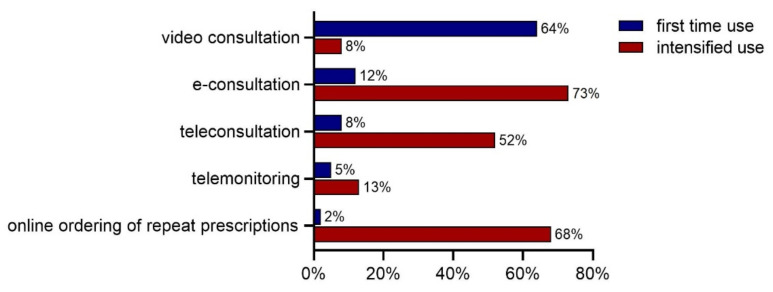
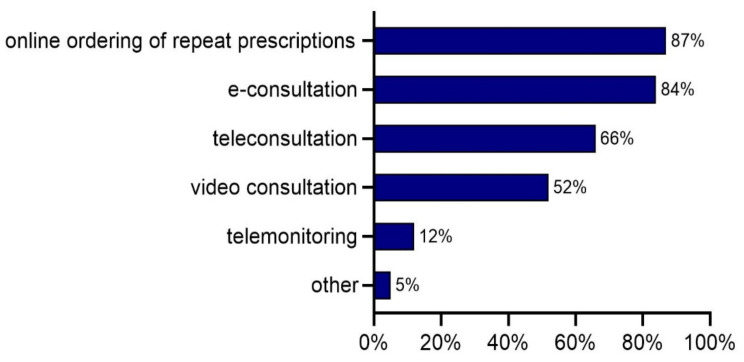
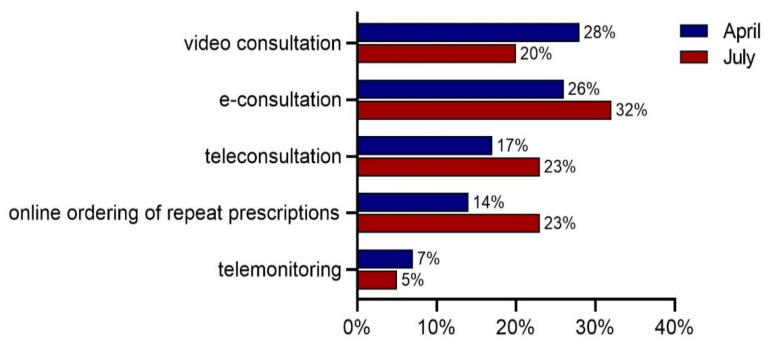
The COVID-19 pandemic has forced general practices to search for possibilities to provide healthcare remotely (e.g., e-health). In this study, the impact of the pandemic on the use of e-health in general practices in the Netherlands was investigated. In addition, the intention of practices to continue using e-health more intensively and differences in the use of e-health between practice types were investigated. For this purpose, web surveys were sent to general practices in April and July 2020. Descriptive data analysis was performed and differences in the use of e-health between practice types were tested using one-way ANOVA. Response rates were 34% (n = 1433) in April and 17% (n = 719) in July. The pandemic invoked an increased use of several (new) e-health applications. A minority of practices indicated the intention to maintain this increased use. In addition, small differences in the use of e-health between the different practice types were found. This study showed that although there was an increased uptake of e-health in Dutch general practice during the COVID-19 pandemic, only a minority of practices intends to maintain this increased use in the future. This may point towards a temporary uptake of digital healthcare delivery rather than accelerated implementation of digital processes.
Overview
The claims and statistics of this paper haven’t been checked yet.
Free: it reads the open-access text and checks the first 5 claims that cite a source we can check. Create a free account to check every claim.
Integrity signals
Registry
Cites
Statistics
Figures
Verification
Claims the paper makes
The claims and statistics of this paper haven’t been checked yet.
Free: it reads the open-access text and checks the first 5 claims that cite a source we can check. Create a free account to check every claim.
Claims other papers make about this one
Each is checked against this paper’s own text: does it say what the citing paper says it does?
The source backs part of the claim, not all of it — or backs it for a different population, condition or comparison.
In the citing paper
“Despite increased use, only 32% of practices in The Netherlands intended to continue using e-consultations. 27”
From Effectiveness and safety of asynchronous telemedicine consultations in general practice: a systematic review (2024) · cites this paper as [27]
Experimental — accuracy not yet measured
Self-check
Percentages, sums and reported differences re-computed from the paper’s own numbers.
The self-check needs the paper’s full text.
Citations
Cites
The theory of planned behavior
Ajzen, I. (1991) · Organizational Behavior and Human Decision Processes · doi:10.1016/0749-5978(91)90020-t · Cited by 134,657
Building on the momentum: Sustaining telehealth beyond COVID-19
Thomas, E. E., Haydon, H. M., Mehrotra, A., Caffery, L. J., Snoswell, C. L., Banbury, A., & Smith, A. C. (2022) · Journal of Telemedicine and Telecare · doi:10.1177/1357633x20960638 · Cited by 414
A MODEL FOR ASSESSMENT OF TELEMEDICINE APPLICATIONS: MAST
Kidholm, K., Ekeland, A. G., Jensen, L. K., Rasmussen, J., Pedersen, C. D., Bowes, A., Flottorp, S. A., & Bech, M. (2012) · International Journal of Technology Assessment in Health Care · doi:10.1017/s0266462311000638 · Cited by 383
A Qualitative Study of Primary Care Physicians’ Experiences With Telemedicine During COVID-19
Gomez, T., Anaya, Y. B., Shih, K. J., & Tarn, D. M. (2021) · The Journal of the American Board of Family Medicine · doi:10.3122/jabfm.2021.s1.200517 · Cited by 310
Bhaskar, S., Bradley, S., Chattu, V. K., Adisesh, A., Nurtazina, A., Kyrykbayeva, S., Sakhamuri, S., Yaya, S., Sunil, T., Thomas, P., et al. (2020) · Frontiers in Public Health · doi:10.3389/fpubh.2020.556720 · Cited by 305
Bokolo, A. J. (2021) · Health and Technology · doi:10.1007/s12553-020-00516-4 · Cited by 230
COVID-19 and primary care in six countries
Huston, P., Campbell, J., Russell, G., Goodyear-Smith, F., Phillips, R. L., van Weel, C., & Hogg, W. (2020) · BJGP Open · doi:10.3399/bjgpopen20x101128 · Cited by 164
Telehealth uptake in general practice as a result of the coronavirus (COVID-19) pandemic
Snoswell, C. L., Caffery, L. J., Haydon, H. M., Thomas, E. E., & Smith, A. C. (2020) · Australian Health Review · doi:10.1071/ah20183 · Cited by 144
Johnsen, T. M., Norberg, B. L., Kristiansen, E., Zanaboni, P., Austad, B., Krogh, F. H., & Getz, L. (2021) · Journal of Medical Internet Research · doi:10.2196/26433 · Cited by 135
Empowering the health workforce to make the most of the digital revolution
Socha-Dietrich, K. (2021) · OECD health working papers · doi:10.1787/37ff0eaa-en · Cited by 129
Research works printed but not linked: 2
- Rogers E.M. Diffusion of Innovations 5th ed. Free Press New York, NY, USA 2003
- Davis F.D. A Technology Acceptance Model for Empirically Testing New End-User Information Systems: Theory and Results Massachusetts Institute of Technology Cambridge, MA, USA 1986
Cited by
Hvidt, E. A., Atherton, H., Keuper, J., Kristiansen, E., Lüchau, E. C., Norberg, B. L., Steinhäuser, J., van den Heuvel, J., & van Tuyl, L. H. D. (2023) · Journal of Medical Internet Research · doi:10.2196/47173 · Cited by 57
Self-citationAlsahli, S., Hor, S.-Y., & Lam, M. K. (2023) · JMIR mhealth and uhealth · doi:10.2196/50419 · Cited by 54
Peeters, K. M. M., Reichel, L. A. M., Muris, D. M. J., & Cals, J. (2024) · JAMA Network Open · doi:10.1001/jamanetworkopen.2023.51623 · Cited by 44
Leighton, C., Cooper, A., Porter, A., Edwards, A., & Joseph-Williams, N. (2024) · BJGP Open · doi:10.3399/bjgpo.2023.0177 · Cited by 34
“27 Supplementary Table S1 details study characteristics.”
Peeters, K. M. M., Giroldi, E., Veldhuizen, L., Abdelaziz, K., Muris, D. M. J., & Cals, J. (2023) · Journal of Medical Internet Research · doi:10.2196/40318 · Cited by 23
Meurs, M., Keuper, J., Sankatsing, V. D. V., Batenburg, R. S., & van Tuyl, L. H. D. (2022) · International Journal of Environmental Research and Public Health · doi:10.3390/ijerph19095120 · Cited by 19
Self-citationTensen, E., Kuziemsky, C. E., Jaspers, M., & Peute, L. (2023) · JMIR Dermatology · doi:10.2196/46682 · Cited by 12
Kollmann, J., Sana, S., Magnée, T., Boer, S., Merkelbach, I., Kocken, P., & Denktaş, S. (2024) · Primary Health Care Research & Development · doi:10.1017/s1463423624000240 · Cited by 10
Rijpkema, C., Bos, N., Brandenbarg, D., Homburg, M., Beugel, G., Barkema, W. S., Hartman, T. O., Muris, J. W. M., Peters, L. L., Berger, M. Y., et al. (2023) · BMC Health Services Research · doi:10.1186/s12913-023-09654-7 · Cited by 10
Self-citationGangapersad, R. N., Zhou, G., García‐Gómez, P., Bos, J., Hak, E., Koch, B. C. P., Schuiling‐Veninga, C. C. M., & Dierckx, B. (2024) · European Child & Adolescent Psychiatry · doi:10.1007/s00787-023-02340-3 · Cited by 9
Care by general practitioners for patients with asthma or COPD during the COVID-19 pandemic
Rijpkema, C., Ramerman, L., Homburg, M., Meijer, E., Muris, J. W. M., Hartman, T. O., Berger, M. Y., Peters, L. L., & Verheij, R. A. (2023) · npj Primary Care Respiratory Medicine · doi:10.1038/s41533-023-00340-z · Cited by 9
Self-citationGeneral Practices’ Experiences With Patients’ Web-Based Access to Medical Records: Survey Study
Keuper, J., Batenburg, R. S., van Tuyl, L. H. D., & Verheij, R. A. (2023) · Journal of Medical Internet Research · doi:10.2196/41832 · Cited by 8
Self-citationLeighton, C., Joseph-Williams, N., Porter, A., Edwards, A., & Cooper, A. (2025) · BMC Primary Care · doi:10.1186/s12875-025-02717-0 · Cited by 7
Blood pressure measurements for diagnosing hypertension in primary care: room for improvement
Voorbrood, V., de Schepper, E. I. T., Bohnen, A. M., Ruiterkamp, M. F. E., Rijnbeek, P. R., & Bindels, P. (2024) · BMC Family Practice · doi:10.1186/s12875-023-02241-z · Cited by 7
E-Health Family Interventions for Parents of Children With Autism Aged 0–6 Years: A Scoping Review
Shang, C., Xie, W., Zeng, J., Osman, N., Sun, C., Zou, M., Wang, J., & Wu, L. (2024) · Psychiatry Investigation · doi:10.30773/pi.2023.0399 · Cited by 7
Schnoor, K., Versluis, A., Chavannes, N. H., & Talboom-Kamp, E. P. W. A. (2023) · JMIR Formative Research · doi:10.2196/42151 · Cited by 6
Caring remotely through ‘fitting’: Video consultation use in Danish general practice
Lüchau, E. C., Olesen, F., Atherton, H., Søndergaard, J., & Hvidt, E. A. (2024) · Health An Interdisciplinary Journal for the Social Study of Health Illness and Medicine · doi:10.1177/13634593241306577 · Cited by 6
Beerbaum, J., Robens, S., Fehring, L., Mortsiefer, A., & Meister, S. (2025) · JMIR Formative Research · doi:10.2196/58867 · Cited by 6
Sturm, J., Dierick, A., Christianen, M., van Gelder, M., & Wouters, E. (2023) · Healthcare · doi:10.3390/healthcare11111612 · Cited by 5
Houben, F., den Heijer, C. D. J., Dukers–Muijrers, N. H. T. M., de Bont, E. G. P. M., Volbeda, H. T., & Hoebe, C. J. P. A. (2024) · BMC Family Practice · doi:10.1186/s12875-024-02451-z · Cited by 5
Innovative Methods Used in Monitoring COVID-19 in Europe: A Multinational Study
Unim, B., Schutte, N. M., Thißen, M., & Palmieri, L. (2022) · International Journal of Environmental Research and Public Health · doi:10.3390/ijerph20010564 · Cited by 5
Oudbier, S. J., Cate, T. A. T., Nurmohamed, A. S., Meij, H. J., & Smets, E. M. A. (2025) · PEC Innovation · doi:10.1016/j.pecinn.2025.100448 · Cited by 4
Spierings, J. F., Willinge, G. J. A., Kokke, M. C., Twigt, B. A., de Lange, W., Geerdink, T. H., van der Velde, D., Repping, S., & Goslings, J. C. (2023) · JMIR mhealth and uhealth · doi:10.2196/51510 · Cited by 4
Exploring effective patient feedback methods for eHealth in general practice
Nasori, M., der Vossen, M. M., Holtrop, M., & Bont, J. (2025) · BMC Family Practice · doi:10.1186/s12875-025-02725-0 · Cited by 3
Bremmers, L. G. M., Roijen, L. H., Gräler, E. S., Groot, C. A. U., & Fabbricotti, I. N. (2022) · International Journal of Environmental Research and Public Health · doi:10.3390/ijerph192416425 · Cited by 3
Lukaschek, K., Lezius, S., van den Akker, M., Hanf, M., Zapf, A., Heider, D., König, H. ‐., Gensichen, J. S., & for the PREMA-study group (2023) · International Journal of Cognitive Therapy · doi:10.1007/s41811-023-00195-9 · Cited by 2
Schnoor, K., Talboom-Kamp, E. P. W. A., Hajtić, M., Chavannes, N. H., & Versluis, A. (2024) · JMIR Human Factors · doi:10.2196/45115 · Cited by 2
Machado, A. T. G. D. M., Pinto, R. D. S., Peixoto, R. T. R. D. C., Perillo, R. D., Borde, E., de Freitas, M. A. C., Macieira, C., Senna, M. I. B., Godoy, S. C. B., de Aguiar, R. A. T., et al. (2023) · Telemedicine Journal and e-Health · doi:10.1089/tmj.2022.0441 · Cited by 1
Zanaboni, P., Bergmo, T. S., & Kristiansen, E. (2024) · BMJ Open · doi:10.1136/bmjopen-2023-075352 · Cited by 1
e-Health in the time of COVID-19. The leap forward: hold onto it before it backslides!
Elsanousi, Y. E. A. (2022) · World Journal of Advanced Research and Reviews · doi:10.30574/wjarr.2022.16.3.1359
Assessing the implementation of electronic consultation in the Ghanaian health sector.
Nketia, M. O. (2023) · ResearchSpace (University of KwaZulu-Natal) · doi:10.29086/10413/22911
Auener, S. L. (2025) · Radboud Repository (Radboud University)
Keuper, J. J., Tuyl, L. H. D. V., & Batenburg, R. S. (2024) · Radboud Repository (Radboud University)
Self-citationNurses of the future: Exploring competencies, tasks and labour market trends in nursing
Wit, R. F. (2025) · Radboud Repository (Radboud University)
Fuger, J. M., Voggenberger, L., & Zelko, E. (2026) · Journal of Medical Internet Research · doi:10.2196/83343
Standaar, L. M. B., van der Vaart, R., Menting, J., Leenaars, K. E. F., Friele, R. D., & van Tuyl, L. H. D. (2026) · INQUIRY The Journal of Health Care Organization Provision and Financing · doi:10.1177/00469580261469829
USERS’ INTENTION TO USE AN E WALLET INTEGRATED WITH E-HEALTH
Ming, K. L. Y., Ling, P. S., & Jais, M. (2022) · International Journal of Accounting, Finance and Business
Metadata
- Authors
- Keuper, J., Batenburg, R., Verheij, R., & van Tuyl, L.
- Affiliations
- Tilburg University (NL)
- Radboud University Nijmegen (NL)
- Netherlands Institute for Health Services Research (NL)
- Corresponding author
- Keuper, Jelle
- Venue
- International Journal of Environmental Research and Public Health
- Publisher
- MDPI AG
- Published
- 2021-11-26
- Volume
- 18
- Issue
- 23
- Pages
- 12479
- ISSN
- 1660-4601 (ISSN-L)
- PMC
- PMC8656482
- OpenAlex
- W3217218546
- Semantic Scholar
- fab93bf5949cd87ea0f9193114af1e9d96555068
- Cited by
- 32
- References
- 19
- Citations by year
- 2026: 2 · 2025: 4 · 2024: 9 · 2023: 12 · 2022: 5
- FWCI
- 5.63
- Type
- journal article
- Language
- en
- Open access
- gold
- doi.org
- Licence
- Locations
- International Journal of Environmental Research and Public Health (publishedVersion, cc-by)
- PubMed Central (publishedVersion, cc-by)
- PubMed (publishedVersion)
- Research portal (Tilburg University) (submittedVersion, cc-by)
- Data Archiving and Networked Services (DANS) (submittedVersion, cc-by)
- Data Archiving and Networked Services (DANS) (submittedVersion, other-oa)
- RePEc: Research Papers in Economics (submittedVersion)
- DOAJ (DOAJ: Directory of Open Access Journals) (submittedVersion, cc-by-sa)
- Radboud Repository (Radboud University) (submittedVersion)
- Radboud Repository (Radboud University) (submittedVersion, other-oa)
- Funders
- Dutch Healthcare Authority (NZa) ((no grant number))
- Topics
- Health Sciences › Medicine › Public Health, Environmental and Occupational Health › Telemedicine and Telehealth Implementation
- Health Sciences › Health Professions › Health Information Management › Electronic Health Records Systems
- Physical Sciences › Computer Science › Information Systems › Healthcare during COVID-19 Pandemic
- Keywords
- e-health, general practice, COVID-19 pandemic, remote care, digital health adoption, practice type, primary care, Netherlands
- MeSH terms
- COVID-19, SARS-CoV-2, Humans, Surveys and Questionnaires, Telemedicine, General Practice, Pandemics
About these checks
Registry, retraction, Cites and statistics results are computed, not judged, with one exception: a printed reference that no index lists is read once by a model before it counts as a citation error. Claims are extracted by a model and kept only when their quote appears verbatim in the text; each cited source is then checked, with a model’s help, for whether it says what the claim relies on. Those verdicts can be wrong — read the claim’s quote and the cited source before relying on one.
Statistics and arithmetic are recomputed, not judged.
Confidence bands are shown only for fields calibrated on our annotated test set. None is calibrated yet, so no band is shown.
What counts as a claim ›How we measure confidence ›How we check this ›
Are you an author, or do you see a problem with this page? Request a review
Data sources
Bibliographic data: Semantic Scholar, OpenAlex, Crossref.
Contains information from the Semantic Scholar Academic Graph Datasets, made available under the ODC Attribution License (ODC-BY 1.0).
Semantic Scholar’s data is described in: Kinney, R., et al. (2023). The Semantic Scholar Open Data Platform. arXiv:2301.10140.
