

Direct and Indirect Effects of Indoor Particulate Matter on Blood Indicators Related to Anemia
Open accessThe DOI matches its Crossref record; 38 of the 38 references it cites were found in a registry or an index.
Abstract
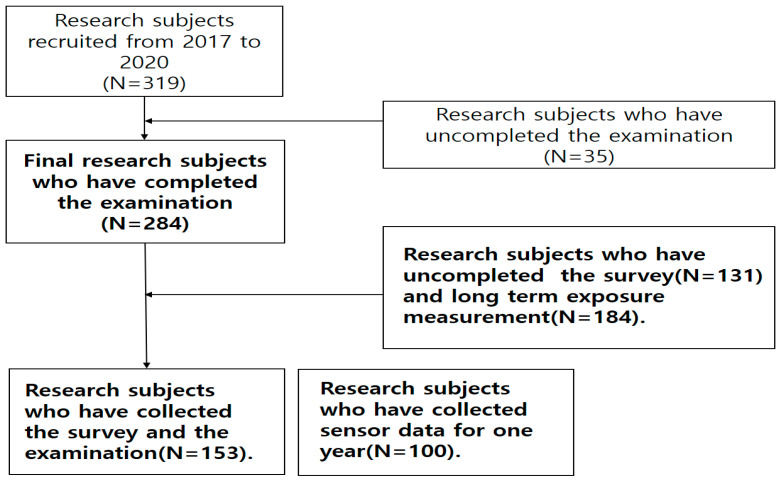
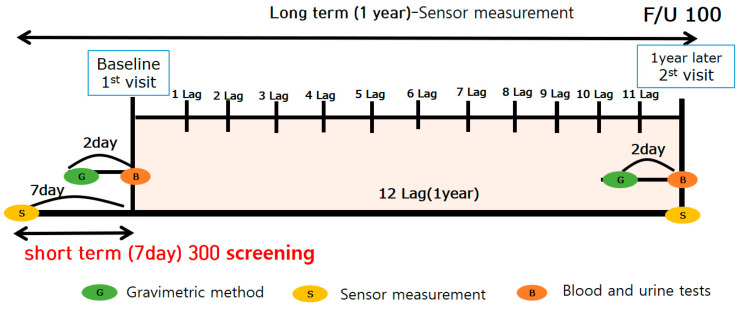
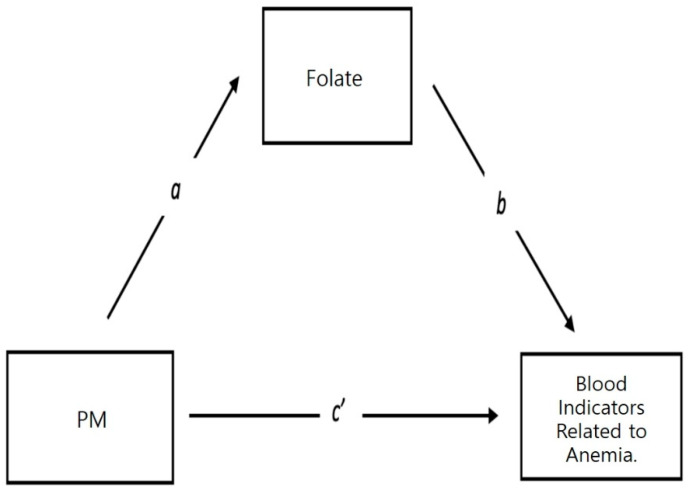
Exposure to indoor particulate matter (PM) is a potential risk factor that increases systemic inflammation and affects erythropoiesis. This study investigated the association between exposure to indoor PM and blood indicators related to anemia (BIRA) in housewives. Indoor PM and blood folate status are important factors in the risk of anemia. This was a housewife cohort study; we recruited 284 housewives in Seoul and Ulsan, Republic of Korea. Indoor exposure to PM2.5 and PM10 was measured by gravimetric analysis and sensors. We investigated the BIRA, such as hemoglobin (Hb), hematocrit, mean corpuscular volume (MCV), mean corpuscular Hb (MCH), and mean corpuscular Hb concentration (MCHC). Statistical analysis was performed by multiple linear regression model and mediation analysis. The association between BIRA and PM was assessed by multiple linear regression models fitted by mediation analyses. The increase in the level of indoor PM2.5 was associated with a decrease in MCV (Beta coefficient (B): −0.069, Standard error (SE): 0.022) and MCH (B: −0.019, SE: 0.009) in gravimetric measurements. The increase in the level of indoor PM2.5 was associated with a decrease in Hb (B: −0.024, SE: 0.011), hematocrit (B: −0.059, SE: 0.033), and MCV (B: −0.081, SE: 0.037) and MCH (B: −0.037, SE: 0.012) in sensor measurements (PM2.5-Lag10). Further, we identified a serum folate-mediated PM effect. The indoor PM exposure was significantly associated with decreased Hb, MCV, and MCH in housewives. Taken together, our data show that exposure to indoor PM is a risk factor for anemia in housewives. Blood folate concentration can be a mediating factor in the effect of indoor PM on BIRA. Therefore, folate intake should be recommended to prevent anemia in housewives. Moreover, indoor PM exposure should be managed.
Overview
The claims and statistics of this paper haven’t been checked yet.
Free: it reads the open-access text and checks the first 5 claims that cite a source we can check. Create a free account to check every claim.
Integrity signals
Registry
Cites
Statistics
Figures
Verification
Claims the paper makes
The claims and statistics of this paper haven’t been checked yet.
Free: it reads the open-access text and checks the first 5 claims that cite a source we can check. Create a free account to check every claim.
Claims other papers make about this one
Each is checked against this paper’s own text: does it say what the citing paper says it does?
The source backs part of the claim, not all of it — or backs it for a different population, condition or comparison.
In the citing paper
“household PM2.5 and PM10 levels negatively correlated with hemoglobin levels [51].”
From Environmental Contaminants, Iron Deficiency, and Iron‐Deficiency Anemia: A Review of the Literature (2025) · cites this paper as [51]
Experimental — accuracy not yet measured
Self-check
Percentages, sums and reported differences re-computed from the paper’s own numbers.
The self-check needs the paper’s full text.
Citations
Cites
Effect of Particulate Matter Air Pollution on Cardiovascular Oxidative Stress Pathways
Rao, X., Zhong, J., Brook, R. D., & Rajagopalan, S. (2018) · Antioxidants & Redox Signaling · doi:10.1089/ars.2017.7394 · Cited by 359
PM2.5 induces ferroptosis in human endothelial cells through iron overload and redox imbalance
Wang, Y., & Tang, M. (2019) · Environmental Pollution · doi:10.1016/j.envpol.2019.07.105 · Cited by 253
Antioxidants Mediate Both Iron Homeostasis and Oxidative Stress
Imam, M., Zhang, S., Ma, J., Wang, H., & Wang, F. (2017) · Nutrients · doi:10.3390/nu9070671 · Cited by 223
Does biofuel smoke contribute to anaemia and stunting in early childhood?
Mishra, V., & Retherford, R. D. (2007) · International Journal of Epidemiology · doi:10.1093/ije/dyl234 · Cited by 194
Zhong, J., Karlsson, O., Wang, G., Li, J., Guo, Y., Lin, X., Zemplenyi, M., Sanchez-Guerra, M., Trevisi, L., Urch, B., et al. (2017) · Proceedings of the National Academy of Sciences · doi:10.1073/pnas.1618545114 · Cited by 155
Prevalence of Anaemia, Deficiencies of Iron and Folic Acid and Their Determinants in Ethiopian Women
Haidar, J. (2010) · Journal of Health, Population and Nutrition · doi:10.3329/jhpn.v28i4.6042 · Cited by 150
Vreugdenhil, G., Wognum, A. W., van Eijk, H. G., & Swaak, A. J. G. (1990) · Annals of the Rheumatic Diseases · doi:10.1136/ard.49.2.93 · Cited by 147
The Mothers and Children’s Environmental Health (MOCEH) study
The MOCEH Study Group, Kim, B.-M., Ha, M., Park, H.-S., Lee, B. E., Kim, Y. J., Hong, Y.-C., Kim, Y., Chang, N., Roh, Y.-M., et al. (2009) · European Journal of Epidemiology · doi:10.1007/s10654-009-9370-7 · Cited by 119
Self-citationHonda, T., Pun, V. C., Manjourides, J., & Suh, H. (2017) · Environment International · doi:10.1016/j.envint.2017.01.017 · Cited by 114
Laboratory assessment of folate (vitamin B9) status
Sobczyńska‐Malefora, A., & Harrington, D. J. (2018) · Journal of Clinical Pathology · doi:10.1136/jclinpath-2018-205048 · Cited by 106
Cited by
Deng, Y.-L., Steenland, K., Sinharoy, S. S., Peel, J. L., Ye, W., Pillarisetti, A., Eick, S. M., Chang, H. H., Wang, J., Chen, Y., et al. (2024) · Environment International · doi:10.1016/j.envint.2024.108815 · Cited by 23
“In a cohort study comprising 319 women, Kwag et al. (2021) reported that increased indoor PM 2.5 levels were linked to reduced hemoglobin levels ( β : (cid:0) 0.024, SE: 0.011).”
BackgroundInfluentialFloková, L., Hübelová, D., Kozumplíková, A., Caha, J., & Janošíková, L. (2023) · Cities · doi:10.1016/j.cities.2023.104338 · Cited by 21
Yadav, V. K., Bijekar, S., Gacem, A., Alkahtani, A. M., Yadav, K. K., Alreshidi, M. A., Kumar, P., Ghosh, T., Verma, R. K., Mishra, S., et al. (2023) · Particle & Particle Systems Characterization · doi:10.1002/ppsc.202300157 · Cited by 15
Risk analysis of air pollutants and types of anemia: a UK Biobank prospective cohort study
Li, L., Ran, Y., Zhuang, Y., Wang, L., Chen, J., Sun, Y., Lu, S., Ye, F., Mei, L., Ning, Y., et al. (2024) · International Journal of Biometeorology · doi:10.1007/s00484-024-02670-0 · Cited by 14
“…our study, a cross-sectional study of Korean housewives showed that while the overall effect of PM 2.5 exposure was a decrease in mean corpuscular volume (MCV) and mean corpuscular hemoglobin (MCH), PM 2.5 was also significantly negatively correlated with serum folate levels (Kwag et al. 2021 ).”
InfluentialExposure to air pollution as a risk factor for anaemia: a global scoping review
Khan, Y., & Banerjee, R. (2024) · International Journal of Environmental Health Research · doi:10.1080/09603123.2024.2327532 · Cited by 13
FAKTOR YANG MEMENGARUHI KEJADIAN ANEMIA PADA IBU HAMIL DI PUSKESMAS KAMPUNG DALAM
Asseggaf, S. N. Y. R. S., Zakiah, M., & Nurmainah, N. (2023) · Jurnal Vokasi Kesehatan · doi:10.30602/jvk.v9i1.1102 · Cited by 12
Effect of PM concentration on anemia blood indicators reduced by air purifiers
Kwag, Y., Oh, J., Yang, W., Kim, Y., Ha, E.-H., & Ye, S. (2023) · Chemosphere · doi:10.1016/j.chemosphere.2023.138131 · Cited by 11
Self-citationAppiah-Dwomoh, C., Tettey, P., Akyeampong, E., Amegbor, P. M., Okello, G., Botwe, P. K., & Quansah, R. (2024) · BMC Public Health · doi:10.1186/s12889-024-18304-4 · Cited by 11
Status and frontier analysis of indoor PM2.5-related health effects: a bibliometric analysis
Zhao, X., Xu, H., Li, Y., Liu, Y., Guo, C., & Li, Y. (2023) · Reviews on Environmental Health · doi:10.1515/reveh-2022-0228 · Cited by 8
Effects of PM2.5 exposure on hematopoiesis and coupled immune disorder in adult male mice
Ma, L., Wang, Y., Wang, H., Ren, L., Guo, Y., Qin, L., Gong, Z., Li, G., & Sang, N. (2024) · Journal of Environmental Sciences · doi:10.1016/j.jes.2024.08.030 · Cited by 8
Zheng, Y., Liu, X., Song, X., He, Y., Kang, N., Zhang, C., Liao, W., Yuchi, Y., Hou, J., Mao, Z., et al. (2023) · Environmental Science and Pollution Research · doi:10.1007/s11356-022-25074-2 · Cited by 7
“5 was explained for decreased hemoglobin, HCT, MCV, and mean corpuscular hemoglobin (MCH) (Kwag et al.”
BackgroundZheng, Y., He, Y., Kang, N., Zhang, C., Liao, W., Yuchi, Y., Liu, X., Hou, J., Mao, Z., Huo, W., et al. (2023) · Toxics · doi:10.3390/toxics11110885 · Cited by 7
“Researchers in the Korean Children’s Environmental Health Study observed a negative correlation between indoor PM 2.5 and HGB and HCT levels [14].”
BackgroundInfluentialEnvironmental Contaminants, Iron Deficiency, and Iron‐Deficiency Anemia: A Review of the Literature
Lichtler, R., & Cowley, M. (2025) · Scientifica · doi:10.1155/sci5/5007983 · Cited by 6
“5 and PM10 levels negatively correlated with hemoglobin levels [51].”
Pacheco‐Miranda, S., Owais, A., López, M. V., Herrera, E. Y. K., Unar‐Munguía, M., Mejía‐Rodríguez, F., Merritt, C. E., Lee, C., Rattan, P., Ataullahjan, A., et al. (2024) · American Journal of Clinical Nutrition · doi:10.1016/j.ajcnut.2024.05.032 · Cited by 5
RetractedAssessing the impact of air pollution on anemia: a comprehensive review and meta-analysis
Dinh, C.-T., Lee, Y., Chang, L.-T., Chang, T.-Y., Chung, K. F., Lee, K.-Y., Chang, J., & Chuang, H. (2026) · Expert Review of Hematology · doi:10.1080/17474086.2026.2643325 · Cited by 4
“…77 reports were assessed, with 41 being excluded for various reasons, including irrelevance to the study focus (13 reviews/commentaries), being outside the study’s scope (16), lack of a direct air pollution effect (6), or missing necessary data, such as effect estimates of the associations (6).”
Li, X., Li, Z., Sun, Y., Zhang, M., Zhong, M., Wu, Y., Chen, X., Sun, X., Chen, D., Cai, H., et al. (2025) · Atmospheric Environment · doi:10.1016/j.atmosenv.2025.121432 · Cited by 3
Pamungkas, Y., Indriani, R. D., & Syulthoni, Z. B. (2024) · Proceeding of the Electrical Engineering Computer Science and Informatics · doi:10.1109/eecsi63442.2024.10776106 · Cited by 3
Ren, L., Hou, G., Ma, L., Wang, H., Ku, T., Li, G., & Sang, N. (2025) · Environmental Science & Technology · doi:10.1021/acs.est.5c03663 · Cited by 2
The Association Between Ambient Particulate Matter Exposure and Anemia in HIV/AIDS Patients
Liang, W., Han, A., Hou, D., Li, R., Hu, Q., Shen, H., Jin, Y., & Xiang, H. (2024) · Epidemiology · doi:10.1097/ede.0000000000001825 · Cited by 1
“Based on previous literature regarding the associations between PM and anemia, 12,35–37 we identified relevant covariates from the CRIMS, medical records systems of designated AIDS treatment hospitals, questionnaires, and telephone follow-ups.”
Li, X., Wu, Z., Zhao, Y., Chen, X., Li, Z., Sun, Y., Gong, Y., Hu, P., Huang, X., Pan, W., et al. (2025) · Journal of Global Health · doi:10.7189/jogh.15.04346 · Cited by 1
“Other confounding factors, such as higher probability of outdoor exposure among men and increased exposure to cooking fumes among women, could also explain the observed effects [ 39 , 40 ].”
Barnwal, J., Hussain, D., & Chandra, R. K. (2026) · PLoS ONE · doi:10.1371/journal.pone.0343845 · Cited by 1
“Many studies have also found that exposure to IAP reduces haemoglobin levels, thereby increasing the risk of anaemia [9,15,36,37].”
Enfermedades hematológicas y contaminación del aire: una revisión narrativa de la literatura
Jaramillo-Aguilar, S., Jaramillo-Aguilar, L., Flores-Carpio, D. I., Guamán-Caguana, T. A., Feijó-Erazo, M., & Jaramillo-Cabrera, M. (2025) · Revista Hematología · doi:10.48057/hematologa.v29i3.670
“Entre los contaminantes implicados se incluyen PM 2.5 , PM 10 , NO 2 , SO 2 , CO y productos derivados de la combustión, tanto en ambientes exteriores como interiores (15,16) .”
InfluentialEstimating the risk of anemia associated with PM2.5 exposure in Nepalese women of reproductive age
Acharya, S. R., & Bhatta, J. (2026) · Communications Medicine · doi:10.1038/s43856-026-01533-6
Díaz, J. A. S. (2025) · LA Referencia (Red Federada de Repositorios Institucionales de Publicaciones Científicas)
Dinh, C.-T., Chuang, H., Tran, H. M., Wang, Y., Lin, Y.-C., Vo-Pham-Minh, T., Tseng, C., Su, C.-L., Lee, K., Chen, T.-T., et al. (2026) · Aerosol and Air Quality Research · doi:10.1007/s44408-026-00131-4
“Previ - ous studies highlight significant associations between PM 2.5 exposure and anemia-related indices, such as hemoglobin, hematocrit, mean corpuscular volume (MCV), and mean corpuscular hemoglobin (MCH) (Kwag et al. 2021; Ameg-bor et al. 2022; Xie et al. 2022; Odo et al. 2023; Hwang and Kim 2024).”
InfluentialNegotiating Clean Energy: Women’s Bargaining Power and the impact of energy transition subsidyPreprint
Sureka, K., & Filippini, M. (2026) · SSRN Electronic Journal · doi:10.2139/ssrn.7206695
Yuksel, B., & Yildirim, S. A. (2026) · Frontiers in Public Health · doi:10.3389/fpubh.2026.1953388
“Indoor PM exposure has been separately linked to reductions in anaemia-related blood indices, such as mean corpuscular volume and mean corpuscular haemoglobin (17).”
Lee, K., Reynolds, B.-L., Dinesh, A., Lipke, L., & Thomas, D. B. (2026) · International Journal of Environmental Research and Public Health · doi:10.3390/ijerph23091224
Metadata
- Authors
- Kwag, Y., Ye, S., Oh, J., Lee, D.-W., Yang, W., Kim, Y., & Ha, E.
- Affiliations
- Ewha Womans University (KR)
- Occupational Safety and Health Research Institute (KR)
- Seoul National University (KR)
- Daegu Catholic University (KR)
- University of Ulsan (KR)
- Department of Environmental Medicine, School of Medicine, Ewha Womans University, Seoul KS013, Korea
- Corresponding author
- Kim, Yangho
- Venue
- International Journal of Environmental Research and Public Health
- Publisher
- MDPI AG
- Published
- 2021-12-07
- Volume
- 18
- Issue
- 24
- Pages
- 12890
- ISSN
- 1660-4601 (ISSN-L)
- PMC
- PMC8701383
- OpenAlex
- W4200278116
- Cited by
- 25
- References
- 38
- Citations by year
- 2026: 6 · 2025: 5 · 2024: 8 · 2023: 6
- FWCI
- 1.39
- Type
- journal article
- Language
- en
- Open access
- gold
- doi.org
- Licence
- Locations
- International Journal of Environmental Research and Public Health (publishedVersion, cc-by)
- PubMed Central (publishedVersion, cc-by)
- PubMed (publishedVersion)
- RePEc: Research Papers in Economics (submittedVersion)
- DOAJ (DOAJ: Directory of Open Access Journals) (submittedVersion, cc-by-sa)
- Seoul National University Open Repository (Seoul National University) (submittedVersion)
- Funders
- National Research Foundation of Korea (NRF- 2017M3D8A1092010)
- Korea Disease Control and Prevention Agency ([grant nos. (2020ER671501)])
- Topics
- Physical Sciences › Environmental Science › Health, Toxicology and Mutagenesis › Air Quality and Health Impacts
- Physical Sciences › Environmental Science › Health, Toxicology and Mutagenesis › Indoor Air Quality and Microbial Exposure
- Physical Sciences › Environmental Science › Pollution › Energy and Environment Impacts
- Keywords
- indoor particulate matter, anemia, blood indicators, PM2.5, PM10, serum folate, hemoglobin, hematocrit, mean corpuscular volume, mean corpuscular hemoglobin, housewives, mediation analysis, erythropoiesis, systemic inflammation
- MeSH terms
- Air Pollutants, Anemia, Erythrocyte Indices, Hematocrit, Humans, Cohort Studies, Air Pollution, Indoor, Particulate Matter
About these checks
Registry, retraction, Cites and statistics results are computed, not judged, with one exception: a printed reference that no index lists is read once by a model before it counts as a citation error. Claims are extracted by a model and kept only when their quote appears verbatim in the text; each cited source is then checked, with a model’s help, for whether it says what the claim relies on. Those verdicts can be wrong — read the claim’s quote and the cited source before relying on one.
Statistics and arithmetic are recomputed, not judged.
Confidence bands are shown only for fields calibrated on our annotated test set. None is calibrated yet, so no band is shown.
What counts as a claim ›How we measure confidence ›How we check this ›
Are you an author, or do you see a problem with this page? Request a review
Data sources
Bibliographic data: Semantic Scholar, OpenAlex, Crossref.
Contains information from the Semantic Scholar Academic Graph Datasets, made available under the ODC Attribution License (ODC-BY 1.0).
Semantic Scholar’s data is described in: Kinney, R., et al. (2023). The Semantic Scholar Open Data Platform. arXiv:2301.10140.
