

Resilience Interventions Conducted in Western and Eastern Countries—A Systematic Review
Open accessThe DOI matches its Crossref record; 227 of the 234 references it cites were found in a registry or an index, and 1 are not checked yet.
Abstract
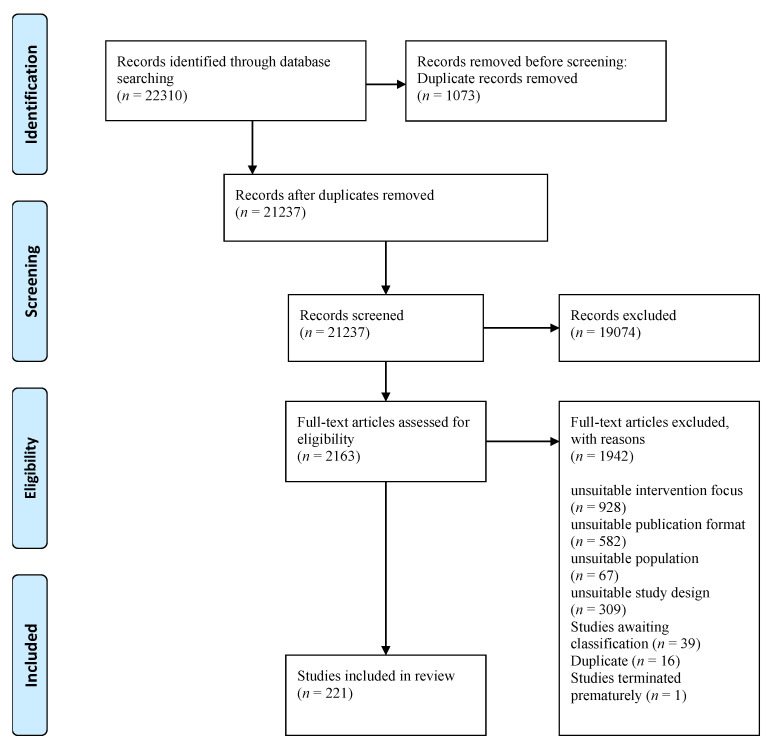
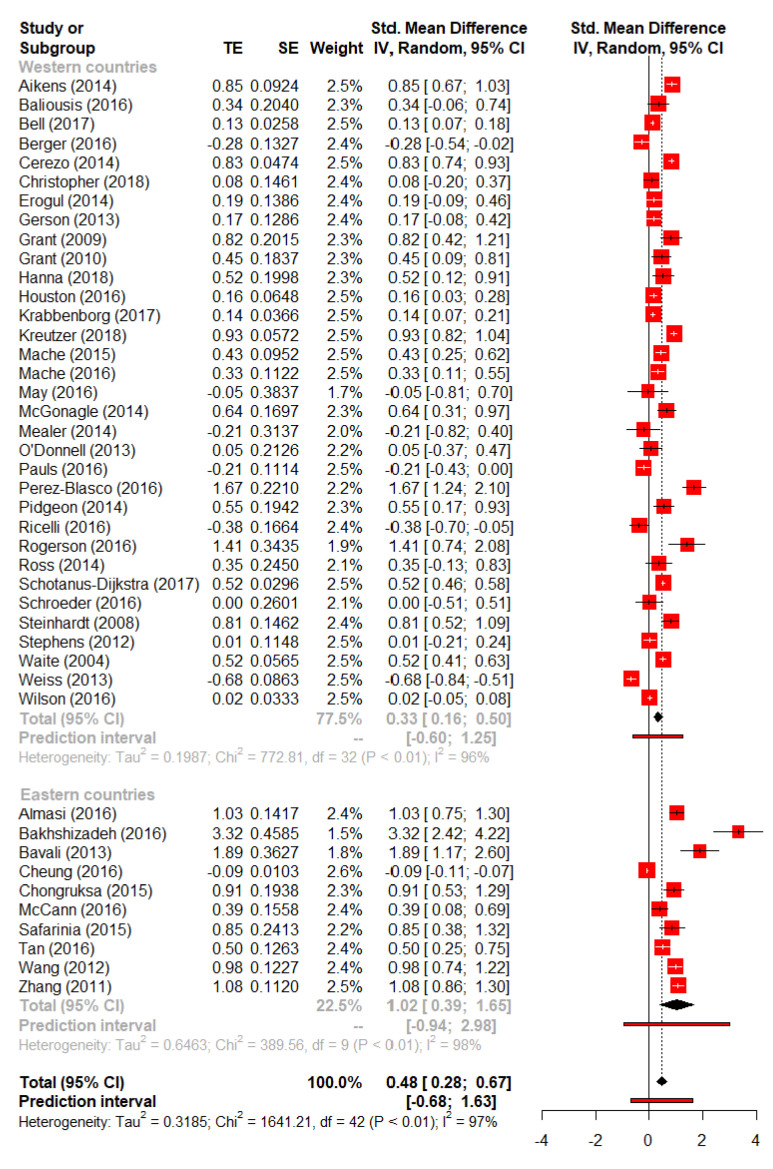
Previous research has demonstrated the efficacy of psychological interventions to foster resilience. However, little is known about whether the cultural context in which resilience interventions are implemented affects their efficacy on mental health. Studies performed in Western (k = 175) and Eastern countries (k = 46) regarding different aspects of interventions (setting, mode of delivery, target population, underlying theoretical approach, duration, control group design) and their efficacy on resilience, anxiety, depressive symptoms, quality of life, perceived stress, and social support were compared. Interventions in Eastern countries were longer in duration and tended to be more often conducted in group settings with a focus on family caregivers. We found evidence for larger effect sizes of resilience interventions in Eastern countries for improving resilience (standardized mean difference [SMD] = 0.48, 95% confidence interval [CI] 0.28 to 0.67; p < 0.0001; 43 studies; 6248 participants; I2 = 97.4%). Intercultural differences should receive more attention in resilience intervention research. Future studies could directly compare interventions in different cultural contexts to explain possible underlying causes for differences in their efficacy on mental health outcomes.
Overview
The claims and statistics of this paper haven’t been checked yet.
Free: it reads the open-access text and checks the first 5 claims that cite a source we can check. Create a free account to check every claim.
Integrity signals
Registry
Cites
Statistics
Figures
Verification
Claims the paper makes
The claims and statistics of this paper haven’t been checked yet.
Free: it reads the open-access text and checks the first 5 claims that cite a source we can check. Create a free account to check every claim.
Claims other papers make about this one
Each is checked against this paper’s own text: does it say what the citing paper says it does?
The source backs part of the claim, not all of it — or backs it for a different population, condition or comparison.
In the citing paper
“Studies in the global north often emphasize individual traits and adaptability38.”
From Resilience and brain health in global populations (2025) · cites this paper as [38]
Experimental — accuracy not yet measured
Self-check
Percentages, sums and reported differences re-computed from the paper’s own numbers.
The self-check needs the paper’s full text.
Citations
Cites
Conducting Meta-Analyses in R with the metafor Package
Viechtbauer, W. (2010) · Journal of Statistical Software · doi:10.18637/jss.v036.i03 · Cited by 20,464 · cited 5×
“We applied random-effects modeling to pool the effect sizes using the R package metafor [36] to account for between-study heterogeneity regarding outcome measures, as recommended in most clinical psychology and health sciences [37].”
MethodInfluentialThe weirdest people in the world?
Henrich, J., Heine, S. J., & Norenzayan, A. (2010) · Behavioral and Brain Sciences · doi:10.1017/s0140525x0999152x · Cited by 12,641
Ordinary magic: Resilience processes in development.
Masten, A. S. (2001) · American Psychologist · doi:10.1037/0003-066x.56.3.227 · Cited by 8,497 · cited 1×
“Resilience is a lifelong, ongoing process that does not necessarily lead to a person encountering fewer stressors in their life, but can lead to more effective coping with stressors and more adaptive responses [3].”
Dimensionalizing Cultures: The Hofstede Model in Context
Hofstede, G. (2011) · Online Readings in Psychology and Culture · doi:10.9707/2307-0919.1014 · Cited by 7,250
Acceptance and commitment therapy: model, processes and outcomes
Hayes, S. C., Luoma, J. B., Bond, F. W., Masuda, A., & Lillis, J. (2006) · Behaviour Research and Therapy · doi:10.1016/j.brat.2005.06.006 · Cited by 6,587
Cohen, J. (1992) · Current Directions in Psychological Science · doi:10.1111/1467-8721.ep10768783 · Cited by 5,870
How to perform a meta-analysis with R: a practical tutorial
Balduzzi, S., Rücker, G., & Schwarzer, G. (2019) · Evidence Based Mental Health · doi:10.1136/ebmental-2019-300117 · Cited by 5,827 · cited 5×
“The Cochrane Handbook for Systematic Reviews of Interventions was used for the interpretation of I2: low (0–40%), moderate (30–60%), substantial (50–90%), and considerable heterogeneity (75–100%) [27,30,34].”
MethodInfluentialHenrich, J., Heine, S. J., & Norenzayan, A. (2010) · Nature · doi:10.1038/466029a · Cited by 3,441
IntHout, J., Ioannidis, J. P., & Borm, G. F. (2014) · BMC Medical Research Methodology · doi:10.1186/1471-2288-14-25 · Cited by 2,419 · cited 1×
“The test statistics and CIs were adjusted with the Hartung-KnappSidik-Jonkman method [38].”
MethodUngar, M. (2006) · British Journal of Social Work · doi:10.1093/bjsw/bcl343 · Cited by 1,899 · cited 3×
“As Ungar mentioned in his work, resilience research is not only conducted exclusively for Western populations but also does not consider resilience definitions from other cultures or even what is considered healthy functioning in different cultures [16].”
Background
Research works printed but not linked: 26
- Antweiler C. Zur Universalität von Emotionen. Befunde und Kritik kulturvergleichender Ansätze Emotionen—Perspektiven auf Innen und Außen Kienlin T.L. Koch L.C. Universitätsforschungen zur Prähistorischen Archäologie Bonn, Germany 2017 Volume 305 125 147
- Review Manager Web (RevMan Web) The Cochrane Collaboration London, UK 2020
- Baliousis M. Rennoldson M. Mills J. Watson L. Dawson D. Das Nair R. Psychological intervention to alleviate distress in haematopoietic stem cell transplantation: A Phase 2 study Proceedings of the 42nd Annual Meeting of the European Society for Blood and Marrow Transplantation, EBMT 2016 Valencia, Spain 3–6 April 2016 547 548 Bone Marrow Transplantation 2016
- Jennings D.A. The Effects of Resiliency Training on Physical Activity Participation, Job Satisfaction, and Protective Factors Among Nonmanagerial Females at the Worksite Ph.D. Thesis Department of Exercise and Sport Science University of Utah, Salt Lake City, UT, USA 2002
- May A.C. Cronan T. Acceptance and Commitment Therapy for Patients with Breast Cancer: A Pilot Study Ph.D. Thesis San Diego State University San Diego, CA, USA 2016
- Mejia-Downs A.M. An Intervention Enhances Resilience in Physical Therapy Students Ph.D. Thesis Utah Rocky Mountain University of Health Professions Provo, UT, USA 2016
- O′Donnell P.J. Psychological Effects of a Strength-Based Intervention Among Inpatients in Rehabilitation for Pain and Disability Ph.D. Thesis Northcentral University Scottsdale, AZ, USA 2013 75
- Sadow D. Hopkins B. Resiliency training and empowerment among homeless, substance-abusing veterans. Increasing a sense of self-efficacy and internal attribution of control as a result of resiliency training Res. Commun. Psychol. Psychiatry Behav. 1993 18 121 134
- Taylor L.M. The Relation Between Resilience, Coaching, Coping Skills Training, and Perceived Stress During a Career-threatening Milestone Ph.D. Thesis Georgia State University Atlanta, GA, USA 1997
- Waite P.J. Determining the efficacy of resiliency training in the worksite Diss. Abstr. Int. Sect. A Humanit. Soc. Sci. 2004 33 62
- West C.P. Dyrbye L.N. Satele D. Shanafelt T.D. A randomized controlled trial evaluating the effect of COMPASS (COlleagues Meeting to Promote and Sustain Satisfaction) small group sessions on physician well-being, meaning, and job satisfaction J. Gen. Intern. Med. 2015 30 45
- Wilson I. Effectiveness of Stress Inoculation and Stress Management Approaches for Enhancing Resilience in a U.S. Military Combat Population Ph.D. Thesis Alliant International University Alhambra, CA, USA, 2016 76
- Bakhshizadeh S.H. Afrooz G.H.A. Beh-pajooh A. Ghobari Bonab B. Shokoohi Yekta M. Effectiveness of resiliency based on islamic spirituality training on mental health & spiritual resiliency among mothers of slow pace (mentally retarded) children Armaghane-Danesh 2016 21 492 512
- Bari N.S. Bahrainian S.A. Azargoon H. Abedi H. Aghaee F. The effectiveness of reality therapy on resiliency of divorced women in Neyshabour city of Iran World Sci. J. 2013 1 115 123
- Bavali F. Faramarzi S. Manshaie G. Khaledian M. Effectiveness of Group Logo Therapy on resiliency of the mothers with intellectual disability children Int. Res. J. Appl. Basic Sci. 2013 6 160 164
- Haydari L. Farhadian M. Effectiveness resiliency training to reduce stress and improve the quality of life of female-headed household Res. J. Fish. Hydrobiol. 2015 10 105 110
- Kaveh M. Alizadeh H. Delavar A. Borjali A. Development of a resilience fostering program against stress and its impact on quality of life components in parents of children with mild intellectual disability J. Ophthalmol. Eye Care 2011 11 119 140
- Naemi A.M. Effectiveness of family-based education on mental health and resiliency of women with addicted husband (Case study: Sabzevar) Women Dev. Politics 2015 13 41 52
- Safarinia M. Aghayoosefi A. Mehmannavazan A. Dehestani M. The effectiveness of training problem solving skills on the resiliency of the students residing at the dormitory of the Industrial University of Khaje Nasiredin Toosi Res. J. Pharm. Biol. Chem. Sci. 2015 6 1497 1504
- Sansom-Daly U. Wakefield C. Bryant R. Ellis S. Doolan E. Cohn R. Adapting evidence-based psychological therapy to the computer screen for adolescent and young adult cancer survivors: Preliminary results from the “recapture life” randomised controlled trial Asia-Pac. J. Clin. Oncol. 2014 10 36
- Cheung Y.L. Psychological first aid as a public health disaster response preparedness strategy for responders in critical incidents and disasters Diss. Abstr. Int. Sect. B Sci. Eng. 2016 76 1 361
- Sanchez-Teruel D. Robles-Bello M.A. Responding to a program of resilience applied parents of children with Down Syndrome Universitas Psychologica 2015 14 645 657
- Yu E.S. Kim B.S. Lee J.H. Kim J.H. A randomized controlled trial of stress management program for breast cancer patients under treatment Asia-Pac. J. Clin. Oncol. 2012 8 299 300
- Caruso R. Sabato S. Massarenti S. Nanni M.G. Grassi L. The experience of cancer in advanced phases of illness: Italian CALM project Proceedings of the IPOS 16th World Congress of Psycho-Oncology and Psychosocial Lisbon, Portugal 20–24 October 2014 26 27 Psycho-Oncology 2014
- Patrão I. Deep C.N. Leal I. Cancer related fatigue and a cognitive behavioral intervention in quality of life in subjects undergoing radiotherapy–Alongitudinal and randomised trial PSYCHO-ONCOLOGY Wiley-Blackwell Hoboken, NJ, USA 2014 170 171
- Meichenbaum D. Stress inoculation training: A preventative and treatment approach Principles and Practice of Stress Management Lehrer P.M. Woolfolk R.L. Sime W.S. Guilford Press New York, NY, USA 2007 Volume 3 497 518
Cited by
Relation between resilience and personality traits: The role of hopelessness and age
Nieto, M., Visier, M. E., Silvestre, I. N., Navarro, B., Serrano, J. P., & Martínez‐Vizcaíno, V. (2023) · Scandinavian Journal of Psychology · doi:10.1111/sjop.12866 · Cited by 64
Resilience and brain health in global populations
Udeh-Momoh, C. T., Migeot, J., Blackmon, K., Mielke, M. M., Melloni, M., Cox, L., Yaffe, K., Santamaria-Garcia, H., Stern, Y., & Ibanez, A. (2025) · Nature Medicine · doi:10.1038/s41591-025-03846-w · Cited by 42
“Studies in the global north often emphasize individual traits and adaptability 38 .”
Ang, W. R., Ang, W. H. D., Cham, S. Q. G., Mel, S. D., Chew, H. S. J., & Devi, M. K. (2023) · European Journal of Oncology Nursing · doi:10.1016/j.ejon.2023.102446 · Cited by 45
Luo, S., Hu, J., Zhang, J., Mei, Z., Tang, Z., & Luo, S. (2025) · Frontiers in Psychiatry · doi:10.3389/fpsyt.2025.1536553 · Cited by 56
“Given that the concept of resilience originated in Western contexts and has been studied across disciplines as early as the beginning of the 21st century (20), it is likely more established in Western cultures compared to Eastern ones (101), leading to the present fi ndings of this study.”
Psychological resilience and cortisol levels in adults: A systematic review
Aizpurua‐Perez, I., Arregi, A., Labaka, A., Martinez‐Villar, A., & Pérez-Tejada, J. (2023) · American Journal of Human Biology · doi:10.1002/ajhb.23954 · Cited by 37
“These interventions have been shown to be effective in improving mental health outcomes, including quality of life and perceived stress or distress in different populations (Blessin et al., 2022; Chmitorz et al., 2018).”
BackgroundMethodSieder, K., Thiedmann, P., Voracek, M., & Tran, U. S. (2024) · Applied Psychology: Health and Well-Being · doi:10.1111/aphw.12550 · Cited by 16
Behrendt, D., Boß, L., Hannibal, S., Kunzler, A. M., Wessa, M., & Lehr, D. (2023) · Internet Interventions · doi:10.1016/j.invent.2023.100649 · Cited by 19
Self-citationAhlborg, M. G., Nygren, J., Svedberg, P., & Regber, S. (2024) · Nursing Open · doi:10.1002/nop2.2219 · Cited by 13
“Other research has shown similar findings and concluded that intercultural differences are important to consider when studying resilience in multicultural settings (Blessin et al., 2022).”
ResultRösner, C., Brähler, E., Sachser, C., Clemens, V., & Petrowski, K. (2024) · BMC Psychology · doi:10.1186/s40359-024-01995-0 · Cited by 14
“Although resilience has been measured separately across different countries, few studies to date have examined the influence of cultural factors on resilience [36].”
BackgroundCiren, Z., Tsui, H. K. H., & Chan, S. K. W. (2025) · Adolescent Research Review · doi:10.1007/s40894-025-00270-6 · Cited by 22
“A systematic review (Blessin et al., 2022) further revealed that the resilience interventions conducted in Eastern countries demonstrated larger effect sizes compared to those in Western countries.”
The Role of Emotion Regulation in Distinct Measures of Emotional Resilience
Razak, H. A., MacLeod, C. M., Rudaizky, D., & Notebaert, L. (2025) · Cognitive Therapy and Research · doi:10.1007/s10608-025-10581-6 · Cited by 16
“For example, cultural-specific definitions and demonstrations of what constitutes as healthy emotional functioning following adversity, and assessments of culturally relevant stressors specific to the study’s target population should be considered (Blessin et al., 2022).”
Gündüzyeli, B. (2025) · Sustainability · doi:10.3390/su17073134 · Cited by 37
“In a study by Blessin et al. [17], resilience interventions in Western and Eastern cultures were compared.”
Child and adolescent psychiatry: challenges, solutions, opportunities, and future directions
Cortese, S., Arango, C., Aymerich, C., Catalan, A., Chetouani, M., Cohen, D., Coghill, D., Gabellone, A., Iniesta, R., Kadan, A., et al. (2026) · World Psychiatry · doi:10.1002/wps.70044 · Cited by 4
“Western contexts favor individual-focused strategies, emphasizing self-efficacy and self-esteem, while Eastern contexts benefit more from family and social support 285 .”
Meyer, H. H., Thompson, M. F., Gunawan, T., Schwandt, M. L., Ramchandani, V. A., Diazgranados, N., & Luk, J. W. (2025) · Alcoholism Clinical and Experimental Research · doi:10.1111/acer.70158 · Cited by 7
Zhang, Y., Ji, X., Yu, Y., Ye, P., Wang, L., Wang, L., Zhao, L., & Yang, X. (2025) · Asia-Pacific Journal of Oncology Nursing · doi:10.1016/j.apjon.2025.100811 · Cited by 5
“50 Therefore, health care professionals should be advised to adopt a family resilience perspective, focusing on enhancing intimacy and constructive interactions between patients and their spouses.”
Conceptualizing resilience among health workers in the Gaza Strip: a scoping review
Nyhus, H. B., Tofthagen, R., Bruaset, G. T. F., Ekiz, P., & Abudayya, A. (2025) · Mental Health & Prevention · doi:10.1016/j.mhp.2025.200427 · Cited by 4
Research Trends in Family Psychology: from Disadvantage to Resilience
Makhnach, A. V. (2024) · Social Psychology and Society · doi:10.17759/sps.2024150301 · Cited by 3
Ruswadi, I., Wennie, J., Susiani, A., & Masliha, M. (2025) · Jurnal Berita Ilmu Keperawatan · doi:10.23917/bik.v18i2.9806 · Cited by 2
Towards mechanism-focused and scalable resilience interventions
Schäfer, S. K., Stoffers‐Winterling, J., & Lieb, K. (2026) · Nature Reviews Psychology · doi:10.1038/s44159-026-00573-y · Cited by 6
“Resilience interventions are programmes, techniques, strategies and measures that seek to enhance resilient outcomes 26–29 .”
InfluentialSelf-citationMakhnach, A. V., Saraeva, N. M., Dagbaeva, S. B., Laktionova, A. I., & Sukhanov, A. A. (2024) · Social Psychology and Society · doi:10.17759/sps.2024150307 · Cited by 1
Patil, S. (2025) · IntechOpen eBooks · doi:10.5772/intechopen.1009432 · Cited by 1
Defining resilience for global healthcare workforce: A narrative review
Pundir, P., Sadanand, S., Srinivasan, V., Jacob, A. G., Sebaoui, S., Shareef, A., John, O., & Manwar, A. (2025) · Health Sciences Review · doi:10.1016/j.hsr.2025.100252 · Cited by 4
Wang, X., & Madihie, A. (2026) · Frontiers in Psychology · doi:10.3389/fpsyg.2026.1745726 · Cited by 4
Constantino, R. E., Braxter, B., Hui, C. C. V., Allen, L. C., Wolfe, L. J., Endres, K. H., Cutamora, J. C., Garcia, L., Palompon, D. R., Thimsen, K., et al. (2024) · Health · doi:10.4236/health.2024.167046 · Cited by 1
Cheung, Y. C. H., Wong, D. F. K., Zhuang, X., Dai, X., & Ng, F. W. (2024) · Research on Social Work Practice · doi:10.1177/10497315241281319 · Cited by 1
“First, a recent systematic review covering 221 clinical trials found that 80% of the intervention studies were conducted in Western countries (Blessin et al., 2022).”
Resilience Intervention for Disaster Responders in Southeast Asia (SEA): A Scoping Review ProtocolPreprint
Dewi, Y. A., Masrikhan, M., & Soeparno, K. (2024) · doi:10.31219/osf.io/4j7uz
Hall, C. D. X., Bao, A., Sabuncu, B. C., Wang, L., Luu, M. N., Mills, J. C., Trang, K., Millender, E., Lane, B. L., Cheung, D. H., et al. (2025) · AIDS Care · doi:10.1080/09540121.2025.2578652
“…not appear to exist, a systematic review summarizes recent evidence from China, South Korea, Thailand, Singapore and Taiwan addressed resilience interventions for police officers, cancer survivors, older adults, military personnel, college students and female sex workers (Blessin et al., 2022).”
InfluentialVISUAL COMMUNICATION STRATEGIES IN DIGITAL CRISIS MANAGEMENT: AN AI-ENABLED MEDIA ANALYSIS APPROACH
Dixit, D., Sharma, R. G., Patil, M. S., Ramtirthkar, C. R., Goel, P., & Nagargoje, Y. (2025) · ShodhKosh Journal of Visual and Performing Arts · doi:10.29121/shodhkosh.v6.i5s.2025.6959
Longitudinal Patterns of Distress and Resilience in Japan Self-Defense Forces Peacekeepers
Saito, T., Waki, F., & Nagamine, M. (2026) · Military Medicine · doi:10.1093/milmed/usag035
Adama, K. A. N. E., Fall, N., Fall, A. N., & Venghaus, S. (2026) · SSRN Electronic Journal · doi:10.2139/ssrn.6544040
Makhnach, A. V., & Laktionova, A. I. (2026) · Cultural-Historical Psychology · doi:10.17759/chp.2026220113
Liu, Y., Mitchell, J. W., Brown, L., Chandler, C. J., Odom, U., Jenkins, D., Osman, A., & Zhang, C. (2026) · Discover Public Health · doi:10.1186/s12982-026-01773-w
“These perspectives underscore resilience as an iterative, forward-looking process, reinforcing the need for interventions that simultaneously strengthen individual skills and create affirming environments [61–63].”
Broll, J., Lüdecke, D., Nickel, S., Schäfer, S. K., Lieb, K., & Helmreich, I. (2026) · International Journal of Nursing Studies · doi:10.1016/j.ijnurstu.2026.105541
Self-citationPsychosocial interventions for alcohol use disorder in China: A systematic review and meta-analysis
Kong, X., Liu, Y., Liu, H., Watkins, L. E., Liu, J., Hao, W., & Tang, Y. (2026) · Drug and Alcohol Dependence · doi:10.1016/j.drugalcdep.2026.113198 · Cited by 1
Wei, W., & Üzar‐Özçetin, Y. S. (2026) · Psycho-Oncology · doi:10.1002/pon.70504
Toward a Socioecological Understanding of Resilience in the Context of Chronic Pain
Makhoul, M., Doumit, M. A. A., & Bartley, E. J. (2026) · Pain Management Nursing · doi:10.1016/j.pmn.2026.05.003
Feasibility of an Online Resilience Program for Mothers With Adverse Childhood Experiences
Yun, H., & Choi, E. K. (2026) · Research in Nursing & Health · doi:10.1002/nur.70085
“Similarly, broader reviews of resilience interventions have highlighted heterogeneity in intervention content, intensity, and outcome measurement, complicating definitive conclusions regarding effectiveness (Chmitorz et al. 2018; Blessin et al. 2022).”
Bartelt, S., Werner, T., von Boros, L., Schäfer, S. K., Koehler, F., Wirth, B. E., Lieb, K., Tuescher, O., & Wessa, M. (2026) · Scientific Reports · doi:10.1038/s41598-026-67088-7
Self-citationCoșa, L. E., & Trifan, I.-M. (2026) · Behavioral Sciences · doi:10.3390/bs16091623
“Blessin et al. (2022), in a comparative meta-analysis of 175 Western and 46 Eastern studies examining resilience-building interventions, reported that interventions implemented in Eastern countries produced significantly larger effects on resilience (SMD = 0.48, 95% CI [0.28, 0.67], p < 0.0001; 43…”
InfluentialFostering adolescent resilience in India: A systematic review and narrative synthesis
Lakshman, K. A., Navaneetham, J., Prabhu, S. G., Arelingaiah, M., Nag, R., Mallikarjun, P. K., Podiya, J. K., Palmer, A., & Hugh‐Jones, S. (2026) · Industrial Psychiatry Journal · doi:10.4103/ipj.ipj_445_25
Metadata
- Authors
- Blessin, M., Lehmann, S., Kunzler, A. M., van Dick, R., & Lieb, K.
- Affiliations
- Goethe University Frankfurt (DE)
- Leibniz Institute for Resilience Research (DE)
- Department of Social Psychology, Goethe University, 60323 Frankfurt, Germany
- Corresponding author
- Lieb, Klaus
- Venue
- International Journal of Environmental Research and Public Health
- Publisher
- MDPI AG
- Published
- 2022-06-05
- Volume
- 19
- Issue
- 11
- Pages
- 6913
- ISSN
- 1660-4601 (ISSN-L)
- PMC
- PMC9180776
- OpenAlex
- W4281744997
- Cited by
- 40
- References
- 234
- Citations by year
- 2026: 15 · 2025: 13 · 2024: 8 · 2023: 3 · 2022: 1
- FWCI
- 1.04
- Type
- journal article
- Language
- en
- Open access
- gold
- doi.org
- Licence
- Locations
- International Journal of Environmental Research and Public Health (publishedVersion, cc-by)
- PubMed Central (publishedVersion, cc-by)
- PubMed (publishedVersion)
- Informationszentrum Lebenswissenschaften (ZB MED) (submittedVersion, cc-by)
- RePEc: Research Papers in Economics (submittedVersion)
- DOAJ (DOAJ: Directory of Open Access Journals) (submittedVersion)
- Publication Server of Goethe University Frankfurt am Main (Goethe University Frankfurt) (submittedVersion, cc-by)
- Funders
- Leibniz Gemeinschaft (K83/2017)
- Topics
- Social Sciences › Psychology › Clinical Psychology › Resilience and Mental Health
- Social Sciences › Psychology › Clinical Psychology › Mindfulness and Compassion Interventions
- Health Sciences › Medicine › Oncology › Cancer survivorship and care
- Keywords
- resilience interventions, cultural context, intercultural differences, intervention efficacy, mental health outcomes, anxiety, depressive symptoms, perceived stress, social support, quality of life, group intervention, family caregivers, intervention duration
- MeSH terms
- Anxiety, Depression, Humans, Mental Health, Quality of Life, Stress, Psychological, Caregivers
About these checks
Registry, retraction, Cites and statistics results are computed, not judged, with one exception: a printed reference that no index lists is read once by a model before it counts as a citation error. Claims are extracted by a model and kept only when their quote appears verbatim in the text; each cited source is then checked, with a model’s help, for whether it says what the claim relies on. Those verdicts can be wrong — read the claim’s quote and the cited source before relying on one.
Statistics and arithmetic are recomputed, not judged.
Confidence bands are shown only for fields calibrated on our annotated test set. None is calibrated yet, so no band is shown.
What counts as a claim ›How we measure confidence ›How we check this ›
Are you an author, or do you see a problem with this page? Request a review
Data sources
Bibliographic data: Semantic Scholar, OpenAlex, Crossref.
Contains information from the Semantic Scholar Academic Graph Datasets, made available under the ODC Attribution License (ODC-BY 1.0).
Semantic Scholar’s data is described in: Kinney, R., et al. (2023). The Semantic Scholar Open Data Platform. arXiv:2301.10140.
