

Ketogenic Diet Benefits to Weight Loss, Glycemic Control, and Lipid Profiles in Overweight Patients with Type 2 Diabetes Mellitus: A Meta-Analysis of Randomized Controlled Trails
Open accessThe DOI matches its Crossref record; 51 of the 52 references it cites were found in a registry or an index.
Abstract
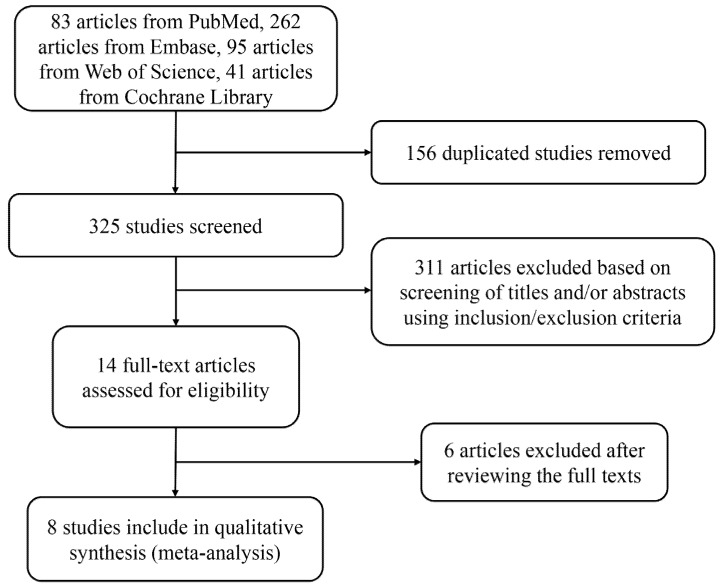
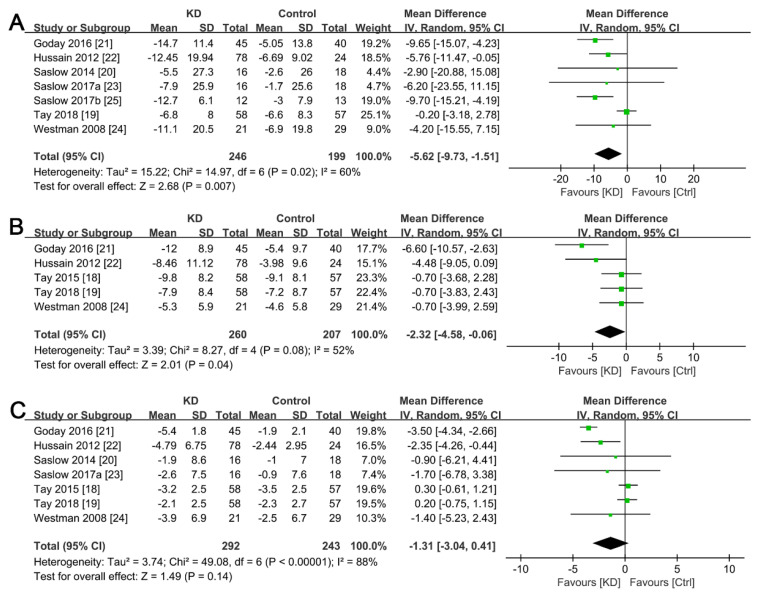
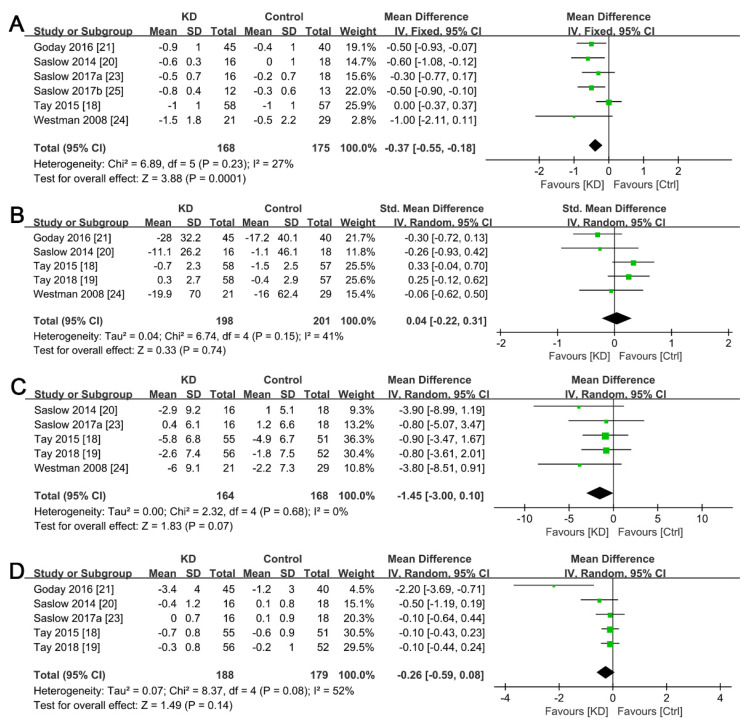
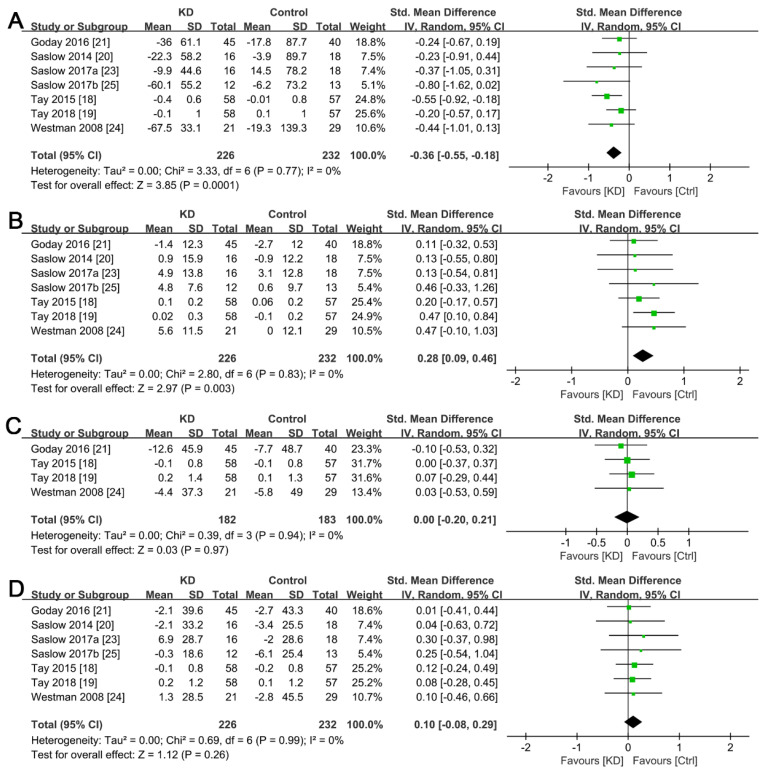
A ketogenic diet, characterized by low calories with high levels of fat, adequate levels of protein, and low levels of carbohydrates, has beneficial effects on body weight control in overweight patients. In the present study, a meta-analysis was conducted to investigate the role of a ketogenic diet in body weight control and glycemic management in overweight patients with type 2 diabetes mellitus (T2DM). In summary, we systematically reviewed articles from the Embase, PubMed, Web of Science and Cochrane Library databases and obtained eight randomized controlled trials for meta-analysis. The results show that a ketogenic diet had significantly beneficial effects on the loss of body weight (SMD, −5.63, p = 0.008), the reduction of waist circumference (SMD, −2.32, p = 0.04), lowering glycated hemoglobin (SMD, −0.38, p = 0.0008) and triglycerides (SMD, −0.36, p = 0.0001), and increasing high-density lipoproteins (SMD, 0.28, p = 0.003). Overall, these results suggest that a ketogenic diet may be an effective dietary intervention for body weight and glycemic control, as well as improved lipid profiles in overweight patients with T2DM. Hence, a ketogenic diet can be recommended for the therapeutic intervention of overweight patients with T2DM.
Overview
The claims and statistics of this paper haven’t been checked yet.
Free: it reads the open-access text and checks the first 5 claims that cite a source we can check. Create a free account to check every claim.
Integrity signals
Registry
Cites
Statistics
Figures
Verification
Claims the paper makes
The claims and statistics of this paper haven’t been checked yet.
Free: it reads the open-access text and checks the first 5 claims that cite a source we can check. Create a free account to check every claim.
Claims other papers make about this one
Each is checked against this paper’s own text: does it say what the citing paper says it does?
The source backs part of the claim, not all of it — or backs it for a different population, condition or comparison.
In the citing paper
“Ketosis is a good regulator of calorie intake and mimics the starvation effect in the body, leading to body weight control and consequent metabolism.”
From Low-Calorie Ketogenic Diet: Potential Application in the Treatment of Polycystic Ovary Syndrome in Adolescents (2023) · cites this paper as [8]
Experimental — accuracy not yet measuredThe source backs part of the claim, not all of it — or backs it for a different population, condition or comparison.
In the citing paper
“In addition to the positive regulation of glucose metabolism, KD may also result in enhanced lipolysis and fatty-acid oxidation, leading to a better lipidic profile [8].”
From Low-Calorie Ketogenic Diet: Potential Application in the Treatment of Polycystic Ovary Syndrome in Adolescents (2023) · cites this paper as [8]
Experimental — accuracy not yet measuredThe source backs part of the claim, not all of it — or backs it for a different population, condition or comparison.
In the citing paper
“Additionally, during ketogenesis, insulin receptor sensitivity is also promoted.”
From Low-Calorie Ketogenic Diet: Potential Application in the Treatment of Polycystic Ovary Syndrome in Adolescents (2023) · cites this paper as [8]
Experimental — accuracy not yet measured
Self-check
Percentages, sums and reported differences re-computed from the paper’s own numbers.
The self-check needs the paper’s full text.
Citations
Cites
The worldwide epidemiology of type 2 diabetes mellitus—present and future perspectives
Chen, L., Magliano, D. J., & Zimmet, P. Z. (2012) · Nature Reviews Endocrinology · doi:10.1038/nrendo.2011.183 · Cited by 2,227 · cited 1×
“Type 2 diabetes mellitus (T2DM) is a high-incidence chronic metabolic disorder, with high mortality and morbidity rates worldwide due to its multiple complications [1].”
BackgroundBeyond weight loss: a review of the therapeutic uses of very-low-carbohydrate (ketogenic) diets
Paoli, A., Rubini, A., Volek, J. S., & Grimaldi, K. A. (2013) · European Journal of Clinical Nutrition · doi:10.1038/ejcn.2013.116 · Cited by 885
Bueno, N. B., de Melo, I. S. V., de Oliveira, S. L., & da Rocha Ataide, T. (2013) · British Journal of Nutrition · doi:10.1017/s0007114513000548 · Cited by 778
Huxley, R., Mendis, S., Zheleznyakov, E., Reddy, S., & Chan, J. (2010) · European Journal of Clinical Nutrition · doi:10.1038/ejcn.2009.68 · Cited by 770 · cited 1×
“Additionally, ketogenic diet-based intervention was associated with a significant reduction in waist circumference, a parameter of central obesity that has been shown to be an important risk factor for the progression and prognosis of diabetes and related complications [32].”
BackgroundVeech, R. L. (2004) · Prostaglandins, Leukotrienes and Essential Fatty Acids · doi:10.1016/j.plefa.2003.09.007 · Cited by 755 · cited 2×
“Moreover, ketone bodies can increase the concentration of intracellular glucose and generate metabolic effects similar to those of insulin, but without activating the insulin signaling pathway, which allows for a therapeutic effect of mild ketosis in insulin resistance states [42].”
BackgroundMechanisms of insulin resistance in obesity
Ye, J. (2013) · Frontiers of Medicine · doi:10.1007/s11684-013-0262-6 · Cited by 699 · cited 2×
“Bo weight control is consid red an effective interventio strat gy for attenuating nsulin resistan e induce by obesity [27,28].”
BackgroundTomiyama, A. J. (2019) · Annual Review of Psychology · doi:10.1146/annurev-psych-010418-102936 · Cited by 695 · cited 2×
“Obesity, which is highly prevalent in patients with T2DM, has been associated with chronic inflammatio statuses, such as mitochondrial dysfunct on, endoplasmic reticulum s ress, nd hyperinsulinemia [26].”
BackgroundDiabetes mellitus: complications and therapeutics.
Tripathi, B. K., & Srivastava, A. K. (2006) · PubMed · Cited by 500
Westman, E. C., Yancy, W. S., Mavropoulos, J. C., Marquart, M., & McDuffie, J. R. (2008) · Nutrition & Metabolism · doi:10.1186/1743-7075-5-36 · Cited by 475
Johnstone, A. M., Horgan, G. W., Murison, S. D., Bremner, D. M., & Lobley, G. E. (2008) · The American Journal of Clinical Nutrition · doi:10.1093/ajcn/87.1.44 · Cited by 440 · cited 1×
“For instance, some mechanistic studies have indicated that a ketogenic diet can suppress appetite by either directly affecting ketone bodies [34] or regulating appetite control hormones [35].”
Background
Cited by
2026 ACC/AHA/AACVPR/ABC/ACPM/ADA/AGS/APhA/ASPC/NLA/PCNA Guideline on the Management of Dyslipidemia
Blumenthal, R. S., Morris, P. B., Gaudino, M., Johnson, H. M., Anderson, T. S., Bittner, V. A., Blankstein, R., Brewer, L. C., Cho, L., de Ferranti, S. D., et al. (2026) · JACC · doi:10.1016/j.jacc.2025.11.016 · Cited by 304
Writing Committee Members, Blumenthal, R. S., Morris, P. B., Gaudino, M., Johnson, H. M., Anderson, T. S., Bittner, V. A., Blankstein, R., Brewer, L. C., Cho, L., et al. (2026) · Circulation · doi:10.1161/cir.0000000000001423 · Cited by 122
Jing, T., Zhang, S., Bai, M., Chen, Z., Gao, S., Li, S., & Zhang, J. (2023) · Nutrients · doi:10.3390/nu15143156 · Cited by 143
“found that ketogenic diet was an effective dietary intervention for body weight and glycemic control, as well as improved lipid profiles in overweight patients with T2DM [96].”
BackgroundThe Ketogenic Diet and Cardiovascular Diseases
Dyńka, D., Kowalcze, K., Charuta, A., & Paziewska, A. (2023) · Nutrients · doi:10.3390/nu15153368 · Cited by 135
Advances in Research on Type 2 Diabetes Mellitus Targets and Therapeutic Agents
Su, J., Luo, Y., Hu, S., Tang, L., & Ouyang, S. (2023) · International Journal of Molecular Sciences · doi:10.3390/ijms241713381 · Cited by 130
“A meta-analysis revealed that the ketogenic diet was effective in improving the glycemic parameters, body weight, and lipid profile of patients [163].”
Background
Metadata
- Authors
- Zhou, C., Wang, M., Liang, J., He, G., & Chen, N.
- Affiliations
- Wuhan Sports University (CN)
- Tongji Hospital (CN)
- School of Economics and Management, Wuhan Sports University, Wuhan 430079, China
- Corresponding author
- Chen, Ning
- Venue
- International Journal of Environmental Research and Public Health
- Publisher
- MDPI AG
- Published
- 2022-08-22
- Volume
- 19
- Issue
- 16
- Pages
- 10429
- ISSN
- 1660-4601 (ISSN-L)
- PMC
- PMC9408028
- OpenAlex
- W4293778827
- Cited by
- 151
- References
- 52
- Citations by year
- 2026: 40 · 2025: 48 · 2024: 39 · 2023: 23 · 2022: 1
- FWCI
- 3.82
- Type
- journal article
- Language
- en
- Open access
- gold
- doi.org
- Licence
- Locations
- International Journal of Environmental Research and Public Health (publishedVersion, cc-by)
- PubMed Central (publishedVersion, cc-by)
- PubMed (publishedVersion)
- RePEc: Research Papers in Economics (submittedVersion)
- DOAJ (DOAJ: Directory of Open Access Journals) (submittedVersion)
- Funders
- National Natural Science Foundation of China (31771318, 2021yjsCXCY095)
- Fundamental Research Funds for the Central Universities (31771318, 2021yjsCXCY095)
- Chutian Scholar Program and Innovative Start-Up Foundation from Wuhan Sports University (31771318, 2021yjsCXCY095)
- Topics
- Health Sciences › Medicine › Physiology (medical) › Diet and metabolism studies
- Health Sciences › Medicine › Physiology (medical) › Dietary Effects on Health
- Health Sciences › Medicine › Endocrinology, Diabetes and Metabolism › Diabetes Management and Research
- Keywords
- ketogenic diet, type 2 diabetes, overweight, weight loss, glycemic control, HbA1c, lipid profile, triglycerides, HDL cholesterol, waist circumference, dietary intervention
- MeSH terms
- Glycemic Control, Blood Glucose, Body Weight, Diabetes Mellitus, Type 2, Humans, Triglycerides, Weight Loss, Overweight, Diet, Ketogenic
About these checks
Registry, retraction, Cites and statistics results are computed, not judged, with one exception: a printed reference that no index lists is read once by a model before it counts as a citation error. Claims are extracted by a model and kept only when their quote appears verbatim in the text; each cited source is then checked, with a model’s help, for whether it says what the claim relies on. Those verdicts can be wrong — read the claim’s quote and the cited source before relying on one.
Statistics and arithmetic are recomputed, not judged.
Confidence bands are shown only for fields calibrated on our annotated test set. None is calibrated yet, so no band is shown.
What counts as a claim ›How we measure confidence ›How we check this ›
Are you an author, or do you see a problem with this page? Request a review
How to cite
Cite CoChat for the checks on this page, and the paper for its own findings.
- This page
- CoChat. (2026). Citation check: Ketogenic Diet Benefits to Weight Loss, Glycemic Control, and Lipid Profiles in Overweight Patients with Type 2 Diabetes Mellitus: A Meta-Analysis of Randomized Controlled Trails. https://app.cochat.ai/papers/10.3390/ijerph191610429
- The paper
- Zhou, C., Wang, M., Liang, J., He, G., & Chen, N. (2022). Ketogenic Diet Benefits to Weight Loss, Glycemic Control, and Lipid Profiles in Overweight Patients with Type 2 Diabetes Mellitus: A Meta-Analysis of Randomized Controlled Trails. International Journal of Environmental Research and Public Health. https://doi.org/10.3390/ijerph191610429
Data sources
Bibliographic data: Semantic Scholar, OpenAlex, Crossref.
Contains information from the Semantic Scholar Academic Graph Datasets, made available under the ODC Attribution License (ODC-BY 1.0).
Semantic Scholar’s data is described in: Kinney, R., et al. (2023). The Semantic Scholar Open Data Platform. arXiv:2301.10140.
