

Silver Diamine Fluoride (SDF) Efficacy in Arresting Cavitated Caries Lesions in Primary Molars: A Systematic Review and Metanalysis
Open accessThe DOI matches its Crossref record; 44 of the 44 references it cites were found in a registry or an index.
Abstract
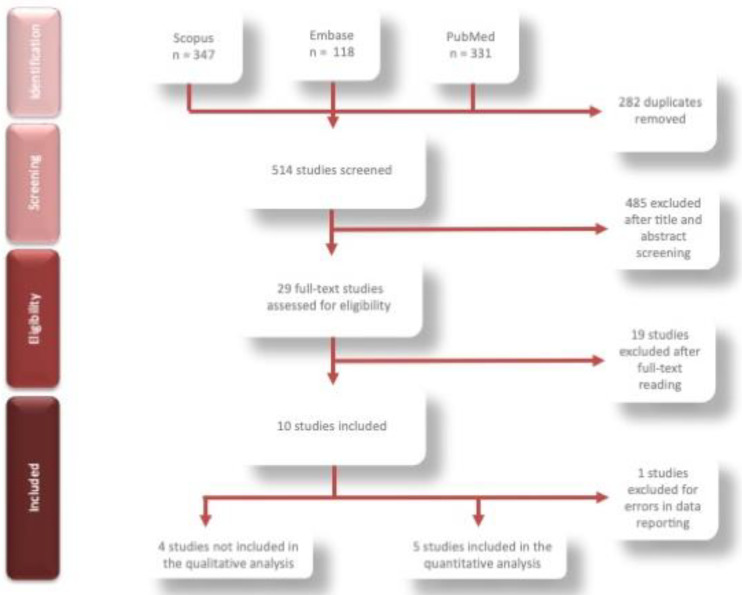
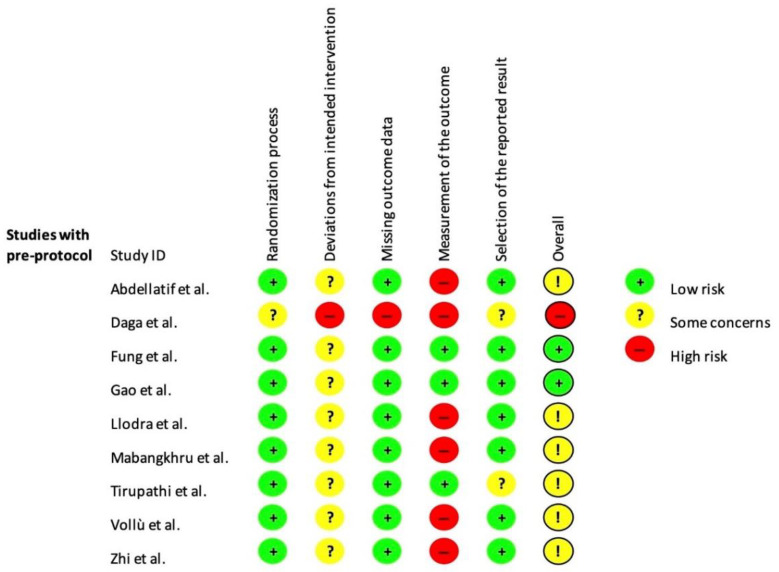
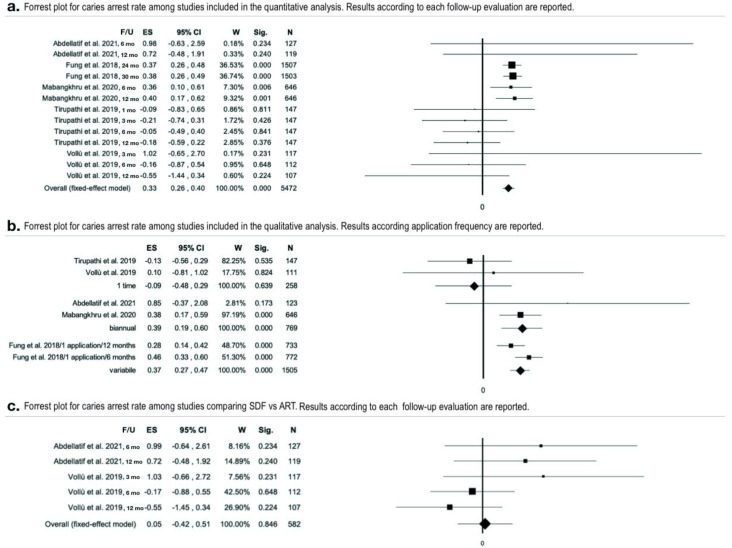
A systematic review and meta-analysis were carried out to evaluate the efficacy of silver diamine fluoride (SDF) in controlling caries progression in cavitated primary molars. A search for randomized and non-randomized trials with follow-up > 6 months was performed using PubMed, Scopus and Embase. The Cochrane risk of bias tools were used for the quality assessment. The success rate and odds ratios were chosen to calculate the effect size for the meta-analysis. A total of 792 papers were identified and 9 were selected. A high variability regarding SDF application protocol was found; otherwise, caries arrest was always recorded using visual/tactile methods. Two studies were judged at low risk of bias, six at moderate risk and one at high risk. Data from five studies were aggregated for meta-analysis. Heterogeneity was found moderate (I2 = 35.69%, p = 0.18). SDF application was found to be overall effective (fixed effect model) in arresting caries progression (ES = 0.35, p < 0.01). In a total of 622 arrested lesions, out of 1205 considered, the caries arrest rate was 51.62% ± 27.40% (Confidence = 1.55) using SDF ≥ 38% applied annually or biannually. In conclusion, when applied to active cavitated caries lesions in primary molars, SDF appears to be effective in arresting dental caries progression, especially if applied biannually.
Overview
The claims and statistics of this paper haven’t been checked yet.
Free: it reads the open-access text and checks the first 5 claims that cite a source we can check. Create a free account to check every claim.
Integrity signals
Registry
Cites
Statistics
Figures
Verification
Claims the paper makes
The claims and statistics of this paper haven’t been checked yet.
Free: it reads the open-access text and checks the first 5 claims that cite a source we can check. Create a free account to check every claim.
Claims other papers make about this one
Each is checked against this paper’s own text: does it say what the citing paper says it does?
The source backs part of the claim, not all of it — or backs it for a different population, condition or comparison.
In the citing paper
“Despite these limitations, SDF has demonstrated important economic and service‐delivery advantages in the literature, with systematic reviews and economic evaluations suggesting favorable cost‐effectiveness and lower downstream treatment costs in appropriate settings [4, 5].”
From Silver Diamine Fluoride in Oral Health Policy: A Strategic Pathway to Improve Access and Equity (2026) · cites this paper as [4]
Experimental — accuracy not yet measuredThe source backs part of the claim, not all of it — or backs it for a different population, condition or comparison.
In the citing paper
“Evidence from school‐ and community‐based programs suggests that SDF can be incorporated into broader prevention strategies, not as a replacement for comprehensive dental care, but as a pragmatic disease‐control measure that can arrest active lesions, reduce treatment escalation, and create a bridge to further restorative or specialist care when required [2, 4, 23].”
From Silver Diamine Fluoride in Oral Health Policy: A Strategic Pathway to Improve Access and Equity (2026) · cites this paper as [4]
Experimental — accuracy not yet measuredThe check wasn’t confident either way, so it gives no verdict — never disputed.
In the citing paper
“The economic case for SDF adoption is increasingly persuasive [4, 5], but different forms of economic benefit should be distinguished.”
From Silver Diamine Fluoride in Oral Health Policy: A Strategic Pathway to Improve Access and Equity (2026) · cites this paper as [4]
Experimental — accuracy not yet measuredThe check wasn’t confident either way, so it gives no verdict — never disputed.
In the citing paper
“However, SDF may also be used as an adjunct to restorative care, including before or beneath glass ionomer‐based restorations in silver‐modified atraumatic restorative techniques, and in selected cases before preformed metal crown placement using the Hall Technique [4, 18, 19, 20].”
From Silver Diamine Fluoride in Oral Health Policy: A Strategic Pathway to Improve Access and Equity (2026) · cites this paper as [4]
Experimental — accuracy not yet measured
Self-check
Percentages, sums and reported differences re-computed from the paper’s own numbers.
The self-check needs the paper’s full text.
Citations
Cites
1 retracted
Operative caries management in adults and children
Ricketts, D., Lamont, T., Innes, N. P., Kidd, E., & Clarkson, J. E. (2013) · Cochrane Database of Systematic Reviews · doi:10.1002/14651858.cd003808.pub3 · Cited by 359 · cited 1×
“The non-invasive treatment consists of the promotion of remineralization and the modification of the biofilm at lesion level, arresting the progressive loss of residual dental tissue [9,10].”
BackgroundRetractedQuantifying heterogeneity in a meta‐analysis
Higgins, J. P. T., & Thompson, S. G. (2002) · Statistics in Medicine · doi:10.1002/sim.1186 · Cited by 36,763 · cited 1×
“The I2 statistics were calculated to describe the percentage of variation across studies due to heterogeneity rather than chance [34].”
RoB 2: a revised tool for assessing risk of bias in randomised trials
Sterne, J. A. C., Savović, J., Page, M. J., Elbers, R. G., Blencowe, N. S., Boutron, I., Cates, C. J., Cheng, H.-Y., Corbett, M. S., Eldridge, S. M., et al. (2019) · BMJ · doi:10.1136/bmj.l4898 · Cited by 34,787 · cited 1×
“No NRSI studies met the inclusion criteria, so only the Cochrane collaboration’s RoB 2 tool was used [30].”
MethodMcGuinness, L. A., & Higgins, J. P. T. (2021) · Research Synthesis Methods · doi:10.1002/jrsm.1411 · Cited by 5,579 · cited 1×
“Microsoft Excel® tool for RoB 2 was used to input answers given to signaling questions, and an algorithm estimated the overall risk of the bias according to the results for each domain as: low risk, some concerns, or high risk; a plot was then drawn using the Cochrane RoBvis web app [31].”
MethodThe PRISMA 2020 statement: An updated guideline for reporting systematic reviews
Page, M. J., McKenzie, J. E., Bossuyt, P. M., Boutron, I., Hoffmann, T. C., Mulrow, C. D., Shamseer, L., Tetzlaff, J. M., Akl, E. A., Brennan, S. E., et al. (2021) · PLoS Medicine · doi:10.1371/journal.pmed.1003583 · Cited by 5,148 · cited 1×
“This systematic review follows the Preferred Reporting Items for Systematic Reviews and Meta-Analyses (PRISMA) guidelines [28], and it was registered on PROSPERO (registration number CRD42021259150).”
MethodOral diseases: a global public health challenge
Peres, M. A., Macpherson, L. M. D., Weyant, R. J., Daly, B., Venturelli, R., Mathur, M. R., Listl, S., Celeste, R. K., Guarnizo-Herreño, C. C., Kearns, C., et al. (2019) · The Lancet · doi:10.1016/s0140-6736(19)31146-8 · Cited by 4,054 · cited 1×
“More than 570 million children around the world present with untreated caries lesions, and these data have unfortunately remained almost constant over the last decades [1,2].”
BackgroundThe well-built clinical question: A key to evidence-based decisions
(1995) · ACP Journal Club · doi:10.7326/acpjc-1995-123-3-a12 · Cited by 2,931 · cited 1×
“The PICO model was used to structure the clinical research question by defining the inclusion criteria [29].”
MethodManaging Carious Lesions: Consensus Recommendations on Carious Tissue Removal
Schwendicke, F., Frencken, J. E., Bjørndal, L., Maltz, M., Manton, D. J., Ricketts, D., Van Landuyt, K., Banerjee, A., Campus, G., Doméjean, S., et al. (2016) · Advances in Dental Research · doi:10.1177/0022034516639271 · Cited by 731
Self-citationUCSF Protocol for Caries Arrest Using Silver Diamine Fluoride: Rationale, Indications and Consent
Horst, J. A., Ellenikiotis, H., & Milgrom, P. L. (2016) · Journal of the California Dental Association · doi:10.1080/19424396.2016.12220962 · Cited by 426
Uribe, S. E., Innes, N., & Maldupa, I. (2021) · International Journal of Paediatric Dentistry · doi:10.1111/ipd.12783 · Cited by 413
Research works printed but not linked: 2
- Bijella M.F.T.B. Bijella V.T. Silva M.S.M.B. Lopes E.S. Avaliação clínica da aplicação de diamino-fluoreto de prata a 12% (Bioride) na dentição decídua e seu efeito na incidência de cárie em primeiros molares permanentes Rev. Paul Odontol. 1991 13 28 35
- Higgins J.P.T. Cochrane Handbook for Systematic Reviews of Interventions 2nd ed. John Wiley & Sons Chichester, UK 2019
Cited by
Muntean, A., Mzoughi, S. M., Păcurar, M., Candrea, S., Inchingolo, A. D., Inchingolo, A. M., Ferrante, L., Dipalma, G., Inchingolo, F., Palermo, A., et al. (2024) · Children · doi:10.3390/children11040499 · Cited by 57
Effects of light curing on silver diamine fluoride-treated carious lesions: A systematic review
Min, S. N., Duangthip, D., & Detsomboonrat, P. (2024) · PLoS ONE · doi:10.1371/journal.pone.0306367 · Cited by 17
Conti, G., Veneri, F., Amadori, F., Garzoni, A., Majorana, A., & Bardellini, E. (2023) · Dentistry Journal · doi:10.3390/dj11060149 · Cited by 20
“Therefore, desirable properties for pediatric restorative materials indeed include the ability to provide a reliable adhesive interface, to exert antimicrobial activity against cariogenic bacteria, such as Streptococcus mutans, and to promote tooth remineralization to delay and possibly prevent the occurrence of secon…”
BackgroundHypomineralised second primary molars: the Würzburg concept
Bekes, K., Steffen, R., & Krämer, N. (2024) · European Archives of Paediatric Dentistry · doi:10.1007/s40368-024-00913-7 · Cited by 13
“If, in addition to non-compliance, caries is also present, SDF can be used with or without GIC (C2, C3) (Zaffarano et al. 2022, Inchingolo et al. 2023).”
MethodThe use of silver diamine fluoride to prevent/treat enamel carious lesions: a narrative review
AlSheikh, R. (2024) · PeerJ · doi:10.7717/peerj.17897 · Cited by 13
Abdulrahim, R., Splieth, C. H., Mourad, M. S., Vielhauer, A., Khole, M. R., & Santamaría, R. M. (2023) · Medicina · doi:10.3390/medicina60010016 · Cited by 10
“Several systematic reviews and an umbrella review have reported caries arrest rates ranging from 51% to 91% in primary teeth [20–23].”
BackgroundCost-Effectiveness of Silver Diamine Fluoride Depends on Caries Activity: A Decision Analytic Model
Tan, S. H. X., Wang, Y., Lai, C. W. M., Gao, X., Wee, H.-L., Lai, B. W. P., Hong, C. H. L., & Hu, S. (2025) · Caries Research · doi:10.1159/000544001 · Cited by 5
Inchingolo, F., Inchingolo, A. D., Latini, G., Sardano, R., Riccaldo, L., Mancini, A., Palermo, A., Inchingolo, A. M., & Dipalma, G. (2024) · Applied Sciences · doi:10.3390/app14052055 · Cited by 14
Varughese, A., Janakiram, C., Karuveettil, V., & James, A. (2025) · JBI Evidence Synthesis · doi:10.11124/jbies-24-00299 · Cited by 5
Cagna, D. R., Donovan, T. E., McKee, J. R., Eichmiller, F. C., Metz, J. E., Marzola, R., Murphy, K. G., & Troeltzsch, M. (2023) · Journal of Prosthetic Dentistry · doi:10.1016/j.prosdent.2023.06.001 · Cited by 7
Sun, I. G., Duangthip, D., Zheng, F. M., Luo, B. W., Lo, E. C. M., & Chu, C. H. (2024) · Journal of Dentistry · doi:10.1016/j.jdent.2024.105308 · Cited by 4
Salerno, C., Conti, G., Cirio, S., Maspero, C. M. N., Senna, A., Campus, G., & Cagetti, M. G. (2025) · BMC Oral Health · doi:10.1186/s12903-024-05181-x · Cited by 7
“SDF at a concentration of 38% applied to carious lesions in primary teeth has proven to be as effective as glass-ionomer cement restorations and more effective in preventing dental caries than no treatment or fluoride varnish [12, 13].”
InfluentialSelf-citationZhang, X. R., Han, H., & Trafford, J. (2024) · Journal of Primary Health Care · doi:10.1071/hc24134 · Cited by 4
Rashid, B. A., Masri, A. A., Splieth, C. H., Abdalla, M., & Schmoeckel, J. (2024) · Medicina · doi:10.3390/medicina60111907 · Cited by 5
Min, S. N., Duangthip, D., Phyo, W. M., Somboonsavatdee, A., Samaranayake, L. P., & Detsomboonrat, P. (2025) · International Dental Journal · doi:10.1016/j.identj.2024.12.030 · Cited by 3
Cariostatic Agents: From Silver Diamine Fluoride to Emerging Bioactive Compounds
Pacheco-Quito, E.-M., Avila-Cunalata, D., & Cuenca-León, K. (2025) · Clinical Cosmetic and Investigational Dentistry · doi:10.2147/ccide.s502433 · Cited by 4
“26 A systematic review published by Zaffarano L, et al 40 analyzed the effect of SDF on cavitated primary molars.”
Wang, W., & Mao, T. (2026) · BMC Oral Health · doi:10.1186/s12903-026-07741-9 · Cited by 2
“This is especially useful for very young children who do not respond well to dental procedures and need minimal manpower training [10].”
InfluentialOral hygiene agents at work: effects on Streptococcus mutans and caries risk
Katrak, C., Reed, S., Carter, M. C., Khatib, M., Peterson, A. M., Martin, K., Kajfasz, J. K., & Abranches, J. (2026) · Frontiers in Cellular and Infection Microbiology · doi:10.3389/fcimb.2026.1768512 · Cited by 8
Preventive and remineralization agents in pediatric dentistry: review of the literature
Harman, E. B., & Akleyin, E. (2024) · Journal of Dental Sciences and Education · doi:10.51271/jdse-0027 · Cited by 2
“14 Mei et al. 15 reported that a 38% SDF solution exhibited bactericidal effects on cariogenic bacteria, prevented demineralization, and reduced mineral loss from tooth surfaces.”
Motallebi, A., Karimi, A. A., Mazhari, F., & Hoseinzadeh, M. (2025) · The Saudi Dental Journal · doi:10.1007/s44445-025-00012-3 · Cited by 4
“The overall caries arrest rate of 74.4% was higher than a recent meta-analysis result, which found a caries arrest rate of 51.62% using SDF with a concentration of 38% or more, applied annually or biannually (Zaffarano et al. 2022).”
InfluentialJakubauskas, B., Pagni, S. E., & Zandoná, A. F. (2025) · Frontiers in Dental Medicine · doi:10.3389/fdmed.2024.1466962 · Cited by 2
Bukhari, O. M. (2025) · Romanian Journal of Oral Rehabilitation · doi:10.62610/rjor.2025.2.17.89 · Cited by 1
Goswami, M., Johnson, R. M., & Singh, A. K. (2025) · Journal of Indian Society of Pedodontics and Preventive Dentistry · doi:10.4103/jisppd.jisppd_367_25 · Cited by 2
Olegário, I. C., Branco, C. C., Cavalcanti, A. B., Breen, T., Collins, R., Ward, H. E., Fitzpatrick, C., & Silva, C. A. M. (2025) · European Archives of Paediatric Dentistry · doi:10.1007/s40368-025-01149-9 · Cited by 1
“The effectiveness of 38% SDF in arresting dentine caries lesions has been well documented through randomized clinical trials and systematic reviews (Chibinski et al. 2017; Sabbagh et al. 2020; Worthington et al. 2024; Zaffarano et al. 2022).”
Longitudinal effectiveness of silver diamine fluoride on caries lesions in adults
Saffer, A. A., Kolker, J. L., Guzmán‐Armstrong, S., Zeng, E., Marchini, L., Elgreatly, A., & Saffer, Q. A. (2026) · The Journal of the American Dental Association · doi:10.1016/j.adaj.2025.11.010 · Cited by 2
Remineralization of carious enamel and dentin with 38% silver diamine fluoride
Lira, G. A. D. L., de Oliveira, S. C. M., Moreira, K. M. S., Gimenez, T., & Imparato, J. C. P. (2026) · The Journal of the American Dental Association · doi:10.1016/j.adaj.2025.12.005 · Cited by 1
Laux, C. M., Elagami, R. A., Santos, A. E., Tedesco, T. K., & Raggio, D. P. (2026) · Evidence-Based Dentistry · doi:10.1038/s41432-026-01214-2 · Cited by 1
Rampant caries management using Silver Diamine Fluoride (SDF): A case report
Kalagi, S., Almeshrafi, A., & Diefenderfer, K. E. (2023) · Medical Science · doi:10.54905/disssi/v27i133/e146ms2939 · Cited by 1
“One of the proposed solutions that embody this principle is silver diamine fluoride (SDF) (Zaffarano et al., 2022).”
BackgroundSilver Diamine Fluoride and its Applications in Pediatric Dentistry: A Review Article
Hefnawy, M. M. A., Hamdy, D., & Khattab, N. M. A. (2023) · Advanced Dental Journal · doi:10.21608/adjc.2023.210450.1312 · Cited by 1
“( Zaffarano et al. , 2022; Mungur et al. , 2023)”
Koul, R. (2023) · Journal of Pediatric Dentistry · doi:10.14744/jpd.2023.8_178 · Cited by 1
Mapping Systematic Reviews on the Management of Dental Caries in Primary Teeth: A Meta-research
Pascareli-Carlos, A. M., Reis, T. M., Novaes, T. F., Montagner, A. F., van de Sande, F. H., Gimenez, T., Raggio, D. P., & Tedesco, T. K. (2024) · Current Pediatric Reviews · doi:10.2174/0115733963290288240813050512 · Cited by 2
Kwek, V. Y. X., Hong, C., Rosa, V., Lum, J. L., Hong, K., & Hu, S. (2025) · Journal of Dentistry · doi:10.1016/j.jdent.2025.105653 · Cited by 1
Gamble, T., Wilkerson, C., Kim, C., Kingsley, K., & Sullivan, V. (2025) · Children · doi:10.3390/children12030357 · Cited by 1
Silver Diamine Fluoride in Oral Health Policy: A Strategic Pathway to Improve Access and Equity
Nouri, A., Jamieson, L., & Javadi, S. K. H. S. (2026) · Journal of Public Health Dentistry · doi:10.1111/jphd.70066
Is Silver Diamine Fluoride a Realistic Choice for Italian Dentists? A National SurveyPreprint
Salerno, C., Conti, G., Cirio, S., Maspero, C. M. N., Senna, A., Campus, G., & Cagetti, M. G. (2023) · SSRN Electronic Journal · doi:10.2139/ssrn.4489205
Self-citationGüncel Pedodonti Çalışmaları IV
Güzel, K. G. U., Odabaş, E., Cihangir, İ., Sezer, A. B., Gümüş, H., Taşpınar, E., Yetiş, Ş., Kılıç, E., Aydınoğlu, S., Ulubay, S. S., et al. (2024) · Akademisyen Kitabevi eBooks · doi:10.37609/akya.3069
Das, S., Thosar, N. R., Luharia, A. A., Mohanty, S. N., Malviya, N. S., & Ragit, R. (2024) · F1000Research · doi:10.12688/f1000research.132893.1
Albujeer, A. N. H., Ghasemi, H., Namdari, M., Taher, A. A. Y., Almahafdha, A., & Khoshnevisan, M. H. (2025) · BDJ Open · doi:10.1038/s41405-025-00307-x · Cited by 2
Fluoride Methods of Caries Control in Private Clinical Practice
Sunemi, S. M., Andrade, S. A. D. P., Araujo, D. S., & Cardoso, C. D. A. B. (2025) · Dentistry · doi:10.5772/intechopen.115540 · Cited by 1
Darabi, F., Farzam, P., & Ghavami‐Lahiji, M. (2025) · Clinical and Experimental Dental Research · doi:10.1002/cre2.70190 · Cited by 1
Whole Genome Deep Sequencing of the Oral Microbiome in Epidermolysis Bullosa
Cannon, M. L., Baghaie, S., Guzman, L., Cosantino, A., & Maurer, B. (2025) · Dermato · doi:10.3390/dermato5030017
Seraj, F., & Tavassoli-Hojjati, S. (2025) · Journal of Research in Dental and Maxillofacial Sciences · doi:10.61882/jrdms.10.3.238
Acceptance of silver diamine fluoride by caregivers of 5-year-old children
Castilho, G. T., de Lima, C. M., de Oliveira, C. C., PESSOA, M. N., Souza, M. E. C., Tagliaferro, E. P. D. S., & Pardi, V. (2025) · Journal of Dentistry · doi:10.1016/j.jdent.2025.106199
Baraka, M., Aly, N. M., Ellakany, P., Abada, H., & Fontana, M. (2025) · Caries Research · doi:10.1159/000549788
Jimeno, F. G., Pineda, E. V., Cappiello, M. C., Durán, A. V., & Sabio, L. M. (2026) · Revista Odontología Pediátrica · doi:10.20960/odontolpediatr.00058
Abbaspanah, B., & Mozdgir, A. (2026) · Dental Research Journal · doi:10.4103/drj.drj_246_25
“[43] Compared to sodium fluoride (NaF) varnish, SDF is more effective in dentin caries arrest; however, the outcome can depend on factors including size of the lesion, time of exposure, diet, and oral hygiene habits.”
Elsenberg, C. P. M., van der Veen, M. H., Jeuring, S., Huysmans, M. C. D. N. J. M., & Kwakkenbos, L. (2026) · European Archives of Paediatric Dentistry · doi:10.1007/s40368-026-01202-1
Mubarak, M. K., Allam, G. G., & Aboushady, N. A. A. (2026) · BMC Oral Health · doi:10.1186/s12903-026-08294-7
“…management increasingly advo-cates for the retention of demineralized tissues with the potential for remineralization, alongside non-invasive interventions that minimize or even eliminate the need for tissue removal, thereby aligning with the principles of conservative and preventive dentistry [6].”
Managing High-Risk Root Caries with Silver Diamine Fluoride Application: A Markov Simulation Study
Kim, Y. S., Yoo, J. W., Tabrizi, M., Ryu, J., Kim, Y., Chong, M. T., Han, D.-H., Won, J. H., Kim, Y., Ioanitoaia-Chaudhry, I., et al. (2026) · Journal of health economics and outcomes research · doi:10.36469/001c.160210
Kumawat, H., Arora, P., Malik, M., & Singh, K. (2026) · Journal of Indian Society of Pedodontics and Preventive Dentistry · doi:10.4103/jisppd.jisppd_218_26
Yuansyah, M. D., Phalosa, G., & Pradana, F. J. P. (2026) · Indonesian Journal of Multidisciplinary on Social and Technology · doi:10.69693/ijmst.v4i3.12353
Metadata
- Authors
- Zaffarano, L., Salerno, C., Campus, G., Cirio, S., Balian, A., Karanxha, L., & Cagetti, M. G.
- Affiliations
- University of Milan (IT)
- University of Bern (CH)
- Corresponding author
- Campus, Guglielmo
- ORCID
- Venue
- International Journal of Environmental Research and Public Health
- Publisher
- MDPI AG
- Published
- 2022-10-09
- Volume
- 19
- Issue
- 19
- Pages
- 12917
- ISSN
- 1660-4601 (ISSN-L)
- PMC
- PMC9566773
- OpenAlex
- W4303946533
- Cited by
- 51
- References
- 43
- Citations by year
- 2026: 13 · 2025: 19 · 2024: 12 · 2023: 7
- FWCI
- 1.76
- Type
- journal article
- Language
- en
- Open access
- gold
- doi.org
- Licence
- Locations
- International Journal of Environmental Research and Public Health (publishedVersion, cc-by)
- PubMed Central (publishedVersion, cc-by)
- PubMed (publishedVersion)
- RePEc: Research Papers in Economics (submittedVersion)
- Archivio Istituzionale della Ricerca (Universita Degli Studi Di Milano) (submittedVersion, other-oa)
- Bern Open Repository and Information System (University of Bern) (submittedVersion, cc-by)
- DOAJ (DOAJ: Directory of Open Access Journals) (submittedVersion, cc-by-sa)
- Open Access CRIS of the University of Bern
- Topics
- Health Sciences › Dentistry › General Dentistry › Dental Health and Care Utilization
- Health Sciences › Dentistry › Oral Surgery › Endodontics and Root Canal Treatments
- Health Sciences › Dentistry › General Dentistry › Dental materials and restorations
- Keywords
- silver diamine fluoride, caries arrest, cavitated caries lesions, primary molars, pediatric dentistry, caries progression
- MeSH terms
- Quaternary Ammonium Compounds, Cariostatic Agents, Dental Caries, Dental Caries Susceptibility, Fluorides, Topical, Humans, Silver Compounds
About these checks
Registry, retraction, Cites and statistics results are computed, not judged, with one exception: a printed reference that no index lists is read once by a model before it counts as a citation error. Claims are extracted by a model and kept only when their quote appears verbatim in the text; each cited source is then checked, with a model’s help, for whether it says what the claim relies on. Those verdicts can be wrong — read the claim’s quote and the cited source before relying on one.
Statistics and arithmetic are recomputed, not judged.
Confidence bands are shown only for fields calibrated on our annotated test set. None is calibrated yet, so no band is shown.
What counts as a claim ›How we measure confidence ›How we check this ›
Are you an author, or do you see a problem with this page? Request a review
Data sources
Bibliographic data: Semantic Scholar, OpenAlex, Crossref.
Contains information from the Semantic Scholar Academic Graph Datasets, made available under the ODC Attribution License (ODC-BY 1.0).
Semantic Scholar’s data is described in: Kinney, R., et al. (2023). The Semantic Scholar Open Data Platform. arXiv:2301.10140.
