

The DOI matches its Crossref record; 121 of the 129 references it cites were found in a registry or an index; 18 of the 34 sources its claims cite were checked for support.
Lessons Learned from an Attempted Pragmatic Randomized Controlled Trial for Improvement of Chronic Pain-Associated Disability in Green Professions: Long-Term Effectiveness of a Guided Online-Based Acceptance and Commitment Therapy (PACT-A)
Open accessAbstract
Musculoskeletal symptoms are increased in farmers, whereas the prevalence of chronified pain is unknown. Online interventions based on acceptance and commitment therapy (ACT) have shown encouraging results in the general population, representing a promising approach for reducing pain interference in green professions (i.e., farmers, foresters, gardeners). We conducted a pragmatic RCT comparing a guided ACT-based online intervention to enhanced treatment-as-usual in entrepreneurs, contributing spouses, family members and pensioners in green professions with chronic pain (CPG: ≥grade II, ≥6 months). Recruitment was terminated prematurely after 2.5 years at N = 89 (of planned N = 286). Assessments were conducted at 9 weeks (T1), 6 months (T2) and 12 months (T3) post-randomization. The primary outcome was pain interference (T1). The secondary outcomes encompassed pain-, health- and intervention-related variables. No treatment effect for reduction of pain interference was found at T1 (β = −0.16, 95%CI: −0.64–0.32, p = 0.256). Improvements in cognitive fusion, pain acceptance, anxiety, perceived stress and quality of life were found only at T3. Intervention satisfaction as well as therapeutic and technological alliances were moderate, and uptake and adherence were low. Results are restricted by low statistical power due to recruitment issues, high study attrition and low intervention adherence, standing in contrast to previous studies. Further research is warranted regarding the use of ACT-based online interventions for chronic pain in this occupational group. Trial registration: German Clinical Trial Registration: DRKS00014619. Registered: 16 April 2018. © 2022 by the authors.
Overview
CoChat Summary
## TL;DR
This pragmatic two-armed RCT tested a guided ACT-based online intervention for chronic pain in German green-profession workers, but the trial was underpowered because recruitment stopped early at N = 89 instead of the planned N = 286. The intervention did not reduce pain interference at 9 weeks, though some delayed improvements appeared at 12 months for cognitive fusion, pain acceptance, anxiety, perceived stress, and quality of life.
## Key findings
- The primary outcome showed no significant reduction in pain interference at 9 weeks post-randomization: β = −0.16, 95% CI −0.64 to 0.32, p = 0.256; effect size d = −0.16.
- At 12 months (T3), the intervention showed significant improvements versus control in:
- cognitive fusion: β = −0.46, p = 0.050, d = −0.23
- pain acceptance: β = 0.44, p = 0.034, d = 0.41
- general anxiety: β = −0.50, p = 0.033, d = −0.32
- perceived stress: β = −0.49, p = 0.037, d = −0.46
- quality of life: β = 0.54, p = 0.003, d = 0.63
- Overall uptake and engagement were low: among intervention participants, 23.8% completed at least 6 of 7 modules by 9 weeks, rising to 45.2% at 6 and 12 months; 33.3% completed no module by 9 weeks.
- Negative effects were reported: 14/27 (51.9%) participants in the intervention group reported at least one side effect at T1, 11/27 (40.7%) at T2, and 11/25 (44.0%) at T3.
## Methods
- Design: Two-armed pragmatic randomized controlled trial with parallel groups; intervention group received guided online ACT-based treatment and control group received unrestricted treatment as usual plus a 5-page psychoeducation email (TAU+).
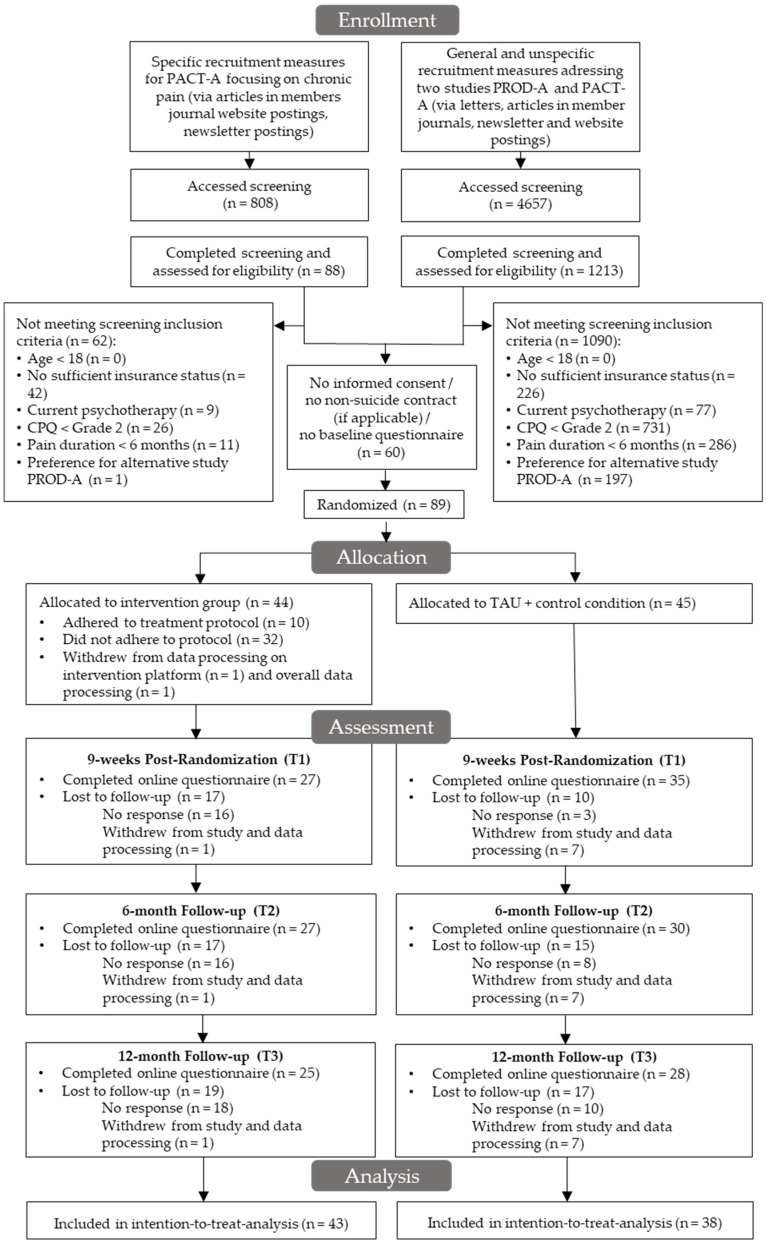
- Sample/data: German SVLFG policyholders in green professions (entrepreneurs, contributing spouses, family members, pensioners) with chronic pain of at least 6 months and pain grade II or higher; final sample N = 89, with final analysis sample n = 43 in intervention and n = 38 in control.
- Analysis: Intention-to-treat analyses using linear regression models, multiple imputation by chained equations, and complete-case sensitivity analyses; primary outcome was pain interference at 9 weeks, with follow-ups at 6 months and 12 months.
## Limitations
- The paper states that recruitment was terminated prematurely, leaving the study with highly limited statistical power and making it impossible to draw a reliable effectiveness conclusion.
- The paper states high attrition and low intervention adherence as major limitations; it notes that these likely reduced power and complicated interpretation.
- Evident from the text: the final sample was mostly female, predominantly low education, and largely self-referred, which the authors say may restrict representativeness for the broader green-professions population.
- Evident from the text: participants with acute suicidality were excluded, so results do not generalize to people with comorbid major depression/acute suicidality or tumor pain.
Model-written summary. Check it against the paper before relying on it.
Integrity signals
Registry
Cites
Statistics
Figures

Verification
Claims the paper makes
12 Valid · 1 Not valid · 6 Not checked · 67 Own results and interpretations
Every source the paper cites for this claim was checked and supports it.
In the paper
“Indeed, farmers were in general only half as likely as non-farmers to consult a general practitioner or mental health professional, according to an Australian study [33].”
§ Lessons Learned from an Attempted Pragmatic Randomized Controlled Trial for Improvement of Chronic Pain-Associated Disability in Green Professions: Long-Term Effectiveness of a Guided Online-Based Acceptance and Commitment Therapy (PACT-A) > 1. Introduction
What the sources say
- Supportedcites [33] Brew, B., Inder, K., Allen, J., Thomas, M., and Kelly, B. (2016). The health and wellbeing of Australian farmers: A longitudinal cohort study. BMC Public Health, 16. source
The Abstract’s Results state that farmers were about half as likely as non-farm workers to visit a GP or mental health professional in the last 12 months, regardless of location. The longitudinal Results report an adjusted odds ratio of 0.59 for visiting a professional for mental health reasons; the Discussion also describes lower GP attendance among farmers. No page numbers are provided in our copy. (LLM, conf=0.94)
plainstates an association- Asserted: passes — The authors put it forward as true.
- Checkable: passes — It can be checked against evidence.
- Load-bearing: passes — The paper’s conclusions depend on it.
- Based: passes — The paper gives a reason why it holds.
- Supported
The sources with a verdict support this claim; the rest weren’t checked yet, have no full text we could read, or their verdicts aren’t rated yet.
In the paper
“Further, pain acceptance has been identified as a mediator in cognitive behavioral therapy (CBT) for chronic pain [26,27].”
§ Lessons Learned from an Attempted Pragmatic Randomized Controlled Trial for Improvement of Chronic Pain-Associated Disability in Green Professions: Long-Term Effectiveness of a Guided Online-Based Acceptance and Commitment Therapy (PACT-A) > 1. Introduction
What the sources say
- Supportedcites [26] Perrin, 2015, The Mediating Role of Acceptance in Multidisciplinary Cognitive-Behavioral Therapy for Chronic Pain, J. Pain source
The accepted manuscript (page not supplied) identifies pain-related acceptance as a mediator of changes in pain interference and depression during CBT-based treatment for chronic pain. It was not related to pain intensity in the multivariate analysis, but the citing claim does not say it mediated every outcome. (LLM, conf=0.90)
- Not checked — no full text of the sourcecites [27] Baranoff, 2013, Acceptance as a process variable in relation to catastrophizing in multidisciplinary pain treatment, Eur. J. Pain source
plainstates a cause- Asserted: passes — The authors put it forward as true.
- Checkable: passes — It can be checked against evidence.
- Load-bearing: passes — The paper’s conclusions depend on it.
- Based: passes — The paper gives a reason why it holds.
- Supported
Every source the paper cites for this claim was checked and supports it.
In the paper
“Regarding the null effect for the primary outcome, these results stand in stark contrast to a study evaluating a previous version of this guided ACT-based chronic pain internet intervention in a general population sample, reporting moderate to large treatment effects regarding reduction of pain interference after 9 weeks and 6 months post-randomization compared to a waitlist CG [50].”
§ Lessons Learned from an Attempted Pragmatic Randomized Controlled Trial for Improvement of Chronic Pain-Associated Disability in Green Professions: Long-Term Effectiveness of a Guided Online-Based Acceptance and Commitment Therapy (PACT-A) > 4. Discussion > 4.2. Comparison to Prior Work Regarding the null effect for the primary outcome, these results stand in stark contrast to a study evaluating a previous version of this guided ACT-based chronic pain internet intervention in a general population sample, reporting moderate to large treatment effects regarding reduction of pain interference after 9 weeks and 6 months post-randomization compared to a waitlist CG [50]. Likewise, a recent meta-analysis pooled the few available studies to date for guided ACT-based chronic pain online interventions compared to non-ACT interventions, attaining a moderate effect of SMD = −0.50 post-treatment and a large effect of SMD = −0.69 at 6-month FU regarding reduction of pain interference [31]. Broadening the focus to include online interventions for chronic pain or functional somatic syndrome that were mostly guided and predominantly based on CBT or third-wave approaches like ACT, smaller average treatment effects of SMD = −0.35 and SMD = −0.18 emerged for reduction of functional interference at post and 6- or more months FU, respectively, compared to passive controls and SMD = −0.15 and SMD = −0.20 emerged at post and 6- or more months FU, respectively, compared to active controls [97]. In terms of secondary outcomes, we observed some delayed exploratory treatment effects after 12 months post-randomization, indicating an intervention effect of cognitive defusion and increased pain acceptance along with an improvement in anxiety, perceived stress and quality of life. This is in line with the previously suggested possibility of an incubation effect based on a meta-analytic review on online-based ACT interventions for chronic pain describing a strengthening of treatment effects over time [31]. However, the increase in completed modules over time might also have contributed to a delay of treatment effects. Several reasons are conceivable for our findings. First and foremost, our null finding regarding the primary outcome has to be considered against the backdrop of highly limited statistical power, as the recruitment had to be terminated preliminary at approximately 31% of the targeted sample size. Post hoc power analysis with the estimated effect size of d = 0.16, alpha level of 5% for a one-tailed t-test and sample sizes n1 = 43 und n2 = 38 revealed a statistical power of only 18%. Thus, the probability of Type II error to falsely reject the null hypotheses lies at 82%. Thus, no reliable statement regarding effectiveness can be derived based on this attempted pragmatic RCT. Second, descriptive data show a within-group reduction in pain interference in both treatment groups. However, the ACT-based intervention did not reduce pain interference significantly beyond the effect of TAU enhanced with information material and spontaneous remission. The descriptive results indicate that, possibly, in this implementation context the offer of an ACT-based intervention for chronic pain might have no incremental added value over TAU enhanced with information material. This would be in line with previous research by Baumeister et al. [98] suggesting that an online intervention for depression treatment in patients with comorbid chronic back pain and a depressive disorder might not achieve an incremental added treatment effect following an orthopedic rehabilitation stay, as patients might have already profited substantially from unspecific routine care offers in rehabilitation. Thus, more research should be conducted to determine in which implementation contexts (e.g., prevention, treatment or aftercare with different intensity levels) the introduction of online interventions for chronic pain can incrementally improve pain interference beyond the effect of routine care. Yet again, as comparison against a minimally active CG like TAU+ provides a stronger statement regarding usefulness of the intervention in routine care than comparison with a waitlist CG, sufficient statistical power is even more important in order to make a comparison with TAU [99]. In line with this, a previous RCT evaluating a former version of this ACT-based online intervention in the general population observed a significant treatment effect in reduction of pain interference, but in comparison against a waitlist CG [50]. Third, adherence was exceptionally low at 9 weeks post-randomization and increased over time. Similar to a parallel trial evaluating a tailored online intervention program for persons occupied in green professions and at risk for depression [39], we observed a pragmatic intervention use over a large time frame of several months. This is in line with participants reporting time restrictions due to high workload in work and private life as key barriers to intervention use in the context of qualitative interviews conducted [100]. Thus, it seems the primary outcome was terminated too early at 9 weeks after randomization. As intervention adherence is associated with outcomes of psychological internet interventions [101], treatment dose might have been too low overall to achieve a reduction of pain interference over the effect in the enhanced TAU group after 9 weeks. However, not even a delayed between-group treatment effect on pain interference emerged over the time frame of 12 months after randomization, even though adherence to the intervention increased up until the 6-month follow up. Fourth, pain interference and intensity at baseline were somewhat lower than in a comparable trial [50]. Possibly, severity of pain interference or pain intensity at baseline could be a potential moderator of the treatment effect. However, pain intensity has not been identified as a moderator for chronic pain outcomes in online primarily self-guided CBT-based [102] and ACT-based [103] interventions. Indeed, in previous research, no sociodemographic, medical or physical impairment variables could be consistently identified as predictors of outcome for conventional behavioral or cognitive behavioral treatment of chronic pain [104]. Fifth, research of non-digital (cognitive) behavioral treatment of chronic pain over the last decades has shown differential effectiveness mostly due to psychological process variables [104]. Specifically, psychological wellbeing [103] and psychological flexibility [25,29] were identified as moderators for ACT-based online therapy. Due to the absence of a treatment effect regarding pain interference, we were not able to investigate these variables as potential moderating and mediating variables. This sample can be classified regarding psychological wellbeing on average as subliminally depressed and anxious at baseline and well below the reported population norms for quality of life for this age group [105]. Possibly, the level of psychological flexibility and wellbeing in the recruited sample were too low to achieve a treatment effect. However, in a comparable pragmatic trial reporting robust treatment effects, similar baseline levels for baseline depression, anxiety and pain acceptance were reported [50]. Sixth, recent studies have shown that higher pain resilience could be associated with less pain catastrophizing in older adults with back pain [106]. Thus, a higher pain resilience in this population group compared to the general population might be a possible reason for experiencing fewer negative beliefs und lower psychological distress due to chronic pain, which would in turn explain why this population sample did not respond well to the psychological ACT-based treatment approach. However, we cannot determine the extent of pain resilience in this sample based on our data. As there is no research literature pertaining pain resilience in green professions, this is a hypothesis to be investigated in future studies. Seventh, participants included in this trial were on average somewhat older than participants included in a recent meta-analysis evaluating ACT-based online interventions for chronic pain [31]. Older adults with chronic pain have been shown to respond better to group-based face-to-face ACT than CBT [107]. However, a systematic review suggested relatively low overall eHealth literacy in older adults [108]. Further, rural regions have been associated with low levels of digital health literacy [109]. Along with a predominantly low education level, we might have recruited a sample generally low in digital health literacy, possibly resulting in a reduced willingness or ability to process health-related information online. Eighth, treatment expectancy has been shown to be positively associated with outcomes in cognitive behavioral and physical treatment of chronic pain [110,111]. As we assume low digital health literacy [109] along with higher levels of stigma regarding mental health problems in older adults in rural regions [112], and specifically in farmers [113], a focus on primarily the somatic aspects of chronic pain in this target group is imaginable. If a primarily somatic disease and treatment model of chronic pain dominates in this occupational group, this would possibly limit treatment expectancy for a psychological treatment approach. Further, this would be in line with the high percentage of participants reporting at baseline to have consulted a primary care clinician (90.1%) or to have consumed pain medication (67.9%) compared to the percentage of participants reporting at baseline to have undergone psychological pain treatment before (1.2%). Further, this would be consistent with the low recruitment success, low adherence and high attrition rate experienced in this study sample. A primarily somatic treatment concept in patients with chronic somatic diseases neglecting mental health aspects can be further hypothesized as a possible explanation against the background of limited results regarding the use of internet interventions for the management of depression in chronic back pain [98] or in coronary heart disease [114]. Thus, measures to raise awareness of psychological treatment options in the context of chronic pain would be indicated, possibly by involving primary care clinicians, which were most frequented by the study sample compared to other health care options. Lastly, this is a pragmatic trial in a routine care setting. Whereas efficacy of internet interventions for different mental and somatic disorders is well confirmed, effectiveness trials in routine care settings often reveal challenges in the uptake, use and benefit of internet interventions, especially when they are unguided [115]. The evaluation of uptake and adherence of a previous unguided version of this ACT-based online intervention for chronic pain in a pragmatic setting without the supporting structures of an RCT study revealed low uptake and an exceptionally low intervention adherence rate [116]. However, our participants received regular guidance optionally via written message or telephone and were embedded in a structured study setting. Yet, possibly a more intensive, tailored or imminent guidance format as practiced in some other programs [117] might be required to facilitate adherence in this specific occupational group. In line, this trial also provided information about feasibility of this ACT-based online intervention to the occupational group of green professions. Overall, the intervention generated little interest in the target group, as shown by low recruitment success, lower satisfaction ratings, higher study attrition and fewer completed modules post-treatment compared to the guided ACT-based intervention condition in a general population sample [50]. First, recruitment measures were part of a general recruitment strategy for advertising online interventions as a prevention offer for policyholders operating in green professions and thus, were most often not specifically addressed to policyholders with chronic pain history. As seen in the study flow, specific recruitment measures generated overall lower response yet had a higher success rate in addressing eligible policyholders, with 29.5% (26/88) of screening completers fulfilling screening inclusion criteria. General recruitment measures generated high response rates, yet only 10.1% (123/1213) of screening completers fulfilled screening inclusion criteria. Overall, the mix of recruitment measures applied was not feasible to develop a sufficient reach for this target population. Thus, large-scale yet simultaneously highly specific recruitment measures addressing directly policyholders with a history of chronic pain might be more suitable to achieve a high response rate in this population. Second, people in green professions might be an occupational group that is generally hard to reach and difficult to treat, due to presumed aspects like perceived stigma for mental health seeking [34,113] or limited digital or mental health literacy, with programs specifically being developed to enhance mental health knowledge [118,119]. However, the ACT-based pain intervention was rated considerably lower regarding intervention satisfaction as well as therapeutic and technological alliances, along with a slightly lower adherence rate at 12-month FU and attained lower recruitment success compared to an online intervention program for depression prevention evaluated in a parallel trial in green professions [38,39]. Therefore, in green professions, specifically, persons burdened by chronic pain did not respond well to this ACT-based intervention in comparison to persons at risk for depression receiving access to an online interventions’ portfolio for depression prevention. Third, participants of this ACT-based intervention can be mostly divided into all-or-nothing users, with most participants either not having completed one intervention module at all or having completed all intervention modules over a time frame of 6 months. Comparison of participant characteristics between intervention completers and non-completers revealed that the age difference was statistically significant, with the sample of non-completers being older by five years on average. Further, there was a trend towards a higher proportion of men and persons with a lower education level in the sample of non-completers. This is in line with research suggesting that lower digital literacy seems to be associated with higher age and lower educational level [120] as well as with the significantly higher agreement rates with technical difficulties as barriers to intervention use we observed in the context of a mixed-method study with a subsample of participants from this RCT as compared to participants of a trial evaluating a portfolio of online interventions for participants working in green professions and being at risk for depression [100]. Possibly, this subgroup of predominantly men of higher age and lower educational level burdened with chronic pain might be an especially hard-to-treat sample. Fourth, as certainly not every online intervention works for everyone, critical aspects for fit between user and intervention need to be identified. This might be different for various target groups. The fit between intervention design and user for one has not been considered in most ACT-based online interventions for chronic pain evaluated to date [121]. This might be an aspect, among others, explaining differences in adherence, acceptance and effectiveness in this occupational group compared to previous study results investigating general population samples.
What the sources say
- Supportedcites [50] Lin, 2017, An internet-based intervention for chronic pain, Dtsch. Arztebl. Int. source
Split into 2 atoms — 2 confirmed, 0 partially supported, 0 disputed, 0 misattributed, 0 unverifiable. Expand the claim to see per-atom verdicts.
plainstates a cause- Asserted: passes — The authors put it forward as true.
- Checkable: passes — It can be checked against evidence.
- Load-bearing: passes — The paper’s conclusions depend on it.
- Based: passes — The paper gives a reason why it holds.
- Supported
A result the paper reports from its own data — it cites no other source for it, so there is none to check. The quote shows it is in the paper.
In the paper
“No treatment effect for reduction of pain interference was found at T1 (β = −0.16, 95%CI: −0.64–0.32, p = 0.256).”
- Also stated in: § 3.2. Primary Outcome · plain
“No significant effect of reduction of pain interference in IG (M = 29.75, SD = 14.94) compared to CG (M = 31.81, SD = 10.56) was observed at T1 based on ITT analysis (β = −0.16, 95% CI: −0.64 to 0.32, p = 0.256) corresponding to an effect size of d = −0.16 [−0.59; 0.28] as shown in Table 2.”
§ Lessons Learned from an Attempted Pragmatic Randomized Controlled Trial for Improvement of Chronic Pain-Associated Disability in Green Professions: Long-Term Effectiveness of a Guided Online-Based Acceptance and Commitment Therapy (PACT-A) > Abstract Musculoskeletal symptoms are increased in farmers, whereas the prevalence of chronified pain is unknown. Online interventions based on acceptance and commitment therapy (ACT) have shown encouraging results in the general population, representing a promising approach for reducing pain interference in green professions (i.e., farmers, foresters, gardeners). We conducted a pragmatic RCT comparing a guided ACT-based online intervention to enhanced treatment-as-usual in entrepreneurs, contributing spouses, family members and pensioners in green professions with chronic pain (CPG: ≥grade II, ≥6 months). Recruitment was terminated prematurely after 2.5 years at N = 89 (of planned N = 286). Assessments were conducted at 9 weeks (T1), 6 months (T2) and 12 months (T3) post-randomization. The primary outcome was pain interference (T1). The secondary outcomes encompassed pain-, health- and intervention-related variables. No treatment effect for reduction of pain interference was found at T1 (β = −0.16, 95%CI: −0.64–0.32, p = 0.256). Improvements in cognitive fusion, pain acceptance, anxiety, perceived stress and quality of life were found only at T3. Intervention satisfaction as well as therapeutic and technological alliances were moderate, and uptake and adherence were low. Results are restricted by low statistical power due to recruitment issues, high study attrition and low intervention adherence, standing in contrast to previous studies. Further research is warranted regarding the use of ACT-based online interventions for chronic pain in this occupational group. Trial registration: German Clinical Trial Registration: DRKS00014619. Registered: 16 April 2018.
plainn = 89- Asserted: passes — The authors put it forward as true.
- Checkable: passes — It can be checked against evidence.
- Load-bearing: passes — The paper’s conclusions depend on it.
- Based: passes — The paper gives a reason why it holds.
- Also stated in: § 3.2. Primary Outcome · plain
A result the paper reports from its own data — it cites no other source for it, so there is none to check. The quote shows it is in the paper.
In the paper
“Improvements in cognitive fusion, pain acceptance, anxiety, perceived stress and quality of life were found only at T3.”
§ Lessons Learned from an Attempted Pragmatic Randomized Controlled Trial for Improvement of Chronic Pain-Associated Disability in Green Professions: Long-Term Effectiveness of a Guided Online-Based Acceptance and Commitment Therapy (PACT-A) > Abstract Musculoskeletal symptoms are increased in farmers, whereas the prevalence of chronified pain is unknown. Online interventions based on acceptance and commitment therapy (ACT) have shown encouraging results in the general population, representing a promising approach for reducing pain interference in green professions (i.e., farmers, foresters, gardeners). We conducted a pragmatic RCT comparing a guided ACT-based online intervention to enhanced treatment-as-usual in entrepreneurs, contributing spouses, family members and pensioners in green professions with chronic pain (CPG: ≥grade II, ≥6 months). Recruitment was terminated prematurely after 2.5 years at N = 89 (of planned N = 286). Assessments were conducted at 9 weeks (T1), 6 months (T2) and 12 months (T3) post-randomization. The primary outcome was pain interference (T1). The secondary outcomes encompassed pain-, health- and intervention-related variables. No treatment effect for reduction of pain interference was found at T1 (β = −0.16, 95%CI: −0.64–0.32, p = 0.256). Improvements in cognitive fusion, pain acceptance, anxiety, perceived stress and quality of life were found only at T3. Intervention satisfaction as well as therapeutic and technological alliances were moderate, and uptake and adherence were low. Results are restricted by low statistical power due to recruitment issues, high study attrition and low intervention adherence, standing in contrast to previous studies. Further research is warranted regarding the use of ACT-based online interventions for chronic pain in this occupational group. Trial registration: German Clinical Trial Registration: DRKS00014619. Registered: 16 April 2018.
plainn = 89- Asserted: passes — The authors put it forward as true.
- Checkable: passes — It can be checked against evidence.
- Load-bearing: unclear — It is unclear whether the paper’s conclusions depend on it.
- Based: passes — The paper gives a reason why it holds.
47 more claims
Create a free account to see all 86 claims and every source verdict.
- Probably not a substantial claim. 23
- It may state two separate claims as one. 16
Claims other papers make about this one
Each is checked against this paper’s own text: does it say what the citing paper says it does?
The source backs part of the claim, not all of it — or backs it for a different population, condition or comparison.
In the citing paper
“Only nine studies reported adherence to the manual [28, 29, 42, 43, 49–51, 55, 60].”
From Acceptance and commitment therapy for patients with chronic pain: A systematic review and meta-analysis on psychological outcomes and quality of life (2024) · cites this paper as [29]
Experimental — accuracy not yet measuredThe cited source says what the claim attributes to it.
In the citing paper
“Thirteen studies documented whether client engagement checks were conducted during the trial [28, 29, 46, 47, 49, 50, 52, 53, 56–60].”
From Acceptance and commitment therapy for patients with chronic pain: A systematic review and meta-analysis on psychological outcomes and quality of life (2024) · cites this paper as [29]
The check wasn’t confident either way, so it gives no verdict — never disputed.
In the citing paper
“In terms of attrition bias, twenty studies were rated as”
From Acceptance and commitment therapy for patients with chronic pain: A systematic review and meta-analysis on psychological outcomes and quality of life (2024) · cites this paper as [29]
Experimental — accuracy not yet measured
Citations
Cites
A Global Measure of Perceived Stress
Cohen, S., Kamarck, T., & Mermelstein, R. (1983) · Journal of Health and Social Behavior · doi:10.2307/2136404 · Cited by 32,807
Multiple Imputation for Nonresponse in Surveys
Rubin, D. B. (1987) · Wiley Series in Probability and Statistics · doi:10.1002/9780470316696 · Cited by 20,701
SAUNDERS, J. B., AASLAND, O. G., BABOR, T. F., DE LA FUENTE, J. R., & GRANT, M. (1993) · Addiction · doi:10.1111/j.1360-0443.1993.tb02093.x · Cited by 13,597 · cited 2×
“Harmful alcohol consumption was evaluated with the Alcohol Use Disorder Identifications Test (AUDIT) [70,71], with satisfactory reliability for the subscales ranging between α = 0.”
MethodInfluentialCONSORT 2010 Statement: updated guidelines for reporting parallel group randomised trials
the CONSORT Group, Schulz, K. F., Altman, D. G., & Moher, D. (2010) · BMC Medicine · doi:10.1186/1741-7015-8-18 · Cited by 13,371
Bundesgesundheitsblatt - Gesundheitsforschung - Gesundheitsschutz
(2013) · Bundesgesundheitsblatt - Gesundheitsforschung - Gesundheitsschutz · doi:10.1007/103.1437-1588 · Cited by 11,796
CONSORT 2010 Statement: updated guidelines for reporting parallel group randomised trials
Schulz, K. F., Altman, D. G., Moher, D., & for the CONSORT Group (2010) · BMJ · doi:10.1136/bmj.c332 · Cited by 9,329
Moher, D., Hopewell, S., Schulz, K. F., Montori, V., Gotzsche, P. C., Devereaux, P. J., Elbourne, D., Egger, M., & Altman, D. G. (2010) · BMJ · doi:10.1136/bmj.c869 · Cited by 8,883 · cited 1×
“Results are reported in accordance with the CONSORT 2010 statement [42,43], the extension for reporting of pragmatic trials [44] and guidelines for internet intervention research [45].”
MethodJacobson, N. S., & Truax, P. (1991) · Journal of Consulting and Clinical Psychology · doi:10.1037/0022-006x.59.1.12 · Cited by 7,770 · cited 1×
“Reliable change index [91] was calculated assuming a reliability estimate of α = 0.”
Method(2010) · University of Twente Research Information · Cited by 6,037
Pain assessment: global use of the Brief Pain Inventory.
Cs, C., & Km, R. (1994) · PubMed · Cited by 5,178
Research works printed but not linked: 3
- Merskey, H., and Bogduk, N. (1994). Classification of Chronic Pain, IASP Press. [2nd ed.].
- Hayes, S.C., Strosahl, K.D., and Wilson, K.G. (1999). Acceptance and Commitment Therapy: An Experiential Approach to Behavior Change, Guilford Press.
- Enders, C.K. (2010). Applied Missing Data Analysis, Guilford Press.
Cited by
Ye, L., Li, Y., Deng, Q., Zhao, X., Zhong, L., & Yang, L. (2024) · PLoS ONE · doi:10.1371/journal.pone.0301226 · Cited by 43
Latreche, H., Bellahcene, M., & Dutot, V. (2024) · International Journal of Bank Marketing · doi:10.1108/ijbm-02-2023-0100 · Cited by 27
Oirschot, G. V., Pomphrey, A., Dunne, C., Murphy, K., Blood, K., & Doherty, C. (2024) · JMIR Rehabilitation and Assistive Technologies · doi:10.2196/48154 · Cited by 11
Apolinário-Hagen, J., Drüge, M., Guthardt, L., & Haller, E. (2024) · Advances in Experimental Medicine and Biology · doi:10.1007/978-981-97-4402-2_12 · Cited by 6
Freund, J., Ebert, D. D., Thielecke, J., Braun, L., Baumeister, H., Berking, M., & Titzler, I. (2023) · Frontiers in Digital Health · doi:10.3389/fdgth.2022.1083143 · Cited by 6
Self-citation
Metadata
- Authors
- Braun, L., Terhorst, Y., Titzler, I., Freund, J., Thielecke, J., Ebert, D. D., & Baumeister, H.
- Affiliations
- Universität Ulm (DE)
- Friedrich-Alexander-Universität Erlangen-Nürnberg (DE)
- Technical University of Munich (DE)
- Corresponding author
- Braun, Lina
- ORCID
- Venue
- International Journal of Environmental Research and Public Health
- Publisher
- MDPI AG
- Published
- 2022-10-25
- Volume
- 19
- Issue
- 21
- Pages
- 13858
- ISSN
- 1660-4601 (ISSN-L)
- PMC
- PMC9655679
- OpenAlex
- W4307547954
- Cited by
- 17
- References
- 129
- Citations by year
- 2026: 4 · 2025: 3 · 2024: 6 · 2023: 4
- FWCI
- 2.97
- Type
- journal article
- Language
- en
- Open access
- gold
- doi.org
- Licence
- Locations
- International Journal of Environmental Research and Public Health (publishedVersion, cc-by)
- PubMed Central (publishedVersion, cc-by)
- PubMed (publishedVersion)
- RePEc: Research Papers in Economics (submittedVersion)
- DOAJ (DOAJ: Directory of Open Access Journals) (submittedVersion, cc-by-sa)
- mediaTUM – the media and publications repository of the Technical University Munich (Technical University Munich) (submittedVersion, cc-by)
- mediaTUM – the media and publications repository of the Technical University Munich (Technical University Munich) (submittedVersion)
- OPUS Repository (Kooperativer Bibliotheksverbund Berlin-Brandenburg) (submittedVersion, cc-by)
- Funders
- Sozialversicherung für Landwirtschaft, Forsten und Gartenbau, SVLFG
- University of Ulm
- Topics
- Social Sciences › Psychology › Clinical Psychology › Mindfulness and Compassion Interventions
- Health Sciences › Health Professions › Physical Therapy, Sports Therapy and Rehabilitation › Musculoskeletal pain and rehabilitation
- Social Sciences › Psychology › Applied Psychology › Digital Mental Health Interventions
- Keywords
- acceptance and commitment therapy, chronic pain, farmers, online intervention, pain interference, musculoskeletal symptoms, occupational pain, intervention adherence, quality of life, anxiety, perceived stress, cognitive fusion, pain acceptance, long-term effectiveness
- MeSH terms
- Internet-Based Intervention, Humans, Occupations, Quality of Life, Treatment Outcome, Chronic Pain, Acceptance and Commitment Therapy
About these checks
Registry, retraction, Cites and statistics results are computed, not judged, with one exception: a printed reference that no index lists is read once by a model before it counts as a citation error. Claims are extracted by a model and kept only when their quote appears verbatim in the text; each cited source is then checked, with a model’s help, for whether it says what the claim relies on. Those verdicts can be wrong — read the claim’s quote and the cited source before relying on one.
The claim verdicts this report counts are experimental: their accuracy is not yet measured.
A language model drew the claims from the paper on 2026-10-11, under version 3 of the claim definition (model deepseek-v4.1-flash, prompt extract-v3).
A second model labelled each claim on 2026-10-11 (model jev-1.13-20260917, definition revision gold-guideline-v0.2).
Cited sources are checked with a language model’s help (gpt-6-sol).
Statistics and arithmetic are recomputed, not judged.
Confidence bands are shown only for fields calibrated on our annotated test set. None is calibrated yet, so no band is shown.
What counts as a claim ›How we measure confidence ›How we check this ›
Are you an author, or do you see a problem with this page? Request a review
How to cite
Cite CoChat for the checks on this page, and the paper for its own findings.
- This page
- CoChat. (2026). Citation check: Lessons Learned from an Attempted Pragmatic Randomized Controlled Trial for Improvement of Chronic Pain-Associated Disability in Green Professions: Long-Term Effectiveness of a Guided Online-Based Acceptance and Commitment Therapy (PACT-A). https://app.cochat.ai/papers/10.3390/ijerph192113858
- The paper
- Braun, L., Terhorst, Y., Titzler, I., Freund, J., Thielecke, J., Ebert, D. D., & Baumeister, H. (2022). Lessons Learned from an Attempted Pragmatic Randomized Controlled Trial for Improvement of Chronic Pain-Associated Disability in Green Professions: Long-Term Effectiveness of a Guided Online-Based Acceptance and Commitment Therapy (PACT-A). International Journal of Environmental Research and Public Health. https://doi.org/10.3390/ijerph192113858
Data sources
Bibliographic data: Semantic Scholar, OpenAlex, Crossref.
Contains information from the Semantic Scholar Academic Graph Datasets, made available under the ODC Attribution License (ODC-BY 1.0).
Semantic Scholar’s data is described in: Kinney, R., et al. (2023). The Semantic Scholar Open Data Platform. arXiv:2301.10140.
