

The DOI matches its Crossref record; 1 of the 1 references it cites were found in a registry or an index.
Disaster Preparedness and Awareness among University Students: A Structural Equation Analysis
Abstract
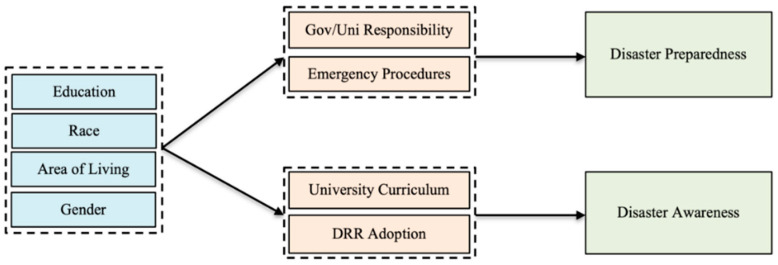
Students have long been among those most emotionally and physically affected by natural or manmade disasters, yet universities and colleges continue to lack effective disaster response and mitigation practices. This research identifies how students’ socio-demographics and disaster preparedness indicators (DPIs) impact their awareness of the dangers of disasters and their ability to survive and cope with the changes that disasters bring. A comprehensive survey was designed and distributed to university students to gain an in-depth understanding of their perceptions of disaster risk reduction factors. A total of 111 responses were received, and the impact of the socio-demographics and DPIs on the students’ disaster awareness and preparedness were evaluated by employing structural equation modeling. The results indicate that the university curriculum impacts the disaster awareness of students while the establishment of university emergency procedures impacts the disaster preparedness of students. The purpose of this research is to enable university stakeholders to identify the DPIs that are important to the students so that they can upgrade their programs and design effective DRR courses. It will also aid policymakers in redesigning effective emergency preparedness policies and procedures.
Overview
The claims and statistics of this paper haven’t been checked yet.
Run the check — free, no account needed. It reads the open-access text and checks the sources it cites.
Integrity signals
Registry
Cites
Statistics
Figures
Verification
Claims the paper makes
The claims and statistics of this paper haven’t been checked yet.
Run the check — free, no account needed. It reads the open-access text and checks the sources it cites.
Claims other papers make about this one
Each is checked against this paper’s own text: does it say what the citing paper says it does?
In the citing paper
“In the campus context, trust in warning systems and past experiences help shape these risk perceptions (Patel et al., 2023).”
From The Mediating Role of Risk Perception in the Effect of Information Literacy on Students’ Disaster Preparedness (2026) · cites this paper as Patel et al., 2023
Self-check
Percentages, sums and reported differences re-computed from the paper’s own numbers.
The self-check needs the paper’s full text.
Citations
Cites
Schermelleh-Engel, K., Moosbrugger, H., & Müller, H. (2003) · Department of Psychology - University of Koblenz-Landau · doi:10.23668/psycharchives.12784 · Cited by 8,975
Research works printed but not linked: 36
- Nipa, 2023, Evaluation of Resilience Dimensions on Reconstruction of Highway Infrastructure Projects, J. Leg. Aff. Disput. Resolut. Eng. Constr., 15, 04522057, 10.1061/JLADAH.LADR-899 · DOI
- Behnam, B. (2017). Post-Earthquake Fire Analysis in Urban Structures: Risk Management Strategies, CRC Press. · DOI
- Sawalha, 2020, A contemporary perspective on the disaster management cycle, Foresight, 22, 469, 10.1108/FS-11-2019-0097 · DOI
- Nipa, 2023, Identification of Resilience Dimensions in Critical Transportation Infrastructure Networks, J. Leg. Aff. Disput. Resolut. Eng. Constr., 15, 03122001, 10.1061/JLADAH.LADR-870 · DOI
- Pamidimukkala, A., Kermanshachi, S., and Safapour, E. (2020). Creative Construction e-Conference 2020, Budapest University of Technology and Economics.
- Pamidimukkala, A., Kermanshachi, S., and Karthick, S. (2020). Creative Construction e-Conference 2020, Budapest University of Technology and Economics.
- Jaradat, 2015, Disaster preparedness in universities, Int. J. Comput. Trends Technol., 19, 1, 10.14445/22312803/IJCTT-V19P101 · DOI
- Safapour, 2021, Post-disaster recovery in urban and rural communities: Challenges and strategies, Int. J. Disaster Risk Reduct., 64, 102535, 10.1016/j.ijdrr.2021.102535 · DOI
- Tanner, 2015, Emergency preparedness amongst university students, Int. J. Disaster Risk Reduct., 13, 409, 10.1016/j.ijdrr.2015.08.007 · DOI
- Mulilis, 2000, Tornado preparedness of students, nonstudent renters, and nonstudent owners: Issues of PrE Theory 1, J. Appl. Soc. Psychol., 30, 1310, 10.1111/j.1559-1816.2000.tb02522.x · DOI
- Tan, 2017, Disaster preparedness among university students in Guangzhou, China: Assessment of status and demand for disaster education, Disaster Med. Public Health Prep., 11, 310, 10.1017/dmp.2016.124 · DOI · Paper page
- Amri, A. (2015). Challenges in Implementing Disaster Risk Reduction Education: Views from the Frontline in Indonesia. [Doctoral Dissertation, Macquarie University].
- Haynes, 2015, Empowering young people and strengthening resilience: Youth-centred participatory video as a tool for climate change adaptation and disaster risk reduction, Child. Geogr., 13, 357, 10.1080/14733285.2013.848599 · DOI
- Whittaker, 2013, Community safety during the 2009 Australian ‘Black Saturday’bushfires: An analysis of household preparedness and response, Int. J. Wildland Fire, 22, 841, 10.1071/WF12010 · DOI
- Edwards, F. (2022, June 13). Campus Roles in Emergency Management. DRU Workshop 2013 Presentations—Disaster Resistant University Workshop: Linking Mitigation and Resilience. Paper 6. Available online: https://scholarworks.uno.edu/dru2013/6.
- Amri, 2017, Disaster risk reduction education in Indonesia: Challenges and recommendations for scaling up, Nat. Hazards Earth Syst. Sci., 17, 595, 10.5194/nhess-17-595-2017 · DOI
- Berlin, 2018, Emergency management and preparedness training for youth (EMPTY): The results of the first Swedish Pilot study, Disaster Med. Public Health Prep., 12, 685, 10.1017/dmp.2017.144 · DOI
- Tkachuck, 2018, Natural disaster preparedness in college students: Implications for institutions of higher learning, J. Am. Coll. Health, 66, 269, 10.1080/07448481.2018.1431897 · DOI
- Goddard, S. (2017). Disaster Preparedness Knowledge, Beliefs, Risk-Perceptions, and Mitigating Factors of Disaster Preparedness Behaviors of Undergraduate Students at a Large Midwest University, AT Still University of Health Sciences. · DOI · Paper page
- Nahayo, 2018, Extent of disaster courses delivery for the risk reduction in Rwanda, Int. J. Disaster Risk Reduct., 27, 127, 10.1016/j.ijdrr.2017.09.046 · DOI
- Johnson, 2014, Classroom responses of New Zealand school teachers following the 2011 Christchurch earthquake, Nat. Hazards, 72, 1075, 10.1007/s11069-014-1053-3 · DOI
- Patel, R.K., Kermanshachi, S., and Namian, M. (2020). Creative Construction e-Conference 2020, Budapest University of Technology and Economics.
- Hladnik, 2013, Image compression and face recognition: Two image processing applications of principal component analysis, Int. Circ. Graph. Educ. Res., 6, 56
- Wang, 2021, Power analysis for parameter es-timation in structural equation modeling: A discussion and tutorial, Adv. Methods Pract. Psychol. Sci., 4, 251524592091825, 10.1177/2515245920918253 · DOI · Paper page
- Sambasivan, 2017, Analy-sis of delays in Tanzanian construction industry: Transaction cost eco-nomics (TCE) and structural equation modeling (SEM) approach, Eng. Constr. Archit. Manag., 24, 308, 10.1108/ECAM-09-2015-0145 · DOI
- Luna, E.M. (2017). The Routledge Handbook of Disaster Risk Reduction Including Climate Change Adaptation, Routledge. · DOI
- Kermanshachi, 2020, Disaster Preparedness Education: Construction Curriculum Requirements to Increase Students’ Preparedness in Pre-and Post-Disaster Activities, Associated Schools of Construction (ASC) Proceedings of the 56th Annual International Conference 2020, Volume 1, 142
- Jahan Nipa, T., Kermanshachi, S., and Patel, R.K. (2020). Creative Construction e-Conference 2020, Budapest University of Technology and Economics.
- Cao, 2012, The interactions between e-shopping and traditional in-store shopping: An application of structural equations model, Transportation, 39, 957, 10.1007/s11116-011-9376-3 · DOI
- Cangur, 2015, Comparison of model fit indices used in structural equation modeling under multivariate normality, J. Mod. Appl. Stat. Methods, 14, 14, 10.22237/jmasm/1430453580 · DOI
- Hooper, D., Coughlan, J., and Mullen, M. (2008, January 19–20). Evaluating model fit: A synthesis of the structural equation modelling literature. Proceedings of the 7th European Conference on Research Methodology for Business and Management Studies, London, UK.
- McDonald, 1989, An index of goodness-of-fit based on noncentrality, J. Classif., 6, 97, 10.1007/BF01908590 · DOI · Paper page
- Weston, 2006, A brief guide to structural equation modeling, Couns. Psychol., 34, 719, 10.1177/0011000006286345 · DOI · Paper page
- Cvetković, V.M., Roder, G., Öcal, A., Tarolli, P., and Dragićević, S. (2018). The role of gender in preparedness and response behaviors towards flood risk in Serbia. Int. J. Environ. Res. Public Health, 15. · DOI
- Patel, R.K., Kermanshachi, S., and Jahan Nipa, T. (2020). Creative Construction e-Conference 2020, Budapest University of Technology and Economics.
- ChungHee, 2015, Experience, awareness and preparedness of disaster among nursing college students, Crisisonomy, 11, 19
Cited by
Atalyan, T., & Bhandary, N. P. (2026) · Natural Hazards Research · doi:10.1016/j.nhres.2026.07.004
Andini, N. F., Putra, R. W., & Aldebaran, M. F. (2026) · JURNAL GEOGRAFI · doi:10.24114/jg.v18i1.72188
Metadata
- Authors
- Patel, R. K., Pamidimukkala, A., Kermanshachi, S., & Etminani-Ghasrodashti, R.
- Affiliations
- Department of Civil Engineering, University of Texas at Arlington, Arlington, TX 76019, USA
- Center for Transportation Equity, Decisions and Dollars (CTEDD), University of Texas at Arlington, Arlington, TX 76019, USA
- Venue
- International Journal of Environmental Research and Public Health
- Publisher
- MDPI AG
- Published
- 2023-03-02
- Volume
- 20
- Issue
- 5
- Pages
- 4447
- ISSN
- 1660-4601
- PMC
- PMC10001636
- Cited by
- 73
- References
- 1
- Language
- en
About these checks
Registry, retraction, Cites and statistics results are computed, not judged, with one exception: a printed reference that no index lists is read once by a model before it counts as a citation error. Claims are extracted by a model and kept only when their quote appears verbatim in the text; each cited source is then checked, with a model’s help, for whether it says what the claim relies on. Those verdicts can be wrong — read the claim’s quote and the cited source before relying on one.
Statistics and arithmetic are recomputed, not judged.
Confidence bands are shown only for fields calibrated on our annotated test set. None is calibrated yet, so no band is shown.
What counts as a claim ›How we measure confidence ›How we check this ›
Are you an author, or do you see a problem with this page? Request a review
Data sources
Bibliographic data: Semantic Scholar, OpenAlex, Crossref.
Contains information from the Semantic Scholar Academic Graph Datasets, made available under the ODC Attribution License (ODC-BY 1.0).
Semantic Scholar’s data is described in: Kinney, R., et al. (2023). The Semantic Scholar Open Data Platform. arXiv:2301.10140.
