

The Association between Physical Activity and Intrinsic Capacity in Chinese Older Adults and Its Connection to Primary Care: China Health and Retirement Longitudinal Study (CHARLS)
Open accessThe DOI matches its Crossref record; 37 of the 37 references it cites were found in a registry or an index.
Abstract
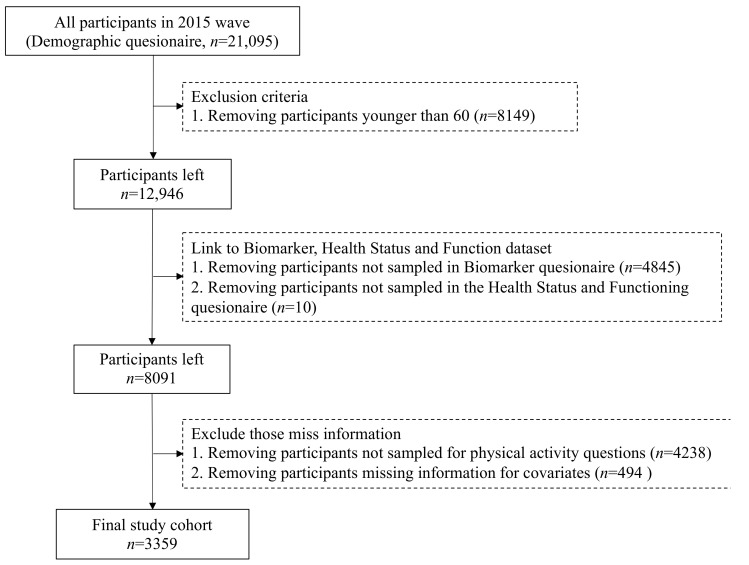
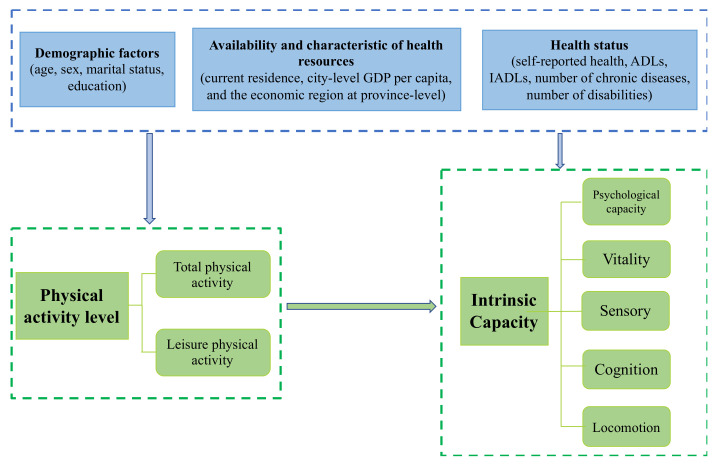
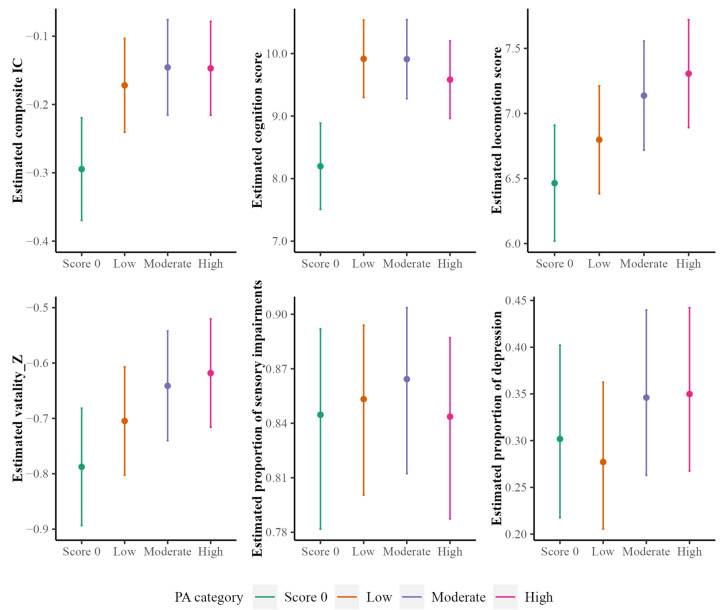
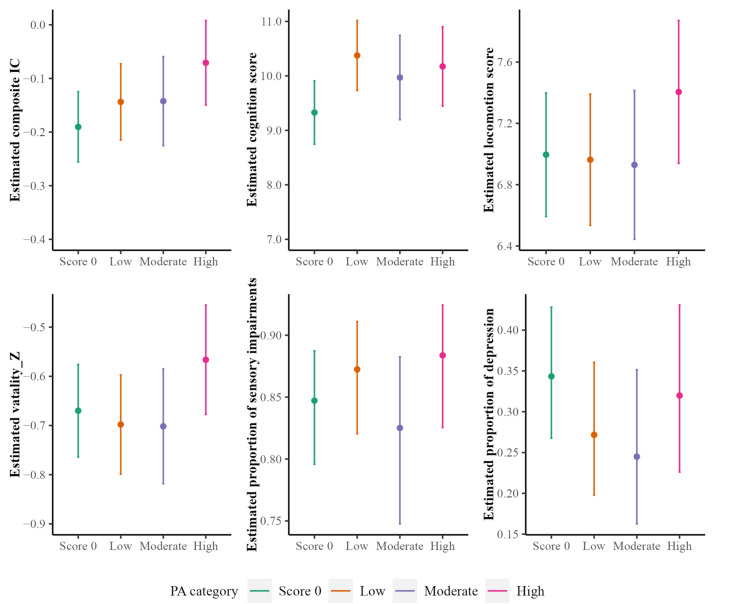
Background: In 2015, intrinsic capacity (IC) was proposed by the WHO as a new measure for healthy aging. Evidence has shown that physical activity (PA) benefits the physical and mental health of older adults. However, the association between PA and IC among older adults was not well evaluated or reported. This study aims to investigate the association between PA and general and specific IC among Chinese older adults. Method: The study included individuals aged 60 and above from the China Health and Retirement Longitudinal Study in 2015. The IC scores were constructed based on the WHO concept of five domains: psychological capacity, cognition, locomotion, vitality, and sensory abilities. Total PA and leisure PA were measured based on different activity purposes. Linear mixed-effects models and generalized linear mixed-effects models were developed to assess the associations between PA and IC. Results: A total of 3359 participants were included in this study. Older adults who reported some PA were associated with a higher composite IC score, with a mean difference of 0.14 (95% CI: 0.09–0.18, p < 0.001) compared to those who reported no PA. In terms of leisure PA, physically active adults had a higher composite IC score with a mean difference of 0.06 (95% CI: 0.03–0.09, p < 0.001). Older adults with a high level of leisure PA also had a significantly higher composite IC score (diff. in mean = 0.07, 95% CI: 0.01–0.13, p < 0.05) compared to those with low-level leisure PA. In addition, PA was positively and significantly associated with three specific IC domains: locomotion, cognition, and vitality. Conclusions: Improving both general and leisure PA can be an effective way to prevent the decline in IC among older adults, thus reducing the personal and public load of primary healthcare for aging countries such as China.
Overview
The claims and statistics of this paper haven’t been checked yet.
Free: it reads the open-access text and checks the first 5 claims that cite a source we can check. Create a free account to check every claim.
Integrity signals
Registry
Cites
Statistics
Figures
Verification
Claims the paper makes
The claims and statistics of this paper haven’t been checked yet.
Free: it reads the open-access text and checks the first 5 claims that cite a source we can check. Create a free account to check every claim.
Claims other papers make about this one
Each is checked against this paper’s own text: does it say what the citing paper says it does?
In the citing paper
“evidence to date suggests that engaging in PA can substantially enhance domains of intrinsic capacity [31]”
From Global consensus on optimal exercise recommendations for enhancing healthy longevity in older adults (ICFSR) (2025) · cites this paper as [31]
In the citing paper
“Although the specific mechanisms and optimal modalities of PA's health benefits are not fully understood, evidence to date suggests that engaging in PA can substantially enhance domains of intrinsic capacity [31].”
From Global consensus on optimal exercise recommendations for enhancing healthy longevity in older adults (ICFSR) (2025) · cites this paper as [31]
Self-check
Percentages, sums and reported differences re-computed from the paper’s own numbers.
The self-check needs the paper’s full text.
Citations
Cites
Screening for Depression in Well Older Adults: Evaluation of a Short Form of the CES-D
Andresen, E. M., Malmgren, J. A., Carter, W. B., & Patrick, D. L. (1994) · American Journal of Preventive Medicine · doi:10.1016/s0749-3797(18)30622-6 · Cited by 5,403 · cited 1×
“The classification using the CHARLS threshold may overestimate the number of subjects with depression and then generate biased results [40].”
ResultCohort Profile: The China Health and Retirement Longitudinal Study (CHARLS)
Zhao, Y., Hu, Y., Smith, J. P., Strauss, J., & Yang, G. (2014) · International Journal of Epidemiology · doi:10.1093/ije/dys203 · Cited by 5,266 · cited 1×
“Detailed information about the purpose, design, sample, and questionnaires of the CHARLS is available in other articles [16].”
BackgroundAndresen, E. M., Malmgren, J. A., Carter, W. B., & Patrick, D. L. (1994) · PubMed · Cited by 4,426
Physical Activity and Mental Health: Current Concepts
Paluska, S. A., & Schwenk, T. L. (2000) · Sports Medicine · doi:10.2165/00007256-200029030-00003 · Cited by 1,722 · cited 2×
“Although many studies showed the beneficial effects of PA in reducing the risk of depression, there was also evidence of no antidepressant effects of habitual PA [38] and self-reported PA [39].”
BackgroundSjöström, M., Ainsworth, B., Bauman, A. E., Bull, F., Hamilton-Craig, C., & Sallis, J. F. (2005) · Cited by 1,403
Association Between Physical Activity and Risk of Depression: A Systematic Review and Meta-analysis
Pearce, M., Garcia, L., Abbas, A., Strain, T., Schuch, F. B., Golubic, R., Kelly, P., Khan, S., Utukuri, M., Laird, Y., et al. (2022) · JAMA Psychiatry · doi:10.1001/jamapsychiatry.2022.0609 · Cited by 1,332 · cited 1×
“Based on the synthesized data, a recent meta-analysis focusing on the associations between PA and depression reported significant mental health benefits from being physically active even if the level of PA was below the public health recommendation levels [37].”
Physical Activity and Quality of Life in Older Adults
Rejeski, W. J., & Mihalko, S. L. (2001) · The Journals of Gerontology Series A: Biological Sciences and Medical Sciences · doi:10.1093/gerona/56.suppl_2.23 · Cited by 929 · cited 1×
“Growing evidence also identified PA as a potential low-cost intervention in reducing mortality [22], falls [23], and improving the quality of life [24] for older adults.”
BackgroundExercise for improving balance in older people
Howe, T. E., Rochester, L., Neil, F., Skelton, D. A., & Ballinger, C. (2011) · Cochrane Database of Systematic Reviews · doi:10.1002/14651858.cd004963.pub3 · Cited by 809
Evidence for the Domains Supporting the Construct of Intrinsic Capacity
Cesari, M., Araujo de Carvalho, I., Amuthavalli Thiyagarajan, J., Cooper, C., Martin, F. C., Reginster, J.-Y., Vellas, B., & Beard, J. R. (2018) · The Journals of Gerontology: Series A · doi:10.1093/gerona/gly011 · Cited by 745 · cited 1×
“five pivotal domains: locomotion, vitality, cognition, psychological capacities, and sensory abilities [4].”
BackgroundChoi, K. W., Chen, C.-Y., Stein, M. B., Klimentidis, Y. C., Wang, M.-J., Koenen, K. C., Smoller, J. W., & Major Depressive Disorder Working Group of the Psychiatric Genomics Consortium (2019) · JAMA Psychiatry · doi:10.1001/jamapsychiatry.2018.4175 · Cited by 744
Research works printed but not linked: 1
- World Health Organization Integrated Care for Older People: Guidelines on Community-Level Interventions to Manage Declines in Intrinsic Capacity World Health Organization Geneva, Switzerland 2017 29608259
Cited by
Izquierdo, M., de Souto Barreto, P., Arai, H., Bischoff-Ferrari, H. A., Cadore, E. L., Cesari, M., Chen, L.-K., Coen, P. M., Courneya, K. S., Duque, G., et al. (2025) · The Journal of nutrition, health and aging · doi:10.1016/j.jnha.2024.100401 · Cited by 273
Social determinants of intrinsic capacity: A systematic review of observational studies
Huang, Z.-T., Lai, E. T. C., Luo, Y., & Woo, J. (2024) · Ageing Research Reviews · doi:10.1016/j.arr.2024.102239 · Cited by 50
Intrinsic Capacity and Its Biological Basis: A Scoping Review
Beyene, M. B., Visvanathan, R., & Amare, A. T. (2024) · The Journal of Frailty & Aging · doi:10.14283/jfa.2024.30 · Cited by 53
“Other ways employed to compute IC were averaging the z-scores of the domains (70, 72, 81, 90, 93, 96, 102), direct summation of the values of indicators (5, 16, 17, 88, 101, 115), the latent growth modeling (LGM) method (31), weighted linear combination of indicators with loading greater than 0.3…”
InfluentialSánchez‐Sánchez, J. L., Ortolá, R., Banegas, J. R., Lucía, A., Rodríguez-Artalejo, F., Sotos‐Prieto, M., & Valenzuela, P. L. (2025) · The Lancet Healthy Longevity · doi:10.1016/j.lanhl.2024.100681 · Cited by 35
Cacciatore, S., Marzetti, E., Calvani, R., Picca, A., Salini, S., Russo, A., Tosato, M., & Landi, F. (2024) · Aging Clinical and Experimental Research · doi:10.1007/s40520-024-02822-7 · Cited by 31
Yang, F., Su, Q., Ran, Q., & Hu, Y. (2024) · The journal of nutrition health & aging · doi:10.1016/j.jnha.2024.100214 · Cited by 18
Chen, X.-L., Li, J., Sun, S., Zhao, Q.-Q., Lin, S.-R., Wang, L., Yang, Z.-Q., Ni, S.-H., & Lu, L. (2024) · Journal of Medical Internet Research · doi:10.2196/54200 · Cited by 24
Li, S., Zhang, J., Yang, Y., & Yang, Y. (2024) · Frontiers in Public Health · doi:10.3389/fpubh.2024.1462570 · Cited by 16
Raffin, J., Fourteau, M., Giudici, K. V., Rolland, Y., Vellas, B. J., & Barreto, P. D. S. (2024) · Archives of Gerontology and Geriatrics · doi:10.1016/j.archger.2024.105724 · Cited by 16
Chen, X.-L., Li, J., Sun, S., Zhang, X., Chen, J., Wang, L., Yang, Z.-Q., Ni, S.-H., & Lu, L. (2024) · The journal of nutrition health & aging · doi:10.1016/j.jnha.2024.100365 · Cited by 15
Felipe, S. G. B., Printes, C. B., Sato, D. K., & Baptista, R. R. (2025) · PeerJ · doi:10.7717/peerj.19017 · Cited by 12
“Conversely, higher intrinsic capacity scores are associated with a reduced risk of frailty and falls ( Zhou, Kuang & Hu, 2023 ).”
Zhu, Y. H., Zhu, Y. B., Li, J., Shi, N., Li, W., Tang, Y., Hua, L., Zhang, H., Yan, F., & Ma, Y. (2025) · Global Health & Medicine · doi:10.35772/ghm.2025.01026 · Cited by 11
Li, N., Wang, N., Lin, S., Yuan, Y., Huang, F., & Zhu, P. (2024) · Scientific Reports · doi:10.1038/s41598-024-69114-y · Cited by 10
“This implies that the higher frequency of PA at various intensities throughout the week is associated with reduced sedentary time or improved sleep quality, correlating with a lower likelihood of IC decline 58 .”
BackgroundYin, W., Zhao, X., Tyndall, A., & Hu, N. (2025) · International Journal of Environmental Research and Public Health · doi:10.3390/ijerph22081219 · Cited by 8
“This modeling framework improves the precision of fixed-effect estimates by adjusting for unobserved heterogeneity across these nested levels [41,44].”
Self-citationCheng, Y., Xiao, S., Cai, Y., Jing, L., Li, W., & Liu, X. (2025) · The Journals of Gerontology Series A · doi:10.1093/gerona/glaf172 · Cited by 7
Yin, W., Sifre, N., Chamorro, D., Chowdhury, S., & Hu, N. (2025) · International Journal of Environmental Research and Public Health · doi:10.3390/ijerph22020201 · Cited by 7
Self-citationContribution of physical activity to intrinsic capacity differs in USA, UK, Europe and China
Huang, Z., Lai, E., & Woo, J. (2025) · Journal of Aging Research and Lifestyle · doi:10.1016/j.jarlif.2025.100007 · Cited by 11
“Several studies have re-ported that PA was associated with improved IC, highlighting its role in promoting well-being among older adults [ 9 , 10 ].”
InfluentialSun, R., Li, Y., Kang, Y., Xu, X., Zhu, J., Fu, H., Zhang, Y., Lin, J., & Liu, Y. (2025) · Maturitas · doi:10.1016/j.maturitas.2025.108594 · Cited by 7
Wang, R., Tan, J., Su, Z., Kong, Y., Su, H., Ran, P., Zhong, Y., & Kuang, L. (2025) · BMC Public Health · doi:10.1186/s12889-025-23128-x · Cited by 8
“Recreational physical activities (RPA) are those carried out for entertainment or exercise, while non-recreational physical activities (NRPA) are those carried out for job demands or other purposes [35].”
Self-citationAlabdullatif, N., Arrieta, A., Dlugasch, L. B., & Hu, N. (2025) · BMC Public Health · doi:10.1186/s12889-025-23833-7 · Cited by 6
Self-citationHu, N., Yin, W., Noon, R. I., & Alabdullatif, N. (2025) · International Journal of Environmental Research and Public Health · doi:10.3390/ijerph22060908 · Cited by 4
“Additionally, random effects at the household and community levels were included to adjust for contextual dependencies, ensuring more precise estimations of fixed effects [42,43].”
Self-citationXu, W., Tian, L., & Dai, H. (2025) · Archives of Gerontology and Geriatrics · doi:10.1016/j.archger.2025.105993 · Cited by 5
Felipe, S. G. B., Printes, C. B., Brauner, F. D. O., Sato, D. K., & Baptista, R. R. (2025) · Frontiers in Aging · doi:10.3389/fragi.2025.1562383 · Cited by 4
Shen, J., Kang, Y., Zhang, C., Pang, J., Li, J., Shi, H., & Zhang, J. (2025) · BMC Geriatrics · doi:10.1186/s12877-025-06201-3 · Cited by 4
“Previous studies have demonstrated the protective effects of PLA on the health of older adults [30, 31].”
Liang, F., Yu, H., Li, F., & Li, X. (2025) · Frontiers in Public Health · doi:10.3389/fpubh.2025.1685991 · Cited by 3
Qing, M. M., Wang, J. L., Wang, L., Xie, L., He, Y., Ran, L., & Wang, X. (2026) · The journal of nutrition health & aging · doi:10.1016/j.jnha.2026.100809 · Cited by 3
Beyene, M. B., Visvanathan, R., Alemu, R. G., Theou, O., Benyamin, B., Cesari, M., Beard, J., & Amare, A. T. (2026) · The Journals of Gerontology Series A · doi:10.1093/gerona/glag057 · Cited by 6
“Among these, physical activity showed a strong positive association with IC, consistent with previous studies, 52,53 and this is the first study to examine this relationship using the PASE scale, a validated tool for older adults.”
Lyu, W., Tanaka, T., & Iijima, K. (2026) · Geriatrics and gerontology international/Geriatrics & gerontology international · doi:10.1111/ggi.70671 · Cited by 4
Fang, Y., Wang, R., Qing, Y., Zou, G., & Zhang, C. (2025) · BMC Geriatrics · doi:10.1186/s12877-025-06849-x · Cited by 3
“A total weekly energy expenditure of less than 600 METs is indicative of insufficient vitality [44, 50, 51].”
Li, X., Gao, C., & Yang, Y. (2025) · GeroScience · doi:10.1007/s11357-025-01802-7 · Cited by 2
Xie, C., Zhang, Y., Zhu, L., & Zou, G. (2026) · BMC Geriatrics · doi:10.1186/s12877-026-07103-8 · Cited by 2
“Many factors including low parental education, poor child health, environment [2], physical activity [3], advanced age, low educational attainment, and wid-owhood [4] affect IC.”
Temesgen, W. A., Cheng, H. Y., & Chong, Y. Y. (2024) · Journal of Alzheimer s Disease · doi:10.1177/13872877241305828 · Cited by 2
“17,36,37 The CHALRS considered activities such as carrying light stuff, bicycling at normal speed, mopping, and speed walking as kind of moderate physical activities that causes breathe faster than usual.”
Yang, C., Chen, X., Wan, X., & Cai, Y. (2025) · Frontiers in Medicine · doi:10.3389/fmed.2025.1595241 · Cited by 2
Changes in Sarcopenia Status and Subsequent Cardiovascular Outcomes: Prospective Cohort Study
Zhu, Y., Wang, K., Lu, Z., Li, F., Xu, Y., Shen, L., Bi, Y., & Hu, W. (2025) · JMIR Aging · doi:10.2196/69860 · Cited by 3
“Ideal physical activity level was defined as participating in moderate or vigorous activity more than once a week [26].”
Zhang, C., Chen, Q., Yin, F., Qin, L., & Zhang, S. (2025) · Frontiers in Public Health · doi:10.3389/fpubh.2025.1461554 · Cited by 2
Liu, Y., Yang, Z., Zhang, L., Liu, J., Wang, J., Feng, W., Shan, P., Tian, S., Jia, C., & Zhu, Y. (2025) · BMJ Open · doi:10.1136/bmjopen-2024-094060 · Cited by 1
Cheng, S., Lei, S., Hou, C., Qin, J., Du, X., Yue, X., & Guo, Y. (2025) · GeroScience · doi:10.1007/s11357-025-01983-1 · Cited by 3
Wan, Z., & Cai, S. (2026) · International Journal of Biometeorology · doi:10.1007/s00484-025-03122-z · Cited by 1
“As the CHARLS database only comprehensively col - lected physical activity-related data between 2015 and 2020, this study selected tracking data from three time points—2015, 2018, and 2020—for longitudinal analysis (K. Zhang et al. 2025a , b; Zhou et al. 2023 ).”
Hu, L., Tan, J., & Pu, C. (2026) · Healthcare · doi:10.3390/healthcare14070936 · Cited by 1
“In contrast, although physical activity is generally beneficially associated with IC, its effects appear to be more domain-specific and context-dependent, with stronger associations observed mainly in specific domains such as locomotion and vitality [34].”
Saffari, M., Liu, C., Su, H., Huang, H.-W., Hou, W., Chen, H., Hou, W., Wu, Y., Li, C.-Y., Griffiths, M. D., et al. (2026) · Journal of Prevention · doi:10.1007/s10935-026-00935-5 · Cited by 1
Felipe, S. G. B., Printes, C. B., Brauner, F. D. O., Sato, D. K., & Baptista, R. R. (2024) · Geriatrics Gerontology and Aging · doi:10.53886/gga.e0000104_en · Cited by 1
Felipe, S. G. B., Printes, C. B., Brauner, F. D. O., Sato, D. K., & Baptista, R. R. (2024) · Geriatrics Gerontology and Aging · doi:10.53886/gga.e0000104_pt
Enhancing Geriatric Care: International Collaboration and Best Practices for Aging Populations
(2025) · Frontiers research topics · doi:10.3389/978-2-8325-6977-1
Are Physical Activity Levels predictors of Aerobic Capacity in Active Senior Adults?
Gonçalves, L. C. V. B., Silva, L. R., Queirós, T., Carvalhais, A., & Brochado, G. (2025) · RIAGE - Revista Ibero-Americana de Gerontologia · doi:10.61415/riage.425
Yin, F., Fan, X., Chen, J., & Wu, X. (2026) · BMC Geriatrics · doi:10.1186/s12877-026-07056-y
“…in isolation, such as physical exercise, social engagement, or cognitive training [8–10], lacking a comprehensive investigation from a “behavioral pattern” perspective that considers the diverse and systematic combinations of leisure activities in which older adults typically engage [11–13].”
Jin, B., Zhang, Z., Yan, T., Yao, M., Wang, C., Wei, Y., Zhang, X., 何汝梅, Wang, L., Xi, S., et al. (2026) · Egyptian Journal of Bronchology · doi:10.1186/s43168-026-00582-8
Zheng, H. T., Phyo, A. Z. Z., McCubbin, C., Wu, Z., Bischoff-Ferrari, H. A., & Ryan, J. L. (2026) · The Journals of Gerontology Series A · doi:10.1093/gerona/glag133 · Cited by 1
“28,57,61 There are a few points to be noted from the findings of this review.”
Majchrowicz, B., Kowalczuk, K., Rak, R., & Tomaszewska, K. (2026) · Frontiers in Public Health · doi:10.3389/fpubh.2026.1781099
“Analyses from Asian countries also confirm that regular physical activity constitutes an important protective factor for maintaining functional abilities in older age (23).”
Wu, H., Sun, R., Chen, Z., Zhou, J., Guan, G., Li, Y., Kang, Y., & Liu, Y. (2026) · Experimental Gerontology · doi:10.1016/j.exger.2026.113191
Physical activity, sedentary behavior, sleep quality and the biological aging clocks
Raffin, J., Rolland, Y., Guyonnet, S., Vellas, B. J., Barreto, P. D. S., I. H. U. HealthAge INSPIRE/Open Science study group, Brigitte, L., Milhet, A., Paez, E., Müller, E., et al. (2026) · GeroScience · doi:10.1007/s11357-026-02592-2
Metadata
- Authors
- Zhou, M., Kuang, L., & Hu, N.
- Affiliations
- Karolinska Institutet (SE)
- Sun Yat-sen University (CN)
- Florida International University (US)
- Corresponding author
- Hu, Nan
- Venue
- International Journal of Environmental Research and Public Health
- Publisher
- MDPI AG
- Published
- 2023-03-31
- Volume
- 20
- Issue
- 7
- Pages
- 5361
- ISSN
- 1660-4601 (ISSN-L)
- PMC
- PMC10094135
- OpenAlex
- W4362588762
- Cited by
- 49
- References
- 37
- Citations by year
- 2026: 12 · 2025: 23 · 2024: 14
- FWCI
- 7.24
- Type
- journal article
- Language
- en
- Open access
- gold
- doi.org
- Licence
- Locations
- International Journal of Environmental Research and Public Health (publishedVersion, cc-by)
- PubMed Central (publishedVersion, cc-by)
- PubMed (publishedVersion)
- RePEc: Research Papers in Economics (submittedVersion)
- Topics
- Health Sciences › Medicine › Geriatrics and Gerontology › Frailty in Older Adults
- Health Sciences › Medicine › Public Health, Environmental and Occupational Health › Physical Activity and Health
- Health Sciences › Medicine › Public Health, Environmental and Occupational Health › Aging, Health, and Disability
- Keywords
- physical activity, intrinsic capacity, older adults, healthy aging, leisure-time physical activity, locomotion, cognition, vitality, primary care, China Health and Retirement Longitudinal Study
- MeSH terms
- East Asian People, Aged, China, Humans, Longitudinal Studies, Mental Health, Middle Aged, Physical Fitness, Primary Health Care, Retirement, Exercise
About these checks
Registry, retraction, Cites and statistics results are computed, not judged, with one exception: a printed reference that no index lists is read once by a model before it counts as a citation error. Claims are extracted by a model and kept only when their quote appears verbatim in the text; each cited source is then checked, with a model’s help, for whether it says what the claim relies on. Those verdicts can be wrong — read the claim’s quote and the cited source before relying on one.
Statistics and arithmetic are recomputed, not judged.
Confidence bands are shown only for fields calibrated on our annotated test set. None is calibrated yet, so no band is shown.
What counts as a claim ›How we measure confidence ›How we check this ›
Are you an author, or do you see a problem with this page? Request a review
Data sources
Bibliographic data: Semantic Scholar, OpenAlex, Crossref.
Contains information from the Semantic Scholar Academic Graph Datasets, made available under the ODC Attribution License (ODC-BY 1.0).
Semantic Scholar’s data is described in: Kinney, R., et al. (2023). The Semantic Scholar Open Data Platform. arXiv:2301.10140.
