

The DOI matches its Crossref record; 45 of the 46 references it cites were found in a registry or an index, and 1 are not checked yet.
The Social Ecology of Caregiving: Applying the Social–Ecological Model across the Life Course
Open accessAbstract
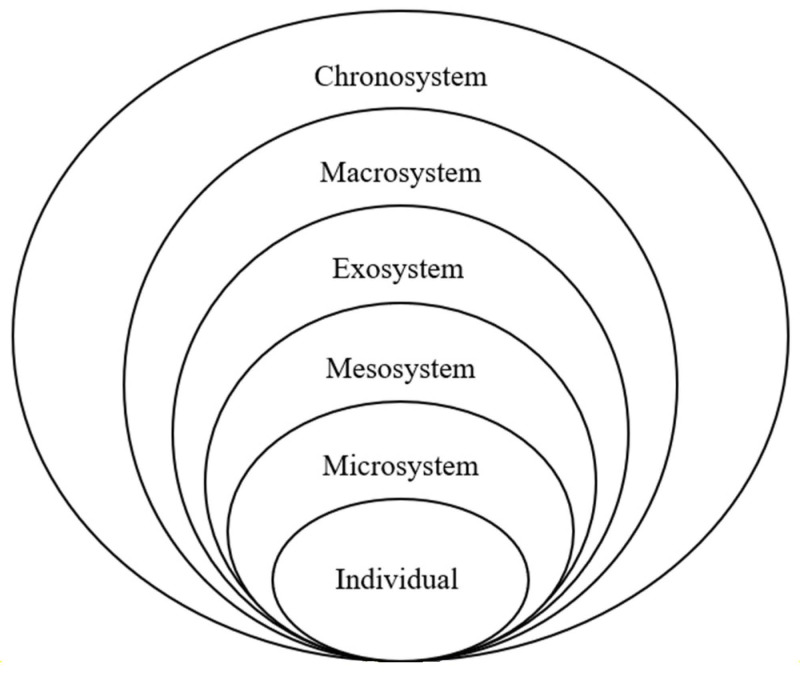
Family caregivers provide care to people with disabilities, as well as ill and older adults, often with little to no outside assistance from the formal long-term care system. They are the backbone of long-term care, and it is a misconception that the majority of people institutionalize disabled people and older adults in the United States. Youth caregiving is under-examined in the field of public health and is in need of theoretical and practical attention. Building upon the work of Talley and Crews and Bronfenbrenner, we aim to broaden the scope of the discussion around caregiving through the application of the social-ecological model (SEM) to inform research and practice. This paper picks up where they left off, digging deeper into the ecological model to reimagine research, policy, and practices related to youth and young adult caregivers that are rooted in this framework. This application highlights care as embedded in social relations while allowing for an exploration of the ways structural barriers impact the caring unit. Looking holistically at the unit, rather than individuals as service users, provides an opportunity for understanding the interconnectedness of those giving and receiving care. It does so by rendering visible the interdependence of the caring unit, and the myriad structures, which bear down on care at the individual and household levels. This approach runs counter to dominant thinking, which focuses exclusively on the individuals involved in caregiving relationships, rather than considering them as interdependent units of care. This paper provides an analytic contribution, utilizing a narrative composite vignette based on literature and previous research.
Overview
The claims and statistics of this paper haven’t been checked yet.
Run the check — free, no account needed. It reads the open-access text and checks the sources it cites.
Integrity signals
Registry
Cites
Statistics
Figures
Verification
Claims the paper makes
The claims and statistics of this paper haven’t been checked yet.
Run the check — free, no account needed. It reads the open-access text and checks the sources it cites.
Claims other papers make about this one
Each is checked against this paper’s own text: does it say what the citing paper says it does?
The source backs part of the claim, not all of it — or backs it for a different population, condition or comparison.
In the citing paper
“Results from the qualitative analysis (e.g., “3.1.1 Psychological burden,” “3.1.2 Physical burden”) are consistent with Ornstein and Caruso’s research on family caregiving support systems (75).”
From Caring alone: older adult care burdens, practices, and structural imbalances among China's one-child generation (2025) · cites this paper as [75]
Experimental — accuracy not yet measuredThe source backs part of the claim, not all of it — or backs it for a different population, condition or comparison.
In the citing paper
“As untrained family caregivers, only children are likely to experience prolonged psychological stress and health risks, highlighting the urgent need for external support at the social level (75).”
From Caring alone: older adult care burdens, practices, and structural imbalances among China's one-child generation (2025) · cites this paper as [75]
Experimental — accuracy not yet measured
Self-check
Percentages, sums and reported differences re-computed from the paper’s own numbers.
The self-check needs the paper’s full text.
Citations
Cites
An ecological perspective on health promotion programs
McLeroy, K. R., Bibeau, D., Steckler, A., & Glanz, K. (1988) · Health Education Quarterly · doi:10.1177/109019818801500401 · Cited by 8,502
Translating Social Ecological Theory into Guidelines for Community Health Promotion
Stokols, D. (1996) · American Journal of Health Promotion · doi:10.4278/0890-1171-10.4.282 · Cited by 2,763
Establishing and maintaining healthy environments: Toward a social ecology of health promotion.
Stokols, D. (1992) · American Psychologist · doi:10.1037/0003-066x.47.1.6 · Cited by 2,107
Families Caring for an Aging America
Schulz, R., & Eden, J. (2016) · National Academies Press eBooks · doi:10.17226/23606 · Cited by 961
The Economic Value Of Informal Caregiving
Arno, P. S., Levine, C., & Memmott, M. M. (1999) · Health Affairs · doi:10.1377/hlthaff.18.2.182 · Cited by 697
Krieger, N. (2020) · Annual Review of Public Health · doi:10.1146/annurev-publhealth-040119-094017 · Cited by 411
Framing the Public Health of Caregiving
Talley, R. C., & Crews, J. E. (2006) · American Journal of Public Health · doi:10.2105/ajph.2004.059337 · Cited by 375
National Alliance for Caregiving, & AARP (2020) · doi:10.26419/ppi.00103.001 · Cited by 243
Dyadic Intervention for Family Caregivers and Care Receivers in Early-Stage Dementia
Whitlatch, C. J., Judge, K., Zarit, S. H., & Femia, E. E. (2006) · The Gerontologist · doi:10.1093/geront/46.5.688 · Cited by 214
Shannon, J. (2013) · Progress in Human Geography · doi:10.1177/0309132513484378 · Cited by 206
Hanson, G. C., Perrin, N., Moss, H., Laharnar, N., & Glass, N. E. (2015) · BMC Public Health · doi:10.1186/s12889-014-1340-7 · Cited by 203
Leu, A., & Becker, S. (2016) · Journal of Youth Studies · doi:10.1080/13676261.2016.1260698 · Cited by 180
Job Stress and Job Satisfaction: Home Care Workers in a Consumer‐Directed Model of Care
Delp, L., Wallace, S. P., Geiger-Brown, J. M., & Muntaner, C. (2010) · Health Services Research · doi:10.1111/j.1475-6773.2010.01112.x · Cited by 172
Valuing the Invaluable: 2023 Update
Reinhard, S. C., Caldera, S., Houser, A., & Choula, R. B. (2023) · doi:10.26419/ppi.00082.006 · Cited by 158
Stacey, C. L. (2011) · Cornell University Press eBooks · doi:10.7591/cornell/9780801449857.001.0001 · Cited by 149
Wertz, M. S., Nosek, M., McNiesh, S. G., & Marlow, E. (2011) · International Journal of Qualitative Studies on Health and Well-Being · doi:10.3402/qhw.v6i2.5882 · Cited by 140
Young Adult Caregivers: A First Look at an Unstudied Population
Levine, C., Hunt, G. G., Halper, D., Hart, A. Y., Lautz, J., & Gould, D. A. D. (2005) · American Journal of Public Health · doi:10.2105/ajph.2005.067702 · Cited by 129
Unacknowledged Caregivers: A Scoping Review of Research on Caregiving Youth in the United States
Kavanaugh, M. S., Stamatopoulos, V., Cohén, D., & Zhang, L. (2015) · Adolescent Research Review · doi:10.1007/s40894-015-0015-7 · Cited by 97
Noursi, S., Saluja, B., & Richey, L. (2020) · Journal of Racial and Ethnic Health Disparities · doi:10.1007/s40615-020-00825-4 · Cited by 92
Reckrey, J. M., Tsui, E. K., Morrison, R. S., Geduldig, E. T., Stone, R. I., Ornstein, K. A., & Federman, A. D. (2019) · Health Affairs · doi:10.1377/hlthaff.2019.00004 · Cited by 89
Factors that contribute to adult children caregivers' well-being: a scoping review
Wasilewski, M. B., Gignac, M. A. M., Kapral, M. K., & Cameron, J. I. (2014) · Health & Social Care in the Community · doi:10.1111/hsc.12144 · Cited by 63
Safety and Health Support for Home Care Workers: The COMPASS Randomized Controlled Trial
Olson, R., Thompson, S. V., Elliot, D. L., Hess, J. A., Rhoten, K. L., Parker, K. N., Wright, R. R., Wipfli, B., Bettencourt, K. M., Buckmaster, A. M., et al. (2016) · American Journal of Public Health · doi:10.2105/ajph.2016.303327 · Cited by 58
Cloutier, D., Martin-Matthews, A., Byrne, K. M., & Wolse, F. (2015) · Social & Cultural Geography · doi:10.1080/14649365.2015.1020336 · Cited by 52
Introducing systems change in the schools: the case of school luncheons and vending machines
Suarez‐Balcazar, Y., Redmond, L., Kouba, J., Hellwig, M., Davis, R., Martinez, L. I., & Jones, L. (2007) · American Journal of Community Psychology · doi:10.1007/s10464-007-9102-7 · Cited by 49
(2017) · Routledge eBooks · doi:10.4324/9781315281216 · Cited by 45
Linkages between informal and formal care-givers in home-care networks of frail older adults
Jacobs, M. T., van Tilburg, T. G., GROENEWEGEN, P., & Groenou, M. I. B. V. (2015) · Ageing and Society · doi:10.1017/s0144686x15000598 · Cited by 43
Tebb, S. S., & Jivanjee, P. R. (2000) · Journal of Gerontological Social Work · doi:10.1300/j083v34n02_06 · Cited by 43
Using Written Narratives in Public Health Practice: A Creative Writing Perspective
Thompson, T., & Kreuter, M. (2014) · Preventing Chronic Disease · doi:10.5888/pcd11.130402 · Cited by 35
Commentary: Addressing Inequities in the Era of COVID-19
Ford, C. L. (2020) · Family & Community Health · doi:10.1097/fch.0000000000000266 · Cited by 35
Gelman, C. R., & Rhames, K. (2018) · Dementia · doi:10.1177/1471301216647097 · Cited by 32
Martin-Matthews, A., Sims‐Gould, J., & Tong, C. E. (2012) · Canadian Review of Social Policy / Revue canadienne de politique sociale · Cited by 31
How Far Have We Come? An Updated Scoping Review of Young Carers in the U.S.
Hendricks, B. A., Kavanaugh, M. S., & Bakitas, M. A. (2021) · Child and Adolescent Social Work Journal · doi:10.1007/s10560-021-00783-8 · Cited by 30
Paid Caregiver Communication With Homebound Older Adults, Their Families, and the Health Care Team
Reckrey, J. M., Geduldig, E. T., Lindquist, L. A., Morrison, R. S., Boerner, K., Federman, A. D., & Brody, A. A. (2019) · The Gerontologist · doi:10.1093/geront/gnz067 · Cited by 26
What Quality Paid Home Care Means to Family Caregivers
Piercy, K. W., & Dunkley, G. J. (2004) · Journal of Applied Gerontology · doi:10.1177/0733464804267972 · Cited by 24
Closing the Home Care Case: Home Health Aides’ Perspectives on Family Caregiving
Hokenstad, A., Hart, A. Y., Gould, D. A. D., Halper, D., & Levine, C. (2006) · Home Health Care Management & Practice · doi:10.1177/1084822305284749 · Cited by 21
Caregiving and Women's Health: Toward an Intersectional Approach
Versey, H. S. (2017) · Women s Health Issues · doi:10.1016/j.whi.2017.01.009 · Cited by 20
Time to Recognize and Support Emerging Adult Caregivers in Public Health
Kent, E. E. (2020) · American Journal of Public Health · doi:10.2105/ajph.2020.305951 · Cited by 20
Transforming School Food Politics around the World
Gaddis, J. E. 1., Robert, S. A., & Federici, S. 1. (2024) · The MIT Press eBooks · doi:10.7551/mitpress/15426.001.0001 · Cited by 13
Caregiver burden and the structural family model
Clark, M. C., & Standard, P. L. (1996) · Family & Community Health · doi:10.1097/00003727-199601000-00010 · Cited by 10
Ecosystems, Society, and Health
Hällström, L., Guehlstorf, N. P., & Parkes, M. W. (2015) · McGill-Queen's University Press eBooks · doi:10.1515/9780773583122 · Cited by 10
Paying the Hidden Bill: How Public Health Can Support Older Adults and Informal Caregivers
Plichta, S. B. (2018) · American Journal of Public Health · doi:10.2105/ajph.2018.304670 · Cited by 9
Cranford, C. J. (2020) · Cornell University Press eBooks · doi:10.7591/cornell/9781501749254.001.0001 · Cited by 5
AN ECOLOGICAL FRAMEWORK FOR CAREGIVING
Eckenwiler, L. A. (2007) · American Journal of Public Health · doi:10.2105/ajph.2007.117390 · Cited by 3
Mong, S. N. (2020) · Cornell University Press eBooks · doi:10.1515/9781501751479 · Cited by 3
Family Caregivers: The Unrecognized Strength Behind Hospital At Home
(2021) · Forefront Group · doi:10.1377/forefront.20210528.703003 · Cited by 2
Re-framing Informal Family Caregiving
Ornstein-Sloan, M. T. (2016) · CUNY Academic Works (City University of New York) · Cited by 2
Research works printed but not linked: 4
- Viola, 2012, The Economic Value of Youth Caregiving in the United States, Relational Child Youth Care Pract., 25, 10
- Duffy, M., Armenia, A., and Stacey, C.L. (2015). Caring on the Clock: The Complexities and Contradictions of Paid Care Work, Rutgers University Press.
- Postlethwaite, T., and Husen, T. (1994). International Encyclopedia of Education, Elsevier Sciences, LTD. [2nd ed.].
- Morris, 2014, The Myth of the Rugged Individual: Implications for Public Administration, Civic Engagement, And Civil Society, Va. Soc. Sci. J., 49, 29
Cited by
Sorted by citations
Mu, Y., & Li, Z. (2025) · Cities · doi:10.1016/j.cities.2025.106392 · Cited by 11
Xiang, S., Xiang, H., Ren, Q., & Deng, Q. (2025) · Frontiers in Public Health · doi:10.3389/fpubh.2025.1694636 · Cited by 6
“As untrained family caregivers, only children are likely to experience prolonged psychological stress and health risks, highlighting the urgent need for external support at the social level (75).”
InfluentialGuo, S., Chen, Q., & Chan, K. L. (2025) · BMC Public Health · doi:10.1186/s12889-025-23307-w · Cited by 5
Surveillance as Care: Configuring Baby Monitors in the Home
Song, Q.-R., Liu, Y., Zhang, Z.-N., Kou, Y.-B., & Gui, X.-N. (2026) · International Conference on Human Factors in Computing Systems · doi:10.1145/3772318.3791462 · Cited by 4
Ellicott, C., Rubab, S. U., McGowan, A., Neale, B., Bidaran, A., Dewsbery, F., Norman, A., & Lloyd, H. M. (2025) · Healthcare · doi:10.3390/healthcare13030280 · Cited by 3
Metadata
- Authors
- Ornstein, M. T., & Caruso, C. C.
- Affiliations
- Sarah Lawrence College (US)
- Wesleyan University (US)
- Corresponding author
- Ornstein, Maggie T.
- ORCID
- Caruso, Christine C.
- Venue
- International Journal of Environmental Research and Public Health
- Publisher
- MDPI AG
- Published
- 2024-01-22
- Volume
- 21
- Issue
- 1
- Pages
- 119
- ISSN
- 1660-4601 (ISSN-L)
- PMC
- PMC10815033
- OpenAlex
- W4391100556
- Cited by
- 24
- References
- 44
- Citations by year
- 2026: 13 · 2025: 9 · 2024: 2
- FWCI
- 16.39
- Type
- journal article
- Language
- en
- Open access
- gold
- doi.org
- Licence
- Locations
- International Journal of Environmental Research and Public Health (publishedVersion, cc-by)
- PubMed Central (publishedVersion, cc-by)
- PubMed (publishedVersion)
- RePEc: Research Papers in Economics (submittedVersion)
- Topics
- Health Sciences › Nursing › Research and Theory › Nursing care and research
- Social Sciences › Sociology and Political Science › Intergenerational Family Dynamics and Caregiving
- Social Sciences › Life-span and Life-course Studies › Aging, Elder Care, and Social Issues
- Keywords
- young adult caregivers, family caregivers, socio-ecological model, long-term care, care relationships, structural barriers to care, caregiver burden, life course, older adults, Bronfenbrenner
- MeSH terms
- Adolescent, Aged, Family, Humans, Life Change Events, Long-Term Care, Models, Theoretical, Social Environment, United States, Caregivers, Young Adult
About these checks
Registry, retraction, Cites and statistics results are computed, not judged, with one exception: a printed reference that no index lists is read once by a model before it counts as a citation error. Claims are extracted by a model and kept only when their quote appears verbatim in the text; each cited source is then checked, with a model’s help, for whether it says what the claim relies on. Those verdicts can be wrong — read the claim’s quote and the cited source before relying on one.
Statistics and arithmetic are recomputed, not judged.
Confidence bands are shown only for fields calibrated on our annotated test set. None is calibrated yet, so no band is shown.
What counts as a claim ›How we measure confidence ›How we check this ›
Are you an author, or do you see a problem with this page? Request a review
