

The DOI matches its Crossref record; 239 of the 239 references it cites were found in a registry or an index.
The mTOR Signalling Pathway in Human Cancer
Open accessAbstract
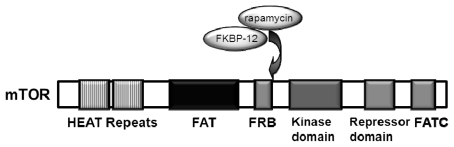
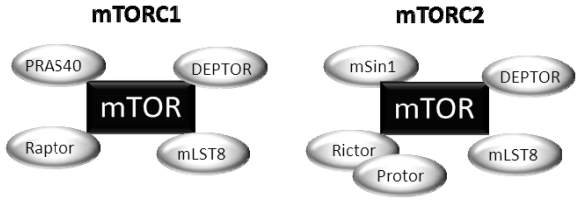
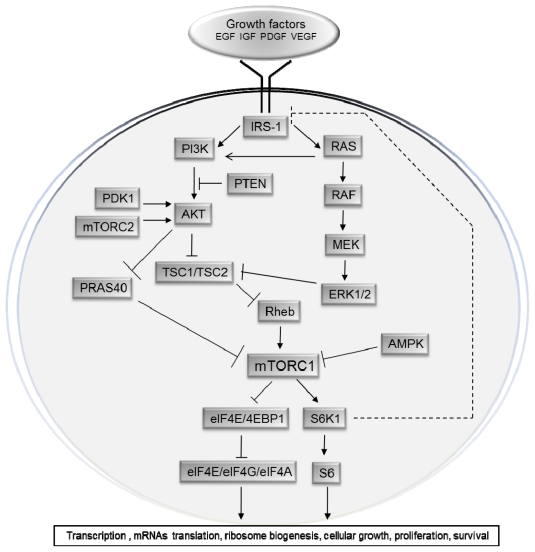
The conserved serine/threonine kinase mTOR (the mammalian target of rapamycin), a downstream effector of the PI3K/AKT pathway, forms two distinct multiprotein complexes: mTORC1 and mTORC2. mTORC1 is sensitive to rapamycin, activates S6K1 and 4EBP1, which are involved in mRNA translation. It is activated by diverse stimuli, such as growth factors, nutrients, energy and stress signals, and essential signalling pathways, such as PI3K, MAPK and AMPK, in order to control cell growth, proliferation and survival. mTORC2 is considered resistant to rapamycin and is generally insensitive to nutrients and energy signals. It activates PKC-α and AKT and regulates the actin cytoskeleton. Deregulation of multiple elements of the mTOR pathway (PI3K amplification/mutation, PTEN loss of function, AKT overexpression, and S6K1, 4EBP1 and eIF4E overexpression) has been reported in many types of cancers, particularly in melanoma, where alterations in major components of the mTOR pathway were reported to have significant effects on tumour progression. Therefore, mTOR is an appealing therapeutic target and mTOR inhibitors, including the rapamycin analogues deforolimus, everolimus and temsirolimus, are submitted to clinical trials for treating multiple cancers, alone or in combination with inhibitors of other pathways. Importantly, temsirolimus and everolimus were recently approved by the FDA for the treatment of renal cell carcinoma, PNET and giant cell astrocytoma. Small molecules that inhibit mTOR kinase activity and dual PI3K-mTOR inhibitors are also being developed. In this review, we aim to survey relevant research, the molecular mechanisms of signalling, including upstream activation and downstream effectors, and the role of mTOR in cancer, mainly in melanoma.
Overview
The claims and statistics of this paper haven’t been checked yet.
Run the check — free, no account needed. It reads the open-access text and checks the sources it cites.
Integrity signals
Registry
Cites
Statistics
Figures
Verification
Claims the paper makes
The claims and statistics of this paper haven’t been checked yet.
Run the check — free, no account needed. It reads the open-access text and checks the sources it cites.
Claims other papers make about this one
Each is checked against this paper’s own text: does it say what the citing paper says it does?
In the citing paper
“Although the mTOR pathway can be activated in the majority of melanomas, mTOR inhibitors have not been proven effective in this clinical setting20–22.”
From Targeting the mTOR pathway uncouples the efficacy and toxicity of PD-1 blockade in renal transplantation (2019) · cites this paper as [20]
Self-check
Percentages, sums and reported differences re-computed from the paper’s own numbers.
The self-check needs the paper’s full text.
Citations
Cites
Hallmarks of Cancer: The Next Generation
Hanahan, D., & Weinberg, R. A. (2011) · Cell · doi:10.1016/j.cell.2011.02.013 · Cited by 66,590
Repertoires of Autophagy in the Pathogenesis of Ocular Diseases
Li, Y., Jiang, Q. L., Cao, G.-F., Yao, J., & Yan, B. (2015) · Cellular Physiology and Biochemistry · doi:10.1159/000373980 · Cited by 16,351
Autophagy in the Pathogenesis of Disease
Levine, B., & Kroemer, G. (2008) · Cell · doi:10.1016/j.cell.2007.12.018 · Cited by 7,069
Autophagy fights disease through cellular self-digestion
Mizushima, N., Levine, B., Cuervo, A. M., & Klionsky, D. J. (2008) · Nature · doi:10.1038/nature06639 · Cited by 6,452
Phosphorylation and regulation of Akt/PKB by the rictor-mTOR complex
Sarbassov, D. D., Guertin, D. A., Ali, S. M., & Sabatini, D. M. (2005) · Science · doi:10.1126/science.1106148 · Cited by 6,216
The phosphatidylinositol 3-Kinase–AKT pathway in human cancer
Vivanco, I., & Sawyers, C. L. (2002) · Nature reviews. Cancer · doi:10.1038/nrc839 · Cited by 6,155
TOR signaling in growth and metabolism
Wullschleger, S., Loewith, R., & Hall, M. N. (2006) · Cell · doi:10.1016/j.cell.2006.01.016 · Cited by 5,787
Li, J., Yen, C., Liaw, D., Podsypanina, K., Bose, S., Wang, S. I., Puc, J., Miliaresis, C., Rodgers, L., McCombie, R., et al. (1997) · Science · doi:10.1126/science.275.5308.1943 · Cited by 4,785
Autophagy and Viruses: Adversaries or Allies?
Dong, X., & Levine, B. (2013) · Journal of Innate Immunity · doi:10.1159/000346388 · Cited by 4,444
Upstream and downstream of mTOR
Hay, N., & Sonenberg, N. (2004) · Genes & Development · doi:10.1101/gad.1212704 · Cited by 4,181
Cited by
Sorted by citations
Panwar, V., Singh, A., Bhatt, M., Tonk, R. K., Azizov, S., Raza, A. S., Sengupta, S., Kumar, D., & Garg, M. (2023) · Signal Transduction and Targeted Therapy · doi:10.1038/s41392-023-01608-z · Cited by 967
The Roles of Autophagy in Cancer
Yun, C. W., & Lee, S. H. (2018) · International Journal of Molecular Sciences · doi:10.3390/ijms19113466 · Cited by 965
Signaling pathways in cancer-associated fibroblasts and targeted therapy for cancer
Wu, F., Yang, J., Liu, J., Wang, Y., Mu, J., Zeng, Q., Deng, S., & Zhou, H. (2021) · Signal Transduction and Targeted Therapy · doi:10.1038/s41392-021-00641-0 · Cited by 773
Rapalogs and mTOR inhibitors as anti-aging therapeutics
Lamming, D. W., Ye, L., Sabatini, D. M., & Baur, J. A. (2013) · Journal of Clinical Investigation · doi:10.1172/jci64099 · Cited by 531
Dysregulation of the IGF‐I/PI3K/AKT/mTOR signaling pathway in autism spectrum disorders
Chen, J., Alberts, I., & Li, X. (2014) · International Journal of Developmental Neuroscience · doi:10.1016/j.ijdevneu.2014.03.006 · Cited by 151
Metadata
- Authors
- Pópulo, H., Lopes, J. M., & Soares, P.
- Affiliations
- Universidade do Porto (PT)
- Corresponding author
- Soares, Paula
- Venue
- International Journal of Molecular Sciences
- Publisher
- MDPI AG
- Published
- 2012-02-10
- Volume
- 13
- Issue
- 2
- Pages
- 1886-1918
- ISSN
- 1422-0067 (ISSN-L)
- PMC
- PMC3291999
- OpenAlex
- W1965766554
- Cited by
- 830
- References
- 239
- Citations by year
- 2026: 12 · 2025: 46 · 2024: 57 · 2023: 65 · 2022: 84 · 2021: 80 · 2020: 65 · 2019: 69 · 2018: 61 · 2017: 72 · 2016: 55 · 2015: 40 · 2014: 44 · 2013: 54 · 2012: 22
- FWCI
- 4.57
- Type
- journal article
- Language
- en
- Open access
- gold
- doi.org
- Licence
- Locations
- International Journal of Molecular Sciences (publishedVersion, cc-by)
- Europe PMC (PubMed Central) (publishedVersion, cc-by)
- PubMed Central (publishedVersion, cc-by)
- PubMed (publishedVersion)
- DOAJ (DOAJ: Directory of Open Access Journals) (submittedVersion, cc-by-sa)
- Funders
- Fundação para a Ciência e a Tecnologia (SFRH/BD/31369/2006)
- Topics
- Life Sciences › Biochemistry, Genetics and Molecular Biology › Molecular Biology › PI3K/AKT/mTOR signaling in cancer
- Life Sciences › Biochemistry, Genetics and Molecular Biology › Molecular Biology › Metabolism, Diabetes, and Cancer
- Health Sciences › Medicine › Genetics (clinical) › Tuberous Sclerosis Complex Research
- Keywords
- mTOR signaling, mTORC1, mTORC2, PI3K/Akt signaling, rapamycin, S6K1, 4E-BP1, mRNA translation, protein kinase C alpha, actin cytoskeleton, PTEN loss, melanoma, mTOR inhibitors, temsirolimus, everolimus, renal cell carcinoma, giant cell astrocytoma, PI3K/mTOR dual inhibitor, cancer therapy
- MeSH terms
- Mechanistic Target of Rapamycin Complex 1, Mechanistic Target of Rapamycin Complex 2, Animals, Humans, Longevity, Melanoma, Neoplasms, Skin Neoplasms, Signal Transduction, Multiprotein Complexes, Growth and Development, TOR Serine-Threonine Kinases
About these checks
Registry, retraction, Cites and statistics results are computed, not judged, with one exception: a printed reference that no index lists is read once by a model before it counts as a citation error. Claims are extracted by a model and kept only when their quote appears verbatim in the text; each cited source is then checked, with a model’s help, for whether it says what the claim relies on. Those verdicts can be wrong — read the claim’s quote and the cited source before relying on one.
Statistics and arithmetic are recomputed, not judged.
Confidence bands are shown only for fields calibrated on our annotated test set. None is calibrated yet, so no band is shown.
What counts as a claim ›How we measure confidence ›How we check this ›
Are you an author, or do you see a problem with this page? Request a review
