

Chronic Δ9-THC Exposure Differently Affects Histone Modifications in the Adolescent and Adult Rat Brain
Open accessThe DOI matches its Crossref record; 35 of the 35 references it cites were found in a registry or an index.
Abstract
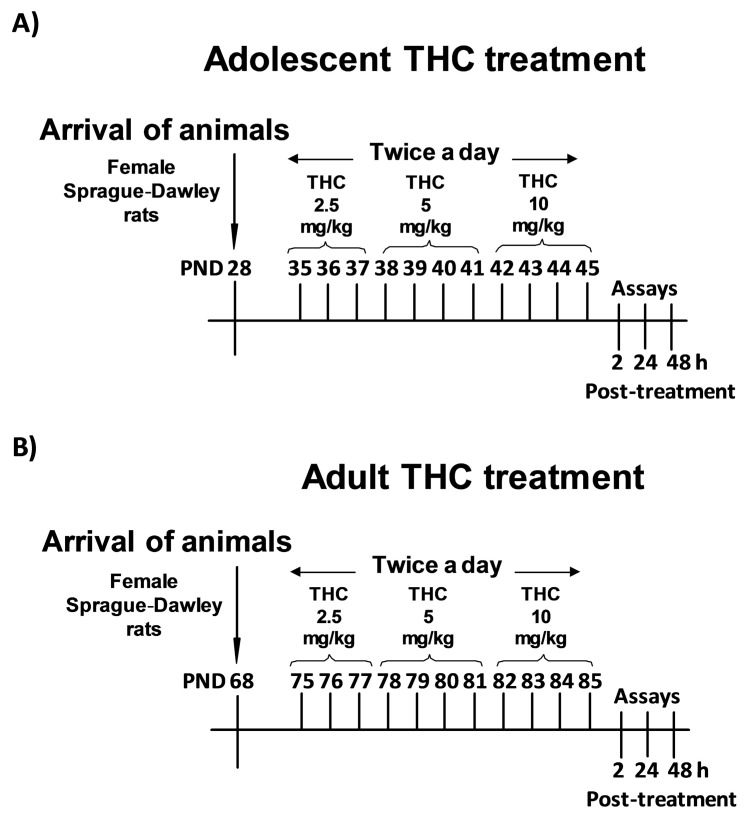
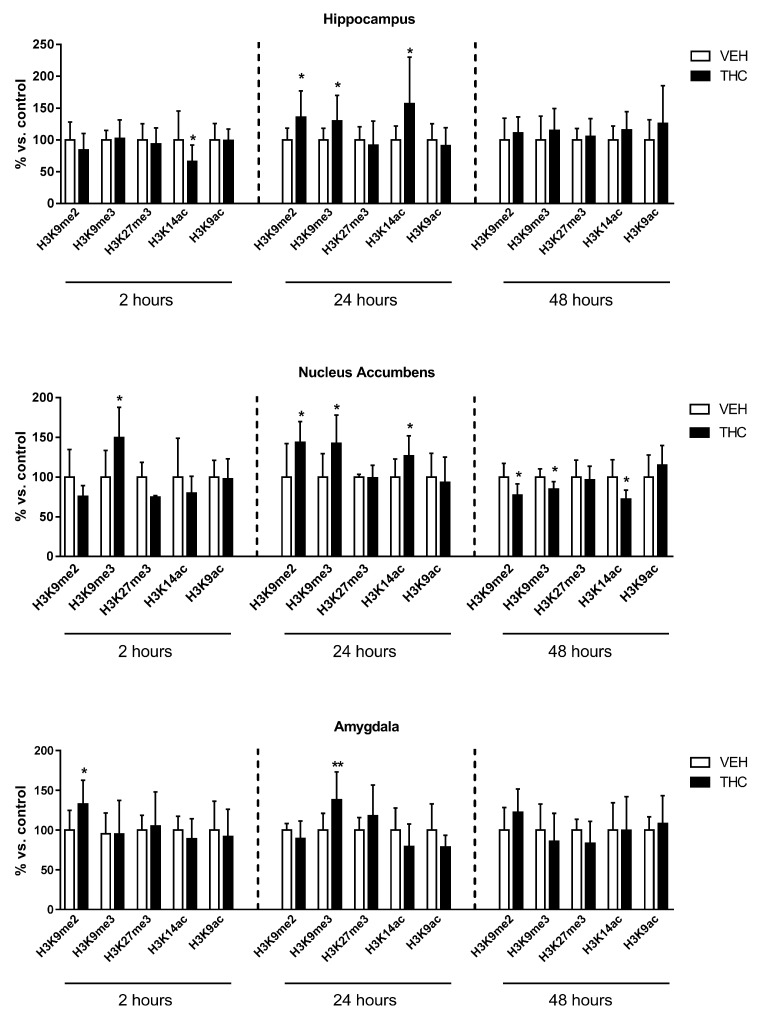
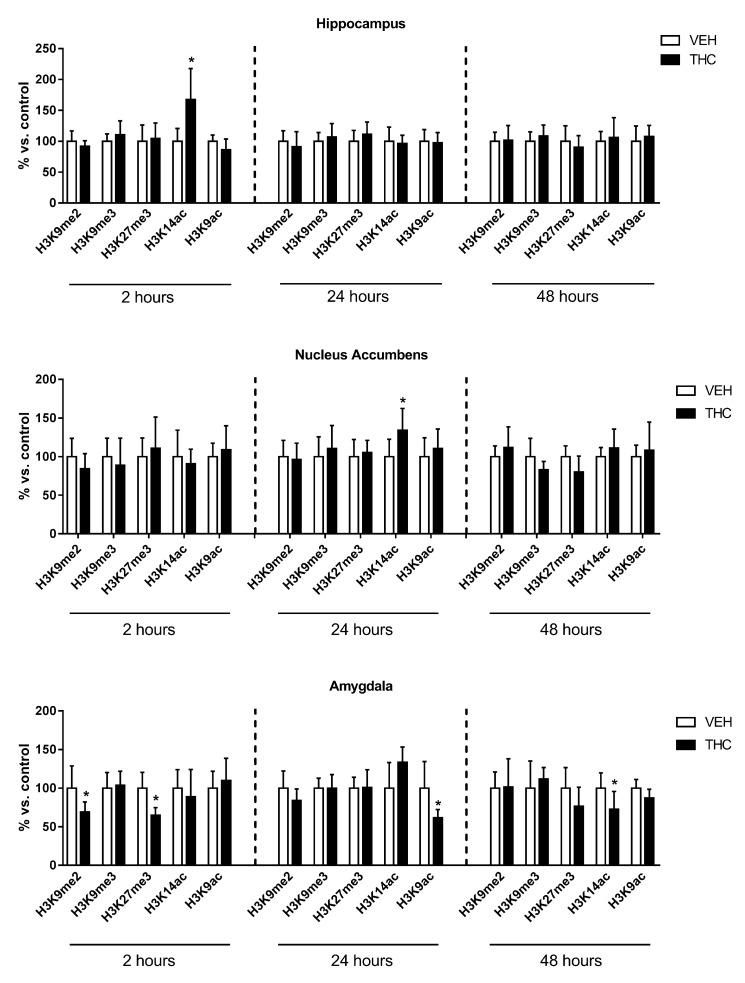
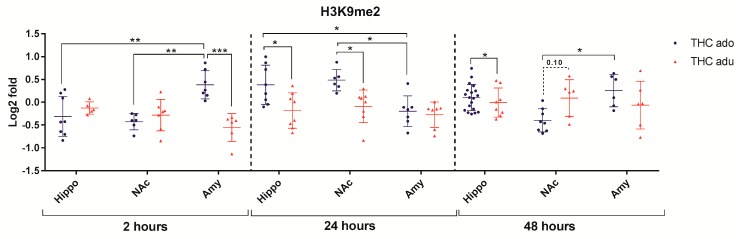
Adolescence represents a vulnerable period for the psychiatric consequences of delta9-tetrahydrocannabinol (Δ9-THC) exposure, however, the molecular underpinnings of this vulnerability remain to be established. Histone modifications are emerging as important epigenetic mechanisms involved in the etiopathogenesis of psychiatric diseases, thus, we investigated the impact of chronic Δ9-THC exposure on histone modifications in different brain areas of female rats. We checked histone modifications associated to both transcriptional repression (H3K9 di- and tri-methylation, H3K27 tri-methylation) and activation (H3K9 and H3K14 acetylation) after adolescent and adult chronic Δ9-THC exposure in the hippocampus, nucleus accumbens, and amygdala. Chronic exposure to increasing doses of Δ9-THC for 11 days affected histone modifications in a region- and age-specific manner. The primary effect in the adolescent brain was represented by changes leading to transcriptional repression, whereas the one observed after adult treatment led to transcriptional activation. Moreover, only in the adolescent brain, the primary effect was followed by a homeostatic response to counterbalance the Δ9-THC-induced repressive effect, except in the amygdala. The presence of a more complex response in the adolescent brain may be part of the mechanisms that make the adolescent brain vulnerable to Δ9-THC adverse effects.
Overview
The claims and statistics of this paper haven’t been checked yet.
Free: it reads the open-access text and checks the first 5 claims that cite a source we can check. Create a free account to check every claim.
Integrity signals
Registry
Cites
Statistics
Figures
Verification
Claims the paper makes
The claims and statistics of this paper haven’t been checked yet.
Free: it reads the open-access text and checks the first 5 claims that cite a source we can check. Create a free account to check every claim.
Claims other papers make about this one
Each is checked against this paper’s own text: does it say what the citing paper says it does?
The source backs part of the claim, not all of it — or backs it for a different population, condition or comparison.
In the citing paper
“recent research suggests that epigenetic factors may play a role.”
From Consequences of adolescent drug use (2023) · cites this paper as [155]
Experimental — accuracy not yet measuredThe cited source says what the claim attributes to it.
In the citing paper
“ACE in female rats produced age-dependent alterations in histone modifications in several brain regions, including the PFC, amygdala, and hippocampus [155].”
From Consequences of adolescent drug use (2023) · cites this paper as [155]
Self-check
Percentages, sums and reported differences re-computed from the paper’s own numbers.
The self-check needs the paper’s full text.
Citations
Cites
Brain development during childhood and adolescence: a longitudinal MRI study
Giedd, J. N., Blumenthal, J., Jeffries, N. O., Castellanos, F. X., Liu, H., Zijdenbos, A., Paus, T., Evans, A. C., & Rapoport, J. L. (1999) · Nature Neuroscience · doi:10.1038/13158 · Cited by 5,552
The adolescent brain and age-related behavioral manifestations
Spear, L. P. (2000) · Neuroscience & Biobehavioral Reviews · doi:10.1016/s0149-7634(00)00014-2 · Cited by 5,433 · cited 1×
“During adolescence the brain undergoes intense structural remodeling [2–4], and interfering with these key processes may affect brain functionality and behavior [5].”
BackgroundNeurobiology of addiction: a neurocircuitry analysis
Koob, G. F., & Volkow, N. D. (2016) · The Lancet Psychiatry · doi:10.1016/s2215-0366(16)00104-8 · Cited by 3,698 · cited 2×
“These analyses were performed 2, 24, and 48 h after the last ∆9-THC injection in the hippocampus (Hippo), nucleus accumbens (NAc), and amygdala (Amy) brain areas, which undergo dramatic changes during adolescence and which are mainly affected by drug consumption [6,7].”
BackgroundMethodThe human amygdala and the emotional evaluation of sensory stimuli
Zald, D. H. (2003) · Brain Research Reviews · doi:10.1016/s0165-0173(02)00248-5 · Cited by 1,062 · cited 1×
“Since it has been established that the amygdala is activated during exposure to aversive stimuli, functioning as a “behavioral brake” [32], the different response between adult and adolescent animals could represent the biological bases of the adolescent propensity for risk-taking and novelty-seeking behaviors.”
BackgroundTranscriptional and epigenetic mechanisms of addiction
Robison, A. J., & Nestler, E. J. (2011) · Nature Reviews Neuroscience · doi:10.1038/nrn3111 · Cited by 993 · cited 1×
“Consistently, previous studies demonstrated that alterations in NAc histone acetylation affected addiction-related behaviors such as place conditioning and locomotor responses to psychostimulants [31].”
ResultTriadic model of the neurobiology of motivated behavior in adolescence.
ERNST, M., PINE, D. S., & HARDIN, M. (2006) · Psychological Medicine · doi:10.1017/s0033291705005891 · Cited by 718 · cited 1×
“This fits well with the triadic model of neurodevelopment [34], suggesting that motivated behavior is mediated by the tension between reward (NAc) and threat (amygdala) systems.”
BackgroundErnst, M., Nelson, E. E., Jazbec, S., McClure, E. B., Monk, C. S., Leibenluft, E., Blair, J., & Pine, D. S. (2005) · NeuroImage · doi:10.1016/j.neuroimage.2004.12.038 · Cited by 635 · cited 1×
“Remarkably, also in adolescent humans, neuroimaging studies have shown a weaker involvement of the amygdala, and a greater contribution of the NAc, in response to negative and positive stimuli compared to adults [33].”
ResultSchneider, M., & Koch, M. (2003) · Neuropsychopharmacology · doi:10.1038/sj.npp.1300225 · Cited by 427
Epigenetic regulation of gene expression in physiological and pathological brain processes
Gräff, J., Kim, D., Dobbin, M. M., & Tsai, L.-H. (2011) · Physiological Reviews · doi:10.1152/physrev.00012.2010 · Cited by 373 · cited 1×
“These changes might contribute, at least in part, to the etiopathogenesis of drug-induced psychiatric disorders [12].”
BackgroundGogtay, N., & Thompson, P. M. (2010) · Brain and Cognition · doi:10.1016/j.bandc.2009.08.009 · Cited by 347
Cited by
Consequences of adolescent drug use
Steinfeld, M. R., & Torregrossa, M. M. (2023) · Translational Psychiatry · doi:10.1038/s41398-023-02590-4 · Cited by 237
Cannabis and synaptic reprogramming of the developing brain
Bara, A., Ferland, J.-M. N., Rompala, G., Szutorisz, H., & Hurd, Y. L. (2021) · Nature Reviews Neuroscience · doi:10.1038/s41583-021-00465-5 · Cited by 215
Salmanzadeh, H., Ahmadi‐Soleimani, S. M., Pachenari, N., Azadi, M., Halliwell, R. F., Rubino, T., & Azizi, H. (2020) · Brain Research Bulletin · doi:10.1016/j.brainresbull.2020.01.007 · Cited by 176
Self-citationThe Epigenetics of the Endocannabinoid System
Meccariello, R., Santoro, A., D’Angelo, S., Morrone, R., Fasano, S., Viggiano, A., & Pierantoni, R. (2020) · International Journal of Molecular Sciences · doi:10.3390/ijms21031113 · Cited by 97
The Modulating Role of Sex and Anabolic-Androgenic Steroid Hormones in Cannabinoid Sensitivity
Struik, D., Sanna, F., & Fattore, L. (2018) · Frontiers in Behavioral Neuroscience · doi:10.3389/fnbeh.2018.00249 · Cited by 48
“…systems, while most of the information at molecular and genetic/epigenetic level are still missing, although initial efforts in this direction have begun to fill the gap (see for example Mani et al., 2001; Gammon et al., 2005; Szutorisz and Hurd, 2016, 2018; Prini et al., 2017; Rosas et al., 2018).”
BackgroundCannabinoid Receptors Signaling in the Development, Epigenetics, and Tumours of Male Germ Cells
Barchi, M., Innocenzi, E., Giannattasio, T., Dolci, S., Rossi, P., & Grimaldi, P. (2019) · International Journal of Molecular Sciences · doi:10.3390/ijms21010025 · Cited by 38
Impaired cocaine‐induced behavioral plasticity in the male offspring of cocaine‐experienced sires
Wimmer, M. E., Vassoler, F. M., White, S., Schmidt, H. D., Sidoli, S., Han, Y., Garcia, B. A., & Pierce, R. C. (2018) · European Journal of Neuroscience · doi:10.1111/ejn.14310 · Cited by 31
Molecular Insights into Epigenetics and Cannabinoid Receptors
Basavarajappa, B. S., & Subbanna, S. (2022) · Biomolecules · doi:10.3390/biom12111560 · Cited by 31
Epigenetic Effects of Addictive Drugs in the Nucleus Accumbens
Anderson, E. M., & Taniguchi, M. (2022) · Frontiers in Molecular Neuroscience · doi:10.3389/fnmol.2022.828055 · Cited by 30
Mallick, R., & Duttaroy, A. K. (2023) · Neurochemistry International · doi:10.1016/j.neuint.2023.105627 · Cited by 28
“H3K4me2, H3K9me3, Global H3K14ac levels Adolescent and adult female rats Brain region-specific and agespecific alterations of histone modifications at different times after exposure in hippocampus, nucleus accumbens and amygdala of adolescent and adult brains (Prini et al., 2017) CpG DNA methylation at promoters, inte…”
BackgroundContribution of Dopamine Transporter Gene Methylation Status to Cannabis Dependency
Grzywacz, A., Barczak, W., Chmielowiec, J., Chmielowiec, K., Suchanecka, A., Trybek, G., Masiak, J., Jagielski, P., Grocholewicz, K., & Rubiś, B. (2020) · Brain Sciences · doi:10.3390/brainsci10060400 · Cited by 21
Epigenetic Effects of Drugs of Abuse
Heinbockel, T., & Csoka, A. B. (2018) · International Journal of Environmental Research and Public Health · doi:10.3390/ijerph15102098 · Cited by 22
“Another study addressed epigenetic changes in the nucleus accumbens and also in hippocampus and amygdala, two key brain areas for spatial memory and emotions, respectively [43].”
BackgroundInfluentialCannabinoid CB1 receptor-sensitive neurodevelopmental processes and trajectories
Tseng, K. Y., & Molla, H. M. (2025) · Molecular Psychiatry · doi:10.1038/s41380-025-03057-2 · Cited by 22
Coelho, A. A., Bastos, S., Gobira, P. H., & Lisboa, S. F. D. S. (2023) · Neuronal Signaling · doi:10.1042/ns20220034 · Cited by 24
Endocannabinoid-Epigenetic Cross-Talk: A Bridge toward Stress Coping
Rusconi, F., Rubino, T., & Battaglioli, E. (2020) · International Journal of Molecular Sciences · doi:10.3390/ijms21176252 · Cited by 22
Self-citationKondev, V., Winters, N. D., & Patel, S. (2021) · International review of neurobiology · doi:10.1016/bs.irn.2020.09.007 · Cited by 24
Transgenerational inheritance and its modulation by environmental cues
Verdikt, R., Armstrong, A. A., & Allard, P. (2022) · Current topics in developmental biology/Current Topics in Developmental Biology · doi:10.1016/bs.ctdb.2022.10.002 · Cited by 15
Phytocannabinoids in neuromodulation: From omics to epigenetics
Banerjee, S., Saha, D., Sharma, R., Jaidee, W., Puttarak, P., Chaiyakunapruk, N., & Chaoroensup, R. (2024) · Journal of Ethnopharmacology · doi:10.1016/j.jep.2024.118201 · Cited by 16
Martínez-Peña, A. A., Lee, K., Pereira, M., Ayyash, A., Petrik, J., Hardy, D. B., & Holloway, A. C. (2022) · International Journal of Molecular Sciences · doi:10.3390/ijms23148000 · Cited by 13
Endocannabinoid system and epigenetics in spermatogenesis and testicular cancer
Barchi, M., Guida, E., Dolci, S., Rossi, P., & Grimaldi, P. (2023) · Vitamins and hormones · doi:10.1016/bs.vh.2023.01.002 · Cited by 11
Oyacı, Y., Aytaç, H. M., Pasin, Ö., Aydın, P. Ç., & Pehlıvan, S. (2021) · Journal of Addictive Diseases · doi:10.1080/10550887.2021.1906618 · Cited by 12
Epigenetic Studies for Evaluation of NPS Toxicity: Focus on Synthetic Cannabinoids and Cathinones
Mazdai, L., Fabbri, M., Tirri, M., Corli, G., Arfè, R., Marchetti, B., Bilel, S., Bergamin, E., Gaudio, R. M., Rubini, M., et al. (2022) · Biomedicines · doi:10.3390/biomedicines10061398 · Cited by 13
Pehlıvan, S., Aytaç, H. M., Aydın, P. Ç., Nursal, A. F., & Pehlıvan, M. (2021) · Psychiatry Research · doi:10.1016/j.psychres.2021.113774 · Cited by 11
Gobira, P. H., Roncalho, A. L., Silva, N. R., Silote, G. P., Sales, A. J., & Joca, S. R. L. (2021) · Psychopharmacology · doi:10.1007/s00213-021-05926-4 · Cited by 6
Zucchi, A., Innocenzi, E., Onorato, A., Dolci, S., Colopi, A., Balistreri, C., & Grimaldi, P. (2023) · Mechanisms of Ageing and Development · doi:10.1016/j.mad.2023.111840 · Cited by 3
Therapeutic and toxicological aspects of the use of cannabis and cannabinoids in medicine
Parolaro, D. (2021) · RENDICONTI LINCEI · doi:10.1007/s12210-020-00968-w · Cited by 4
Ganesh, S., Vidya, K. L., Rashid, A., Singh, J., & D’Souza, D. C. (2018) · Current Addiction Reports · doi:10.1007/s40429-018-0233-8 · Cited by 4
Sahebi, K., Arianejad, M., Azadi, S., Hosseinpour-Soleimani, F., Kazemi, R., Tajbakhsh, A., & Negahdaripour, M. (2025) · European Journal of Pharmacology · doi:10.1016/j.ejphar.2025.177630 · Cited by 3
Suchanecka, A., Recław, R., Chmielowiec, K., Chmielowiec, J., Masiak, J., & Grzywacz, A. (2025) · Genes Brain & Behavior · doi:10.1111/gbb.70040 · Cited by 2
“This interpretation is consistent with previous work showing that personality characteristics such as impulsivity and risk-taking are associated with dopaminergic function and may increase susceptibility to substance use disorders [29].”
InfluentialFloccari, S., Sabry, R., Choux, L., Neal, M. S., Khokhar, J. Y., & Favetta, L. A. (2024) · BMC Pharmacology and Toxicology · doi:10.1186/s40360-024-00763-5 · Cited by 3
Zamberletti, E., Manenti, C., Gabaglio, M., Rubino, T., & Parolaro, D. (2022) · Elsevier eBooks · doi:10.1016/b978-0-12-823490-7.00005-8 · Cited by 1
Self-citationReward mechanisms underlying substance use disorder: A role for learning and memory
Fetterly, T. L., Vera, V. A., & Wood, M. A. (2024) · Elsevier eBooks · doi:10.1016/b978-0-443-15754-7.00063-8
Watt, G., & Karl, T. (2025) · Springer eBooks · doi:10.1007/978-3-031-87990-6_14
Pharmacoepigenetics of cannabis and cannabinoids
Starnawska, A., Ørskov, L. H., Per, Q., & Sâmia, J. (2025) · Elsevier eBooks · doi:10.1016/b978-0-443-18722-3.00004-9
Epigenetic modulation by the endocannabinoid system in the central nervous system
Pereira-Teixeira, C., Pereira, F. C., Carvalho, F., & Silva, J. P. (2025) · Handbook of behavioral neuroscience · doi:10.1016/b978-0-443-13908-6.00015-3
The endocannabinoid system and the ageing brain
Zimmer, A. (2026) · Nature reviews. Neuroscience · doi:10.1038/s41583-026-01085-7
Paiva-da-Rocha, E., Carvalho, F. D., Silva, J. P., & Carmo, H. (2026) · Archives of Toxicology · doi:10.1007/s00204-026-04601-x
Metadata
- Authors
- Prini, P., Penna, F., Sciuccati, E., Alberio, T., & Rubino, T.
- Affiliations
- University of Insubria (IT)
- Corresponding author
- Prini, Pamela
- Venue
- International Journal of Molecular Sciences
- Publisher
- MDPI AG
- Published
- 2017-10-04
- Volume
- 18
- Issue
- 10
- Pages
- 2094
- ISSN
- 1422-0067 (ISSN-L)
- PMC
- PMC5666776
- OpenAlex
- W2763216994
- Semantic Scholar
- 5d693d2353e4c348f1d6d1ffeb215c6bac9e6c25
- Cited by
- 37
- References
- 35
- Citations by year
- 2026: 2 · 2025: 6 · 2024: 3 · 2023: 5 · 2022: 6 · 2021: 6 · 2020: 4 · 2019: 1 · 2018: 4
- FWCI
- 1.72
- Type
- journal article
- Language
- en
- Open access
- gold
- doi.org
- Licence
- Locations
- International Journal of Molecular Sciences (publishedVersion, cc-by)
- PubMed Central (publishedVersion, cc-by)
- PubMed (publishedVersion)
- DOAJ (DOAJ: Directory of Open Access Journals) (submittedVersion, cc-by-sa)
- IrInSubria (University of Insubria) (submittedVersion, cc-by)
- Topics
- Health Sciences › Medicine › Pharmacology (medical) › Cannabis and Cannabinoid Research
- Life Sciences › Biochemistry, Genetics and Molecular Biology › Molecular Biology › Epigenetics and DNA Methylation
- Social Sciences › Psychology › Clinical Psychology › Psychedelics and Drug Studies
- Keywords
- histone modifications, adolescence, epigenetics, transcriptional repression, transcriptional activation, H3K9 methylation, H3K27 methylation, H3K9 acetylation, H3K14 acetylation, hippocampus, nucleus accumbens, amygdala, female rats
- MeSH terms
- Animals, Brain, Female, Psychotropic Drugs, Illicit Drugs, Dronabinol, Rats, Sprague-Dawley, Histone Code, Rats
About these checks
Registry, retraction, Cites and statistics results are computed, not judged, with one exception: a printed reference that no index lists is read once by a model before it counts as a citation error. Claims are extracted by a model and kept only when their quote appears verbatim in the text; each cited source is then checked, with a model’s help, for whether it says what the claim relies on. Those verdicts can be wrong — read the claim’s quote and the cited source before relying on one.
Statistics and arithmetic are recomputed, not judged.
Confidence bands are shown only for fields calibrated on our annotated test set. None is calibrated yet, so no band is shown.
What counts as a claim ›How we measure confidence ›How we check this ›
Are you an author, or do you see a problem with this page? Request a review
Data sources
Bibliographic data: Semantic Scholar, OpenAlex, Crossref.
Contains information from the Semantic Scholar Academic Graph Datasets, made available under the ODC Attribution License (ODC-BY 1.0).
Semantic Scholar’s data is described in: Kinney, R., et al. (2023). The Semantic Scholar Open Data Platform. arXiv:2301.10140.
