

Alterations in Galanin-Like Immunoreactivity in the Enteric Nervous System of the Porcine Stomach Following Acrylamide Supplementation
Open accessThe DOI matches its Crossref record; 62 of the 62 references it cites were found in a registry or an index.
Abstract
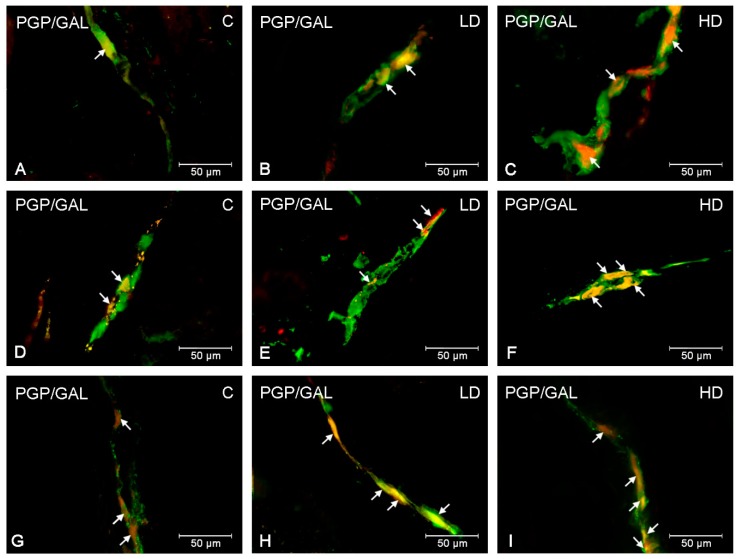
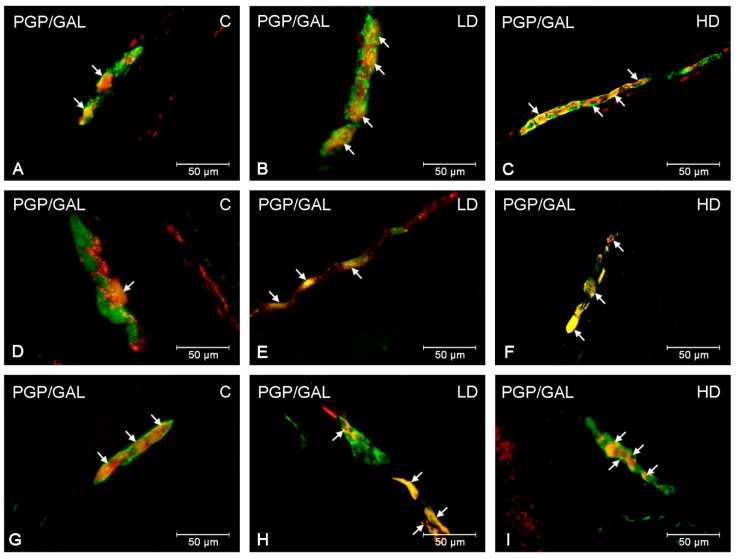
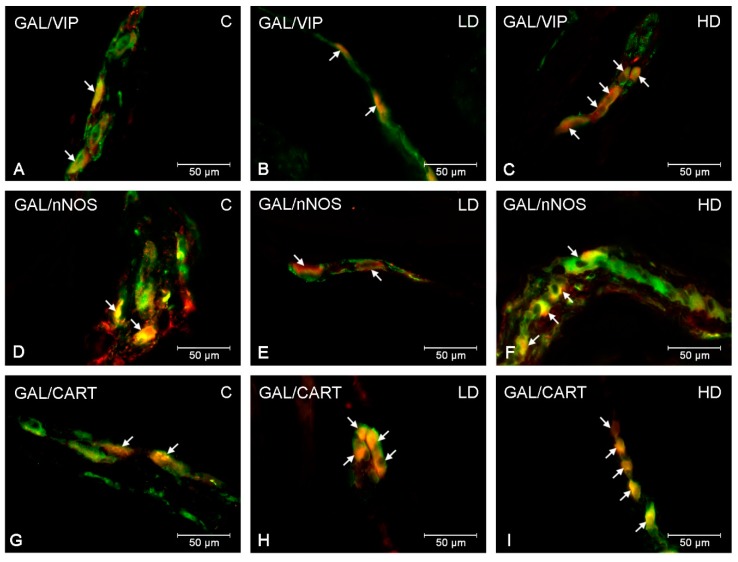
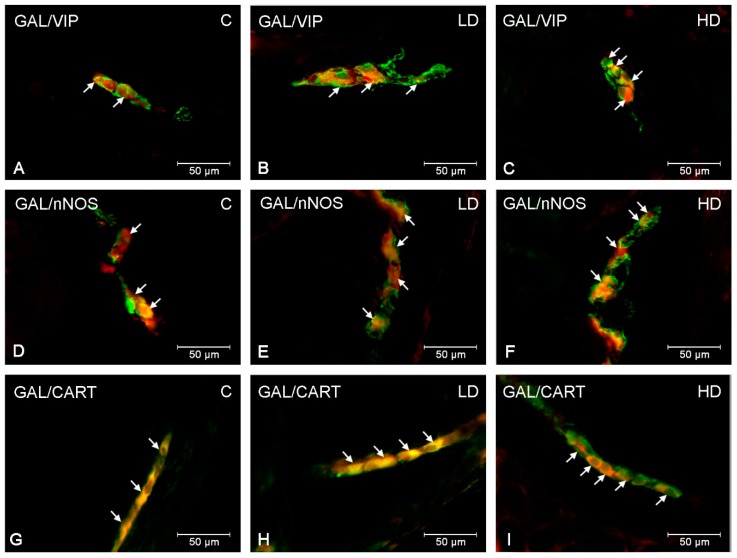
In recent years, a significant increase in the consumption of products containing large amounts of acrylamide (e.g., chips, fries, coffee), especially among young people has been noted. The present study was created to establish the impact of acrylamide supplementation, in tolerable daily intake (TDI) dose and a dose ten times higher than TDI, on the population of galanin-like immunoreactive (GAL-LI) stomach neurons in pigs. Additionally, in the present study, the possible functional co-operation of GAL with other neuroactive substances and their role in acrylamide intoxication was investigated. Using double-labelling immunohistochemistry, alterations in the expression of GAL were examined in the porcine stomach enteric neurons after low and high doses of acrylamide supplementation. Generally, upregulation in GAL-LI immunoreactivity in both myenteric and submucous plexuses was noted in all stomach fragments studied. Additionally, the proportion of GAL-expressing cell bodies simultaneously immunoreactive to vasoactive intestinal peptide (VIP), neuronal nitric oxide synthase (nNOS) and cocaine- and amphetamine- regulated transcript peptide (CART) also increased. The results suggest neurotrophic or/and neuroprotective properties of GAL and possible co-operation of GAL with VIP, nNOS, CART in the recovery processes in the stomach enteric nervous system (ENS) neurons following acrylamide intoxication.
Overview
The claims and statistics of this paper haven’t been checked yet.
Free: it reads the open-access text and checks the first 5 claims that cite a source we can check. Create a free account to check every claim.
Integrity signals
Registry
Cites
Statistics
Figures
Verification
Claims the paper makes
The claims and statistics of this paper haven’t been checked yet.
Free: it reads the open-access text and checks the first 5 claims that cite a source we can check. Create a free account to check every claim.
Claims other papers make about this one
Each is checked against this paper’s own text: does it say what the citing paper says it does?
The cited source says what the claim attributes to it.
In the citing paper
“the population of galanin-like immunoreactive neurons was found to be increased in both the submucous and myenteric plexuses of the stomach, even at low doses.”
From Effects of Coffee and Its Components on the Gastrointestinal Tract and the Brain–Gut Axis (2020) · cites this paper as [193]
The cited source says what the claim attributes to it.
In the citing paper
“the submucous and myenteric neuronal populations of cells immunoreactive to galanin and simultaneously immunoreactive to VIP, nNOS, or CART were increased.”
From Effects of Coffee and Its Components on the Gastrointestinal Tract and the Brain–Gut Axis (2020) · cites this paper as [193]
Self-check
Percentages, sums and reported differences re-computed from the paper’s own numbers.
The self-check needs the paper’s full text.
Citations
Cites
Oxidative Stress: An Essential Factor in the Pathogenesis of Gastrointestinal Mucosal Diseases
Bhattacharyya, A., Chattopadhyay, R., Mitra, S., & Crowe, S. E. (2014) · Physiological Reviews · doi:10.1152/physrev.00040.2012 · Cited by 2,484 · cited 1×
“It is assumed that oxidative stress and an insufficient amount of antioxidants are responsible for the gastric mucosal damage [16].”
BackgroundGalanin — a novel biologically active peptide from porcine intestine
Tatemoto, K., Rökaeus, Å., Jörnvall, H., McDonald, T. J., & Mutt, V. (1983) · FEBS Letters · doi:10.1016/0014-5793(83)80033-7 · Cited by 1,490
The enteric nervous system and gastrointestinal innervation: integrated local and central control
Furness, J. B., Callaghan, B. P., Rivera, L. R., & Cho, H.-J. (2014) · Advances in Experimental Medicine and Biology · doi:10.1007/978-1-4939-0897-4_3 · Cited by 827 · cited 1×
“Based on autonomy, the huge number of neurons that create enteric plexuses, as well as numerous neurotransmitters synthesized and released by neurons, the ENS has been called the intestinal brain [21].”
BackgroundThe Significance of Vasoactive Intestinal Peptide in Immunomodulation
Delgado, M., Pozo, D., & Ganea, D. (2004) · Pharmacological Reviews · doi:10.1124/pr.56.2.7 · Cited by 412 · cited 1×
“engaged in the regulation of inflammatory conditions, which closely interacts with the immune system, inhibits macrophage activity, supports Th2 cells and decreases T cell migration through intestinal Peyer’s patches [53].”
BackgroundLANG, R., GUNDLACH, A., & KOFLER, B. (2007) · Pharmacology & Therapeutics · doi:10.1016/j.pharmthera.2007.05.009 · Cited by 376 · cited 2×
“In contrast, the opposite action was observed in mouse distal colon, rat stomach, as well as in the porcine and rabbit ileum [1,33,34].”
BackgroundThe Changing View of Acrylamide Neurotoxicity
LoPachin, R. M. (2004) · NeuroToxicology · doi:10.1016/j.neuro.2004.01.004 · Cited by 310 · cited 1×
“Particularly important, however, is its neurotoxic effects, which was examined, not only in experimental animals, but also in humans [43,44].”
BackgroundAcrylamide: Review of Toxicity Data and Dose-Response Analyses for Cancer and Noncancer Effects
Shipp, A., Lawrence, G., Gentry, R., McDonald, T., Bartow, H., Bounds, J., Macdonald, N., Clewell, H., Allen, B., & Van Landingham, C. (2006) · Critical Reviews in Toxicology · doi:10.1080/10408440600851377 · Cited by 305 · cited 3×
“Particularly important, however, is its neurotoxic effects, which was examined, not only in experimental animals, but also in humans [43,44].”
BackgroundEnteric neuroplasticity evoked by inflammation
Vasina, V., Barbara, G., Talamonti, L., Stanghellini, V., Corinaldesi, R., Tonini, M., De Ponti, F., & De Giorgio, R. (2006) · Autonomic Neuroscience · doi:10.1016/j.autneu.2006.02.025 · Cited by 221 · cited 1×
“It is also in accordance with the neuronal plasticity phenomenon found in ENS neurons, defined as the ability to modify the chemical code of neurons by altering neuropeptide expression in response to changing environmental conditions, injures or other disorders [2,42].”
ResultGalanin nerve fibers in the rat gut: Distribution, origin and projections
Ekblad, E., Rökaeus, Å., H*.akanson, R., & Sundler, F. (1985) · Neuroscience · doi:10.1016/0306-4522(85)90008-9 · Cited by 214
The participation of galanin in pain processing at the spinal level
Liu, H.-X., & Hökfelt, T. (2002) · Trends in Pharmacological Sciences · doi:10.1016/s0165-6147(02)02074-6 · Cited by 195 · cited 1×
“Moreover, previous studies have indicated that GAL as a neuroprotective factor mediates survival or regeneration after neural injury and exerts anti-inflammatory activities [9,10].”
Background
Cited by
Effects of Coffee and Its Components on the Gastrointestinal Tract and the Brain–Gut Axis
Iriondo-DeHond, A., Uranga, J. A., del Castillo, M. D., & Abalo, R. (2020) · Nutrients · doi:10.3390/nu13010088 · Cited by 126
“These findings were, again, interpreted by the authors as a neurotrophic/neuroprotective role of galanin (in possible co-operation with VIP, nNOS, and CART) in the recovery processes in the gastric ENS after acrylamide intoxication [193].”
BackgroundNeuropeptidergic Control of Feeding: Focus on the Galanin Family of Peptides
Marcos, P., & Coveñas, R. (2021) · International Journal of Molecular Sciences · doi:10.3390/ijms22052544 · Cited by 38
“In both submucous and myenteric plexuses, an upregulation of the GAL-immunoreactivity was observed, and the proportion of neurons co-expressing GAL and vasoactive intestinal peptide or nitric oxide synthase was also augmented [80].”
BackgroundBrzozowska, M., & Całka, J. (2021) · Frontiers in Immunology · doi:10.3389/fimmu.2020.602070 · Cited by 30
“In the stomach, GAL is commonly found in both the myenteric and submucosal plexuses in all parts of the organ (34).”
BackgroundInfluentialSelf-citationDietary Exposure to Acrylamide Has Negative Effects on the Gastrointestinal Tract: A Review
Palus, K. (2024) · Nutrients · doi:10.3390/nu16132032 · Cited by 34
“The changes depended on the dose and the gastrointestinal tract section under investigation [39,86,89–95].”
BackgroundSelf-citationPeptides for Health Benefits 2019
Martínez‐Villaluenga, C., & Hernández‐Ledesma, B. (2020) · International Journal of Molecular Sciences · doi:10.3390/ijms21072543 · Cited by 18
“[15] report the neurothropic and/or neuroprotective properties of galanin, alone or in combination with other neuroactive substances such as vasoactive intestinal peptide, neuronal nitric oxide synthase and cocaine- and amphetamine-regulated transcript peptide in the recovery processes in the stomach enteric nervous s…”
BackgroundDağ, Y., Yıldırım, S., Şengül, E., Aykurt, F., Gök, M., & Cınar, A. (2025) · BMC Pharmacology and Toxicology · doi:10.1186/s40360-025-00900-8 · Cited by 13
“Increased nNOS activity triggers neuroinflammation, worsening neuronal damage [41].”
Aldawood, N., Jalouli, M., Alrezaki, A., Nahdi, S., Alamri, A. M., Alanazi, M., Manoharadas, S., Alwasel, S. H., & Harrath, A. H. (2022) · Aging · doi:10.18632/aging.204269 · Cited by 14
Makowska, K., Całka, J., & Gonkowski, S. (2023) · Scientific Reports · doi:10.1038/s41598-023-27511-9 · Cited by 14
Self-citationGlyphosate affects the neurochemical phenotype of the intramural neurons in the duodenum in the pig
Palus, K., Bulc, M., & Całka, J. (2022) · Neurogastroenterology & Motility · doi:10.1111/nmo.14507 · Cited by 11
Self-citationXu, X., Wei, S., Lin, M., Chen, F., Zhang, X., & Zhu, Y. (2024) · Critical Reviews in Food Science and Nutrition · doi:10.1080/10408398.2024.2440602 · Cited by 10
“Since the ENS can transmit signals to the brain via the vagus nerve upon stimulation, the effects of AA on the ENS could potentially undermine central nervous system (Fried et al. 2021; Palus, Makowska, and Całka 2019).”
Brzozowska, M., Jana, B., & Całka, J. (2021) · International Journal of Molecular Sciences · doi:10.3390/ijms222111689 · Cited by 8
“Therefore, an increased GAL expression has been recorded in the porcine stomach following hydrochloric acid infusion [40] and acrylamide supplementation [41] and also after treatment with naproxen and indomethacin in porcine duodenum [23,25].”
BackgroundSelf-citationde Luca, B. G., Almeida, P. P., Röpke, R., Soares, D. J. S., Frantz, E. D. C., Miranda‐Alves, L., Stockler‐Pinto, M. B., Machado‐Santos, C., & Magliano, D. C. (2025) · Food and Chemical Toxicology · doi:10.1016/j.fct.2025.115280 · Cited by 9
Palus, K., Bulc, M., & Całka, J. (2020) · Animals · doi:10.3390/ani10040555 · Cited by 7
Self-citationBulc, M., Całka, J., & Palus, K. (2023) · International Journal of Molecular Sciences · doi:10.3390/ijms242316998 · Cited by 5
Self-citationBulc, M., Całka, J., Zielonka, Ł., Dąbrowski, M., & Palus, K. (2020) · Annals of Animal Science · doi:10.2478/aoas-2020-0121 · Cited by 5
Self-citationMakowska, K., & Gonkowski, S. (2022) · International Journal of Environmental Research and Public Health · doi:10.3390/ijerph192316187 · Cited by 4
“Generally, these observations are in agreement with previous studies regarding the influence of toxic factors on the intestine, and confirm the ability of enteric neurons to change their neurochemical characterization under the influence of ingested toxicants [17,39,40].”
ResultSelf-citationMakowska, K., & Gonkowski, S. (2024) · International Journal of Molecular Sciences · doi:10.3390/ijms25136941 · Cited by 3
“In general, these observations are consistent with previous studies on the impact of toxic agents on the gastrointestinal tract and confirm the ability of intestinal neurons to change their neurochemical characteristics under the influence of toxic substances [30–32].”
BackgroundResultInfluentialSelf-citationPalus, K., Chmielewska‐Krzesińska, M., Jana, B., & Całka, J. (2024) · Scientific Reports · doi:10.1038/s41598-024-59581-8 · Cited by 2
“The same effect was observed as a result of pig intoxication with bisphenol A 13 and acrylamide 7 .”
BackgroundSelf-citationGonkowski, S. (2024) · PubMed · doi:10.14670/hh-18-721 · Cited by 2
Enteric Nervous System Damage by Food Contaminants: A Pathway to Neurodegeneration?
Ramos, H., Araújo, A. M., Ferreira, I. M. P. L. V. O., & Faria, M. Â. (2026) · Comprehensive Reviews in Food Science and Food Safety · doi:10.1111/1541-4337.70448 · Cited by 1
“Additionally, elevated levels of pro-inflammatory cytokines (IL-1 β , IL-6, and TNF-α ) were observed in the ileal wall, suggesting that acrylamide may also promote local inflammation (Palus et al. 2019 ).”
Immunodetection of P2X2 Receptor in Enteric Nervous System Neurons of the Small Intestine of Pigs
Mozel, S., & Arciszewski, M. B. (2022) · Animals · doi:10.3390/ani12243576
“The neuroprotective action of galanin is also suggested by the results of an experiment in pigs with acrylamide supplementation, in which galanin was overexpressed in the MP and SP neurons of the stomach [25].”
BackgroundBiochemical and Physiological Effects of Galanin in Health and Disease
Mireles, P., Wang, Y., Rhodes, K., & DeMorrow, S. (2026) · The FASEB Journal · doi:10.1096/fj.202504477r · Cited by 1
“The proportion of galanin-expressing cell bodies that are also immunoreactive to a vasoactive intestinal peptide (VIP), neuronal nitric oxide synthase (nNOS), and co- caine-and amphetamine-regulated transcript peptide (CART) increased as well [58].”
Metadata
- Authors
- Palus, K., Makowska, K., & Całka, J.
- Affiliations
- University of Warmia and Mazury in Olsztyn (PL)
- Corresponding author
- Palus, Katarzyna
- Venue
- International Journal of Molecular Sciences
- Publisher
- MDPI AG
- Published
- 2019-07-08
- Volume
- 20
- Issue
- 13
- Pages
- 3345
- ISSN
- 1422-0067 (ISSN-L)
- PMC
- PMC6651480
- OpenAlex
- W2953848665
- Cited by
- 22
- References
- 61
- Citations by year
- 2026: 2 · 2025: 2 · 2024: 5 · 2023: 2 · 2022: 4 · 2021: 3 · 2020: 4
- FWCI
- 1.31
- Type
- journal article
- Language
- en
- Open access
- gold
- dx.doi.org
- Licence
- Locations
- International Journal of Molecular Sciences (publishedVersion, cc-by)
- PubMed Central (publishedVersion, cc-by)
- PubMed (publishedVersion)
- DOAJ (DOAJ: Directory of Open Access Journals) (submittedVersion, cc-by-sa)
- Funders
- Funded by KNOW (Leading National Research Centre) Scientific Consortium “Healthy Animal – Safe Food”, decision of Ministry of Science and Higher Education No. 05-1/KNOW2/2015 and the University of Warmia and Mazury in Olsztyn (statutory research) (grant No 15.610.003-300.)
- Topics
- Life Sciences › Neuroscience › Cellular and Molecular Neuroscience › Neuropeptides and Animal Physiology
- Life Sciences › Agricultural and Biological Sciences › Food Science › Potato Plant Research
- Health Sciences › Medicine › Gastroenterology › Gastrointestinal motility and disorders
- Keywords
- galanin, acrylamide, enteric nervous system, stomach, myenteric plexus, submucosal plexus, vasoactive intestinal peptide, neuronal nitric oxide synthase, cocaine- and amphetamine-regulated transcript, neuroprotection, neurotrophic effects, pigs
- MeSH terms
- Animals, Fluorescent Antibody Technique, Myenteric Plexus, Stomach, Swine, Biomarkers, Enteric Nervous System, Galanin, Dietary Supplements, Acrylamide, Protein Transport
About these checks
Registry, retraction, Cites and statistics results are computed, not judged, with one exception: a printed reference that no index lists is read once by a model before it counts as a citation error. Claims are extracted by a model and kept only when their quote appears verbatim in the text; each cited source is then checked, with a model’s help, for whether it says what the claim relies on. Those verdicts can be wrong — read the claim’s quote and the cited source before relying on one.
Statistics and arithmetic are recomputed, not judged.
Confidence bands are shown only for fields calibrated on our annotated test set. None is calibrated yet, so no band is shown.
What counts as a claim ›How we measure confidence ›How we check this ›
Are you an author, or do you see a problem with this page? Request a review
Data sources
Bibliographic data: Semantic Scholar, OpenAlex, Crossref.
Contains information from the Semantic Scholar Academic Graph Datasets, made available under the ODC Attribution License (ODC-BY 1.0).
Semantic Scholar’s data is described in: Kinney, R., et al. (2023). The Semantic Scholar Open Data Platform. arXiv:2301.10140.
