

Osteoporosis in Patients with Chronic Kidney Diseases: A Systemic Review
Open accessThe DOI matches its Crossref record; 182 of the 183 references it cites were found in a registry or an index.
Abstract
Chronic kidney disease (CKD) is associated with the development of mineral bone disorder (MBD), osteoporosis, and fragility fractures. Among CKD patients, adynamic bone disease or low bone turnover is the most common type of renal osteodystrophy. The consequences of CKD-MBD include increased fracture risk, greater morbidity, and mortality. Thus, the goal is to prevent the occurrences of fractures by means of alleviating CKD-induced MBD and treating subsequent osteoporosis. Changes in mineral and humoral metabolism as well as bone structure develop early in the course of CKD. CKD-MBD includes abnormalities of calcium, phosphorus, PTH, and/or vitamin D; abnormalities in bone turnover, mineralization, volume, linear growth, or strength; and/or vascular or other soft tissue calcification. In patients with CKD-MBD, using either DXA or FRAX to screen fracture risk should be considered. Biomarkers such as bALP and iPTH may assist to assess bone turnover. Before initiating an antiresorptive or anabolic agent to treat osteoporosis in CKD patients, lifestyle modifications, such as exercise, calcium, and vitamin D supplementation, smoking cessation, and avoidance of excessive alcohol intake are important. Managing hyperphosphatemia and SHPT are also crucial. Understanding the complex pathogenesis of CKD-MBD is crucial in improving one's short- and long-term outcomes. Treatment strategies for CKD-associated osteoporosis should be patient-centered to determine the type of renal osteodystrophy. This review focuses on the mechanism, evaluation and management of patients with CKD-MBD. However, further studies are needed to explore more details regarding the underlying pathophysiology and to assess the safety and efficacy of agents for treating CKD-MBD.
Overview
The claims and statistics of this paper haven’t been checked yet.
Free: it reads the open-access text and checks the first 5 claims that cite a source we can check. Create a free account to check every claim.
Integrity signals
Registry
Cites
Statistics
Figures
Verification
Claims the paper makes
The claims and statistics of this paper haven’t been checked yet.
Free: it reads the open-access text and checks the first 5 claims that cite a source we can check. Create a free account to check every claim.
Claims other papers make about this one
Each is checked against this paper’s own text: does it say what the citing paper says it does?
The source backs part of the claim, not all of it — or backs it for a different population, condition or comparison.
In the citing paper
“Chronically high PTH fundamentally shifts bone turnover, driving relentless osteoclast activation and culminating in osteitis fibrosa [6,99,100]”
From Interorgan Communications in Skeletal Pathophysiology: From Molecular Pathways to Multidisciplinary Therapies (2026) · cites this paper as [99]
Experimental — accuracy not yet measured
Self-check
Percentages, sums and reported differences re-computed from the paper’s own numbers.
The self-check needs the paper’s full text.
Citations
Cites
1 retracted
Retracted: Bone Mineral Density Predicts Fractures in Chronic Kidney Disease
West, S. L., Lok, C. E., Langsetmo, L., Cheung, A. M., Szabo, E., Pearce, D., Fusaro, M., Wald, R., Weinstein, J., & Jamal, S. A. (2015) · Journal of Bone and Mineral Research · doi:10.1002/jbmr.2406 · Cited by 182
RetractedOsteoporosis Prevention, Diagnosis, and Therapy
NIH Consensus Development Panel on Osteoporosis Prevention, D. (2001) · JAMA: The Journal of the American Medical Association · doi:10.1001/jama.285.6.785 · Cited by 5,529
Ross, A. C., Manson, J. E., Abrams, S. A., Aloia, J. F., Brannon, P. M., Clinton, S. K., Durazo-Arvizu, R. A., Gallagher, J. C., Gallo, R. L., Jones, G., et al. (2011) · The Journal of Clinical Endocrinology & Metabolism · doi:10.1210/jc.2010-2704 · Cited by 4,026 · cited 1×
“A serum 25(OH)D (calcidiol) level < 30 nmol/L indicates vitamin D deficiency [37,38], which is common among patients with CKD.”
BackgroundOPGL is a key regulator of osteoclastogenesis, lymphocyte development and lymph node organogenesis.
Kong, Y.-Y., Yoshida, H., Sarosi, I., Tan, H.-L., Timms, E., Capparelli, C., Morony, S., Oliveira-dos-Santos, A. J., Van, G., Itie, A., et al. (1999) · Nature · doi:10.1038/16852 · Cited by 3,351 · cited 1×
“RANK-L knockout mice had been demonstrated to develop severe osteoporosis as well as defective T and B lymphocytes differentiation [133].”
BackgroundOnce-Yearly Zoledronic Acid for Treatment of Postmenopausal Osteoporosis
Black, D. M., Delmas, P. D., Eastell, R., Reid, I. R., Boonen, S., Cauley, J. A., Cosman, F., Lakatos, P., Leung, P. C., Man, Z., et al. (2007) · New England Journal of Medicine · doi:10.1056/nejmoa067312 · Cited by 2,986 · cited 3×
“Studies evaluating the optimal diagnostic and management strategy in patients with CKD G4–5D are needed.”
BackgroundGoodman, W. G., Goldin, J., Kuizon, B. D., Yoon, C., Gales, B., Sider, D., Wang, Y., Chung, J., Emerick, A., Greaser, L., et al. (2000) · New England Journal of Medicine · doi:10.1056/nejm200005183422003 · Cited by 2,509 · cited 1×
“Risk factors for vascular calcification among CKD patients included increasing age [56–58], time on dialysis [58], hyperphosphatemia [57], persistent hypercalcemia, increased oral calcium intake [56,58], calcium-containing phosphate binders [58], secondary hyperparathyroidism [57], adynamic bone”
BackgroundBlock, G., Hulbert-Shearon, T., Levin, N., & Port, F. (1998) · American Journal of Kidney Diseases · doi:10.1053/ajkd.1998.v31.pm9531176 · Cited by 2,354 · cited 2×
“In patients with CKD G5D, both low and high iPTH [28] are associated with mortality [29].”
BackgroundOodman, W. I. G. G., Oldin, J. O. G., Uizon, D. K., Oon, C. H. Y., Ales, B. A. G., Ider, D. O. S., Ang, W. C., Oanie, J., Hung, C., Merick, A. L. E., et al. (2000) · Cited by 2,191
Moe, S., Drüeke, T., Cunningham, J., Goodman, W., Martin, K., Olgaard, K., Ott, S., Sprague, S., Lameire, N., & Eknoyan, G. (2006) · Kidney International · doi:10.1038/sj.ki.5000414 · Cited by 1,993 · cited 7×
“By definition, renal osteodystrophy is a noticeable transformation of bone morphology in patients with CKD; it is one measure of the skeletal component of the systemic disorder of CKD-MBD that is quantified by histomorphometry of bone biopsy [2].”
BackgroundMethodInfluential(2017) · Kidney International Supplements · doi:10.1016/j.kisu.2017.04.001 · Cited by 1,956
Cited by
Iron Deficiency and Iron Deficiency Anemia: Potential Risk Factors in Bone Loss
Yang, J., Li, Q., Feng, Y., & Zeng, Y. H. (2023) · International Journal of Molecular Sciences · doi:10.3390/ijms24086891 · Cited by 169
“Similar to the general population, women and older CKD patients are at higher risk of osteoporosis [61].”
ResultCellular senescence in brain aging and cognitive decline
Shafqat, A., Khan, S., Omer, M. H., Niaz, M., Albalkhi, I., AlKattan, K. M., Yaqinuddin, A., Tchkonia, T., Kirkland, J. L., & Hashmi, S. K. (2023) · Frontiers in Aging Neuroscience · doi:10.3389/fnagi.2023.1281581 · Cited by 86
“CKD patients are also susceptible to systemic early aging-related conditions, including osteoporosis and pathologic fractures (Pimentel et al., 2017; Hsu et al., 2020), hypogonadism (Skiba et al., 2020), impaired wound healing (Maroz and Simman, 2013), insulin resistance (Spoto et al., 2016),…”
BackgroundIndoxyl-Sulfate-Induced Redox Imbalance in Chronic Kidney Disease
Lu, C., Zheng, C., Lu, K., Liao, M.-T., Wu, K., & Ma, M. (2021) · Antioxidants · doi:10.3390/antiox10060936 · Cited by 79
“bone formation, presenting with extensive bone marrow fibrosis [99].”
BackgroundBone Disease in Chronic Kidney Disease and Kidney Transplant
Bellorín-Font, E., Rojas, E., & Martin, K. J. (2022) · Nutrients · doi:10.3390/nu15010167 · Cited by 67
Role of Vitamin K in Chronic Kidney Disease: A Focus on Bone and Cardiovascular Health
Bellone, F., Cinquegrani, M., Nicotera, R., Carullo, N., Casarella, A., Presta, P., Andreucci, M., Squadrito, G., Mandraffino, G., Prunestì, M., et al. (2022) · International Journal of Molecular Sciences · doi:10.3390/ijms23095282 · Cited by 60
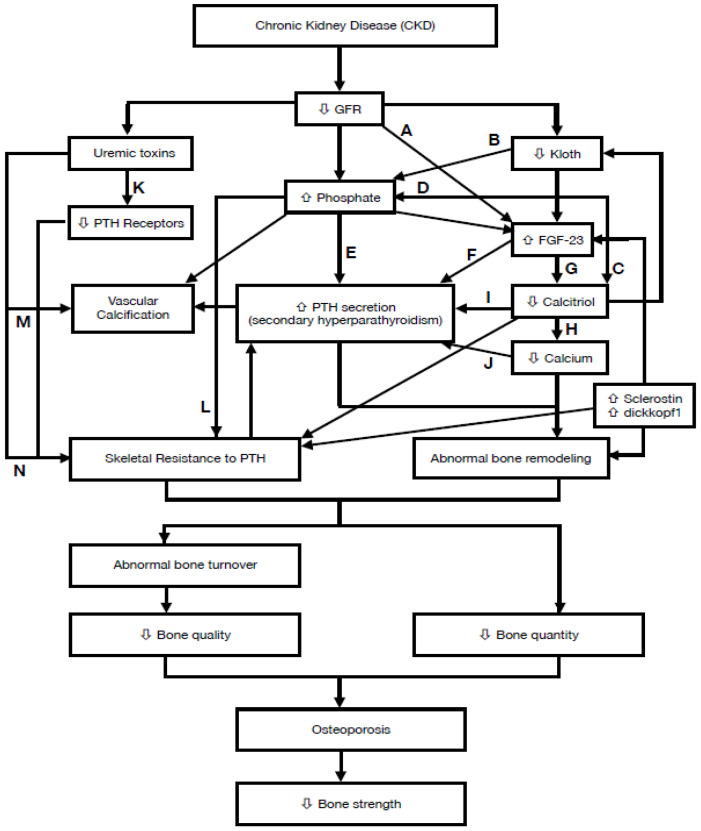
“In addition to PTH, vitamin D, calcium and phosphorus, fibroblast growth factor-23 (FGF-23), sclerostin, and Klotho play a role in CKD-MBD (Figure 1) [71,73].”
Background
Metadata
- Authors
- Hsu, C.-Y., Chen, L.-R., & Chen, K.-H.
- Affiliations
- Chung Yuan Christian University (TW)
- National Yang Ming Chiao Tung University (TW)
- Tzu Chi University (TW)
- Corresponding author
- Chen, Kuo-Hu
- Venue
- International Journal of Molecular Sciences
- Publisher
- MDPI AG
- Published
- 2020-09-18
- Volume
- 21
- Issue
- 18
- Pages
- 6846
- ISSN
- 1422-0067 (ISSN-L)
- PMC
- PMC7555655
- OpenAlex
- W3087316672
- Cited by
- 162
- References
- 183
- Citations by year
- 2026: 22 · 2025: 31 · 2024: 32 · 2023: 29 · 2022: 31 · 2021: 13 · 2020: 4
- FWCI
- 3.10
- Type
- journal article
- Language
- en
- Open access
- gold
- doi.org
- Licence
- Locations
- International Journal of Molecular Sciences (publishedVersion, cc-by)
- PubMed Central (publishedVersion, cc-by)
- PubMed (publishedVersion)
- DOAJ (DOAJ: Directory of Open Access Journals) (submittedVersion, cc-by-sa)
- Funders
- Taipei Tzu Chi Hospital (Taipei Tzu-Chi Hospital, Taiwan (TCRD-TPE-109-10))
- Topics
- Health Sciences › Medicine › Nephrology › Parathyroid Disorders and Treatments
- Health Sciences › Medicine › Orthopedics and Sports Medicine › Bone health and osteoporosis research
- Health Sciences › Medicine › Nephrology › Renal function and acid-base balance
- Keywords
- chronic kidney disease, osteoporosis, chronic kidney disease-mineral and bone disorder, renal osteodystrophy, fragility fractures, fracture risk, bone turnover markers, parathyroid hormone, vitamin D, hyperphosphatemia, secondary hyperparathyroidism, antiresorptive therapy, anabolic therapy, lifestyle modification, calcium and vitamin D supplementation, calcinosis
- MeSH terms
- Bone and Bones, Calcium, Calcium, Dietary, Renal Dialysis, Humans, Kidney Diseases, Osteoporosis, Phosphorus, Chronic Kidney Disease-Mineral and Bone Disorder, Vitamin D, Biomarkers, Fractures, Bone, Renal Insufficiency, Chronic
About these checks
Registry, retraction, Cites and statistics results are computed, not judged, with one exception: a printed reference that no index lists is read once by a model before it counts as a citation error. Claims are extracted by a model and kept only when their quote appears verbatim in the text; each cited source is then checked, with a model’s help, for whether it says what the claim relies on. Those verdicts can be wrong — read the claim’s quote and the cited source before relying on one.
Statistics and arithmetic are recomputed, not judged.
Confidence bands are shown only for fields calibrated on our annotated test set. None is calibrated yet, so no band is shown.
What counts as a claim ›How we measure confidence ›How we check this ›
Are you an author, or do you see a problem with this page? Request a review
Data sources
Bibliographic data: Semantic Scholar, OpenAlex, Crossref.
Contains information from the Semantic Scholar Academic Graph Datasets, made available under the ODC Attribution License (ODC-BY 1.0).
Semantic Scholar’s data is described in: Kinney, R., et al. (2023). The Semantic Scholar Open Data Platform. arXiv:2301.10140.
