

PI3K/Akt/mTOR Signaling Pathway as a Target for Colorectal Cancer Treatment
Open accessThe DOI matches its Crossref record; 143 of the 144 references it cites were found in a registry or an index, and 1 are not checked yet.
Abstract
In the last decade, pathway-specific targeted therapy has revolutionized colorectal cancer (CRC) treatment strategies. This type of therapy targets a tumor-vulnerable spot formed primarily due to an alteration in an oncogene and/or a tumor suppressor gene. However, tumor heterogeneity in CRC frequently results in treatment resistance, underscoring the need to understand the molecular mechanisms involved in CRC for the development of novel targeted therapies. The phosphatidylinositol 3-kinase/protein kinase B/mammalian target of the rapamycin (PI3K/Akt/mTOR) signaling pathway axis is a major pathway altered in CRC. The aberrant activation of this pathway is associated with CRC initiation, progression, and metastasis and is critical for the development of drug resistance in CRC. Several drugs target PI3K/Akt/mTOR in clinical trials, alone or in combination, for the treatment of CRC. This review aims to provide an overview of the role of the PI3K/Akt/mTOR signaling pathway axis in driving CRC, existing PI3K/Akt/mTOR-targeted agents against CRC, their limitations, and future trends.
Overview
The claims and statistics of this paper haven’t been checked yet.
Free: it reads the open-access text and checks the first 5 claims that cite a source we can check. Create a free account to check every claim.
Integrity signals
Registry
Cites
Statistics
Figures
Verification
Claims the paper makes
The claims and statistics of this paper haven’t been checked yet.
Free: it reads the open-access text and checks the first 5 claims that cite a source we can check. Create a free account to check every claim.
Claims other papers make about this one
Each is checked against this paper’s own text: does it say what the citing paper says it does?
The cited source says what the claim attributes to it.
In the citing paper
“Activating mutations in PIK3CA can also contribute to resistance to anti-EGFR therapy in KRAS-WT CRC patients by persistent activation of the PI3K/AKT/mTOR signaling pathway [126].”
From Mechanisms and Strategies to Overcome Drug Resistance in Colorectal Cancer (2025) · cites this paper as [126]
The cited source says what the claim attributes to it.
In the citing paper
“While PI3K pathway inhibitors as a monotherapy have not shown significant antitumor effects in treating CRC, their utility in combination therapy is actively being studied.”
From Mechanisms and Strategies to Overcome Drug Resistance in Colorectal Cancer (2025) · cites this paper as [126]
The cited source says what the claim attributes to it.
In the citing paper
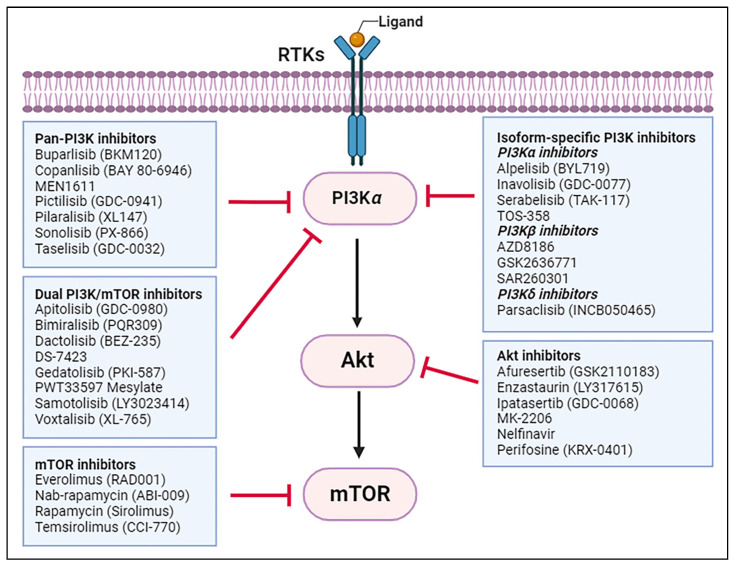
“Various drugs targeting this pathway are under investigation for CRC treatment, including pan-PI3K inhibitors, isoform-specific PI3K inhibitors, dual PI3K-mTOR inhibitors, Akt inhibitors, and mTOR inhibitors [126].”
From Mechanisms and Strategies to Overcome Drug Resistance in Colorectal Cancer (2025) · cites this paper as [126]
Self-check
Percentages, sums and reported differences re-computed from the paper’s own numbers.
The self-check needs the paper’s full text.
Citations
Cites
Sung, H., Ferlay, J., Siegel, R. L., Laversanne, M., Soerjomataram, I., Jemal, A., & Bray, F. (2021) · CA: A Cancer Journal for Clinicians · doi:10.3322/caac.21660 · Cited by 108,699 · cited 2×
“Colorectal cancer (CRC) is a significant cause of morbidity and mortality worldwide and the second leading cause of cancer mortality in the United States [1–3].”
BackgroundInfluentialRepertoires of Autophagy in the Pathogenesis of Ocular Diseases
Li, Y.-J., Jiang, Q., Cao, G.-F., Yao, J., & Yan, B. (2015) · Cellular Physiology and Biochemistry · doi:10.1159/000373980 · Cited by 16,304
Siegel, R. L., Miller, K. D., Wagle, N. S., & Jemal, A. (2023) · CA: A Cancer Journal for Clinicians · doi:10.3322/caac.21763 · Cited by 16,303 · cited 2×
“In the United States, there will be an estimated 153,000 new cases and 53,000 deaths from CRC in 2023 [2,3].”
BackgroundPhosphorylation and regulation of Akt/PKB by the rictor-mTOR complex
Sarbassov, D. D., Guertin, D. A., Ali, S. M., & Sabatini, D. M. (2005) · Science · doi:10.1126/science.1106148 · Cited by 6,216 · cited 2×
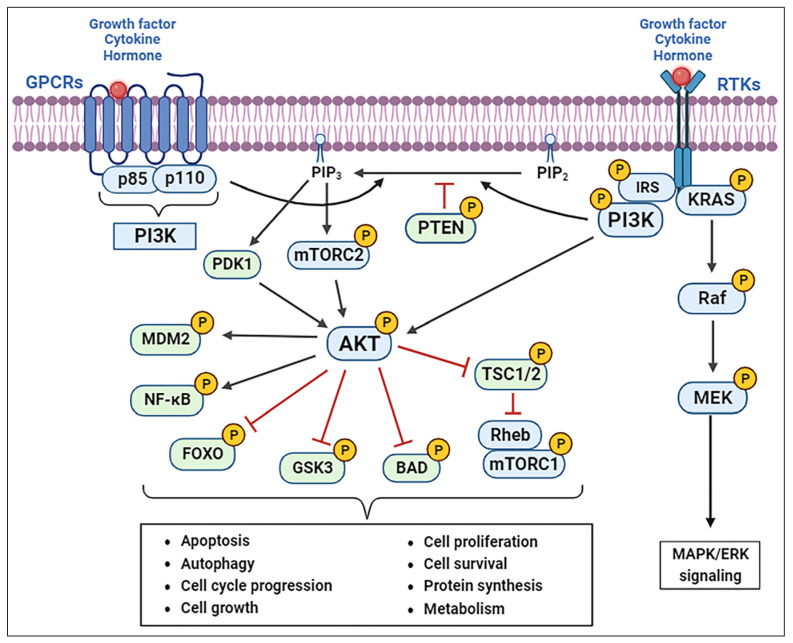
“…in both the cytoplasm and nucleus, including the Bcl2-associated agonist of cell death (BAD), forkhead box O (FOXO), glycogen synthase kinase 3 (GSK3), the Full Akt activity is achieved through phosphorylation at the Serine 473 residue in the C-terminal hydrophobic motif by mTORC2 [17].”
BackgroundAKT/PKB signaling: navigating downstream
Manning, B. D., & Cantley, L. C. (2007) · Cell · doi:10.1016/j.cell.2007.06.009 · Cited by 6,115 · cited 1×
“Akt regulates mTOR, a downstream target that promotes protein translation, growth, metabolism, and angiogenesis in CRC [29].”
BackgroundmTOR: from growth signal integration to cancer, diabetes and ageing
Zoncu, R., Efeyan, A., & Sabatini, D. M. (2011) · Nature Reviews Molecular Cell Biology · doi:10.1038/nrm3025 · Cited by 3,941 · cited 4×
“Compared with other PI3K pathway inhibitors, dual PI3K/mTOR inhibitors can inhibit all PI3K catalytic isoforms, mTORC1, and mTORC2 [80] and should block this pathway completely and overcome the feedback inhibition observed with mTORC1 inhibitors (i.e., rapamycin analogs).”
BackgroundInfluentialColorectal cancer statistics, 2023
Siegel, R. L., Wagle, N. S., Cercek, A., Smith, R. A., & Jemal, A. (2023) · CA: A Cancer Journal for Clinicians · doi:10.3322/caac.21772 · Cited by 3,733 · cited 3×
“Colorectal cancer (CRC) is a significant cause of morbidity and mortality worldwide and the second leading cause of cancer mortality in the United States [1–3].”
BackgroundHigh Frequency of Mutations of the PIK3CA Gene in Human Cancers
Samuels, Y., Wang, Z., Bardelli, A., Silliman, N., Ptak, J., Szabo, S., Yan, H., Gazdar, A., Powell, S. M., Riggins, G. J., et al. (2004) · Science · doi:10.1126/science.1096502 · Cited by 3,437
Alessi, D. R., James, S. R., Downes, C. P., Holmes, A. B., Gaffney, P. R. J., Reese, C. B., & Cohen, P. (1997) · Current Biology · doi:10.1016/s0960-9822(06)00122-9 · Cited by 2,826 · cited 1×
“PI3K-generated PIP binds to the PH domain of both Akt and phosphoinositide-dependent kinase 1 (PDK1) and induces their translocation to the plasma membrane, where PDK1 phosphorylates the Akt kinase at the Threonine 308 residue in the “activation loop,” leading to its partial activation [14].”
BackgroundThe PI3K Pathway in Human Disease
Fruman, D. A., Chiu, H., Hopkins, B. D., Bagrodia, S., Cantley, L. C., & Abraham, R. T. (2017) · Cell · doi:10.1016/j.cell.2017.07.029 · Cited by 2,749 · cited 5×
“The PI3K/Akt/mTOR pathway axis is critical for cell survival, proliferation, and growth, and it is one of the most frequently altered pathways in human cancer, making it a promising target for cancer therapy [9–12].”
BackgroundInfluential
Cited by
PI3K/AKT/mTOR Axis in Cancer: From Pathogenesis to Treatment
Jiang, M., Zhang, K., Zhang, Z., Zeng, X., Huang, Z., Qin, P., Xie, Z., Cai, X., Ashrafizadeh, M., Tian, Y., et al. (2025) · MedComm · doi:10.1002/mco2.70295 · Cited by 237
Mechanisms and Strategies to Overcome Drug Resistance in Colorectal Cancer
Haynes, J., & Manogaran, P. (2025) · International Journal of Molecular Sciences · doi:10.3390/ijms26051988 · Cited by 82
“Various drugs targeting this pathway are under investigation for CRC treatment, including pan-PI3K inhibitors, isoform-specific PI3K inhibitors, dual PI3K-mTOR inhibitors, Akt inhibitors, and mTOR inhibitors [126].”
Research on the role and mechanism of the PI3K/Akt/mTOR signalling pathway in osteoporosis
Liu, C., Zhang, J., Ye, Z., Luo, J., Peng, B., & Wang, Z. (2025) · Frontiers in Endocrinology · doi:10.3389/fendo.2025.1541714 · Cited by 76
“As a second messenger (47, 48), PIP3 recruits protein kinase B (Akt), which contains a pleckstrin homology domain (PH domain) (49).”
Zhang, H., Tang, J., Cao, H., Wang, C., Shen, C., & Liu, J. (2024) · Journal of Ethnopharmacology · doi:10.1016/j.jep.2024.119007 · Cited by 27
Razzaq, S., Fatima, I., Moafian, Z., Rahdar, A., Fathi‐karkan, S., Kharaba, Z. J., Shirzad, M., Khan, S. A., & Pandey, S. (2025) · Medical Oncology · doi:10.1007/s12032-025-02670-z · Cited by 28
“The amplification of the PIK3CA gene is another mechanism by which PI3K is activated, leading to increased levels of protein expression and activity [42, 48–50].”
Metadata
- Authors
- Leiphrakpam, P., & Are, C.
- Affiliations
- University of Nebraska Medical Center (US)
- Corresponding author
- Leiphrakpam, Premila
- Venue
- International Journal of Molecular Sciences
- Publisher
- MDPI AG
- Published
- 2024-03-09
- Volume
- 25
- Issue
- 6
- Pages
- 3178
- ISSN
- 1422-0067 (ISSN-L)
- PMC
- PMC10970097
- OpenAlex
- W4392661434
- Cited by
- 193
- References
- 144
- Citations by year
- 2026: 82 · 2025: 82 · 2024: 29
- FWCI
- 7.89
- Type
- journal article
- Language
- en
- Open access
- gold
- doi.org
- Licence
- Locations
- International Journal of Molecular Sciences (publishedVersion, cc-by)
- PubMed Central (publishedVersion, cc-by)
- PubMed (publishedVersion)
- Topics
- Life Sciences › Biochemistry, Genetics and Molecular Biology › Molecular Biology › PI3K/AKT/mTOR signaling in cancer
- Health Sciences › Medicine › Oncology › Colorectal Cancer Treatments and Studies
- Life Sciences › Biochemistry, Genetics and Molecular Biology › Molecular Biology › Metabolism, Diabetes, and Cancer
- Keywords
- colorectal cancer, PI3K/AKT/mTOR pathway, targeted therapy, drug resistance, tumor heterogeneity, metastasis, PI3K inhibitors, AKT inhibitors, mTOR inhibitors, combination therapy
- MeSH terms
- Phosphoinositide-3 Kinase Inhibitors, Humans, Colorectal Neoplasms, Signal Transduction, Phosphatidylinositol 3-Kinases, Proto-Oncogene Proteins c-akt, TOR Serine-Threonine Kinases
About these checks
Registry, retraction, Cites and statistics results are computed, not judged, with one exception: a printed reference that no index lists is read once by a model before it counts as a citation error. Claims are extracted by a model and kept only when their quote appears verbatim in the text; each cited source is then checked, with a model’s help, for whether it says what the claim relies on. Those verdicts can be wrong — read the claim’s quote and the cited source before relying on one.
Statistics and arithmetic are recomputed, not judged.
Confidence bands are shown only for fields calibrated on our annotated test set. None is calibrated yet, so no band is shown.
What counts as a claim ›How we measure confidence ›How we check this ›
Are you an author, or do you see a problem with this page? Request a review
Data sources
Bibliographic data: Semantic Scholar, OpenAlex, Crossref.
Contains information from the Semantic Scholar Academic Graph Datasets, made available under the ODC Attribution License (ODC-BY 1.0).
Semantic Scholar’s data is described in: Kinney, R., et al. (2023). The Semantic Scholar Open Data Platform. arXiv:2301.10140.
