

The DOI matches its Crossref record; 2 of the 2 references it cites were found in a registry or an index.
Non-Specific Lipid Transfer Protein Amb a 6 Is a Source-Specific Important Allergenic Molecule in Ragweed Pollen
Abstract
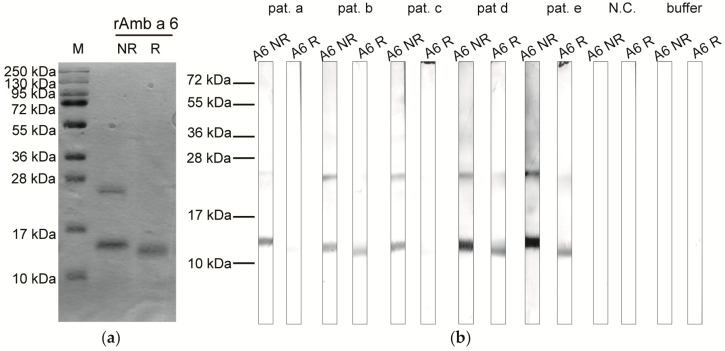
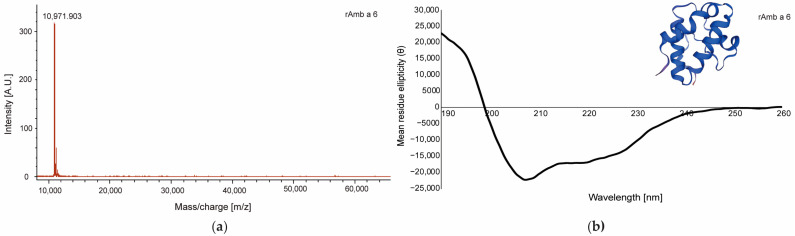
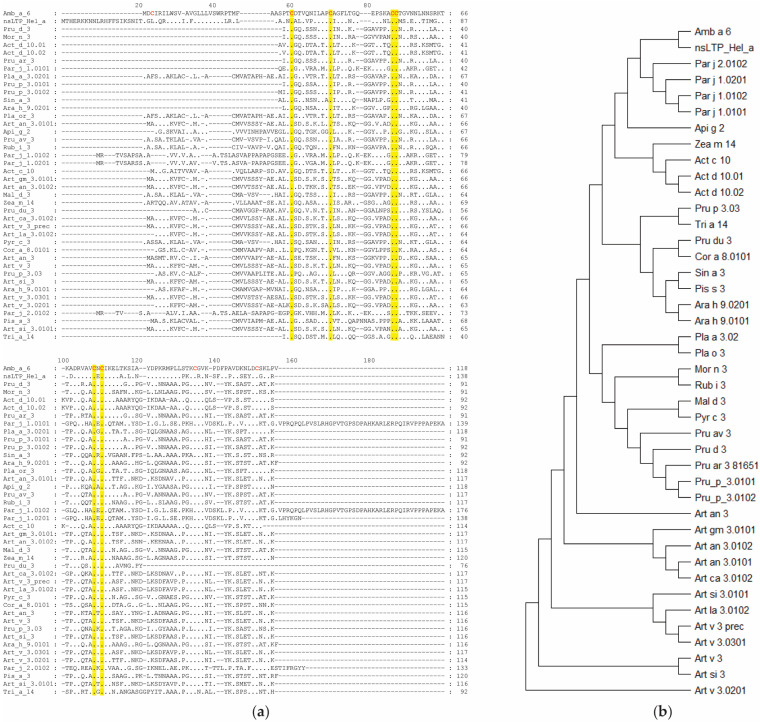
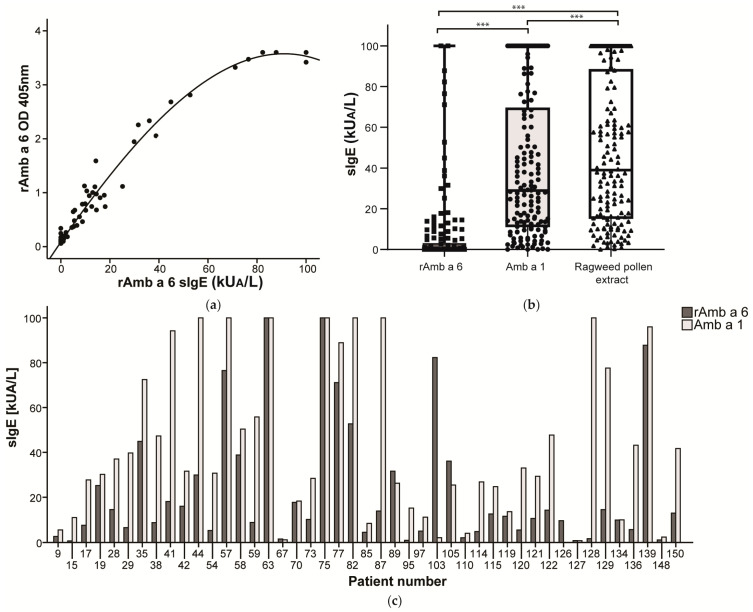
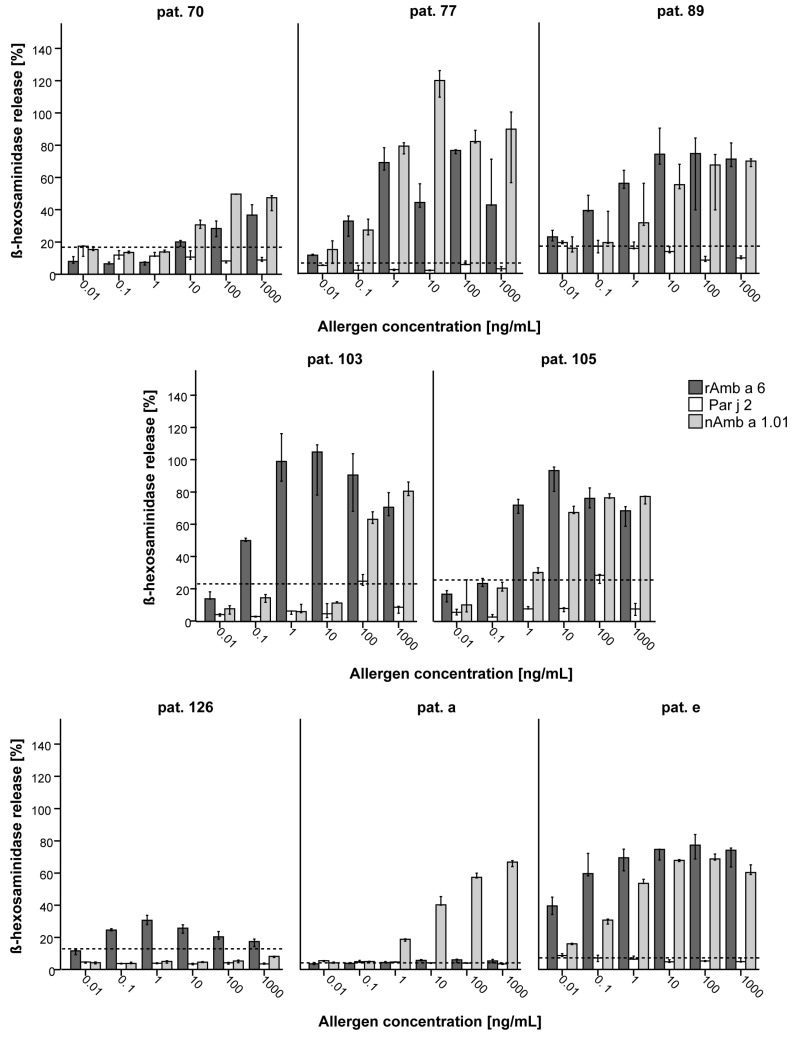
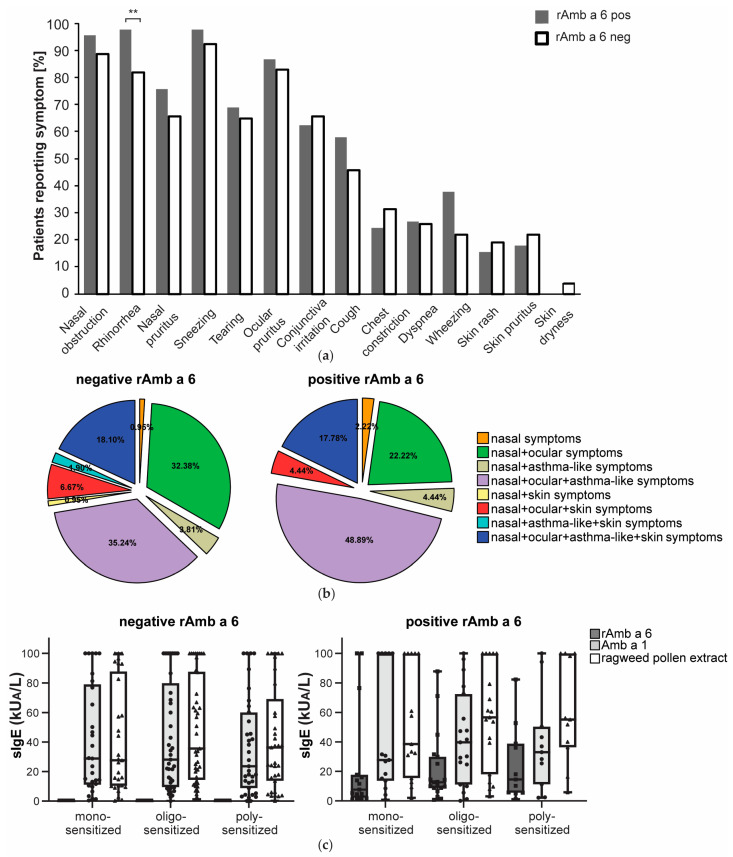
Pollen from common ragweed is an important allergen source worldwide and especially in western and southern Romania. More than 100 million patients suffer from symptoms of respiratory allergy (e.g., rhinitis, asthma) to ragweed pollen. Among the eleven characterized allergens, Amb a 6 is a non-specific lipid transfer protein (nsLTP). nsLTPs are structurally stable proteins in pollen and food from different unrelated plants capable of inducing severe reactions. The goal of this study was to produce Amb a 6 as a recombinant and structurally folded protein (rAmb a 6) and to characterize its physicochemical and immunological features. rAmb a 6 was expressed in Spodoptera frugiperda Sf9 cells as a secreted protein and characterized by mass spectrometry and circular dichroism (CD) spectroscopy regarding molecular mass and fold, respectively. The IgE-binding frequency towards the purified protein was evaluated using sera from 150 clinically well-characterized ragweed-allergic patients. The allergenic activities of rAmb a 6 and the nsLTP from the weed Parietaria judaica (Par j 2) were evaluated in basophil activation assays. rAmb a 6-specific IgE reactivity was associated with clinical features. Pure rAmb a 6 was obtained by insect cell expression. Its deduced molecular weight corresponded to that determined by mass spectrometry (i.e., 10,963 Da). rAmb a 6 formed oligomers as determined by SDS-PAGE under non-reducing conditions. According to multiple sequence comparisons, Amb a 6 was a distinct nsLTP with less than 40% sequence identity to currently known plant nsLTP allergens, except for nsLTP from Helianthus (i.e., 52%). rAmb a 6 is an important ragweed allergen recognized by 30% of ragweed pollen allergic patients. For certain patients, rAmb a 6-specific IgE levels were higher than those specific for the major ragweed allergen Amb a 1 and analysis also showed a higher allergenic activity in the basophil activation test. rAmb a 6-positive patients suffered mainly from respiratory symptoms. The assumption that Amb a 6 is a source-specific ragweed allergen is supported by the finding that none of the patients showing rAmb a 6-induced basophil activation reacted with Par j 2 and only one rAmb a 6-sensitized patient had a history of plant food allergy. Immunization of rabbits with rAmb a 6 induced IgG antibodies which strongly inhibited IgE binding to rAmb a 6. Our results demonstrate that Amb a 6 is an important source-specific ragweed pollen allergen that should be considered for diagnosis and allergen-specific immunotherapy of ragweed pollen allergy.
Overview
The claims and statistics of this paper haven’t been checked yet.
Run the check — free, no account needed. It reads the open-access text and checks the sources it cites.
Integrity signals
Registry
Cites
Statistics
Figures
Verification
Claims the paper makes
The claims and statistics of this paper haven’t been checked yet.
Run the check — free, no account needed. It reads the open-access text and checks the sources it cites.
Claims other papers make about this one
Each is checked against this paper’s own text: does it say what the citing paper says it does?
In the citing paper
“The allergens Amb a 8 (profilin) and Amb a 6 (LTP) cross-react with proteins in foods such as melons, bananas, and cucumbers, leading to the development of PFAS symptoms in sensitized individuals [42,50].”
From Pollen–Food Allergy Syndrome: Allergens, Clinical Insights, Diagnostic and Therapeutic Challenges (2024) · cites this paper as [50]
Self-check
Percentages, sums and reported differences re-computed from the paper’s own numbers.
The self-check needs the paper’s full text.
Citations
Cites
Arbes Jr., S. J., Gergen, P. J., Elliott, L., & Zeldin, D. C. (2005) · Journal of Allergy and Clinical Immunology · doi:10.1016/j.jaci.2005.05.017 · Cited by 639 · cited 1×
“Common ragweed ( Ambrosia artemisiifolia ) pollen has been identified as an important source of allergens in the whole world causing allergy in more than 100 million patients [1–3].”
BackgroundCaraballo, L., Valenta, R., Puerta, L., Pomés, A., Zakzuk, J., Fernandez-Caldas, E., Acevedo, N., Sanchez-Borges, M., Ansotegui, I., Zhang, L., et al. (2020) · World Allergy Organization Journal · doi:10.1016/j.waojou.2020.100118 · Cited by 68
Self-citation
Research works printed but not linked: 51
- Lake, 2017, Climate Change and Future Pollen Allergy in Europe, Environ. Health Perspect., 125, 385, 10.1289/EHP173 · DOI
- Schaffner, 2020, Biological Weed Control to Relieve Millions from Ambrosia Allergies in Europe, Nat. Commun., 11, 1745, 10.1038/s41467-020-15586-1 · DOI
- Thibaudon, 2010, Ragweed Pollen in France: Origin, Diffusion, Exposure, Eur. Ann. Allergy Clin. Immunol., 43, 209
- Makra, 2005, The History and Impacts of Airborne Ambrosia (Asteraceae) Pollen in Hungary, Grana, 44, 57, 10.1080/00173130510010558 · DOI
- Cecchi, 2010, Projections of the Effects of Climate Change on Allergic Asthma: The Contribution of Aerobiology, Allergy Eur. J. Allergy Clin. Immunol., 65, 1073, 10.1111/j.1398-9995.2010.02423.x · DOI
- Ozaslan, 2016, Common Ragweed: An Emerging Threat for Sunflower Production and Human Health in Turkey, Weed Biol. Manag., 16, 42, 10.1111/wbm.12093 · DOI
- Leru, 2015, Health Impact of Ambrosia artemisiifolia Reflected By Allergists Practice in Romania. A Questionnaire—Based Survey, Ann. West Univ. Timişoara Ser. Biol., 18, 43
- Leru, P.M., Eftimie, A.M., Anton, V.F., and Thibaudon, M. (2019). Five-Year Data on Pollen Monitoring, Distribution and Health Impact of Allergenic Plants in Bucharest and the Southeastern Region of Romania. Medicina, 55. · DOI
- Leru, P.M., Anton, V.F., Eftimie, A.M., and Stefanut, S. (2022). Biologic Pollution Due to Ambrosia (Ragweed) Pollen in Urban Environment of Bucharest. Int. J. Environ. Res. Public Health, 19. · DOI
- Gaudeul, M., Giraud, T., Kiss, L., and Shykoff, J.A. (2011). Nuclear and Chloroplast Microsatellites Show Multiple Introductions in the Worldwide Invasion History of Common Ragweed, Ambrosia artemisiifolia. PLoS ONE, 6. · DOI
- Newhouse, 2004, Correlation of Environmental Factors with Asthma and Rhinitis Symptoms in Tulsa, OK, Ann. Allergy Asthma Immunol., 92, 356, 10.1016/S1081-1206(10)61575-X · DOI
- Ziska, 2007, Establishment and Persistence of Common Ragweed (Ambrosia Artemisiifolia L.) in Disturbed Soil as a Function of an Urban-Rural Macro-Environment, Glob. Chang. Biol., 13, 266, 10.1111/j.1365-2486.2006.01264.x · DOI
- El Kelish, A., Zhao, F., Heller, W., Durner, J., Winkler, J.B., Behrendt, H., Traidl-Hoffmann, C., Horres, R., Pfeifer, M., and Frank, U. (2014). Ragweed (Ambrosia artemisiifolia) Pollen Allergenicity: SuperSAGE Transcriptomic Analysis upon Elevated CO2 and Drought Stress. BMC Plant Biol., 14. · DOI
- Chen, 2018, Ragweed Pollen Allergy: Burden, Characteristics, and Management of an Imported Allergen Source in Europe, Int. Arch. Allergy Immunol., 176, 163, 10.1159/000487997 · DOI
- Tamaș, T.P., Buzan, M.R., Zbîrcea, L.E., Cotarcă, M.D., Grijincu, M., Păunescu, V., Panaitescu, C., and Chen, K.W. (2023). Ragweed Major Allergen Amb a 11 Recombinant Production and Clinical Implications. Biomolecules, 13. · DOI
- Buzan, 2022, Complex IgE Sensitization Patterns in Ragweed Allergic Patients: Implications for Diagnosis and Specific Immunotherapy, Clin. Transl. Allergy, 12, e12179, 10.1002/clt2.12179 · DOI
- Zbîrcea, L.E., Buzan, M.R., Grijincu, M., Babaev, E., Stolz, F., Valenta, R., Păunescu, V., Panaitescu, C., and Chen, K.W. (2023). Relationship between IgE Levels Specific for Ragweed Pollen Extract, Amb a 1 and Cross-Reactive Allergen Molecules. Int. J. Mol. Sci., 24. · DOI · Paper page
- Caraballo, 2021, Are the Terms Major and Minor Allergens Useful for Precision Allergology?, Front. Immunol., 12, 10, 10.3389/fimmu.2021.651500 · DOI
- Trifonova, D., Curin, M., Riabova, K., Karsonova, A., Keller, W., Grönlund, H., Käck, U., Konradsen, J.R., van Hage, M., and Karaulov, A. (2023). Allergenic Activity of Individual Cat Allergen Molecules. Int. J. Mol. Sci., 24. · DOI
- Edqvist, 2018, Plant Lipid Transfer Proteins: Are We Finally Closing in on the Roles of These Enigmatic Proteins?, J. Lipid Res., 59, 1374, 10.1194/jlr.R083139 · DOI
- Palacin, 2009, Recombinant Lipid Transfer Protein Tri a 14: A Novel Heat and Proteolytic Resistant Tool for the Diagnosis of Baker’s Asthma, Clin. Exp. Allergy, 39, 1267, 10.1111/j.1365-2222.2009.03280.x · DOI
- Pastorello, 2004, Clinical Role of Lipid Transfer Proteins in Food Allergy, Mol. Nutr. Food Res., 48, 356, 10.1002/mnfr.200400047 · DOI
- Asero, 2011, The Nature of Melon Allergy in Ragweed-Allergic Subjects: A Study of 1000 Patients, Allergy Asthma Proc., 32, 64, 10.2500/aap.2011.32.3416 · DOI · Paper page
- Benito, 2003, Clinically Relevant Peach Allergy Is Related to Peach Lipid Transfer Protein, Pru p 3, in the Spanish Population, J. Allergy Clin. Immunol., 112, 789, 10.1016/S0091-6749(03)02016-5 · DOI
- Bartra, 2013, Prevalence of Asthma and Severity of Allergic Rhinitis Comparing 2 Perennial Allergens: House Dust Mites and Parietaria Judaica Pollen, J. Investig. Allergol. Clin. Immunol., 23, 145
- Ridolo, 2023, Factors and Co-Factors Influencing Clinical Manifestations in NsLTPs Allergy: Between the Good and the Bad, Front. Allergy, 4, 1253304, 10.3389/falgy.2023.1253304 · DOI
- Lombardero, 2004, Prevalence of Sensitization to Artemisia Allergens Art v 1, Art v 3 and Art v 60 KDa. Cross-Reactivity among Art v 3 and Other Relevant Lipid-Transfer Protein Allergens, Clin. Exp. Allergy, 34, 1415, 10.1111/j.1365-2222.2004.02053.x · DOI
- Asero, 2022, Why Lipid Transfer Protein Allergy Is Not a Pollen-Food Syndrome: Novel Data and Literature Review, Eur. Ann. Allergy Clin. Immunol., 54, 198, 10.23822/EurAnnACI.1764-1489.206 · DOI
- Zhao, 2020, Variation in IgE Binding Potencies of Seven Artemisia Species Depending on Content of Major Allergens, Clin. Transl. Allergy, 10, 50, 10.1186/s13601-020-00354-7 · DOI
- Roebber, 1983, Isolation and Properties of a New Short Ragweed Pollen Allergen, Ra6, J. Immunol., 131, 706, 10.4049/jimmunol.131.2.706 · DOI
- Marsh, 1987, Immune Responsiveness to Ambrosia artemisiifolia (Short Ragweed) Pollen Allergen Amb a VI (Ra6) Is Associated with HLA-DR5 in Allergic Humans, Immunogenetics, 26, 230, 10.1007/BF00346517 · DOI
- Curin, 2017, Single Recombinant and Purified Major Allergens and Peptides: How They Are Made and How They Change Allergy Diagnosis and Treatment, Ann. Allergy Asthma Immunol., 119, 201, 10.1016/j.anai.2016.11.022 · DOI
- Hiller, 1998, Cloning and Expression of Ragweed Allergen Amb a 6, Scand. J. Immunol., 48, 26, 10.1046/j.1365-3083.1998.00355.x · DOI
- Salminen, 2016, Lipid Transfer Proteins: Classification, Nomenclature, Structure, and Function, Planta, 244, 971, 10.1007/s00425-016-2585-4 · DOI
- Missaoui, 2022, Plant Non-Specific Lipid Transfer Proteins: An Overview, Plant Physiol. Biochem., 171, 115, 10.1016/j.plaphy.2021.12.026 · DOI
- Dorofeeva, 2019, Expression and Characterization of Recombinant Par j 1 and Par j 2 Resembling the Allergenic Epitopes of Parietaria Judaica Pollen, Sci. Rep., 9, 15043, 10.1038/s41598-019-50854-1 · DOI
- Pokoj, 2010, Pichia Pastoris Is Superior to E. coli for the Production of Recombinant Allergenic Non-Specific Lipid-Transfer Proteins, Protein Expr. Purif., 69, 68, 10.1016/j.pep.2009.08.014 · DOI
- Wangorsch, 2020, 2S Albumins and NsLTP Are Involved in Anaphylaxis to Pizza Sauce: IgE Recognition before and after Allergen Processing, Food Chem., 321, 126679, 10.1016/j.foodchem.2020.126679 · DOI
- Barber, 2008, Understanding Patient Sensitization Profiles in Complex Pollen Areas: A Molecular Epidemiological Study, Allergy Eur. J. Allergy Clin. Immunol., 63, 1550, 10.1111/j.1398-9995.2008.01807.x · DOI
- Aalberse, 2000, Structural Biology of Allergens, J. Allergy Clin. Immunol., 106, 228, 10.1067/mai.2000.108434 · DOI
- Skypala, 2019, Lipid Transfer Protein Allergy in the United Kingdom: Characterization and Comparison with a Matched Italian Cohort, Allergy, 74, 1340, 10.1111/all.13747 · DOI
- Westman, 2022, Alpha-Gal Sensitization among Young Adults Is Associated with Male Sex and Polysensitization, J. Allergy Clin. Immunol. Pract., 10, 333, 10.1016/j.jaip.2021.10.018 · DOI
- (2020, July 01). NIH Basic Local Alignment Search Tool, Available online: https://blast.ncbi.nlm.nih.gov.
- Tamura, 2021, MEGA11: Molecular evolutionary genetics analysis version 11, Mol. Biol. Evol., 38, 3022, 10.1093/molbev/msab120 · DOI
- Grijincu, 2023, Physicochemical and Immunological Characterization of Amb a 12, a Novel Ragweed (Ambrosia artemisiifolia) Pollen Allergen, Mol. Immunol., 157, 18, 10.1016/j.molimm.2023.03.012 · DOI
- Campana, 2011, Altered IgE Epitope Presentation: A Model for Hypoallergenic Activity Revealed for Bet v 1 Trimer, Mol. Immunol., 48, 431, 10.1016/j.molimm.2010.09.016 · DOI
- Sreerama, 2000, Estimation of Protein Secondary Structure from Circular Dichroism Spectra: Comparison of CONTIN, SELCON, and CDSSTR Methods with an Expanded Reference Set, Anal. Biochem., 287, 252, 10.1006/abio.2000.4880 · DOI
- Lungu, 2022, Study of Some Factors Associated with Polyclonal Antibody Production in Rabbit, Eximia, 4, 14
- Nakamura, 2010, A Convenient and Sensitive Allergy Test: IgE Crosslinking-Induced Luciferase Expression in Cultured Mast Cells, Allergy Eur. J. Allergy Clin. Immunol., 65, 1266, 10.1111/j.1398-9995.2010.02363.x · DOI
- Takagi, 2003, Application of Human FcεRI α-Chain-Transfected RBL-2H3 Cells for Estimation of Active Serum IgE, Biol. Pharm. Bull., 26, 252, 10.1248/bpb.26.252 · DOI
- Gieras, 2007, Molecular Determinants of Allergen-Induced Effector Cell Degranulation, J. Allergy Clin. Immunol., 119, 384, 10.1016/j.jaci.2006.09.034 · DOI
Cited by
Sorted by citations
Pollen–Food Allergy Syndrome: Allergens, Clinical Insights, Diagnostic and Therapeutic Challenges
Haidar, L., Bănărescu, C. F., Uța, C., Moldovan, S. I., Zimbru, E.-L., Zimbru, R.-I., Ciurariu, E., Georgescu, M., & Panaitescu, C. (2024) · Applied Sciences · doi:10.3390/app15010066 · Cited by 21
Self-citation
Metadata
- Authors
- Grijincu, M., Tănasie, G., Zbîrcea, L.-E., Buzan, M.-R., Tamaș, T.-P., Cotarcă, M.-D., Huțu, I., Babaev, E., Stolz, F., Dorofeeva, Y., Valenta, R., Păunescu, V., Panaitescu, C., & Chen, K.-W.
- Venue
- International Journal of Molecular Sciences
- Publisher
- MDPI AG
- Published
- 2024-06-13
- Volume
- 25
- Issue
- 12
- Pages
- 6513
- ISSN
- 1422-0067
- PMC
- PMC11204090
- Cited by
- 7
- References
- 2
- Language
- en
- Funders
- INSPIRED (Innovative Strategies for Prevention, Diagnosis, and Therapy of Ragweed Pollen Induced Respiratory Diseases) project (2014–2020 92/09.09.2016, P_37_747, 23-75-30016)
- European Regional Development Fund (ERDF) (2014–2020 92/09.09.2016, P_37_747, 23-75-30016)
- Romanian national budget (2014–2020 92/09.09.2016, P_37_747, 23-75-30016)
- Danube Allergy Research Cluster of the Country of Lower Austria (2014–2020 92/09.09.2016, P_37_747, 23-75-30016)
- Russian Science Foundation (2014–2020 92/09.09.2016, P_37_747, 23-75-30016)
- Victor Babes University of Medicine and Pharmacy, Timișoara (2014–2020 92/09.09.2016, P_37_747, 23-75-30016)
About these checks
Registry, retraction, Cites and statistics results are computed, not judged, with one exception: a printed reference that no index lists is read once by a model before it counts as a citation error. Claims are extracted by a model and kept only when their quote appears verbatim in the text; each cited source is then checked, with a model’s help, for whether it says what the claim relies on. Those verdicts can be wrong — read the claim’s quote and the cited source before relying on one.
Statistics and arithmetic are recomputed, not judged.
Confidence bands are shown only for fields calibrated on our annotated test set. None is calibrated yet, so no band is shown.
What counts as a claim ›How we measure confidence ›How we check this ›
Are you an author, or do you see a problem with this page? Request a review
