

The DOI matches its Crossref record; 212 of the 213 references it cites were found in a registry or an index, and 1 are not checked yet.
The Role of Genetic, Environmental, and Dietary Factors in Alzheimer’s Disease: A Narrative Review
Open accessAbstract
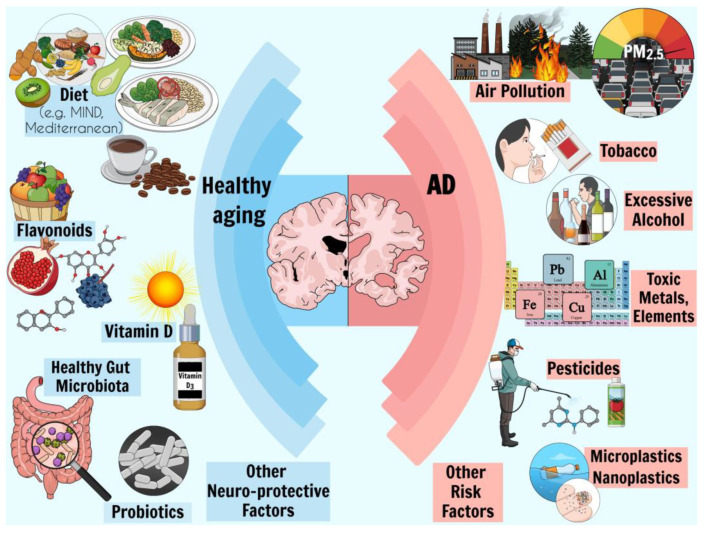
Alzheimer’s disease (AD) is one of the most common and severe forms of dementia and neurodegenerative disease. As life expectancy increases in line with developments in medicine, the elderly population is projected to increase in the next few decades; therefore, an increase in the prevalence of some diseases, such as AD, is also expected. As a result, until a radical treatment becomes available, AD is expected to be more frequently recorded as one of the top causes of death worldwide. Given the current lack of a cure for AD, and the only treatments available being ones that alleviate major symptoms, the identification of contributing factors that influence disease incidence is crucial. In this context, genetic and/or epigenetic factors, mainly environmental, disease-related, dietary, or combinations/interactions of these factors, are assessed. In this review, we conducted a literature search focusing on environmental factors such as air pollution, toxic elements, pesticides, and infectious agents, as well as dietary factors including various diets, vitamin D deficiency, social factors (e.g., tobacco and alcohol use), and variables that are affected by both environmental and genetic factors, such as dietary behavior and gut microbiota. We also evaluated studies on the beneficial effects of antibiotics and diets, such as the Mediterranean-DASH Intervention for Neurodegenerative Delay (MIND) and Mediterranean diets.
Overview
The claims and statistics of this paper haven’t been checked yet.
Run the check — free, no account needed. It reads the open-access text and checks the sources it cites.
Integrity signals
Registry
Cites
Statistics
Figures
Verification
Claims the paper makes
The claims and statistics of this paper haven’t been checked yet.
Run the check — free, no account needed. It reads the open-access text and checks the sources it cites.
Claims other papers make about this one
Each is checked against this paper’s own text: does it say what the citing paper says it does?
The source backs part of the claim, not all of it — or backs it for a different population, condition or comparison.
In the citing paper
“These differences result from a combination of intrinsic factors, such as genetic background, sex, and immune system variability, as well as extrinsic influences including dietary patterns, comorbid conditions, and environmental exposures418,419.”
From Artificial intelligence-driven multi-omics approaches in Alzheimer's disease: Progress, challenges, and future directions (2025) · cites this paper as [419]
Experimental — accuracy not yet measured
Self-check
Percentages, sums and reported differences re-computed from the paper’s own numbers.
The self-check needs the paper’s full text.
Citations
Cites
Neurologic manifestations of hospitalized patients with coronavirus disease 2019 in Wuhan, China
Mao, L., Jin, H., Wang, M., Hu, Y., Chen, S., He, Q., Chang, J., Hong, C., Zhou, Y., Wang, D., et al. (2020) · JAMA Neurology · doi:10.1001/jamaneurol.2020.1127 · Cited by 7,166
Nichols, E., Steinmetz, J. D., Vollset, S. E., Fukutaki, K., Chalek, J., Abd-Allah, F., Abdoli, A., Abualhasan, A., Abu-Gharbieh, E., Akram, T. T., et al. (2022) · The Lancet Public Health · doi:10.1016/s2468-2667(21)00249-8 · Cited by 5,575
Dementia prevention, intervention, and care: 2024 report of the Lancet standing Commission
Livingston, G., Huntley, J., Liu, K. Y., Costafreda, S. G., Selbæk, G., Alladi, S., Ames, D., Banerjee, S., Burns, A., Brayne, C., et al. (2024) · The Lancet · doi:10.1016/s0140-6736(24)01296-0 · Cited by 3,860
2023 Alzheimer's disease facts and figures
(2023) · Alzheimer's & Dementia · doi:10.1002/alz.13016 · Cited by 3,212
Revised criteria for diagnosis and staging of Alzheimer's disease: Alzheimer's Association Workgroup
Jack, C. R., Andrews, J. S., Beach, T. G., Buracchio, T., Dunn, B., Graf, A., Hansson, O., Ho, C., Jagust, W., McDade, E., et al. (2024) · Alzheimer's & Dementia · doi:10.1002/alz.13859 · Cited by 2,803
Wild, C. P. (2005) · Cancer Epidemiology, Biomarkers & Prevention · doi:10.1158/1055-9965.epi-05-0456 · Cited by 2,562
Swanson, K. S., Gibson, G. R., Hutkins, R., Reimer, R. A., Reid, G., Verbeke, K., Scott, K. P., Holscher, H. D., Azad, M. B., Delzenne, N. M., et al. (2020) · Nature Reviews Gastroenterology & Hepatology · doi:10.1038/s41575-020-0344-2 · Cited by 2,196
Dominy, S. S., Lynch, C., Ermini, F., Benedyk, M., Marczyk, A., Konradi, A., Nguyen, M., Haditsch, U., Raha, D., Griffin, C., et al. (2019) · Science Advances · doi:10.1126/sciadv.aau3333 · Cited by 1,966
DrugBank 6.0: the DrugBank Knowledgebase for 2024
Knox, C., Wilson, M., Klinger, C. M., Franklin, M., Oler, E., Wilson, A., Pon, A., Cox, J., Chin, N. E., Strawbridge, S., et al. (2023) · Nucleic Acids Research · doi:10.1093/nar/gkad976 · Cited by 1,894
Adherence to Mediterranean diet and health status: meta-analysis
Sofi, F., Cesari, F., Abbate, R., Gensini, G. F., & Casini, A. (2008) · BMJ · doi:10.1136/bmj.a1344 · Cited by 1,717
Research works printed but not linked: 3
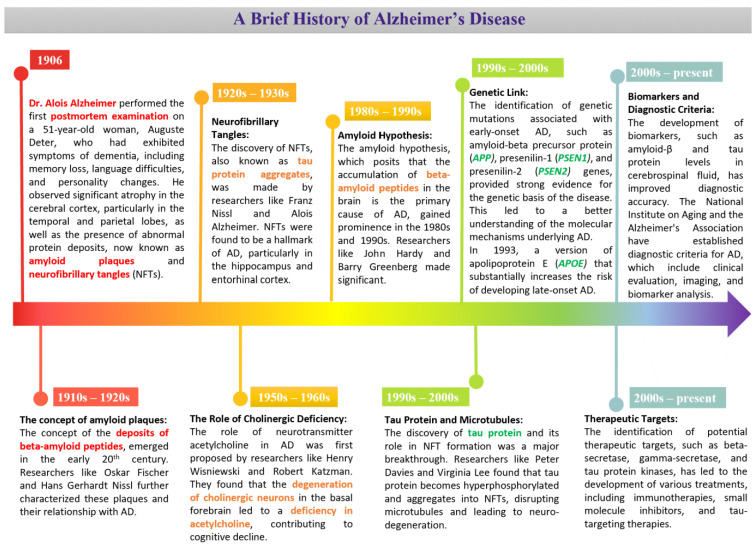
- Kiani, L., and Hodson, R. (2024, December 09). Nature Milestones. The History of Alzheimer’s Disease (1906–2024), Available online: https://www.nature.com/immersive/alzheimers-disease-history/index.html.
- 1973, A New Evolutionary Law, Evol. Theory, 1, 1
- Connor, R.F. (2024). Treatment of Alzheimer disease. UpToDate, Wolters Kluwer. Available online: https://www.uptodate.com/contents/treatment-of-alzheimer-disease?csi=34c234ee-1379-44b0-8d8f-998329f9c1a3&source=contentShare.
Cited by
Sorted by citations
Ren, F., Wei, J., Chen, Q., Hu, M., Yu, L., Mi, J., Zhou, X., Qin, D., Wu, J., & Wu, A. (2025) · Acta Pharmaceutica Sinica B · doi:10.1016/j.apsb.2025.07.030 · Cited by 97
Saad, A. M., Mohammed, D. M., Alkafaas, S. S., Ghosh, S. B., Negm, S. H., Salem, H. M., Fahmy, M. A., Semary, H. E., Ibrahim, E. H., AbuQamar, S. F., et al. (2025) · Frontiers in Immunology · doi:10.3389/fimmu.2025.1653378 · Cited by 106
Mao, Y., Zhang, L., Zhang, C., Qin, L., Liao, X., & Zhao, L. (2025) · Journal of Trace Elements in Medicine and Biology · doi:10.1016/j.jtemb.2025.127692 · Cited by 42
Bandara, E. M. S., Asih, P. R., Pedrini, S., Hone, E., Fernando, W. M. A. D. B., & Martins, R. N. (2025) · Molecular Neurobiology · doi:10.1007/s12035-025-05219-3 · Cited by 36
Diabetes, Alzheimer's Disease Risk Factors, and the Cafeteria Diet: A Comprehensive Review
Abubakar, M., Giri, A., Goel, F., Khan, M., Gupta, J., Kumar, D., Kaushik, M., Nand, S., & Kumar, N. (2025) · Current Neuropharmacology · doi:10.2174/011570159x384737250626094315 · Cited by 29
Suvish, Ghamari, M., & Sundaram, S. (2025) · Journal of Sensor and Actuator Networks · doi:10.3390/jsan14060112 · Cited by 10
Wang, Y., Wang, Z., Li, Y., Cao, M., Zhang, S., Ding, S., Chen, S., Jin, Y., Zhang, Y., Gao, J., et al. (2025) · Alzheimer s Research & Therapy · doi:10.1186/s13195-025-01797-5 · Cited by 4
Sbai, O., Chaure, A., Perrone, L., & Poucheret, P. (2026) · Nutrients · doi:10.3390/nu18111697 · Cited by 4
Unveiling the Polypharmacological Potency of FDA-Approved Rebamipide for Alzheimer’s Disease
Hakeem, I. J., Alahdal, H. M., Baeissa, H. M., Bakhsh, T., Rafeeq, M. M., Habib, A. H., Karami, M. M., Al-Ghamdi, M. A., Abdullah, G., & Tuwaijri, A. A. (2025) · Pharmaceuticals · doi:10.3390/ph18060772 · Cited by 1
Zeng, Z., Dai, M., Jing, Y., Zhao, K., Xu, X., Cheng, L., Huang, R., Song, C., He, J., You, Q., et al. (2025) · Journal of Alzheimer s Disease · doi:10.1177/13872877251393503 · Cited by 1
Monitoring neuronal mitophagy and locomotion deficits in a C. elegans model of Alzheimer’s disease
Niforos-Garcia, G., Tsakiri, E., & Palikaras, K. (2026) · Methods in cell biology · doi:10.1016/bs.mcb.2025.12.001 · Cited by 1
Zhang, H., Zeng, X., & Kong, X. (2026) · European journal of medical research · doi:10.1186/s40001-026-04128-y · Cited by 1
Advances in AI-based diagnosis of Alzheimer’s disease using MRI: a comprehensive survey
Raheem, H. I., López-Guede, J. M., Dara, O. A., Ramos-Hernanz, J. A., Aramendía, Í., & Teso-Fz-Betoño, D. (2026) · Frontiers in Medicine · doi:10.3389/fmed.2026.1767090 · Cited by 2
Zinc–Copper Imbalance and Lipid Peroxidation Mark Glycaemic Control in Type 2 Diabetes MellitusPreprint
Nwaejigh, P. C., Chima-Nwogwugwu, T. J., Odegbo, M. Y., & Udofia, S. S. (2025) · Research Square · doi:10.21203/rs.3.rs-6797345/v1
Ozone-induced Neurotoxicity: Mechanistic Insights and Implications for Neurodegenerative Diseases
Bjørklund, G., Gurgas, L., & Hangan, T. (2025) · Current Medicinal Chemistry · doi:10.2174/0109298673375058250624070823
PF-04691502, a PI3K/mTOR Dual Inhibitor, Ameliorates AD-like Pathology in a Mouse Model of AD
Lanza, M., Basilotta, R., Caccamo, A., Casili, G., Repici, A., Oddo, S., & Esposito, E. (2025) · Cells · doi:10.3390/cells14181474
Gene-Exercise Interactions in Amyloid Metabolism and Clearance: Implications for Alzheimer’s Disease
Astorino, M. F., Cipriano, G. L., Anchesi, I., Lui, M., Raffaele, I., Calabrò, M., & Crisafulli, C. (2025) · International Journal of Molecular Sciences · doi:10.3390/ijms26199816
Mohammadi, S., & Zarei, S. (2025) · Journal of Environmental Health Science and Engineering · doi:10.1007/s40201-025-00959-9
Kelley, A., Sackinger, E. D., Frischman, M., Thomas, N. O., Kim, K., Scuderi, G., Labut, E. M., MacMurchy, D., Ikea-Mario, T., Rauenhorst, J., et al. (2026) · bioRxiv (Cold Spring Harbor Laboratory) · doi:10.64898/2026.02.04.703883
Hakim, M. A., & Li, L. (2026) · Metabolites · doi:10.3390/metabo16030206
Farouk, Y., Nagy, N., Amir, A. M. E., Madbouly, N. A., & El-Khazragy, N. N. (2026) · Molecular Neurobiology · doi:10.1007/s12035-026-05789-w
Youssef, B., Ibrahim, E., Moselhy, S. S., ElShebiney, S. A., & ELabd, W. K. (2026) · Discover Nano · doi:10.1186/s11671-026-04506-9
Chan, B., Wong, S. T. C., & Qi, S. (2026) · IntechOpen eBooks · doi:10.5772/intechopen.1015702
Venkei, Z. G., & Savelieff, M. G. (2026) · Exploration of neuroscience · doi:10.37349/en.2026.1006139
Alzheimer’s Disease: Molecular Pathophysiology and Current Therapeutic Management
Shingade, S. S., Mandhare, T. A., Mujumale, J. S., Kashid, P., & Otari, K. V. (2026) · Biosciences Biotechnology Research Asia · doi:10.13005/bbra/3523
Kelley, A., Sackinger, E. D., Frischman, M., Thomas, N. O., Kim, K., Scuderi, G., Labut, E. M., MacMurchy, D., Ikea-Mario, T., Rauenhorst, J., et al. (2026) · Frontiers in Aging Neuroscience · doi:10.3389/fnagi.2026.1804332
Chen, J., & Zhang, Z. (2026) · Frontiers in Aging Neuroscience · doi:10.3389/fnagi.2026.1855269
Xu, Z., Yang, Y., Xiang, K., Zhuo, L., Fang, Z., Lin, X., Dai, C., Liu, J., Sun, J., & Tong, Q. (2026) · Neurotherapeutics · doi:10.1016/j.neurot.2026.e01047
Chang, H., Liu, Y., Yang, X., & Han, Y. (2026) · The FASEB Journal · doi:10.1096/fj.202504766r
New Alzheimer’s disease diagnostics and psychological clinical perspectives
Aversi, M. T. M., Freitas, P. M., & Aversi‐Ferreira, T. A. (2026) · Frontiers in Psychology · doi:10.3389/fpsyg.2026.1866853
Shehu, K., Onimisi, O. B., Bunza, H. A., Umar, S. M., Oyem, J. C., & Adeyeye, T. A. (2026) · Experimental Neurology · doi:10.1016/j.expneurol.2026.116029
Brenner, M., Sharma, A., & Wang, P. (2026) · Frontiers in Immunology · doi:10.3389/fimmu.2026.1961728
Molecular and genetic basis of alzheimer’s disease and emerging treatment Modalities
Varshney, H., & Siddique, Y. H. (2026) · Neurodegenerative Disease Management · doi:10.1080/17582024.2026.2739332
Epigenetics in Alzheimer’s disease: from molecular mechanisms to emerging novel biomarkers
D’Aversa, E., Grisafi, M., Pernagallo, S., Salvatori, F., Singh, A. V., Nucciarone, A., Tisato, V., & Gemmati, D. (2026) · Frontiers in Aging Neuroscience · doi:10.3389/fnagi.2026.1959361
Mishra, A. K., Singh, A., Kumar, A., Singh, H., Paliwal, S. K., Khan, G., Sharma, K., Chopra, H., & Anand, A. (2026) · Discover Molecules · doi:10.1007/s44345-026-00078-4
Metadata
- Authors
- Mertaş, B., & Boşgelmez, İ. İ.
- Affiliations
- Düzce Üniversitesi (TR)
- Erciyes University (TR)
- Corresponding author
- Boşgelmez, İ. İpek
- Venue
- International Journal of Molecular Sciences
- Publisher
- MDPI AG
- Published
- 2025-01-30
- Volume
- 26
- Issue
- 3
- Pages
- 1222
- ISSN
- 1422-0067 (ISSN-L)
- PMC
- PMC11818526
- OpenAlex
- W4406986281
- Cited by
- 35
- References
- 212
- Citations by year
- 2026: 21 · 2025: 14
- FWCI
- 6.26
- Type
- journal article
- Language
- en
- Open access
- gold
- doi.org
- Licence
- Locations
- International Journal of Molecular Sciences (publishedVersion, cc-by)
- PubMed Central (publishedVersion, cc-by)
- PubMed (publishedVersion)
- Erciyes University - AVESIS (submittedVersion)
- Topics
- Health Sciences › Medicine › Psychiatry and Mental health › Dementia and Cognitive Impairment Research
- Life Sciences › Neuroscience › Cellular and Molecular Neuroscience › Alzheimer's disease research and treatments
- Health Sciences › Medicine › Public Health, Environmental and Occupational Health › Nutritional Studies and Diet
- Keywords
- Alzheimer's disease, genetic risk factors, epigenetics, environmental risk factors, dietary factors, air pollution, toxic elements, pesticides, infectious agents, vitamin D deficiency, tobacco use, alcohol consumption, gut microbiota, dietary behavior, antibiotics, MIND diet, Mediterranean diet, DASH diet, dementia
- MeSH terms
- Gastrointestinal Microbiome, Alzheimer Disease, Animals, Diet, Environment, Environmental Exposure, Humans, Risk Factors, Genetic Predisposition to Disease, Diet, Mediterranean, Epigenesis, Genetic, Gene-Environment Interaction
About these checks
Registry, retraction, Cites and statistics results are computed, not judged, with one exception: a printed reference that no index lists is read once by a model before it counts as a citation error. Claims are extracted by a model and kept only when their quote appears verbatim in the text; each cited source is then checked, with a model’s help, for whether it says what the claim relies on. Those verdicts can be wrong — read the claim’s quote and the cited source before relying on one.
Statistics and arithmetic are recomputed, not judged.
Confidence bands are shown only for fields calibrated on our annotated test set. None is calibrated yet, so no band is shown.
What counts as a claim ›How we measure confidence ›How we check this ›
Are you an author, or do you see a problem with this page? Request a review
