

Evaluation of a Two-Tier Screening Pathway for Congenital Adrenal Hyperplasia in the New South Wales Newborn Screening Programme
Open accessThe DOI matches its Crossref record; 56 of the 57 references it cites were found in a registry or an index.
Abstract
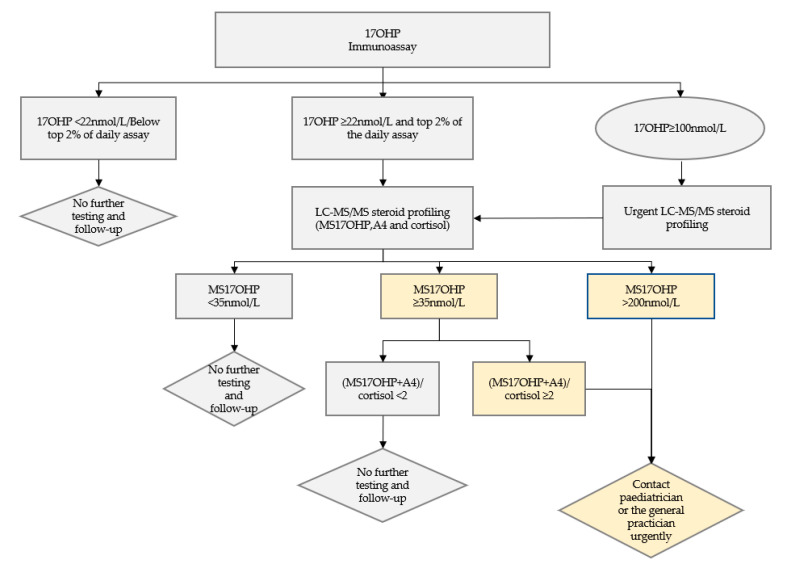
In Australia, all newborns born in New South Wales (NSW) and the Australia Capital Territory (ACT) have been offered screening for rare congenital conditions through the NSW Newborn Screening Programme since 1964. Following the development of the Australian Newborn Bloodspot Screening National Policy Framework, screening for congenital adrenal hyperplasia (CAH) was included in May 2018. As part of the assessment for addition of CAH, the national working group recommended a two-tier screening protocol determining 17α-hydroxyprogesterone (17OHP) concentration by immunoassay followed by steroid profile. A total of 202,960 newborns were screened from the 1 May 2018 to the 30 April 2020. A threshold level of 17OHP from first tier immunoassay over 22 nmol/L and/or top 2% of the daily assay was further tested using liquid chromatography tandem mass spectrometry (LC-MS/MS) steroid profiling for 17OHP (MS17OHP), androstenedione (A4) and cortisol. Samples with a ratio of (MS17OHP + A4)/cortisol > 2 and MS17OHP > 200 nmol/L were considered as presumptive positive. These newborns were referred for clinical review with a request for diagnostic testing and a confirmatory repeat dried blood spot (DBS). There were 10 newborns diagnosed with CAH, (9 newborns with salt wasting CAH). So far, no known false negatives have been notified, and the protocol has a sensitivity of 100%, specificity of 99.9% and a positive predictive value of 71.4%. All confirmed cases commenced treatment by day 11, with none reported as having an adrenal crisis by the start of treatment.
Overview
The claims and statistics of this paper haven’t been checked yet.
Free: it reads the open-access text and checks the first 5 claims that cite a source we can check. Create a free account to check every claim.
Integrity signals
Registry
Cites
Statistics
Figures
Verification
Claims the paper makes
The claims and statistics of this paper haven’t been checked yet.
Free: it reads the open-access text and checks the first 5 claims that cite a source we can check. Create a free account to check every claim.
Claims other papers make about this one
Each is checked against this paper’s own text: does it say what the citing paper says it does?
The cited source says what the claim attributes to it.
In the citing paper
“and both heel stick blood samples (266) and urine samples (267,268) can also be analyzed by mass spectrometric methods.”
From Congenital Adrenal Hyperplasia—Current Insights in Pathophysiology, Diagnostics, and Management (2022) · cites this paper as [268]
The cited source says what the claim attributes to it.
In the citing paper
“Steroids can be measured in blood, urine (268,305), saliva (388) and dried filter-paper blood samples (389,390) and fluctuate with both the circadian rhythm and the timing of glucocorticoid intake (298,391-393).”
From Congenital Adrenal Hyperplasia—Current Insights in Pathophysiology, Diagnostics, and Management (2022) · cites this paper as [268]
The check wasn’t confident either way, so it gives no verdict — never disputed.
In the citing paper
“Usually, a spot urine sample is sufficient for diagnosing an adrenal enzyme defect (268,294,295).”
From Congenital Adrenal Hyperplasia—Current Insights in Pathophysiology, Diagnostics, and Management (2022) · cites this paper as [268]
Experimental — accuracy not yet measured
Self-check
Percentages, sums and reported differences re-computed from the paper’s own numbers.
The self-check needs the paper’s full text.
Citations
Cites
Speiser, P. W., Azziz, R., Baskin, L. S., Ghizzoni, L., Hensle, T. W., Merke, D. P., Meyer-Bahlburg, H. F. L., Miller, W. L., Montori, V. M., Oberfield, S. E., et al. (2010) · The Journal of Clinical Endocrinology & Metabolism · doi:10.1210/jc.2009-2631 · Cited by 1,468
Congenital Adrenal Hyperplasia
(1987) · New England Journal of Medicine · doi:10.1056/nejm198711263172211 · Cited by 1,409
Congenital adrenal hyperplasia
Speiser, P. W., & White, P. C. (2003) · New England Journal of Medicine · doi:10.1056/nejmra021561 · Cited by 1,405
Global Disorders of Sex Development Update since 2006: Perceptions, Approach and Care
Lee, P. A., Nordenström, A., Houk, C. P., Ahmed, S. F., Auchus, R., Baratz, A., Baratz Dalke, K., Liao, L.-M., Lin-Su, K., Looijenga 3rd, L. H. J., et al. (2016) · Hormone Research in Paediatrics · doi:10.1159/000442975 · Cited by 1,273
Speiser, P. W., Arlt, W., Auchus, R. J., Baskin, L. S., Conway, G. S., Merke, D. P., Meyer-Bahlburg, H. F. L., Miller, W. L., Murad, M. H., Oberfield, S. E., et al. (2018) · The Journal of Clinical Endocrinology & Metabolism · doi:10.1210/jc.2018-01865 · Cited by 1,234 · cited 7×
“Following diagnostic sample results and clinical review, 10 were proven to have CAH with 9 SWCAH and 1 newborn classified SVCAH.”
InfluentialCongenital adrenal hyperplasia
El-Maouche, D., Arlt, W., & Merke, D. P. (2017) · The Lancet · doi:10.1016/s0140-6736(17)31431-9 · Cited by 669 · cited 1×
“SWCAH can present with a life-threatening adrenal crisis within the first two weeks of life [51].”
BackgroundPang, S., Wallace, M. A., Hofman, L., Thuline, H. C., Dorche, C., Lyon, I. C. T., Dobbins, R. H., Kling, S., Fujieda, K., & Suwa, S. (1988) · Journal of Urology · doi:10.1016/s0022-5347(17)42164-1 · Cited by 392 · cited 1×
“Reported observed incidence is highest in Yupik Eskimos from Southern Alaska at 1:282 [9].”
BackgroundPW, S., W, A., RJ, A., LS, B., GS, C., DP, M., HFL, M.-B., WL, M., MH, M., SE, O., et al. (2019) · Yearbook of Paediatric Endocrinology · doi:10.1530/ey.16.8.5 · Cited by 300
PANG, S., HOTCHKISS, J., DRASH, A. L., LEVINE, L. S., & NEW, M. I. (1977) · The Journal of Clinical Endocrinology & Metabolism · doi:10.1210/jcem-45-5-1003 · Cited by 293
Neonatal screening for congenital adrenal hyperplasia
White, P. C. (2009) · Nature Reviews Endocrinology · doi:10.1038/nrendo.2009.148 · Cited by 240
Cited by
Congenital Adrenal Hyperplasia—Current Insights in Pathophysiology, Diagnostics, and Management
Claahsen - van der Grinten, H. L., Speiser, P. W., Ahmed, S. F., Arlt, W., Auchus, R. J., Falhammar, H., Flück, C. E., Guasti, L., Huebner, A., Kortmann, B. B. M., et al. (2022) · Endocrine Reviews · doi:10.1210/endrev/bnab016 · Cited by 556
Therrell, B. L., Padilla, C. D., Borrajo, G. J. C., Khneisser, I., Schielen, P. C. J. I., Knight‐Madden, J., Malherbe, H. L., & Kase, M. (2024) · International Journal of Neonatal Screening · doi:10.3390/ijns10020038 · Cited by 205
Current and Novel Treatment Strategies in Children with Congenital Adrenal Hyperplasia
Nordenström, A., Falhammar, H., & Lajić, S. (2022) · Hormone Research in Paediatrics · doi:10.1159/000522260 · Cited by 41
Neonatal Screening for Congenital Adrenal Hyperplasia in Denmark: 10 Years of Experience
Lind‐Holst, M., Bækvad‐Hansen, M., Berglund, A., Cohen, A. S., Melgaard, L., Skogstrand, K., Dunø, M., Main, K. M., HOUGAARD, D. M., Gravholt, C. H., et al. (2022) · Hormone Research in Paediatrics · doi:10.1159/000522230 · Cited by 24
Grosse, S. D., & Vliet, G. V. (2020) · International Journal of Neonatal Screening · doi:10.3390/ijns6040082 · Cited by 22
Newborn Screening for CAH—Challenges and Opportunities
Heather, N. L., & Nordenström, A. (2021) · International Journal of Neonatal Screening · doi:10.3390/ijns7010011 · Cited by 21
“The results of the first 203,000 screened babies are reported here [11].”
Backgroundde Hora, M. R., Heather, N. L., WEBSTER, D. R., Albert, B. B., & Hofman, P. L. (2022) · International Journal of Neonatal Screening · doi:10.3390/ijns8040056 · Cited by 17
“Laboratories performing second-tier LCMSMS analysis have reported that the FP rate of NBS for CAH was reduced when the ratio (17OHP + A4)/F is applied in conjunction with 17OHP [6,10,11].”
MethodWatanabe, K., Tsuji‐Hosokawa, A., Hashimoto, A., Konishi, K., Ishige, N., Yajima, H., Sutani, A., Nakatani, H., Gau, M., Takasawa, K., et al. (2022) · The Journal of Clinical Endocrinology & Metabolism · doi:10.1210/clinem/dgac521 · Cited by 16
Graves, L. E., van Dijk, E. B., Zhu, E., Koyyalamudi, S. R., Wotton, T., Sung, D., Srinivasan, S., Ginn, S. L., & Alexander, I. E. (2024) · Molecular Therapy — Methods & Clinical Development · doi:10.1016/j.omtm.2024.101232 · Cited by 15
Greaves, R. F., Kumar, M., Mawad, N., Francescon, A., Le, X. C., O’Connell, M. A., Chi, J., & Pitt, J. J. (2023) · International Journal of Neonatal Screening · doi:10.3390/ijns9040058 · Cited by 13
de Hora, M. R., Heather, N. L., WEBSTER, D. R., Albert, B. B., & Hofman, P. L. (2023) · Frontiers in Endocrinology · doi:10.3389/fendo.2023.1226284 · Cited by 15
“Lai et al 2020 (28) 202,960 4218 12 17OHP (17OHP+A4)/F – 71.”
BackgroundVliet, G. V., & Grosse, S. D. (2021) · médecine/sciences · doi:10.1051/medsci/2021053 · Cited by 13
“For example, the New South Wales screening program in Australia recently reported a PPV of 71% for 17OHP immunoassay screening of specimens collected at 48-72 hours followed by steroid profiling using liquid chromatography tandem mass spectrometry of specimens in the top 2% of 17OHP values by birthweight as well as re…”
Tippabathani, J., Seenappa, V., Murugan, A., Phani, N. M., Hampe, M. H., Appaswamy, G., & Gambhir, P. S. (2023) · International Journal of Neonatal Screening · doi:10.3390/ijns9010009 · Cited by 13
International Newborn Screening Practices for the Early Detection of Congenital Adrenal Hyperplasia
Conlon, T. A., Hawkes, C. P., Brady, J. J., Loeber, J. G., & Murphy, N. (2023) · Hormone Research in Paediatrics · doi:10.1159/000530754 · Cited by 9
“Screening is now universally implemented in the USA [13], Australia [14, 15], and has been implemented (either as a pilot scheme or permanently) in at least 26 European countries [16] to date.”
BackgroundGenome editing in the adrenal gland: a novel strategy for treating congenital adrenal hyperplasia
van Dijk, E. B., Ginn, S. L., Alexander, I. E., & Graves, L. E. (2024) · Exploration of Endocrine and Metabolic Diseases · doi:10.37349/eemd.2024.00011 · Cited by 8
Saltarelli, M. A., Ferrante, R., Marcello, F. D., David, D., Valentinuzzi, S., Pilenzi, L., Federici, L., Rossi, C., Stuppia, L., & Tumini, S. (2022) · International Journal of Environmental Research and Public Health · doi:10.3390/ijerph19116880 · Cited by 5
“The major reservations not to include CAH in NBS programs are related to the high false positive rates generated from immunoassay in low-birth-weight premature infants [4].”
BackgroundHe, Z., Dai, H., Shen, J., Huang, Y., Liu, J., Yan, R., Zhang, F., & Yan, S. (2024) · Analytical and Bioanalytical Chemistry · doi:10.1007/s00216-024-05411-9 · Cited by 5
Eitel, K. B., & Fechner, P. Y. (2025) · The Journal of Clinical Endocrinology & Metabolism · doi:10.1210/clinem/dgae710 · Cited by 8
de Hora, M. R., Thorstensen, E. B., Heather, N. L., Albert, B. B., WEBSTER, D. R., & Hofman, P. L. (2025) · The Journal of Clinical Endocrinology & Metabolism · doi:10.1210/clinem/dgaf402 · Cited by 5
Tajima, T. (2024) · Clinical Pediatric Endocrinology · doi:10.1297/cpe.2024-0069 · Cited by 5
Neonatal Screening for Congenital Adrenal Hyperplasia in Guangzhou: 7 Years of Experience
Jia, X., Xie, T., Jiang, X., Tang, F., Tan, M., Chen, Q., Liu, S., Huang, Y., & Li, T. (2025) · International Journal of Neonatal Screening · doi:10.3390/ijns11040116 · Cited by 3
The presentation of congenital adrenal hyperplasia in an unscreened population
Conlon, T. A., Hawkes, C. P., Brady, J. J., & Murphy, N. (2021) · Journal of Pediatric Endocrinology and Metabolism · doi:10.1515/jpem-2021-0123 · Cited by 4
Yamano, H., Watanabe, K., Komatsu, M., Hashimoto, A., Suzuki, Y. Y., Kirino, S., Saito, Y., Adachi, E., Gau, M., Nakatani, H., et al. (2025) · The Journal of Clinical Endocrinology & Metabolism · doi:10.1210/clinem/dgaf506 · Cited by 2
Metabolomics used in clinical diagnosis related to newborn screening
Rahman, M., & Ramaswamy, M. (2023) · Elsevier eBooks · doi:10.1016/b978-0-323-99924-3.00007-8 · Cited by 5
Lawrence, S. E., Marcadier, J., Auger, S., Bariciak, E., Chakraborty, P. K., Chambers, A., Eagle, S., Kowalskil, M., Marr, A., McIntosh, N., et al. (2025) · Journal of the Endocrine Society · doi:10.1210/jendso/bvaf157 · Cited by 2
“The use of steroid ratios can further improve screening metrics, with published ratios including: (17-OHP + andro-stenedione)/cortisol [2-5]; (17-OHP + 21-deoxycortisol)/ cortisol [6]; and 17-OHP/11-deoxycortisol [7].”
Houang, M., Nguyen‐Khoa, T., Eguether, T., Ribault, B., Brabant, S., Polak, M., Netchine, I., & Lamazière, A. (2022) · Endocrine Connections · doi:10.1530/ec-22-0101 · Cited by 6
Congenital adrenal hyperplasia: The importance of screening and clinical assessment
Rodrigues, F., & Zacharin, M. (2022) · Journal of Paediatrics and Child Health · doi:10.1111/jpc.16225
Honour, J. W. (2023) · Elsevier eBooks · doi:10.1016/b978-0-12-818124-9.00004-8
David, J., Hrubá, Z., Vinohradská, H., Hedelová, M., Fialová, A., & Votava, F. (2024) · Experimental and Clinical Endocrinology & Diabetes · doi:10.1055/a-2433-0891 · Cited by 1
“In Australia no known false negatives were notified, and the protocol has a reported sensitivity of 100 % and specificity of 99.9 % [11].”
InfluentialA Two-Step LC-MS/MS method to differentiate 21OHD and PORD in Screen-Positive newborns
Nakatani, H., Watanabe, K., Tsuji‐Hosokawa, A., Sutani, A., Saito, Y., Kirino, S., Yamano, H., Orimoto, R., Gau, M., Yogi, A., et al. (2026) · Endocrine · doi:10.1007/s12020-026-04573-z
Antysheva, Z., Bogdanov, V. P., Rutkovskaya, E. A., Stepanova, A., Esibov, A. A., Krupinova, J., Shchekina, V. S., Avsievich, E., Tatyana, F., Bazarova, E., et al. (2026) · International Journal of Molecular Sciences · doi:10.3390/ijms27156938
“A second test is often made to confirm the diagnosis and increase positive predictive value, and confirmation with different 17-OHP measurement strategies is discussed as well [4,5].”
Tuli, G., Munarin, J., Pavanello, E., & SANCTIS, L. D. (2026) · Endocrine · doi:10.1007/s12020-026-04759-5
“These observations have driven the development of accumulating evidence suggesting that the timing and repetition of sample collection may be at least as critical as the analytical method itself [16, 17, 37, 38, 40 – 44, 47, 57, 69].”
Metadata
- Authors
- Lai, F., Srinivasan, S., & Wiley, V.
- Affiliations
- The University of Sydney (AU)
- Corresponding author
- Lai, Fei
- ORCID
- Srinivasan, Shubha
- Venue
- International Journal of Neonatal Screening
- Publisher
- MDPI AG
- Published
- 2020-08-12
- Volume
- 6
- Issue
- 3
- Pages
- 63
- ISSN
- 2409-515X (ISSN-L)
- PMC
- PMC7569785
- OpenAlex
- W3048462612
- Cited by
- 32
- References
- 57
- Citations by year
- 2026: 3 · 2025: 5 · 2024: 6 · 2023: 6 · 2022: 7 · 2021: 4 · 2020: 1
- FWCI
- 1.46
- Type
- journal article
- Language
- en
- Open access
- gold
- doi.org
- Licence
- Locations
- International Journal of Neonatal Screening (publishedVersion, cc-by)
- PubMed Central (publishedVersion, cc-by)
- PubMed (publishedVersion)
- DOAJ (DOAJ: Directory of Open Access Journals) (submittedVersion, cc-by-sa)
- Topics
- Health Sciences › Medicine › Endocrinology, Diabetes and Metabolism › Sexual Differentiation and Disorders
- Life Sciences › Biochemistry, Genetics and Molecular Biology › Clinical Biochemistry › Metabolism and Genetic Disorders
- Health Sciences › Medicine › Endocrinology, Diabetes and Metabolism › Adrenal Hormones and Disorders
- Keywords
- congenital adrenal hyperplasia, newborn screening, 17-hydroxyprogesterone, dried blood spots, steroid profile, salt-wasting CAH, screening sensitivity and specificity, positive predictive value, adrenal crisis
About these checks
Registry, retraction, Cites and statistics results are computed, not judged, with one exception: a printed reference that no index lists is read once by a model before it counts as a citation error. Claims are extracted by a model and kept only when their quote appears verbatim in the text; each cited source is then checked, with a model’s help, for whether it says what the claim relies on. Those verdicts can be wrong — read the claim’s quote and the cited source before relying on one.
Statistics and arithmetic are recomputed, not judged.
Confidence bands are shown only for fields calibrated on our annotated test set. None is calibrated yet, so no band is shown.
What counts as a claim ›How we measure confidence ›How we check this ›
Are you an author, or do you see a problem with this page? Request a review
Data sources
Bibliographic data: Semantic Scholar, OpenAlex, Crossref.
Contains information from the Semantic Scholar Academic Graph Datasets, made available under the ODC Attribution License (ODC-BY 1.0).
Semantic Scholar’s data is described in: Kinney, R., et al. (2023). The Semantic Scholar Open Data Platform. arXiv:2301.10140.
