

The DOI matches its Crossref record; 129 of the 162 references it cites were found in a registry or an index, and 33 are not checked yet; 18 of the 107 sources its claims cite were checked for support.
Congenital adrenal hyperplasia
Open accessAbstract
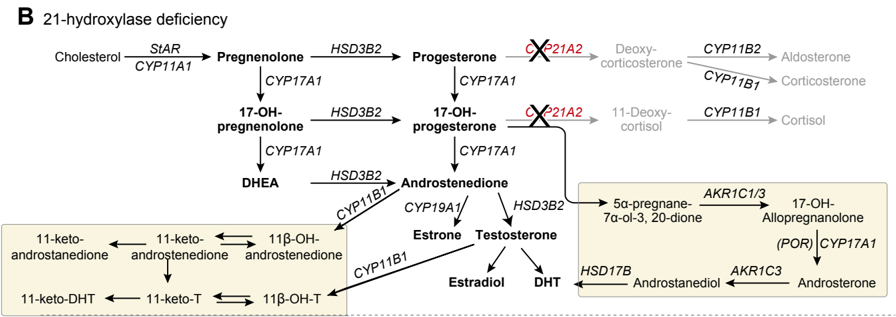
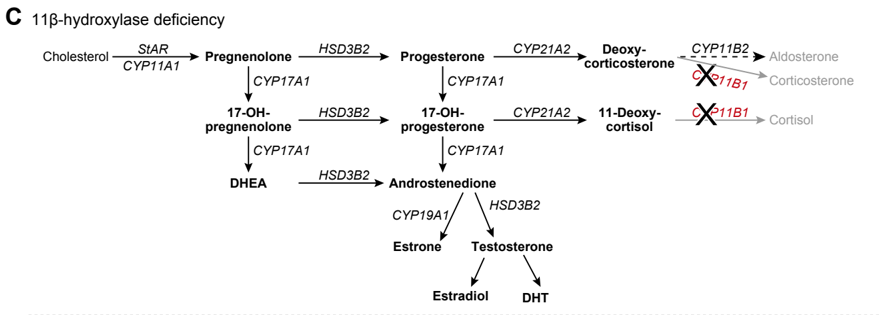
Congenital adrenal hyperplasia is a group of autosomal recessive disorders encompassing enzyme deficiencies in the adrenal steroidogenesis pathway that lead to impaired cortisol biosynthesis. Depending on the type and severity of steroid block, patients can have various alterations in glucocorticoid, mineralocorticoid, and sex steroid production that require hormone replacement therapy. Presentations vary from neonatal salt wasting and atypical genitalia, to adult presentation of hirsutism and irregular menses. Screening of neonates with elevated 17-hydroxyprogesterone concentrations for classic (severe) 21-hydroxylase deficiency, the most common type of congenital adrenal hyperplasia, is in place in many countries, however cosyntropin stimulation testing might be needed to confirm the diagnosis or establish non-classic (milder) subtypes. Challenges in the treatment of congenital adrenal hyperplasia include avoidance of glucocorticoid overtreatment and control of sex hormone imbalances. Long-term complications include abnormal growth and development, adverse effects on bone and the cardiovascular system, and infertility. Novel treatments aim to reduce glucocorticoid exposure, improve excess hormone control, and mimic physiological hormone patterns.
Verified 2026-10-06 · 33 references not checked yet
Overview
CoChat Summary
TL;DR
Congenital adrenal hyperplasia (CAH) is a group of rare autosomal recessive disorders of cortisol biosynthesis, most commonly caused by 21-hydroxylase deficiency, leading to glucocorticoid/mineralocorticoid deficiency and androgen excess. This Lancet seminar reviews genetics, pathophysiology, diagnosis, management, long-term complications, and emerging therapies.
Key findings
- CAH comprises seven autosomal recessive enzyme defects; over 95% is due to 21-hydroxylase deficiency. Classic 21OH deficiency incidence is 1:10,000 to 1:20,000, while nonclassic is about 1:1,000. Neonatal screening is performed in over 40 countries, including all 50 US states since 2009, but not yet in the UK.
- Diagnosis of 21OH deficiency relies on 17OHP: neonatal screening uses dried blood spots; after infancy, early morning 17OHP above 1,000 ng/dL (30 nmol/L) is diagnostic, and less than 200 ng/dL (6 nmol/L) usually excludes nonclassic CAH if measured in the follicular phase. Cosyntropin stimulation is often needed for nonclassic diagnosis.
- Management centers on chronic glucocorticoid therapy, fludrocortisone for salt-wasting forms, stress-dose glucocorticoids, and sex steroid replacement in rare forms; anti-hypertensives may be needed in 11βOH and 17OH deficiency. Genital surgery, prenatal dexamethasone, and bilateral adrenalectomy remain controversial.
- Long-term complications include short stature (meta-analysis of 35 studies: average final height 1.38 SD below population norm in classic 21OH deficiency), excess mortality from adrenal crises in a Swedish cohort of 588 patients, testicular adrenal rest tissue in 44–94% of men and 21–33% of boys with classic 21OH deficiency, and low BMD prevalence of 37–81%. Emerging therapies include Chronocort in 16 patients, a CRF1 antagonist lowering ACTH/17OHP in 6 of 8 females, abiraterone normalizing androstenedione in 5 of 6 women, and anti-androgen/aromatase inhibition with reduced hydrocortisone normalizing growth over 2 years in 28 prepubertal children.
Methods
- Narrative review/Lancet Seminar; no systematic search strategy, formal quality appraisal, or meta-analysis methods are described.
- Synthesizes literature, clinical practice guidelines, cohort studies, trials, and case reports across the seven main forms of CAH: 21OH, 11βOH, 17OH, 3βHSD2, POR, lipoid CAH/StAR, and SCC/CYP11A1 deficiency.
- Reports selected quantitative data from cited studies, including incidences, hormone cutoffs, cohort prevalences, and early-phase trial results, but presents no primary data collection or original analysis.
Limitations
- Stated: long-term effects of prenatal dexamethasone exposure are unknown; genital surgery outcomes are imperfect, and newer surgical approaches lack long enough follow-up to assess outcomes.
- Stated: bilateral adrenalectomy carries increased adrenal crisis risk and about one-third develop adrenal rest tissue if glucocorticoid dose is too low; many novel therapies are early-phase or small studies.
- Evident: as a narrative seminar, it lacks systematic search and formal evidence grading, relying on cited literature and expert synthesis; some statements, such as screening implementation status, are time-sensitive.
Model-written summary. Check it against the paper before relying on it.
Integrity signals
Registry
Cites
Statistics
Figures



Verification
Claims the paper makes
8 Valid · 7 Not valid · 58 Not checked · 21 Own results and interpretations
At least one cited source doesn’t support this claim or points to a different paper, and none confirmed it — see the verdicts below.
In the paper
“Most patients are compound heterozygotes, meaning they have different mutations in the two alleles.”
§ Congenital Adrenal Hyperplasia: The Lancet Seminar Series > Genetics and Pathophysiology of the Various Forms of CAH
What the sources say
- Not checked yetcites [24]
- Disputedcites [25] sourceExperimental — accuracy not yet measured
The Results report the opposite pattern in this study’s children with primary adrenal insufficiency: 62 of 77 were homozygous, and only one was compound heterozygous. The cohort is not a survey of CAH patients generally, so these figures do not establish the frequency in CAH; they contradict the claim if it is attributed to this study’s patients. (LLM, conf=0.84)
Checked by a reasoning model — may be wrong.
plain- Asserted: passes — The authors put it forward as true.
- Checkable: passes — It can be checked against evidence.
- Load-bearing: unclear — It is unclear whether the paper’s conclusions depend on it.
- Based: passes — The paper gives a reason why it holds.
The cited sources that could be checked couldn’t confirm or dispute this claim.
In the paper
“A meta-analysis of 35 studies of classic 21OH deficiency showed an average final height of 1.38 standard deviations below the population norm.72”
§ Congenital Adrenal Hyperplasia: The Lancet Seminar Series > Long-term Complications
What the sources say
- Could not verifycites [72] sourceExperimental — accuracy not yet measured
The 46,XX DSD section discusses 21-hydroxylase deficiency and gender-related outcomes, but does not report final height. Searches for the 35-study meta-analysis, final height, and 1.38 standard deviations found no passage addressing the claimed result in our copy. (LLM, conf=0.74)
plain- Asserted: passes — The authors put it forward as true.
- Checkable: passes — It can be checked against evidence.
- Load-bearing: unclear — It is unclear whether the paper’s conclusions depend on it.
- Based: passes — The paper gives a reason why it holds.
- Could not verify
The cited sources that could be checked couldn’t confirm or dispute this claim.
In the paper
“Mineralocorticoid, in the form of fludrocortisone, is given to achieve a plasma renin activity in the normal range in the salt-wasting forms of CAH (Panel) 20 .”
§ Congenital Adrenal Hyperplasia: The Lancet Seminar Series > Mineralocorticoid replacement
What the sources say
- Could not verifycites [20] sourceExperimental — accuracy not yet measured
The introductory discussion of 11β-hydroxylase deficiency (p. 5463) says patients may develop salt loss during glucocorticoid replacement therapy. Our copy does not state that fludrocortisone is given for salt-wasting CAH or that treatment aims to normalize plasma renin activity; searches for those terms and mineralocorticoid treatment found no such passage. (LLM, conf=0.75)
plainstates a cause- Asserted: passes — The authors put it forward as true.
- Checkable: passes — It can be checked against evidence.
- Load-bearing: passes — The paper’s conclusions depend on it.
- Based: passes — The paper gives a reason why it holds.
- Could not verify
The cited sources that could be checked couldn’t confirm or dispute this claim.
In the paper
“A level of less than 200 ng/dL (6 nmol/L) usually excludes nonclassic CAH if measured during the follicular phase of a reproductive-age woman.64”
§ Congenital Adrenal Hyperplasia: The Lancet Seminar Series > Screening for 21OH deficiency after infancy relies on measuring early morning (before 8 am)
What the sources say
- Could not verifycites [64] sourceExperimental — accuracy not yet measured
The Patients section gives a diagnostic criterion of post-ACTH 17OHP above 10 ng/mL, and Hormone determinations says hormone levels were measured during the follicular phase. Neither passage addresses whether a basal 17OHP level below 200 ng/dL usually excludes nonclassic CAH; searches for that threshold and screening rule found no such passage in our copy. (LLM, conf=0.73)
hedged- Asserted: passes — The authors put it forward as true.
- Checkable: passes — It can be checked against evidence.
- Load-bearing: unclear — It is unclear whether the paper’s conclusions depend on it.
- Based: passes — The paper gives a reason why it holds.
- Could not verify
The cited sources that could be checked couldn’t confirm or dispute this claim.
In the paper
“Cell-free fetal DNA obtained from the mother's plasma as early as 5 weeks gestation has correctly identified fetal CAH status in 14 families.85”
§ Congenital Adrenal Hyperplasia: The Lancet Seminar Series > Prenatal treatment
What the sources say
- Could not verifycites [85] sourceExperimental — accuracy not yet measured
The Background and Case presentation (pages unavailable) discuss CAH and one patient’s diagnosis and fertility treatment, not prenatal testing with maternal plasma. Searches for cell-free fetal DNA, testing at five weeks, and results in 14 families found no passage addressing the claim. (LLM, conf=0.76)
plainstates a causen = 14- Asserted: passes — The authors put it forward as true.
- Checkable: passes — It can be checked against evidence.
- Load-bearing: passes — The paper’s conclusions depend on it.
- Based: passes — The paper gives a reason why it holds.
- Could not verify
41 more claims · 3 with their cited sources checked
Create a free account to see all 94 claims and to verify the 89 references still open.
- Probably not a substantial claim. 8
- It may state two separate claims as one. 43
Claims other papers make about this one
Each is checked against this paper’s own text: does it say what the citing paper says it does?
The cited source says what the claim attributes to it.
In the citing paper
“More than 90% of CAH cases are caused by mutant 21-hydroxylase (CYP21A2) (10), a key enzyme in glucocorticoid and mineralocorticoid biosynthesis (Fig. 1);”
From Steroid Metabolome Analysis in Disorders of Adrenal Steroid Biosynthesis and Metabolism (2019) · cites this paper as [10]
In the citing paper
“The variants of congenital adrenal hyperplasia (CAH) comprise five autosomal recessive inborn disorders defined by glucocorticoid deficiency resulting from inactivating mutations in enzymes involved in adrenal steroidogenesis (10).”
From Steroid Metabolome Analysis in Disorders of Adrenal Steroid Biosynthesis and Metabolism (2019) · cites this paper as [10]
Self-check
Percentages, sums and reported differences re-computed from the paper’s own numbers.
Each contradiction between two passages listed here was confirmed by an independent check.
Rated minor: it would not touch a result — a value no result rests on, a p-value that stays on the same side of the significance level, or a conflict that is clerical, resolved elsewhere in the paper, or outside its own findings.
In the paper
§ Congenital Adrenal Hyperplasia: The Lancet Seminar Series > References
“21OH=12-hydroxylase.”
§ Congenital Adrenal Hyperplasia: The Lancet Seminar Series > Introduction
“21-hydroxylase (21OH)”
Citations
Cites
1 retracted
Wallensteen, L., Zimmermann, M., Sandberg, M. T., Gezelius, A., Nordenström, A., Hirvikoski, T., & Lajić, S. (2016) · Hormones and Behavior · doi:10.1016/j.yhbeh.2016.06.011 · Cited by 6
RetractedThe Molecular Biology, Biochemistry, and Physiology of Human Steroidogenesis and Its Disorders
Miller, W. L., & Auchus, R. J. (2011) · Endocrine Reviews · doi:10.1210/er.2010-0013 · Cited by 2,458
Bornstein, S. R., Allolio, B., Arlt, W., Barthel, A., Don-Wauchope, A., Hammer, G. D., Husebye, E. S., Merke, D. P., Murad, M. H., Stratakis, C. A., et al. (2016) · The Journal of Clinical Endocrinology & Metabolism · doi:10.1210/jc.2015-1710 · Cited by 1,769
Self-citationSpeiser, P. W., Azziz, R., Baskin, L. S., Ghizzoni, L., Hensle, T. W., Merke, D. P., Meyer-Bahlburg, H. F. L., Miller, W. L., Montori, V. M., Oberfield, S. E., et al. (2010) · The Journal of Clinical Endocrinology & Metabolism · doi:10.1210/jc.2009-2631 · Cited by 1,468
Self-citationCongenital Adrenal Hyperplasia
(1987) · New England Journal of Medicine · doi:10.1056/nejm198711263172211 · Cited by 1,409
Congenital adrenal hyperplasia
Speiser, P. W., & White, P. C. (2003) · New England Journal of Medicine · doi:10.1056/nejmra021561 · Cited by 1,405
Role of steroidogenic acute regulatory protein in adrenal and gonadal steroidogenesis
Lin, D., Sugawara, T., Strauss, J. F., Clark, B. J., Stocco, D. M., Saenger, P., Rogol, A., & Miller, W. L. (1995) · Science · doi:10.1126/science.7892608 · Cited by 1,030
The pathophysiology and genetics of congenital lipoid adrenal hyperplasia
Bose, H. S., Sugawara, T., Strauss, J. F., & Miller, W. L. (1996) · New England Journal of Medicine · doi:10.1056/nejm199612193352503 · Cited by 676
Genotyping steroid 21-hydroxylase deficiency: hormonal reference data
NEW, M. I., LORENZEN, F., LERNER, A. J., KOHN, B., OBERFIELD, S. E., POLLACK, M. S., DUPONT, B., STONER, E., LEVY, D. J., PANG, S., et al. (1983) · The Journal of Clinical Endocrinology & Metabolism · doi:10.1210/jcem-57-2-320 · Cited by 624
17-Hydroxylation deficiency in man
Biglieri, E. G., Herron, M. A., & Brust, N. (1966) · Journal of Clinical Investigation · doi:10.1172/jci105499 · Cited by 561 · cited 7×
“Molecular endocrinology (Baltimore, Md) 1988; 2(6): 564-70.”
Influential
Research works printed but not linked: 1
- White, 1994, Disorders of steroid 11 beta-hydroxylase isozymes, Endocr Rev, 15, 421
Cited by
The Molecular Biology, Biochemistry, and Physiology of Human Steroidogenesis and Its Disorders
Miller, W. L., & Auchus, R. J. (2011) · Endocrine Reviews · doi:10.1210/er.2010-0013 · Cited by 2,458
Circulating Testosterone as the Hormonal Basis of Sex Differences in Athletic Performance
Handelsman, D. J., Hirschberg, A. L., & Bermon, S. (2018) · Endocrine Reviews · doi:10.1210/er.2018-00020 · Cited by 594
Congenital Adrenal Hyperplasia—Current Insights in Pathophysiology, Diagnostics, and Management
Claahsen - van der Grinten, H. L., Speiser, P. W., Ahmed, S. F., Arlt, W., Auchus, R. J., Falhammar, H., Flück, C. E., Guasti, L., Huebner, A., Kortmann, B. B. M., et al. (2022) · Endocrine Reviews · doi:10.1210/endrev/bnab016 · Cited by 556
Self-citationHealth status of adults with congenital adrenal hyperplasia: a cohort study of 203 patients
Arlt, W., Willis, D. S., Wild, S. H., Krone, N., Doherty, E. J., Hahner, S., Han, T. S., Carroll, P. V., Conway, G. S., Rees, D. A., et al. (2010) · The Journal of Clinical Endocrinology & Metabolism · doi:10.1210/jc.2010-0917 · Cited by 506
Self-citationHypokalemia: a clinical update
Kardalas, E., Paschou, S. A., Anagnostis, P., Muscogiuri, G., Siasos, G., & Vryonidou, A. (2018) · Endocrine Connections · doi:10.1530/ec-18-0109 · Cited by 362
Metadata
- Authors
- El-Maouche, D., Arlt, W., & Merke, D. P.
- Affiliations
- University of Birmingham (GB)
- Eunice Kennedy Shriver National Institute of Child Health and Human Development (US)
- Corresponding author
- Merke, Deborah P
- Venue
- The Lancet
- Publisher
- Elsevier BV
- Published
- 2017-11
- Volume
- 390
- Issue
- 10108
- Pages
- 2194-2210
- ISSN
- 0099-5355 (ISSN-L)
- 0140-6736
- OpenAlex
- W2103673171
- Semantic Scholar
- bc74f5f4130d1014de0433f4792f449968364c4c
- Cited by
- 669
- References
- 162
- Citations by year
- 2026: 31 · 2025: 43 · 2024: 92 · 2023: 89 · 2022: 85 · 2021: 91 · 2020: 66 · 2019: 58 · 2018: 46 · 2017: 20
- FWCI
- 4.87
- Type
- journal article
- Language
- en
- Open access
- Licence
- cc-by-nc-nd
- www.elsevier.com/tdm/userlicense/1.0/ (tdm)
- Locations
- The Lancet (publishedVersion)
- PubMed (publishedVersion)
- University of Birmingham Research Portal (University of Birmingham) (submittedVersion, cc-by-nc-nd)
- Topics
- Health Sciences › Medicine › Endocrinology, Diabetes and Metabolism › Sexual Differentiation and Disorders
- Health Sciences › Medicine › Endocrinology, Diabetes and Metabolism › Adrenal Hormones and Disorders
- Life Sciences › Biochemistry, Genetics and Molecular Biology › Clinical Biochemistry › Metabolism and Genetic Disorders
- Keywords
- congenital adrenal hyperplasia, 21-hydroxylase deficiency, adrenal steroidogenesis, cortisol production, hormone replacement therapy, newborn screening, 17-hydroxyprogesterone, ACTH stimulation test, salt wasting, ambiguous genitalia, hirsutism, infertility, sex hormone imbalance, late complications
- MeSH terms
- Adrenal Hyperplasia, Congenital, Combined Modality Therapy, Dose-Response Relationship, Drug, Female, Follow-Up Studies, Glucocorticoids, Humans, Infant, Newborn, Male, Severity of Illness Index, Neonatal Screening, Treatment Outcome, Risk Assessment, Genetic Predisposition to Disease, Hormone Replacement Therapy, Rare Diseases
About these checks
Registry, retraction, Cites and statistics results are computed, not judged, with one exception: a printed reference that no index lists is read once by a model before it counts as a citation error. Claims are extracted by a model and kept only when their quote appears verbatim in the text; each cited source is then checked, with a model’s help, for whether it says what the claim relies on. Those verdicts can be wrong — read the claim’s quote and the cited source before relying on one.
The claim verdicts this report counts are experimental: their accuracy is not yet measured.
A language model drew the claims from the paper on 2026-10-06, under version 3 of the claim definition (model deepseek-v4.1-flash, prompt extract-v3).
A second model labelled each claim on 2026-10-06 (model jev-1.13-20260917, definition revision gold-guideline-v0.2).
Cited sources are checked with a language model’s help (gpt-6-sol).
Statistics and arithmetic are recomputed, not judged.
Confidence bands are shown only for fields calibrated on our annotated test set. None is calibrated yet, so no band is shown.
What counts as a claim ›How we measure confidence ›How we check this ›
Are you an author, or do you see a problem with this page? Request a review
How to cite
Cite CoChat for the checks on this page, and the paper for its own findings.
- This page
- CoChat. (2026). Citation check: Congenital adrenal hyperplasia. https://app.cochat.ai/papers/10.1016/s0140-6736(17)31431-9
- The paper
- El-Maouche, D., Arlt, W., & Merke, D. P. (2017). Congenital adrenal hyperplasia. The Lancet. https://doi.org/10.1016/s0140-6736(17)31431-9
Data sources
Bibliographic data: Semantic Scholar, OpenAlex, Crossref.
Contains information from the Semantic Scholar Academic Graph Datasets, made available under the ODC Attribution License (ODC-BY 1.0).
Semantic Scholar’s data is described in: Kinney, R., et al. (2023). The Semantic Scholar Open Data Platform. arXiv:2301.10140.
