

The DOI matches its Crossref record; 80 of the 82 references it cites were found in a registry or an index.
Diabetes Insipidus after Traumatic Brain Injury
Open accessAbstract
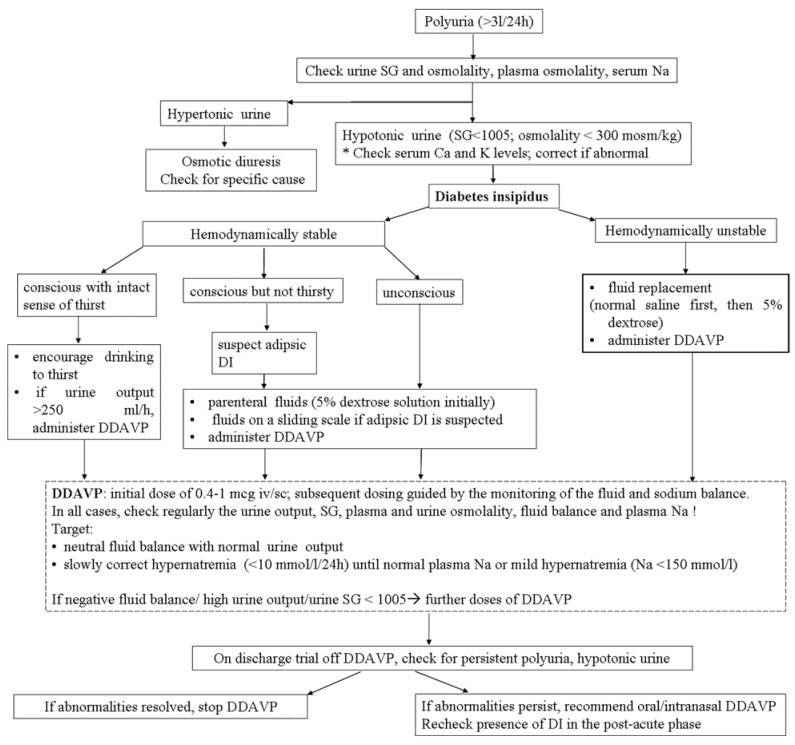
Traumatic brain injury (TBI) is a significant cause of morbidity and mortality in many age groups. Neuroendocrine dysfunction has been recognized as a consequence of TBI and consists of both anterior and posterior pituitary insufficiency; water and electrolyte abnormalities (diabetes insipidus (DI) and the syndrome of inappropriate antidiuretic hormone secretion (SIADH)) are amongst the most challenging sequelae. The acute head trauma can lead (directly or indirectly) to dysfunction of the hypothalamic neurons secreting antidiuretic hormone (ADH) or of the posterior pituitary gland causing post-traumatic DI (PTDI). PTDI is usually diagnosed in the first days after the trauma presenting with hypotonic polyuria. Frequently, the poor general status of most patients prevents adequate fluid intake to compensate the losses and severe dehydration and hypernatremia occur. Management consists of careful monitoring of fluid balance and hormonal replacement. PTDI is associated with high mortality, particularly when presenting very early following the injury. In many surviving patients, the PTDI is transient, lasting a few days to a few weeks and in a minority of cases, it is permanent requiring management similar to that offered to patients with non-traumatic central DI.
Overview
The claims and statistics of this paper haven’t been checked yet.
Run the check — free, no account needed. It reads the open-access text and checks the sources it cites.
Integrity signals
Registry
Cites
Statistics
Figures
Verification
Claims the paper makes
The claims and statistics of this paper haven’t been checked yet.
Run the check — free, no account needed. It reads the open-access text and checks the sources it cites.
Claims other papers make about this one
Each is checked against this paper’s own text: does it say what the citing paper says it does?
The cited source says what the claim attributes to it.
In the citing paper
“The 'triphasic response,' in which transient DI is followed by transient SIADH with some patients then progressing to persistent central DI, has been occasionally described after TBI [15, 16].”
From Neuroendocrine Disruptions Following Head Injury (2023) · cites this paper as [15]
Self-check
Percentages, sums and reported differences re-computed from the paper’s own numbers.
The self-check needs the paper’s full text.
Citations
Cites
ASSESSMENT OF COMA AND IMPAIRED CONSCIOUSNESS
Teasdale, G., & Jennett, B. (1974) · The Lancet · doi:10.1016/s0140-6736(74)91639-0 · Cited by 13,215
Family history of subarachnoid haemorrhage: supplemental value of scrutinizing all relatives.
Greebe, P., Bromberg, J. E. C., Rinkel, G. J. E., Algra, A., & van Gijn, J. (1997) · Journal of Neurology Neurosurgery & Psychiatry · doi:10.1136/jnnp.62.3.273 · Cited by 4,137
Classification of traumatic brain injury for targeted therapies
Saatman, K. E., Duhaime, A.-C., Bullock, R., Maas, A. I. R., Valadka, A., & Manley, G. T. (2008) · Journal of Neurotrauma · doi:10.1089/neu.2008.0586 · Cited by 1,141
Adrogué, H. J., & Madias, N. E. (2000) · New England Journal of Medicine · doi:10.1056/nejm200005183422006 · Cited by 902
Incidence of Traumatic Brain Injury in the United States, 2003
Rutland-Brown, W., Langlois, J. A., Thomas, K. E., & Xi, Y. L. (2006) · Journal of Head Trauma Rehabilitation · doi:10.1097/00001199-200611000-00009 · Cited by 836
Surveillance for traumatic brain injury-related deaths--United States, 1997-2007.
Coronado, V. G., Xu, L., Basavaraju, S. V., McGuire, L. C., Wald, M. M., Faul, M. D., Guzman, B. R., & Hemphill, J. D. (2011) · PubMed · Cited by 721
Holbourn, A. (1943) · The Lancet · doi:10.1016/s0140-6736(00)87453-x · Cited by 681
Disorders of Plasma Sodium — Causes, Consequences, and Correction
Sterns, R. H. (2014) · New England Journal of Medicine · doi:10.1056/nejmra1404489 · Cited by 643
Zaloshnja, E., Miller, T. R., Langlois, J. A., & Selassie, A. W. (2008) · Journal of Head Trauma Rehabilitation · doi:10.1097/01.htr.0000341435.52004.ac · Cited by 609
Central Diabetes Insipidus in Children and Young Adults
Maghnie, M., Cosi, G., Genovese, E. A., Bitti, M. L. M., Cohen, A., Zecca, S., Tinelli, C., Gallucci, M., Bernasconi, S., Boscherini, B., et al. (2000) · New England Journal of Medicine · doi:10.1056/nejm200010053431403 · Cited by 473
Hypopituitarism Secondary to Head Trauma
Benvenga, S. (2000) · Journal of Clinical Endocrinology & Metabolism · doi:10.1210/jc.85.4.1353 · Cited by 423
Residual pituitary function after brain injury-induced hypopituitarism: a prospective 12-month study
Aimaretti, G., Ambrosio, M. R., Di Somma, C., Gasperi, M., Cannavò, S., Scaroni, C., Fusco, A., Del Monte, P., De Menis, E., Faustini-Fustini, M., et al. (2005) · The Journal of Clinical Endocrinology & Metabolism · doi:10.1210/jc.2005-0504 · Cited by 370
Critical care management of severe traumatic brain injury in adults
Haddad, S. H., & Arabi, Y. M. (2012) · Scandinavian Journal of Trauma Resuscitation and Emergency Medicine · doi:10.1186/1757-7241-20-12 · Cited by 341
Neurogenic disorders of osmoregulation
Robertson, G. L., Aycinena, P., & Zerbe, R. L. (1982) · The American Journal of Medicine · doi:10.1016/0002-9343(82)90825-7 · Cited by 329
Treschan, T. A., Peters, J., & Warltier, D. C. (2006) · Anesthesiology · doi:10.1097/00000542-200609000-00026 · Cited by 320
Copeptin and Arginine Vasopressin Concentrations in Critically Ill Patients
Jochberger, S., Morgenthaler, N. G., Mayr, V. D., Luckner, G., Wenzel, V., Ulmer, H., Schwarz, S., Hasibeder, W. R., Friesenecker, B. E., & Dünser, M. W. (2006) · The Journal of Clinical Endocrinology & Metabolism · doi:10.1210/jc.2005-2830 · Cited by 271
Posterior pituitary dysfunction after traumatic brain injury
Agha, A., Thornton, E., O’Kelly, P., Tormey, W., Phillips, J., & Thompson, C. J. (2004) · The Journal of Clinical Endocrinology & Metabolism · doi:10.1210/jc.2004-1058 · Cited by 269
Hensen, J., Henig, A., Fahlbusch, R., Meyer, M. F., Boehnert, M. U., & Buchfelder, M. (1999) · Clinical Endocrinology · doi:10.1046/j.1365-2265.1999.00666.x · Cited by 266
Hypernatremia in critically ill patients
Lindner, G., & Funk, G. (2012) · Journal of Critical Care · doi:10.1016/j.jcrc.2012.05.001 · Cited by 262
Prevalence of Neuroendocrine Dysfunction in Patients Recovering from Traumatic Brain Injury
Lieberman, S. A. (2001) · Journal of Clinical Endocrinology & Metabolism · doi:10.1210/jc.86.6.2752 · Cited by 261
Fluid thresholds and outcome from severe brain injury*
Clifton, G. L., Miller, E. R., Choi, S. C., & Levin, H. S. (2002) · Critical Care Medicine · doi:10.1097/00003246-200204000-00003 · Cited by 260
Zerbe, R. L., & Robertson, G. L. (1981) · New England Journal of Medicine · doi:10.1056/nejm198112243052601 · Cited by 259
Wood, P. (1980) · PubMed · Cited by 247
Traumatic brain injury: intensive care management
Helmy, A. E., Vizcaychipi, M. P., & Gupta, A. K. (2007) · British Journal of Anaesthesia · doi:10.1093/bja/aem139 · Cited by 221
Leal‐Cerro, A., Flores, J. M., Rincon, M., Murillo, F., Pujol, M., Garcia‐Pesquera, F., Dieguez, C., & Casanueva, F. F. (2005) · Clinical Endocrinology · doi:10.1111/j.1365-2265.2005.02250.x · Cited by 199
Hannon, M. J., Crowley, R. K., Behan, L. A., O'Sullivan, E. P., O'Brien, M. M. C., Sherlock, M., Rawluk, D., O'Dwyer, R., Tormey, W., & Thompson, C. J. (2013) · The Journal of Clinical Endocrinology & Metabolism · doi:10.1210/jc.2013-1555 · Cited by 184
The natural history of post-traumatic neurohypophysial dysfunction
Agha, A., Sherlock, M., Phillips, J., Tormey, W., & Thompson, C. J. (2005) · European Journal of Endocrinology · doi:10.1530/eje.1.01861 · Cited by 178
Prevalence and predictive factors of post-traumatic hypopituitarism
Klose, M., Juul, A., Poulsgaard, L., Kosteljanetz, M., Brennum, J., & Feldt‐Rasmussen, U. (2007) · Clinical Endocrinology · doi:10.1111/j.1365-2265.2007.02860.x · Cited by 176
Disorders of Water Homeostasis in Neurosurgical Patients
Hannon, M. J., Finucane, F. M., Sherlock, M., Agha, A., & Thompson, C. J. (2012) · The Journal of Clinical Endocrinology & Metabolism · doi:10.1210/jc.2011-3201 · Cited by 155
Disturbances of Sodium in Critically Ill Adult Neurologic Patients
Tisdall, M. M., Crocker, M., Watkiss, J., & Smith, M. (2005) · Journal of Neurosurgical Anesthesiology · doi:10.1097/01.ana.0000191280.05170.0f · Cited by 152
Anterior pituitary dysfunction following traumatic brain injury (TBI)
Agha, A., & Thompson, C. J. (2006) · Clinical Endocrinology · doi:10.1111/j.1365-2265.2006.02517.x · Cited by 142
Clinical insights into adipsic diabetes insipidus: a large case series
Crowley, R. K., Sherlock, M., Agha, A., Smith, D., & Thompson, C. J. (2007) · Clinical Endocrinology · doi:10.1111/j.1365-2265.2007.02754.x · Cited by 123
Maggiore, U., Picetti, E., Antonucci, E., Parenti, E., Regolisti, G., Mergoni, M., Vezzani, A., Cabassi, A., & Fiaccadori, E. (2009) · Critical Care · doi:10.1186/cc7953 · Cited by 114
Morbidity and mortality in patients with craniopharyngioma after surgery
Crowley, R. K., Hamnvik, O. P., O’Sullivan, E. P., Behan, L. A., Smith, D., Agha, A., & Thompson, C. J. (2010) · Clinical Endocrinology · doi:10.1111/j.1365-2265.2010.03838.x · Cited by 108
Endocrine failure after traumatic brain injury in adults
Powner, D. J., Boccalandro, C., Alp, M. S., & Vollmer, D. G. (2006) · Neurocritical Care · doi:10.1385/ncc:5:1:61 · Cited by 105
Mira, K., Morgenthaler, N. G., Dixit, K., Rutishauser, J., Brabant, G. E., Müller-Stich, B. P., & Christ‐Crain, M. (2007) · The Journal of Clinical Endocrinology & Metabolism · doi:10.1210/jc.2006-2046 · Cited by 105
Treatment of Neurohypophyseal Diabetes Insipidus
Oiso, Y., Robertson, G. L., Nørgaard, J. P., & Juul, K. V. (2013) · The Journal of Clinical Endocrinology & Metabolism · doi:10.1210/jc.2013-2326 · Cited by 101
PREDICTORS AND INCIDENCE OF CENTRAL DIABETES INSIPIDUS AFTER ENDOSCOPIC PITUITARY SURGERY
Sigounas, D. G., Sharpless, J. L., Cheng, D. M. L., Johnson, T. G., Senior, B. A., & Ewend, M. G. (2008) · Neurosurgery · doi:10.1227/01.neu.0000311063.10745.d8 · Cited by 98
Magnetic resonance imaging changes in the pituitary gland following acute traumatic brain injury
Maiya, B., Newcombe, V., Nortje, J., Bradley, P., Bernard, F., Chatfield, D., Outtrim, J., Hutchinson, P., Matta, B., Antoun, N., et al. (2008) · Intensive Care Medicine · doi:10.1007/s00134-007-0902-x · Cited by 91
Acute Diabetes Insipidus in Severe Head Injury: A Prospective Study
Hadjizacharia, P., Beale, E. O., Inaba, K., Chan, L. S., & Demetriades, D. (2008) · Journal of the American College of Surgeons · doi:10.1016/j.jamcollsurg.2008.04.017 · Cited by 90
Clinical review: Practical approach to hyponatraemia and hypernatraemia in critically ill patients
Overgaard‐Steensen, C., & Ring, T. (2012) · Critical Care · doi:10.1186/cc11805 · Cited by 87
(1991) · PubMed · Cited by 85
Diabetes insipidus in the head-injured patient
Boughey, J. C., Yost, M. J., & Bynoe, R. P. (2004) · The American Surgeon · doi:10.1177/000313480407000607 · Cited by 76
Kleindienst, A., Brabant, G., Bock, C., Maser-Gluth, C., & Buchfelder, M. (2009) · Journal of Neurotrauma · doi:10.1089/neu.2008.0601 · Cited by 76
Lam, K. S. L., Wat, M. S., CHOI, K. L., Ip, T., Pang, R. W. C., & Kumana, C. R. (1996) · British Journal of Clinical Pharmacology · doi:10.1046/j.1365-2125.1996.39914.x · Cited by 72
Harper, C. G., Doyle, D., Adams, J. H., & Graham, D. I. (1986) · Journal of Clinical Pathology · doi:10.1136/jcp.39.7.769 · Cited by 72
Hypopituitarism induced by traumatic brain injury in the transition phase
Aimaretti, G., Ambrosio, M. R., Di Somma, C., Gasperi, M., Cannavò, S., Scaroni, C., De Marinis, L., Baldelli, R., Bona, G., Giordano, G., et al. (2005) · Journal of Endocrinological Investigation · doi:10.1007/bf03345336 · Cited by 70
Rembratt, Å., Graugaard-Jensen, C. H., Senderovitz, T., Norgaard, J., & Djurhuus, J. (2004) · European Journal of Clinical Pharmacology · doi:10.1007/s00228-004-0781-9 · Cited by 70
Endocrine changes in brain death and transplantation
Ranasinghe, A. M., & Bonser, R. S. (2011) · Best Practice & Research Clinical Endocrinology & Metabolism · doi:10.1016/j.beem.2011.03.003 · Cited by 62
DIABETES INSIPIDUS FOLLOWING CLOSED HEAD INJURY
Porter, R. J., & Miller, R. A. (1948) · Journal of Neurology Neurosurgery & Psychiatry · doi:10.1136/jnnp.11.4.258 · Cited by 61
Østerberg, O., Savić, R. M., Karlsson, M. O., Simonsson, U. S. H., Nørgaard, J. P., Walle, J. V., & Agersø, H. (2006) · The Journal of Clinical Pharmacology · doi:10.1177/0091270006291838 · Cited by 59
Sodium and Fluid Management in Acute Brain Injury
Wright, W. L. (2012) · Current Neurology and Neuroscience Reports · doi:10.1007/s11910-012-0284-5 · Cited by 57
Roguski, M., Morel, B. C., Sweeney, M., Talan, J., Rideout, L., Riesenburger, R. I., Madan, N., & Hwang, S. W.-H. (2015) · Journal of Neurosurgery Pediatrics · doi:10.3171/2014.10.peds14128 · Cited by 51
Kleindienst, A., Brabant, G. E., Morgenthaler, N. G., Dixit, K., Parsch, H., & Buchfelder, M. (2009) · Acta neurochirurgica. Supplementum · doi:10.1007/978-3-211-98811-4_41 · Cited by 46
Arima, H., Oiso, Y., Juul, K. V., & Nørgaard, J. P. (2013) · Endocrine Journal · doi:10.1507/endocrj.ej13-0165 · Cited by 45
MR Imaging of Central Diabetes Insipidus: A Pictorial Essay
Shin, J. H., Lee, H. K., Choi, C. G., Suh, D. C., Kim, C. J., Hong, S. K., & Na, D. G. (2001) · Korean Journal of Radiology · doi:10.3348/kjr.2001.2.4.222 · Cited by 45
Alharfi, I. M., Stewart, T. C., Kelly, S. H., Morrison, G. C., & Fraser, D. D. (2012) · Journal of Neurotrauma · doi:10.1089/neu.2012.2410 · Cited by 43
NEUROHYPOPHYSEAL PEPTIDE FUNCTION DURING EARLY POSTOPERATIVE DIABETES INSIPIDUS
Seckl, J. R., Dunger, D. B., & Lightman, S. L. (1987) · Brain · doi:10.1093/brain/110.3.737 · Cited by 40
Diabetes Insipidus: A Challenging Diagnosis with New Drug Therapies
Saifan, C., Nasr, R., Mehta, S. J., Acharya, P. S., Perrera, I., Faddoul, G., Nalluri, N., Kesavan, M., Azzi, Y. A., & El‐Sayegh, S. (2013) · ISRN Nephrology · doi:10.5402/2013/797620 · Cited by 39
Combined Central Diabetes Insipidus and Cerebral Salt Wasting Syndrome in Children
Lin, J., Lin, K., Hsia, S., Wu, C., & Wang, H.-S. (2009) · Pediatric Neurology · doi:10.1016/j.pediatrneurol.2008.09.010 · Cited by 34
Disorders of sodium balance after brain injury
Bradshaw, K., & Smith, M. A. (2008) · Continuing Education in Anaesthesia Critical Care & Pain · doi:10.1093/bjaceaccp/mkn019 · Cited by 33
King, B., Gupta, R., & Narayan, R. (2000) · Surgical Clinics of North America · doi:10.1016/s0039-6109(05)70100-6 · Cited by 32
Home sodium monitoring in patients with diabetes insipidus
Green, R. P., & Landt, M. (2002) · The Journal of Pediatrics · doi:10.1067/mpd.2002.128544 · Cited by 30
Tsagarakis, S., Tzanela, M., & Dimopoulou, I. (2005) · Pituitary · doi:10.1007/s11102-006-6049-x · Cited by 30
John, C. A., & Day, M. W. (2012) · Critical Care Nurse · doi:10.4037/ccn2012904 · Cited by 30
Moritz, M. L., & Ayus, J. C. (2015) · New England Journal of Medicine · doi:10.1056/nejmc1501342 · Cited by 28
Antibodies to Vasopressin in Patients with Diabetes Insipidus
Vokes, T., GASKILL, M. B., & Robertson, G. L. (1988) · Annals of Internal Medicine · doi:10.7326/0003-4819-108-2-190 · Cited by 26
Desmopressin duration of antidiuretic action in patients with central diabetes insipidus
Juul, K. V., Bichet, D. G., & Nørgaard, J. P. (2011) · Endocrine · doi:10.1007/s12020-011-9492-z · Cited by 26
Hypothalamic and pituitary injury.
Treip, C. S. (1970) · Journal of Clinical Pathology · doi:10.1136/jcp.s3-4.1.178 · Cited by 25
Unusual delayed onset of diabetes insipidus following closed head trauma
Hadani, M., Findler, G., Shared, I., & Sahar, A. (1985) · Journal of neurosurgery · doi:10.3171/jns.1985.63.3.0456 · Cited by 22
Posterior pituitary hematoma in a case of posttraumatic diabetes insipidus
Kawai, K., Aoki, M., Nakayama, H., Kobayashi, K., Sano, K., & Tamura, A. (1995) · Journal of neurosurgery · doi:10.3171/jns.1995.83.2.0368 · Cited by 17
Central Diabetes Insipidus in Children With Acute Brain Insult
Yang, Y.-H., Lin, J., Hsia, S., Wu, C., Wang, H.-S., Hung, P., Chou, M.-L., Hsieh, M.-Y., & Lin, K. (2011) · Pediatric Neurology · doi:10.1016/j.pediatrneurol.2011.09.002 · Cited by 17
Treatment of Endocrine Disorders in the Neuroscience Intensive Care Unit
Hwang, J. J., & Hwang, D. Y. (2014) · Current Treatment Options in Neurology · doi:10.1007/s11940-013-0271-4 · Cited by 17
Post-traumatic anterior and posterior pituitary dysfunction.
Su, D., Chang, Y.-C., & Chang, C.-C. (2005) · PubMed · Cited by 16
Alaca, R., Yılmaz, B., & Gündüz, Ş. (2002) · American Journal of Physical Medicine & Rehabilitation · doi:10.1097/00002060-200210000-00013 · Cited by 15
Post-traumatic diabetes insipidus combined with primary polydipsia
Labib, M., McPhate, G., & Marks, V. (1987) · Postgraduate Medical Journal · doi:10.1136/pgmj.63.735.33 · Cited by 15
Permanent central diabetes insipidus after mild traumatic brain injury
Chou, Y., Wang, T.-Y., Yang, P.-Y., Meng, N., & Chou, L. (2009) · Brain Injury · doi:10.3109/02699050903379396 · Cited by 12
Water Metabolism and Postconcussional Symptoms 5 Weeks after Mild Head Injury
Bohnen, N. I., Twijnstra, A., & JOLLES, J. (2008) · European Neurology · doi:10.1159/000116907 · Cited by 9
Karali, V., Massa, E. C. D., Vassiliadou, G. I., Chouris, I., Rodin, I., & Bitzani, M. (2008) · Critical Care · doi:10.1186/cc6351 · Cited by 7
Diabetes insipidus after traumata of two extremes in severity
Yoshida, J., Shiroozu, A., Zaitsu, A., Imazono, Y., Kohrogi, T., Yokohata, K., & Kishikawa, H. (1990) · Yonsei Medical Journal · doi:10.3349/ymj.1990.31.1.71 · Cited by 4
Research works printed but not linked: 1
- Cyran, 1918, Hypophysenschaedigung durch schaedelbasisfraktur, Deutsch Med. Wochenschr., 44, 1261
Cited by
Sorted by citations
Diabetes insipidus: The other diabetes
Malve, H., Kalra, S., Zargar, A., Jain, S., Sethi, B. K., Chowdhury, S., Singh, A., Thomas, N., Unnikrishnan, A., & Thakkar, P. (2015) · Indian Journal of Endocrinology and Metabolism · doi:10.4103/2230-8210.172273 · Cited by 95
Posterior pituitary dysfunction following traumatic brain injury: review
Tudor, R. M., & Thompson, C. J. (2018) · Pituitary · doi:10.1007/s11102-018-0917-z · Cited by 62
Christ‐Crain, M., & Gaisl, O. (2021) · La Presse Médicale · doi:10.1016/j.lpm.2021.104093 · Cited by 55
Making sense of gut feelings in the traumatic brain injury pathogenesis
Royes, L. F. F., & Gómez‐Pinilla, F. (2019) · Neuroscience & Biobehavioral Reviews · doi:10.1016/j.neubiorev.2019.05.012 · Cited by 55
Tsai, H., Chao, A., & Hsiao, W.-L. (2022) · Intensive and Critical Care Nursing · doi:10.1016/j.iccn.2022.103359 · Cited by 44
Metadata
- Authors
- Capatina, C., Paluzzi, A., Mitchell, R., & Karavitaki, N.
- Affiliations
- Carol Davila University of Medicine and Pharmacy (RO)
- University Hospitals Birmingham NHS Foundation Trust (GB)
- University of Birmingham (GB)
- Corresponding author
- Karavitaki, Niki
- Venue
- Journal of Clinical Medicine
- Publisher
- MDPI AG
- Published
- 2015-07-13
- Volume
- 4
- Issue
- 7
- Pages
- 1448-1462
- ISSN
- 2077-0383 (ISSN-L)
- PMC
- PMC4519799
- OpenAlex
- W2137669373
- Cited by
- 120
- References
- 82
- Citations by year
- 2026: 7 · 2025: 17 · 2024: 10 · 2023: 8 · 2022: 13 · 2021: 9 · 2020: 14 · 2019: 16 · 2018: 15 · 2017: 5 · 2016: 4 · 2015: 2
- FWCI
- 1.54
- Type
- journal article
- Language
- en
- Open access
- gold
- dx.doi.org
- Licence
- Locations
- Journal of Clinical Medicine (publishedVersion, cc-by)
- Europe PMC (PubMed Central) (publishedVersion, cc-by)
- PubMed Central (publishedVersion, cc-by)
- PubMed (publishedVersion)
- DOAJ (DOAJ: Directory of Open Access Journals) (submittedVersion, cc-by-sa)
- University of Birmingham Research Portal (University of Birmingham) (submittedVersion, cc-by)
- Topics
- Health Sciences › Medicine › Nephrology › Electrolyte and hormonal disorders
- Health Sciences › Medicine › Clinical Neurology › Traumatic Brain Injury and Neurovascular Disturbances
- Health Sciences › Medicine › Endocrinology, Diabetes and Metabolism › Pituitary Gland Disorders and Treatments
- Keywords
- diabetes insipidus, traumatic brain injury, post-traumatic diabetes insipidus, vasopressin, posterior pituitary dysfunction, hypothalamic dysfunction, syndrome of inappropriate antidiuretic hormone secretion, polyuria, dehydration, hypernatremia, fluid balance, neuroendocrine dysfunction
About these checks
Registry, retraction, Cites and statistics results are computed, not judged, with one exception: a printed reference that no index lists is read once by a model before it counts as a citation error. Claims are extracted by a model and kept only when their quote appears verbatim in the text; each cited source is then checked, with a model’s help, for whether it says what the claim relies on. Those verdicts can be wrong — read the claim’s quote and the cited source before relying on one.
Statistics and arithmetic are recomputed, not judged.
Confidence bands are shown only for fields calibrated on our annotated test set. None is calibrated yet, so no band is shown.
What counts as a claim ›How we measure confidence ›How we check this ›
Are you an author, or do you see a problem with this page? Request a review
