

Association between Thyroid-Stimulating Hormone Level after Total Thyroidectomy and Hypercholesterolemia in Female Patients with Differentiated Thyroid Cancer: A Retrospective Study
Open accessThe DOI matches its Crossref record; 32 of the 32 references it cites were found in a registry or an index.
Abstract
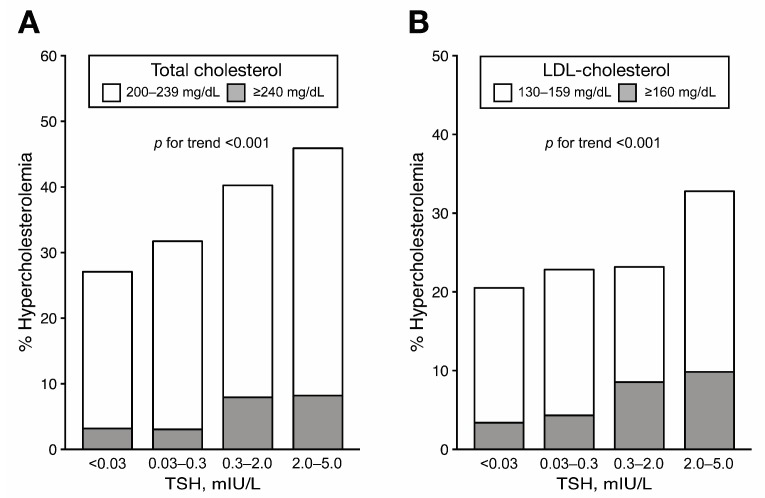
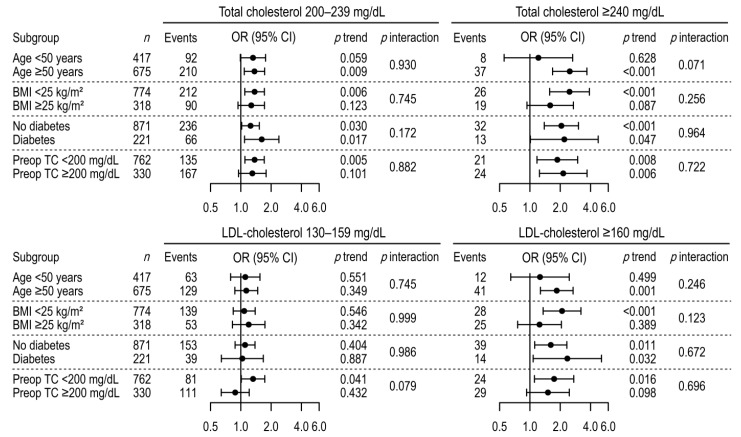
Less-intense TSH suppression strategies can be used for differentiated thyroid cancer (DTC) patients with a low recurrence risk, but their metabolic outcomes are not well known. We aimed to evaluate changes in the serum cholesterol levels and the risk of hypercholesterolemia according to postoperative TSH levels in 1092 female DTC patients receiving levothyroxine after total thyroidectomy. The preoperative-to-follow-up change in total cholesterol (TC) levels in the TSH level <0.03, 0.03–0.3, 0.3–2, and 2–5 mIU/L groups was −3.69 mg/dL (p = 0.006), +0.13 mg/dL (p = 0.926), +12.46 mg/dL (p < 0.001), and +16.46 mg/dL (p < 0.001), respectively. When compared with TSH levels of 0.03–0.3 mIU/L, those of 0.3–2 mIU/L were found to be associated with hypercholesterolemia (adjusted odds ratio (AOR) = 1.86 and 5.08 for TC 200–240 and ≥240 vs. <200 mg/dL) and hyper-low-density lipoprotein (LDL)-cholesterolemia (AOR = 2.76 for LDL-cholesterol ≥160 vs. <130 mg/dL). Additionally, TSH levels of 2–5 mIU/dL were associated with hypercholesterolemia (AOR = 2.85 and 6.95 for TC 200–240 and ≥240 vs. <200 mg/dL) and hyper-LDL-cholesterolemia (AOR = 2.08 and 4.17 for LDL-cholesterol 130–159 and ≥160 mg/dL vs. <130 mg/dL). In patients with normal TSH level maintenance following thyroidectomy, TC levels markedly increased, resulting in an increased hypercholesterolemia prevalence. Metabolic derangement risk due to insufficient levothyroxine replacement should be considered in the adoption of less-intense TSH suppression strategies, postoperatively, in DTC patients.
Overview
The claims and statistics of this paper haven’t been checked yet.
Free: it reads the open-access text and checks the first 5 claims that cite a source we can check. Create a free account to check every claim.
Integrity signals
Registry
Cites
Statistics
Figures

Verification
Claims the paper makes
The claims and statistics of this paper haven’t been checked yet.
Free: it reads the open-access text and checks the first 5 claims that cite a source we can check. Create a free account to check every claim.
Claims other papers make about this one
Each is checked against this paper’s own text: does it say what the citing paper says it does?
The source backs part of the claim, not all of it — or backs it for a different population, condition or comparison.
In the citing paper
“While LT4 therapy is very effective in normalizing serum TSH levels, it fails to restore euthyroidism in some tissues based on an array of metabolic parameters such as serum cholesterol levels and other biomarkers that remain abnormal in LT4treated patients, despite a normal serum TSH [14-16].”
From Evidence-Based Use of Levothyroxine/Liothyronine Combinations in Treating Hypothyroidism: A Consensus Document (2021) · cites this paper as [15]
Experimental — accuracy not yet measuredThe cited source says what the claim attributes to it.
In the citing paper
“While LT4 therapy is very effective in normalizing serum TSH levels, it fails to restore euthyroidism in some tissues based on an array of metabolic parameters such as serum cholesterol levels and other biomarkers that remain abnormal in LT4-treated patients, despite a normal serum TSH (14–16).”
From Evidence-Based Use of Levothyroxine/Liothyronine Combinations in Treating Hypothyroidism: A Consensus Document (2021) · cites this paper as [15]
The cited source says what the claim attributes to it.
In the citing paper
“have higher serum cholesterol and low density lipoprotein levels (19–21)”
From Liothyronine and Desiccated Thyroid Extract in the Treatment of Hypothyroidism (2020) · cites this paper as [20]
Self-check
Percentages, sums and reported differences re-computed from the paper’s own numbers.
The self-check needs the paper’s full text.
Citations
Cites
Friedewald, W. T., Levy, R. I., & Fredrickson, D. S. (1972) · Clinical Chemistry · doi:10.1093/clinchem/18.6.499 · Cited by 32,423 · cited 1×
“Low-density lipoprotein (LDL)-cholesterol levels were calculated using the Friedewald formula [9].”
MethodHaugen, B. R., Alexander, E. K., Bible, K. C., Doherty, G. M., Mandel, S. J., Nikiforov, Y. E., Pacini, F., Randolph, G. W., Sawka, A. M., Schlumberger, M., et al. (2016) · Thyroid® · doi:10.1089/thy.2015.0020 · Cited by 16,535
Detection, evaluation, and treatment of high blood cholesterol in adults (Adult Treatment Panel III)
Grundy, S. M., Becker, D. M., Clark, L. T., Cooper, R., Denke, M. A., Howard, J. L., Hunninghake, D. B., Illingworth, D. R., Luepker, R. V., McBride, P. E., et al. (2002) · Civil War Book Review · Cited by 12,198
Antihyperlipidemic and Biochemical Activities of Mcy Protein in Streptozotocin Induced Diabetic Rats
Marella, S., Maddirela, D. R., Badri, K. R., Jyothi Kumar, M. V., & Chippada, A. (2015) · Cellular Physiology and Biochemistry · doi:10.1159/000373954 · Cited by 5,938
Ross, D. S., Burch, H. B., Cooper, D. S., Greenlee, M. C., Laurberg, P., Maia, A. L., Rivkees, S. A., Samuels, M., Sosa, J. A., Stan, M. N., et al. (2016) · Thyroid® · doi:10.1089/thy.2016.0229 · Cited by 2,938
The Global Burden of Cancer 2013
Fitzmaurice, C., Dicker, D., Pain, A., Hamavid, H., Moradi-Lakeh, M., MacIntyre, M. F., Allen, C., Hansen, G., Woodbrook, R., Wolfe, C., et al. (2015) · JAMA Oncology · doi:10.1001/jamaoncol.2015.0735 · Cited by 2,707
Laboratory Support for the Diagnosis and Monitoring of Thyroid Disease
(2003) · Thyroid · doi:10.1089/105072503321086962 · Cited by 1,212
Flynn, R. W., Bonellie, S. R., Jung, R. T., MacDonald, T. M., Morris, A. D., & Leese, G. P. (2010) · The Journal of Clinical Endocrinology & Metabolism · doi:10.1210/jc.2009-1625 · Cited by 415 · cited 1×
“However, unlike the results in subclinical hyperthyroidism, the occurrence rate of adverse cardiovascular outcomes is not known to increase when thyroidectomized patients or those receiving levothyroxine therapy have mildly suppressed TSH levels [20,21].”
BackgroundLevothyroxine Monotherapy Cannot Guarantee Euthyroidism in All Athyreotic Patients
Gullo, D., Latina, A., Frasca, F., Le Moli, R., Pellegriti, G., & Vigneri, R. (2011) · PLoS ONE · doi:10.1371/journal.pone.0022552 · Cited by 307 · cited 1×
“In the previous studies, thyroidectomized patients had lower TSH levels when their free T3 levels are similar to those at the preoperative stage or those of controls with normal thyroid function [7,8,14,15].”
Background
Cited by
Jonklaas, J., Bianco, A. C., Cappola, A. R., Celi, F. S., Fliers, E., Heuer, H., McAninch, E. A., Moeller, L. C., Nygaard, B., Sawka, A. M., et al. (2021) · Thyroid® · doi:10.1089/thy.2020.0720 · Cited by 172
Jonklaas, J., Bianco, A. C., Cappola, A. R., Celi, F. S., Fliers, E., Heuer, H., McAninch, E. A., Moeller, L. C., Nygaard, B., Sawka, A. M., et al. (2021) · European Thyroid Journal · doi:10.1159/000512970 · Cited by 78
Individualized Therapy for Hypothyroidism: Is T4 Enough for Everyone?
Ettleson, M. D., & Bianco, A. C. (2020) · The Journal of Clinical Endocrinology & Metabolism · doi:10.1210/clinem/dgaa430 · Cited by 75
Liothyronine and Desiccated Thyroid Extract in the Treatment of Hypothyroidism
Idrees, T., Palmer, S., Maciel, R. M. B., & Bianco, A. C. (2020) · Thyroid® · doi:10.1089/thy.2020.0153 · Cited by 58
di Mauro, G., Zinzi, A., Scavone, C., Mascolo, A., Gaio, M., Sportiello, L., Ferrajolo, C., Rafaniello, C., Rossi, F., & Capuano, A. (2020) · Drug Safety · doi:10.1007/s40264-020-01021-3 · Cited by 49
Metadata
- Authors
- Lee, Y. K., Lee, H., Han, S., Jung, H., Shin, D. Y., Nam, K.-H., Chung, W. Y., & Lee, E. J.
- Affiliations
- National Cancer Center (KR)
- Yonsei University (KR)
- Hallym University (KR)
- Corresponding author
- Shin, Dong Yeob
- Venue
- Journal of Clinical Medicine
- Publisher
- MDPI AG
- Published
- 2019-07-25
- Volume
- 8
- Issue
- 8
- Pages
- 1106
- ISSN
- 2077-0383 (ISSN-L)
- PMC
- PMC6723726
- OpenAlex
- W2962715202
- Cited by
- 24
- References
- 32
- Citations by year
- 2026: 2 · 2025: 2 · 2024: 3 · 2022: 4 · 2021: 7 · 2020: 6
- FWCI
- 3.45
- Type
- journal article
- Language
- en
- Open access
- gold
- dx.doi.org
- Licence
- Locations
- Journal of Clinical Medicine (publishedVersion, cc-by)
- PubMed Central (publishedVersion, cc-by)
- PubMed (publishedVersion)
- DOAJ (DOAJ: Directory of Open Access Journals) (submittedVersion, cc-by-sa)
- YUHSpace (Yonsei University Medical Library) (submittedVersion, cc-by-nc-nd)
- Topics
- Health Sciences › Medicine › Endocrinology, Diabetes and Metabolism › Thyroid Cancer Diagnosis and Treatment
- Health Sciences › Medicine › Surgery › Thyroid and Parathyroid Surgery
- Health Sciences › Medicine › Endocrinology, Diabetes and Metabolism › Thyroid Disorders and Treatments
- Keywords
- thyroid-stimulating hormone, hypercholesterolemia, total thyroidectomy, differentiated thyroid cancer, levothyroxine, TSH suppression, total cholesterol, LDL cholesterol, female patients, thyroid hormone replacement
About these checks
Registry, retraction, Cites and statistics results are computed, not judged, with one exception: a printed reference that no index lists is read once by a model before it counts as a citation error. Claims are extracted by a model and kept only when their quote appears verbatim in the text; each cited source is then checked, with a model’s help, for whether it says what the claim relies on. Those verdicts can be wrong — read the claim’s quote and the cited source before relying on one.
Statistics and arithmetic are recomputed, not judged.
Confidence bands are shown only for fields calibrated on our annotated test set. None is calibrated yet, so no band is shown.
What counts as a claim ›How we measure confidence ›How we check this ›
Are you an author, or do you see a problem with this page? Request a review
How to cite
Cite CoChat for the checks on this page, and the paper for its own findings.
- This page
- CoChat. (2026). Citation check: Association between Thyroid-Stimulating Hormone Level after Total Thyroidectomy and Hypercholesterolemia in Female Patients with Differentiated Thyroid Cancer: A Retrospective Study. https://app.cochat.ai/papers/10.3390/jcm8081106
- The paper
- Lee, Y. K., Lee, H., Han, S., Jung, H., Shin, D. Y., Nam, K.-H., Chung, W. Y., & Lee, E. J. (2019). Association between Thyroid-Stimulating Hormone Level after Total Thyroidectomy and Hypercholesterolemia in Female Patients with Differentiated Thyroid Cancer: A Retrospective Study. Journal of Clinical Medicine. https://doi.org/10.3390/jcm8081106
Data sources
Bibliographic data: Semantic Scholar, OpenAlex, Crossref.
Contains information from the Semantic Scholar Academic Graph Datasets, made available under the ODC Attribution License (ODC-BY 1.0).
Semantic Scholar’s data is described in: Kinney, R., et al. (2023). The Semantic Scholar Open Data Platform. arXiv:2301.10140.
