

The DOI matches its Crossref record; 53 of the 53 references it cites were found in a registry or an index; none of the 56 sources its claims cite is checked for support yet.
The Influence of Home-Court Advantage in Elite Basketball: A Systematic Review
Open accessAbstract
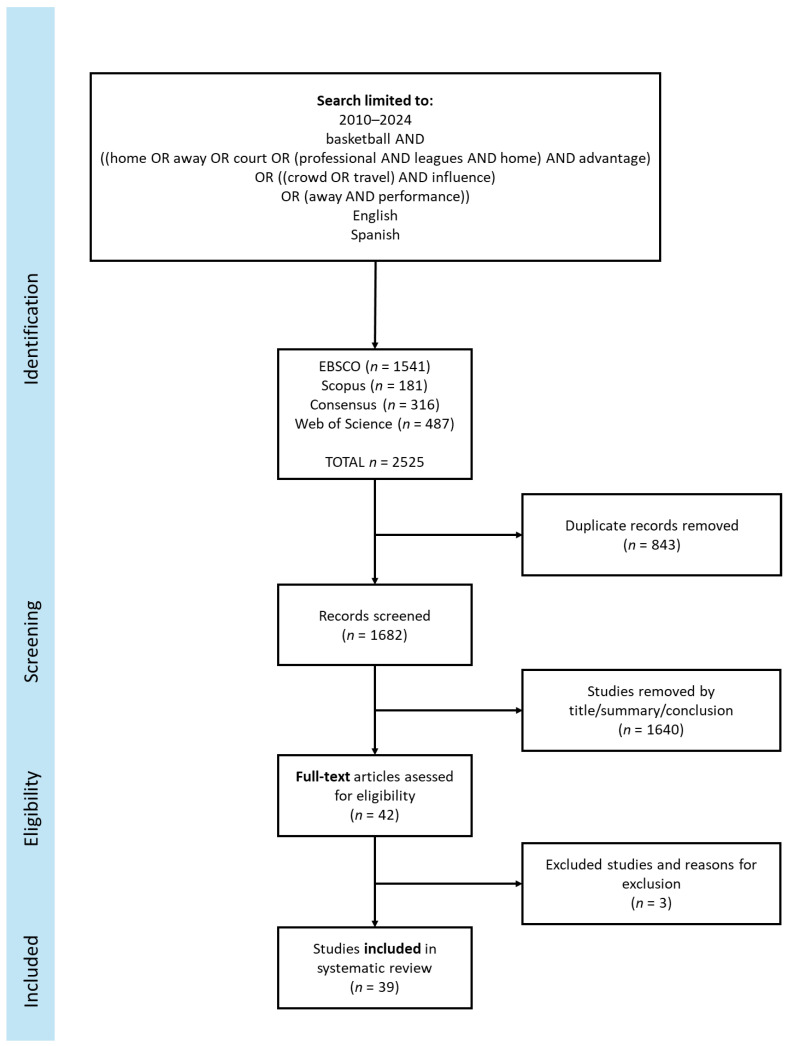
Background: This systematic review analyzes the factors that influence home advantage in basketball across various competitions in the United States and Europe. Methods: Through an investigation of English- and Spanish-language articles published in EBSCO, Scopus, Consensus, and Web of Science between 2010 and 2024 related to home advantage in basketball, 1682 articles were initially identified. After applying specific filters to ensure that only articles concerning National Basketball Association (NBA), Women’s National Basketball Association (WNBA), Euroleague, Spanish basketball, and European basketball were considered, 39 articles met the final requirements for in-depth analysis. Results: The studies analyzed in this review suggested that player performance, player position, and sleep influenced home advantage in competitions in Europe and the United States. Fan behavior had a bigger impact in European competitions, where teams from capital cities have a lower home advantage. In the United States, where teams must travel long distances to play, several studies indicated that teams traveling eastwards tend to perform more strongly than teams traveling westwards. Also of note is that, in many cases, COVID-19 pandemic restrictions reduced home advantage. Conclusions: This review identifies factors contributing to home advantage in basketball, compares competitions in different regions, and proposes ideas for future research such as a greater focus on women’s competitions, the impact of television, and the introduction of new performance indicators.
Overview
CoChat Summary
TL;DR
This PRISMA systematic review synthesizes 39 studies on home-court advantage in elite basketball across the NBA, WNBA, Euroleague, Spanish, and other European competitions. It concludes that player performance, player position, and sleep are common factors across regions, while crowd behavior matters more in Europe and travel distance/direction matters more in the United States.
Key findings
- Across the reviewed literature, home advantage was a consistent phenomenon in basketball, with factors including player performance, spectators, travel logistics, familiarity with the home court, geography, and sleep.
- In European leagues, De Angelis and Reade reported a 5.1% reduction in home-winning probability in top European basketball leagues without spectators in 2020, and an 8.3% reduction in Spain; in eight leagues home advantage decreased after COVID-19, with Lega Basket Serie A in Italy showing an 11.3% decrease.
- In the NBA, Barreira and Morgado analyzed 76 seasons (1946–2022) and found home advantage remained around 65%, with a significant decrease since 1965; García Rubio et al. reported 59.6% home advantage in the NBA between 2006–2007 and 2012–2013.
- Travel direction was highlighted in the NBA: teams traveling eastward had more assists and higher field-goal percentages and committed more fouls than teams traveling westward, while eastward jet lag negatively impacted away teams and westward jet lag did not show significant impact.
- Crowd effects were reported in both regions: Ganz and Allsop concluded fans influence home team performance with a 1.69-point increase per game and a difference of 5.7 home wins per season when matches are played with spectators.
Methods
- Systematic review following PRISMA guidelines, searching EBSCO, Scopus, Consensus, and Web of Science for English- and Spanish-language articles published 2010–2024 on home advantage in basketball.
- From 1682 initially identified articles, 42 met inclusion criteria; after detailed reading, 3 were excluded for focusing only on one team, leaving 39 articles for in-depth analysis.
- Included studies covered the NBA, WNBA, Euroleague, Spanish basketball, and European basketball; data extracted included study design, seasons, participant characteristics, statistical methods, and findings, with risk of bias assessed using Cochrane Collaboration guidelines.
Limitations
- The paper states that future research should address limitations in the reviewed studies, including more focus on women’s competitions, referee bias, television impact, new performance metrics, player/coach/referee/spectator interviews, and international tournaments such as FIBA World Cup, European Championships, Olympic Games, or Euroleague Final Four.
- The text notes limited coverage of women’s basketball: the results state only one article about women’s basketball was found, while the limitations section says the review found only two articles about women’s basketball.
- Evident from the text: the review is descriptive and analytical rather than a meta-analysis, and it reports no pooled quantitative effect estimate across studies.
Model-written summary. Check it against the paper before relying on it.
Integrity signals
Registry
Cites
Statistics
Figures
Verification
Claims the paper makes
0 Valid · 1 Not valid · 51 Not checked · 26 Own results and interpretations
A check of a cited source is scheduled, or we don’t hold its full text yet; the claim is checked once it runs.
In the paper
“When the Euroleague teams played in the playoffs, home teams won 58% of their games [49].”
§ The Influence of Home-Court Advantage in Elite Basketball: A Systematic Review > 3. Results > 3.1. Home Advantage in the Euroleague
What the sources say
- Not checked yetcites [49] Pojskić, H., Šeparović, V., and Užičanin, E. (2011). Modelling Home Advantage in Basketball at Different Levels of Competition. Acta Kinesiol., 5, Available online: www.fiba.com.
A check is scheduled.
plain- Asserted: passes — The authors put it forward as true.
- Checkable: passes — It can be checked against evidence.
- Load-bearing: unclear — It is unclear whether the paper’s conclusions depend on it.
- Based: passes — The paper gives a reason why it holds.
- Not checked yet
A result the paper reports from its own data — it cites no other source for it, so there is none to check. The quote shows it is in the paper.
In the paper
“The studies analyzed in this review suggested that player performance, player position, and sleep influenced home advantage in competitions in Europe and the United States.”
§ The Influence of Home-Court Advantage in Elite Basketball: A Systematic Review > Abstract
hedgedstates an association- Asserted: passes — The authors put it forward as true.
- Checkable: passes — It can be checked against evidence.
- Load-bearing: passes — The paper’s conclusions depend on it.
- Based: passes — The paper gives a reason why it holds.
A result the paper reports from its own data — it cites no other source for it, so there is none to check. The quote shows it is in the paper.
In the paper
“The studies analyzed in this review suggested that player performance, player position, and sleep influenced home advantage in competitions in Europe and the United States.”
§ The Influence of Home-Court Advantage in Elite Basketball: A Systematic Review > Abstract
hedgedstates a cause- Asserted: passes — The authors put it forward as true.
- Checkable: passes — It can be checked against evidence.
- Load-bearing: passes — The paper’s conclusions depend on it.
- Based: passes — The paper gives a reason why it holds.
A result the paper states — it cites no source for it, so there is none to check. The quote shows it is in the paper.
In the paper
“In the United States, where teams must travel long distances to play, several studies indicated that teams traveling eastwards tend to perform more strongly than teams traveling westwards.”
§ The Influence of Home-Court Advantage in Elite Basketball: A Systematic Review > Abstract
hedgedstates an association- Asserted: passes — The authors put it forward as true.
- Checkable: passes — It can be checked against evidence.
- Load-bearing: unclear — It is unclear whether the paper’s conclusions depend on it.
- Based: passes — The paper gives a reason why it holds.
A check of a cited source is scheduled, or we don’t hold its full text yet; the claim is checked once it runs.
In the paper
“The quality of the players [49,54], familiarity with the home court [29], and the influence of spectators [48] are significant factors contributing to home advantage in Euroleague basketball.”
§ The Influence of Home-Court Advantage in Elite Basketball: A Systematic Review > 3. Results > 3.1. Home Advantage in the Euroleague
What the sources say
- Not checked yetcites [49] Pojskić, H., Šeparović, V., and Užičanin, E. (2011). Modelling Home Advantage in Basketball at Different Levels of Competition. Acta Kinesiol., 5, Available online: www.fiba.com.
A check is scheduled.
- Not checked yetcites [54] Sampaio, 2013, Game location influences basketball players’ performance across playing positions, Int. J. Sport Psychol.
A check is scheduled.
plainstates a cause- Asserted: passes — The authors put it forward as true.
- Checkable: passes — It can be checked against evidence.
- Load-bearing: passes — The paper’s conclusions depend on it.
- Based: passes — The paper gives a reason why it holds.
- Not checked yet
32 more claims
Create a free account to see all 78 claims and to verify the 55 references still open.
- The quote only partly states this claim. 1
- Probably not a substantial claim. 19
- It may state two separate claims as one. 28
Self-check
Percentages, sums and reported differences re-computed from the paper’s own numbers.
Each contradiction between two passages listed here was confirmed by an independent check.
Rated minor: it would not touch a result — a value no result rests on, a p-value that stays on the same side of the significance level, or a conflict that is clerical, resolved elsewhere in the paper, or outside its own findings.
In the paper
§ The Influence of Home-Court Advantage in Elite Basketball: A Systematic Review > 3. Results
“This systematic review found only one article about women’s basketball.”
§ The Influence of Home-Court Advantage in Elite Basketball: A Systematic Review > 4. Limitations and Recommendations for Future Research
“this systematic review found only two articles about women’s basketball.”
Rated minor: it would not touch a result — a value no result rests on, a p-value that stays on the same side of the significance level, or a conflict that is clerical, resolved elsewhere in the paper, or outside its own findings.
In the paper
§ The Influence of Home-Court Advantage in Elite Basketball: A Systematic Review > 3. Results > 3.4. Home Advantage in NBA and WNBA
“Leota et al. [37] noted that empty arenas eliminated home advantage.”
§ The Influence of Home-Court Advantage in Elite Basketball: A Systematic Review > References
“37. Gómez M.A. Pollard R. Reduced home advantage for basketball teams from capital cities in Europe Eur. J. Sport Sci. 2011 11 143 148 10.1080/17461391.2010.499970”
Rated minor: it would not touch a result — a value no result rests on, a p-value that stays on the same side of the significance level, or a conflict that is clerical, resolved elsewhere in the paper, or outside its own findings.
In the paper
§ The Influence of Home-Court Advantage in Elite Basketball: A Systematic Review > 2. Methodology > 2.5. Data Analysis
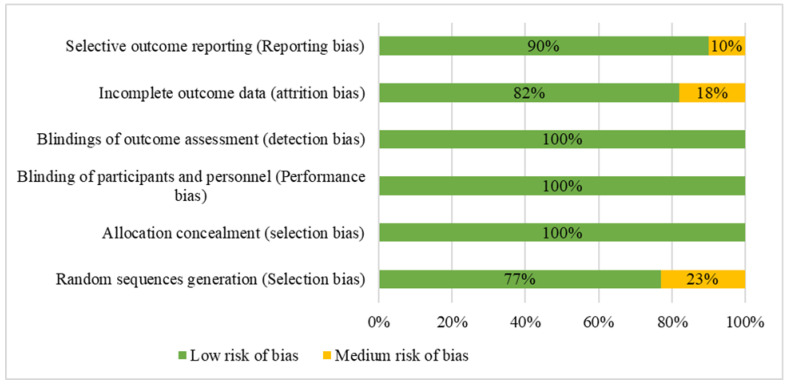
“The following classifications were used: low risk, high risk, and unclear risk (either lack of information or uncertainty regarding the potential for bias).”
§ The Influence of Home-Court Advantage in Elite Basketball: A Systematic Review > 2. Methodology > 2.5. Data Analysis
“a small percentage of studies exhibited a medium risk of bias.”
Rated minor: it would not touch a result — a value no result rests on, a p-value that stays on the same side of the significance level, or a conflict that is clerical, resolved elsewhere in the paper, or outside its own findings.
In the paper
§ The Influence of Home-Court Advantage in Elite Basketball: A Systematic Review > 2. Methodology > 2.3. Inclusion Criteria
“The 39 articles remaining were reviewed using a descriptive and analytical approach.”
§ The Influence of Home-Court Advantage in Elite Basketball: A Systematic Review > 3. Results
“A systematic review was conducted, and we ended up finding forty articles that focused on diverse aspects of home advantage in basketball.”
Rated minor: it would not touch a result — a value no result rests on, a p-value that stays on the same side of the significance level, or a conflict that is clerical, resolved elsewhere in the paper, or outside its own findings.
In the paper
§ The Influence of Home-Court Advantage in Elite Basketball: A Systematic Review > 2. Methodology > 2.4. Data Extraction
“24 cover the NBA and WNBA”
§ The Influence of Home-Court Advantage in Elite Basketball: A Systematic Review > 3. Results > 3.4. Home Advantage in NBA and WNBA
“The systematic review found 25 articles that analyzed these competitions over several seasons.”
Citations
Cites
The PRISMA 2020 statement: An updated guideline for reporting systematic reviews
Page, M. J., McKenzie, J. E., Bossuyt, P. M., Boutron, I., Hoffmann, T. C., Mulrow, C. D., Shamseer, L., Tetzlaff, J. M., Akl, E. A., Brennan, S. E., et al. (2021) · BMJ · doi:10.1136/bmj.n71 · Cited by 108,283
The Home Advantage In Sport Competitions: A Literature Review
Courneya, K. S., & Carron, A. V. (1992) · Journal of Sport and Exercise Psychology · doi:10.1123/jsep.14.1.13 · Cited by 561
Pollard, R., & Pollard, G. (2005) · Journal of Sports Sciences · doi:10.1080/02640410400021559 · Cited by 278
Basketball game‐related statistics that discriminate between teams’ season‐long success
Ibáñez, S. J., Sampaio, J. E., Molina, S. F., Calvo, A. L., Gómez, M., & Ortega, E. (2008) · European Journal of Sport Science · doi:10.1080/17461390802261470 · Cited by 265
Sampaio, J. E., Janeira, M. A., Ibáñez, S. J., & Calvo, A. L. (2006) · European Journal of Sport Science · doi:10.1080/17461390600676200 · Cited by 243
Factors associated with home advantage in English and Scottish soccer matches
Nevill, A. M., Newell, S., & Gale, S. (1996) · Journal of Sports Sciences · doi:10.1080/02640419608727700 · Cited by 216
Spectator Booing and the Home Advantage: A Study of Social Influence in the Basketball Arena
Greer, D. L. (1983) · Social Psychology Quarterly · doi:10.2307/3033796 · Cited by 145
An Analysis of Home and Away Game Performance of Male College Basketball Teams
Varca, P. E. (1980) · Journal of Sport Psychology · doi:10.1123/jsp.2.3.245 · Cited by 99
García-Rubio, J., Ibáñez, S. J., Gómez, A. M., & Sampaio, J. E. (2014) · International Journal of Performance Analysis in Sport · doi:10.1080/24748668.2014.11868733 · Cited by 97
Mizruchi, M. S. (1991) · Social Psychology Quarterly · doi:10.2307/2786935 · Cited by 87
Research works printed but not linked: 4
- Pollard, 2007, Home advantage analysis in different basketball leagues according to team ability, Iber. Congr. Basketb. Res., 4, 126
- Lorenzo, 2012, An Analysis of Home Advantage Effect Affecting the Final Outcome of the Critical Moments in Basketball Games, Rev. Esp. Educ. Fís. Dep., 396, 49
- Bourdas, 2022, Home-audience advantage in basketball: Evidence from a natural experiment in Euro League games during the 2019-2021 Covid-19 era, J. Phys. Educ. Sport, 22, 1761
- 2015, Effects of Attendance, Crowd Density and Capacity of Arena in Home Advantage According to NBA Conference, Cuad. Psicol. Deporte, 15, 175
Cited by
Vázquez-Estévez, C., Prieto-Lage, I., Reguera-López-de-la-Osa, X., Gutiérrez-Santiago, J. A., Toledo-González, M., & Gutiérrez-Santiago, A. (2025) · Applied Sciences · doi:10.3390/app15041928 · Cited by 13
From Data to Decisions: Using Explainable Machine Learning to Predict EuroLeague Basketball Outcomes
Foteinakis, P. F., Kokkotis, C., Karamousalidis, G., Avloniti, A. A., Pavlidou, S. P., Zaras, N. D., Stampoulis, T., Pantazis, D., Aggelakis, P., Balampanos, D., et al. (2025) · Applied Sciences · doi:10.3390/app152312401 · Cited by 8
Li, F., Jiang, F., Sansone, P., Gastin, P. B., & Gomez, M.-A. (2025) · International Journal of Performance Analysis in Sport · doi:10.1080/24748668.2025.2574170 · Cited by 3
Imal, O., Verbruggen, F. F., Malý, T., Stephenson, C., Zahálka, F., & Petway, A. J. (2025) · International Journal of Sports Science & Coaching · doi:10.1177/17479541251343787 · Cited by 2
Vázquez-Estévez, C., Prieto-Lage, I., Reguera-López-de-la-Osa, X., Rodríguez-Crespo, M., Gutiérrez-Santiago, J. A., & Gutiérrez-Santiago, A. (2025) · Applied Sciences · doi:10.3390/app15095046 · Cited by 2
Bustamante-Sánchez, Á., Gómez, M., Lago‐Peñas, C., & Sáiz, S. L. J. (2025) · International Journal of Performance Analysis in Sport · doi:10.1080/24748668.2025.2467535 · Cited by 1
Self-citationHome court advantage is declining in Brazilian National Basketball League
Góes, D. F., & de Almeida, M. B. (2025) · Journal of Physical Education and Sport · doi:10.7752/jpes.2025.05119 · Cited by 1
Does Geography Shape Victory? Home-Court Advantage and Home Win Percentage in Women’s Basketball
López-García, A., Alonso, E., Sáiz, S. L. J., Navarro, R. M., & Nieto-Acevedo, R. (2025) · Applied Sciences · doi:10.3390/app152412940
BASKETBOL ANTRENMANLARINDA KULLANILAN ŞUT TEKNOLOJİLERİNİN TEMATİK ANALİZİ
Özen, G., & Akgün, O. (2026) · DergiPark (Istanbul University)
To what extent can we use statistical models to accurately predict the outcome of basketball games?
Yang, Z. (2026) · Advances in Engineering Innovation · doi:10.54254/2977-3903/2026.32828
Filiz, E. (2026) · Ordu Üniversitesi Bilim ve Teknoloji Dergisi · doi:10.54370/ordubtd.1931137
Zhang, X., Qiu, M., Dong, R., Wei, B., & Zhang, M. (2026) · Journal of Sports Sciences · doi:10.1080/02640414.2026.2698222
STUPARIU, M. I., FEFLEA, I., & GHERDAN, J.-M. (2026) · Geosport for Society · doi:10.30892/gss.2506-156
Metadata
- Authors
- Mochales Cuesta, I., Jiménez-Sáiz, S. L., Kelly, A. L., & Bustamante-Sánchez, Á.
- Affiliations
- Faculty of Sports Sciences, Universidad Europea de Madrid, Tajo Street, s/n, 28670 Madrid, Spain
- Sport Sciences Research Centre, Universidad Rey Juan Carlos, 28942 Madrid, Spain
- Birmingham City University (GB)
- Universidad Europea de Madrid (ES)
- Venue
- Journal of Functional Morphology and Kinesiology
- Publisher
- MDPI AG
- Published
- 2024-10-10
- Volume
- 9
- Issue
- 4
- Pages
- 192
- ISSN
- 2411-5142 (ISSN-L)
- PMC
- PMC11503446
- OpenAlex
- W4403300119
- Semantic Scholar
- 4b0d3494799913fe46ca985ce0afaa0fec5331c1
- Cited by
- 13
- References
- 53
- Citations by year
- 2026: 5 · 2025: 8
- FWCI
- 0.99
- Type
- journal article
- Language
- en
- Open access
- gold
- doi.org
- Licence
- Locations
- Journal of Functional Morphology and Kinesiology (publishedVersion, cc-by)
- PubMed Central (publishedVersion, cc-by)
- PubMed (publishedVersion)
- BCU Open Access Repository (Birmingham City University) (acceptedVersion)
- DOAJ (DOAJ: Directory of Open Access Journals) (submittedVersion, cc-by-sa)
- Topics
- Social Sciences › Economics, Econometrics and Finance › Economics and Econometrics › Sports Analytics and Performance
- Health Sciences › Medicine › Orthopedics and Sports Medicine › Sports Performance and Training
- Social Sciences › Psychology › Developmental and Educational Psychology › Sport Psychology and Performance
- Keywords
- home court advantage, basketball, elite basketball, player performance, playing position, sleep, fan behavior, travel distance, COVID-19 pandemic, NBA, WNBA, Euroleague, women's basketball
About these checks
Registry, retraction, Cites and statistics results are computed, not judged, with one exception: a printed reference that no index lists is read once by a model before it counts as a citation error. Claims are extracted by a model and kept only when their quote appears verbatim in the text; each cited source is then checked, with a model’s help, for whether it says what the claim relies on. Those verdicts can be wrong — read the claim’s quote and the cited source before relying on one.
A language model drew the claims from the paper on 2026-11-14, under version 3 of the claim definition (model deepseek-v4.1-flash, prompt extract-v3).
A second model labelled each claim on 2026-11-14 (model jev-1.13-20260917, definition revision gold-guideline-v0.2).
Statistics and arithmetic are recomputed, not judged.
Confidence bands are shown only for fields calibrated on our annotated test set. None is calibrated yet, so no band is shown.
What counts as a claim ›How we measure confidence ›How we check this ›
Are you an author, or do you see a problem with this page? Request a review
Data sources
Bibliographic data: Semantic Scholar, OpenAlex, Crossref.
Contains information from the Semantic Scholar Academic Graph Datasets, made available under the ODC Attribution License (ODC-BY 1.0).
Semantic Scholar’s data is described in: Kinney, R., et al. (2023). The Semantic Scholar Open Data Platform. arXiv:2301.10140.
