

A Fractional Fourier Transform-Based Channel Estimation and Equalization Algorithm for Mud Pulse Telemetry
Open accessThe DOI matches its Crossref record; 32 of the 35 references it cites were found in a registry or an index; 1 of the 14 sources its claims cite were checked for support.
Abstract
Mud pulse telemetry (MPT) systems are a promising approach to transmitting downhole data to the ground. During transmission, the amplitudes of pressure waves decay exponentially with distance, and the channel is often frequency-selective due to reflection and multipath effect. To address these issues, this work proposes a fractional Fourier transform (FrFT)-based channel estimation and equalization method. Leveraging the energy aggregation of linear frequency-modulated signals in the fractional Fourier domain, the time delay and attenuation parameters of the multipath channel can be estimated accurately. Furthermore, a fractional Fourier domain equalizer is proposed to pre-filter the frequency-selective fading channel using fractionally spaced decision feedback equalization. The effectiveness of the proposed method is evaluated through a simulation analysis and field experiments. The simulation results demonstrate that this method can significantly reduce multipath effects, effectively control the impact of noise, and facilitate subsequent demodulation. The field experiment results indicate that the demodulation of real data achieves advanced data rate communication (over 12 bit/s) and a low bit error rate (below 0.5%), which meets engineering requirements in a 3000 m drilling system.
Overview
CoChat Summary
TL;DR
This paper proposes a fractional Fourier transform (FrFT)-based channel estimation and equalization method for mud pulse telemetry, using LFM energy aggregation to estimate multipath delay/attenuation and an FrFT-domain equalizer before time-domain DFE. Simulations and a 3000 m field test show reduced multipath/noise effects and BER below 0.5% with data rates over 12 bit/s.
Key findings
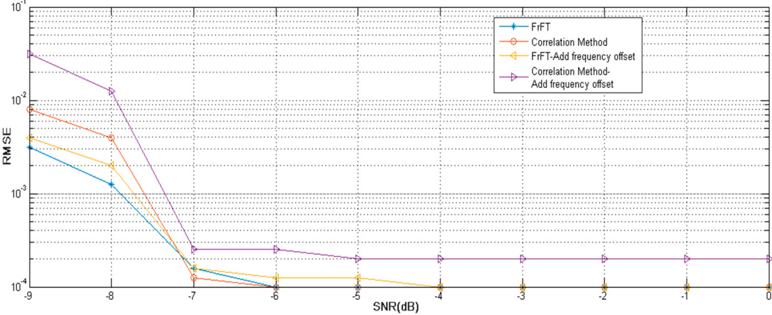
- In simulation with an unknown frequency offset of 0.025, the FrFT-based time-delay estimation had RMSE approximately 20% of the conventional correlation-based method; without frequency offset, both methods performed comparably.
- In equalization simulation with six multipaths, BFSK, training symbol length 128, SNR 10 dB, and optimal order p = 1.23, FrFT equalization produced a single autocorrelation peak instead of multiple peaks and a higher peak-to-noise ratio, indicating reduced multipath and noise effects.
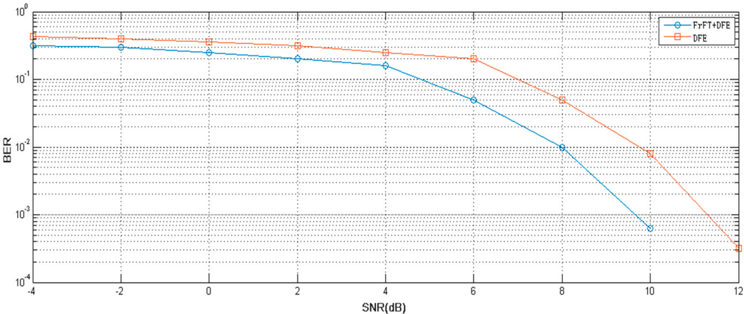
- In the real well test, DFE + FrFT reduced BER by 90% compared with DFE alone and achieved BER below 0.5%, with advanced data rate communication over 12 bit/s in a 3000 m drilling system. Table 1 examples: at 2602 m and 9 bit/s, DFE BER 0.50 vs. DFE + FrFT 0.05; at 2890 m and 12 bit/s, 0.14 vs. 0.03; at 3016 m and 12 bit/s, 0.08 vs. 0.
- Table 2 reports lower BER for FrFT than ZF and MMSE in several real-well cases, e.g. at 2890 m and 12 bit/s: ZF 0.15, MMSE 0.14, FrFT 0.03; at 2980 m and 10 bit/s: ZF 0.12, MMSE 0.17, FrFT 0.02.
Methods
- The MPT system is modeled as linear time-invariant, r(t) = h(t) * x(t) + n(t). FrFT channel estimation exploits LFM energy compaction in the fractional Fourier domain to estimate multipath delays and attenuation coefficients, with an optimal-order search minimizing an objective function ε_p; the method requires only a single FrFT calculation.
- Equalization preprocesses the received signal with a fractional Fourier domain multiplicative filter using a regularization constant, then inverse-FrFTs back to the time domain and feeds the result into a decision feedback equalizer; the abstract describes this as fractionally spaced decision feedback equalization.
- Simulation used AWGN, 1000 ms channel duration, 1000 Hz sampling, a three-path channel with 0 dB attenuation per path, frequency offset 0.025, SNR from 9 dB to 0 dB, and 1000 Monte Carlo runs for RMSE; equalization simulation used six multipaths, BFSK, 128 training symbols, and SNR 10 dB. Field data were collected in Xinjiang, China, in October 2017, with depths exceeding 3000 m, BFSK modulation, 1000 Hz sample rate, and 10 bit/s symbol rate.
Limitations
- The paper states that there is currently no adaptive threshold method for LFM signal detection due to noise, that the high computational complexity of selecting the optimal fractional order should be reduced, that comparison with more advanced published works is needed, and that further experiments are needed in different drilling environments.
- The paper also states future work should analyze sensitivity of fractional order selection under dynamic channel conditions, develop lightweight adaptive order estimation, and implement FrFT-based processing on embedded or low-power DSP platforms.
- Evident from the text: the simulation assumes AWGN and a time-invariant channel, while the field validation is limited to one site/time (Xinjiang, October 2017), BFSK modulation, and depths around 887–3016 m; these constraints are not framed as limitations by the authors but are apparent from the reported setup.
Model-written summary. Check it against the paper before relying on it.
Integrity signals
Registry
Cites
Statistics
Figures






Verification
Claims the paper makes
0 Valid · 1 Not valid · 13 Not checked · 61 Own results and interpretations
A result the paper reports from its own data — it cites no other source for it, so there is none to check. The quote shows it is in the paper.
In the paper
“Initial estimation of the channels at various orders leads to the determination of the optimal order p = 1.23.”
§ A Fractional Fourier Transform-Based Channel Estimation and Equalization Algorithm for Mud Pulse Telemetry > 3.1. Simulation Test
hedgedstates a cause- Asserted: passes — The authors put it forward as true.
- Checkable: passes — It can be checked against evidence.
- Load-bearing: unclear — It is unclear whether the paper’s conclusions depend on it.
- Based: passes — The paper gives a reason why it holds.
- Rests on an assumption not shown here.
A result the paper reports from its own data — it cites no other source for it, so there is none to check. The quote shows it is in the paper.
In the paper
“Figures 5 and 6 reveal that the presence of multipath effect in the channel results in multiple peaks in the autocorrelation results of the signal without fractional Fourier transform equalization, causing inter-symbol crosstalk.”
§ A Fractional Fourier Transform-Based Channel Estimation and Equalization Algorithm for Mud Pulse Telemetry > 3.1. Simulation Test
plainstates a cause- Asserted: passes — The authors put it forward as true.
- Checkable: passes — It can be checked against evidence.
- Load-bearing: passes — The paper’s conclusions depend on it.
- Based: passes — The paper gives a reason why it holds.
- Rests on an assumption not shown here.
A result the paper reports from its own data — it cites no other source for it, so there is none to check. The quote shows it is in the paper.
In the paper
“The results show that, in the presence of an unknown frequency offset, the RMSE of the FrFT-based method is approximately 20% of that of the conventional correlation-based method.”
§ A Fractional Fourier Transform-Based Channel Estimation and Equalization Algorithm for Mud Pulse Telemetry > 3.1. Simulation Test
plainstates an association- Asserted: passes — The authors put it forward as true.
- Checkable: passes — It can be checked against evidence.
- Load-bearing: passes — The paper’s conclusions depend on it.
- Based: passes — The paper gives a reason why it holds.
- Rests on an assumption not shown here.
A result the paper reports from its own data — it cites no other source for it, so there is none to check. The quote shows it is in the paper.
In the paper
“In contrast, after fractional Fourier transform equalization, the autocorrelation results exhibit a single peak, indicating a significant reduction in the multipath”
§ A Fractional Fourier Transform-Based Channel Estimation and Equalization Algorithm for Mud Pulse Telemetry > 3.1. Simulation Test
hedgedstates a cause- Asserted: passes — The authors put it forward as true.
- Checkable: passes — It can be checked against evidence.
- Load-bearing: passes — The paper’s conclusions depend on it.
- Based: passes — The paper gives a reason why it holds.
- Rests on an assumption not shown here.
A result the paper reports from its own data — it cites no other source for it, so there is none to check. The quote shows it is in the paper.
In the paper
“However, when no frequency offset is present, the performance of both methods is comparable in terms of RMSE.”
§ A Fractional Fourier Transform-Based Channel Estimation and Equalization Algorithm for Mud Pulse Telemetry > 3.1. Simulation Test
plain- Asserted: passes — The authors put it forward as true.
- Checkable: passes — It can be checked against evidence.
- Load-bearing: unclear — It is unclear whether the paper’s conclusions depend on it.
- Based: passes — The paper gives a reason why it holds.
- Rests on an assumption not shown here.
46 more claims
Create a free account to see all 75 claims and every source verdict.
- Probably not a substantial claim. 5
- It may state two separate claims as one. 18
- The quote only partly states this claim. 1
Self-check
Percentages, sums and reported differences re-computed from the paper’s own numbers.
Each contradiction between two passages listed here was confirmed by an independent check.
Rated major: it would touch a result — a value a result rests on, reported and recomputed p-values on opposite sides of the significance level, two passages that conflict with no sign which is right, or a cited work retracted before this paper was published.
In the paper
§ A Fractional Fourier Transform-Based Channel Estimation and Equalization Algorithm for Mud Pulse Telemetry > 3.2. Real Well Test
“In general, integration of FrFT equalization reduces the BER to below 0.5%, which meets the engineering requirements.”
§ A Fractional Fourier Transform-Based Channel Estimation and Equalization Algorithm for Mud Pulse Telemetry > 5. Conclusions
“| 4 | BFSK | 2602 | 9 | 0.50 | 0.05 |”
Rated minor: it would not touch a result — a value no result rests on, a p-value that stays on the same side of the significance level, or a conflict that is clerical, resolved elsewhere in the paper, or outside its own findings.
In the paper
§ A Fractional Fourier Transform-Based Channel Estimation and Equalization Algorithm for Mud Pulse Telemetry > 3.2. Real Well Test
“When using channel estimation based on FrFt plus DFE, BER is decreased by 90%, which is shown in Table 1.”
§ A Fractional Fourier Transform-Based Channel Estimation and Equalization Algorithm for Mud Pulse Telemetry > 5. Conclusions
“| 2 | BFSK | 887 | 10 | 0.12 | 0.04 |”
Rated minor: it would not touch a result — a value no result rests on, a p-value that stays on the same side of the significance level, or a conflict that is clerical, resolved elsewhere in the paper, or outside its own findings.
In the paper
§ A Fractional Fourier Transform-Based Channel Estimation and Equalization Algorithm for Mud Pulse Telemetry > 5. Conclusions
“Finally, we achieve advanced data rate communication (over 12 bit/s) in a 3000 m drilling system.”
§ A Fractional Fourier Transform-Based Channel Estimation and Equalization Algorithm for Mud Pulse Telemetry > 5. Conclusions
“| 8 | BFSK | 3016 | 12 | 0.08 | 0 |”
Citations
Cites
A New Mud Pulse Telemetry System for Enhanced MWD/LWD Applications
Klotz, C., Bond, P., Wasserman, I., et al. (2008) · doi:10.2118/112683-ms · Cited by 58
Adaptive dual-sensor noise cancellation method for continuous wave mud pulse telemetry
Qu, F., Zhang, Z., Hu, J., Xu, J., Wang, S., & Wu, Y. (2018) · Journal of Petroleum Science and Engineering · doi:10.1016/j.petrol.2017.12.058 · Cited by 54
Self-citationCharacterization of EM downhole-to-surface communication links
Haslett, J. W., Klassen, A., Segal, M., et al. (2000) · IEEE Transactions on Geoscience and Remote Sensing · doi:10.1109/36.885201 · Cited by 44
Fractional Fourier analysis using the mobius inversion formula
Miao, H., Zhang, F., & Tao, R. (2019) · IEEE Transactions on Signal Processing · doi:10.1109/tsp.2019.2912878 · Cited by 32
Jia, S., Zou, S., Zhang, X., Tian, D., & Da, L. (2022) · Applied Acoustics · doi:10.1016/j.apacoust.2022.108721 · Cited by 27
Reliable High-speed Mud Pulse Telemetry
Emmerich, W.-D., Akimov, O., Brahim, I. B., et al. (2015) · doi:10.2118/173032-ms · Cited by 22
Analysis of Signal Transmission for Use of Logging While Drilling
Qu, S., Zhu, K.-B., Nie, Z., et al. (2012) · IEEE Geoscience and Remote Sensing Letters · doi:10.1109/lgrs.2012.2227928 · Cited by 19
Li, P., Pan, W., Zou, X., & Yan, L. (2022) · Journal of Lightwave Technology · doi:10.1109/jlt.2021.3127449 · Cited by 18
Experimental study on repeater-free acoustic telemetry for downhole operations
Pagtalunan, J., Parmar, K., Kim, S., Moon, B., & Park, S. S. (2021) · Journal of Petroleum Science and Engineering · doi:10.1016/j.petrol.2021.108551 · Cited by 16
High-resolution multicomponent LFM parameter estimation based on deep learning
Yan, B., Li, Y., Cheng, W., Dong, L., & Kou, Q. (2025) · Signal Processing · doi:10.1016/j.sigpro.2024.109714 · Cited by 12
Wigner-Hough transform based on slices entropy and its application to multi-LFM signal detection
(2017) · Journal of Systems Engineering and Electronics · doi:10.21629/jsee.2017.04.02 · Cited by 12
Wang, H., Jiang, W., Hu, Q., Zeng, Z., & Li, Z. (2024) · IEEE Sensors Journal · doi:10.1109/jsen.2024.3389298 · Cited by 11
DFrFT-based near-field channel estimation for extremely large-scale MIMO systems
Xu, P.-Z., Xiang, W., & Yu, Q.-Y. (2024) · IEEE Communications Letters · doi:10.1109/lcomm.2024.3408796 · Cited by 11
IRS-OTFS Systems: Design of Reflection Coefficients for Low-Complexity ZF Equalizer
Yadav, R. K., Mishra, H. B., Mukhopadhyay, S., et al. (2024) · IEEE Transactions on Vehicular Technology · doi:10.1109/tvt.2024.3400529 · Cited by 10
Noise Cancellation Method for Mud Pulse Telemetry Based on Discrete Fourier Transform
Zhang, J., Sha, Z., Tu, X., Zhang, Z., Zhu, J., Wei, Y. D., & Qu, F. (2025) · Journal of Marine Science and Engineering · doi:10.3390/jmse13010075 · Cited by 10
Self-citationWang, L., Jiang, H., He, H., et al. (2021) · Optics Letters · doi:10.1364/ol.417598 · Cited by 10
Fractional convolution, correlation theorem and its application in filter design
Feng, Q., & Wang, R.-B. (2020) · Signal, Image and Video Processing · doi:10.1007/s11760-019-01563-9 · Cited by 10
KAN-ResNet-Enhanced Radio Frequency Fingerprint Identification with Zero-Forcing Equalization
Chen, H., Zhou, R., Yuan, Q., Guo, Z., & Fu, W. (2025) · Sensors · doi:10.3390/s25072222 · Cited by 9
Wang, Q., Guan, Z., Zhang, B., Liu, Y., & Li, C. (2020) · Journal of Petroleum Science and Engineering · doi:10.1016/j.petrol.2019.106878 · Cited by 8
SDM Optical Systems With MMSE Equalizers: Information Rates and Performance Monitoring
Zischler, L., & Mello, D. A. A. (2025) · Journal of Lightwave Technology · doi:10.1109/jlt.2025.3573029 · Cited by 4
Mallouki, N., Nsiri, B., Ghanbarisabagh, M., Hakimi, W., & Ammar, M. (2017) · Wireless Networks · doi:10.1007/s11276-016-1290-3 · Cited by 4
FrFT equalization for underwater sweep-spread communication system
Pan, C., Jia, Z., & Yuan, F. (2023) · Applied Acoustics · doi:10.1016/j.apacoust.2023.109671 · Cited by 4
Multipath Component Parameter Estimation Based on Fractional Fourier Transform
Zhang, J., Tang, Z., Zhu, C., & Liu, S. (2025) · IEEE Transactions on Instrumentation and Measurement · doi:10.1109/tim.2025.3556173 · Cited by 3
Self-citationDong, P., Xiang, X., Wang, P., et al. (2025) · Wireless Networks · doi:10.1007/s11276-025-03919-1 · Cited by 3
Borehole telemetry system is key to continuous down-hole drilling measurements
McDonald, W. J., & Ward, C. E. W. (1975) · Oil & gas journal/Oil and gas journal · Cited by 3
Drilling Better Wells Cheaper and Faster
Brooks, R., & Wilson, J. W. (2008) · Intelligent Energy Conference and Exhibition · doi:10.2118/112241-ms · Cited by 2
Pan, N., Mei, L., Wang, L., et al. (2021) · Lecture notes of the Institute for Computer Sciences, Social Informatics and Telecommunications Engineering · doi:10.1007/978-3-030-69066-3_17 · Cited by 2
Performance of iterative decision feedback channel estimation in turbo FDE for DFT-spread OFDM
Mori, C., Sawahashi, M., Miki, N., & Suyama, S. (2025) · IEICE Transactions on Communications · doi:10.23919/transcom.2024ebp3052 · Cited by 2
Research on the Integration of Sensing and Communication Based on Fractional-Order Fourier Transform
(2025) · doi:10.3390/s25102956 · Cited by 2
Self-citationA fast method for intra-pulse parameters estimation of polyphase-coded radar signals based on FRFT
Dong, J., Chen, S., Sun, G., & Wu, C. (2024) · Signal Image and Video Processing · doi:10.1007/s11760-024-03506-5 · Cited by 2
Design of Optimal Reflection Coefficients and Low-Complexity Equalizer for IRS-OTFS System
Yadav, R. K., Dora, S. K., Mishra, H. B., et al. (2025) · TENCON 2025 - 2025 IEEE Region 10 Conference (TENCON) · doi:10.1109/tencon66050.2025.11375025
UAV Sensing and Communication Integration Based on Fractional-Order Fourier Transform
Qi, M., Wang, Z., Lu, K., et al. (2025) · 2025 IEEE 5th International Conference on Computer Communication and Artificial Intelligence (CCAI) · doi:10.1109/ccai65422.2025.11189826
Research works printed but not linked: 5
- 2. Gardner, W.R. High data rate MWD mud pulse telemetry. In Proceedings of the United States Department of Energy Natural Gas Conference, Houston, TX, USA, 25 March 1997.
- 8. Chin, W.; Yinao, S.U.; Sheng, L.; Lin, L.I.; Bian, H.; Shi, R. High-data-rate MWD system for very deep wells. Well Logging Technol. 2014, 38, 713-721.
- 14. Lv, C.; Wang, G.; Chen, H.; Zhang, G.; Chen, Z. Estimation of moving thermal boundary condition and temperature field reconstruction of workpieces in drilling process. Hsi-Chiao Tung Ta Hsueh/J. Xi'an Jiaotong Univ. 2019, 53, 18-24+43.
- 18. Zhang, Q.; Xu, Y. Channel estimation based on multi-armed approach for maritime OFDM wireless communications. J. China Univ. Posts Telecommun. 2023, 30, 75-85.
- 22. Fang, Z.; Zhang, T.; Wang, R.; Wang, X. Acquisition of binary offset carrier modulation signals in a highly dynamic environment. J. Signal Process. 2022, 38, 2164-2172.
Cited by
Dong, X., Yan, L., Wang, L. L., et al. (2026) · Processes · doi:10.3390/pr14101589 · Cited by 1
Tian, J., Shen, J., Cha, L., et al. (2026) · Geomechanics and Geoengineering · doi:10.1080/17486025.2026.2654052
“Zhang et al .”
Metadata
- Authors
- Zhang, J., Sha, Z., Wan, L., Su, Y., Zhu, J., & Qu, F.
- Affiliations
- Zhejiang University (CN)
- Xiamen University (CN)
- Tianjin University (CN)
- Corresponding author
- Zhu, Jiang
- Venue
- Journal of Marine Science and Engineering
- Publisher
- MDPI AG
- Published
- 2025-07-31
- Volume
- 13
- Issue
- 8
- Pages
- 1468
- ISSN
- 2077-1312 (ISSN-L)
- OpenAlex
- W4412818242
- Cited by
- 2
- References
- 35
- Citations by year
- 2026: 2
- FWCI
- 0.78
- Type
- journal article
- Language
- en
- Open access
- gold
- doi.org
- Licence
- Locations
- Journal of Marine Science and Engineering (publishedVersion, cc-by)
- DOAJ (DOAJ: Directory of Open Access Journals) (submittedVersion, cc-by-sa)
- Funders
- National Natural Science Fund for Distinguished Young Scholars (62225114)
- Topics
- Physical Sciences › Energy › Fuel Technology › Drilling and Well Engineering
- Physical Sciences › Engineering › Electrical and Electronic Engineering › Advanced Wireless Communication Techniques
- Physical Sciences › Engineering › Electrical and Electronic Engineering › Advanced Signal Processing Techniques
- Keywords
- mud pulse telemetry, fractional Fourier transform, channel estimation, equalization, multipath channels, frequency-selective fading, linear frequency modulated signals, time delay estimation, attenuation estimation, downhole data transmission, drilling
About these checks
Registry, retraction, Cites and statistics results are computed, not judged, with one exception: a printed reference that no index lists is read once by a model before it counts as a citation error. Claims are extracted by a model and kept only when their quote appears verbatim in the text; each cited source is then checked, with a model’s help, for whether it says what the claim relies on. Those verdicts can be wrong — read the claim’s quote and the cited source before relying on one.
The claim verdicts this report counts are experimental: their accuracy is not yet measured.
A language model drew the claims from the paper on 2026-10-11, under version 3 of the claim definition (model deepseek-v4.1-flash, prompt extract-v3).
A second model labelled each claim on 2026-10-11 (model jev-1.13-20260917, definition revision gold-guideline-v0.2).
Statistics and arithmetic are recomputed, not judged.
Confidence bands are shown only for fields calibrated on our annotated test set. None is calibrated yet, so no band is shown.
What counts as a claim ›How we measure confidence ›How we check this ›
Are you an author, or do you see a problem with this page? Request a review
Data sources
Bibliographic data: Semantic Scholar, OpenAlex, Crossref.
Contains information from the Semantic Scholar Academic Graph Datasets, made available under the ODC Attribution License (ODC-BY 1.0).
Semantic Scholar’s data is described in: Kinney, R., et al. (2023). The Semantic Scholar Open Data Platform. arXiv:2301.10140.
