

The Impact of AI-Personalized Recommendations on Clicking Intentions: Evidence from Chinese E-Commerce
Open accessThe DOI matches its Crossref record; 131 of the 134 references it cites were found in a registry or an index, and 1 are not checked yet; 35 of the 109 sources its claims cite were checked for support.
Abstract
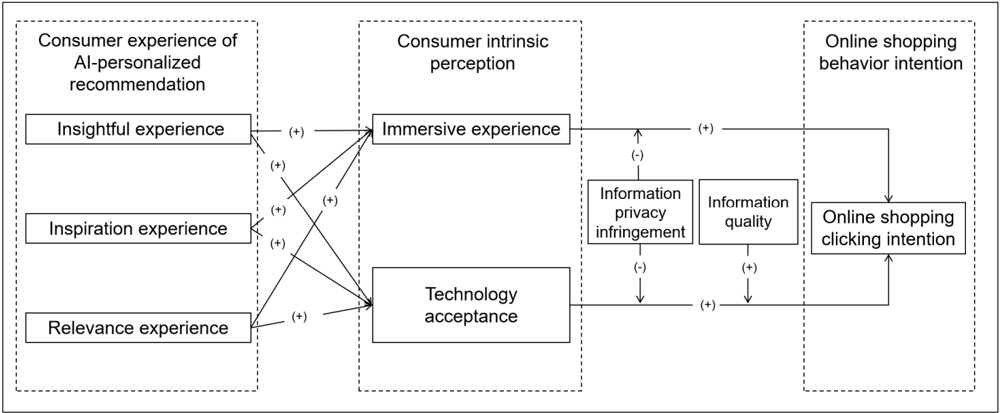
AI-personalized recommendation technology offers more accurate and diverse choices to consumers and increases click-through rates and sales on e-commerce platforms. Yet, data on consumers’ experiences of AI-personalized recommendations and their impact path on clicking intention are scarce. This article addressed these issues through three studies. In study 1, we adopted the Grounded Theory approach to conduct in-depth interviews with 30 Chinese consumers and constructed a scale to measure the impact of consumer experience on click intention. In study 2, we adopted the empirical research method to conduct reliability and validity tests on 347 valid questionnaires to finalize the scale officially. In study 3, based on the SOR theory, we constructed a model and formulated hypotheses and then conducted empirical analysis using 1097 valid questionnaires. We found that the relevance, inspiration, and insightful experiences of AI-personalized recommendations can significantly promote consumers’ clicking intention. Moreover, immersive experience mediates between the former three factors and clicking intention, and technology acceptance mediates between relevance, inspiration, and clicking intention. When consumers perceive a high degree of information privacy infringement, the immersive experience’s positive impact on clicking intention will be weakened. Meanwhile, the promoting effect of technology acceptance on clicking intention will also be inhibited. When information quality improves, the positive impact of technology acceptance on clicking intention will be enhanced. This research fills the gap in the literature on consumers’ experiences of AI-personalized recommendations and clarifies how these experiences affect the clicking intention. It offers valuable insights for e-commerce platforms to continuously optimize personalized recommendation algorithms and boost the click conversion rate of online shopping.
Verified 2026-11-22 · 1 reference not checked yet
Overview
CoChat Summary
TL;DR
This paper develops and validates a scale for Chinese consumers’ experience with AI-personalized recommendations and tests an SOR model linking relevance, inspiration, and insightful experiences to online clicking intention via immersive experience and technology acceptance, with information privacy infringement and information quality as moderators. Across three studies, most hypothesized paths were supported, except technology acceptance did not mediate the insightful experience–clicking intention path and information quality did not moderate the immersive experience–clicking intention path.
Key findings
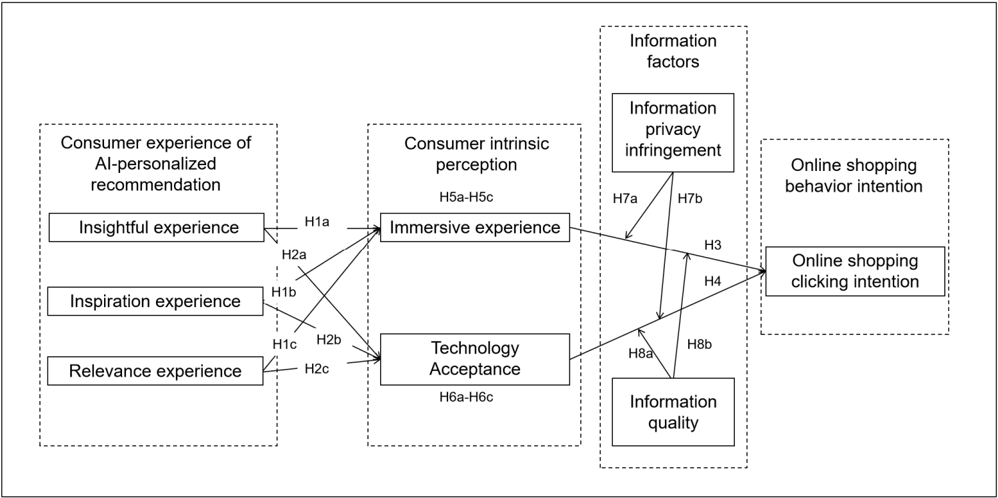
- Relevance, inspiration, and insightful experiences significantly promoted immersive experience (coefficients 0.441, 0.501, 0.652) and technology acceptance (0.25, 0.157, 0.313); immersive experience (0.291) and technology acceptance (0.099) promoted online clicking intention.
- Immersive experience mediated the effects of insightful, inspiration, and relevance experiences on clicking intention (indirect effects 0.074, 0.077, 0.091). Technology acceptance mediated inspiration (0.010) and relevance (0.015) but not insightful experience (0.010; bootstrap confidence interval included 0).
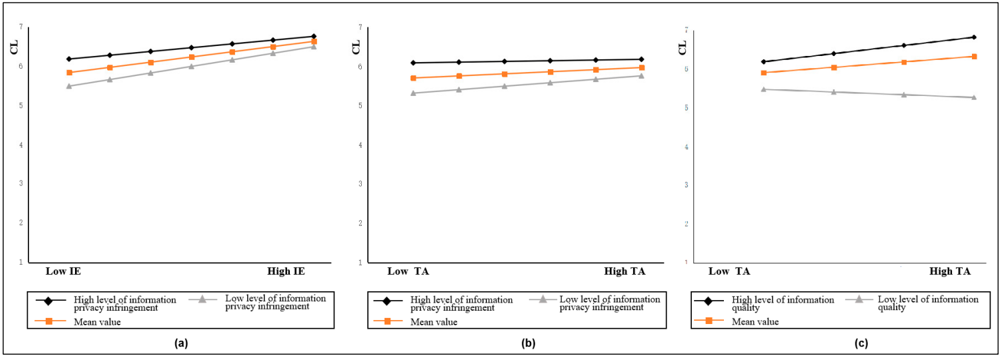
- Information privacy infringement negatively moderated immersive experience–clicking intention (−0.054, p = 0.003) and technology acceptance–clicking intention (−0.053, p < 0.01). Information quality positively moderated technology acceptance–clicking intention (0.047, p < 0.01) but did not moderate immersive experience–clicking intention (0.006, not supported).
- Scale development produced a final 36-item scale after EFA/CFA; the qualitative study extracted 60 initial concepts, 22 subcategories, and four main categories from 30 interviews.
Methods
- Study 1 used Grounded Theory with semi-structured, in-depth interviews of 30 Chinese online shopping consumers (23 interviews coded, 7 used for theoretical saturation testing), followed by open, axial, and selective coding.
- Study 2 collected 347 valid questionnaires and used SPSS 26.0 for reliability and exploratory factor analysis and AMOS 23.0 for confirmatory factor analysis to finalize the scale.
- Study 3 tested an SOR-based model with 1097 valid questionnaires from 1368 distributed via Credamo (86.8% effective rate), using a 7-point Likert scale, regression, bootstrap mediation, and moderation analyses in SPSS 26.0 and AMOS 23.0.
Limitations
- The paper states that findings may not apply to other countries and cultures, are limited to AI-personalized recommendations on online shopping platforms, and exclude short-video e-commerce; the qualitative interview sample was limited, and memory bias and expression ability may have affected answers and information quality.
- The paper also states that cultural differences limit applicability and that Grounded Theory interviews were restricted by consumers’ shopping experiences and expressive abilities.
- Evident from the text: the dependent variable is self-reported clicking intention rather than observed click behavior, and the sample is skewed (e.g., 65.72% female, 72.47% bachelor’s degree, 94.70% Taobao users), which may limit generalizability.
Model-written summary. Check it against the paper before relying on it.
Integrity signals
Registry
Cites
Statistics
Figures

Verification
Claims the paper makes
24 Valid · 12 Not valid · 46 Not checked · 149 Own results and interpretations
The cited sources that could be checked couldn’t confirm or dispute this claim.
In the paper
“Through interviews with 30 consumers and analysis of the related literature, it was found that in online shopping, information privacy infringement most frequently occurs in identifying information obtained from mobile phone calls and WeChat as well as in the cross-platform dissemination of data [139].”
§ The Impact of AI-Personalized Recommendations on Clicking Intentions: Evidence from Chinese E-Commerce > 6.2. Validating the Path of the Consumer Experience of AI-Personalized Recommendations on Clicking Intention Online
What the sources say
- Could not verifycites [139] Zhang, X., and Yu, X. (2020). The impact of perceived risk on consumers’cross-platform buying behavior. Front. Psychol., 11. sourceExperimental — accuracy not yet measured
The Research Method > Questionnaire Design describes an online questionnaire distributed through WeChat, not interviews with 30 consumers. Searches for privacy infringement, identifying information from phone calls or WeChat, and cross-platform data dissemination found no passage reporting where such infringement most frequently occurs. The Strengths and Limitations section mentions difficulty protecting participants’ personal information, but does not address the claimed finding; page numbers are unavailable in our copy. (LLM, conf=0.76)
plain- Asserted: passes — The authors put it forward as true.
- Checkable: passes — It can be checked against evidence.
- Load-bearing: unclear — It is unclear whether the paper’s conclusions depend on it.
- Based: passes — The paper gives a reason why it holds.
- Could not verify
The sources with a verdict support this claim; the rest weren’t checked yet, have no full text we could read, or their verdicts aren’t rated yet.
In the paper
“We found that, unlike previous research, which treated the usefulness and ease of use of technologies or information systems as independent variables, in AI-personalized recommendation applications, consumers' technology acceptance has blurred the boundaries between usefulness and ease of use, completely breaking the boundaries between them [104,105].”
§ The Impact of AI-Personalized Recommendations on Clicking Intentions: Evidence from Chinese E-Commerce > 6.1. Enriched Scales of Consumer Experience-Behavior Relationship in AI-Personalized Recommendation
What the sources say
- Supportedcites [104] Keni, 2020, How perceived usefulness and perceived ease of use affecting intent to repurchase?, J. Manaj. Hutan Trop. source
The citation supports the sentence’s description of previous research, not the citing authors’ finding about AI-personalized recommendations. In Methods, Keni measures perceived usefulness and perceived ease of use as separate variables; the Outer Model Analysis tests their effects separately. The paper does not study AI-personalized recommendations, but that conclusion is presented as the citing authors’ own finding. (LLM, conf=0.88)
- Not checked — no full text of the sourcecites [105] Caffaro, 2020, Drivers of farmers’ intention to adopt technological innovations in Italy: The role of information sources, perceived usefulness, and perceived ease of use, J. Rural Stud. source
plainstates a cause- Asserted: passes — The authors put it forward as true.
- Checkable: passes — It can be checked against evidence.
- Load-bearing: passes — The paper’s conclusions depend on it.
- Based: passes — The paper gives a reason why it holds.
- Supported
A result the paper reports from its own data — it cites no other source for it, so there is none to check. The quote shows it is in the paper.
In the paper
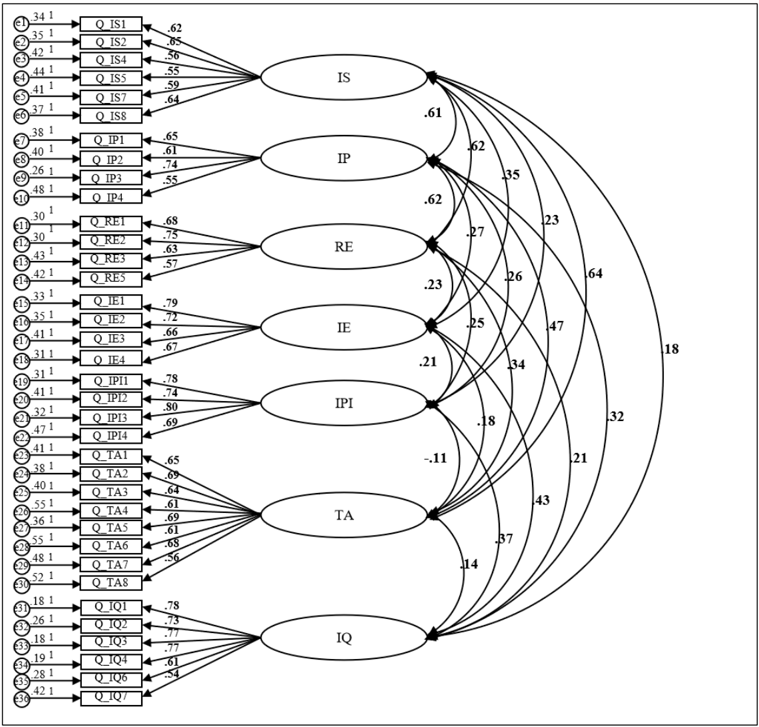
“Therefore, the items Q_RE7, Q_RE8, Q_IQ5, and Q_IS6, with a standardized factor loading lower than 0.5, were deleted.”
§ The Impact of AI-Personalized Recommendations on Clicking Intentions: Evidence from Chinese E-Commerce > 3.2.1. Exploratory Factor Analysis (EFA)
plain- Asserted: passes — The authors put it forward as true.
- Checkable: passes — It can be checked against evidence.
- Load-bearing: passes — The paper’s conclusions depend on it.
- Based: passes — The paper gives a reason why it holds.
A result the paper states — it cites no source for it, so there is none to check. The quote shows it is in the paper.
In the paper
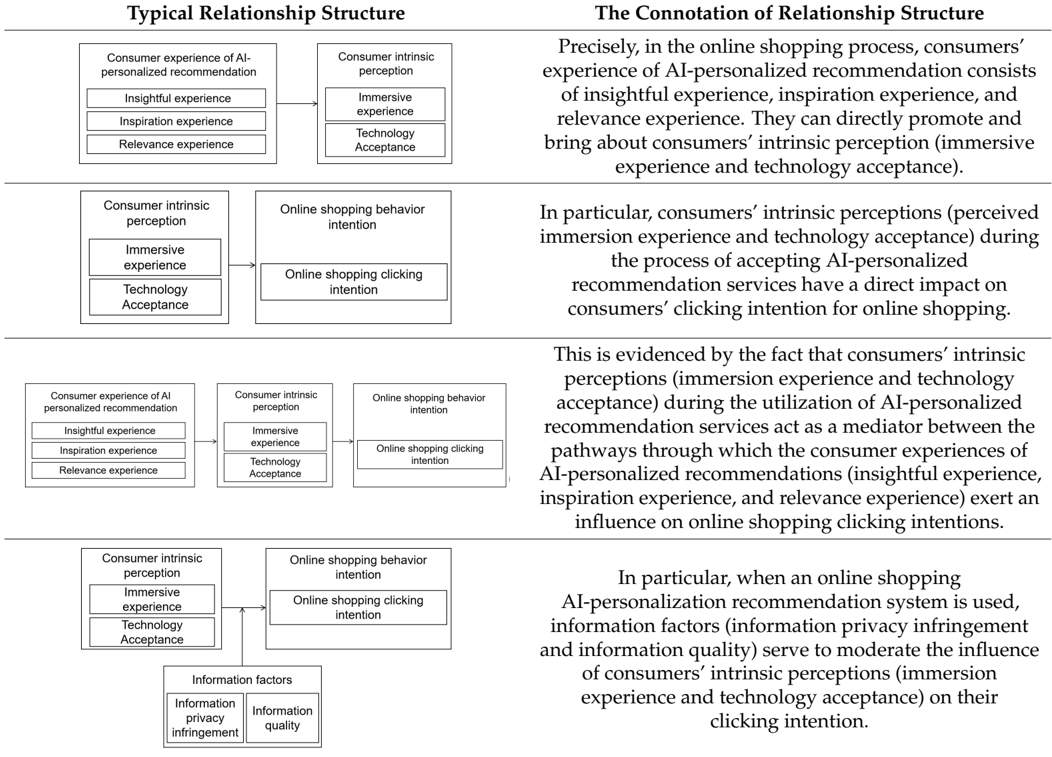
“(4) information factors (perceived information privacy infringement and information quality) play a moderating role in the process of consumers' intrinsic perception of AI-personalized recommendation system use on online clicking intention.”
- Also stated in: § Typical Relationship Structure · plain
“In particular, when an online shopping AI-personalization recommendation system is used, information factors (information privacy infringement and information quality) serve to moderate the influence of consumers' intrinsic perceptions (immersion experience and technology acceptance) on their clicking intention.”
§ The Impact of AI-Personalized Recommendations on Clicking Intentions: Evidence from Chinese E-Commerce > 2.2.3. Selective Coding
plainstates a possible cause- Asserted: passes — The authors put it forward as true.
- Checkable: passes — It can be checked against evidence.
- Load-bearing: passes — The paper’s conclusions depend on it.
- Based: passes — The paper gives a reason why it holds.
- Also stated in: § Typical Relationship Structure · plain
A result the paper reports from its own data — it cites no other source for it, so there is none to check. The quote shows it is in the paper.
In the paper
“When consumers perceive a high degree of information privacy infringement, the immersive experience's positive impact on clicking intention will be weakened.”
- Also stated in: § Typical Relationship Structure · plain
“In particular, when an online shopping AI-personalization recommendation system is used, information factors (information privacy infringement and information quality) serve to moderate the influence of consumers' intrinsic perceptions (immersion experience and technology acceptance) on their clicking intention.”
§ The Impact of AI-Personalized Recommendations on Clicking Intentions: Evidence from Chinese E-Commerce > Abstract
plainstates a possible cause- Asserted: passes — The authors put it forward as true.
- Checkable: passes — It can be checked against evidence.
- Load-bearing: passes — The paper’s conclusions depend on it.
- Based: passes — The paper gives a reason why it holds.
- Also stated in: § Typical Relationship Structure · plain
82 more claims
Create a free account to see all 231 claims and to verify the 15 references still open.
- Probably not a substantial claim. 112
- It may state two separate claims as one. 64
- The quote only partly states this claim. 2
Claims other papers make about this one
Each is checked against this paper’s own text: does it say what the citing paper says it does?
The source backs part of the claim, not all of it — or backs it for a different population, condition or comparison.
In the citing paper
“Yin et al. (2025) [29] demonstrated that the advantages of AI-PPR-such as relevance, inspiration, and insight-help accurately match users' real needs and provide them with functional information and product reviews, thereby significantly enhancing their spontaneous buying intention.”
From Exploring the Mechanism of AI-Powered Personalized Product Recommendation on Generation Z Users’ Spontaneous Buying Intention on Short-Form Video Platforms: A Perceived Evaluation Perspective (2025) · cites this paper as [29]
Experimental — accuracy not yet measured
Self-check
Percentages, sums and reported differences re-computed from the paper’s own numbers.
Each contradiction between two passages listed here was confirmed by an independent check.
Rated major: it would touch a result — a value a result rests on, reported and recomputed p-values on opposite sides of the significance level, two passages that conflict with no sign which is right, or a cited work retracted before this paper was published.
In the paper
§ The Impact of AI-Personalized Recommendations on Clicking Intentions: Evidence from Chinese E-Commerce > 6.2. Validating the Path of the Consumer Experience of AI-Personalized Recommendations on Clicking Intention Online
“As verified by hypotheses H6a-b, consumers form an acceptance of the technology based on their perception of the relevance of the recommended products, and this acceptance will be further transformed into actual online click intention.”
§ The Impact of AI-Personalized Recommendations on Clicking Intentions: Evidence from Chinese E-Commerce > 5.2. Hypothesis Test of Mediating Effect Relationship
“Therefore, H5a, H5b, H5c, H6b, and H6c are supported.”
Rated minor: it would not touch a result — a value no result rests on, a p-value that stays on the same side of the significance level, or a conflict that is clerical, resolved elsewhere in the paper, or outside its own findings.
In the paper
§ The Impact of AI-Personalized Recommendations on Clicking Intentions: Evidence from Chinese E-Commerce > H8a. The information quality exerts a moderating influence on the relationship between technology acceptance and online clicking intention.
“H8a. The information quality exerts a moderating influence on the relationship between technology acceptance and online clicking intention.”
§ The Impact of AI-Personalized Recommendations on Clicking Intentions: Evidence from Chinese E-Commerce > 5.3. Hypothesis Test of Moderating Effect Relationship
“After adding the interaction term between immersive experience and information quality to regression equation M14, the R 2 value of M15 remained unchanged; thus, hypothesis H8a is not supported (see Table 13).”
Rated minor: it would not touch a result — a value no result rests on, a p-value that stays on the same side of the significance level, or a conflict that is clerical, resolved elsewhere in the paper, or outside its own findings.
In the paper
§ The Impact of AI-Personalized Recommendations on Clicking Intentions: Evidence from Chinese E-Commerce > 5.2. Hypothesis Test of Mediating Effect Relationship
“The mediating effects of technology acceptance between insightful experience, inspiring experience, and relevant experience and online clicking behavioral intention were, respectively, 0.01 (p < 0.001), 0.01 (p < 0.001), and 0.015 (p < 0.001).”
§ The Impact of AI-Personalized Recommendations on Clicking Intentions: Evidence from Chinese E-Commerce > Characteristic Item Sample Size Proportion
“| IS-TA-CL | Indirect effect | 0.010 | 0.0062 | -0.0008 | 0.0234 | | Unsupported |”
Rated minor: it would not touch a result — a value no result rests on, a p-value that stays on the same side of the significance level, or a conflict that is clerical, resolved elsewhere in the paper, or outside its own findings.
In the paper
§ The Impact of AI-Personalized Recommendations on Clicking Intentions: Evidence from Chinese E-Commerce > 3.2.1. Exploratory Factor Analysis (EFA)
“the values on the diagonal line are more significant than the correlation coefficient under the line, indicating that the discriminant validity of the model is good (see Table 5).”
§ The Impact of AI-Personalized Recommendations on Clicking Intentions: Evidence from Chinese E-Commerce > Characteristic Item Sample Size Proportion
“| IS | 0.622 *** | 0.614 | - | - | - | - | - |”
Rated minor: it would not touch a result — a value no result rests on, a p-value that stays on the same side of the significance level, or a conflict that is clerical, resolved elsewhere in the paper, or outside its own findings.
In the paper
“1368 questionnaires were distributed through Credamo, an online survey platform, and 1097 questionnaires were effectively recovered, with an effective rate of 86.8%.”
§ The Impact of AI-Personalized Recommendations on Clicking Intentions: Evidence from Chinese E-Commerce > 4.2. Materials
Reported 86.8 · recomputed 80.190058
Citations
Cites
Evaluating Structural Equation Models with Unobservable Variables and Measurement Error
Fornell, C., & Larcker, D. F. (1981) · Journal of Marketing Research · doi:10.2307/3151312 · Cited by 109,314
Evaluating structural equation models with unobservable variables and measurement error
Fornell, C., & Larcker, D. F. (1981) · Journal of Marketing Research · doi:10.1177/002224378101800104 · Cited by 109,190 · cited 1×
“The immersive experience of AI-personalized recommendations will positively influence online clicking intention.”
Practical issues in structural modeling
BENTLER, P. M., & CHOU, C.-P. (1987) · Sociological Methods & Research · doi:10.1177/0049124187016001004 · Cited by 5,804 · cited 1×
“This novel and person-J alized information has the potential to capture consumers’ attention, thereby enhancing their engagement in the shopping process.”
How artificial intelligence will change the future of marketing
Davenport, T., Guha, A., Grewal, D., & Bressgott, T. (2020) · Journal of the Academy of Marketing Science · doi:10.1007/s11747-019-00696-0 · Cited by 2,875 · cited 1×
“Technology acceptance plays a mediating role between relevance experience and online clicking intention.”
A strategic framework for artificial intelligence in marketing
Huang, M.-H., & Rust, R. T. (2021) · Journal of the Academy of Marketing Science · doi:10.1007/s11747-020-00749-9 · Cited by 2,059 · cited 1×
“This may take the form of the “Guess Your Favorite” or “Look and See” intelligent push component of online shopping platforms [14].”
Flow and the Foundations of Positive Psychology: The Collected Works of Mihaly Csikszentmihalyi
Csikszentmihalyi, M. (2014) · doi:10.1007/978-94-017-9088-8 · Cited by 1,653
Consumers and artificial intelligence: An experiential perspective
Puntoni, S., Reczek, R. W., Giesler, M., & Botti, S. (2021) · Journal of Marketing · doi:10.1177/0022242920953847 · Cited by 1,547 · cited 1×
“After unrotated factor analysis of all questionnaire items, the highest explanatory factor variance contribution rate was 38.86%, indicating that the common method bias problem in this study is not significant.”
InfluentialKim, M. J., Lee, C.-K., & Jung, T. (2020) · Journal of Travel Research · doi:10.1177/0047287518818915 · Cited by 1,333 · cited 1×
“…of online reviews on consumers’ online purchase intention [40], the influencing mechanism of impulse purchase behavior in the context of e-commerce live-streaming [41,42], consumer behavior in virtual reality tourism [43], and the inhibiting factors of e-shopping in developing country markets [44].”
Deep learning modelling techniques: Current progress, applications, advantages, and challenges
Ahmed, S. F., Alam, M. S. B., Hassan, M., Rozbu, M. R., Ishtiak, T., Rafa, N., Mofijur, M., Shawkat Ali, A. B. M., & Gandomi, A. H. (2023) · Artificial Intelligence Review · doi:10.1007/s10462-023-10466-8 · Cited by 1,079 · cited 1×
“Technology acceptance plays a mediating role between relevance experience and online clicking intention.”
Customer experiences in the age of artificial intelligence
Ameen, N., Tarhini, A., Reppel, A., & Anand, A. (2021) · Computers in Human Behavior · doi:10.1016/j.chb.2020.106548 · Cited by 833
Research works printed but not linked: 16
- 11. Zhang, Y.; Lyu, W.; Zhang, J. Marketing research of AI: Prospect and challenges. J. Manag. Sci. 2019, 32, 75-86.
- 15. Song, S.; Feng, L. Consumers' demand for dual values and retail marketing innovation from new economic sociology perspective. J. Beijing Technol. Bus. Univ. (Soc. Sci.) 2019, 34, 1-11.
- 34. Mehrabian, A.; Russell, J.A. An Approach to Environmental Psychology; The MIT Press: Cambridge, MA, USA, 1974; pp. 62-65.
- 48. Xudong, J.; Liang, H. The "jungle", history, and approach road of the grounded theory. Sci. Res. Manag. 2020, 41, 151-163.
- 49. Han, X. A Mechanistic Study of the Role of E-Commerce Anchor Attributes on Consumers' Online Behavioral Intentions. Ph.D. Thesis, Jilin University, Changchun, China, 2020.
- 72. Zhang, S.; Wang, A.N.; Chen, H. Apathy dependence and immersive experience: Research on the users' continuous use intention of mobile short video APPS. Libr. Inf. Serv. 2022, 66, 89-100.
- 74. Zhou, P.; Fu, S.; Zhao, Y. Empirical Study on the Factors Influencing the Users Continuous Use of Shopping APP. J. Nanjing Norm. Univ. (Nat. Sci. Ed.) 2020, 43, 140-148.
- 75. Yang, Y.W.; Sun, G.H.; Wang, Y. Are consumers willing to adopt recommendations? Based on information systems success- technology acceptance model. J. Cent. Univ. Financ. Econ. 2016, 7, 109-117.
- 82. Hao, L. Research on the Influeneing Factors of Privacy Information Disclosure in Personalized Recommendations of AI Human- Computer Interaction Users. Inf. Stud. Theory Appl. 2024, 47, 69-80.
- 92. Zhang, Y.; Zhuang, B.; Li, Q.; Zhu, Q. Homogenization dilemma: Concept analysis and theoretical framework construction of information cocoons. J. Lib. Sci. China 2023, 49, 107-122.
- 93. Liu, K.; Li, J.; Li, G. A Comparative Study of Algorithm-Based Distribution and Editor Based Distribution from the Perspective of Information Quality. Henan Sci. Technol. 2024, 51, 139-144.
- 94. Zhang, Y.; Li, Q. Research on the Influencing Factors to Online Users' Willingness of Retention in Information Cocoons Based on PPM Theory. J. Mod. Inf. 2022, 42, 52-61.
- 95. Hou, M.; Tan, Y. A New Interpretation of the "Information Cocoon Room from the Perspective of Online Shopping Platform Users. J. Guangxi Sci. Technol. Norm. Univ. 2022, 37, 76-85.
- 97. Wang, X.H.; Zhao, B.; Liu, Z. From multi-channel to omni-channel, transformation and updating path in traditional retail enterprises under internet background: Double case study based on intime department store and Yonghui superstores. J. Beijing Technol. Bus. Univ. (Soc. Sci.) 2018, 33, 22-32.
- Wang, 2023, ‘Chasing Traffic’ or ‘Chasing Quality’: The Impact of Service Strategies of Sellers on Service Performance of Social Health Information Service Platform, CJWT, 1, 50
- Paripati, 2024, AI Algorithms for Personalization: Recommender Systems, Predictive Analytics, and Beyond. Darpan, Int. Res. Anal., 12, 51
Cited by
Huang, Y., & Liu, L. (2025) · Acta Psychologica · doi:10.1016/j.actpsy.2025.105383 · Cited by 52
Turki, H. (2025) · Technology in Society · doi:10.1016/j.techsoc.2025.103033 · Cited by 57
Papastamoulou, P., & Αντωνόπουλος, Ν. (2025) · Systems · doi:10.3390/systems13090746 · Cited by 30
Qadri, U. A., Moustafa, A. M. A., & Waqas, M. (2025) · Journal of Retailing and Consumer Services · doi:10.1016/j.jretconser.2025.104592 · Cited by 43
Theodorakopoulos, L., Theodoropoulou, A., & Klavdianos, C. (2026) · Big Data and Cognitive Computing · doi:10.3390/bdcc10020046 · Cited by 48
“AI-driven recommendations and targeted ads can increase purchase intentions when users experience them as accurate and helpful, but the same mechanisms can harm trust when consumers feel over-tracked, manipulated or profiled in opaque ways [20].”
Unwrapping generative AI paradigms for product and service innovation differentiation
Shonubi, O. A. (2026) · Journal of Strategy & Innovation · doi:10.1016/j.jsinno.2025.200562 · Cited by 20
Hu, S., Liu, J., Li, H., Yin, J., & Liu, X. (2025) · Journal of Theoretical and Applied Electronic Commerce Research · doi:10.3390/jtaer20040290 · Cited by 11
Self-citationZobair, A. S. O., Kodai, Z. M. O., Almansour, M., Mohammed, S. D. A., Agag, G., & Alipour, O. (2026) · Journal of Retailing and Consumer Services · doi:10.1016/j.jretconser.2026.104844 · Cited by 14
How AI-Driven Personalization Shapes Green Purchasing Behavior Among Youth in Java Island
Surbakti, F. P. S., Hutahaean, H. A., Inderawati, M. M. W., Madjid, J. M., Sely, L. E., & Yee, Y. M. (2025) · Sustainability · doi:10.3390/su17219600 · Cited by 23
Brand Trust in AI-Driven E-Commerce Personalization: The Well-Being–Privacy Trade-Off
Aydin, S. (2026) · Sustainability · doi:10.3390/su18021073 · Cited by 26
Khan, T., & Emon, M. M. H. (2025) · IEEE International Conference on Computing, Applications and Systems (COMPAS) · doi:10.1109/compas67506.2025.11381790 · Cited by 5
“Additionally, TRU was revealed to play a key role in positively shaping CPI, which supports earlier research emphasizing trust as a crucial mediator in online shopping decisions [7].”
InfluentialEffects of Privacy Regulatory Protection on Users’ Data Sharing in Mobile Apps
Kang, J. S., Lan, J., Huang, S., & Chen, L. (2025) · Journal of theoretical and applied electronic commerce research · doi:10.3390/jtaer20030153 · Cited by 6
Hu, J., & Lee, E. T. (2026) · Journal of theoretical and applied electronic commerce research · doi:10.3390/jtaer21010033 · Cited by 13
“Second, given that trust can significantly amplify the effect of technological stimulation, in the AR interface, it is possible to incorporate friendly prompts (such as “This virtual try-on is generated based on your preferred style”) to clarify algorithm logic and enhance transparency [11].”
Shou-fen, J., Zheng, W., & Kong, H. (2025) · Journal of theoretical and applied electronic commerce research · doi:10.3390/jtaer20040339 · Cited by 8
“Furthermore, Yin et al. [21] demonstrated that AI-powered personalized recommendations guide consumers to allocate limited attentional resources to product areas through precise matching of consumer needs with content, thereby enhancing both the intensity and stability of product attention.”
Zhong, L., Xie, Y., Yang, Y., & Zhao, Y. (2025) · Journal of theoretical and applied electronic commerce research · doi:10.3390/jtaer20040326 · Cited by 5
Wu, S. (2025) · Applied and Computational Engineering · doi:10.54254/2755-2721/2025.po26107 · Cited by 8
Roy, S. K., Arafin, M., & Ahmed, J. (2025) · Telematics and Informatics Reports · doi:10.1016/j.teler.2025.100219 · Cited by 23
Kala, D., & Chaubey, D. S. (2026) · The International Review of Retail Distribution and Consumer Research · doi:10.1080/09593969.2026.2650765 · Cited by 7
Alsaffarini, E. J., & Awwad, B. (2026) · Sustainability · doi:10.3390/su18021123 · Cited by 29
Influence of Social Media and Virtual Reality on Consumer Behavior
Amalia, F., Zahira, T., & Sekti, B. A. (2026) · Advances in computational intelligence and robotics book series · doi:10.4018/979-8-3373-2747-1.ch004 · Cited by 2
Li, Z., Yu, X., & Tian, K. (2026) · Frontiers in Public Health · doi:10.3389/fpubh.2025.1746304 · Cited by 7
Ezzaouia, I. (2026) · Journal of Services Marketing · doi:10.1108/jsm-12-2025-0884 · Cited by 2
Sanawan, S. U., Hassan, M. T., & Khalid, S. (2026) · Pakistan Journal of Commerce and Social Sciences · doi:10.64534/commer.2026.675 · Cited by 6
Bai, J., Liang, J., Gao, Y., & Feng, X. (2026) · Frontiers in Psychology · doi:10.3389/fpsyg.2026.1750808 · Cited by 5
Li, L., & Jiang, Y. (2026) · AIMS Mathematics · doi:10.3934/math.2026130 · Cited by 4
Availability Bias in AI Recommenders: Impacts on Impulse Buying
Li, X., Zhou, T., Hu, C., & Liu, H. (2025) · Journal of Computer Information Systems · doi:10.1080/08874417.2025.2547173 · Cited by 3
SyncFit: AI-powered Mobile eCommerce Application Utilising AR for Virtual Clothing Fitting
Shakeel, M. U., Ejaz, A., Ashfaq, H., et al. (2025) · doi:10.1109/acdsa65407.2025.11165966 · Cited by 1
“The integration of virtual reality (VR) powered by augmented reality (AR) has significantly influenced consumer shopping behavior post-COVID-19 [25].”
AI-Driven Chatbots and Virtual Assistants: Transforming Customer Engagement in the Digital Era
Singh, A., Singh, R., & Kour, M. (2026) · Advances in computational intelligence and robotics book series · doi:10.4018/979-8-3373-9159-5.ch009
You, Y., & She, Z. (2026) · International Journal of e-Collaboration · doi:10.4018/ijec.421477
Zhu, X., Pongsakornrungsilp, S., Pongsakornrungsilp, P., & Ekinci, Y. (2026) · Journal of theoretical and applied electronic commerce research · doi:10.3390/jtaer21090310 · Cited by 1
Kasapi, I., Shtëmbari, E., & Bogdani, E. (2026) · Journal of theoretical and applied electronic commerce research · doi:10.3390/jtaer21090298
“First, it provides evidence for a market contingency—a candidate boundary condition—of algorithmic personalization’s retention promise, in contrast with the positive effects reported in developed and large emerging markets [1,4,10].”
InfluentialDia, S., Harb, H., Khreis, M., Taşkıran, M. N., Farraj, N. A., & AlSahely, T. (2026) · Administrative Sciences · doi:10.3390/admsci16080396 · Cited by 4
“First, most empirical studies examine consumer responses within single-country frameworks, substantially limiting the generalizability of findings across different market conditions (Alalwan, 2018; Gupta et al., 2025; Yin et al., 2025).”
Why AI recommendations convert: dual trust mechanisms and divergent privacy effects
Liu, Q., & Liu, M. (2026) · Electronic Commerce Research · doi:10.1007/s10660-026-10190-9
Human-centered AI in E-commerce: Examining consumer engagement through attitude and perceived value
Alhakimi, W., Al‐Mekhlafi, A. A., Mohammed, A., & Al‐Mamary, Y. H. (2026) · Human Systems Management · doi:10.1177/01672533261476155 · Cited by 1
Sareddy, M. R., Islam, J., Hemnath, R., Kumar, S., & Dhivya (2026) · International Journal of Innovation and Technology Management · doi:10.1142/s0219877026400110
Labib, E. (2026) · Frontiers in Blockchain · doi:10.3389/fbloc.2026.1775870
Pahari, S., & Lim, W. M. (2026) · Electronic Commerce Research · doi:10.1007/s10660-026-10175-8 · Cited by 2
Nofal, R. (2026) · Journal of theoretical and applied electronic commerce research · doi:10.3390/jtaer21070229 · Cited by 5
“Prior studies demonstrate that AI recommendation systems improve perceived relevance, convenience, and decision efficiency [5,10], while AR interfaces enhance sensory engagement, spatial presence, and experiential value [6–8].”
Elsantil, Y. G. (2026) · Corporate and Business Strategy Review · doi:10.22495/cbsrv7i3art11 · Cited by 1
Evolution of cross-cultural brand adaptation: a review and future directions
Dhiman, A., & Singh, T. (2026) · Communication and Change · doi:10.1007/s44382-026-00031-6 · Cited by 2
“Expected outcomes AI Personalization (Gao & Liu, 2022; Yin et al., 2025) Uses”
Li, Y., Liu, Z., & Liu, F. (2026) · JMIR Mental Health · doi:10.2196/96331 · Cited by 3
“The affordances of specific platforms, including algorithmic recommendation intensity, content format, and interaction norms, may shape the depth of parasocial engagement and its downstream psychological consequences [22,23].”
Building Customer Engagement through Trust in AI-Based Retail Services
Lempoy, J. A., & Sari, R. K. (2026) · International Conference on Control, Decision and Information Technologies (CoDIT) · doi:10.1109/codit70676.2026.11631134
“This finding is consistent with previous studies showing that AI-driven personalization, personalized recommendations, relevance, usefulness, and trust influence consumer responses and engagement in digital retail and AI-mediated contexts [8], [9], [11], [15], [16], [17], [20].”
InfluentialZhang, A., 胡珑瑛, & Ren, X. (2026) · Electronic Commerce Research · doi:10.1007/s10660-026-10150-3
AI-driven customer experience in FinTech applications
Yadav, R. (2026) · Fintech and Digital Accounting Review · doi:10.1108/fdar-06-2025-0001
Artificial intelligence marketing for green products in E-commerce supply chain
Cui, X., Yu, Z., Sun, J., & Li, Y. (2026) · Asia Pacific Journal of Marketing and Logistics · doi:10.1108/apjml-10-2025-2185 · Cited by 2
Wang, L. Y., Wu, J., Feng, W., Li, Y., & Liu, Q. (2026) · Information & Management · doi:10.1016/j.im.2026.104382
Mubashshir, Khan, M. A., Anas, M., & Adil, M. (2026) · SN Business & Economics · doi:10.1007/s43546-026-01166-w · Cited by 1
“Furthermore, Stimulus–Organism–Response (SOR) paradigm, Flow Theory, and valence-based frameworks help in explaining the consumers’ emotional and cogni - tive mechanisms that impact consumers’ shopping outcomes on AI-driven platforms (Yin et al. 2025 ).”
User Satisfaction Analysis of QPON Indonesia Using TAM-IPA
Nabila, A., & Waluyo, M. (2026) · Academia Open · doi:10.21070/acopen.11.2026.14016
How AI Tools Affect the Customer Experience: a case study
Boulkara, A., & Khadich, G. (2026) · Dutch Journal of Finance and Management · doi:10.55267/djfm/18558
Rachmat, B. (2026) · Innovative Marketing · doi:10.21511/im.22(2).2026.13 · Cited by 2
From Experience to Advocacy: The Role of Outcome Expectations in Driving Brand Evangelism
Narangajavana, Y., Narangajavana, Y., Blas, S. S., & Garrigós‐Simón, F. J. (2026) · Journal of theoretical and applied electronic commerce research · doi:10.3390/jtaer21050145 · Cited by 1
Prediction of AI-Driven Elements on E-Procurement Decision of Gen Z in Vietnam
Truong, T.-K. H. V., & Tieu, U. T. T. (2026) · ASU International Conference in Emerging Technologies for Sustainability and Intelligent Systems (ICETSIS) · doi:10.1109/icetsis68266.2026.11549295
“Yin, Qiu, and Wang [16] discovered that the perceived relevance of personalised recommendations enhances positive experiences on platforms and influences product selection decisions, which are essential precursors to purchase decisions.”
Wahyudi, M. A. (2026) · Ilomata International Journal of Management · doi:10.61194/ijjm.v7i2.2098 · Cited by 2
“E-commerce platforms such as Tokopedia, Shopee, and Lazada dominate the Indonesian marketplace, yet the ways in which AI strategies, privacy perceptions, and service quality influence long-term customer commitment are still under-researched (Owen & Moore, 2023; Yin et al., 2025).”
Tran, H. M. N., Que, A. P. N., & Nguyen, T. T. (2026) · International Conference on Knowledge Engineering and Communication Systems (ICKECS) · doi:10.1109/ickecs70176.2026.11527869
“Work on AI personalized recommendations also connects the experience of recommendations to early behavioral intentions such as clicking, which hints that the perceived relevance of recommendations may increase attention and consideration in the beginning of the decision path [5].”
Jung, Y., & Govindarazan, K. (2026) · CHI Conference Extended Abstracts on Human Factors in Computing Systems (CHI EA) · doi:10.1145/3772363.3798763
Wang, L., Wang, Y., Li, X., Zhang, J., & Zhao, Y. (2026) · Information Technology and People · doi:10.1108/itp-10-2024-1272
Self-citationGao, L., & Wang, X. (2026) · Administrative Sciences · doi:10.3390/admsci16040175
Li, Y., Liu, Z., & Liu, F. (2026) · doi:10.2196/preprints.96331
ARTIFICIAL INTELLIGENCE IN CHINA'S RETAIL INDUSTRY: A SYSTEMATIC LITERATURE REVIEW
Haidong, Z., & Abdullah, Z. (2026) · Journal of Information System and Technology Management · doi:10.35631/jistm.1142013
QIUHAN, Z., Qin, C., Lu, Z., & Sun, Y. (2026) · Technological Forecasting and Social Change · doi:10.1016/j.techfore.2026.124611 · Cited by 2
Efrizoni, L., Junadhi, & Agustin (2026) · Matrik Jurnal Manajemen Teknik Informatika dan Rekayasa Komputer · doi:10.30812/matrik.v25i2.5988
“In addition, research in [4] highlights that users’ affective and emotional responses toward content significantly influence perceived relevance, indicating that click-based prediction alone no longer adequately represents user satisfaction.”
Zheng, Y.-H., Li, H., Xu, T., Li, C.-Y., & LIN, L.-Z. (2026) · Libri · doi:10.1515/libri-2025-0166
“…with the rapid development of mobile communication, e-commerce technology, and AI technology, a large number of smartphone applications have embedded similar IOS for the virtual governance of individual customers, especially online shopping apps and their accompanying CRM systems (Yin et al. 2025).”
WHAT DETERMINES THE USAGE OF ARTIFICIAL INTELLIGENCE IN ONLINE SHOPPING?
Singh, S. (2026) · International Journal of Research -GRANTHAALAYAH · doi:10.29121/granthaalayah.v14.i1.2026.7090
THE EFFECTS OF ARTIFICIAL INTELLIGENCE IN E-COMMERCE
Eshaq, S. B. (2026) · İstanbul Ticaret Üniversitesi Girişimcilik Dergisi · doi:10.55830/tje.1701074
Mansoor, R., Rūtelionė, A., & Bhutto, M. Y. (2026) · Sustainability · doi:10.3390/su18010495 · Cited by 2
Investigating the Use of AI in E-Business by the Shoprite Holdings Group
Khan, Z., Saurombe, B., & Maluleka, R. (2026) · Lecture notes in computer science · doi:10.1007/978-3-032-13167-6_17
Yang, F. (2026) · Management for professionals · doi:10.1007/978-981-95-9430-6_1
Suhud, U., Caniago, D. P., Sihotang, D. S., et al. (2026) · EPJ Web of Conferences · doi:10.1051/epjconf/202637706017 · Cited by 1
Predictive Analytics and AI-Driven Personalisation in Online Shopping Decisions
Sadiqova, L., Mardan, M. M., & Mikayıl, A. A. (2026) · Lecture notes in networks and systems · doi:10.1007/978-3-032-15926-7_51
Qualified, N., & Kashyap, K. (2025) · Exploresearch. · doi:10.62823/exre/2025/02/04.129
Guerrero, A. R. C., Rogel, A. J. P., & Espinoza, N. J. T. (2025) · Sciencevolution · doi:10.61325/ser.v4i4.230 · Cited by 1
KADIN GİRİŞİMCİLERİN ONLİNE SATIN ALMA NİYETİNDE YAPAY ZEKA İLE ÜRÜN KİŞİSELLEŞTİRMEYE BAKIŞ
ONAY, P. E. (2025) · Hakkari Review · doi:10.31457/hr.1821948
Waghmare, G., Sasane, J. J., Ahengar, N. A., Sule, B., Mathkoor, M. M., & Mudhafar, M. (2025) · IEEE International Conference on ICT in Business Industry & Government (ICTBIG) · doi:10.1109/ictbig68706.2025.11323784
“AI systems that protect data privacy and can grow have been created [8].”
Hamali, S., Darmo, I. S., & Meliala, J. S. (2025) · International Seminar on Research of Information Technology and Intelligent Systems (ISRITI) · doi:10.1109/isriti68345.2025.11393261
Zhu, C. (2025) · Convergence The International Journal of Research into New Media Technologies · doi:10.1177/13548565251403582 · Cited by 5
Anindita, F. A. (2025) · International Conference on Software and e-Business (ICSEB) · doi:10.1145/3789037.3789046
Benetthan, B., Winata, T. G., & Hidayat, D. (2025) · International Conference on Emerging Trends in Information Systems and Informatics (ICETISI) · doi:10.1109/icetisi67983.2025.11406008
Xie, Y., & Saedon, M. A. M. (2025) · International Conference on Artificial Intelligence, Digital Media Technology and Interaction Design (ICADI) · doi:10.1145/3795926.3796008 · Cited by 1
Garidzira, T. C., Matobobo, C., & Vambe, W. T. (2025) · International Multidisciplinary Information Technology and Engineering Conference (IMITEC) · doi:10.1109/imitec67386.2025.11410443
“Behavioural segmentation reveals distinct patterns such as high-spending loyal buyers, frequent bargain-seekers, and seasonal shoppers, each showing unique purchase triggers and engagement styles as supported by [24], [25], [26].”
El rol del marketing digital en la optimización del comercio electrónico y la logística
Vargas, E. Y. M., Plaza, I. A. C., Rojas, E. R. C., & Terán, H. E. E. (2025) · Religación · doi:10.46652/rgn.v10i48.1574
The impact of AI identity on consumer behavior in the use of AI-enabled recommendation systems*
Peng, B., Xu, Y., & Deng, H. (2025) · Conference proceedings/Conference proceedings - IEEE International Conference on Systems, Man, and Cybernetics · doi:10.1109/smc58881.2025.11342790
Consumer Experience and Loyalty in the Metaverse: A Systematic Review
Bowo, F. A., Rahim, A. R., & Nut, N. (2025) · Jurnal Manajemen Akuntansi Ekonomi · doi:10.59066/jmae.v4i2.1739
Karthikeyan, G., V, Basha, S. R., Al-Milli, N., et al. (2025) · doi:10.1109/icriset64803.2025.11252443
“Nonetheless, there was less research on experiences of consumers with these types of suggestions and its impact on the intention to click [13].”
Management in the Digital Era: Harnessing Knowledge Machines for Strategic Innovation
Rajkumar, Greeshmapavithran, Marques, V., Audia, C., & González, R. A. (2025) · Management Sustainability and Life Span · doi:10.64780/msl.v1i1.117 · Cited by 1
Research on Cross-Border E-Commerce Advertising and Marketing
徐, 一. (2025) · E-Commerce Letters · doi:10.12677/ecl.2025.1451551
Metadata
- Authors
- Yin, J., Qiu, X., & Wang, Y.
- Affiliations
- Beijing Jiaotong University (CN)
- Corresponding author
- Qiu, Xiaodong
- Venue
- Journal of Theoretical and Applied Electronic Commerce Research
- Publisher
- MDPI AG
- Published
- 2025-02-05
- Volume
- 20
- Issue
- 1
- Pages
- 21
- ISSN
- 0718-1876 (ISSN-L)
- OpenAlex
- W4407152861
- Semantic Scholar
- 84d2389f4d375c1db81cb208a166739180be2274
- Cited by
- 103
- References
- 134
- Citations by year
- 2026: 73 · 2025: 30
- FWCI
- 106.16
- Type
- journal article
- Language
- en
- Open access
- gold
- doi.org
- Licence
- Locations
- Journal of theoretical and applied electronic commerce research (publishedVersion, cc-by)
- DOAJ (DOAJ: Directory of Open Access Journals) (submittedVersion)
- Funders
- National Social Science Foundation (15AGL002)
- Topics
- Physical Sciences › Computer Science › Information Systems › Recommender Systems and Techniques
- Social Sciences › Business, Management and Accounting › Marketing › AI in Service Interactions
- Social Sciences › Decision Sciences › Information Systems and Management › Technology Adoption and User Behaviour
- Keywords
- customer experience, relevance, inspiration, insight, immersive experience, technology acceptance, information quality, e-commerce, click-through rate, Chinese consumers
About these checks
Registry, retraction, Cites and statistics results are computed, not judged, with one exception: a printed reference that no index lists is read once by a model before it counts as a citation error. Claims are extracted by a model and kept only when their quote appears verbatim in the text; each cited source is then checked, with a model’s help, for whether it says what the claim relies on. Those verdicts can be wrong — read the claim’s quote and the cited source before relying on one.
The claim verdicts this report counts are experimental: their accuracy is not yet measured.
A language model drew the claims from the paper on 2026-09-28, under version 3 of the claim definition (prompt extract-v3).
A second model labelled each claim on 2026-09-28 (model jev-1.13-20260917, definition revision gold-guideline-v0.2).
Cited sources are checked with a language model’s help (gpt-6-sol).
Statistics and arithmetic are recomputed, not judged.
Confidence bands are shown only for fields calibrated on our annotated test set. None is calibrated yet, so no band is shown.
What counts as a claim ›How we measure confidence ›How we check this ›
Are you an author, or do you see a problem with this page? Request a review
Data sources
Bibliographic data: Semantic Scholar, OpenAlex, Crossref.
Contains information from the Semantic Scholar Academic Graph Datasets, made available under the ODC Attribution License (ODC-BY 1.0).
Semantic Scholar’s data is described in: Kinney, R., et al. (2023). The Semantic Scholar Open Data Platform. arXiv:2301.10140.
