

The DOI matches its Crossref record.
A Systematic Comparison of Cultural and Ecological Landscape Corridors in Europe
Abstract
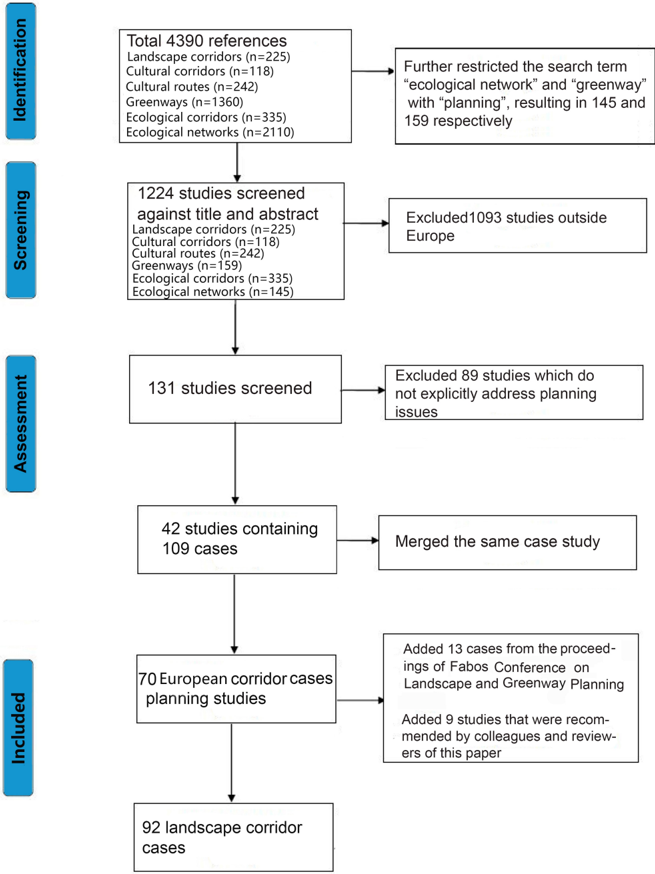
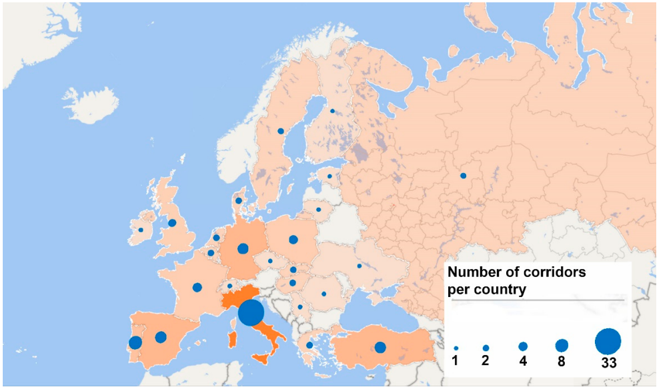
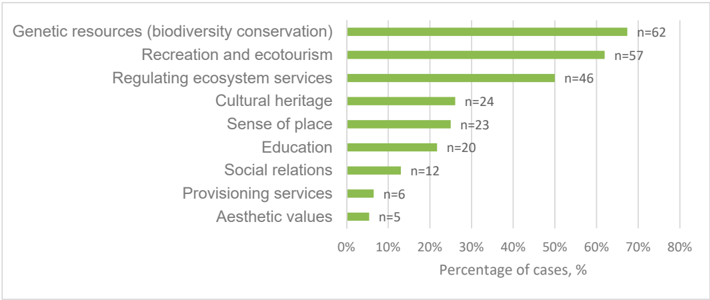
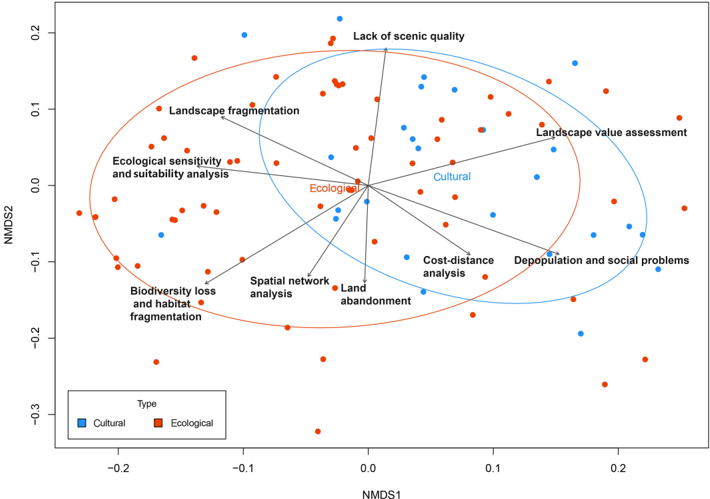
Landscape corridors are narrow strips of land that differ from the matrix on either side. In addition to providing connectivity between fragmented landscapes, these corridors serve scenic, cultural, social, ecological, and recreational purposes. We systematically reviewed reports and studies related to 92 cultural and ecological landscape corridors in Europe, focusing, in particular, on their planning and management, problems addressed, approaches and tools used, stakeholders involved and spatial scales. Biodiversity conservation was found to be the most frequently stated aim (67% of the cases), followed by recreation and tourism (62%). The planning processes for cultural and ecological landscape corridors were dominated by similar, quite narrow, stakeholder groups, but via a wide variety of approaches and tools. Ecological corridors existed at larger and more variable scales relative to cultural landscape corridors. Significant differences were found in many aspects of the two types of corridors, although a complete separation of the two categories was difficult since most of the cases reviewed were designed to serve multiple aims. We close the paper by making a few recommendations for decision makers concerning future corridor planning.
Overview
The claims and statistics of this paper haven’t been checked yet.
Run the check — free, no account needed. It reads the open-access text and checks the sources it cites.
Integrity signals
Registry
Cites
Statistics
Figures
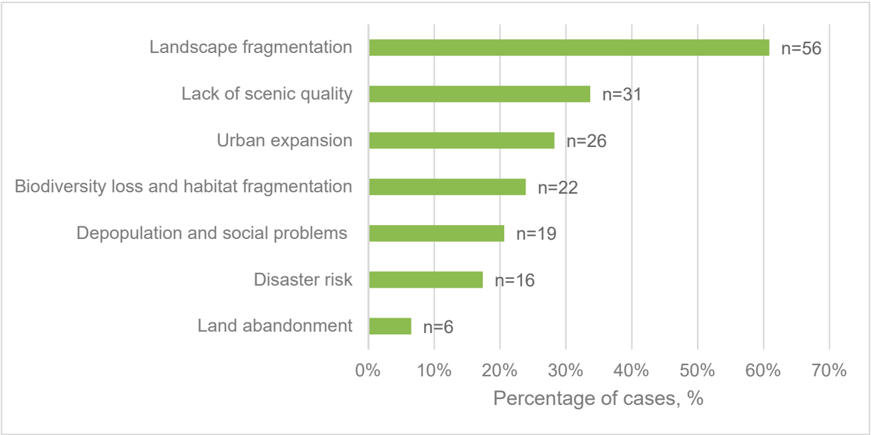
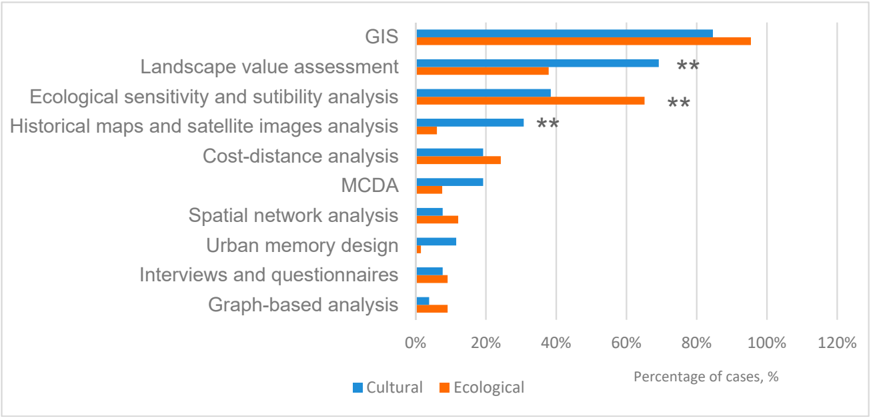
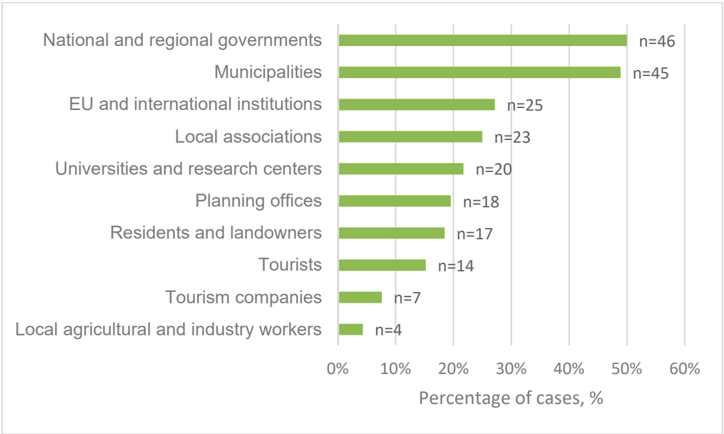
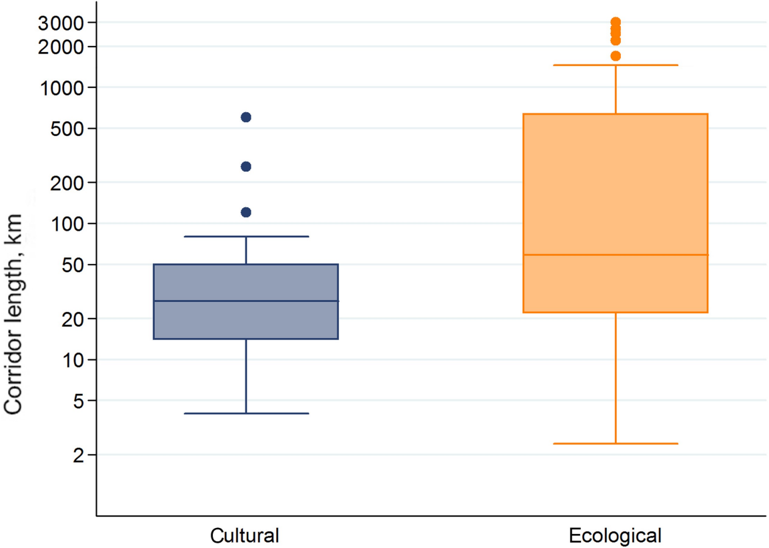
Verification
Claims the paper makes
The claims and statistics of this paper haven’t been checked yet.
Run the check — free, no account needed. It reads the open-access text and checks the sources it cites.
Claims other papers make about this one
Each is checked against this paper’s own text: does it say what the citing paper says it does?
The source backs part of the claim, not all of it — or backs it for a different population, condition or comparison.
In the citing paper
“Academic contributions have emphasized the significant role of cultural corridor construction in promoting regional development 50 .”
From Circuit theory-based cultural heritage corridor network development in qin river basin (2025) · cites this paper as [50]
Experimental — accuracy not yet measured
Self-check
Percentages, sums and reported differences re-computed from the paper’s own numbers.
The self-check needs the paper’s full text.
Citations
Cites
No references could be resolved yet.
Research works printed but not linked: 109
- Forman, R.T.T., and Godron, M. (1986). Landscape Ecology, Wiley.
- Rosenberg, 1997, Biological corridors: Form, function, and efficacy, BioScience, 47, 677, 10.2307/1313208 · DOI
- Hilty, J., Lidicker, W., and Merenlender, A. (2006). Corridor ecology: The Science and Practice of Connectivity for Biodiversity Conservation, Island Press.
- Hoppert, 2018, The saale-Unstrut cultural landscape corridor, Environ. Earth Sci., 77, 58, 10.1007/s12665-017-7222-4 · DOI
- Blicharska, 2013, Integrating ecological, social and cultural dimensions in the implementation of the Landscape Convention, Landsc. Res., 38, 384, 10.1080/01426397.2011.650629 · DOI
- Shishmanova, 2015, Cultural tourism in cultural corridors, itineraries, areas and cores networked, Procedia Soc. Behav. Sci., 188, 246, 10.1016/j.sbspro.2015.03.382 · DOI
- Lafortezza, 2013, Green infrastructure as a tool to support spatial planning in European urban regions, iForest-Biogeosci. For., 6, 102, 10.3832/ifor0723-006 · DOI
- Madureira, 2014, Planning for multifunctional urban green infrastructures: Promises and challenges, Urban Des. Int., 19, 38, 10.1057/udi.2013.11 · DOI
- Tzoulas, 2007, Promoting ecosystem and human health in urban areas using green infrastructure: A literature review, Landsc. Urban Plan., 81, 167, 10.1016/j.landurbplan.2007.02.001 · DOI
- Kattwinkel, 2011, Temporary conservation for urban biodiversity, Biol. Conserv., 144, 2335, 10.1016/j.biocon.2011.06.012 · DOI
- Klaus, 2013, Urban grassland restoration: A neglected opportunity for biodiversity conservation, Restor. Ecol., 21, 665, 10.1111/rec.12051 · DOI
- Gratani, 2013, Carbon sequestration and noise attenuation provided by hedges in Rome: The contribution of hedge traits in decreasing pollution levels, Atmos. Pollut. Res., 4, 315, 10.5094/APR.2013.035 · DOI
- Pataki, 2011, Coupling biogeochemical cycles in urban environments: Ecosystem services, green solutions, and misconceptions, Front. Ecol. Environ., 9, 27, 10.1890/090220 · DOI · Paper page
- Cettner, 2014, Sustainable development and urban stormwater practice, Urban Water J., 11, 185, 10.1080/1573062X.2013.768683 · DOI
- Nickel, 2014, German experience in managing stormwater with green infrastructure, J. Environ. Plan. Manag., 57, 403, 10.1080/09640568.2012.748652 · DOI
- Nowak, 2006, Air pollution removal by urban trees and shrubs in the United States, Urban For. Urban Greening, 4, 115, 10.1016/j.ufug.2006.01.007 · DOI
- Barthel, 2013, Urban gardens, agriculture, and water management: Sources of resilience for long-term food security in cities, Ecol. Econ., 86, 224, 10.1016/j.ecolecon.2012.06.018 · DOI
- Chiesura, 2004, The role of urban parks for the sustainable city, Landsc. Urban Plan., 68, 129, 10.1016/j.landurbplan.2003.08.003 · DOI · Paper page
- Cohen, 2007, Contribution of public parks to physical activity, Am. J. Public Health, 97, 509, 10.2105/AJPH.2005.072447 · DOI
- Lee, 2014, Planning landscape corridors in ecological infrastructure using least-cost path methods based on the value of ecosystem services, Sustainability, 6, 7564, 10.3390/su6117564 · DOI
- Vollmer, 2015, Understanding the value of urban riparian corridors: Considerations in planning for cultural services along an Indonesian river, Landsc. Urban Plan., 138, 144, 10.1016/j.landurbplan.2015.02.011 · DOI · Paper page
- Mossman, 2015, Modelling biodiversity distribution in agricultural landscapes to support ecological network planning, Landsc. Urban Plan., 141, 59, 10.1016/j.landurbplan.2015.04.010 · DOI
- Perkl, 2016, Geodesigning landscape linkages: Coupling GIS with wildlife corridor design in conservation planning, Landsc. Urban Plan., 156, 44, 10.1016/j.landurbplan.2016.05.016 · DOI
- Lowenthal, 2005, Natural and cultural heritage, Int. J. Herit. Stud., 11, 81, 10.1080/13527250500037088 · DOI
- Harrison, 2015, Beyond “natural” and “cultural” heritage: Toward an ontological politics of heritage in the age of Anthropocene, Herit. Soc., 8, 24, 10.1179/2159032X15Z.00000000036 · DOI
- Anderson, 2010, Sustainable multifunctional landscapes: A review to implementation, Curr. Opin. Environ. Sustain., 2, 59, 10.1016/j.cosust.2010.02.005 · DOI
- 2014, Impacts of the european landscape convention on national planning systems: A comparative investigation of six case studies, Landsc. Urban Plan., 124, 53, 10.1016/j.landurbplan.2014.01.005 · DOI
- Richards, 2011, Tourism development trajectories: From culture to creativity?, Tourism Manag. Stud., 6, 9
- Zabbini, 2012, Cultural routes and intangible heritage, Almatourism J. Tour. Cult. Territ. Dev., 3, 58
- Ryan, 2004, International greenway planning: An introduction, Landsc. Urban Plan., 2, 143
- Fabos, 1995, Introduction and overview: The greenway movement, uses and potentials of greenways, Landsc. Urban Plan., 33, 1, 10.1016/0169-2046(95)02035-R · DOI
- Theobald, 2013, A general model to quantify ecological integrity for landscape assessments and US application, Landsc. Ecol., 28, 1859, 10.1007/s10980-013-9941-6 · DOI
- Vogt, 2009, Mapping functional connectivity, Ecol. Indic., 9, 64, 10.1016/j.ecolind.2008.01.011 · DOI
- Vuilleumier, 2002, Map of ecological networks for landscape planning, Landsc. Urban Plan., 58, 157, 10.1016/S0169-2046(01)00218-3 · DOI
- Marulli, 2005, A GIS methodology for assessing ecological connectivity: Application to the Barcelona metropolitan area, Landsc. Urban Plan., 71, 243, 10.1016/S0169-2046(04)00079-9 · DOI
- UMass Amherst Campus Center (2018, October 08). 6th Fábos Conference on Landscape and Greenway Planning. Available online: https://www.umass.edu/larp/news-events/6th-f%C3%A1bos-conference-landscape-and-greenway-planning.
- Millennium Assessment (2005). Millennium Ecosystem Assessment, Island Press.
- Sarukhan, J., Whyte, A., Hassan, R., Scholes, R., Ash, N., Carpenter, S., Pingali, P., Bennett, E., Zurek, M., and Chopra, K. (2005). Millenium Ecosystem Assessment: Ecosystems and Human Well-Being, Island Press.
- Acosta, J.A., Faz, Á., Zornoza, R., Martínez-Martínez, S., Kabas, S., and Bech, J. (2015, January 12–17). In Multifunctional greenway approach for landscape planning and reclamation of a post-mining district: Cartagena-La Unión, SE Spain. Proceedings of the EGU General Assembly Conference, Vienna, Austria.
- Pourjafar, 2015, Explaining design dimensions of ecological greenways, Open J. Ecol., 5, 66, 10.4236/oje.2015.53007 · DOI
- Levey, 2005, Effects of landscape corridors on seed dispersal by birds, Science, 309, 146, 10.1126/science.1111479 · DOI
- Fumagalli, 2012, Relationship between greenways and ecological network: A case study in Italy, Int. J. Environ. Res., 6, 903
- 2007, Pan-European ecological networks, J. Nat. Conserv., 15, 262, 10.1016/j.jnc.2007.10.001 · DOI
- Stahlschmidt, P., Swaffield, S., Primdahl, J., and Nellemann, V. (2017). Landscape Analysis: Investigating the Potentials of Space and Place, Routledge. · DOI
- Hall, P., and Tewdwr-Jones, M. (2010). Urban and Regional Planning, Routledge. · DOI
- Eiter, 2015, Public participation in landscape planning: Effective methods for implementing the European landscape convention in Norway, Land Use Policy, 44, 44, 10.1016/j.landusepol.2014.11.012 · DOI
- Healey, 2009, In search of the “strategic” in spatial strategy making, Plan. Theory Pract., 10, 439, 10.1080/14649350903417191 · DOI
- Primdahl, 2016, Landscape strategy making and landscape characterisation—Experiences from Danish experimental planning processes, Landsc. Res., 41, 227, 10.1080/01426397.2015.1135322 · DOI
- Ahern, 1995, Greenways as a planning strategy, Landsc. Urban Plan., 33, 131, 10.1016/0169-2046(95)02039-V · DOI
- Jongman, 2004, European ecological networks and greenways, Landsc. Urban Plan., 68, 305, 10.1016/S0169-2046(03)00163-4 · DOI
- 2012, Czech approach to implementation of ecological network, J. Landsc. Ecol., 5, 14
- 2000, A multi-level ecological network in the Czech Republic: Implementating the territorial system of ecological stability, GeoJournal, 51, 211, 10.1023/A:1017518529210 · DOI
- Brandt, 1995, Ecological networks in Danish planning, Landschap, 12, 63
- Hasen, R., Olafsson, S.A., Van der Jagt, A., Rall, E.L., and Pauleit, S. (July, January 30). Planning muntifunctional green infrastructure in urban areas—Advanced approaches based on case studies from Denmark, Germany and the UK. Proceedings of the 5th Fabos Conference on Landscape and Greenway Planning, Budapest, Hungary.
- Raet, 2010, Distribution of the green network of Estonia, For. Stud., 53, 66
- Sevastiyanov, 2014, Management of tourism and recreation possibilities for the sustainable development of the north-western border region in Russia, Nordia Geogr. Publ., 43, 27
- Cormier, L.G., Grésillon, É., Glatron, S., Blanc, N., and Sun, S. (2013, January 12–13). Perceptions and Implementations of Urban Green Infrastructures in France. Proceedings of the 4th Fabos Conference on Landscape and Greenway Planning, Amherst, MA, USA.
- Cormier, L., and Madureira, H. (2013, January 12–13). Which local approaches for European green infrastructures concept? Case analysis of the Angers and Porto cites. Proceedings of the 4th Fabos Conference on Landscape and Greenway Planning, Amherst, MA, USA.
- Gurrutxaga, 2011, Key connectors in protected forest area networks and the impact of highways: A transnational case study from the Cantabrian Range to the Western Alps (SW Europe), Landsc. Urban Plan., 101, 310, 10.1016/j.landurbplan.2011.02.036 · DOI
- Contreras, R. (2013, January 12–13). Scientific Approaches for Designing Ecological Networks: A Case Study for the Faunal Species of Inland Wetlands of Lower Saxony, Germany. Proceedings of the 4th Fabos Conference on Landscape and Greenway Planning, Amherst, MA, USA.
- Reich, 2006, The German way to greenways and habitat networks, Landsc. Urban Plan., 76, 7, 10.1016/j.landurbplan.2004.09.041 · DOI
- Bennett, G., and Wit, P. (2018, October 08). The Development and Application of Ecological Networks: A Review of Proposals, Plans and Programmes. Available online: https://portals.iucn.org/library/sites/library/files/documents/2001–042.pdf.
- Kantartzis, A., Schwartz, M., Pollalis, S., and Chase, N. (2013, January 12–13). Edessa Greenways: A land use planning tool promoting sustainable development in Northern Greece. Proceedings of the 4th Fabos Conference on Landscape and Greenway Planning, Amherst, MA, USA.
- Kantartzis, A.V., Varras, G., Kakouri, P., Koutsikou, M., and Papadopoulou, A. (2006, January 20–22). The role of Greenway Planning in the Integration of Urban and Rural Mediterranean landscapes. The case of Agrinio, Greece. Proceedings of the 5th WSEAS International Conference on Environment, Ecosystems and Development, Venice, Italy.
- Zakota, Z.Z. (July, January 30). On the Possibility of Extending the European Green Belt to the Hungarian-Romanian Border Region. Proceedings of the 5th Fabos Conference on Landscape and Greenway Planning, Budapest, Hungary.
- Szabo, 2014, The Baranya greenway as thematic tourism product and regional brand in cross-border cooperation, Geogr. Timisiensis, 23, 27
- Manton, 2012, Identification and classification of factors affecting route selection of cycling routes in Ireland, Cycl. Res. Int., 3, 136
- Govindan, 2016, Greenways for rural sustainable development: An integration between geographic information systems and group analytic hierarchy process, Land Use Policy, 50, 429, 10.1016/j.landusepol.2015.10.016 · DOI
- Palmisano, 2016, Using Analytic Network Process and Dominance-based Rough Set Approach for sustainable requalification of traditional farm buildings in Southern Italy, Land Use Policy, 59, 95, 10.1016/j.landusepol.2016.08.016 · DOI
- Meini, 2014, Landscape conservation and valorization by satellite imagery and historic maps. The case of Italian transhumance routes, Eur. J. Remote Sens., 47, 375, 10.5721/EuJRS20144722 · DOI
- Cassatella, 2013, The ‘Corona Verde’ Strategic Plan: An integrated vision for protecting and enhancing the natural and cultural heritage, Urban Res. Pract., 6, 219, 10.1080/17535069.2013.810933 · DOI
- Toccolini, 2006, Greenways planning in Italy: The Lambro River Valley greenways system, Landsc. Urban Plan., 76, 98, 10.1016/j.landurbplan.2004.09.038 · DOI
- Scudo, 2006, The Greenways of Pavia: Innovations in Italian landscape planning, Landsc. Urban Plan., 76, 112, 10.1016/j.landurbplan.2004.09.030 · DOI
- Ottolino, 2012, Greenway in Italy: Examples of projects and implementation, J. Agric. Eng., 42, 29, 10.4081/jae.2011.39 · DOI
- Fossa, G., and Fossati, A. (2003, January 11–13). Un greenway lungo il naviglio grande. Proceedings of the X Conferenza Internazionale: Vivere e Camminare in Città. Mobilità non Motorizzata e Risorse Territoriali, Brescia, Italy.
- Oppido, 2014, Abandoned Railways, Renewed Pathways: Opportunities for Accessing Landscapes, Adv. Eng. Forum, 11, 424, 10.4028/www.scientific.net/AEF.11.424 · DOI
- Quattrone, 2018, Analysis and evaluation of abandoned railways aimed at greenway conversion: A methodological application in the Sicilian landscape using Multi-criteria analysis and GIS, J. Agric. Eng., 49, 744, 10.4081/jae.2018.744 · DOI
- Caschili, 2016, Urban–rural ecological networks for landscape planning, Land Use Policy, 50, 312, 10.1016/j.landusepol.2015.10.004 · DOI
- Scolozzi, 2012, A multi-scale qualitative approach to assess the impact of urbanization on natural habitats and their connectivity, Environ. Impact Assess. Rev., 36, 9, 10.1016/j.eiar.2012.03.001 · DOI
- Fichera, 2015, Application, validation and comparison in different geographical contexts of an integrated model for the design of ecological networks, J. Agric. Eng., 46, 52, 10.4081/jae.2015.459 · DOI
- Braioni, 2017, Some operational advice for reducing hydraulic risk and for protecting biodiversity and the landscape in riparian areas–river corridor, Ecohydrol. Hydrobiol., 17, 4, 10.1016/j.ecohyd.2016.12.003 · DOI
- Mierauskas, 2012, Ecological network in Lithuania: Its development and implementation within the nature frame, Sustain. Dev. Strategy Pract., 1, 58
- Swart, 2008, Ecological corridors, connecting science and politics: The case of the Green River in the Netherlands, J. Appl. Ecol., 45, 124, 10.1111/j.1365-2664.2007.01404.x · DOI
- Gawryluk, D., and Kłopotowski, M. (July, January 30). Bialystok (Poland)—Green city. Historical greenways in a contemporary city. Proceedings of the 5th Fabos Conference on Landscape and Greenway Planning, Budapest, Hungary.
- Środulska-Wielgus, J., Wielgus, K., and Maj, O. (July, January 30). Cultural tourism trails as part of sustainable tourism- the tool of shaping the greenways and protection of ecosystems in Gorce. Proceedings of the 5th Fabos Conference on Landscape and Greenway Planning, Budapest, Hungary.
- Romanowski, 2007, Vistula River Valley as the ecological corridor for mammals, Pol. J. Ecol., 55, 805
- Manuela, R., Duarte, M., and Ana, M. (2013, January 12–13). Soft Mobility towards Ecological Sustainability in Lisbon Metropolitan Area–Case study of Almada Municipality. Proceedings of the 4th Fabos Conference on Landscape and Greenway Planning, Amherst, MA, USA.
- Ribeiro, 2006, Greenways for recreation and maintenance of landscape quality: Five case studies in Portugal, Landsc. Urban Plan., 76, 79, 10.1016/j.landurbplan.2004.09.042 · DOI
- Andresen, 2004, The Alto Douro wine region greenway, Landsc. Urban Plan., 68, 289, 10.1016/S0169-2046(03)00156-7 · DOI
- Oliveira, R. (July, January 30). Planning the Green Infrastructure of the Tagus River Estuary in Lisbon Metropolitan Area, Portugal. Proceedings of the 5th Fábos Conference on Landscape and Greenway Planning, Budapest, Hungary.
- Shchekotova, 2015, Using GIS to create an ecological network in the Moscow region, InterCarto. InterGIS, 21, 599, 10.24057/2414-9179-2015-1-21-599-604 · DOI
- Marijanušić, K., Orlović, S., Kurjakov, A., Maja, L., and Pavlović, L. (July, January 30). Greenways in landscape planning—Case study: Municipality of Subotica. Proceedings of the 5th Fabos Conference on Landscape and Greenway Planning, Budapest, Hungary.
- Tóth, A. (July, January 30). Greenways as Linear Components of Green Infrastructure in Rural Agricultural Landscapes of South-Western Slovakia. Proceedings of the 5th Fabos Conference on Landscape and Greenway Planning, Budapest, Hungary.
- Miklós, L. (1995). The concept of the territorial system of ecological stability in Slovakia. Ecological and Landscape Consequences of Land Use Change in Europe. Proceedings of the ECNC Seminar on Land Use Change and Its Ecological Consequences, FAO.
- Chasco, F.R., and Meneses, A.S. (2009, January 8–10). Project for a greenway on the vasco-navarro railway. Proceedings of the 13th International Congress on Project Engineering, Badajoz, Spain.
- Gurrutxaga, 2010, GIS-based approach for incorporating the connectivity of ecological networks into regional planning, J. Nat. Conserv., 18, 318, 10.1016/j.jnc.2010.01.005 · DOI
- Saura, 2008, Integrating landscape connectivity in broad-scale forest planning through a new graph-based habitat availability methodology: Application to capercaillie (Tetrao urogallus) in Catalonia (NE Spain), Eur. J. Forest Res., 127, 23, 10.1007/s10342-006-0165-z · DOI
- Melero, 2018, Natura 2000 sites, public forests and riparian corridors: The connectivity backbone of forest green infrastructure, Land Use Policy, 75, 429, 10.1016/j.landusepol.2018.04.002 · DOI
- Xiu, N., Ignatieva, M., and van den Bosch, C.K. (July, January 30). Planning and Design of Urban Green networks in Stockholm. Proceedings of the 5th Fabos Conference on Landscape and Greenway Planning, Budapest, Hungary.
- Peterson, A., Gyllin, M., Haaland, C., and Larsson, A. (2010, January 30). Recreation in Swedish agricultural areas-public attitudes to multifunctional greenway design. Proceedings of the 3th Fabos Conference on Landscape and Greenway Planning, Budapest, Hungary.
- Shakouri, N., and Emin BARIS, M. (2013, January 12–13). The Importance of Urban Corridors in Improving the Green Infrastructure in Cities: Case Study Gaziantep-Turkey. Proceedings of the 4th Fabos Conference on Landscape and Greenway Planning, Amherst, MA, USA.
- Kurdoglu, 2016, Greenway planning process in the example of Toklu Valley, J. Environ. Prot. Ecol., 17, 611
- Yigiter, 2011, Greenway planning context in Istanbul-Haliç: A compulsory intervention into the historical green corridor of golden horn, Landsc. Res., 36, 341, 10.1080/01426397.2011.555529 · DOI
- Kurdoglu, 2010, Determining recreational, scenic, and historical–cultural potentials of landscape features along a segment of the ancient Silk Road using factor analyzing, Environ. Monit. Assess., 170, 99, 10.1007/s10661-009-1219-8 · DOI
- Baris, 2010, Greenways and the urban form: City of Ankara, Turkey, Biotechnol. Biotechnol. Equip., 24, 1657, 10.2478/V10133-010-0022-6 · DOI
- 2018, Multi-criteria decision-making for greenways: The case of Trabzon, Turkey, Plan. Prac. Res., 33, 326
- Turner, 2006, Greenway planning in Britain: Recent work and future plans, Landsc. Urban Plan., 76, 240, 10.1016/j.landurbplan.2004.09.035 · DOI
- James, 2002, Frameworks, networks and the UK regional agenda: Nature planning for landscapes?, Landsc. Res., 27, 325, 10.1080/0142639022000023925 · DOI
- Ridel, 2007, National Ecological Network of Ukraine and the state of research on odonatofauna in protected territories, Wiadomości Entomologiczne, 26, 237
Cited by
Sorted by citations
Circuit theory-based cultural heritage corridor network development in qin river basin
Lin, Z., & Li, B. (2025) · npj Heritage Science · doi:10.1038/s40494-025-01906-5 · Cited by 24
Metadata
- Authors
- Xu, H., Plieninger, T., & Primdahl, J.
- Venue
- Land
- Publisher
- MDPI AG
- Published
- 2019-02-27
- Volume
- 8
- Issue
- 3
- Pages
- 41
- ISSN
- 2073-445X
- Cited by
- 35
- References
- 0
- Language
- en
About these checks
Registry, retraction, Cites and statistics results are computed, not judged, with one exception: a printed reference that no index lists is read once by a model before it counts as a citation error. Claims are extracted by a model and kept only when their quote appears verbatim in the text; each cited source is then checked, with a model’s help, for whether it says what the claim relies on. Those verdicts can be wrong — read the claim’s quote and the cited source before relying on one.
Statistics and arithmetic are recomputed, not judged.
Confidence bands are shown only for fields calibrated on our annotated test set. None is calibrated yet, so no band is shown.
What counts as a claim ›How we measure confidence ›How we check this ›
Are you an author, or do you see a problem with this page? Request a review
