

Defining Lyfe in the Universe: From Three Privileged Functions to Four Pillars
Open accessThe DOI matches its Crossref record; 112 of the 113 references it cites were found in a registry or an index.
Abstract
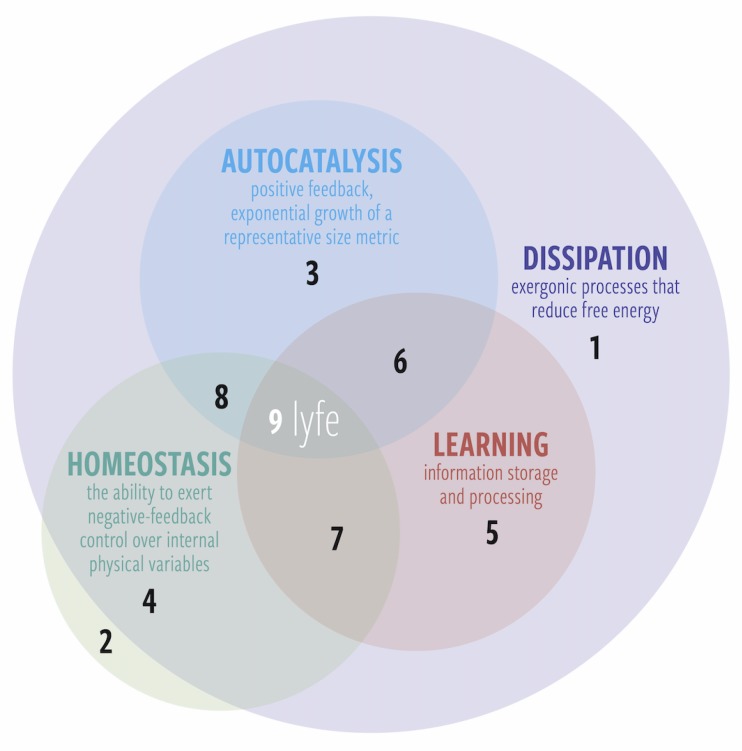
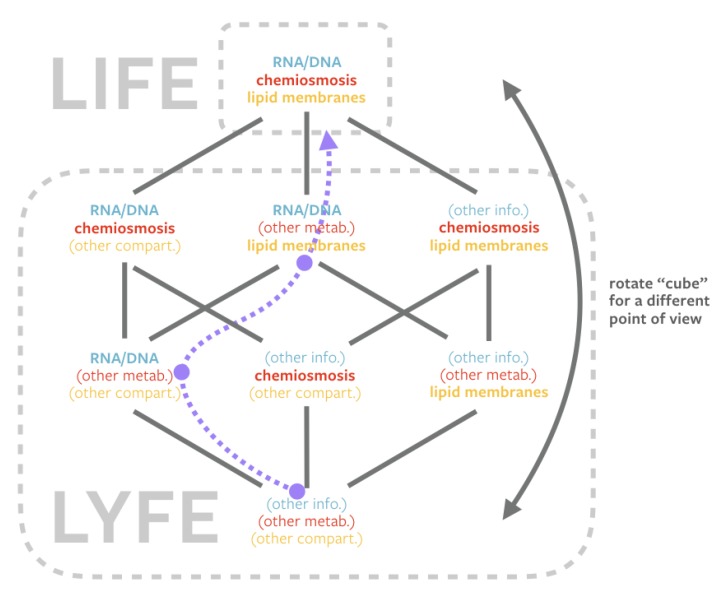
Motivated by the need to paint a more general picture of what life is—and could be—with respect to the rest of the phenomena of the universe, we propose a new vocabulary for astrobiological research. Lyfe is defined as any system that fulfills all four processes of the living state, namely: dissipation, autocatalysis, homeostasis, and learning. Life is defined as the instance of lyfe that we are familiar with on Earth, one that uses a specific organometallic molecular toolbox to record information about its environment and achieve dynamical order by dissipating certain planetary disequilibria. This new classification system allows the astrobiological community to more clearly define the questions that propel their research—e.g., whether they are developing a historical narrative to explain the origin of life (on Earth), or a universal narrative for the emergence of lyfe, or whether they are seeking signs of life specifically, or lyfe at large across the universe. While the concept of “life as we don’t know it” is not new, the four pillars of lyfe offer a novel perspective on the living state that is indifferent to the particular components that might produce it.
Overview
The claims and statistics of this paper haven’t been checked yet.
Free: it reads the open-access text and checks the first 5 claims that cite a source we can check. Create a free account to check every claim.
Integrity signals
Registry
Cites
Statistics
Figures
Verification
Claims the paper makes
The claims and statistics of this paper haven’t been checked yet.
Free: it reads the open-access text and checks the first 5 claims that cite a source we can check. Create a free account to check every claim.
Claims other papers make about this one
Each is checked against this paper’s own text: does it say what the citing paper says it does?
In the citing paper
“Moreover, even if executed robustly, top-down data has limited utility for inferring the temporal sequence of events prior to (LUCA) [42].”
From ‘Whole Organism’, Systems Biology, and Top-Down Criteria for Evaluating Scenarios for the Origin of Life (2021) · cites this paper as [42]
Self-check
Percentages, sums and reported differences re-computed from the paper’s own numbers.
The self-check needs the paper’s full text.
Citations
Cites
Exaptation—a missing term in the science of form
Gould, S. J., & Vrba, E. S. (1982) · Paleobiology · doi:10.1017/s0094837300004310 · Cited by 5,136 · cited 1×
“For further examples of exaptation, see the seminal work by [76] and citations therein.”
BackgroundIrreversibility and heat generation in the computing process
Landauer, R. (1961) · IBM Journal of Research and Development · doi:10.1147/rd.53.0183 · Cited by 4,980
Antibacterial resistance worldwide: causes, challenges and responses
Levy, S. B., & Marshall, B. (2004) · Nature Medicine · doi:10.1038/nm1145 · Cited by 4,052 · cited 1×
“, fungal species learning to degrade plastics [48–50] or humans learning to counter pathogens with antiobiotics, which then learn resistance strategies [51]).”
BackgroundProtein Misfolding, Amyloid Formation, and Human Disease: A Summary of Progress Over the Last Decade
Chiti, F., & Dobson, C. M. (2017) · Annual Review of Biochemistry · doi:10.1146/annurev-biochem-061516-045115 · Cited by 2,629 · cited 1×
“Although amyloidosis is most famously known for being associated with human diseases [99], modern life uses functional amyloidal proteins to its benefit, from biofilm formation to dehydration resistance to long-term memory [58].”
BackgroundIrreversibility and heat generation in the computing process
Landauer, R. (2000) · IBM Journal of Research and Development · doi:10.1147/rd.441.0261 · Cited by 2,585 · cited 1×
“However, harnessing such a fluctuation would require measurement and information-processing, and, as [56] showed, to accomplish this in a finite memory system requires erasure, which cannot be done for free and hence there is in fact no free energy created by fluctuations of an equilibrium system.”
Background(1944) · Andalas University Repository (Andalas University) · Cited by 2,118
Integrated information theory: from consciousness to its physical substrate
Tononi, G., Boly, M., Massimini, M., & Koch, C. (2016) · Nature Reviews Neuroscience · doi:10.1038/nrn.2016.44 · Cited by 1,727
DNA transposons and the evolution of eukaryotic genomes.
Feschotte, C., & Pritham, E. J. (2007) · Annual Review of Genetics · doi:10.1146/annurev.genet.40.110405.090448 · Cited by 1,218
Directed Evolution: Bringing New Chemistry to Life
Arnold, F. H. (2018) · Angewandte Chemie International Edition · doi:10.1002/anie.201708408 · Cited by 1,144 · cited 1×
“Such narratives may deal with the transition between nonlife and life, or they could create new forms of life from pre-existing forms of life, via directed evolution [20] or an artificially expanded basis set for encoding information [21].”
BackgroundATP synthase — a marvellous rotary engine of the cell
Yoshida, M., Muneyuki, E., & Hisabori, T. (2001) · Nature Reviews Molecular Cell Biology · doi:10.1038/35089509 · Cited by 956 · cited 1×
“, the conversion of chemiosmotic gradients to rotational motion using the ATP synthase family of molecular motors [109].”
Method
Research works printed but not linked: 2
- Maturana H.R. Varela F.J. Autopoiesis and Cognition: The Realization of the Living Springer Science & Business Media Berlin/Heidelberg, Germany 1991 Volume 42
- Cairns-Smith A.G. Seven Clues to the Origin of Life: A Scientific Detective Story Cambridge University Press Cambridge, UK 1990
Cited by
Possible chemical and physical scenarios towards biological homochirality
Sallembien, Q., Bouteiller, L., Crassous, J., & Raynal, M. (2022) · Chemical Society Reviews · doi:10.1039/d1cs01179k · Cited by 186
On the roles of function and selection in evolving systems
Wong, M. L., Cleland, C. E., Arend, D., Bartlett, S., Cleaves, H. J., Demarest, H., Prabhu, A., Lunine, J. I., & Hazen, R. M. (2023) · Proceedings of the National Academy of Sciences · doi:10.1073/pnas.2310223120 · Cited by 229
“Let us call dissipation, autocatalysis, homeostasis, and information processing the “core functions” (49).”
BackgroundSelf-citationMinimal physicalism as a scale-free substrate for cognition and consciousness
Fields, C., Glazebrook, J. F., & Levin, M. (2021) · Neuroscience of Consciousness · doi:10.1093/nc/niab013 · Cited by 90
Determining the “Biosignature Threshold” for Life Detection on Biotic, Abiotic, or Prebiotic Worlds
Barge, L. M., Rodriguez, L. E., Weber, J. M., & Theiling, B. (2021) · Astrobiology · doi:10.1089/ast.2021.0079 · Cited by 61
“Life (or ‘‘Lyfe’’) (Bartlett and Wong, 2020) on other geological bodies might look chemically different from life on Earth, yet it might still fulfill fundamental qualities that we define as ‘‘alive.’’”
How Do Living Systems Create Meaning?
Fields, C., & Levin, M. G. (2020) · Philosophies · doi:10.3390/philosophies5040036 · Cited by 74
Regulative development as a model for origin of life and artificial life studies
Fields, C., & Levin, M. (2023) · Biosystems · doi:10.1016/j.biosystems.2023.104927 · Cited by 40
Gentili, P. L. (2024) · Biomimetics · doi:10.3390/biomimetics9020121 · Cited by 43
Assessing planetary complexity and potential agnostic biosignatures using epsilon machines
Bartlett, S., Li, J., Gu, L., Sinapayen, L., Fan, S., Natraj, V., Jiang, J. H., Crisp, D., & Yung, Y. L. (2022) · Nature Astronomy · doi:10.1038/s41550-021-01559-x · Cited by 41
“The models are known as epsilon machines, and they are designed to fulfil several criteria: (1) the ability to reproduce the deterministic (reproducible) features of the given time series, (2) the ability to reproduce the stochastic (non-reproducible) features of the given time series, (3) the property of being optima…”
BackgroundSelf-citationToland, A. R. (2023) · Environmental Humanities · doi:10.1215/22011919-10746023 · Cited by 34
Phosphine Generation Pathways on Rocky Planets
Omran, A. P., Oze, C., Jackson, B. K., Mehta, C., Barge, L. M., Bada, J. L., & Pasek, M. A. (2021) · Astrobiology · doi:10.1089/ast.2021.0034 · Cited by 31
“For perspectives of life as we ‘‘don’t know it,’’ see the article on ‘‘Lyfe’’ by Bartlett and Wong (2020), which focuses on specific metrics for identifying biochemically dissimilar life elsewhere.”
The Origin of Life: What Is the Question?
Malaterre, C., Jeancolas, C., & Nghe, P. (2022) · Astrobiology · doi:10.1089/ast.2021.0162 · Cited by 36
“Research programs that more specifically address this formulation of the OoL question include programs in astrobiology that aim at finding new forms of life outside of Earth, or in universal biology ( e.g., Deamer and Damer, 2017; Bartlett and Wong, 2020).”
Searching for Life, Mindful of Lyfe’s Possibilities
Wong, M. L., Bartlett, S., Chen, S., & Tierney, L. (2022) · Life · doi:10.3390/life12060783 · Cited by 35
Self-citationThe Grayness of the Origin of Life
Smith, H. H., Hyde, A. S., Simkus, D. N., Libby, E., Maurer, S., Graham, H. V., Kempes, C. P., Lollar, B. S., Chou, L., Ellington, A. D., et al. (2021) · Life · doi:10.3390/life11060498 · Cited by 37
Physics of Life: Exploring Information as a Distinctive Feature of Living Systems
Bartlett, S., Eckford, A. W., Egbert, M. D., Lingam, M., Kolchinsky, A., Frank, A., & Ghoshal, G. (2025) · PRX Life · doi:10.1103/rsx4-8x5f · Cited by 28
Self-citationMorphogenetic metasurfaces: unlocking the potential of Turing patterns
Fromentèze, T., Yurduseven, O., Uche, C. Z., Arnaud, E., Smith, D. R., & Decroze, C. (2023) · Nature Communications · doi:10.1038/s41467-023-41775-9 · Cited by 29
Brunk, C. F., & Marshall, C. R. (2021) · Life · doi:10.3390/life11070690 · Cited by 23
Wong, M. L., Prabhu, A., Williams, J. J., Morrison, S. M., & Hazen, R. M. (2023) · Journal of Geophysical Research Planets · doi:10.1029/2022je007658 · Cited by 25
“Because biological systems exhibit information-rich structures, it is thought that system complexity can be a metric by which to measure the living state (Bartlett & Beckett, 2019; Bartlett et al., 2022; Walker et al., 2018, 2020).”
BackgroundSelf-citationAsymptotic burnout and homeostatic awakening: a possible solution to the Fermi paradox?
Wong, M. L., & Bartlett, S. (2022) · Journal of The Royal Society Interface · doi:10.1098/rsif.2022.0029 · Cited by 23
Self-citationGentili, P. L. (2025) · Advanced Optical Materials · doi:10.1002/adom.202500016 · Cited by 23
Provenance of life: Chemical autonomous agents surviving through associative learning
Bartlett, S., & Louapre, D. (2022) · Physical review. E · doi:10.1103/physreve.106.034401 · Cited by 21
“A natural question thus arises: what are the conserved quantities that we expect extant life, early life, and even extraterrestrial life, to exhibit? While definitions of life abound [70–76], and much previous work was inspired by the autopoiesis and chemoton concepts, a definition has recently been introduced that co…”
BackgroundInfluentialSelf-citationChapter 9: Life as We Don't Know It
Grefenstette, N. M., Chou, L., Colón‐Santos, S. M., Fisher, T. M., Mierzejewski, V., Nural, C., Sinhadc, P., Vidaurri, M., Vincent, L., & Weng, M. M. (2024) · Astrobiology · doi:10.1089/ast.2021.0103 · Cited by 18
“The movement of air or water could also be used to create and maintain chemical disequilibria (Bartlett and Wong, 2020).”
InfluentialDiscovering sensorimotor agency in cellular automata using diversity search
Hamon, G., Etcheverry, M., Chan, B. W.-C., Moulin-Frier, C., & Oudeyer, P. (2025) · Science Advances · doi:10.1126/sciadv.adp0834 · Cited by 20
Probing complexity: thermodynamics and computational mechanics approaches to origins studies
Bartlett, S., & Beckett, P. (2019) · Interface Focus · doi:10.1098/rsfs.2019.0058 · Cited by 19
Self-citationMegevand, V., Carrizo, D., Lezcano, M. Á., Moreno‐Paz, M., Cabrol, N. A., Parro, V., & Sánchez‐García, L. (2022) · Frontiers in Microbiology · doi:10.3389/fmicb.2022.811904 · Cited by 16
Does Evolution Have a Target Morphology?
Fields, C., & Levin, M. G. (2020) · Organisms. Journal of Biological Sciences · doi:10.13133/2532-5876/16961 · Cited by 24
“Origin-of-life proposals are notoriously diverse and controversial, and the structure of the biosphere prior to LUCA remains primarily a topic of speculation (Cornish-Bowden and Cárdenas, 2017; Bartlett and Wong, 2020).”
BackgroundModeling Virus and Bacteria Populations in Europa’s Subsurface Ocean
Gomez-Buckley, A. C., Showalter, G. M., & Wong, M. L. (2022) · Life · doi:10.3390/life12050620 · Cited by 15
Self-citationChapter 1: The Astrobiology Primer 3.0
Schaible, M. J., Szeinbaum, N., Bozdag, G. O., Chou, L., Grefenstette, N. M., Colón‐Santos, S. M., Rodriguez, L. E., Styczinski, M. J., Thweatt, J. L., Todd, Z. R., et al. (2024) · Astrobiology · doi:10.1089/ast.2021.0129 · Cited by 14
“Other efforts to describe life universally have focused on more abstract descriptions of life’s processes including autocatalysis, dissipation, and learning in efforts to include other, yet undiscovered, forms of life (Bartlett and Wong, 2020).”
Cells as the first data scientists
Wong, M. L., & Prabhu, A. (2023) · Journal of The Royal Society Interface · doi:10.1098/rsif.2022.0810 · Cited by 13
“…of biological information processing over deep time on Earth, the abstract principles of informatics and learning may be more universal frameworks for understanding extraterrestrial life, which may not necessarily use Darwinian evolution to update its knowledge about its surroundings [13,69].”
BackgroundInfluentialSelf-citationThe essence of life revisited: how theories can shed light on it
Cornish-Bowden, A. J., & Cárdenas, M. L. (2021) · Theory in Biosciences · doi:10.1007/s12064-021-00342-w · Cited by 12
“11 A very recent discussion of the essence of life (Bartlett and Wong 2020) recognizes the need for regulation, under the name homeostasis, together with three other “pillars”: dissipation (entropy production), autocatalysis, and learning (information storage).”
BackgroundWong, M. L., Duckett, M., Hernandez, E. S., Rajaei, V., & Smith, K. J. (2024) · Perspectives of Earth and Space Scientists · doi:10.1029/2023cn000223 · Cited by 11
“Is life as we know it the only viable type of living system, or are we just one example of a much broader spectrum of “lyfe” as we do not know it (Bartlett & Wong, 2020)?”
Self-citationWhat Is Artificial Life Today, and Where Should It Go?
Dorin, A., & Stepney, S. (2024) · Artificial Life · doi:10.1162/artl_e_00435 · Cited by 22
Chandru, K., Potiszil, C., & Jia, T. Z. (2024) · Life · doi:10.3390/life14091069 · Cited by 11
“Similarly, the definition of terms we use to describe life in this paper, such as ‘life as we know it’ and ‘life as we don’t know it’, is not discussed here, as it is well covered elsewhere [97].”
BackgroundIlan, Y. (2025) · Computational and Structural Biotechnology Reports · doi:10.1016/j.csbr.2025.100040 · Cited by 11
Follow the serpentine as a comprehensive diagnostic for extraterrestrial habitability
Shen, J., Liu, C., Pan, Y., & Lin, W. (2024) · Nature Astronomy · doi:10.1038/s41550-024-02373-x · Cited by 11
“In any case, life could benefit from the nutrient and energy stock naturally generated by serpentinization 72 .”
From biosemiotics to physiosemiotics: Towards a speculative semiotics of the inorganic world.
Zengiaro, N. (2024) · Linguistic Frontiers · doi:10.2478/lf-2022-0019 · Cited by 15
Fields, C., & Levin, M. G. (2025) · Communicative & Integrative Biology · doi:10.1080/19420889.2025.2466017 · Cited by 13
Colón‐Santos, S. M., Vázquez-Salazar, A., Adams, A., Campillo-Balderas, J. A., Hernández-Morales, R., Jácome, R., Muñoz‐Velasco, I., Rodriguez, L. E., Schaible, M. J., Schaible, G. A., et al. (2024) · Astrobiology · doi:10.1089/ast.2021.0116 · Cited by 9
“…to enable hypothesis testing and the possibility of detecting other life-forms (see Table 2.5 for some examples; Ruiz-Mirazo et al., 2004; Hazen, 2008; Macklem and Seely, 2010; Pascal et al., 2013; Walker and Davies, 2013; Cottin et al., 2017; Vitas and Dobovisˇek, 2019; Bartlett and Wong, 2020).”
InfluentialChapter 8: Searching for Life Beyond Earth
Chou, L., Grefenstette, N. M., Borges, S. R., Caro, T. A., Catalano, E., Harman, C. E., McKaig, J. M., Raj, C. G., Trubl, G., & Young, A. V. (2024) · Astrobiology · doi:10.1089/ast.2021.0104 · Cited by 8
“In addition to a spectrum of different stages of ‘‘aliveness’’ (Sutherland, 2016), numerous ambiguous entities are often debated as being alive or not ( e.g., viruses; Bartlett and Wong, 2020).”
Major transitions in the physiological machinery of cognition
Just, B. B., & de Farías, S. T. (2025) · Biosystems · doi:10.1016/j.biosystems.2025.105517 · Cited by 6
Teece, B. L., Beaty, D. W., Graham, H. V., McDonnell, G. E., Lollar, B. S., Siljeström, S. M., Steele, A., SSAP Tiger Team, & Mackelprang, R. (2025) · Astrobiology · doi:10.1177/15311074251382156 · Cited by 5
“” For example, viruses and prions on Earth would be detected by the protocol, though they do not necessarily fi t the canonical de fi nitions of terran life (Bartlett and Wong, 2020; Chou et al., 2024).”
Planetary Complexity Revealed by the Joint Differential Entropy of Eigencolors
Segal, G., Parkinson, D., & Bartlett, S. (2024) · The Astronomical Journal · doi:10.3847/1538-3881/ad20cf · Cited by 5
“…the signatures of life is challenging because we have no universal definition of life, we only have the example of life as we find it on earth (Barge et al. 2022; Bartlett & Wong 2020; Chou et al. 2021a,b,c; Cleland 2019a,b; Guttenberg et al. 2021; Johnson et al. 2018; Marshall et al. 2021).”
BackgroundSelf-citationTowards origins of virtual artificial life: an overview
Stepney, S. (2025) · Philosophical Transactions of the Royal Society B Biological Sciences · doi:10.1098/rstb.2024.0298 · Cited by 10
Life as a Cyber-Bio-Physical System
Stepney, S. (2023) · Genetic and evolutionary computation · doi:10.1007/978-981-19-8460-0_8 · Cited by 10
Origins of life: the possible and the actual
Solé, R. V., Kempes, C. P., & Stepney, S. (2025) · Philosophical Transactions of the Royal Society B Biological Sciences · doi:10.1098/rstb.2024.0281 · Cited by 10
Emergence, Construction, or Unlikely? Navigating the Space of Questions Regarding Life's Origins
Bartlett, S., & Wong, M. L. (2023) · Wiley eBooks · doi:10.1002/9781119555568.ch3 · Cited by 4
Self-citationNeutrino intergalactic communication, metal life, and viruses: quo vadis ex machina Part 1
Shapshak, P. (2021) · Bioinformation · doi:10.6026//97320630017331 · Cited by 4
Mapping life’s disparity and evolutionary constraints in a geometric complexity space
Dera, G., Nardin, É., Risser, L., Albino, M., Garnier, Q., Kardacz, M., & Monge-Waleryszak, L. (2026) · Science Advances · doi:10.1126/sciadv.aea6945 · Cited by 4
“Many authors define living forms as thermodynamic dissipative systems that combine essential properties such as compartmentalization, metabolism, homeostasis, reproduction, and learning ( 79 , 80 ).”
Rethinking “Prebiotic Chemistry”
Wong, M. L., Christensen, M., & Bartlett, S. (2025) · Perspectives of Earth and Space Scientists · doi:10.1029/2025cn000275 · Cited by 7
“For example, one might see lyfe, in general, as a complex adaptive system capable of performing certain core functions—such as disequilibria conversions, autocatalysis, homeostasis, and information processing—which may arise in many different kinds of substrates (Bartlett & Wong, 2020).”
Self-citationLyfe: learning to learn better
Bartlett, S., & Wong, M. L. (2025) · Interface Focus · doi:10.1098/rsfs.2025.0019 · Cited by 3
Self-citationZhu, D., 弗里斯, 彼., & Friess, P. (2024) · Leonardo · doi:10.1162/leon_a_02625 · Cited by 3
An exploration of origin of life for exoplanetary science
Keller, F., Kataria, T., Barge, L. M., Chen, P., Yung, Y. L., & Weber, J. M. (2025) · Frontiers in Astronomy and Space Sciences · doi:10.3389/fspas.2025.1544426 · Cited by 4
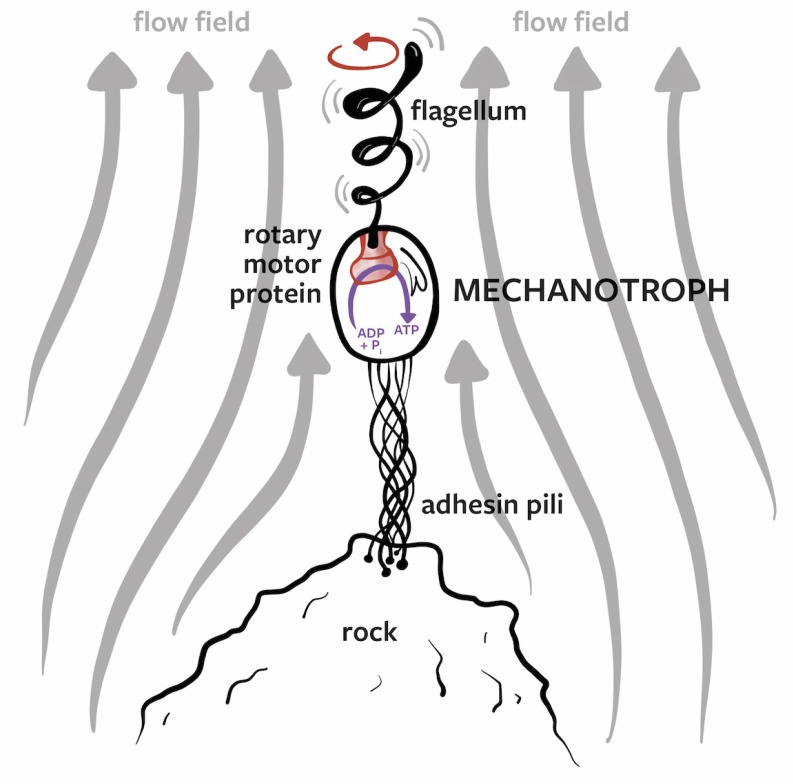
“For example, an organism might be capable of using the flow of a solvent to rotate part of its body to activate a protein that could generate ATP (Bartlett and Wong, 2020).”
Flow-Lenia: Emergent Evolutionary Dynamics in Mass Conservative Continuous Cellular Automata
Plantec, E., Hamon, G., Etcheverry, M., Chan, B. W.-C., Oudeyer, P., & Moulin-Frier, C. (2025) · Artificial Life · doi:10.1162/artl_a_00471 · Cited by 7
“The study of the role of dissipative dynamics in this setting is motivated by dissipation having been proposed as one of the four pillars of “lyfe”, a more general definition of life (Bartlett & Wong, 2020).”
The quest for the definition of lifePreprint
Azar, K. H. (2022) · arXiv (Cornell University) · doi:10.48550/arxiv.2210.12072 · Cited by 3
The Search for Technosignatures: a Review of PossibilitiesPreprint
Vidal, C., Fields, B. L., Sowinski, D., Bartlett, S., Terrile, R. J., Ellery, A. A., Bibas, D., Mastrogiovanni, A. M., Döbler, N. A., Singla, M., et al. (2026) · arXiv (Cornell University) · doi:10.48550/arxiv.2605.21093 · Cited by 5
Self-citationOrigins and Evolution of Imagination, From Australopithecus to Modern‐Day Deep Learning
Sidhu, K., Roy, R., & D’Angiulli, A. (2026) · Wiley Interdisciplinary Reviews Cognitive Science · doi:10.1002/wcs.70030 · Cited by 2
“Yet, unlike living systems, non-living entities have very limited flexibility and can tolerate only minimal, or a very restricted range of change before they dissipate (Bartlett and Wong 2020).”
Astrobiology in the Time of Artificial Intelligence
Scharf, C. A. (2026) · Astrobiology · doi:10.1177/15311074261463025 · Cited by 2
Brazhnikov, P. (2021) · Systems · doi:10.3390/systems9020024 · Cited by 1
“NASA uses the following definition of life: "Life is a self-sustaining chemical system capable of Darwinian evolution" [3].”
MethodLouapre, D. (2023) · Pour la Science · doi:10.3917/pls.545.0034 · Cited by 1
Wolters, C., Vuitton, V., Orthous‐Daunay, F., Flandinet, L., He, C., Moran, S. E., & Hörst, S. M. (2023) · ACS Earth and Space Chemistry · doi:10.1021/acsearthspacechem.3c00069 · Cited by 1
Телеономные и когнитивные факторы направленности эволюции
Sukhoverkhov, A. V., Kobyakova, I., & Pozdeyev, I. (2023) · Philosophy Journal of the Higher School of Economics · doi:10.17323/2587-8719-2023-2-116-142 · Cited by 1
The extraterrestrial hypothesis: an epistemological case for removing the taboo
Lane, W. C. (2025) · European Journal for Philosophy of Science · doi:10.1007/s13194-025-00634-8 · Cited by 17
“• Cognition , defined as the ‘acquisition, organization, and usage of knowledge inherent in every living organism’ (D ȍ bler & Raab, 2021, 701), is an essential activity of life (Dall et al., 2005; Bartlett & Wong, 2020; Kessler & Muel-ler, 2024).”
InfluentialHomeodynamic Laws and Life Principles
Paul, D. (2025) · Springer eBooks · doi:10.1007/978-3-032-08808-6_9 · Cited by 1
Imagining the Generations: Introduction to the Nature of Multigenerational Memory
Williams, N. R. (2021) · Studies in the psychosocial · doi:10.1007/978-3-030-66157-1_2 · Cited by 1
Information Transmission via Molecular Communication in Astrobiological Environments
Lingam, M. (2023) · Astrobiology · doi:10.1089/ast.2023.0069 · Cited by 1
“…not surprising that a number of publications have advocated studying and foregrounding the information-centric aspects of the origin(s) of life (Ku¨ppers, 1990; Yockey, 2002; Hazen et al., 2007; Adami, 2015; Davies and Imari Walker, 2016; Imari Walker, 2017; Bartlett and Wong, 2020; Scharf, 2021).”
The Interplay Between Logical Phenomena and the Cognitive System of the MindPreprint
Azar, K. H. (2024) · arXiv (Cornell University) · doi:10.48550/arxiv.2401.09465 · Cited by 1
Coupling biological, interior and atmosphere models to infer habitability and biosignatures
Affholder, A. (2022) · theses.fr (ABES) · doi:10.70675/2097bf4bz3cebz45f9zb3cdz470fc5ddac4d · Cited by 2
Scientists' Understanding of Ethics and Responsibility in Astrobiology: An Empirical Study
Wahl, J. (2021) · DigitalGeorgetown (Georgetown University Library) · doi:10.5281/zenodo.5156105
Graham, L. (2023) · Springer eBooks · doi:10.1007/978-3-031-38681-7_16
Øllgaard, J., Nielsen, H. K., Hauge, H., Christensen, S., Thorup, M., Raffnsøe, S., Stjernfelt, F., Olesen, S. G., Lieberkind, J., Fink, H., et al. (2023) · doi:10.7146/aul.503
Sallembien, Q. (2021) · theses.fr (ABES) · doi:10.70675/e8227832z1887z4770zb651zbdf3adf7a8d3 · Cited by 1
Exotic Forms of Life on Other Worlds
Irwin, L. N. (2024) · Springer eBooks · doi:10.1007/978-3-319-30648-3_161-2
An Open-Ended Approach to Understanding Local, Emergent Conservation Laws in Biological Evolution
Adams, A., Jacopin, E., Gagrani, P., & Witkowski, O. (2024) · IEEE Congress on Evolutionary Computation (CEC) · doi:10.1109/cec60901.2024.10612085
“Next, we briefly review the characterization of the most important rules that distinguish living systems (“lyfe”) from abiotic ones (“non-lyfe”) [2], [3].”
BackgroundIl digitale al cuore delle (tras)mutazioni delle scritture e delle realtà italiane
Laghi, R. (2023) · theses.fr (ABES) · doi:10.70675/229e0835z7e74z4e11z84bcza5a0843229ad
Culture and the much-more-than-human: the case of colloids
Szerszynski, B. (2022) · Cultural Science Journal · doi:10.2478/csj-2024-0016
Separación entre forma y función biológica: Consecuencias para la tesis de la contingencia radical
Leal, V. E. P. (2021) · Epistemología e Historia de la Ciencia · doi:10.61377/ehc.32434
1. Jakob von Uexkülls biologische Schriften – 100 Jahre später
Leiß, O. (2024) · Medical humanities · doi:10.14361/9783839475942-003
Edmunds, M. (2025) · Astronomy & Geophysics · doi:10.1093/astrogeo/ataf033
The single beacon: progresses in understanding Earth as an exoplanet using DSCOVR/EPIC observations
Jian, X.-J., Gu, L., Fan, S., Bartlett, S., Yang, J., Jiang, J. H., Luo, Y., & Yung, Y. L. (2025) · Frontiers in Remote Sensing · doi:10.3389/frsen.2025.1635015
Self-citationGrabowska-Derlatka, K., Gomułka, J., & 'Preppikoma' Palm, R. (2022) · PhilPapers (PhilPapers Foundation)
Systems Engineering with Attitude
Dove, R., Humes, M., Leach, G., Massey, R., Ourada, G., Papke, B., Scheuer, A., Span, M. T., Sudmeier, D., Thomas, L., et al. (2025) · INCOSE International Symposium · doi:10.1002/iis2.70004
Paul, D. (2025) · Springer eBooks · doi:10.1007/978-3-032-08808-6_7
Explorer les hiérarchies d’âge dans le vivant: La domination adulte chez les primates
Allegret, G. (2026) · Sociétés plurielles · doi:10.46298/societes-plurielles.2026.17329
Summary of KAVLI-IAU Symposium (IAUS 387): (Toward) Discovery of Life Beyond Earth and its Impact
Kovačević, A., & Mason, N. J. (2024) · Proceedings of the International Astronomical Union · doi:10.1017/s1743921324001819
Climates of Terrestrial Exoplanets and Biosignatures
Bhatnagar, S., Bolmont, É., Boeren, N. J., Hansen, J., Konrad, B. S., Schlarmann, L., Alei, E., Azevedo, M., Braam, M., Chaverot, G., et al. (2026) · Lirias · doi:10.48550/arxiv.2601.20620 · Cited by 1
An Ontological Framework for Defining Life
Şengör, H. C. A. (n.d.) · PhilPapers (PhilPapers Foundation)
Nietzsche, Critical Posthumanism, and Transhumanism
Schussler, A.-E. (2025) · Trivent Publishing eBooks · doi:10.22618/tp.tt.ps.2025.198
Wolters, C. (2021) · theses.fr (ABES) · doi:10.70675/ad9f67c5z16a0z479bza370za7b4ea8f1fb9 · Cited by 1
Desoeuvres, A. (2021) · theses.fr (ABES) · doi:10.70675/33158ed9z46abz48c7zb9e0z3539b94209fc · Cited by 1
Machine learning methods for computational studies in origins of life
Devergne, T. (2023) · theses.fr (ABES) · doi:10.70675/d83a8c32zc303z49a0zabc0zace8824c0eb7 · Cited by 3
Hamon, G. (2025) · theses.fr (ABES) · doi:10.70675/4b858087z5190z4bfdzbeeez1fc799394dbc · Cited by 1
Epistemic Pluralism & Astrobiology
Smith, K. J., Anderson, P. D., & Wong, M. L. (2026) · Journal for General Philosophy of Science · doi:10.1007/s10838-025-09760-6
Self-citationTemporal Retention of Information as a BiosignaturePreprint
Kee, T. P., & McCrum, J. (2026) · arXiv (Cornell University) · doi:10.48550/arxiv.2604.18359
“Another similar thesis is the concept of ‘ Lyfe ’ that contains as one example the familiar organic-biological life of terrestrial ecosystems but is not solely comprised of that (Bartlett and Wong, 2020).”
Temporal retention of information as a biosignature
Kee, T. P., & McCrum, J. (2026) · International Journal of Astrobiology · doi:10.1017/s1473550426100287
“Another similar thesis is the concept of ‘ Lyfe ’ that contains as one example the familiar organic-biological life of terrestrial ecosystems but is not solely comprised of that (Bartlett and Wong, 2020).”
Slaughter, E., Hystad, G., Cody, G., Prabhu, A., Cleaves, H. J., Hazen, R. M., & Wong, M. L. (2026) · Frontiers in Astronomy and Space Sciences · doi:10.3389/fspas.2026.1695325
Self-citationThe challenge of distinguishing living from non-living entities
Azar, K. H. (2026) · Theory in Biosciences · doi:10.1007/s12064-026-00481-y · Cited by 1
“In their work, Bartlett and Wong ( 2020) propose a reframing of the definition of life, aiming to encompass a broader range of possibilities while acknowledging the need to differentiate the specific kind of life observed on Earth.”
La originalidad de la vida… una singularidad impredecible
García-Cohen, A. D. P. (2021) · quaerentibus
Uma Nova Estrutura Universal de Deteção de Vida na Terra e no Sistema Solar – Alcance e Limitações
Ramos, C., Orench, J., de Gouveia, L. B., Rodrigues, P., Carvalho, M., Colaço, A., Viveiros, F., Silva, C., Cesário, R., Canário, J., et al. (2026) · Boletim da Sociedade Portuguesa de Química · doi:10.52590/m3.p726.a30003202
Metadata
- Authors
- Bartlett, S., & Wong, M. L.
- Affiliations
- Tokyo Institute of Technology (JP)
- University of Washington (US)
- Corresponding author
- Bartlett, Stuart
- Venue
- Life
- Publisher
- MDPI AG
- Published
- 2020-04-16
- Volume
- 10
- Issue
- 4
- Pages
- 42
- ISSN
- 2075-1729 (ISSN-L)
- PMC
- PMC7235751
- OpenAlex
- W3016927940
- Cited by
- 77
- References
- 113
- Citations by year
- 2026: 7 · 2025: 18 · 2024: 14 · 2023: 14 · 2022: 11 · 2021: 10 · 2020: 2
- FWCI
- 4.15
- Type
- journal article
- Language
- en
- Open access
- gold
- dx.doi.org
- Licence
- Locations
- Life (publishedVersion, cc-by)
- PubMed Central (publishedVersion, cc-by)
- PubMed (publishedVersion)
- CaltechAUTHORS (California Institute of Technology) (submittedVersion, cc-by)
- DOAJ (DOAJ: Directory of Open Access Journals) (submittedVersion, cc-by-sa)
- Funders
- California Institute of Technology
- Topics
- Physical Sciences › Physics and Astronomy › Astronomy and Astrophysics › Origins and Evolution of Life
- Physical Sciences › Physics and Astronomy › Astronomy and Astrophysics › Space Science and Extraterrestrial Life
- Physical Sciences › Environmental Science › Global and Planetary Change › Earth Systems and Cosmic Evolution
- Keywords
- concept of life, astrobiology, energy dissipation, autocatalysis, homeostasis, learning, origin of life, signs of life, organometallic chemistry
About these checks
Registry, retraction, Cites and statistics results are computed, not judged, with one exception: a printed reference that no index lists is read once by a model before it counts as a citation error. Claims are extracted by a model and kept only when their quote appears verbatim in the text; each cited source is then checked, with a model’s help, for whether it says what the claim relies on. Those verdicts can be wrong — read the claim’s quote and the cited source before relying on one.
Statistics and arithmetic are recomputed, not judged.
Confidence bands are shown only for fields calibrated on our annotated test set. None is calibrated yet, so no band is shown.
What counts as a claim ›How we measure confidence ›How we check this ›
Are you an author, or do you see a problem with this page? Request a review
Data sources
Bibliographic data: Semantic Scholar, OpenAlex, Crossref.
Contains information from the Semantic Scholar Academic Graph Datasets, made available under the ODC Attribution License (ODC-BY 1.0).
Semantic Scholar’s data is described in: Kinney, R., et al. (2023). The Semantic Scholar Open Data Platform. arXiv:2301.10140.
