

The DOI matches its Crossref record; 163 of the 164 references it cites were found in a registry or an index.
Effects of Electronic Health Record Implementation and Barriers to Adoption and Use: A Scoping Review and Qualitative Analysis of the Content
Open accessAbstract
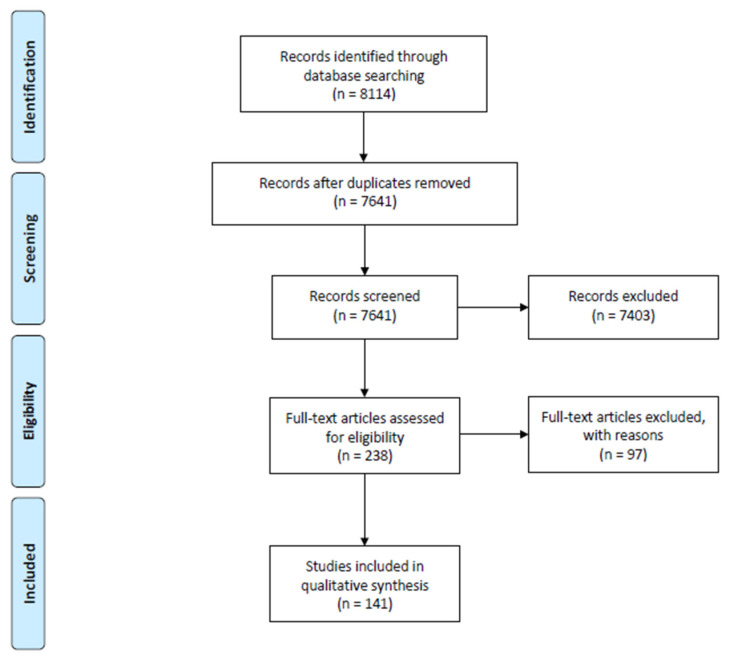
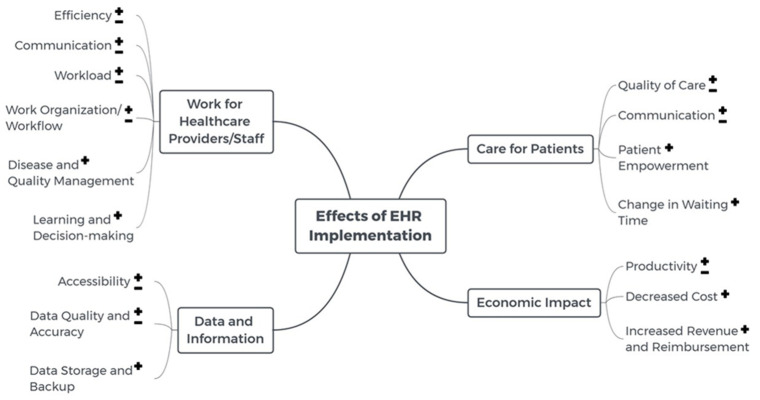
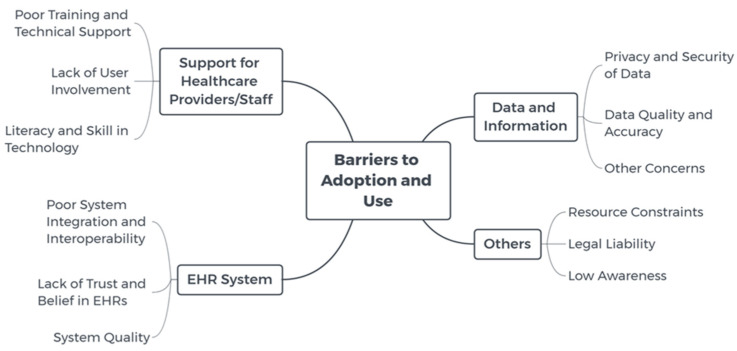
Despite the great advances in the field of electronic health records (EHRs) over the past 25 years, implementation and adoption challenges persist, and the benefits realized remain below expectations. This scoping review aimed to present current knowledge about the effects of EHR implementation and the barriers to EHR adoption and use. A literature search was conducted in PubMed, Web of Science, IEEE Xplore Digital Library and ACM Digital Library for studies published between January 2005 and May 2020. In total, 7641 studies were identified of which 142 met the criteria and attained the consensus of all researchers on inclusion. Most studies (n = 91) were published between 2017 and 2019 and 81 studies had the United States as the country of origin. Both positive and negative effects of EHR implementation were identified, relating to clinical work, data and information, patient care and economic impact. Resource constraints, poor/insufficient training and technical/educational support for users, as well as poor literacy and skills in technology were the identified barriers to adoption and use that occurred frequently. Although this review did not conduct a quality analysis of the included papers, the lack of uniformity in the use of EHR definitions and detailed contextual information concerning the study settings could be observed.
Overview
The claims and statistics of this paper haven’t been checked yet.
Run the check — free, no account needed. It reads the open-access text and checks the sources it cites.
Integrity signals
Registry
Cites
Statistics
Figures
Verification
Claims the paper makes
The claims and statistics of this paper haven’t been checked yet.
Run the check — free, no account needed. It reads the open-access text and checks the sources it cites.
Claims other papers make about this one
Each is checked against this paper’s own text: does it say what the citing paper says it does?
The source backs part of the claim, not all of it — or backs it for a different population, condition or comparison.
In the citing paper
“This assists clinicians in making more informed decisions.[13]”
From Ethical implications of AI and robotics in healthcare: A review (2023) · cites this paper as [13]
Experimental — accuracy not yet measuredThe check wasn’t confident either way, so it gives no verdict — never disputed.
In the citing paper
“AI systems provide healthcare professionals with real-time clinical decision support, offering evidence-based recommendations for treatment plans, drug interactions, and diagnostic accuracy.”
From Ethical implications of AI and robotics in healthcare: A review (2023) · cites this paper as [13]
Experimental — accuracy not yet measuredThe check wasn’t confident either way, so it gives no verdict — never disputed.
In the citing paper
“AI-driven algorithms can analyze vast datasets, including genomic information, to tailor treatment plans to individual patients.”
From Ethical implications of AI and robotics in healthcare: A review (2023) · cites this paper as [11]
Experimental — accuracy not yet measuredThe check wasn’t confident either way, so it gives no verdict — never disputed.
In the citing paper
“This approach, known as precision medicine, allows for more accurate diagnosis and personalized treatment strategies.[11]”
From Ethical implications of AI and robotics in healthcare: A review (2023) · cites this paper as [11]
Experimental — accuracy not yet measured
Self-check
Percentages, sums and reported differences re-computed from the paper’s own numbers.
The self-check needs the paper’s full text.
Citations
Cites
Content analysis and thematic analysis: Implications for conducting a qualitative descriptive study
Vaismoradi, M., Turunen, H., & Bondas, T. (2013) · Nursing & Health Sciences · doi:10.1111/nhs.12048 · Cited by 8,327
Guidance for conducting systematic scoping reviews
Peters, M. D. J., Godfrey, C. M., Khalil, H., McInerney, P., Parker, D., & Soares, C. B. (2015) · International Journal of Evidence-Based Healthcare · doi:10.1097/xeb.0000000000000050 · Cited by 7,472
Arndt, B. G., Beasley, J. W., Watkinson, M. D., Temte, J. L., Tuan, W.-J., Sinsky, C. A., & Gilchrist, V. J. (2017) · The Annals of Family Medicine · doi:10.1370/afm.2121 · Cited by 972 · cited 1×
“Primary care physicians spent more than one-half of their workday, nearly six hours, interacting with EHRs during and after clinic hours [152].”
BackgroundPoissant, L. (2005) · Journal of the American Medical Informatics Association · doi:10.1197/jamia.m1700 · Cited by 901
Electronic Health Records: Then, Now, and in the Future
Evans, R. S. (2016) · Yearbook of Medical Informatics · doi:10.15265/iys-2016-s006 · Cited by 816
Safran, C., Bloomrosen, M., Hammond, W. E., Labkoff, S., Markel-Fox, S., Tang, P., & Detmer, D. (2007) · JAMIA Journal of the American Medical Informatics Association · doi:10.1197/jamia.m2273 · Cited by 714
Personal health records: a scoping review
Archer, N., Fevrier-Thomas, U., Lokker, C., McKibbon, K. A., & Straus, S. E. (2011) · Journal of the American Medical Informatics Association · doi:10.1136/amiajnl-2011-000105 · Cited by 573
Physician stress and burnout: the impact of health information technology
Gardner, R. L., Cooper, E., Haskell, J., Harris, D. A., Poplau, S., Kroth, P. J., & Linzer, M. (2019) · Journal of the American Medical Informatics Association · doi:10.1093/jamia/ocy145 · Cited by 566
Nguyen, L., Bellucci, E., & Nguyen, L. T. (2014) · International Journal of Medical Informatics · doi:10.1016/j.ijmedinf.2014.06.011 · Cited by 549
Adler‐Milstein, J., Zhao, W., Willard‐Grace, R., Knox, M. J., & Grumbach, K. (2019) · Journal of the American Medical Informatics Association · doi:10.1093/jamia/ocz220 · Cited by 370
Research works printed but not linked: 3
- Institute of Medicine—Committee on Improving the Patient Record (1997). The Computer-Based Patient Record an Essential Technology for Health Care, National Academy Press. Revised Edition.
- Voss, 2016, European Union Data Privacy Law Reform: General Data Protection Regulation, Privacy Shield, and the Right to Delisting, Bus. Lawyer, 72, 221
- Liew, C.L., and Harjadinata, J. (2017, January 19–23). Patient Portal Service: An Exploration of Patients’ Experience and Perception. Proceedings of the ICDS 2017: The Eleventh International Conference on Digital Society, Nice, France.
Cited by
Sorted by citations
Ethical implications of AI and robotics in healthcare: A review
Elendu, C., Amaechi, D. C., Elendu, T. C., Jingwa, K. A., Okoye, O. K., John Okah, M., Ladele, J. A., Farah, A. H., & Alimi, H. A. (2023) · Medicine · doi:10.1097/md.0000000000036671 · Cited by 370
“[13] 3.”
Gupta, N. S., & Kumar, P. (2023) · Computers in Biology and Medicine · doi:10.1016/j.compbiomed.2023.107051 · Cited by 170
The impact of electronic health records on patient care and outcomes: A comprehensive review
Adeniyi, A. O., Arowoogun, J. O., Chidi, R., Okolo, C. A., & Babawarun, O. (2024) · World Journal of Advanced Research and Reviews · doi:10.30574/wjarr.2024.21.2.0592 · Cited by 149
Woldemariam, M. T., & Jimma, W. (2023) · BMJ Health & Care Informatics · doi:10.1136/bmjhci-2022-100704 · Cited by 153
Advancing health care with digital twins: meta-review of applications and implementation challenges
Ringeval, M., Etindele Sosso, F. A., Cousineau, M., & Paré, G. (2025) · Journal of Medical Internet Research · doi:10.2196/69544 · Cited by 108
Metadata
- Authors
- Tsai, C. H., Eghdam, A., Davoody, N., Wright, G., Flowerday, S., & Koch, S.
- Affiliations
- Karolinska Institutet (SE)
- Rhodes University (ZA)
- Corresponding author
- Koch, Sabine
- Venue
- Life
- Publisher
- MDPI AG
- Published
- 2020-12-04
- Volume
- 10
- Issue
- 12
- Pages
- 327
- ISSN
- 2075-1729 (ISSN-L)
- PMC
- PMC7761950
- OpenAlex
- W3109639294
- Cited by
- 305
- References
- 164
- Citations by year
- 2026: 63 · 2025: 95 · 2024: 68 · 2023: 48 · 2022: 18 · 2021: 13
- FWCI
- 3.01
- Type
- journal article
- Language
- en
- Open access
- gold
- doi.org
- Licence
- Locations
- Life (publishedVersion, cc-by)
- PubMed Central (publishedVersion, cc-by)
- PubMed (publishedVersion)
- DOAJ (DOAJ: Directory of Open Access Journals) (submittedVersion, cc-by-sa)
- Funders
- Forskningsrådet om Hälsa, Arbetsliv och Välfärd (2016-07324)
- South African Medical Research Council (2016-07324)
- Topics
- Health Sciences › Health Professions › Health Information Management › Electronic Health Records Systems
- Health Sciences › Health Professions › Health Information Management › Medical Coding and Health Information
- Health Sciences › Nursing › Research and Theory › Nursing Diagnosis and Documentation
- Keywords
- electronic health records, EHR implementation, clinical work, patient care, economic impact, resource constraints, employee training, technical support, digital literacy, technological competence
About these checks
Registry, retraction, Cites and statistics results are computed, not judged, with one exception: a printed reference that no index lists is read once by a model before it counts as a citation error. Claims are extracted by a model and kept only when their quote appears verbatim in the text; each cited source is then checked, with a model’s help, for whether it says what the claim relies on. Those verdicts can be wrong — read the claim’s quote and the cited source before relying on one.
Statistics and arithmetic are recomputed, not judged.
Confidence bands are shown only for fields calibrated on our annotated test set. None is calibrated yet, so no band is shown.
What counts as a claim ›How we measure confidence ›How we check this ›
Are you an author, or do you see a problem with this page? Request a review
