

The DOI matches its Crossref record; 52 of the 52 references it cites were found in a registry or an index; none of the 56 sources its claims cite is checked for support yet.
Hydration Status of Elite Youth Soccer Players: Training Versus FIFA Competition
Open accessAbstract
Optimal hydration is crucial for maintaining health and athletic performance in young soccer players. This requires constant monitoring by medical and sports teams during training sessions and competitions. Objective: The purpose of this study was to examine hydration status based on variations in body weight, fluid intake, and urine specific gravity during three training sessions and a FIFA competition in elite U-17 youth soccer players, national team members. Methods: Twenty-one elite soccer players, aged 17.2 ± 0.29 years, with a body weight of 72.1 ± 6.95 kg and a height of 1.80 ± 0.05 m, participated in the study. To determine hydration status, percentage weight loss, fluid intake, and urine density were measured during three training sessions and one FIFA-level competition. Results: Differences in body weight were observed in two of the training sessions, with greater variation in the competition (3.5% of BW, p < 0.001). Significant differences were found between weight losses in training sessions vs. matches. An increase in initial weight was associated with lower urine density. Regression coefficients showed that differences in body weight can predict urine density during training and competition (p < 0.05). A decrease in final body weight could be a valid indicator as a predictor of higher urinary density.
Overview
CoChat Summary
TL;DR
This study examined hydration status in 21 Chilean U-17 national team soccer players across three training sessions and one FIFA match using body weight change, fluid intake, and urine specific gravity (USG). It found greater body-mass loss and fluid intake in competition, with body-mass changes predicting USG.
Key findings
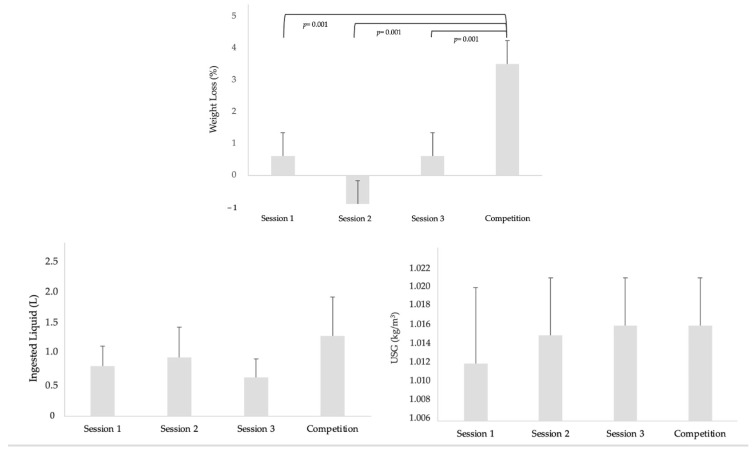
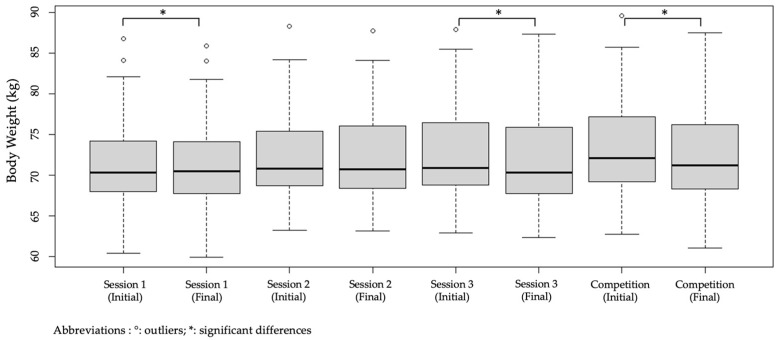
- Body mass decreased significantly from start to end in training sessions 1 and 3 and in the FIFA match (p ≤ 0.001). Percentage weight loss was 0.61% in session 1, 0.89% in session 3, and 3.47% in the match; session 2 showed a small weight gain (−0.13%).
- Fluid intake and weight loss differed significantly across assessments (p ≤ 0.001); USG did not differ significantly (p = 0.083). Average fluid intake was 0.62–0.94 L in training sessions and reached up to 1.29 L in competition.
- Most players showed at least minimal dehydration by USG; 38.09–76.19% experienced significant dehydration (USG 1.021–1.030), and no severe dehydration was reported.
- Ordinal logistic regression showed initial and final body mass were associated with USG in the first training session and the official match; an increase in initial body mass was associated with lower probability of moving to a higher USG category, while an increase in final weight was associated with higher probability. The abstract states that a decrease in final body weight may predict higher urinary density.
Methods
- Repeated-measures study in 21 Chilean U-17 national team players (age 17.2 ± 0.29 years, body weight 72.1 ± 6.95 kg, height 1.80 ± 0.05 m), all with at least 4 years of sporting experience and no musculoskeletal injuries or competition restrictions.
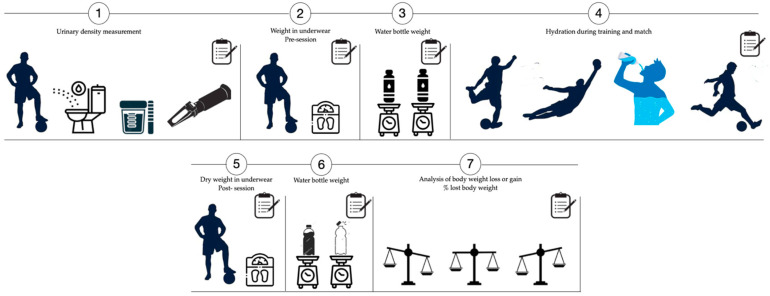
- Four hydration assessments: three training sessions at one-month intervals beginning three months before competition, and one official FIFA competition match. Hydration was measured by percentage body weight loss, estimated fluid intake from ad libitum water bottles, and morning USG via refractometer; no hydration or dietary recommendations were given during assessment.
- Analysis used Shapiro–Wilk, Friedman and Wilcoxon tests, and ordinal logistic regression with USG as the dependent variable and body weight before, body weight after, and fluid intake as independent variables; significance was set at p < 0.05; data analysed in R 4.5.1.
Limitations
- The paper states that due to the nature of the population and sample, results cannot be extrapolated to other groups and should be considered cautiously when implementing hydration strategies in untrained populations.
- Evident: the sample was small (n = 21) and specific to elite Chilean U-17 national team players; only three training sessions and one FIFA match were assessed.
- Evident: training sessions occurred in 3–8 °C while competition was 22 °C, so environmental differences may confound training-versus-competition hydration comparisons; no hydration or dietary recommendations were made, and the abstract/results describe the final-weight–USG direction inconsistently.
Model-written summary. Check it against the paper before relying on it.
Integrity signals
Registry
Cites
Statistics
Figures
Verification
Claims the paper makes
0 Valid · 0 Not valid · 29 Not checked · 29 Own results and interpretations
A result the paper reports from its own data — it cites no other source for it, so there is none to check. The quote shows it is in the paper.
In the paper
“Between 38.09% and 76.19% experienced some degree of significant dehydration (SGS between 1.021 and 1.030), and between 9.52% and 1.04% experienced dehydration, with no cases of severe dehydration reported.”
§ Hydration Status of Elite Youth Soccer Players: Training Versus FIFA Competition > 4. Discussion
plain- Asserted: passes — The authors put it forward as true.
- Checkable: passes — It can be checked against evidence.
- Load-bearing: passes — The paper’s conclusions depend on it.
- Based: passes — The paper gives a reason why it holds.
A result the paper reports from its own data — it cites no other source for it, so there is none to check. The quote shows it is in the paper.
In the paper
“while an increase in final weight is associated with an increase in the probability of moving up to a higher category.”
§ Hydration Status of Elite Youth Soccer Players: Training Versus FIFA Competition > 3. Results
plainstates an association- Asserted: passes — The authors put it forward as true.
- Checkable: passes — It can be checked against evidence.
- Load-bearing: unclear — It is unclear whether the paper’s conclusions depend on it.
- Based: passes — The paper gives a reason why it holds.
A result the paper reports from its own data — it cites no other source for it, so there is none to check. The quote shows it is in the paper.
In the paper
“significant decreases (p ≤ 0.001) in body mass were observed between the start and end of sessions one and three, and the match”
§ Hydration Status of Elite Youth Soccer Players: Training Versus FIFA Competition > 3. Results
plain- Asserted: passes — The authors put it forward as true.
- Checkable: passes — It can be checked against evidence.
- Load-bearing: passes — The paper’s conclusions depend on it.
- Based: passes — The paper gives a reason why it holds.
A result the paper reports from its own data — it cites no other source for it, so there is none to check. The quote shows it is in the paper.
In the paper
“The percentage weight loss in session 1 was 0.61%, in session 3 it was 0.89%, and in SP it was 3.47%.”
§ Hydration Status of Elite Youth Soccer Players: Training Versus FIFA Competition > 4. Discussion
plain- Asserted: passes — The authors put it forward as true.
- Checkable: passes — It can be checked against evidence.
- Load-bearing: unclear — It is unclear whether the paper’s conclusions depend on it.
- Based: passes — The paper gives a reason why it holds.
A result the paper reports from its own data — it cites no other source for it, so there is none to check. The quote shows it is in the paper.
In the paper
“Regression analysis determined that pre- and post-competition body weights are determinants of USG in a competition.”
§ Hydration Status of Elite Youth Soccer Players: Training Versus FIFA Competition > 4. Discussion
plainstates an association- Asserted: passes — The authors put it forward as true.
- Checkable: passes — It can be checked against evidence.
- Load-bearing: passes — The paper’s conclusions depend on it.
- Based: passes — The paper gives a reason why it holds.
21 more claims
Create a free account to see all 58 claims and to verify the 56 references still open.
- It may state two separate claims as one. 23
- Probably not a substantial claim. 18
Self-check
Percentages, sums and reported differences re-computed from the paper’s own numbers.
Each contradiction between two passages listed here was confirmed by an independent check.
Rated major: it would touch a result — a value a result rests on, reported and recomputed p-values on opposite sides of the significance level, two passages that conflict with no sign which is right, or a cited work retracted before this paper was published.
In the paper
§ Hydration Status of Elite Youth Soccer Players: Training Versus FIFA Competition > 3. Results
“an increase in final weight is associated with an increase in the probability of moving up to a higher category.”
§ Hydration Status of Elite Youth Soccer Players: Training Versus FIFA Competition > Abstract
“A decrease in final body weight could be a valid indicator as a predictor of higher urinary density.”
Rated major: it would touch a result — a value a result rests on, reported and recomputed p-values on opposite sides of the significance level, two passages that conflict with no sign which is right, or a cited work retracted before this paper was published.
In the paper
§ Hydration Status of Elite Youth Soccer Players: Training Versus FIFA Competition > 3. Results
“Regarding the USG variable, no significant differences were found (p = 0.083).”
§ Hydration Status of Elite Youth Soccer Players: Training Versus FIFA Competition > 5. Conclusions
“significant differences in percentage of weight loss, fluid intake, and USG between the two settings.”
Rated minor: it would not touch a result — a value no result rests on, a p-value that stays on the same side of the significance level, or a conflict that is clerical, resolved elsewhere in the paper, or outside its own findings.
In the paper
§ Hydration Status of Elite Youth Soccer Players: Training Versus FIFA Competition > 4. Discussion
“between 9.52% and 1.04% experienced dehydration”
§ Hydration Status of Elite Youth Soccer Players: Training Versus FIFA Competition > 2. Materials and Methods > 2.1. Participants
“Twenty-one Chilean U-17 players, aged 17.2 ± 0.29 years, participated in the study.”
Rated minor: it would not touch a result — a value no result rests on, a p-value that stays on the same side of the significance level, or a conflict that is clerical, resolved elsewhere in the paper, or outside its own findings.
In the paper
§ Hydration Status of Elite Youth Soccer Players: Training Versus FIFA Competition > 2. Materials and Methods > 2.3. Procedure
“Eight circumference measurements”
§ Hydration Status of Elite Youth Soccer Players: Training Versus FIFA Competition > 2. Materials and Methods > 2.3. Procedure
“(head, relaxed arm, flexed arm at tension, maximum forearm, mid-sternal chest, minimum waist, maximum hip, maximum thigh, medial thigh, and maximum calf)”
Rated minor: it would not touch a result — a value no result rests on, a p-value that stays on the same side of the significance level, or a conflict that is clerical, resolved elsewhere in the paper, or outside its own findings.
In the paper
§ Hydration Status of Elite Youth Soccer Players: Training Versus FIFA Competition > 2. Materials and Methods > 2.3. Procedure
“a value equal to or greater than 1020 mg/L was considered dehydrated”
§ Hydration Status of Elite Youth Soccer Players: Training Versus FIFA Competition > 1. Introduction
“with values ≥ 1.020 g/mL being an indicator of hypohydration”
Citations
Cites
World Medical Association (2025) · JAMA · doi:10.1001/jama.2024.21972 · Cited by 1,695
Exercise and Fluid Replacement
(2007) · Medicine & Science in Sports & Exercise · doi:10.1249/mss.0b013e31802ca597 · Cited by 1,497
American College of Sports Medicine Position Stand: Exercise and Fluid Replacement
Shephard, R. J. (2007) · Yearbook of Sports Medicine · doi:10.1016/s0162-0908(08)70206-x · Cited by 667
Périard, J. D., Eijsvogels, T. M. H., & Daanen, H. A. M. (2021) · Physiological Reviews · doi:10.1152/physrev.00038.2020 · Cited by 647
Metabolic Response and Fatigue in Soccer
Bangsbo, J., Iaia, F. M., & Krustrup, P. (2007) · International Journal of Sports Physiology and Performance · doi:10.1123/ijspp.2.2.111 · Cited by 326
Collins, J., Maughan, R. J., Gleeson, M., Bilsborough, J., Jeukendrup, A., Morton, J. P., Phillips, S. M., Armstrong, L., Burke, L. M., Close, G. L., et al. (2021) · British Journal of Sports Medicine · doi:10.1136/bjsports-2019-101961 · Cited by 303
Dehydration and rehydration in competative sport
Maughan, R. J., & Shirreffs, S. M. (2010) · Scandinavian Journal of Medicine & Science in Sports · doi:10.1111/j.1600-0838.2010.01207.x · Cited by 167
Match Running Performance in Young Soccer Players: A Systematic Review
Palucci Vieira, L. H., Carling, C., Barbieri, F. A., Aquino, R., & Santiago, P. R. P. (2019) · Sports Medicine · doi:10.1007/s40279-018-01048-8 · Cited by 149
Water and electrolyte needs for football training and match-play
Shirreffs, S. M., Sawka, M. N., & Stone, M. (2006) · Journal of Sports Sciences · doi:10.1080/02640410500482677 · Cited by 87
Maughan, R. J., & Shirreffs, S. M. (2010) · Scandinavian Journal of Medicine & Science in Sports · doi:10.1111/j.1600-0838.2010.01191.x · Cited by 75
Research works printed but not linked: 1
- Ceylan, 2021, Hydration Status and Fluid Intake of Adolescent Athletes From Different Sports During Training, Turk. J. Sport Exerc., 23, 165
Cited by
Effects of Hydration Strategies on Physical Test Performance in Elite Youth Footballers
Ouédraogo, B., Moussouami, S. I., Mahougnon, K. S., Nigan, I. B., & Sawadogo, A. (2025) · Food and Nutrition Sciences · doi:10.4236/fns.2025.1611098 · Cited by 2
Aveiga-Banchón, A. E., Chiriboga-Orellana, F. N., Cabadiana-Cevallos, M. A., & Poveda-Loor, C. L. (2025) · RICEAFS Revista de Investigación en Ciencias de la Educación Actividad Física y Salud · doi:10.64905/riceafs.v3n.2.jy0w6d44
A INFLUÊNCIA DE ALTERAÇÕES CLIMÁTICAS NA HIDRATAÇÃO E NO DESEMPENHO FÍSICO DE ATLETAS DE FUTEBOL
Soares, J. V. G. D. S., Vieira, J. N., Pereira, A. S., & de Oliveira, S. D. (2026) · Revista interdisciplinar em saúde · doi:10.35621/23587490.v13.n1.p1415-1425
A INFLUÊNCIA DE ALTERAÇÕES CLIMÁTICAS NA HIDRATAÇÃO E NO DESEMPENHO FÍSICO DE ATLETAS DE FUTEBOL
Soares, J. V. G. D. S., & Vieira, J. N. (2026) · Revista interdisciplinar em saúde · doi:10.35621/23587490.v13.n1.p1498-1508
Malik, M. A., Yunus, M., Wahyudi, N. T., Enzeli, S. A., Shabira, L. Z., & Manggolono, L. N. G. (2026) · Asian Journal of Community Services · doi:10.55927/ajcs.v5i6.36
Metadata
- Authors
- Jorquera-Aguilera, C., Droppelmann-Díaz, G., Romero-Vera, L., Andrades-Ramírez, O., Barrientos-Bustamante, C., Cofré-Acevedo, C., Silva-Rojas, J., Araya-Sierralta, S., & Ulloa-Díaz, D.
- Affiliations
- Universidad Mayor (CL)
- Research Center on Medicine, Exercise, Sport and Health, MEDS Clinic, Santiago 7691236, Chile
- University of the Americas (CL)
- Universidad Andrés Bello (CL)
- Facultad de Ciencias, Escuela de Nutrición y Dietética, Universidad Mayor, Santiago 8580745, Chile
- Nutrición y Dietética, Facultad de Ciencias de la Salud, Universidad de Tarapacá, Arica 1100000, Chile
- University of Atacama (CL)
- Universidad Católica de la Santísima Concepción (CL)
- Corresponding author
- Ulloa-Díaz, David
- ORCID
- Venue
- Life
- Publisher
- MDPI AG
- Published
- 2025-10-02
- Volume
- 15
- Issue
- 10
- Pages
- 1546
- ISSN
- 2075-1729 (ISSN-L)
- PMC
- PMC12565253
- OpenAlex
- W4414746803
- Cited by
- 8
- References
- 52
- Citations by year
- 2026: 6 · 2025: 2
- FWCI
- 3.84
- Type
- journal article
- Language
- en
- Open access
- gold
- doi.org
- Licence
- Locations
- Life (publishedVersion, cc-by)
- Europe PMC (PubMed Central) (publishedVersion, cc-by)
- PubMed (publishedVersion)
- PubMed Central (publishedVersion, cc-by)
- DOAJ (DOAJ: Directory of Open Access Journals) (submittedVersion, cc-by-sa)
- Funders
- Pontificia Universidad Católica de Valparaíso
- Topics
- Health Sciences › Medicine › Physiology (medical) › Thermoregulation and physiological responses
- Health Sciences › Medicine › Orthopedics and Sports Medicine › Sports Performance and Training
- Health Sciences › Medicine › Orthopedics and Sports Medicine › Sports injuries and prevention
- Keywords
- hydration status, youth football players, fluid intake, urine specific gravity, weight loss, training versus competition, elite youth athletes, fluid balance
About these checks
Registry, retraction, Cites and statistics results are computed, not judged, with one exception: a printed reference that no index lists is read once by a model before it counts as a citation error. Claims are extracted by a model and kept only when their quote appears verbatim in the text; each cited source is then checked, with a model’s help, for whether it says what the claim relies on. Those verdicts can be wrong — read the claim’s quote and the cited source before relying on one.
A language model drew the claims from the paper on 2026-11-14, under version 3 of the claim definition (model deepseek-v4.1-flash, prompt extract-v3).
A second model labelled each claim on 2026-11-14 (model jev-1.13-20260917, definition revision gold-guideline-v0.2).
Statistics and arithmetic are recomputed, not judged.
Confidence bands are shown only for fields calibrated on our annotated test set. None is calibrated yet, so no band is shown.
What counts as a claim ›How we measure confidence ›How we check this ›
Are you an author, or do you see a problem with this page? Request a review
How to cite
Cite CoChat for the checks on this page, and the paper for its own findings.
- This page
- CoChat. (2026). Citation check: Hydration Status of Elite Youth Soccer Players: Training Versus FIFA Competition. https://app.cochat.ai/papers/10.3390/life15101546
- The paper
- Jorquera-Aguilera, C., Droppelmann-Díaz, G., Romero-Vera, L., Andrades-Ramírez, O., Barrientos-Bustamante, C., Cofré-Acevedo, C., Silva-Rojas, J., Araya-Sierralta, S., & Ulloa-Díaz, D. (2025). Hydration Status of Elite Youth Soccer Players: Training Versus FIFA Competition. Life. https://doi.org/10.3390/life15101546
Data sources
Bibliographic data: Semantic Scholar, OpenAlex, Crossref.
Contains information from the Semantic Scholar Academic Graph Datasets, made available under the ODC Attribution License (ODC-BY 1.0).
Semantic Scholar’s data is described in: Kinney, R., et al. (2023). The Semantic Scholar Open Data Platform. arXiv:2301.10140.
