

Simple Organics and Biomonomers Identified in HCN Polymers: An Overview
Open accessThe DOI matches its Crossref record; 114 of the 116 references it cites were found in a registry or an index.
Abstract
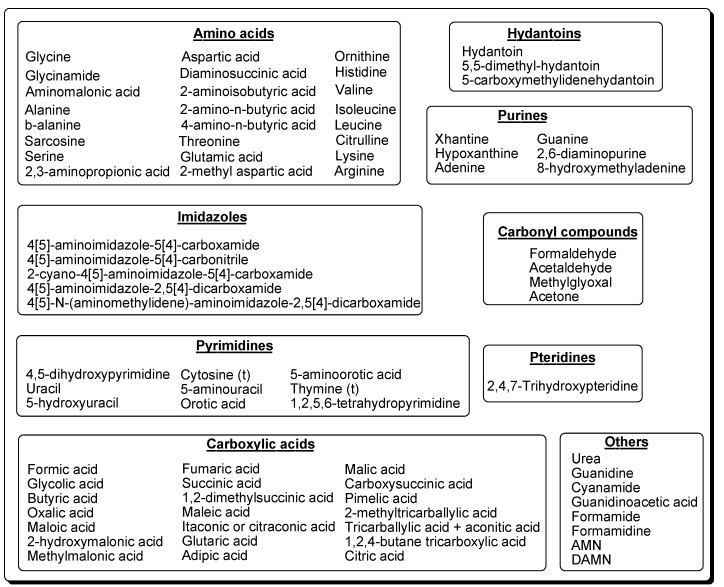
Hydrogen cyanide (HCN) is a ubiquitous molecule in the Universe. It is a compound that is easily produced in significant yields in prebiotic simulation experiments using a reducing atmosphere. HCN can spontaneously polymerise under a wide set of experimental conditions. It has even been proposed that HCN polymers could be present in objects such as asteroids, moons, planets and, in particular, comets. Moreover, it has been suggested that these polymers could play an important role in the origin of life. In this review, the simple organics and biomonomers that have been detected in HCN polymers, the analytical techniques and procedures that have been used to detect and characterise these molecules and an exhaustive classification of the experimental/environmental conditions that favour the formation of HCN polymers are summarised. Nucleobases, amino acids, carboxylic acids, cofactor derivatives and other compounds have been identified in HCN polymers. The great molecular diversity found in HCN polymers encourages their placement at the central core of a plausible protobiological system.
Overview
The claims and statistics of this paper haven’t been checked yet.
Free: it reads the open-access text and checks the first 5 claims that cite a source we can check. Create a free account to check every claim.
Integrity signals
Registry
Cites
Statistics
Figures

Verification
Claims the paper makes
The claims and statistics of this paper haven’t been checked yet.
Free: it reads the open-access text and checks the first 5 claims that cite a source we can check. Create a free account to check every claim.
Claims other papers make about this one
Each is checked against this paper’s own text: does it say what the citing paper says it does?
The cited source says what the claim attributes to it.
In the citing paper
“Whatever the exact structure, hydrolysis of the resulting polymers can afford molecules of prebiotic interest, including amino acids, purines and pyrimidines [69].”
From Prebiotic Reaction Networks in Water (2020) · cites this paper as [69]
In the citing paper
“While the fact that HCN 1 can polymerise under aqueous conditions is well known [69], the details of the ensuing reaction network are not fully understood.”
From Prebiotic Reaction Networks in Water (2020) · cites this paper as [69]
Self-check
Percentages, sums and reported differences re-computed from the paper’s own numbers.
The self-check needs the paper’s full text.
Citations
Cites
A Production of Amino Acids Under Possible Primitive Earth Conditions
Miller, S. L. (1953) · Science · doi:10.1126/science.117.3046.528 · Cited by 3,522 · cited 1×
“Miller demonstrated with his famous and successful experiment that a prebiotic formation of amino acids was possible [62].”
BackgroundGilbert, W. (1986) · Nature · doi:10.1038/319618a0 · Cited by 2,721
Infrared Observations of the Saturnian System from Voyager 1
Hanel, R., Conrath, B., Flasar, F. M., Kunde, V., Maguire, W., Pearl, J., Pirraglia, J., Samuelson, R., Herath, L., Allison, M., et al. (1981) · Science · doi:10.1126/science.212.4491.192 · Cited by 576
Calvin, M. (1969) · PubMed · Cited by 560
HCN Survey of Normal Spiral, Infrared‐luminous, and Ultraluminous Galaxies
Gao, Y., & Solomon, P. M. (2004) · The Astrophysical Journal Supplement Series · doi:10.1086/383003 · Cited by 497 · cited 1×
“HCN has been detected in remote galaxies [7], in interstellar clouds [8,9], notably in star-forming regions [10–14], in reflection nebulae [15–18], in planetary nebulae [19], in interplanetary dust [20,21], in circumstellar envelopes and discs [22–27], in comets [28–31], in meteorites [32], in the atmospheres of the o…”
BackgroundSynthesis of adenine from ammonium cyanide
Oró, J. (1960) · Biochemical and Biophysical Research Communications · doi:10.1016/0006-291x(60)90138-8 · Cited by 481 · cited 7×
“The first prebiotic synthesis of purines was carried out by Oró [6] using concentrated aqueous solutions of ammonium cyanide, which were heating at 70 °C for several days.”
BackgroundMethodInfluentialUniversality in intermediary metabolism
Smith, E., & Morowitz, H. J. (2004) · Proceedings of the National Academy of Sciences · doi:10.1073/pnas.0404922101 · Cited by 408 · cited 1×
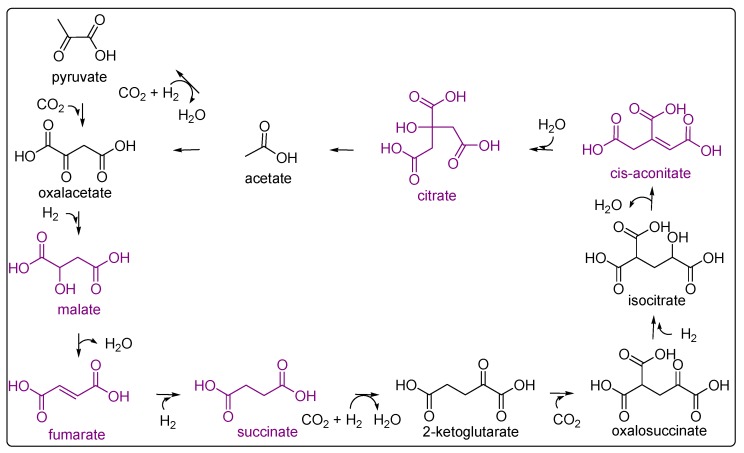
“The scheme is adapted from Smith and Morowitz [107].”
MethodSynthesis of Purines under Possible Primitive Earth Conditions. I. Adenine from Hydrogen Cyanide
Oró, J., & Kimball, A. P. (1961) · Archives of Biochemistry and Biophysics · doi:10.1016/0003-9861(61)90033-9 · Cited by 406 · cited 9×
“9 90/8 d/NH4OH Solution Non hydrolysis 60 mg/L 2D-PC, UV-spectrum [78] HCN, 10 80/24 h/NH4OH Solution Acid 0.”
BackgroundInfluentialThe mechanism of synthesis of amino acids by electric discharges
Miller, S. L. (1957) · Biochimica et Biophysica Acta · doi:10.1016/0006-3002(57)90366-9 · Cited by 380 · cited 1×
“HCN is the major product when appropriate gas mixtures are subjected to intense physical energy, such as from electric discharges, UV radiation or shock waves [40–44].”
BackgroundVitamin B12: Experiments Concerning the Origin of Its Molecular Structure
Eschenmoser, A. (1988) · Angewandte Chemie International Edition in English · doi:10.1002/anie.198800051 · Cited by 374
Research works printed but not linked: 2
- Proust J.L. Contributions on Cyanides Ann. Chim. Phys. 1806 60 233
- Labadie M. Jensen R. Neuzil E. Recherches sur l’eévolution pré-biologique. I. Composition en amino-acides des microsphérules obtenues a partir du cyanure d’ammonium Bull. Soc. Chim. Biol. 1967 49 673 682 6060515
Cited by
Chemistry of Abiotic Nucleotide Synthesis
Yadav, M., Kumar, R., & Krishnamurthy, R. (2020) · Chemical Reviews · doi:10.1021/acs.chemrev.9b00546 · Cited by 225
Prebiotic-chemistry inspired polymer coatings for biomedical and material science applications
Thissen, H. W., Koegler, A., Salwiczek, M., Easton, C. D., Qu, Y., Lithgow, T. J., & Evans, R. A. (2015) · NPG Asia Materials · doi:10.1038/am.2015.122 · Cited by 58
A Comprehensive Review of HCN-Derived Polymers
Ruiz-Bermejo, M., de la Fuente, J. L., Pérez-Fernández, C., & Mateo-Martí, E. (2021) · Processes · doi:10.3390/pr9040597 · Cited by 52
Self-citationNon-Equilibrium Thermodynamic Foundations of the Origin of Life
Michaelian, K. (2022) · Foundations · doi:10.3390/foundations2010022 · Cited by 56
The Role of Aqueous Aerosols in the “Glyoxylate Scenario”: An Experimental Approach
Marín‐Yaseli, M. R., González‐Toril, E., Mompeán, C., & Ruiz‐Bermejo, M. (2016) · Chemistry – A European Journal · doi:10.1002/chem.201602195 · Cited by 48
Self-citationRahm, M., Lunine, J. I., Usher, D. A., & Shalloway, D. (2016) · Proceedings of the National Academy of Sciences · doi:10.1073/pnas.1606634113 · Cited by 47
A Continuous Reaction Network that Produces RNA Precursors
Yi, R., Tran, Q. P., Ali, S., Yoda, I., Adam, Z. R., Cleaves, H. J., & Fahrenbach, A. C. (2020) · Proceedings of the National Academy of Sciences · doi:10.1073/pnas.1922139117 · Cited by 45
Hortal, L., Pérez-Fernández, C., de la Fuente, J. L., Valles, P., Mateo-Martí, E., & Ruiz-Bermejo, M. (2020) · Scientific Reports · doi:10.1038/s41598-020-79112-5 · Cited by 43
Self-citationA Prebiotic Synthesis of Pterins
Marín‐Yaseli, M. R., Mompeán, C., & Ruiz‐Bermejo, M. (2015) · Chemistry – A European Journal · doi:10.1002/chem.201502345 · Cited by 41
Self-citationAdhesive Prebiotic Chemistry Inspired Coatings for Bone Contacting Applications
Menzies, D. J., Ang, A. S. M., Thissen, H. W., & Evans, R. A. (2017) · ACS Biomaterials Science & Engineering · doi:10.1021/acsbiomaterials.7b00038 · Cited by 42
Main group cyanides: from hydrogen cyanide to cyanido-complexes
Schulz, A., & Surkau, J. (2022) · Reviews in Inorganic Chemistry · doi:10.1515/revic-2021-0044 · Cited by 35
Bizzarri, B. M., Saladino, R., Delfino, I., García-Ruiz, J. M., & Di Mauro, E. (2021) · International Journal of Molecular Sciences · doi:10.3390/ijms22020917 · Cited by 33
“The possibility of HCN conversion to other reagents, such as HCONH2 and HCOONH4, was not considered.”
BackgroundInfluentialPrebiotic Reaction Networks in Water
Tran, Q. P., Adam, Z. R., & Fahrenbach, A. C. (2020) · Life · doi:10.3390/life10120352 · Cited by 32
“Whatever the exact structure, hydrolysis of the resulting polymers can afford molecules of prebiotic interest, including amino acids, purines and pyrimidines [69].”
BackgroundInfluentialThe Dissipative Photochemical Origin of Life: UVC Abiogenesis of Adenine
Michaelian, K. (2021) · Entropy · doi:10.3390/e23020217 · Cited by 37
“evidence of all, however, is that many photochemical routes to the synthesis of nucleic acids [43], amino 215 acids [44], fatty acids [17], sugars [45], and other pigments [12] from common precursor molecules 216”
BackgroundSandström, H., & Rahm, M. (2021) · ACS Earth and Space Chemistry · doi:10.1021/acsearthspacechem.1c00195 · Cited by 30
Further progress into the thermal characterization of HCN polymers
de la Fuente, J., Ruiz‐Bermejo, M., Nna-Mvondo, D., & Minard, R. D. (2014) · Polymer Degradation and Stability · doi:10.1016/j.polymdegradstab.2014.09.005 · Cited by 32
“Many of these organics compounds are building blocks of current proteins and nucleic acids or are active participants in metabolism [3].”
BackgroundSelf-citationFernández, A., Ruiz-Bermejo, M., & de la Fuente, J. L. (2018) · Physical Chemistry Chemical Physics · doi:10.1039/c8cp01662c · Cited by 25
Self-citationZhao, Q., Garimella, S. S., & Savoie, B. M. (2023) · Journal of the American Chemical Society · doi:10.1021/jacs.2c11857 · Cited by 26
Meteorites and the RNA World: A Thermodynamic Model of Nucleobase Synthesis within Planetesimals
Pearce, B. K. D., & Pudritz, R. E. (2016) · Astrobiology · doi:10.1089/ast.2015.1451 · Cited by 21
“For example, it has been demonstrated that the formation of 8-hydroxymethyladenine is favored over A for increased formaldehyde concentrations (Ruiz-Bermejo et al. , 2013).”
Marín‐Yaseli, M. R., Moreno, M., de la Fuente, J., Briones, C., & Ruiz‐Bermejo, M. (2017) · Spectrochimica Acta Part A Molecular and Biomolecular Spectroscopy · doi:10.1016/j.saa.2017.10.003 · Cited by 23
Self-citationCharacterization of HCN-Derived Thermal Polymer: Implications for Chemical Evolution
Villafañe-Barajas, S. A., Ruiz‐Bermejo, M., Rayo-Pizarroso, P., & Colín-García, M. (2020) · Processes · doi:10.3390/pr8080968 · Cited by 21
Self-citationHighly efficient melt polymerization of diaminomaleonitrile
Mas, I., Hortelano, C., Ruiz‐Bermejo, M., & de la Fuente, J. L. (2020) · European Polymer Journal · doi:10.1016/j.eurpolymj.2020.110185 · Cited by 22
Self-citationFilms and Materials Derived from Aminomalononitrile
Thissen, H. W., Evans, R. A., & Ball, V. (2021) · Processes · doi:10.3390/pr9010082 · Cited by 22
Pérez-Fernández, C., Ruiz‐Bermejo, M., Gálvez, S., & Mateo‐Martí, E. (2021) · RSC Advances · doi:10.1039/d1ra02658e · Cited by 21
Self-citationRuiz‐Bermejo, M., de la Fuente, J., & Marín‐Yaseli, M. R. (2017) · Journal of Analytical and Applied Pyrolysis · doi:10.1016/j.jaap.2017.02.015 · Cited by 22
Self-citationMas, I., de la Fuente, J. L., & Ruiz‐Bermejo, M. (2020) · European Polymer Journal · doi:10.1016/j.eurpolymj.2020.109719 · Cited by 22
Self-citationChemical evolution: from formamide to nucleobases and amino acids without the presence of catalyst
Enchev, V. G., Angelov, I. K., Dincheva, I. N., Stoyanova, N., Slavova, S. O., Rangelov, M. A., & Markova, N. V. (2020) · Journal of Biomolecular Structure and Dynamics · doi:10.1080/07391102.2020.1792986 · Cited by 19
“Sealed glass ampoules containing pure formamide (4ml) heated at 100–140 C for 1–2weeks. have not been fully characterized due to their complex and heterogeneous nature (Ru ız-Bermejo et al., 2013).”
BackgroundMarín‐Yaseli, M. R., Cid, C., Yagüe, A. I., & Ruiz‐Bermejo, M. (2017) · Chemistry & Biodiversity · doi:10.1002/cbdv.201600241 · Cited by 18
Self-citationThe Non-Equilibrium Thermodynamics of Natural Selection: From Molecules to the Biosphere
Michaelian, K. (2023) · Entropy · doi:10.3390/e25071059 · Cited by 20
Ruiz‐Bermejo, M., Armada, M. P. G., Mateo‐Martí, E., & de la Fuente, J. L. (2021) · European Polymer Journal · doi:10.1016/j.eurpolymj.2021.110897 · Cited by 16
Self-citationVázquez-Salazar, A., Tan, G. K., Stockton, A. M., Fani, R., Becerra, A., & Lazcano, A. (2016) · Origins of Life and Evolution of Biospheres · doi:10.1007/s11084-016-9525-y · Cited by 16
Crossroads at the Origin of Prebiotic Chemical Complexity: Hydrogen Cyanide Product Diversification
Sandström, H., & Rahm, M. (2023) · The Journal of Physical Chemistry A · doi:10.1021/acs.jpca.3c01504 · Cited by 15
“Geometry optimizations were performed in Gaussian 16, revision B.01, 49,50 using the Perdew − Burke − Ernzerhof (PBE) functional 51 and Grimme’s D3 dispersion correction.”
InfluentialPrebiotic synthesis of noncanonical nucleobases under plausible alkaline hydrothermal conditions
Pérez-Fernández, C., Vega, J., Rayo-Pizarroso, P., Mateo‐Martí, E., & Ruiz‐Bermejo, M. (2022) · Scientific Reports · doi:10.1038/s41598-022-19474-0 · Cited by 17
Self-citationSantalucia, R., Pazzi, M., Bonino, F., Signorile, M., Scarano, D., Ugliengo, P., Spoto, G., & Mino, L. (2022) · Physical Chemistry Chemical Physics · doi:10.1039/d1cp05407d · Cited by 18
Cheng, S.-Y., Chiang, Y.-L., Chang, Y.-H., Thissen, H. W., & Tsai, S. (2021) · Colloids and Surfaces B Biointerfaces · doi:10.1016/j.colsurfb.2021.111913 · Cited by 13
Bizzarri, B. M., Fanelli, A., Cesarini, S., & Saladino, R. (2022) · European Journal of Organic Chemistry · doi:10.1002/ejoc.202200598 · Cited by 14
Villafañe-Barajas, S. A., Ruiz‐Bermejo, M., Rayo-Pizarroso, P., Gálvez, S., Mateo‐Martí, E., & Colín-García, M. (2021) · Life · doi:10.3390/life11070661 · Cited by 18
Self-citationVillafañe-Barajas, S. A., Colín-García, M., Negrón-Mendoza, A., & Ruiz‐Bermejo, M. (2020) · International Journal of Astrobiology · doi:10.1017/s1473550420000142 · Cited by 14
Self-citationDissipative Photochemical Abiogenesis of the Purines
Hernández, C., & Michaelian, K. (2022) · Entropy · doi:10.3390/e24081027 · Cited by 12
“The most convincing evidence of all, however, is that many photochemical routes to the synthesis of nucleic acids [35], amino acids [36], fatty acids [23], sugars [37], and other pigments [18] from common and simple precursor molecules have been identified at these wavelengths and the rate of photon dissipation within…”
BackgroundProgrammed Formation of HCN Oligomers through Organosulfur Catalysis
Grundke, C., Kong, C., Kampf, C. J., Gupton, B. F., McQuade, D. T., & Opatz, T. (2021) · The Journal of Organic Chemistry · doi:10.1021/acs.joc.1c01023 · Cited by 10
Ruiz‐Bermejo, M., Armada, M. P. G., Vallés, P., & de la Fuente, J. L. (2022) · Polymers · doi:10.3390/polym14173460 · Cited by 11
“Classically, HCN polymers have been considered preferential prebiotic precursors of biomonomers [52] and the DAMN as a key intermediate in the oligomerization/polymerization of HCN [3,24,39].”
BackgroundSelf-citationMarín‐Yaseli, M. R., González‐Toril, E., & Ruiz‐Bermejo, M. (2020) · Frontiers in Astronomy and Space Sciences · doi:10.3389/fspas.2020.519017 · Cited by 9
“In most of the previous works reported in the bibliography that performed chromatography analysis of HCN polymers, only the soluble or insoluble fractions of the total material obtained were analyzed (Ruiz-Bermejo et al., 2013b).”
BackgroundSelf-citationWeakly Bound Complex Formation between HCN and CH3Cl: A Matrix-Isolation and Computational Study
Hockey, E. K., Vlahos, K., Howard, T., Palko, J., & Dodson, L. G. (2022) · The Journal of Physical Chemistry A · doi:10.1021/acs.jpca.2c00716 · Cited by 10
Hydrogen cyanide and hydrocarbons mix on Titan
Izquierdo‐Ruiz, F., Cable, M. L., Hodyss, R., Vu, T. H., Sandström, H., Lobato, Á., & Rahm, M. (2025) · Proceedings of the National Academy of Sciences · doi:10.1073/pnas.2507522122 · Cited by 8
The Pigment World: Life’s Origins as Photon-Dissipating Pigments
Michaelian, K. (2024) · Life · doi:10.3390/life14070912 · Cited by 7
“Many photochemical routes from common and simple precursor molecules to the synthesis of nucleic acids [12,27,32], amino acids [112], fatty acids [31], sugars [55,113], and other pigments [17] have been identified at these UV-C wavelengths.”
BackgroundNucleic acid bases in Titan tholins and possible genetic systems in the Titan liquidosphere
Kawai, J., Kebukawa, Y., McKay, C. P., & Kobayashi, K. (2018) · Life Sciences in Space Research · doi:10.1016/j.lssr.2018.11.002 · Cited by 10
Abiotic formation of nitrile precursors to amino acids and nucleobases in interstellar ice analogues
Wang, J., Inada, S., Zhang, C., Marks, J. H., Wang, Z., Bergantini, A., McAnally, M., Eckhardt, A. K., & Kaiser, R. I. (2026) · Chemical Science · doi:10.1039/d5sc08569a · Cited by 6
Pérez-Fernández, C., Vega, J., de la Fuente, J. L., Mateo‐Martí, E., Vallés, P., & Ruiz‐Bermejo, M. (2023) · Physical Chemistry Chemical Physics · doi:10.1039/d3cp00968h · Cited by 9
Self-citationA Thermodynamic Landscape of Hydrogen Cyanide-Derived Molecules and Polymers
Sandström, H., Izquierdo‐Ruiz, F., Cappelletti, M., Dogan, R., Sharma, S., Bailey, C., & Rahm, M. (2024) · ACS Earth and Space Chemistry · doi:10.1021/acsearthspacechem.4c00088 · Cited by 6
Nucleobases on the Primitive Earth: Their Sources and Stabilities
Cleaves, H. J. (2018) · Nucleic acids and molecular biology · doi:10.1007/978-3-319-93584-3_1 · Cited by 7
Experimental Models on the Prebiotic Formation of Biopolymer Building Blocks
Menor-Salván, C., & Ruiz‐Bermejo, M. (2025) · Astrobiology · doi:10.1177/15311074251365950 · Cited by 6
“These salts may have acted as reservoirs that released cyanide under intense early solar radiation and potentially contributed to amino acid synthesis (Ruiz-Bermejo et al., 2013).”
Self-citationBancone, N., Santalucia, R., Pantaleone, S., Ugliengo, P., Mino, L., Rimola, A., & Corno, M. (2024) · The Journal of Physical Chemistry C · doi:10.1021/acs.jpcc.4c03454 · Cited by 6
Fioroni, M., & DeYonker, N. J. (2022) · Monthly Notices of the Royal Astronomical Society · doi:10.1093/mnras/stac271 · Cited by 5
How Does Adenine Form from Hydrogen Cyanide?
Cappelletti, M., & Rahm, M. (2026) · Journal of the American Chemical Society · doi:10.1021/jacs.5c09522 · Cited by 3
“Overall, changing ε has but a minor effect on the kinetics and thermodynamics of the first step.”
InfluentialTer‐Ovanessian, L. M. P., Ryan, K. L., Shaarda, J., Stubbs, R. T., Krishnamurthy, R., & Springsteen, G. (2025) · Angewandte Chemie International Edition · doi:10.1002/anie.202507248 · Cited by 3
Mancin, E., Capecchi, E., Botta, L., & Bizzarri, B. M. (2024) · ChemistryOpen · doi:10.1002/open.202400265 · Cited by 2
Field-Theodore, T. E., Ravasio, M., Alessandrini, S., Carlo, C., & Puzzarini, C. (2025) · The Astrophysical Journal · doi:10.3847/1538-4357/ae058d · Cited by 1
“…not only in solution, but also in the solid ( ice ) phase; a variety of prebiotic biomolecules are, of course, produced via the oligomerization of HCN under appropriate conditions ( H. Wakamatsu et al. 1966; J. P. Ferris et al. 1972a, 1972b; M. Ruiz-Bermejo et al. 2013; M. Yadav et al. 2020 ) .”
Sherpa, L. T., Khatun, M., Panda, S., & Anoop, A. (2025) · Physical Chemistry Chemical Physics · doi:10.1039/d5cp03273c · Cited by 1
Electric Fields Can Assist Prebiotic Reactivity on Hydrogen Cyanide Surfaces
Cappelletti, M., Sandström, H., & Rahm, M. (2026) · ACS Central Science · doi:10.1021/acscentsci.5c01497 · Cited by 1
HCN-Derived Polymers: From Prebiotic Chemistry to Materials Science
Ruiz‐Bermejo, M., de la Fuente, J. L., Pérez-Fernández, C., & Mateo‐Martí, E. (2024) · Advances in material research and technology · doi:10.1007/978-3-031-62186-4_3 · Cited by 1
Self-citationFerus, M. (2023) · Encyclopedia of Astrobiology · doi:10.1007/978-3-662-65093-6_5453 · Cited by 1
Ferus, M. (2022) · Encyclopedia of Astrobiology · doi:10.1007/978-3-642-27833-4_5453-1
Pérez-Fernández, C., González‐Toril, E., Mateo‐Martí, E., & Ruiz‐Bermejo, M. (2023) · Polymers · doi:10.3390/polym15020410
Self-citationGargaud, M., Irvine, W. M., Amils, R., Claeys, P., Cleaves, H. J., Gérin, M., Rouan, D., Spohn, T., Tirard, S., & Viso, M. (2023) · Encyclopedia of Astrobiology · doi:10.1007/978-3-662-65093-6_300040
Addressing the Miller Paradox and the Prebiotic Synthesis of Nucleobases
Callahan, M. P., & Cleaves, H. J. (2023) · ACS Earth and Space Chemistry · doi:10.1021/acsearthspacechem.3c00246 · Cited by 1
Ter‐Ovanessian, L. M. P., Ryan, K. L., Shaarda, J., Stubbs, R. T., Krishnamurthy, R., & Springsteen, G. (2025) · Angewandte Chemie · doi:10.1002/ange.202507248 · Cited by 1
Did it all begin with hydrogen cyanide?
Rahm, M. (2026) · Proceedings of the National Academy of Sciences · doi:10.1073/pnas.2608465123
Self-Catalytic Mechanism of Prebiotic Reactions: From Formamide to Pyrimidines
Enchev, V. G., & Slavova, S. O. (2026) · The Journal of Physical Chemistry B · doi:10.1021/acs.jpcb.5c08322
Wang, J. (. R. N. )., Wang, Z., Inada, S., & Kaiser, R. I. (2026) · Journal of the American Chemical Society · doi:10.1021/jacs.6c14563
Metadata
- Authors
- Ruiz-Bermejo, M., Zorzano, M.-P., & Osuna-Esteban, S.
- Affiliations
- Departamento de Evolución Molecular, Centro de Astrobiología (CSIC-INTA), Ctra, Torrejón-Ajalvir, km 4, 28850-Torrejón de Ardoz, Madrid, Spain
- Consejo Superior de Investigaciones Científicas (ES)
- Venue
- Life
- Publisher
- MDPI AG
- Published
- 2013-07-29
- Volume
- 3
- Issue
- 3
- Pages
- 421-448
- ISSN
- 2075-1729 (ISSN-L)
- PMC
- PMC4187177
- OpenAlex
- W1966225300
- Cited by
- 70
- References
- 116
- Citations by year
- 2026: 6 · 2025: 6 · 2024: 6 · 2023: 8 · 2022: 10 · 2021: 10 · 2020: 10 · 2018: 3 · 2017: 3 · 2016: 5 · 2015: 2 · 2014: 1
- FWCI
- 0.18
- Type
- journal article
- Language
- en
- Open access
- gold
- doi.org
- Licence
- Locations
- Life (publishedVersion, cc-by)
- Europe PMC (PubMed Central) (publishedVersion, cc-by)
- PubMed Central (publishedVersion, cc-by)
- PubMed (publishedVersion)
- Aberdeen University Research Archive (Aberdeen University) (submittedVersion)
- DIGITAL.CSIC (Spanish National Research Council (CSIC)) (submittedVersion, cc-by)
- DOAJ (DOAJ: Directory of Open Access Journals) (submittedVersion, cc-by-sa)
- Funders
- Ministerio de Ciencia e Innovación (AYA2009-13920-C02-01)
- Instituto Nacional de Técnica Aeroespacial
- Topics
- Physical Sciences › Physics and Astronomy › Astronomy and Astrophysics › Origins and Evolution of Life
- Physical Sciences › Physics and Astronomy › Astronomy and Astrophysics › Space Science and Extraterrestrial Life
- Physical Sciences › Physics and Astronomy › Astronomy and Astrophysics › Astrophysics and Star Formation Studies
- Keywords
- hydrogen cyanide, prebiotic chemistry, origin of life, nucleobases, amino acids, carboxylic acids, reducing atmosphere, comets, asteroids
About these checks
Registry, retraction, Cites and statistics results are computed, not judged, with one exception: a printed reference that no index lists is read once by a model before it counts as a citation error. Claims are extracted by a model and kept only when their quote appears verbatim in the text; each cited source is then checked, with a model’s help, for whether it says what the claim relies on. Those verdicts can be wrong — read the claim’s quote and the cited source before relying on one.
Statistics and arithmetic are recomputed, not judged.
Confidence bands are shown only for fields calibrated on our annotated test set. None is calibrated yet, so no band is shown.
What counts as a claim ›How we measure confidence ›How we check this ›
Are you an author, or do you see a problem with this page? Request a review
Data sources
Bibliographic data: Semantic Scholar, OpenAlex, Crossref.
Contains information from the Semantic Scholar Academic Graph Datasets, made available under the ODC Attribution License (ODC-BY 1.0).
Semantic Scholar’s data is described in: Kinney, R., et al. (2023). The Semantic Scholar Open Data Platform. arXiv:2301.10140.
