

Exposed Areas Above Sea Level on Earth >3.5 Gyr Ago: Implications for Prebiotic and Primitive Biotic Chemistry
Open accessThe DOI matches its Crossref record; 54 of the 54 references it cites were found in a registry or an index.
Abstract
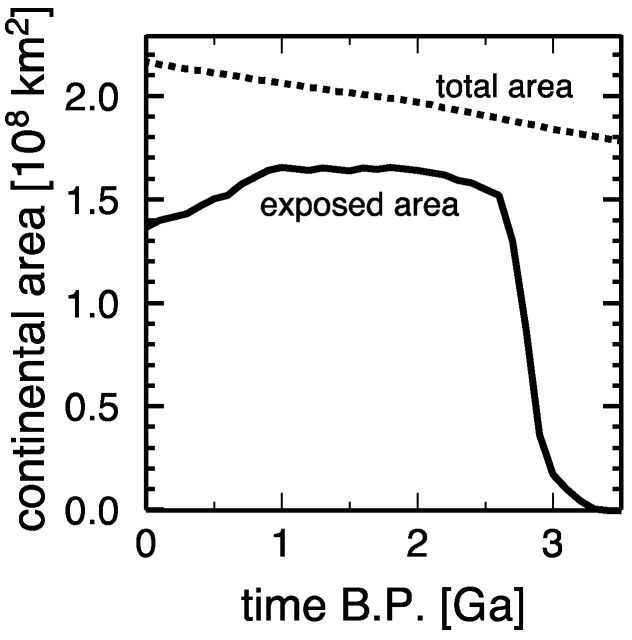
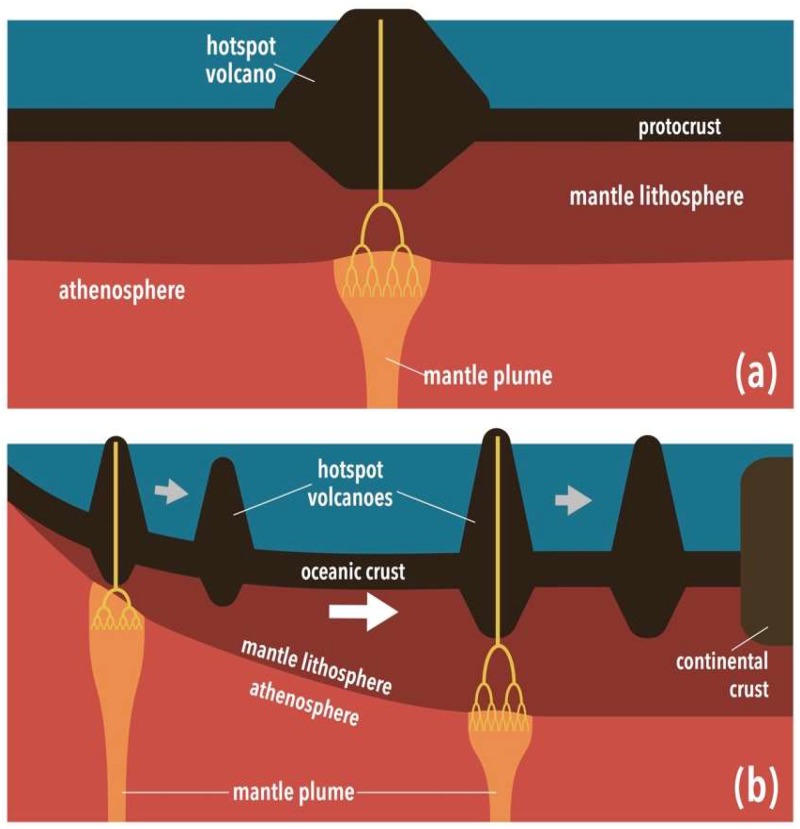
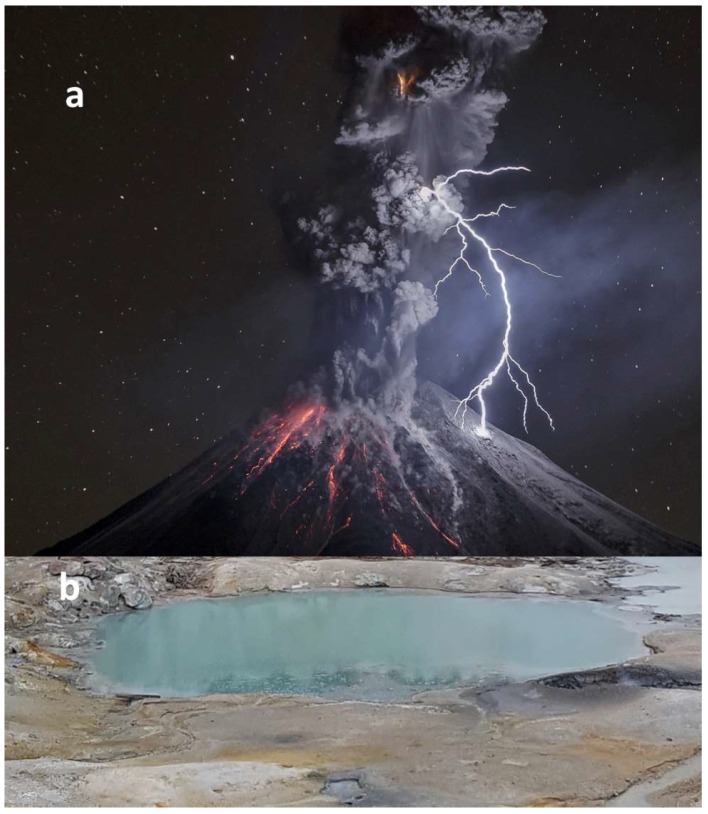
How life began on Earth is still largely shrouded in mystery. One of the central ideas for various origins of life scenarios is Darwin’s “warm little pond”. In these small bodies of water, simple prebiotic compounds such as amino acids, nucleobases, and so on, were produced from reagents such as hydrogen cyanide and aldehydes/ketones. These simple prebiotic compounds underwent further reactions, producing more complex molecules. The process of chemical evolution would have produced increasingly complex molecules, eventually yielding a molecule with the properties of information storage and replication prone to random mutations, the hallmark of both the origin of life and evolution. However, there is one problematic issue with this scenario: On the Earth >3.5 Gyr ago there would have likely been no exposed continental crust above sea level. The only land areas that protruded out of the oceans would have been associated with hotspot volcanic islands, such as the Hawaiian island chain today. On these long-lived islands, in association with reduced gas-rich eruptions accompanied by intense volcanic lightning, prebiotic reagents would have been produced that accumulated in warm or cool little ponds and lakes on the volcano flanks. During seasonal wet–dry cycles, molecules with increasing complexity could have been produced. These islands would have thus been the most likely places for chemical evolution and the processes associated with the origin of life. The islands would eventually be eroded away and their chemical evolution products would have been released into the oceans where Darwinian evolution ultimately produced the biochemistry associated with all life on Earth today.
Overview
The claims and statistics of this paper haven’t been checked yet.
Free: it reads the open-access text and checks the first 5 claims that cite a source we can check. Create a free account to check every claim.
Integrity signals
Registry
Cites
Statistics
Figures
![Figure 4 Aerial view taken in 1965 of ice-covered Lake Waiau in the Pu‘u Waiau cinder cone near the summit of the Mauna Kea volcano on the island of Hawai‘i (USGS Library, Denver; Photo KPA-N183].](https://figures.cochat.ai/paper-figures/2c06cb8cb1094ab7a01150a55613111d/exposed-areas-above-sea-level-on-earth-gt-3-5-gyr-ago-implications-for-prebiotic-figure-4.jpg)
Verification
Claims the paper makes
The claims and statistics of this paper haven’t been checked yet.
Free: it reads the open-access text and checks the first 5 claims that cite a source we can check. Create a free account to check every claim.
Claims other papers make about this one
Each is checked against this paper’s own text: does it say what the citing paper says it does?
The cited source says what the claim attributes to it.
In the citing paper
“Volcanoes emerging through a global ocean would be the original land masses on the Hadean Earth (Van Kranendonk, 2010; Bada and Korenaga, 2018), analogous to Hawaii and Iceland today.”
From The Hot Spring Hypothesis for an Origin of Life (2020) · cites this paper as Bada and Korenaga, 2018
Self-check
Percentages, sums and reported differences re-computed from the paper’s own numbers.
The self-check needs the paper’s full text.
Citations
Cites
Wilde, S. A., Valley, J. W., Peck, W. H., & Graham, C. M. (2001) · Nature · doi:10.1038/35051550 · Cited by 1,744 · cited 2×
“4 Gyr ago [25,26], the volume of continents and their exposed area are poorly constrained.”
BackgroundHotspots and mantle plumes: Some phenomenology
Sleep, N. H. (1990) · Journal of Geophysical Research: Solid Earth · doi:10.1029/jb095ib05p06715 · Cited by 1,119
Oxygen-isotope evidence from ancient zircons for liquid water at the Earth's surface 4,300 Myr ago
Mojzsis, S. J., Harrison, T. M., & Pidgeon, R. T. (2001) · Nature · doi:10.1038/35051557 · Cited by 863 · cited 2×
“4 Gyr ago [25,26], the volume of continents and their exposed area are poorly constrained.”
BackgroundScaling of temperature- and stress-dependent viscosity convection
Solomatov, V. S. (1995) · Physics of Fluids · doi:10.1063/1.868624 · Cited by 642 · cited 2×
“In any case, the tectonic regime before plate tectonics would probably have been stagnant id c nvection, as it is the ost natural st le of thermal convection with strongly temperature-dependent viscosity [32].”
BackgroundArmstrong, R. L. (1981) · Philosophical Transactions of the Royal Society of London. Series A, Mathematical and Physical Sciences · doi:10.1098/rsta.1981.0122 · Cited by 618 · cited 1×
“However, the composition of sea spray (and thus rainwater) on the early Earth was likely much different than today because of the ancient ocean composition [14], being depleted in Mg2+ and enriched in Fe2+ relative to today.”
BackgroundInitiation and evolution of plate tectonics on Earth: Theories and observations
Korenaga, J. (2013) · Annual Review of Earth and Planetary Sciences · doi:10.1146/annurev-earth-050212-124208 · Cited by 533 · cited 2×
“When such a transition took place is widely debated [27]; many geologists are content with the operat on of plate tect nics at least back to ~3 Gyr ago [28], and some suggest that the geochemistry of zircon pushes its onset to >4.”
BackgroundSelf-citationCondie, K. C., & Aster, R. C. (2010) · Precambrian Research · doi:10.1016/j.precamres.2010.03.008 · Cited by 490
Potentially biogenic carbon preserved in a 4.1 billion-year-old zircon
Bell, E. A., Boehnke, P., Harrison, T. M., & Mao, W. L. (2015) · Proceedings of the National Academy of Sciences · doi:10.1073/pnas.1517557112 · Cited by 474 · cited 1×
“If exposed areas above sea level were scarce, were WLPs indeed plausible on the early Earth? This is a critical issue because it was in this period that life arose based on microfossil and geochemical fossil evidence [7,8].”
BackgroundSaito, M. A., Sigman, D. M., & Morel, F. M. M. (2003) · Inorganica Chimica Acta · doi:10.1016/s0020-1693(03)00442-0 · Cited by 440 · cited 1×
“[13], the early oceans would have had high concentrations of Fe+2 and “the relative availability of trace metals would have been similar to that of a sulfidic system, Fe > Mn, Ni, Co >> Cd, Zn, Cu .”
BackgroundThe Miller volcanic spark discharge experiment
Johnson, A. P., Cleaves, H. J., Dworkin, J. P., Glavin, D. P., Lazcano, A., & Bada, J. L. (2008) · Science · doi:10.1126/science.1161527 · Cited by 376 · cited 2×
“Evidence for this volcanic-island-based prebiotic synthesis of organic compounds has been provided from analyses of samples Stanley Miller archived from one of his classic 1950s spark discharge experiments [48,49].”
BackgroundSelf-citation
Research works printed but not linked: 2
- Buick R. The earliest records of life on Earth Planets and Life: The Emerging Science of Astrobiology Woodruff T.S. III John B. Cambridge University Press Cambridge, UK 2007 237 264
- Massey J.E. Physicochemical influences on phytoplankton production in a tropical alpine lake Archiv. Hydrobiol. 1981 91 133 143
Cited by
The Hot Spring Hypothesis for an Origin of Life
Damer, B., & Deamer, D. (2020) · Astrobiology · doi:10.1089/ast.2019.2045 · Cited by 478
“The setting is the Hadean Earth, *4 billion years ago by which time a global ocean has formed, with emerging volcanic land masses (Pearce et al., 2018).”
BackgroundInfluentialSecular change and the onset of plate tectonics on Earth
Palin, R. M., Santosh, M., Cao, W., Li, S.-S., Hernández-Uribe, D., & Parsons, A. (2020) · Earth-Science Reviews · doi:10.1016/j.earscirev.2020.103172 · Cited by 355
Hadean geodynamics and the nature of early continental crust
Korenaga, J. (2021) · Precambrian Research · doi:10.1016/j.precamres.2021.106178 · Cited by 136
Self-citationWas There Land on the Early Earth?
Korenaga, J. (2021) · Life · doi:10.3390/life11111142 · Cited by 98
“They only suggested that, based on the work of Van Kranendonk [210] and Bada and Korenaga [11], volcanoes emerging through a global ocean would be the original landmass on the Hadean Earth.”
BackgroundSelf-citationAlkaline lake settings for concentrated prebiotic cyanide and the origin of life
Toner, J. D., & Catling, D. C. (2019) · Geochimica et Cosmochimica Acta · doi:10.1016/j.gca.2019.06.031 · Cited by 85
“…landmasses may have been present as early as the Hadean based on evidence from zircons (Harrison, 2009), possibly associated with hotspot volcanism (Bada and Korenaga, 2018), and there is strong evidence for landmasses in the early Archean based on 3.8 Ga sediments in Greenland (Nutman et al.,…”
BackgroundInfluentialCamprubí, E., de Leeuw, J. W., House, C. H., Raulin, F., Russell, M. J., Spang, A., Tirumalai, M. R., & Westall, F. (2019) · Space Science Reviews · doi:10.1007/s11214-019-0624-8 · Cited by 84
Lightning strikes as a major facilitator of prebiotic phosphorus reduction on early Earth
Hess, B., Piazolo, S., & Harvey, J. (2021) · Nature Communications · doi:10.1038/s41467-021-21849-2 · Cited by 98
Kadoya, S., Krissansen‐Totton, J., & Catling, D. C. (2020) · Geochemistry, Geophysics, Geosystems · doi:10.1029/2019gc008734 · Cited by 72
“This is important because carbonate-rich lakes with basic pH have been proposed as sites for the origin of life (Bada & Korenaga, 2018), in part because such aqueous chemistry concentrates critical reactants for prebiotic schemes, such as cyanide (Toner & Catling, 2019) and phosphate (Toner &…”
BackgroundInfluentialOrigin-of-life Molecules in the Atmosphere after Big Impacts on the Early Earth
Wogan, N. F., Catling, D. C., Zahnle, K. J., & Lupu, R. (2023) · The Planetary Science Journal · doi:10.3847/psj/aced83 · Cited by 96
Calabon, M. S., Hyde, K., Jones, E., Bao, D., Bhunjun, C. S., Phukhamsakda, C., Shen, H. F., Gentekaki, E., Sharie, A. A., de Barros, J. S., et al. (2023) · Mycosphere · doi:10.5943/mycosphere/14/1/4 · Cited by 91
Origin of Life on Mars: Suitability and Opportunities
Clark, B. C., Kolb, V. M., Steele, A., House, C. H., Lanza, N., Gasda, P. J., VanBommel, S. J. V., NEWSOM, H. E., & Martínez‐Frías, J. (2021) · Life · doi:10.3390/life11060539 · Cited by 59
“For all the OoL hypotheses requiring land and subaerial exposures, the expectations for a successful origin would be constrained if Earth’s ocean were global and tectonic activity subdued [233].”
BackgroundKobayashi, K., Ise, J.-I., Aoki, R., Kinoshita, M., Naito, K., Udo, T., Kunwar, B., Takahashi, J., Shibata, H., Mita, H., et al. (2023) · Life · doi:10.3390/life13051103 · Cited by 50
“The produced molecules precipitated down into these low-temperature environments, where they could be efficiently accumulated and produce simple prebiotic compounds including amino acids, nucleobases, and other biologically relevant molecules [70,71].”
BackgroundArchaean seafloors shallowed with age due to radiogenic heating in the mantle
Rosas, J. C., & Korenaga, J. (2021) · Nature Geoscience · doi:10.1038/s41561-020-00673-1 · Cited by 43
Self-citationThe evolving redox chemistry and bioavailability of vanadium in deep time
Moore, E. K., Hao, J., Spielman, S. J., & Yee, N. (2020) · Geobiology · doi:10.1111/gbi.12375 · Cited by 36
“…of continental land above sea level is very limited until the middle of the Archean with lower elevation than that of the present-day plateaus (Bada & Korenaga, 2018; Flament, Coltice, & Rey, 2013; Korenaga, Planavsky, & Evans, 2017), thus possibly constraining the input of continental…”
BackgroundUnterborn, C. T., Foley, B. J., Desch, S. J., Young, P. A., Vance, G., Chiffelle, L., & Kane, S. R. (2022) · The Astrophysical Journal Letters · doi:10.3847/2041-8213/ac6596 · Cited by 38
“…may be essential for life on Earth, as weathering of subaerial land supplies critical nutrients to the oceans (e.g., Maruyama et al. 2013; Dohm & Maruyama 2015), and some leading theories for the origin of life rely on wet–dry cycles and therefore require exposed land (e.g., Bada & Korenaga 2018).”
BackgroundFactoring Origin of Life Hypotheses into the Search for Life in the Solar System and Beyond
Longo, A., & Damer, B. (2020) · Life · doi:10.3390/life10050052 · Cited by 45
“Therefore, it is conceivable that ancient analogs could have been present on the rare volcanic land masses and islands which may have emerged from the global ocean on the early Earth [72,73].”
BackgroundRibose Selected as Precursor to Life
Bánfalvi, G. (2019) · DNA and Cell Biology · doi:10.1089/dna.2019.4943 · Cited by 25
“According to the recent view, life on Earth came into being through chemical evolution by producing increasingly complex molecules and yielding a molecule with the properties of information storage and replication prone to mutations (Gilbert, 1986; Bada and Korenaga, 2018).”
Macrobiont: Cradle for the Origin of Life and Creation of a Biosphere
Clark, B. C., & Kolb, V. M. (2020) · Life · doi:10.3390/life10110278 · Cited by 19
“Similarly, relatively rare volcanic islands poking above a global ocean to provide WLPs has also been championed [12].”
BackgroundResolving the History of Life on Earth by Seeking Life As We Know It on Mars
Carr, C. E. (2022) · Astrobiology · doi:10.1089/ast.2021.0043 · Cited by 20
Layered intrusions in the Precambrian: Observations and perspectives
Smith, W. D., Jenkins, M. C., Augustin, C. T., Virtanen, V. J., Vukmanovic, Z., & O’Driscoll, B. (2024) · Precambrian Research · doi:10.1016/j.precamres.2024.107615 · Cited by 17
“E. Global geodynamics with the continental freeboard (Bada and Korenaga 2018) and ages of local subduction initiation according to Ba contents of TTG suites (Huang et al. 2022).”
Eta-Earth Revisited II: Deriving a Maximum Number of Earth-Like Habitats in the Galactic Disk
Scherf, M., Lammer, H., & Sproß, L. (2024) · Astrobiology · doi:10.1089/ast.2023.0076 · Cited by 19
Analytical Chemistry in Astrobiology
Seaton, K. M., Cable, M. L., & Stockton, A. M. (2021) · Analytical Chemistry · doi:10.1021/acs.analchem.0c04271 · Cited by 16
Generation of Archean TTGs via sluggish subduction
Foley, B. J. (2024) · Geology · doi:10.1130/g52196.1 · Cited by 15
Prebiotic membrane structures mimic the morphology of alleged early traces of life on Earth
Jordan, S. F., van Zuilen, M. A., Rouillard, J., Martins, Z., & Lane, N. J. (2024) · Communications Earth & Environment · doi:10.1038/s43247-024-01372-0 · Cited by 20
Zaia, D. A. M., & Zaia, C. T. B. V. (2020) · Symmetry · doi:10.3390/sym12122046 · Cited by 11
“Amino acids synthesized on Earth or brought from outside the Earth fell into the sea that covered almost the entire planet [57].”
BackgroundInfluentialRanjan, S., Abdelazim, K., Lozano, G. G., Mandal, S., Zhou, C. Y., Kufner, C. L., Todd, Z. R., Sahai, N., & Sasselov, D. D. (2023) · AGU Advances · doi:10.1029/2023av000926 · Cited by 15
“However, this worst-case scenario is unlikely to be realized, because most natural surfaces, the basalts proposed to have constituted the first land (Bada & Korenaga, 2018; Korenaga, 2021; Rosas & Korenaga, 2021), have low UV reflectivity (Dollfus et al., 1980; Turner & Parisi, 2018), meaning that…”
BackgroundData‐Driven Investigation Reveals Subaerial Proportion of Basalts Since the Early Archean
Liu, C., Liu, X., & ZhangZhou, J. (2024) · Geophysical Research Letters · doi:10.1029/2023gl107066 · Cited by 13
“It has been suggested that volcanic islands like present‐day Iceland or Hawaii are the most plausible areas that could have been exposed above the Archean oceans due to the hotter and weaker crust at that time (Bada & Korenaga, 2018; Damer & Deamer, 2020; Russell, 2021).”
BackgroundDash, S., BABU, E. V. S. S. K., Ganne, J., & Mukherjee, S. (2024) · International Geology Review · doi:10.1080/00206814.2024.2394994 · Cited by 12
“2017; Bada and Korenaga 2018; Bindeman et al .”
Intrinsic Contributions of 2′‐Hydroxyl to the Hydration of Nucleosides at the Monomeric Level
Wang, Z., Liu, J., Zhang, Y., Qi, J., Han, X., Zhao, X., Bai, D., Zhao, H., & Chen, Q. (2020) · Chemistry - A European Journal · doi:10.1002/chem.202002835 · Cited by 7
Biosynthesis of Ribose-5-Phosphate—Metabolic Regulator of Escherichia coli Viability
Seregina, T. A., Shakulov, R. S., Petrushanko, I. Y., Lobanov, K. V., & Mironov, A. S. (2025) · Cells · doi:10.3390/cells14221775 · Cited by 7
“According to modern concepts, life on Earth arose through chemical evolution, which resulted in the emergence of complex molecules with the properties of storing and replicating information in the form of RNA and DNA polymers [15,16].”
The Early Earth as an Analogue for Exoplanetary Biogeochemistry
Stüeken, E. E., Olson, S. L., Moore, E. K., & Foley, B. J. (2024) · Reviews in Mineralogy and Geochemistry · doi:10.2138/rmg.2024.90.14 · Cited by 5
Zetterlind, A., Kopacz, N., Jumpertz, L., Locht, S. L. D., Schneidt, A., Deelen, S., Krijnen, M., van Ingen, H., Hellebrand, E. W. G., & ten Kate, I. L. (2025) · International Journal of Astrobiology · doi:10.1017/s1473550425100098 · Cited by 4
“The frequent impact events during the Hadean delivered essential elements and organic molecules to early Earth ’ s surface (Bada and Korenaga, 2018), likely allowing for organic molecules to accumulate in early ponds.”
Prebiotic formation of thioesters via cyclic anhydrides as a key step in the emergence of metabolism
Qami, A. E., Hilari, J. I., Blandin, V., Gayraud, O., Milet, A., & Vallée, Y. (2025) · Scientific Reports · doi:10.1038/s41598-025-91547-2 · Cited by 4
Zoleikhaei, Y., Mazumder, R., Cawood, P. A., & De, S. (2023) · Precambrian Research · doi:10.1016/j.precamres.2023.107174 · Cited by 5
A Limited Effect of Continents on Subduction Initiation for Convection With Grain‐Damage
Choi, H., & Foley, B. J. (2024) · Journal of Geophysical Research Solid Earth · doi:10.1029/2024jb029136 · Cited by 2
“…key factor in the origin of life on Earth by providing environments favorable for prebiotic chemistry at hydrothermal vents or subaerial continents (Bada & Korenaga, 2018; Dick, 2019; Martin et al., 2008; Par-nell, 2004; Santosh et al., 2017) However, despite its importance, when and how plate…”
Singh, D., Sinha, R. K., & Acharyya, K. (2024) · Journal of Geophysical Research Planets · doi:10.1029/2024je008311 · Cited by 2
“Hydrologically active topographic depressions, or sedimentary basins, can have cycles of environmental change (drying and wetting), which may lead to the synthesis of simple molecules and nucleic acids, and such areas are conceived as ideal settings for the origin of simple life on a prebiotic Earth (Bada & Korenaga,…”
InfluentialThe plausibility of origins scenarios requiring two impactors
Anslow, R. J., Bonsor, A., Rimmer, P. B., Rae, A. S. P., McDonald, C. H., & Walton, C. R. (2025) · Proceedings of the Royal Society A Mathematical Physical and Engineering Sciences · doi:10.1098/rspa.2024.0327 · Cited by 5
Tectonics and Surface Environments on Early Earth
Korenaga, J. (2025) · Astrobiology · doi:10.1089/ast.2024.0093 · Cited by 4
“Without plate tectonics, magmatic activities would be limited to those by mantle plumes, the presence of which is nearly guaranteed through Earth ’ s history (Bada and Korenaga, 2018), so the surface would have been covered by ma fi c protocrust.”
Self-citationA tectonic context for fluctuations in late Paleoproterozoic oxygen content
Partin, C. A. (2022) · Geological Society of America eBooks · doi:10.1130/2022.1220(07 · Cited by 2
Singh, D., Singh, P., Roy, N., & Mukherjee, S. (2024) · Planetary and Space Science · doi:10.1016/j.pss.2024.105974 · Cited by 3
Gordon, R., Singh, S. R. V., Katyal, K., & Gordon, N. K. (2023) · Wiley eBooks · doi:10.1002/9781119555568.ch17 · Cited by 10
Paschek, K., Henning, T. K., Molaverdikhani, K., Miyazaki, Y., Pearce, B. K. D., Pudritz, R. E., & Semenov, D. A. (2025) · The Astrophysical Journal · doi:10.3847/1538-4357/adc39b · Cited by 7
Geometric phase in the Crow-Kimura model of molecular evolution on dynamic environments
Suvorov, V., Solé, R. V., & Saakian, D. B. (2025) · Physical review. E · doi:10.1103/rv4q-l8cq · Cited by 1
Biasiotti, L., Simonetti, P., Locci, D., Cecchi-Pestellini, C., Vladilo, G., Calderone, L., Dogo, F., Monai, S., & Ivanovski, S. L. (2025) · The Astrophysical Journal · doi:10.3847/1538-4357/ae200a · Cited by 2
Chatterjee, S. (2023) · Springer eBooks · doi:10.1007/978-3-031-23397-5_6 · Cited by 1
Hydrothermalism for the Chemical Evolution Toward the Simplest Life‐Like System on the Hadean Earth
Kawamura, K. (2023) · Wiley eBooks · doi:10.1002/9781394264155.ch8
Gordon, R., Singh, S. R. V., Katyal, K., Gordon, N. K., & Deamer, D. W. (2024) · Wiley eBooks · doi:10.1002/9781119901228.ch6
Ferreira, G. W., Pintor, B. E., Samulewski, R. B., & Zaia, D. A. M. (2025) · ACS Omega · doi:10.1021/acsomega.5c03351
Characteristics and genetic models of major chromitite deposit types worldwide
Hui-dan, X. I. E., Gui, W., Gong, X.-H., He, L., Tian, Q. I. U., Xu, X., Jing-sui, Y. A. N. G., & Xiong, F. (2026) · Bulletin of Mineralogy Petrology and Geochemistry · doi:10.3724/j.issn.1007-2802.20260004 · Cited by 3
Guo, M., Meng, Z., Liu, S., & Redfern, S. A. T. (2026) · Life · doi:10.3390/life16091436
“…mantle temperature, and topography were all evolving during the Hadean– early Archean (Figure 4), land emergence was likely non-monotonic, with intervals of meaningful exposure alternating with periods dominated by ocean islands, transient shore-lines, or submerged continental crust [38,149,150].”
Metadata
- Authors
- Bada, J. L., & Korenaga, J.
- Affiliations
- Scripps Institution of Oceanography (US)
- Yale University (US)
- Corresponding author
- Bada, Jeffrey L.
- Venue
- Life
- Publisher
- MDPI AG
- Published
- 2018-11-04
- Volume
- 8
- Issue
- 4
- Pages
- 55
- ISSN
- 2075-1729 (ISSN-L)
- PMC
- PMC6316429
- OpenAlex
- W2899323343
- Semantic Scholar
- 2c877a22cc42d7bae9bd017db03c291c1061720d
- Cited by
- 51
- References
- 54
- Citations by year
- 2026: 2 · 2025: 9 · 2024: 11 · 2023: 8 · 2022: 4 · 2021: 6 · 2020: 6 · 2019: 5
- FWCI
- 2.28
- Type
- journal article
- Language
- en
- Open access
- gold
- dx.doi.org
- Licence
- Locations
- Life (publishedVersion, cc-by)
- Europe PMC (PubMed Central) (publishedVersion, other-oa)
- PubMed Central (publishedVersion, cc-by)
- PubMed (publishedVersion)
- eScholarship (California Digital Library) (submittedVersion, cc-by)
- DOAJ (DOAJ: Directory of Open Access Journals) (submittedVersion, cc-by-sa)
- eScholarship (California Digital Library) (submittedVersion)
- Funders
- U.S. Geological Survey
- Topics
- Physical Sciences › Physics and Astronomy › Astronomy and Astrophysics › Origins and Evolution of Life
- Physical Sciences › Earth and Planetary Sciences › Paleontology › Paleontology and Stratigraphy of Fossils
- Physical Sciences › Environmental Science › Global and Planetary Change › Earth Systems and Cosmic Evolution
- Keywords
- origin of life, prebiotic chemistry, chemical evolution, early Earth, continental crust, volcanic lightning, wetting-drying cycles, amino acids, nucleobases, hydrogen cyanide
About these checks
Registry, retraction, Cites and statistics results are computed, not judged, with one exception: a printed reference that no index lists is read once by a model before it counts as a citation error. Claims are extracted by a model and kept only when their quote appears verbatim in the text; each cited source is then checked, with a model’s help, for whether it says what the claim relies on. Those verdicts can be wrong — read the claim’s quote and the cited source before relying on one.
Statistics and arithmetic are recomputed, not judged.
Confidence bands are shown only for fields calibrated on our annotated test set. None is calibrated yet, so no band is shown.
What counts as a claim ›How we measure confidence ›How we check this ›
Are you an author, or do you see a problem with this page? Request a review
Data sources
Bibliographic data: Semantic Scholar, OpenAlex, Crossref.
Contains information from the Semantic Scholar Academic Graph Datasets, made available under the ODC Attribution License (ODC-BY 1.0).
Semantic Scholar’s data is described in: Kinney, R., et al. (2023). The Semantic Scholar Open Data Platform. arXiv:2301.10140.
