

The DOI matches its Crossref record.
Self-Healing Capacity of Asphalt Mixtures Including By-Products Both as Aggregates and Heating Inductors
Abstract
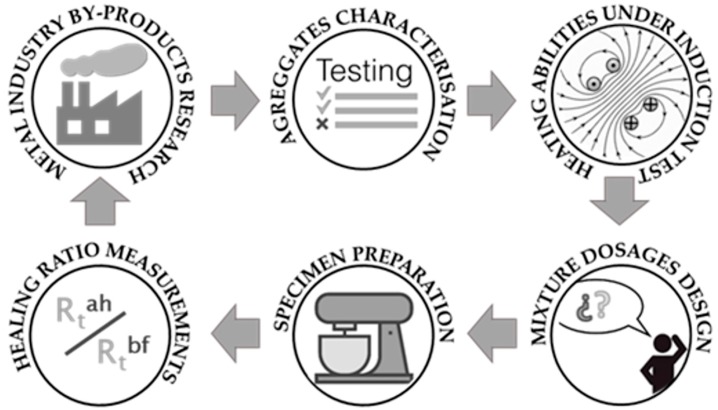
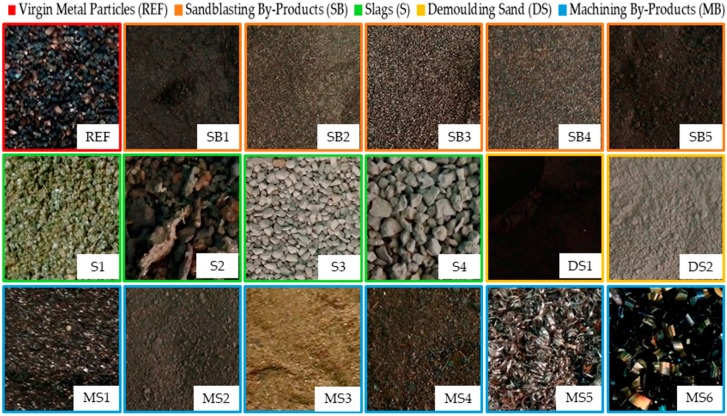
Major advances have been achieved in the field of self-healing by magnetic induction in which the addition of metallic particles into asphalt mixtures enables repairing their own cracks. This technology has already been proven to increase the life expectancy of roads. Nevertheless, its higher costs in comparison with conventional maintenance caused by the price of virgin metallic particles still makes it unattractive for investment. This research aimed at making this process economically accessible as well as environmentally efficient. To this end, an intense search for suitable industrial by-products to substitute both the virgin metal particles and the natural aggregates forming asphalt mixtures was conducted. The set of by-products used included sand blasting wastes, stainless shot wastes, and polished wastes as metallic particles and other inert by-products as aggregates. The results demonstrated that the by-products were adequately heated, which leads to satisfactory healing ratios in comparison with the reference mixture.
Overview
The claims and statistics of this paper haven’t been checked yet.
Run the check — free, no account needed. It reads the open-access text and checks the sources it cites.
Integrity signals
Registry
Cites
Statistics
Figures
Verification
Claims the paper makes
The claims and statistics of this paper haven’t been checked yet.
Run the check — free, no account needed. It reads the open-access text and checks the sources it cites.
Claims other papers make about this one
Each is checked against this paper’s own text: does it say what the citing paper says it does?
In the citing paper
“The technological parameters required variations in broad ranges in output power of 10-200 kW, inductor currents up to thousands of amps, low or high inductor voltages and resonant frequencies up to 300 kHz.”
Self-check
Percentages, sums and reported differences re-computed from the paper’s own numbers.
The self-check needs the paper’s full text.
Citations
Cites
No references could be resolved yet.
Research works printed but not linked: 17
- Liu, 2011, Induction healing of asphalt mastic and porous asphalt concrete, Constr. Build. Mater., 25, 3746, 10.1016/j.conbuildmat.2011.04.016 · DOI
- Barrasa, 2014, Addressing durability of asphalt concrete by self-healing mechanism, Procedia Soc. Behav. Sci., 162, 188, 10.1016/j.sbspro.2014.12.199 · DOI
- Hager, 2016, Self-healing technology for asphalt pavements, Advances in Polymer Science, 273, 285
- Ayar, 2016, The healing capability of asphalt pavements: A state of the art review, J. Clean. Prod., 113, 28, 10.1016/j.jclepro.2015.12.034 · DOI
- Schlangen, 2012, A simple model to define induction heating in asphalt mastic, Constr. Build. Mater., 31, 38, 10.1016/j.conbuildmat.2011.12.046 · DOI
- Liu, 2010, Induction heating of electrically conductive porous asphalt concrete, Constr. Build. Mater., 24, 1207, 10.1016/j.conbuildmat.2009.12.019 · DOI
- Partl, 2013, Experimental evaluation of dense asphalt concrete properties for induction heating purposes, Constr. Build. Mater., 46, 48, 10.1016/j.conbuildmat.2013.04.030 · DOI
- Bueno, 2015, Single and multiple healing of porous and dense asphalt concrete, J. Intell. Mater. Syst. Struct., 26, 425, 10.1177/1045389X14529029 · DOI
- Menozzi, 2015, Induction healing of fatigue damage in asphalt test samples, Constr. Build. Mater., 74, 162, 10.1016/j.conbuildmat.2014.10.034 · DOI
- Bueno, 2016, Damage detection and artificial healing of asphalt concrete after trafficking with a load simulator, Mech. Time-Dependent Mater., 20, 265, 10.1007/s11043-016-9306-z · DOI
- Garcia, 2016, Self-healing of asphalt mixture by microwave and induction heating, Mater. Des., 106, 404, 10.1016/j.matdes.2016.05.095 · DOI
- Zhu, 2017, Self-healing efficiency of ferrite-filled asphalt mixture after microwave irradiation, Constr. Build. Mater., 141, 12, 10.1016/j.conbuildmat.2017.02.145 · DOI
- Franesqui, 2017, Top-down cracking self-healing of asphalt pavements with steel filler from industrial waste applying microwaves, Constr. Build. Mater., 149, 612, 10.1016/j.conbuildmat.2017.05.161 · DOI
- Chang, 2013, Resistance to permanent deformation of road and airport high performance asphalt concrete base courses, Advanced Materials Research, 723, 494, 10.4028/www.scientific.net/AMR.723.494 · DOI
- Pasetto, 2014, Influence of the aggregate skeleton design method on the permanent deformation resistance of stone mastic asphalt, Mater. Res. Innov., 18, S3, 10.1179/1432891714Z.000000000588 · DOI
- Shapiro, 1968, A comparative study of various tests for normality, J. Am. Stat. Assoc., 63, 1343, 10.1080/01621459.1968.10480932 · DOI
- Brown, 1974, Robust tests for the equality of variances, J. Am. Stat. Assoc., 69, 364, 10.1080/01621459.1974.10482955 · DOI · Paper page
Cited by
Dimitrov, B., Hayatleh, K., Barker, S., & Collier, G. (2021) · Electricity · doi:10.3390/electricity2040026 · Cited by 3
Metadata
- Authors
- Vila-Cortavitarte, M., Jato-Espino, D., Castro-Fresno, D., & Calzada-Pérez, M. Á.
- Venue
- Materials
- Publisher
- MDPI AG
- Published
- 2018-05-15
- Volume
- 11
- Issue
- 5
- Pages
- 800
- ISSN
- 1996-1944
- PMC
- PMC5978177
- Cited by
- 35
- References
- 0
- Language
- en
- Funders
- Ministerio de Economía, Industria y Competitividad, Gobierno de España (BIA2016-77372-R)
About these checks
Registry, retraction, Cites and statistics results are computed, not judged, with one exception: a printed reference that no index lists is read once by a model before it counts as a citation error. Claims are extracted by a model and kept only when their quote appears verbatim in the text; each cited source is then checked, with a model’s help, for whether it says what the claim relies on. Those verdicts can be wrong — read the claim’s quote and the cited source before relying on one.
Statistics and arithmetic are recomputed, not judged.
Confidence bands are shown only for fields calibrated on our annotated test set. None is calibrated yet, so no band is shown.
What counts as a claim ›How we measure confidence ›How we check this ›
Are you an author, or do you see a problem with this page? Request a review
Data sources
Bibliographic data: Semantic Scholar, OpenAlex, Crossref.
Contains information from the Semantic Scholar Academic Graph Datasets, made available under the ODC Attribution License (ODC-BY 1.0).
Semantic Scholar’s data is described in: Kinney, R., et al. (2023). The Semantic Scholar Open Data Platform. arXiv:2301.10140.
