

Optimization and Modeling of Process Parameters in Multi-Hole Simultaneous Drilling Using Taguchi Method and Fuzzy Logic Approach
Open accessThe DOI matches its Crossref record; 34 of the 34 references it cites were found in a registry or an index; 2 of the 16 sources its claims cite were checked for support.
Abstract
In industries such as aerospace and automotive, drilling many holes is commonly required to assemble different structures where machined holes need to comply with tight geometric tolerances. Multi-spindle drilling using a poly-drill head is an industrial hole-making approach that allows drilling several holes simultaneously. Optimizing process parameters also improves machining processes. This work focuses on the optimization of drilling parameters and two drilling processes-namely, one-shot drilling and multi-hole drilling-using the Taguchi method. Analysis of variance and regression analysis was implemented to indicate the significance of drilling parameters and their impact on the measured responses i.e., surface roughness and hole size. From the Taguchi optimization, optimal drilling parameters were found to occur at a low cutting speed and feed rate using a poly-drill head. Furthermore, a fuzzy logic approach was employed to predict the surface roughness and hole size. It was found that the fuzzy measured values were in good agreement with the experimental values; therefore, the developed models can be effectively used to predict the surface roughness and hole size in multi-hole drilling. Moreover, confirmation tests were performed to validate that the Taguchi optimized levels and fuzzy developed models effectively represent the surface roughness and hole size.
Overview
CoChat Summary
TL;DR
This paper compares one-shot drilling with multi-hole simultaneous drilling using a poly-drill head for Al5083, optimizing cutting speed, feed rate, and drilling type with Taguchi analysis. It also builds regression and fuzzy logic models to predict surface roughness and hole size, finding that lower cutting speed and feed rate give better hole quality.
Key findings
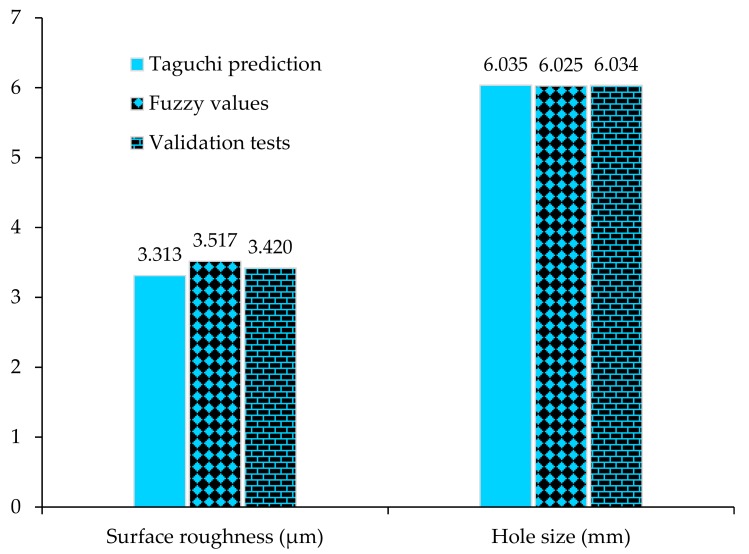
- Taguchi optimization found the best settings for both surface roughness (SR) and hole size (HS) at drilling type level 2, cutting speed level 1, and feed rate level 1; the paper reports predicted values of SR = 3.313 and HS = 6.035, with predicted S/N ratios of −10.688 and −15.614, respectively.
- ANOVA showed that for SR, cutting speed contributed 40.16% and feed rate 25.02%; for HS, feed rate contributed 61.31% and cutting speed 28.72%.
- Regression models had R² = 83.89% for SR and R² = 95.09% for HS, which the authors interpret as effective prediction.
- The fuzzy model’s predicted values were reported to be in good agreement with experiments, with validation errors within 10%.
Methods
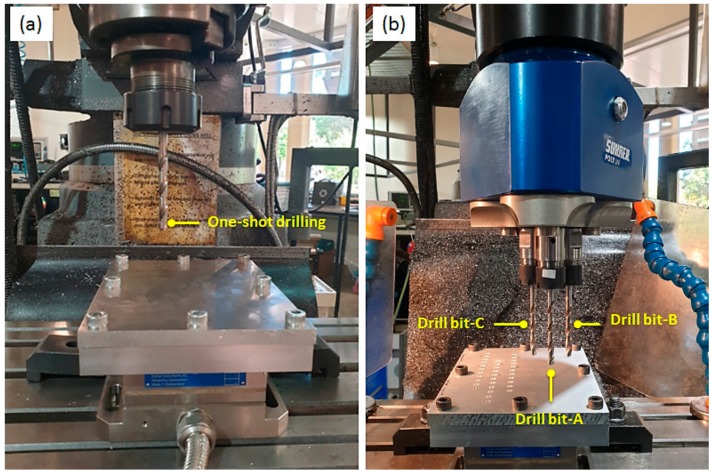
- Experimental drilling study on Aluminium 5083 plate of 10 mm thickness and 150 mm × 200 mm size, using 6 mm uncoated HSS twist drills; experiments were run under dry drilling on a vertical turret milling machine with a poly-drill head (SUNHER MH 30/13) for multi-hole drilling.
- Design of experiments used a full factorial DoE and L18 mixed orthogonal array with three control factors: cutting speed (3 levels), feed rate (3 levels), and drilling type (2 levels).
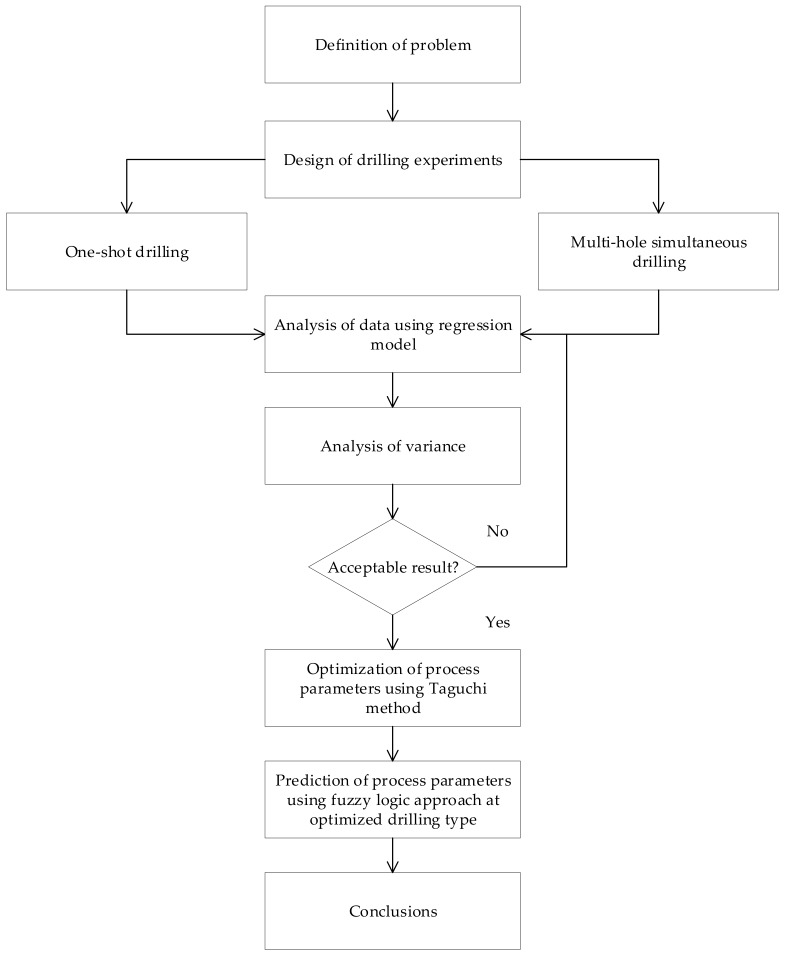
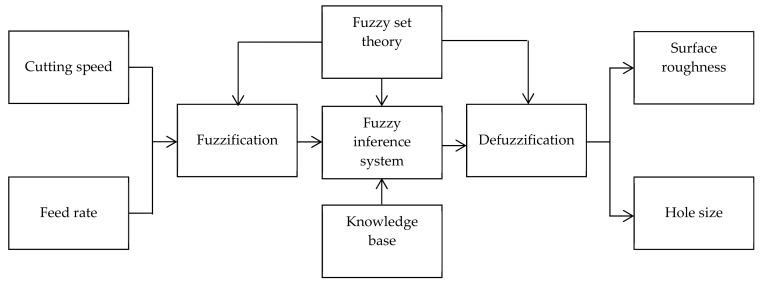
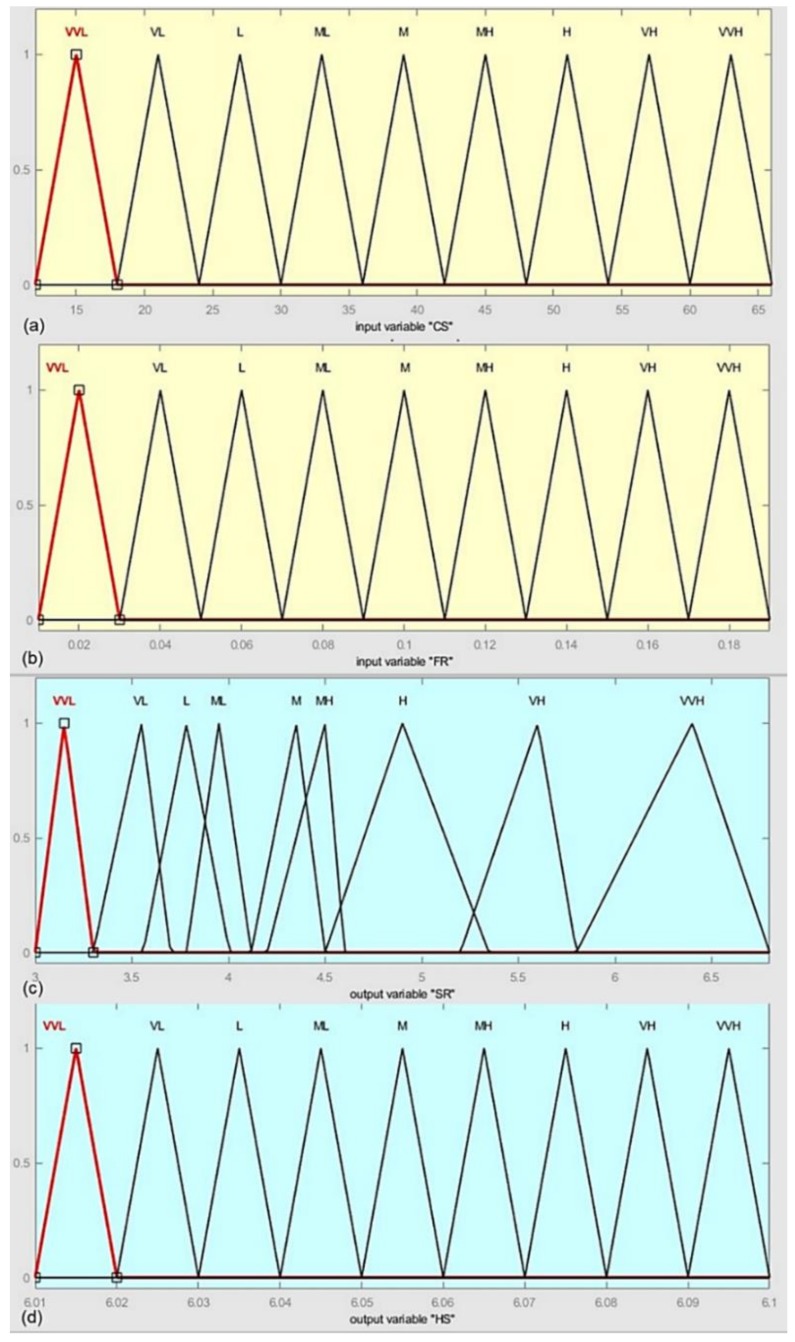
- Analysis included Taguchi S/N ratios (smaller-the-better), regression analysis, ANOVA, and a Mamdani fuzzy inference system in MATLAB (R2018b) to predict SR and HS; validation tests were then performed at the optimized settings.
Limitations
- The paper does not report a detailed limitation section or explicitly state study limitations.
- Evident from the text: the study is limited to Al5083, one tool type/diameter, dry drilling, and the specific experimental setup used, so generalization beyond these conditions is not demonstrated.
Model-written summary. Check it against the paper before relying on it.
Integrity signals
Registry
Cites
Statistics
Figures
Verification
Claims the paper makes
2 Valid · 0 Not valid · 12 Not checked · 32 Own results and interpretations
A result the paper reports from its own data — it cites no other source for it, so there is none to check. The quote shows it is in the paper.
In the paper
“The percentage contribution of FR is 61.31%, which is more than the contribution of CS with a statistical significance of 28.72%.”
§ Optimization and Modeling of Process Parameters in Multi-Hole Simultaneous Drilling Using Taguchi Method and Fuzzy Logic Approach > 3. Results and Discussion > 3.4. Analysis of Variance
plainstates a cause- Asserted: passes — The authors put it forward as true.
- Checkable: passes — It can be checked against evidence.
- Load-bearing: passes — The paper’s conclusions depend on it.
- Based: passes — The paper gives a reason why it holds.
- Rests on an assumption not shown here.
A result the paper reports from its own data — it cites no other source for it, so there is none to check. The quote shows it is in the paper.
In the paper
“SR = 2.728 − 0.401 DT + 0.675 CS + 0.541 FR + ε R2 = 83.89%”
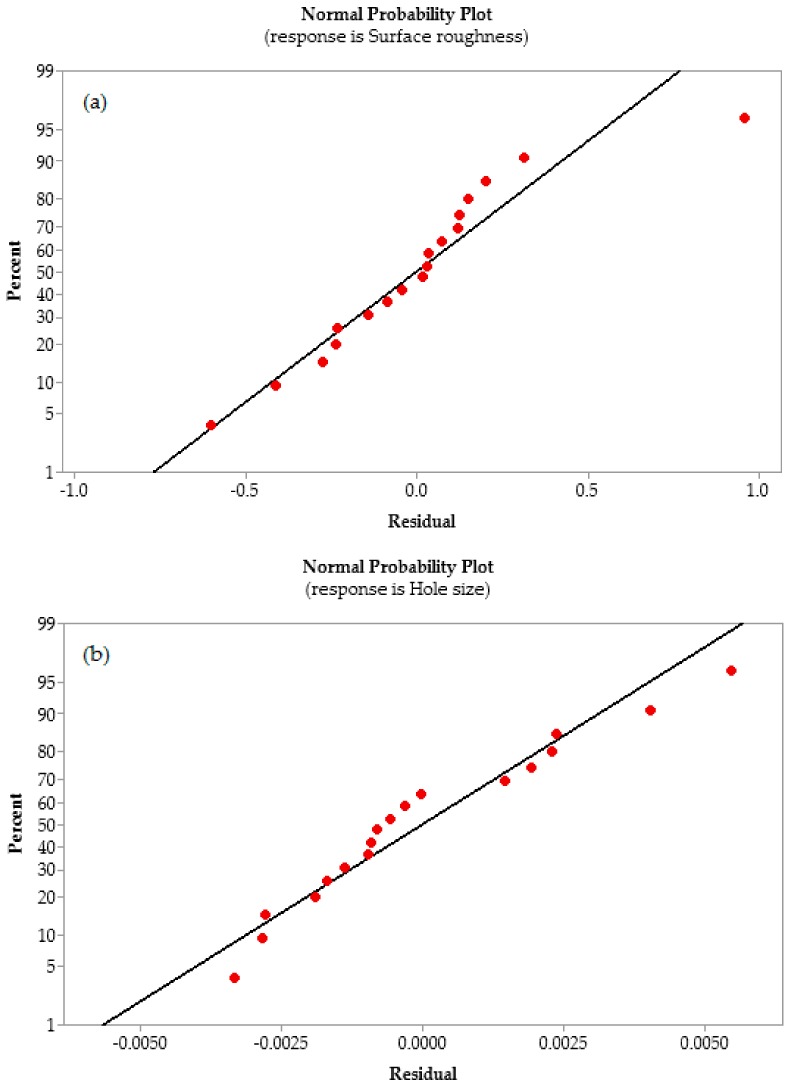
§ Optimization and Modeling of Process Parameters in Multi-Hole Simultaneous Drilling Using Taguchi Method and Fuzzy Logic Approach > 3. Results and Discussion > 3.1. Regression Analysis In machining processes, regression analysis used to analyze and formulate the correlation between the process parameters and the responses [24]. In this study, the process parameters are the cutting speed (CS), feed rate (FR), and drilling type (DT), where the responses are the surface roughness (SR) and hole size (HS). Therefore, a linear regression model is used to check if the data of SR and HS signify a fitness characteristic. The regression model obtained in this work is given below: SR = β0 + β1(DT) + β2 (CS) + β3 (FR) + ε SR = 2.728 − 0.401 DT + 0.675 CS + 0.541 FR + ε R2 = 83.89% HS = β0 + β1(DT) + β2 (CS) + β3 (FR) + ε HS = 6.01961 − 0.00167 DT + 0.007083 CS + 0.010593 FR + ε R2 = 95.09% where β0 is the constant value when the predictor variables i.e., DT, CS, and FR are zero, β1 + β2 + β3 + β4 +…. + βn are the coefficients or estimates of the process parameters, and ε is the error. R2 indicates the effectiveness of the developed model. The value equal to 1 shows that the model is 100% effective [25]. Therefore, the larger values of R2 are always desirable [26]. In the current study, the values of R2 are more than 80%, which indicates that the models are effective in predicting the responses with respect to the machining variables. Figure 3 shows the normal probability plots of the residuals for a predicted response for SR and HS, respectively. Figure 3 also shows that the proposed models are satisfactory as all the residuals follow almost the same pattern of the straight line, which has also been reported by Davidson et al. [27] and Vankanti and Ganta [8]. Therefore, for the selection of process parameters in drilling aluminum, this work will be useful for reducing SR and the deviation of HS from its nominal value.
plainstates an association- Asserted: passes — The authors put it forward as true.
- Checkable: passes — It can be checked against evidence.
- Load-bearing: passes — The paper’s conclusions depend on it.
- Based: passes — The paper gives a reason why it holds.
- Rests on an assumption not shown here.
A result the paper reports from its own data — it cites no other source for it, so there is none to check. The quote shows it is in the paper.
In the paper
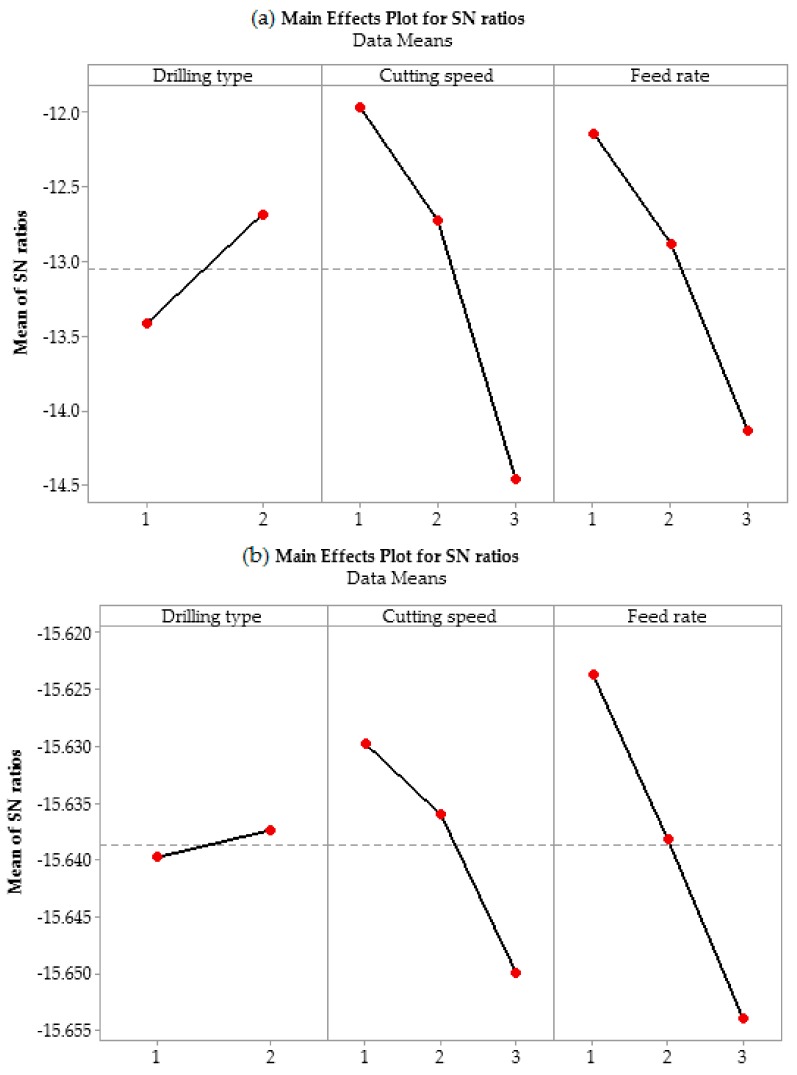
“From Table 6 and Figure 4, the optimum conditions for HS can be selected. The analysis of S/N ratio shows that the poly-drill head also performs better than one-shot drilling, as the best combination of parameters can be obtained at DT level 2, CS level 1, and FR level 1.”
§ Optimization and Modeling of Process Parameters in Multi-Hole Simultaneous Drilling Using Taguchi Method and Fuzzy Logic Approach > 3. Results and Discussion > 3.2. Optimization of Drilling Conditions Using Taguchi Analysis
plainstates a cause- Asserted: passes — The authors put it forward as true.
- Checkable: passes — It can be checked against evidence.
- Load-bearing: passes — The paper’s conclusions depend on it.
- Based: passes — The paper gives a reason why it holds.
- Rests on an assumption not shown here.
A result the paper reports from its own data — it cites no other source for it, so there is none to check. The quote shows it is in the paper.
In the paper
“Figure 7 shows that there is a small difference among all the values, and the response optimization predicts the optimum conditions comparatively well.”
§ Optimization and Modeling of Process Parameters in Multi-Hole Simultaneous Drilling Using Taguchi Method and Fuzzy Logic Approach > 3. Results and Discussion > 3.6. Validations of Results
plain- Asserted: passes — The authors put it forward as true.
- Checkable: passes — It can be checked against evidence.
- Load-bearing: passes — The paper’s conclusions depend on it.
- Based: passes — The paper gives a reason why it holds.
- Rests on an assumption not shown here.
A result the paper reports from its own data — it cites no other source for it, so there is none to check. The quote shows it is in the paper.
In the paper
“The analysis of S/N ratio shows that the poly-drill head also performs better than one-shot drilling, as the best combination of parameters can be obtained at DT level 2, CS level 1, and FR level 1.”
§ Optimization and Modeling of Process Parameters in Multi-Hole Simultaneous Drilling Using Taguchi Method and Fuzzy Logic Approach > 3. Results and Discussion > 3.2. Optimization of Drilling Conditions Using Taguchi Analysis
plainstates a cause- Asserted: passes — The authors put it forward as true.
- Checkable: passes — It can be checked against evidence.
- Load-bearing: passes — The paper’s conclusions depend on it.
- Based: passes — The paper gives a reason why it holds.
- Rests on an assumption not shown here.
19 more claims
Create a free account to see all 46 claims and to verify the 3 references still open.
- Probably not a substantial claim. 13
- It may state two separate claims as one. 11
- The quote only partly states this claim. 3
Citations
Cites
Design optimization of cutting parameters for turning operations based on the Taguchi method
Yang, W. H., & Tarng, Y. S. (1998) · Journal of Materials Processing Technology · doi:10.1016/s0924-0136(98)00079-x · Cited by 1,302 · cited 2×
“In the Taguchi method, an orthogonal array is designed that studies the entire parameter space with a small number of experiments [7].”
BackgroundMethodRecent advances in drilling of carbon fiber–reinforced polymers for aerospace applications: a review
Aamir, M., Tolouei-Rad, M., Giasin, K., & Nosrati, A. (2019) · The International Journal of Advanced Manufacturing Technology · doi:10.1007/s00170-019-04348-z · Cited by 329
Self-citationMohan, N. S., Ramachandra, A., & Kulkarni, S. M. (2005) · Composite Structures · doi:10.1016/j.compstruct.2005.09.039 · Cited by 201 · cited 1×
“In addition, the drilling process is normally amongst the last steps of final assembly of fabricating parts, where poor hole quality might lead to part rejection, which can become costly if optimum process parameters, tools, or drilling operations are not taken into consideration [4].”
BackgroundKurt, M., Bagci, E., & Kaynak, Y. (2009) · The International Journal of Advanced Manufacturing Technology · doi:10.1007/s00170-007-1368-2 · Cited by 198 · cited 13×
“Then, regression analysis and ANOVA were applied to confirm the accuracy of the model and the significance of process parameters.”
BackgroundMethodInfluentialOptimization of process parameters in drilling of GFRP composite using Taguchi method
Vankanti, V. K., & Ganta, V. (2014) · Journal of Materials Research and Technology · doi:10.1016/j.jmrt.2013.10.007 · Cited by 192 · cited 10×
“Then, regression analysis and ANOVA were applied to confirm the accuracy of the model and the significance of process parameters.”
BackgroundMethodInfluentialKılıçkap, E. (2010) · The International Journal of Advanced Manufacturing Technology · doi:10.1007/s00170-009-2469-x · Cited by 153 · cited 4×
“This shows that the CS has more impact on hole roughness than the FR. Similar findings were also reported by Kilickap [23] when drilling aluminium alloys.”
BackgroundMethodResultInfluentialGiasin, K., Hodzic, A., Phadnis, V. A., & Ayvar-Soberanis, S. (2016) · The International Journal of Advanced Manufacturing Technology · doi:10.1007/s00170-016-8563-y · Cited by 124 · cited 1×
“SR shows irregularities in the surface of any workpiece due to machining operations [28].”
BackgroundSelf-citationAn experimental study on drilling of unidirectional GLARE fibre metal laminates
Giasin, K., Ayvar-Soberanis, S., & Hodzic, A. (2015) · Composite Structures · doi:10.1016/j.compstruct.2015.08.007 · Cited by 112 · cited 1×
“Therefore, measuring SR is important for determining the quality of holes [30].”
BackgroundSelf-citationEvaluating Hole Quality in Drilling of Al 6061 Alloys
Uddin, M., Basak, A., Pramanik, A., Singh, S., Krolczyk, G. M., & Prakash, C. (2018) · Materials · doi:10.3390/ma11122443 · Cited by 109 · cited 1×
“Lower FR facilitated the slower insertion of the tool, which allowed a stable and jerk-free performance as the cutting edges of the tool removed the material with smaller chip thickness; consequently, the HS shows less dimensional error [34].”
MethodEvaluation of drilled hole quality in Al 2024 alloy
Kurt, M., Kaynak, Y., & Bagci, E. (2008) · The International Journal of Advanced Manufacturing Technology · doi:10.1007/s00170-007-1049-1 · Cited by 102 · cited 4×
“[29] reported in their studies that HS is also influenced by drilling parameters, where the hole diameter may increase from the nominal size.”
BackgroundInfluential
Research works printed but not linked: 3
- Saravanakumar, 2016, Optimization of Machining Parameters using Taguchi Method for Surface Roughness, J. Mater. Environ. Sci, 7, 1556
- C. Douglas, M. (2011). Design and Analysis of Experiments, Wiley. [7th ed.].
- Ross, P.J. (1988). Taguchi techniques for quality engineering: loss function, orthogonal experiments, parameter and tolerance design, McGraw-Hill.
Cited by
A review: drilling performance and hole quality of aluminium alloys for aerospace applications
Aamir, M., Giasin, K., Tolouei-Rad, M., & Vafadar, A. (2020) · Journal of Materials Research and Technology · doi:10.1016/j.jmrt.2020.09.003 · Cited by 286
“[26] Aamir M, Tu S, Tolouei-Rad M, Giasin K, Vafadar A.”
BackgroundSelf-citationAdvanced Computational Methods for Modeling, Prediction and Optimization—A Review
Krzywański, J., Sosnowski, M., Grabowska, K., Żyłka, A., Lasek, L., & Kijo–Kleczkowska, A. (2024) · Materials · doi:10.3390/ma17143521 · Cited by 189
“Since this approach allows for the formalization of an empirical problem using experience rather than strict knowledge of the process, the methods run intuitively and have the potential to overcome the shortcomings of traditional approaches [89–91].”
MethodA Critical Review on Control Strategies for Structural Vibration Control
Wani, Z. R., Tantray, M., Farsangi, E. N., Nikitas, N., Noori, M. N., Samali, B., & Yang, T. Y. (2022) · Annual Reviews in Control · doi:10.1016/j.arcontrol.2022.09.002 · Cited by 113
Mohamadi, S., Sammen, S. S., Panahi, F., Ehteram, M., Kişi, Ö., Mosavi, A. H., Ahmed, A. N., El‐Shafie, A., & Al-Ansari, N. A. (2020) · Natural Hazards · doi:10.1007/s11069-020-04180-9 · Cited by 84
Recent Progress Trend on Abrasive Waterjet Cutting of Metallic Materials: A Review
Llanto, J. M., Tolouei‐Rad, M., Vafadar, A., & Aamir, M. (2021) · Applied Sciences · doi:10.3390/app11083344 · Cited by 86
Self-citation
Metadata
- Authors
- Aamir, M., Tu, S., Tolouei-Rad, M., Giasin, K., & Vafadar, A.
- Affiliations
- Edith Cowan University (AU)
- Beijing University of Technology (CN)
- School of Engineering, Edith Cowan University, Joondalup, WA 6027, Australia
- University of Portsmouth (GB)
- Corresponding author
- Tu, Shanshan
- Venue
- Materials
- Publisher
- MDPI AG
- Published
- 2020-02-03
- Volume
- 13
- Issue
- 3
- Pages
- 680
- ISSN
- 1996-1944 (ISSN-L)
- PMC
- PMC7040725
- OpenAlex
- W3003210699
- Cited by
- 86
- References
- 34
- Citations by year
- 2026: 5 · 2025: 8 · 2024: 7 · 2023: 13 · 2022: 14 · 2021: 28 · 2020: 11
- FWCI
- 8.12
- Type
- journal article
- Language
- en
- Open access
- gold
- dx.doi.org
- Licence
- Locations
- Materials (publishedVersion, cc-by)
- PubMed Central (publishedVersion, cc-by)
- PubMed (publishedVersion)
- Australasian Journal of Paramedicine (submittedVersion, cc-by)
- DOAJ (DOAJ: Directory of Open Access Journals) (submittedVersion, cc-by-sa)
- Funders
- National Natural Science Foundation of China (No. 61801008), National Key R&D Program of China (No. 2018YFB0803600), Beijing Natural Science Foundation National (No. L172049), Scientific Research Common Program of Beijing Municipal Commission of Education (61801008)
- Topics
- Physical Sciences › Engineering › Mechanical Engineering › Advanced machining processes and optimization
- Physical Sciences › Engineering › Industrial and Manufacturing Engineering › Advanced Machining and Optimization Techniques
- Social Sciences › Decision Sciences › Management Science and Operations Research › Optimal Experimental Design Methods
- Keywords
- process parameter optimization, Taguchi method, fuzzy logic, surface roughness prediction, cutting speed, feed rate
About these checks
Registry, retraction, Cites and statistics results are computed, not judged, with one exception: a printed reference that no index lists is read once by a model before it counts as a citation error. Claims are extracted by a model and kept only when their quote appears verbatim in the text; each cited source is then checked, with a model’s help, for whether it says what the claim relies on. Those verdicts can be wrong — read the claim’s quote and the cited source before relying on one.
A language model drew the claims from the paper on 2026-10-10, under version 3 of the claim definition (model deepseek-v4.1-flash, prompt extract-v3).
A second model labelled each claim on 2026-10-10 (model jev-1.13-20260917, definition revision gold-guideline-v0.2).
Statistics and arithmetic are recomputed, not judged.
Confidence bands are shown only for fields calibrated on our annotated test set. None is calibrated yet, so no band is shown.
What counts as a claim ›How we measure confidence ›How we check this ›
Are you an author, or do you see a problem with this page? Request a review
How to cite
Cite CoChat for the checks on this page, and the paper for its own findings.
- This page
- CoChat. (2026). Citation check: Optimization and Modeling of Process Parameters in Multi-Hole Simultaneous Drilling Using Taguchi Method and Fuzzy Logic Approach. https://app.cochat.ai/papers/10.3390/ma13030680
- The paper
- Aamir, M., Tu, S., Tolouei-Rad, M., Giasin, K., & Vafadar, A. (2020). Optimization and Modeling of Process Parameters in Multi-Hole Simultaneous Drilling Using Taguchi Method and Fuzzy Logic Approach. Materials. https://doi.org/10.3390/ma13030680
Data sources
Bibliographic data: Semantic Scholar, OpenAlex, Crossref.
Contains information from the Semantic Scholar Academic Graph Datasets, made available under the ODC Attribution License (ODC-BY 1.0).
Semantic Scholar’s data is described in: Kinney, R., et al. (2023). The Semantic Scholar Open Data Platform. arXiv:2301.10140.
