

Analyzing the Effects of Nano-Titanium Dioxide and Nano-Zinc Oxide Nanoparticles on the Mechanical and Durability Properties of Self-Cleaning Concrete
Open accessThe DOI matches its Crossref record; 44 of the 46 references it cites were found in a registry or an index; none of the 44 sources its claims cite is checked for support yet.
Abstract
The goal of this paper is to investigate the impact of nano-materials on the mechanical and electrochemical properties of self-cleaning concrete. Nano-titanium dioxide and nano-zinc oxide were used as additives for this purpose. Additionally, a comparative study on the effect of using these materials on the self-cleaning concrete’s characteristics was conducted. The dosages of nano-titanium dioxide (nps-TiO2) and nano-zinc oxide (nps-ZnO) used were 0, 0.5, 1, 1.5, 2, and 2.5% and 0, 1, 2, and 3% of the weight of the cement, respectively. The results showed that the optimum compressive strength and the lowest corrosion rate were fulfilled at 2.5% of nps-TiO2 and 1% of nps-ZnO, and using 2.5% of nps-TiO2 achieved the highest improvement in the corrosion rate. However, 1% for nps-TiO2 mixtures and 1% for nps-ZnO mixtures were the best ratios for flexural strength. On the other hand, for the corrosion rate, the samples were tested at 2 and 6 months. When nps-TiO2 and nps-ZnO samples were compared to the control sample, 2.5% and 1% of nps-TiO2 and nps-ZnO, respectively, showed the largest improvement in resistance to corrosion. Also, the self-cleaning property of the samples containing nano-materials (nps-TiO2 and nps-ZnO) was tested. As the results illustrated, the self-cleaning property of the samples was increased over time due to photocatalytic degradation. Furthermore, the results of the photocatalytic tests showed that nps-TiO2 samples outperformed nps-ZnO samples overall.
Overview
CoChat Summary
TL;DR
This study tested nano-TiO2 and nano-ZnO in self-cleaning concrete/mortar and found that both can improve performance, but their best dosages differed by property. Overall, nps-TiO2 performed better for compressive strength, corrosion resistance, and photocatalytic self-cleaning, while nps-ZnO had a narrower optimum and weaker self-cleaning.
Key findings
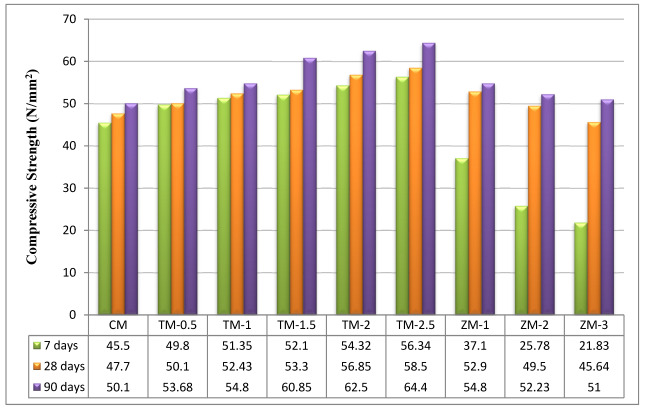
- For compressive strength, the best nps-TiO2 dosage was 2.5%, with increases of 23.82%, 22.64%, and 28.54% at 7, 28, and 90 days; for nps-ZnO, the best dosage was 1%, improving strength by 10.90% and 9.38% at 28 and 90 days, while at 7 days it was −18.46% versus control.
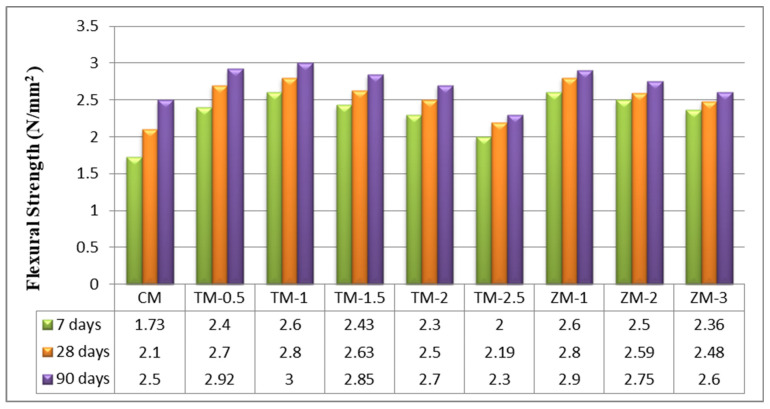
- For flexural strength, the best dosages were 1% nps-TiO2 and 1% nps-ZnO; the reported increases were 33.46%, 33.33%, and 20% for nps-TiO2 at 7, 28, and 90 days, and 50.29%, 33.33%, and 16% for nps-ZnO at the same ages.
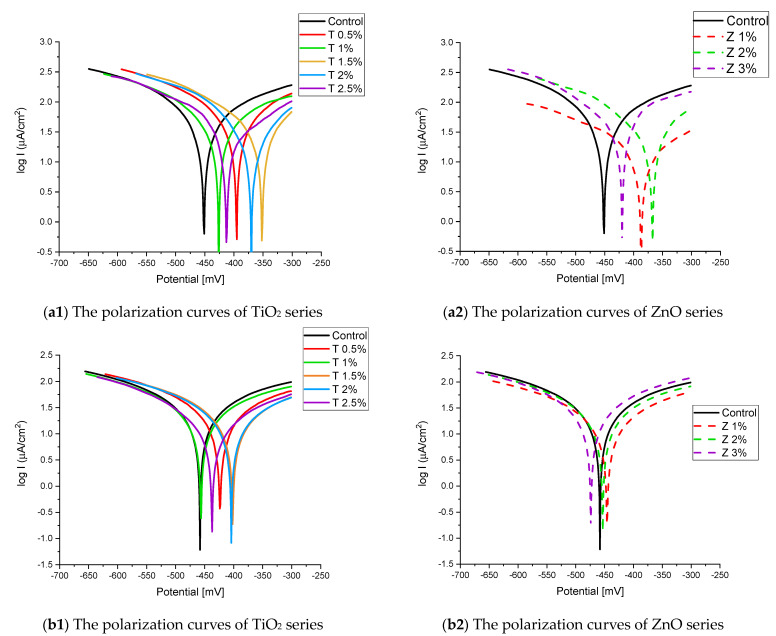
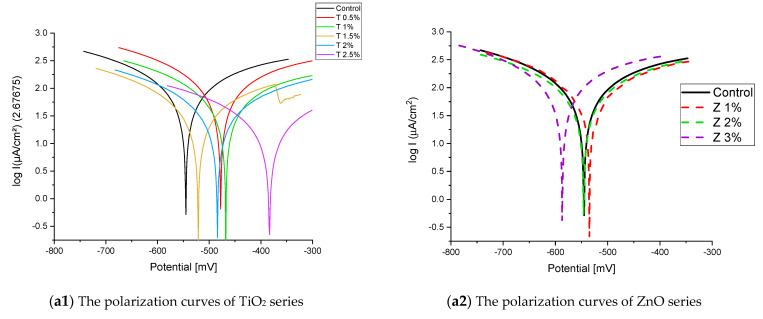
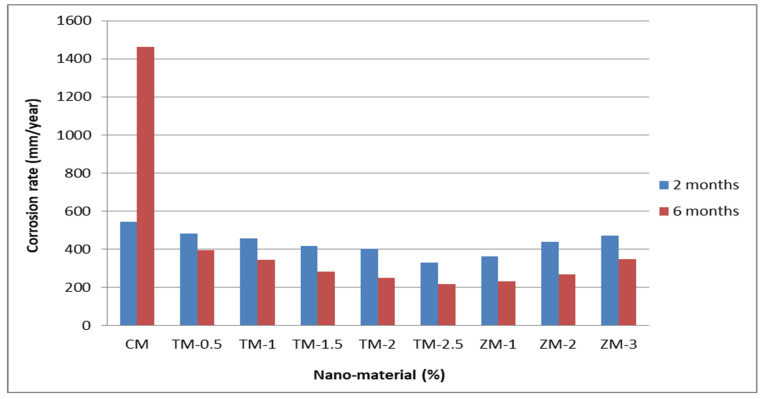
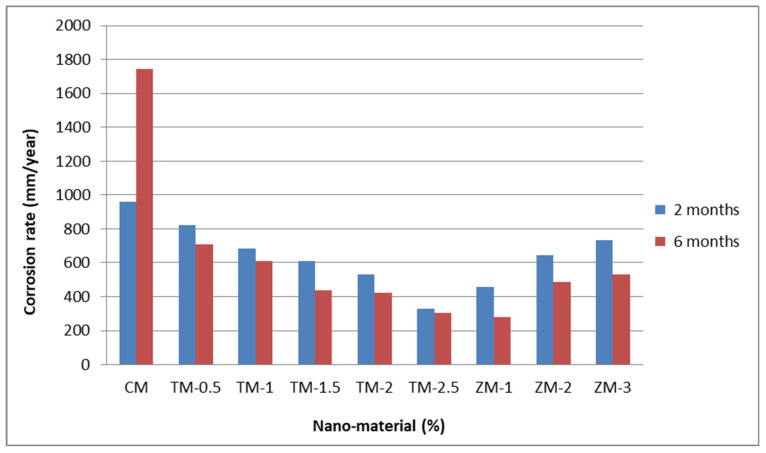
- Corrosion rate decreased with increasing nps-TiO2 ratio, while nps-ZnO increased corrosion rate when the ratio rose above 1%; the paper states that the lowest corrosion rate and highest improvement in resistance to corrosion were achieved with 2.5% nps-TiO2 and 1% nps-ZnO.
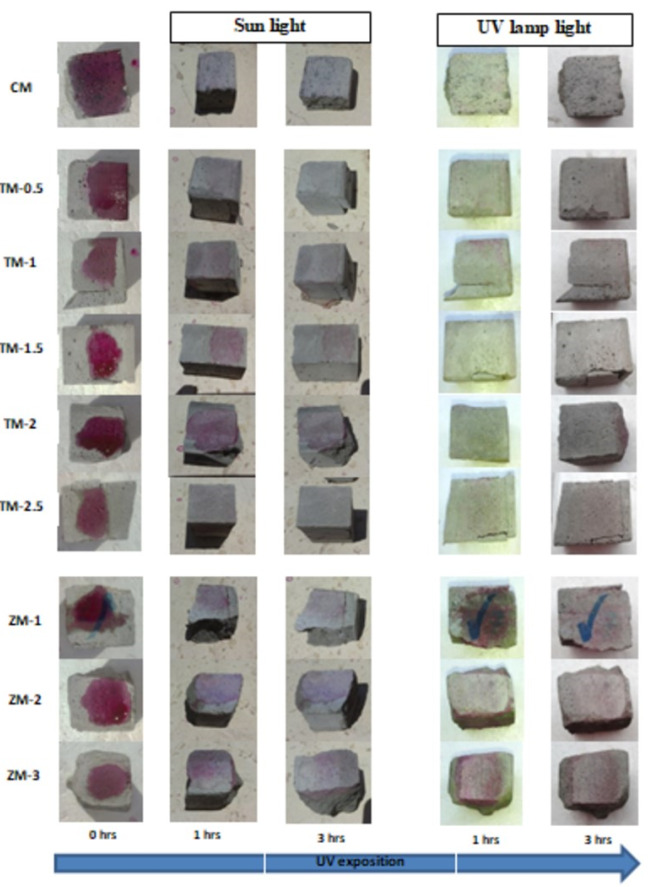
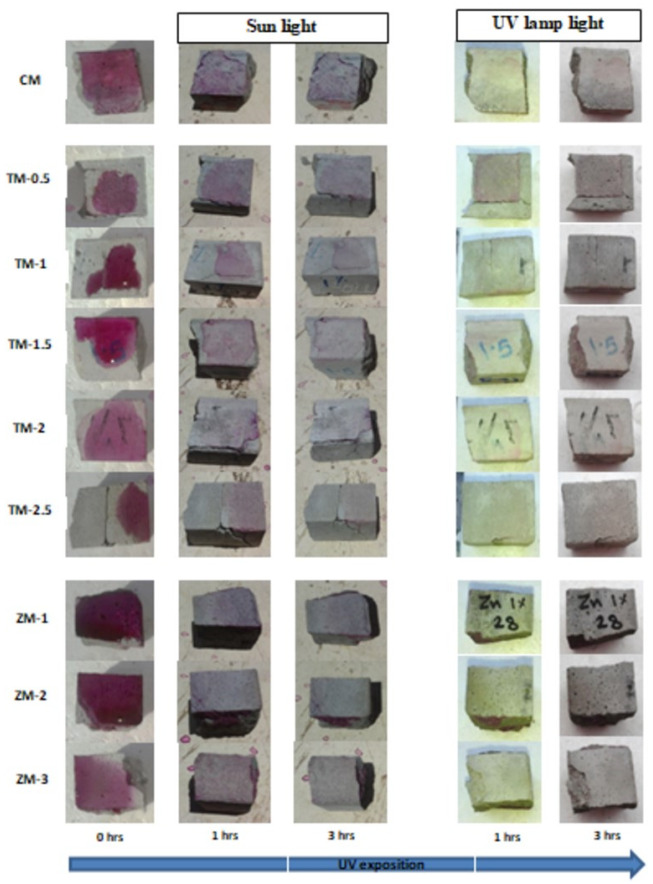
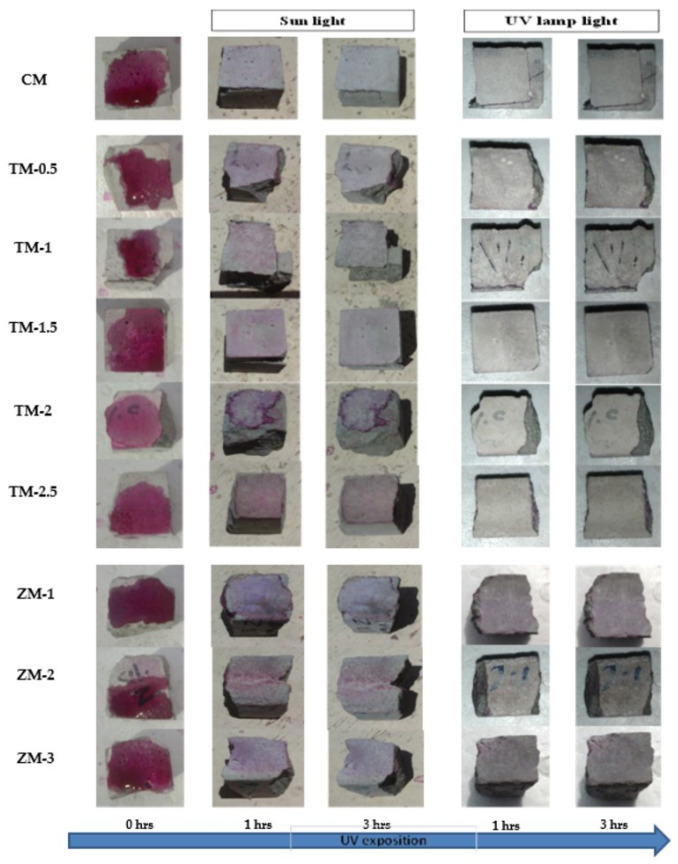
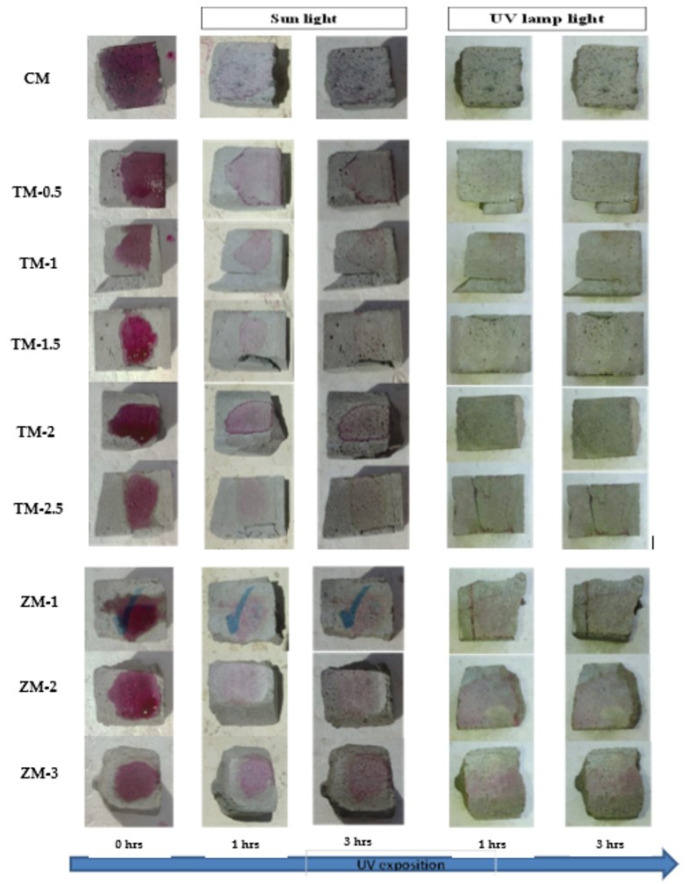
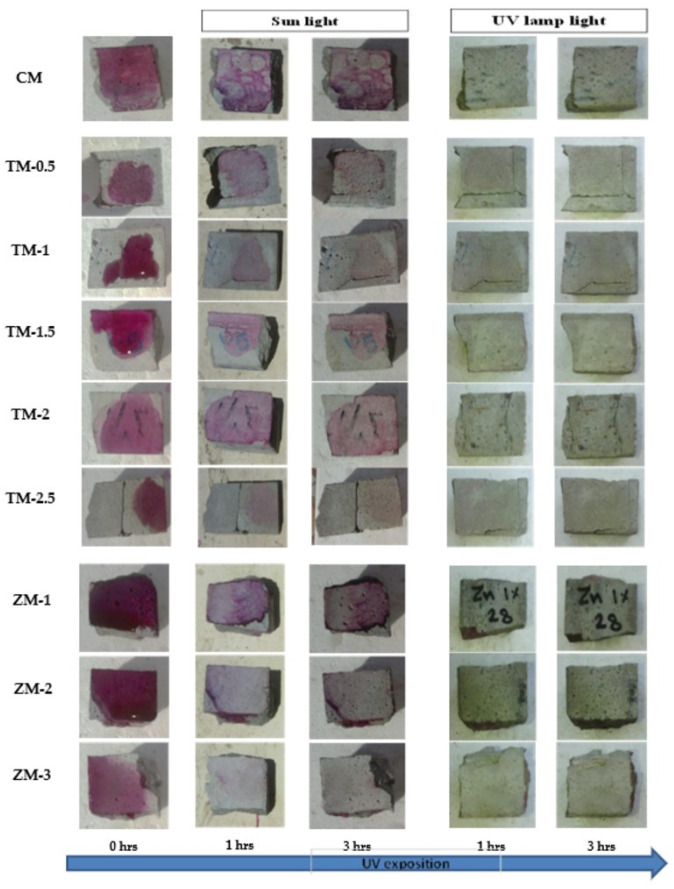
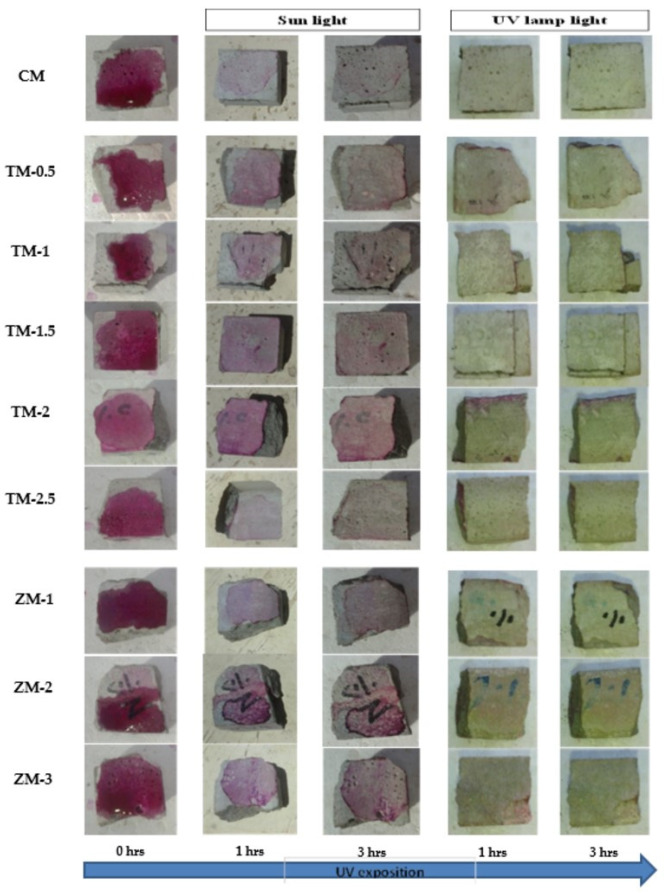
- Self-cleaning improved with longer UV/sunlight exposure, and the paper reports that nps-TiO2 samples outperformed nps-ZnO samples overall; the TM-2.5% sample “always gives the best result in all stages,” even at the higher 4000 ppm phenolphthalein concentration.
Methods
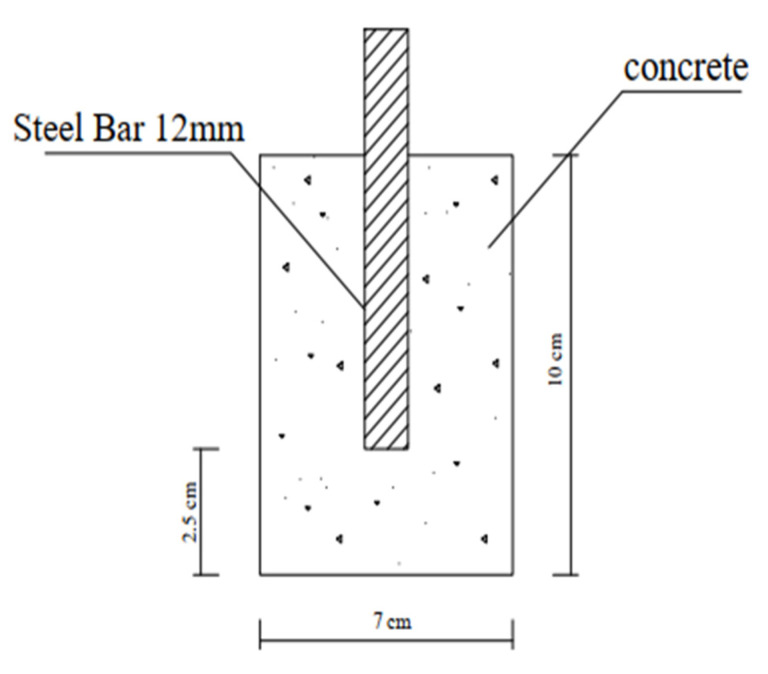
- Experimental study using three specimen types: 100 mm cubes for compressive strength, 40 × 40 × 160 mm prisms for self-cleaning/flexural tests, and 70 mm × 100 mm cylinders with a 12 mm rebar for corrosion testing.
- Mixes included a control and nano-modified samples with nps-TiO2 at 0, 0.5, 1, 1.5, 2, and 2.5% of cement weight and nps-ZnO at 0, 1, 2, and 3%; specimens were cured in fresh tap water or salt water from Qaroun Lake.
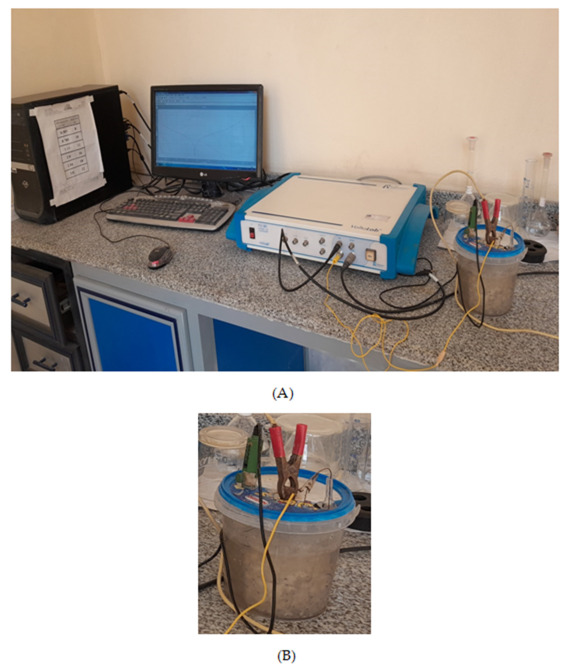
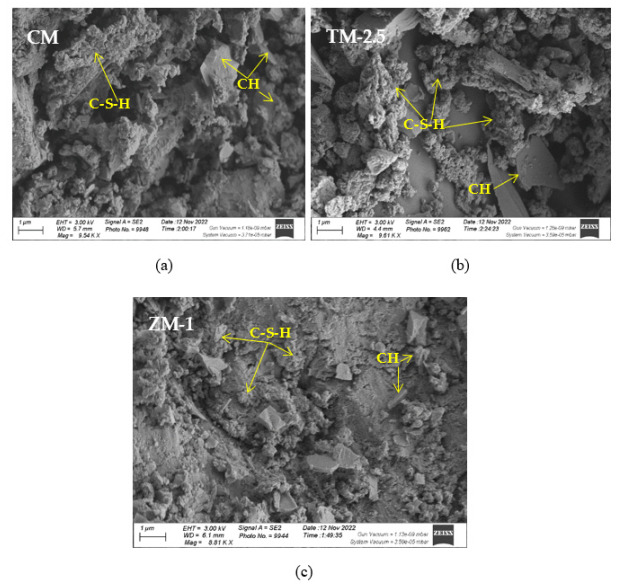
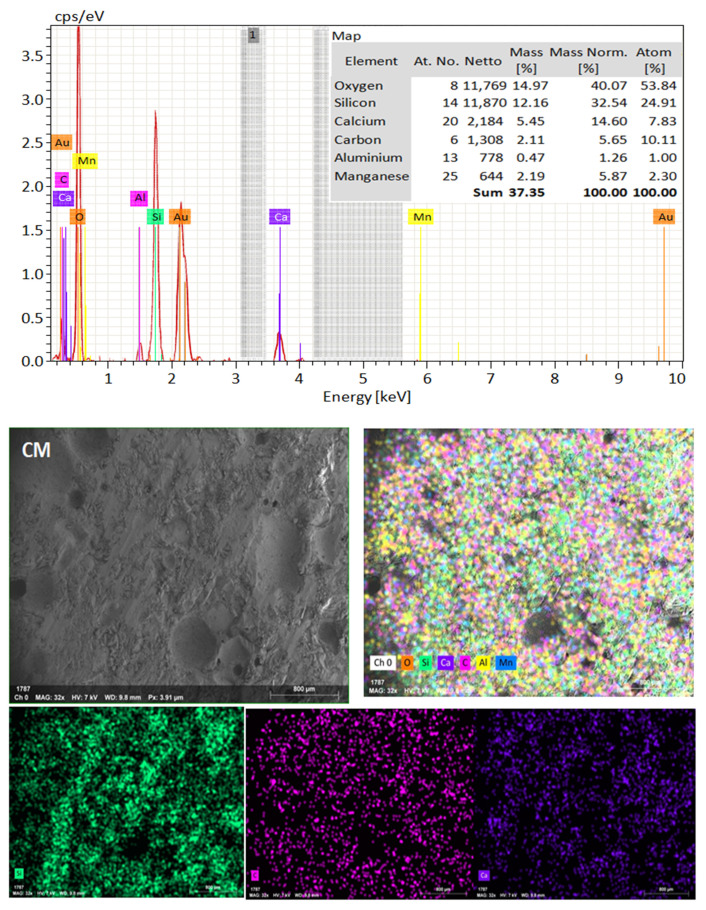
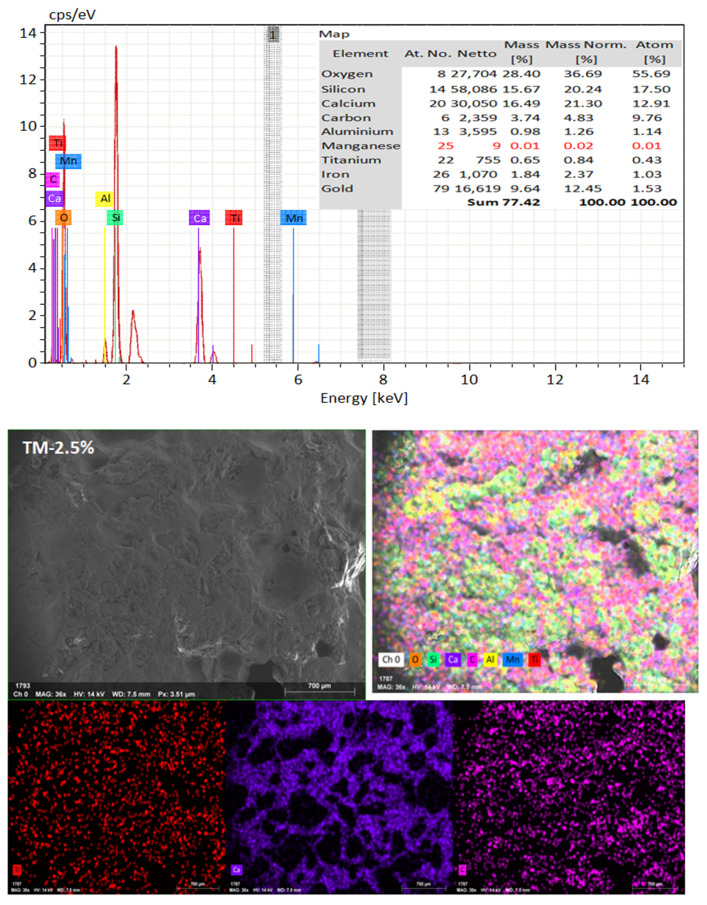
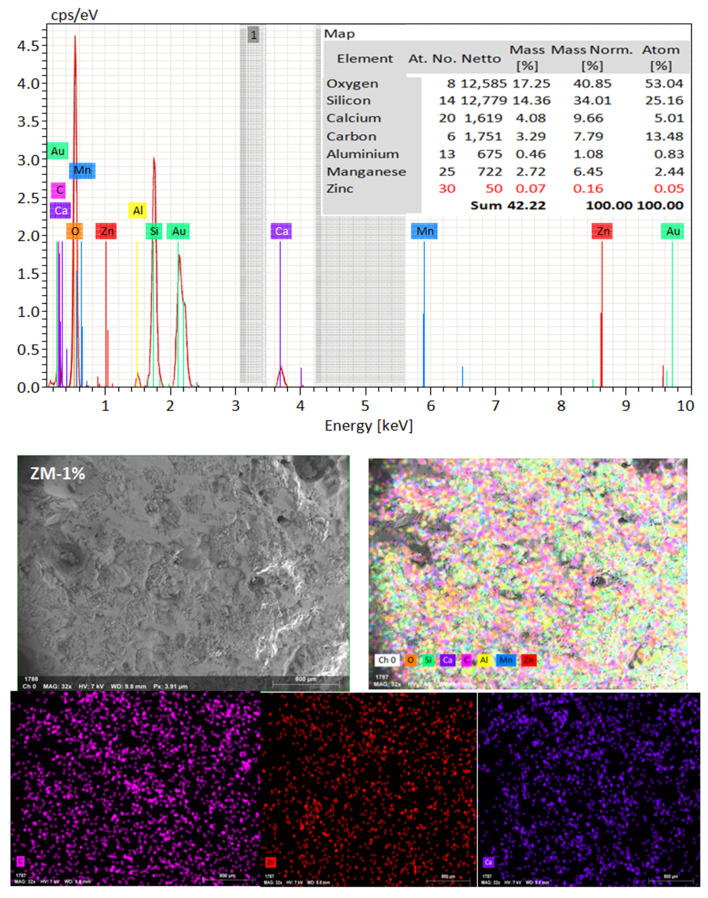
- Main analyses were compressive and flexural strength tests, linear polarization resistance (LPR) for corrosion at 2 and 6 months, phenolphthalein discoloration tests under sunlight/UV, and SEM/EDX microstructure/elemental characterization.
Limitations
- The paper explicitly notes that the conclusions are based on the mixes and exposure conditions tested, but it does not provide a formal limitations section.
- Evident from the text: the study uses a limited set of dosages and specific curing/exposure conditions (fresh tap water, Qaroun Lake salt water, sunlight/UV), so generalization beyond these settings is not directly established.
- Evident from the text: the article reports results through described figures and tables, but the provided text does not include full numerical data for all outcomes, especially some compressive-strength details and all corrosion/self-cleaning measurements.
Model-written summary. Check it against the paper before relying on it.
Integrity signals
Registry
Cites
Statistics
Figures
Verification
Claims the paper makes
0 Valid · 0 Not valid · 28 Not checked · 29 Own results and interpretations
A result the paper reports from its own data — it cites no other source for it, so there is none to check. The quote shows it is in the paper.
In the paper
“According to the results, the compressive strength for nps-TiO2 mixes improved with increasing nps-TiO2 concentrations (as shown in Figure 6), and the optimum values were recorded with 2.5% of nps-TiO2.”
- Also stated in: § 5. Conclusions · plain
“In nps-TiO2 and nps-ZnO mixes, the best percentages for compressive strength are TM-2.5% and ZM-1%.”
§ Analyzing the Effects of Nano-Titanium Dioxide and Nano-Zinc Oxide Nanoparticles on the Mechanical and Durability Properties of Self-Cleaning Concrete > 4. Results and Discussion > 4.1. Compressive Strength Test
plainstates an association- Asserted: passes — The authors put it forward as true.
- Checkable: passes — It can be checked against evidence.
- Load-bearing: passes — The paper’s conclusions depend on it.
- Based: passes — The paper gives a reason why it holds.
- Also stated in: § 5. Conclusions · plain
A result the paper reports from its own data — it cites no other source for it, so there is none to check. The quote shows it is in the paper.
In the paper
“According to the current results, the optimal value for nps-TiO2 is TM-1 (1%).”
- Also stated in: § 5. Conclusions · plain
“For the flexural strength test, TM-1 (1%), for nps-TiO2, is the ideal value.”
§ Analyzing the Effects of Nano-Titanium Dioxide and Nano-Zinc Oxide Nanoparticles on the Mechanical and Durability Properties of Self-Cleaning Concrete > 4. Results and Discussion > 4.2. Flexural Strength
plain- Asserted: passes — The authors put it forward as true.
- Checkable: passes — It can be checked against evidence.
- Load-bearing: passes — The paper’s conclusions depend on it.
- Based: passes — The paper gives a reason why it holds.
- Also stated in: § 5. Conclusions · plain
A result the paper reports from its own data — it cites no other source for it, so there is none to check. The quote shows it is in the paper.
In the paper
“The increment ratios of the sample containing 2.5% of nps-TiO2 are 23.82%, 22.64%, and 28.54% at 7, 28, and 90 days, respectively.”
- Also stated in: § 5. Conclusions · plain
“As a result, at 7, 28, and 90 days, the increment ratios of the sample containing 2.5% of nps-TiO2 were 23.82%, 22.64%, and 28.54%, respectively.”
§ Analyzing the Effects of Nano-Titanium Dioxide and Nano-Zinc Oxide Nanoparticles on the Mechanical and Durability Properties of Self-Cleaning Concrete > 4. Results and Discussion > 4.1. Compressive Strength Test
plain- Asserted: passes — The authors put it forward as true.
- Checkable: passes — It can be checked against evidence.
- Load-bearing: passes — The paper’s conclusions depend on it.
- Based: passes — The paper gives a reason why it holds.
- Also stated in: § 5. Conclusions · plain
A result the paper states — it cites no source for it, so there is none to check. The quote shows it is in the paper.
In the paper
“For nps-TiO2 specimens, according to this research, it can be noted that the corrosion rate gradually decreases with the increasing nps-TiO2 ratio.”
- Also stated in: § 5. Conclusions · plain
“In regard to corrosion rate, this study shows that the corrosion rate for nps-TiO2 specimens gradually reduces with an increasing nps-TiO2 percentage in all exposure conditions.”
§ Analyzing the Effects of Nano-Titanium Dioxide and Nano-Zinc Oxide Nanoparticles on the Mechanical and Durability Properties of Self-Cleaning Concrete > 4. Results and Discussion > 4.3. Corrosion Rate
plainstates a cause- Asserted: passes — The authors put it forward as true.
- Checkable: passes — It can be checked against evidence.
- Load-bearing: passes — The paper’s conclusions depend on it.
- Based: passes — The paper gives a reason why it holds.
- Also stated in: § 5. Conclusions · plain
A result the paper reports from its own data — it cites no other source for it, so there is none to check. The quote shows it is in the paper.
In the paper
“According to the results, the compressive strength for nps-TiO2 mixes improved with increasing nps-TiO2 concentrations (as shown in Figure 6)”
- Also stated in: § 5. Conclusions · plain
“With higher nps-TiO2 concentrations, the nps-TiO2 mixture’s compressive strength increased, with 2.5% of nps-TiO2 being the ideal concentration.”
§ Analyzing the Effects of Nano-Titanium Dioxide and Nano-Zinc Oxide Nanoparticles on the Mechanical and Durability Properties of Self-Cleaning Concrete > 4. Results and Discussion > 4.1. Compressive Strength Test
plainstates an association- Asserted: passes — The authors put it forward as true.
- Checkable: passes — It can be checked against evidence.
- Load-bearing: passes — The paper’s conclusions depend on it.
- Based: passes — The paper gives a reason why it holds.
- Also stated in: § 5. Conclusions · plain
34 more claims
Create a free account to see all 57 claims and to verify the 6 references still open.
- It may state two separate claims as one. 12
- Probably not a substantial claim. 9
Citations
Cites
Electrochemical Photolysis of Water at a Semiconductor Electrode
FUJISHIMA, A., & HONDA, K. (1972) · Nature · doi:10.1038/238037a0 · Cited by 34,169 · cited 1×
“The photocatalytic technique is not unique; it has been used since the 1960s [3].”
Solar photocatalytic degradation of azo dye: comparison of photocatalytic efficiency of ZnO and TiO2
Sakthivel, S., Neppolian, B., Shankar, M. V., Arabindoo, B., Palanichamy, M., & Murugesan, V. (2003) · Solar Energy Materials and Solar Cells · doi:10.1016/s0927-0248(02)00255-6 · Cited by 1,684
Ochiai, T., & Fujishima, A. (2012) · Journal of Photochemistry and Photobiology C: Photochemistry Reviews · doi:10.1016/j.jphotochemrev.2012.07.001 · Cited by 610
Nanotechnology: Advantages and drawbacks in the field of construction and building materials
Pacheco-Torgal, F., & Jalali, S. (2011) · Construction and Building Materials · doi:10.1016/j.conbuildmat.2010.07.009 · Cited by 528 · cited 1×
“Because of its nucleation impact, nano-TiO 2 is also applied to cement-based materials in order to enhance their mechanical and hydration characteristics [19–21].”
Hydration and properties of nano-TiO2 blended cement composites
Chen, J., Kou, S.-C., & Poon, C.-S. (2012) · Cement and Concrete Composites · doi:10.1016/j.cemconcomp.2012.02.009 · Cited by 518 · cited 2×
“The addition of nano-TiO 2 particles to the cement decreases the overall porosity of the hardened concrete mixture while improving the pore structure [22].”
BackgroundCement and Concrete Nanoscience and Nanotechnology
Raki, L., Beaudoin, J., Alizadeh, R., Makar, J., & Sato, T. (2010) · Materials · doi:10.3390/ma3020918 · Cited by 450
Sorptivity and acid resistance of ambient-cured geopolymer mortars containing nano-silica
Deb, P. S., Sarker, P. K., & Barbhuiya, S. (2016) · Cement and Concrete Composites · doi:10.1016/j.cemconcomp.2016.06.017 · Cited by 256 · cited 1×
“Because of its nucleation impact, nano-TiO 2 is also applied to cement-based materials in order to enhance their mechanical and hydration characteristics [19–21].”
Yousuf, M., Mollah, A., Hess, T. R., Tsai, Y.-N., & Cocke, D. L. (1993) · Cement and Concrete Research · doi:10.1016/0008-8846(93)90031-4 · Cited by 250
Suitability of sea water for mixing structural concrete exposed to a marine environment
Kaushik, S. K., & Islam, S. (1995) · Cement and Concrete Composites · doi:10.1016/0958-9465(95)00015-5 · Cited by 248
Reactive powder concrete reinforced with nano SiO2-coated TiO2
Han, B., Li, Z., Zhang, L., Zeng, S., Yu, X., Han, B., & Ou, J. (2017) · Construction and Building Materials · doi:10.1016/j.conbuildmat.2017.05.065 · Cited by 237 · cited 1×
“These agree well with earlier research [8,33].”
Research works printed but not linked: 3
- Arora N.K. Parmar K.A. Odedra R.K. Photocatalytic Self cleaning Concrete IJSRD—Int. J. Sci. Res. Dev. 2014 1 2521 2523
- Venturini L. Bacchi M. Research, design, and development of a photocatalytic asphalt pavement Proceedings of the 2nd International Conference on Environmentally Friendly Roads: ENVIROAD Warsaw Poland 15–16 October 2009
- Copeland L. Kantro D. Verbeck G. Paper IV–3. Chemistry of Hydration of Portland Cement Chemistry of Cement, Proceedings of the Fourth International Symposium, Washington, DC, USA, 2–7 October 1960 National Bureau of Standards Washington, DC, USA 1962 Volume 1 429
Cited by
Advancing photocatalytic concrete technologies for design, performance and sustainable futures
Chen, K., Qu, F., Huang, Y., Cai, J., Wu, F., & Li, W. (2024) · Advanced Nanocomposites · doi:10.1016/j.adna.2024.05.002 · Cited by 44
Abdullah, G. M. S., Chohan, I. M., Ali, M., Bheel, N., Ahmad, M., Najeh, T., Gamil, Y., & Almujibah, H. R. (2024) · Frontiers in Materials · doi:10.3389/fmats.2024.1357094 · Cited by 39
Mohsen, A., Amin, M. S., Selim, F. A., & Ramadan, M. (2024) · Construction and Building Materials · doi:10.1016/j.conbuildmat.2024.137218 · Cited by 28
Baikerikar, A. V., Ganachari, V., Khed, V. C., Bheel, N., Alraeeini, A. S., & Almujibah, H. R. (2024) · Scientific Reports · doi:10.1038/s41598-024-79263-9 · Cited by 24
The effect of nano zinc oxide on freeze-thaw resistance of 3D-printed geopolymer mortars
Tanyıldızı, H., Seloğlu, M., & Coşkun, A. (2024) · Journal of Building Engineering · doi:10.1016/j.jobe.2024.110431 · Cited by 16
Metadata
- Authors
- Mostafa, F. E.-Z. M., Smarzewski, P., El Hafez, G. M. A., Farghali, A. A., Morsi, W. M., Faried, A. S., & Tawfik, T. A.
- Affiliations
- Fayoum University (EG)
- Military University of Technology in Warsaw (PL)
- Chemistry Department, Faculty of Science, Fayoum University, Fayoum 2933110, Egypt
- Beni-Suef University (EG)
- Housing and Building National Research Center (EG)
- Slovak Academy of Sciences (SK)
- Corresponding author
- Mostafa, Fatma El-Zahraa M.
- Smarzewski, Piotr
- Venue
- Materials
- Publisher
- MDPI AG
- Published
- 2023-10-27
- Volume
- 16
- Issue
- 21
- Pages
- 6909
- ISSN
- 1996-1944 (ISSN-L)
- PMC
- PMC10649610
- OpenAlex
- W4388190766
- Cited by
- 35
- References
- 46
- Citations by year
- 2026: 11 · 2025: 9 · 2024: 15
- FWCI
- 4.09
- Type
- journal article
- Language
- en
- Open access
- gold
- doi.org
- Licence
- Locations
- Materials (publishedVersion, cc-by)
- PubMed Central (publishedVersion, cc-by)
- PubMed (publishedVersion)
- DOAJ (DOAJ: Directory of Open Access Journals) (submittedVersion)
- Funders
- Faculty of Civil Engineering and Geodesy of the Military University of Technology (UGB 814/2023)
- Topics
- Physical Sciences › Engineering › Civil and Structural Engineering › Concrete and Cement Materials Research
- Physical Sciences › Engineering › Civil and Structural Engineering › Innovative concrete reinforcement materials
- Physical Sciences › Energy › Renewable Energy, Sustainability and the Environment › TiO2 Photocatalysis and Solar Cells
- Keywords
- self-cleaning concrete, nano-titanium dioxide, zinc oxide nanoparticles, photocatalytic degradation, compressive strength, flexural strength, reinforcement corrosion rate, durability, photocatalysis
About these checks
Registry, retraction, Cites and statistics results are computed, not judged, with one exception: a printed reference that no index lists is read once by a model before it counts as a citation error. Claims are extracted by a model and kept only when their quote appears verbatim in the text; each cited source is then checked, with a model’s help, for whether it says what the claim relies on. Those verdicts can be wrong — read the claim’s quote and the cited source before relying on one.
A language model drew the claims from the paper on 2026-10-10, under version 3 of the claim definition (model deepseek-v4.1-flash, prompt extract-v3).
A second model labelled each claim on 2026-10-10 (model jev-1.13-20260917, definition revision gold-guideline-v0.2).
Statistics and arithmetic are recomputed, not judged.
Confidence bands are shown only for fields calibrated on our annotated test set. None is calibrated yet, so no band is shown.
What counts as a claim ›How we measure confidence ›How we check this ›
Are you an author, or do you see a problem with this page? Request a review
How to cite
Cite CoChat for the checks on this page, and the paper for its own findings.
- This page
- CoChat. (2026). Citation check: Analyzing the Effects of Nano-Titanium Dioxide and Nano-Zinc Oxide Nanoparticles on the Mechanical and Durability Properties of Self-Cleaning Concrete. https://app.cochat.ai/papers/10.3390/ma16216909
- The paper
- Mostafa, F. E.-Z. M., Smarzewski, P., El Hafez, G. M. A., Farghali, A. A., Morsi, W. M., Faried, A. S., & Tawfik, T. A. (2023). Analyzing the Effects of Nano-Titanium Dioxide and Nano-Zinc Oxide Nanoparticles on the Mechanical and Durability Properties of Self-Cleaning Concrete. Materials. https://doi.org/10.3390/ma16216909
Data sources
Bibliographic data: Semantic Scholar, OpenAlex, Crossref.
Contains information from the Semantic Scholar Academic Graph Datasets, made available under the ODC Attribution License (ODC-BY 1.0).
Semantic Scholar’s data is described in: Kinney, R., et al. (2023). The Semantic Scholar Open Data Platform. arXiv:2301.10140.
