

Mechanisms of Durability Degradation in Recycled Fine Aggregate Concrete of Varying Strengths Induced by Chloride and Sulfate Dry–Wet Cycles
Open accessThe DOI matches its Crossref record; 32 of the 32 references it cites were found in a registry or an index; none of the 24 sources its claims cite is checked for support yet.
Abstract
With the increasing demand for sustainable building materials, it is essential to investigate the durability of recycled fine aggregate concrete (RFAC) under corrosive environmental conditions. This study systematically assessed the performance of RFAC with three compressive strengths after dry–wet cycles in chloride and sulfate environments, respectively. The experimental program encompassed measurements of compressive strength, mass variation, porosity, ion penetration depth, and free ion content, complemented by comprehensive microstructural characterization. Results show that under sulfate exposure, 20 MPa and 40 MPa RFAC suffered significant strength losses of 60.1% and 18.0% after 70 cycles, while 60 MPa RFAC gained 2.5% strength. In chloride environments, 20 MPa and 40 MPa RFAC experienced strength reductions of 30.7% and 6.9%, whereas 60 MPa RFAC increased in strength by 6.6%. Compared to sulfate exposure, all groups exhibited slight mass increases or porosity reduction under chloride exposure, with high-strength RFAC showing the most noticeable densification. The chloride penetration depth in RFAC of 60 MPa was measured at 14.65 mm, representing a 41.0% reduction compared to RFAC of 20 MPa; sulfate penetration depth was 17.84 mm, which is 44.6% lower than that of the 20 MPa counterpart. Microstructural analysis revealed that sulfate-induced ettringite and gypsum formation triggered crack propagation, while chloride mainly affected pore structure through crystallization and filling, and the formation of C-S-H in high-strength RFAC inhibits pore expansion and mitigates deterioration.
Overview
CoChat Summary
TL;DR
This study compares how recycled fine aggregate concrete (RFAC) of three strength grades (20, 40, 60 MPa) degrades under separate chloride and sulfate dry–wet cycling, tracking mechanical, physical, durability, and microstructural changes. High-strength RFAC resisted both attacks far better, while low-strength RFAC suffered severe sulfate-induced deterioration driven by ettringite and gypsum formation.
Key findings
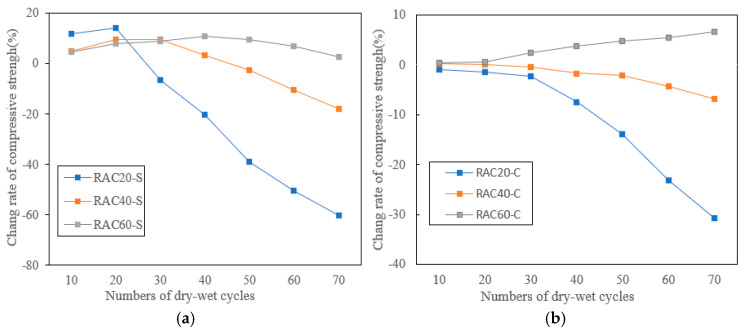
- Under sulfate exposure after 70 cycles, RAC20 and RAC40 lost 60.1% and 18.0% of compressive strength, while RAC60 gained 2.5%; under chloride exposure, losses were 30.7% (RAC20) and 6.9% (RAC40), with RAC60 gaining 6.6%.
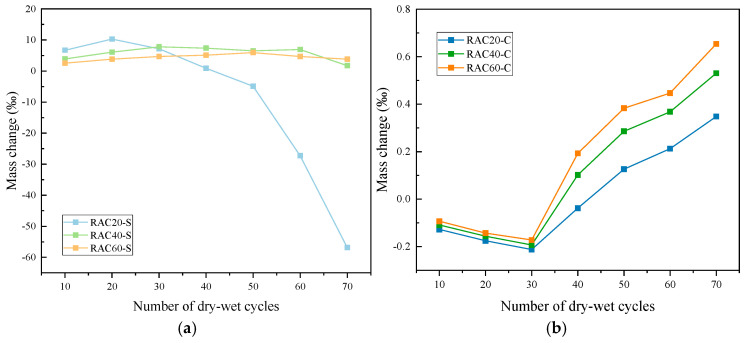
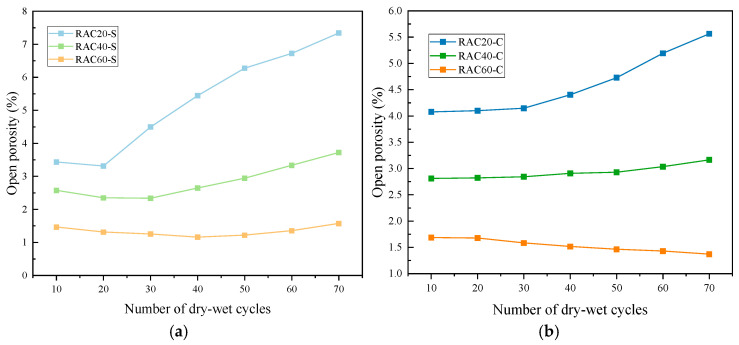
- Sulfate caused mass loss in RAC20 (final −56.8‰) and porosity more than doubling to 7.34%, whereas RAC60 retained +3.8‰ mass and its porosity fell to 1.16% during the first 40 cycles before rising slightly to 1.57%. Chloride exposure produced only slight mass increases or densification across all groups.
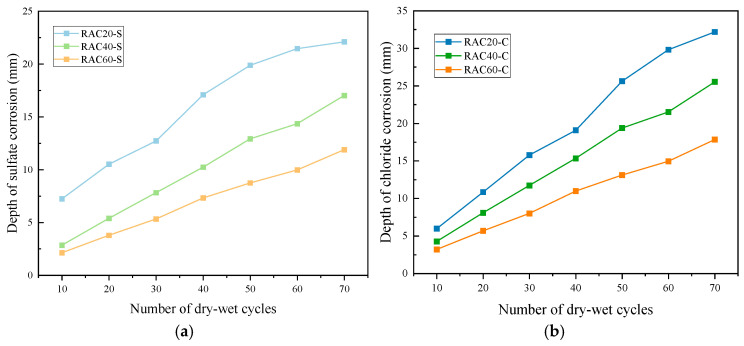
- After 70 cycles, chloride and sulfate penetration depths in RAC60 were 14.65 mm and 17.84 mm, reductions of 41.0% and 44.6% versus RAC20 (24.85 mm and 32.19 mm).
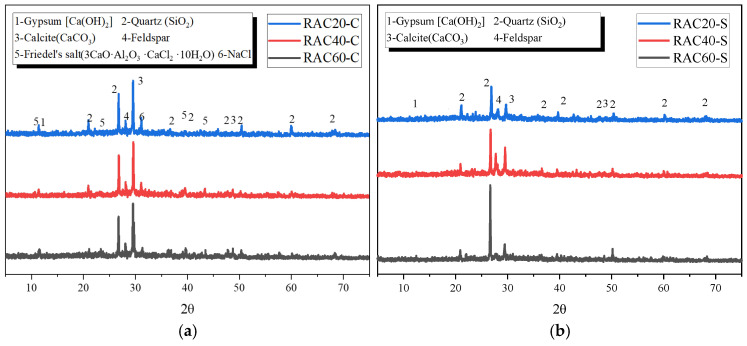
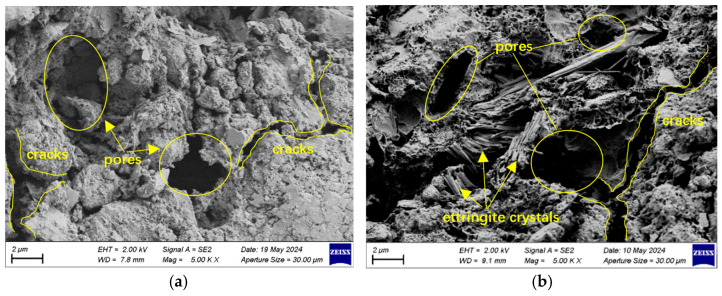
- XRD/SEM showed sulfate degradation via expansive ettringite and gypsum causing microcracking, while chloride acted mainly through crystal filling and Friedel's salt formation; C-S-H in high-strength RFAC suppressed pore expansion.
Methods
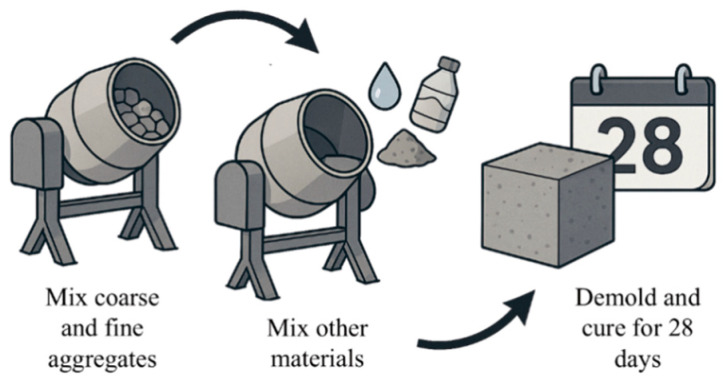
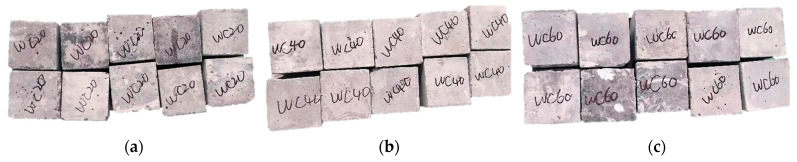
- Three RFAC mixes with target strengths of 20, 40, and 60 MPa (RAC20/40/60) were cast as 100 × 100 × 100 mm cubes, using P.O 32.5 cement for RAC20 and P.O 42.5 cement for RAC40/RAC60, with pre-soaked recycled fine aggregate (0.075–4.75 mm) and natural limestone coarse aggregate.
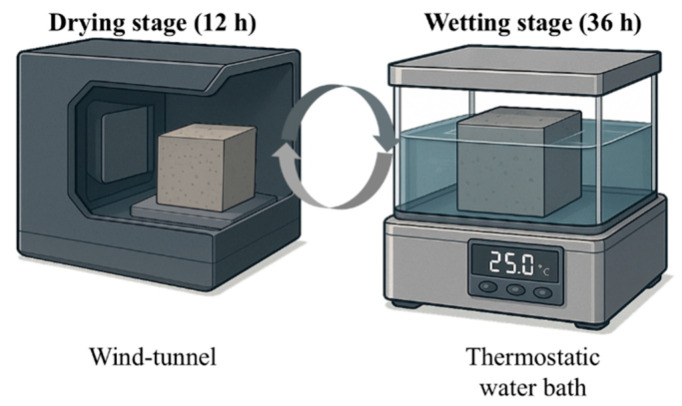
- Specimens underwent dry–wet cycles (36 h drying at 6.0 ± 0.1 m/s air velocity, 25 °C, 50% RH; 12 h wetting at 25 °C) in separate 10% chloride and 10% sulfate solutions, following ASTM D1141-98.
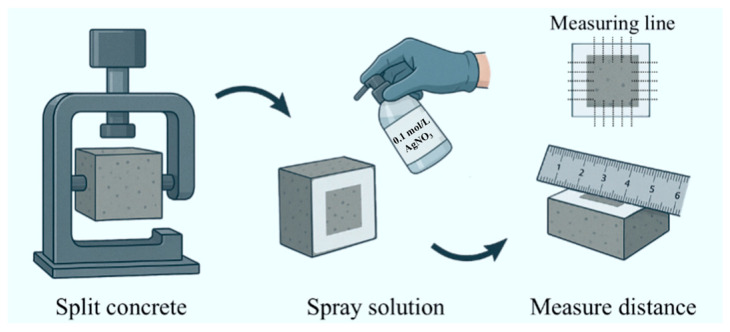
- Testing covered compressive strength, mass variation, open porosity, ion penetration depth (AgNO₃/phenolphthalein indicators), free ion content at 0–30 mm depth by titration, plus SEM and XRD microstructural characterization.
Limitations
- The paper states that only individual chloride and sulfate exposures were tested; in practice these ions often coexist and act synergistically, so coupled chloride–sulfate dry–wet cycling across strength grades requires further investigation.
- The text does not report specimen counts per test group in the main body (referenced only to Table 4), and the exposure durations (up to 70 cycles) are laboratory-accelerated rather than field-validated.
Model-written summary. Check it against the paper before relying on it.
Integrity signals
Registry
Cites
Statistics
Figures
Verification
Claims the paper makes
0 Valid · 0 Not valid · 21 Not checked · 129 Own results and interpretations
A result the paper reports from its own data — it cites no other source for it, so there is none to check. The quote shows it is in the paper.
In the paper
“The chloride penetration depth in RFAC of 60 MPa was measured at 14.65 mm, representing a 41.0% reduction compared to RFAC of 20 MPa”
§ Mechanisms of Durability Degradation in Recycled Fine Aggregate Concrete of Varying Strengths Induced by Chloride and Sulfate Dry–Wet Cycles > Abstract
plainstates an association- Asserted: passes — The authors put it forward as true.
- Checkable: passes — It can be checked against evidence.
- Load-bearing: passes — The paper’s conclusions depend on it.
- Based: passes — The paper gives a reason why it holds.
A result the paper states — it cites no source for it, so there is none to check. The quote shows it is in the paper.
In the paper
“The mass change pattern in the sulfate environment follows a typical “initial increase followed by decline”.”
§ Mechanisms of Durability Degradation in Recycled Fine Aggregate Concrete of Varying Strengths Induced by Chloride and Sulfate Dry–Wet Cycles > 3. Results > 3.2. Physical–Mechanical Properties
plainstates a cause- Asserted: passes — The authors put it forward as true.
- Checkable: passes — It can be checked against evidence.
- Load-bearing: passes — The paper’s conclusions depend on it.
- Based: passes — The paper gives a reason why it holds.
A result the paper reports from its own data — it cites no other source for it, so there is none to check. The quote shows it is in the paper.
In the paper
“Compared with RAC20, the erosion depths for RAC60 at 70 cycles decreased by 41.0% and 44.6% under chloride and sulfate conditions, respectively.”
- Also stated in: § 4. Conclusions · plain
“corresponding to reductions of 41.0% and 44.6%.”
§ Mechanisms of Durability Degradation in Recycled Fine Aggregate Concrete of Varying Strengths Induced by Chloride and Sulfate Dry–Wet Cycles > 3. Results > 3.3. Durability
plainstates a cause- Asserted: passes — The authors put it forward as true.
- Checkable: passes — It can be checked against evidence.
- Load-bearing: passes — The paper’s conclusions depend on it.
- Based: passes — The paper gives a reason why it holds.
- Also stated in: § 4. Conclusions · plain
A result the paper reports from its own data — it cites no other source for it, so there is none to check. The quote shows it is in the paper.
In the paper
“whereas RAC60 consistently retained a net gain of +3.8‰.”
§ Mechanisms of Durability Degradation in Recycled Fine Aggregate Concrete of Varying Strengths Induced by Chloride and Sulfate Dry–Wet Cycles > 4. Conclusions
plain- Asserted: passes — The authors put it forward as true.
- Checkable: passes — It can be checked against evidence.
- Load-bearing: passes — The paper’s conclusions depend on it.
- Based: passes — The paper gives a reason why it holds.
A result the paper reports from its own data — it cites no other source for it, so there is none to check. The quote shows it is in the paper.
In the paper
“whereas RAC60 maintained a net gain of +2.5%”
§ Mechanisms of Durability Degradation in Recycled Fine Aggregate Concrete of Varying Strengths Induced by Chloride and Sulfate Dry–Wet Cycles > 4. Conclusions
plainstates a cause- Asserted: passes — The authors put it forward as true.
- Checkable: passes — It can be checked against evidence.
- Load-bearing: passes — The paper’s conclusions depend on it.
- Based: passes — The paper gives a reason why it holds.
85 more claims
Create a free account to see all 150 claims and to verify the 24 references still open.
- It may state two separate claims as one. 52
- Probably not a substantial claim. 8
Self-check
Percentages, sums and reported differences re-computed from the paper’s own numbers.
Each contradiction between two passages listed here was confirmed by an independent check.
Rated major: it would touch a result — a value a result rests on, reported and recomputed p-values on opposite sides of the significance level, two passages that conflict with no sign which is right, or a cited work retracted before this paper was published.
In the paper
§ Mechanisms of Durability Degradation in Recycled Fine Aggregate Concrete of Varying Strengths Induced by Chloride and Sulfate Dry–Wet Cycles > 2. Materials and Methods > 2.3. Test Methods
“Concrete powders were sampled at depths of 0–30 mm from the exposed surface at 10 mm intervals.”
§ Mechanisms of Durability Degradation in Recycled Fine Aggregate Concrete of Varying Strengths Induced by Chloride and Sulfate Dry–Wet Cycles > 3. Results > 3.3. Durability
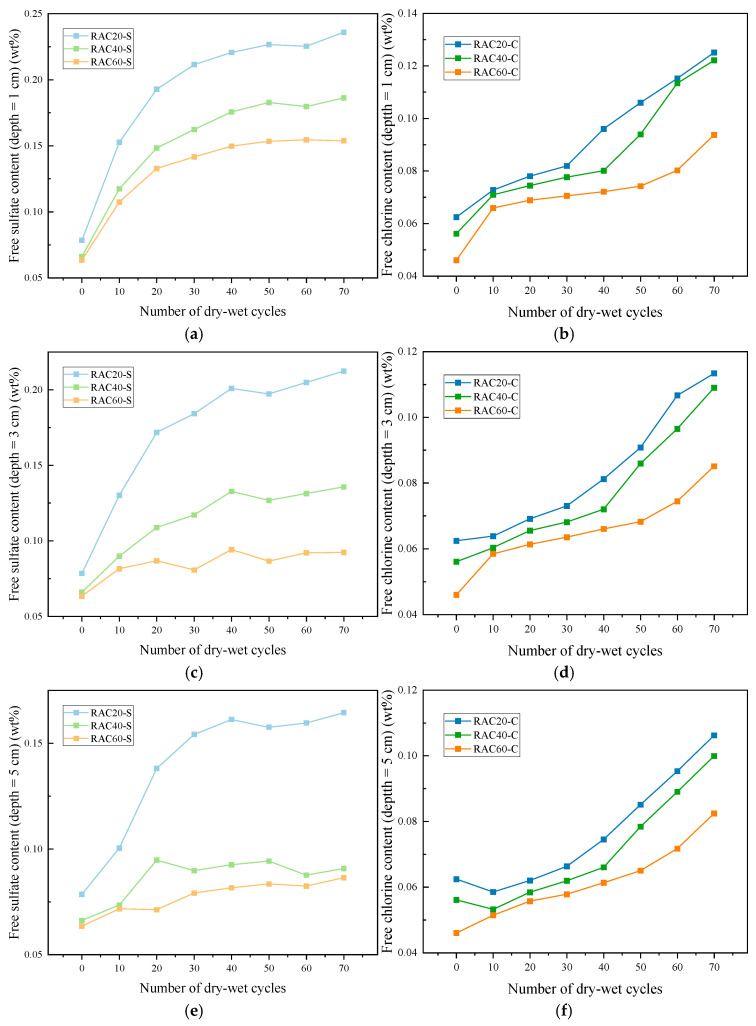
“At 3 cm and 5 cm depths, ion accumulation was considerably lower; after 70 days, sulfide and chloride contents at 5 cm depth were 0.0907 wt% and 0.0999 wt%, respectively.”
Rated minor: it would not touch a result — a value no result rests on, a p-value that stays on the same side of the significance level, or a conflict that is clerical, resolved elsewhere in the paper, or outside its own findings.
In the paper
§ Mechanisms of Durability Degradation in Recycled Fine Aggregate Concrete of Varying Strengths Induced by Chloride and Sulfate Dry–Wet Cycles > 3. Results > 3.2. Physical–Mechanical Properties
“Under chloride exposure, all three RAC groups exhibited a gradual increase in porosity, as shown in Figure 10b.”
§ Mechanisms of Durability Degradation in Recycled Fine Aggregate Concrete of Varying Strengths Induced by Chloride and Sulfate Dry–Wet Cycles > 3. Results > 3.2. Physical–Mechanical Properties
“Notably, RAC60 exhibited a slight reduction in porosity, decreasing from 1.68% to 1.37% between 10 and 70 cycles, indicating significant densification.”
Rated minor: it would not touch a result — a value no result rests on, a p-value that stays on the same side of the significance level, or a conflict that is clerical, resolved elsewhere in the paper, or outside its own findings.
In the paper
“At 5 cm depth, sulfide and chloride contents after 70 days were 0.0864 wt% and 0.0824 wt%, roughly 50–60% of surface values.”
§ Mechanisms of Durability Degradation in Recycled Fine Aggregate Concrete of Varying Strengths Induced by Chloride and Sulfate Dry–Wet Cycles > 3. Results > 3.3. Durability
Reported 60 · recomputed 87.940235
Rated minor: it would not touch a result — a value no result rests on, a p-value that stays on the same side of the significance level, or a conflict that is clerical, resolved elsewhere in the paper, or outside its own findings.
In the paper
§ Mechanisms of Durability Degradation in Recycled Fine Aggregate Concrete of Varying Strengths Induced by Chloride and Sulfate Dry–Wet Cycles > 3. Results > 3.2. Physical–Mechanical Properties
“The initial strength enhancement observed across all groups can be attributed to pore filling by salt crystallization and secondary pozzolanic reactions, which temporarily densified the microstructure [30].”
§ Mechanisms of Durability Degradation in Recycled Fine Aggregate Concrete of Varying Strengths Induced by Chloride and Sulfate Dry–Wet Cycles > 3. Results > 3.2. Physical–Mechanical Properties
“RAC20 exhibited a continuous decrease from the onset, with a 30.7% loss by 70 cycles.”
Rated minor: it would not touch a result — a value no result rests on, a p-value that stays on the same side of the significance level, or a conflict that is clerical, resolved elsewhere in the paper, or outside its own findings.
In the paper
§ Mechanisms of Durability Degradation in Recycled Fine Aggregate Concrete of Varying Strengths Induced by Chloride and Sulfate Dry–Wet Cycles > 1. Introduction
“Therefore, this study designed three strength grades of RFAC and investigated their deterioration behavior under coupled chloride and sulfate-induced dry–wet cyclic conditions from a multi-scale perspective.”
§ Mechanisms of Durability Degradation in Recycled Fine Aggregate Concrete of Varying Strengths Induced by Chloride and Sulfate Dry–Wet Cycles > 4. Conclusions
“This study investigated the deterioration mechanisms of dry–wet cycling performance in RAC of different strength grades under individual exposure to chloride and sulfate salts. However, in practical erosion environments, chlorides and sulfates often coexist and typically act synergistically on the material in a coupled manner.”
Citations
Cites
Durability of recycled aggregate concrete – A review
Guo, H., Shi, C., Guan, X., Zhu, J., Ding, Y., Ling, T.-C., Zhang, H., & Wang, Y. (2018) · Cement and Concrete Composites · doi:10.1016/j.cemconcomp.2018.03.008 · Cited by 829
Zhong, X., Hu, M., Deetman, S., Steubing, B., Lin, H. X., Hernandez, G. A., Harpprecht, C., Zhang, C., Tukker, A., & Behrens, P. (2021) · Nature Communications · doi:10.1038/s41467-021-26212-z · Cited by 449
Influence of the use of recycled concrete aggregates from different sources on structural concrete
Pedro, D., de Brito, J., & Evangelista, L. (2014) · Construction and Building Materials · doi:10.1016/j.conbuildmat.2014.08.030 · Cited by 408
Macro- and micro- properties of multi-recycled aggregate concrete
Thomas, C., de Brito, J., Cimentada, A. I., & Sainz-Aja, J. A. (2019) · Journal of Cleaner Production · doi:10.1016/j.jclepro.2019.118843 · Cited by 228
Autogenous shrinkage and drying shrinkage of recycled aggregate concrete: A review
Mao, Y., Liu, J., & Shi, C. (2021) · Journal of Cleaner Production · doi:10.1016/j.jclepro.2021.126435 · Cited by 189
Hoang, N. H., Ishigaki, T., Kubota, R., Tong, T. K., Nguyen, T. T., Nguyen, H. G., Yamada, M., & Kawamoto, K. (2020) · Waste Management · doi:10.1016/j.wasman.2020.08.006 · Cited by 127
Mechanism and Performance Control Methods of Sulfate Attack on Concrete: A Review
Zhang, C., Li, J., Yu, M., Lu, Y., & Liu, S. (2024) · Materials · doi:10.3390/ma17194836 · Cited by 124
Influence of bonded mortar on recycled aggregate concrete properties: A review
Muhammad, F., Harun, M., Ahmed, A., Kabir, N., Khalid, H. R., & Hanif, A. (2024) · Construction and Building Materials · doi:10.1016/j.conbuildmat.2024.136564 · Cited by 124
Construction and demolition waste management in Korea: recycled aggregate and its application
Kim, J. (2021) · Clean Technologies and Environmental Policy · doi:10.1007/s10098-021-02177-x · Cited by 116
Long, W.-J., Zhang, X., Feng, G.-L., Xie, J., Xing, F., Dong, B., Zhang, J., & Khayat, K. H. (2022) · Cement and Concrete Composites · doi:10.1016/j.cemconcomp.2022.104603 · Cited by 114
Self-citation
Research works printed but not linked: 5
- GB/T 14684-2022 Sand for Construction China Standards Press Beijing, China 2022
- GB/T 14685-2022 Pebble and Crushed Stone for Construction China Standards Press Beijing, China 2022
- GB/T 25176-2010 Recycled Fine Aggregate for Concrete and Mortar China Standards Press Beijing, China 2010
- GB/T 50081-2019 Standard for Test Methods of Concrete Physical and Mechanical Properties China Architecture and Building Press Beijing, China 2019
- GB/T 50082-2009 Standard for Test Methods of Long-Term Performance and Durability of Ordinary Concrete China Architecture and Building Press Beijing, China 2009
Cited by
Zhao, G., Chen, L., Chen, Z., Fang, Y., Zhu, J., Gu, G., Bao, L., Wei, F., & Liu, G. (2026) · Construction and Building Materials · doi:10.1016/j.conbuildmat.2026.145891 · Cited by 3
Abdel-Jaber, M. S., Shhabat, M., Ashteyat, A., Al-Khreisat, A., & Shehabat, O. (2026) · Journal of Asian Architecture and Building Engineering · doi:10.1080/13467581.2026.2678027 · Cited by 1
Sun, W., Li, Y., Liu, R., & Yu, S. (2026) · Materials · doi:10.3390/ma19071464 · Cited by 1
Self-citationDarshanala, A., Kandasamy, S., & Avudaiappan, S. (2026) · Research on Engineering Structures and Materials · doi:10.17515/resm2026-1451ma0106rs
Recycled Aggregate Concrete: Performance, Durability & Sustainability
Patwary, A. B. S., & Hasan, M. A. (2026) · American Journal of Civil Engineering and Constructions · doi:10.54536/ajcec.v2i2.8460
CONCRETE LABORATORY TESTING IMPORTANCE IN CIVIL STRUCTURE INTEGRITY: A COMPREHENSIVE REVIEW
Khan, M. A., Kanwal, H., Aslam, H. M. S., & Ahmed, D. (2026) · Policy Research Journal · doi:10.5281/zenodo.21295828
Tian, Y., Gong, L., Luo, L., Qin, Y., & Wang, X. (2026) · Materials · doi:10.3390/ma19143026
Abedin, Z. U., Ullah, I., Haroon, W., & Shahid, R. M. (2026) · Engineering Research Express · doi:10.1088/2631-8695/ae88bc
Metadata
- Authors
- Chen, C., Alimatu Adama, K., Liu, R., Chen, Y., Zhang, X., & Liu, H.
- Affiliations
- Jiangsu University (CN)
- School of Urban Construction, Changzhou University, Changzhou 213164, China
- Changzhou University (CN)
- Wuhan University of Technology (CN)
- Corresponding author
- Chen, Chunhong
- Liu, Ronggui
- Venue
- Materials
- Publisher
- MDPI AG
- Published
- 2025-10-31
- Volume
- 18
- Issue
- 21
- Pages
- 4985
- ISSN
- 1996-1944 (ISSN-L)
- PMC
- PMC12608766
- OpenAlex
- W4415818391
- Cited by
- 8
- References
- 32
- Citations by year
- 2026: 8
- FWCI
- 2.27
- Type
- journal article
- Language
- en
- Open access
- gold
- doi.org
- Licence
- Locations
- Materials (publishedVersion, cc-by)
- Europe PMC (PubMed Central) (publishedVersion, cc-by)
- PubMed Central (publishedVersion, cc-by)
- PubMed (publishedVersion)
- Funders
- National Natural Science Foundation of China (52108190)
- State Key Laboratory of Silicate Materials for Architectures (SYSJJ2020-14)
- Postgraduate Research & Practice Innovation Program of Jiangsu Province (KYCX25_3333)
- Topics
- Physical Sciences › Engineering › Building and Construction › Recycled Aggregate Concrete Performance
- Physical Sciences › Engineering › Civil and Structural Engineering › Concrete Corrosion and Durability
- Physical Sciences › Engineering › Civil and Structural Engineering › Concrete and Cement Materials Research
- Keywords
- concrete durability, chloride attack, sulfate attack, wetting-drying cycles, compressive strength loss, ion penetration depth, porosity, ettringite, gypsum, calcium silicate hydrate, pore structure, microstructure, compressive strength
About these checks
Registry, retraction, Cites and statistics results are computed, not judged, with one exception: a printed reference that no index lists is read once by a model before it counts as a citation error. Claims are extracted by a model and kept only when their quote appears verbatim in the text; each cited source is then checked, with a model’s help, for whether it says what the claim relies on. Those verdicts can be wrong — read the claim’s quote and the cited source before relying on one.
A language model drew the claims from the paper on 2026-11-27, under version 3 of the claim definition (model deepseek-v4.1-flash, prompt extract-v3).
A second model labelled each claim on 2026-11-27 (model jev-1.13-20260917, definition revision gold-guideline-v0.2).
Statistics and arithmetic are recomputed, not judged.
Confidence bands are shown only for fields calibrated on our annotated test set. None is calibrated yet, so no band is shown.
What counts as a claim ›How we measure confidence ›How we check this ›
Are you an author, or do you see a problem with this page? Request a review
Data sources
Bibliographic data: Semantic Scholar, OpenAlex, Crossref.
Contains information from the Semantic Scholar Academic Graph Datasets, made available under the ODC Attribution License (ODC-BY 1.0).
Semantic Scholar’s data is described in: Kinney, R., et al. (2023). The Semantic Scholar Open Data Platform. arXiv:2301.10140.
