

Acute Exercise Intensity and Memory Function: Evaluation of the Transient Hypofrontality Hypothesis
Open accessThe DOI matches its Crossref record; 47 of the 47 references it cites were found in a registry or an index.
Abstract
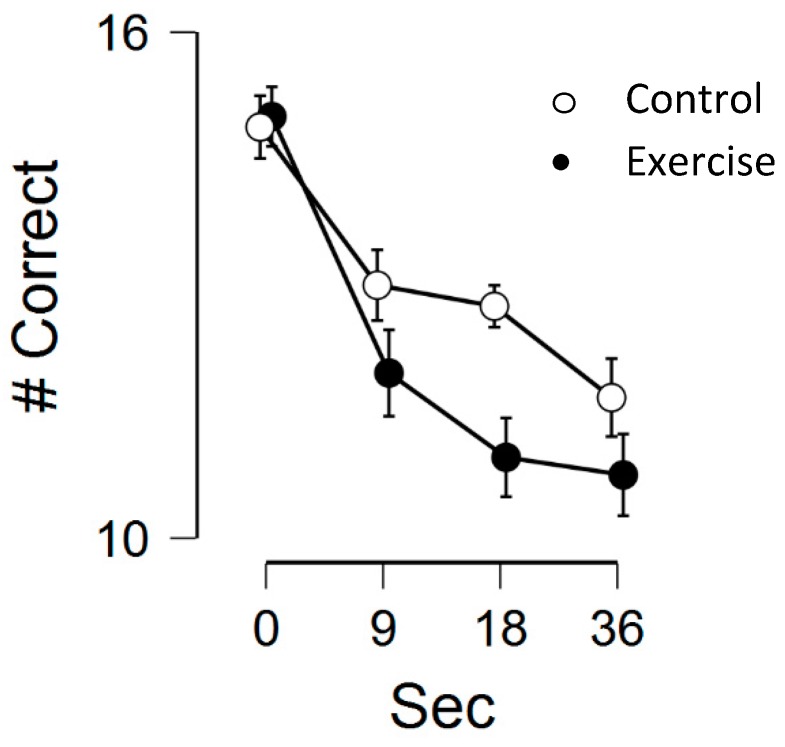
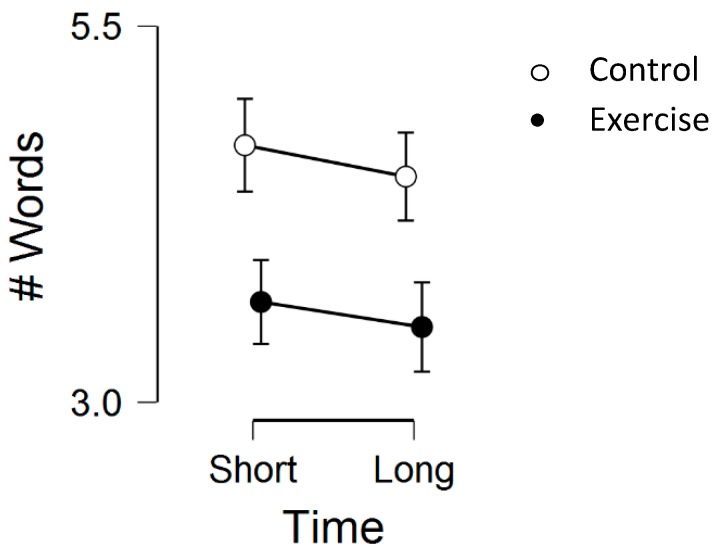
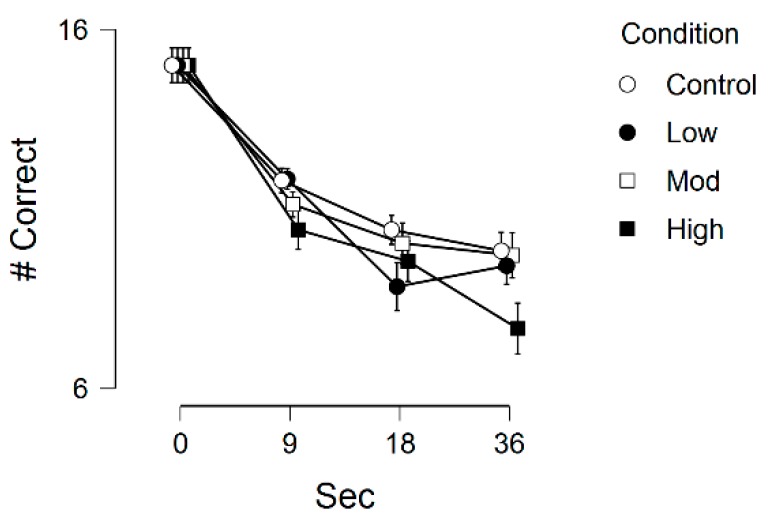
Background and Objective: The transient hypofrontality hypothesis predicts that memory function will be impaired during high-intensity exercise, as a result of a need for metabolic and cognitive resources to be allocated toward sustaining movement, as opposed to performing a cognitive task. The purpose of these experiments was to evaluate this transient hypofrontality hypothesis. Materials and Methods: Experiment 1 involved participants (n = 24; Mage = 21.9 years) completing four counterbalanced visits. Two visits evaluated working memory function, either at rest or during a high-intensity bout of acute exercise. The other two visits evaluated episodic memory function, either at rest or during a high-intensity bout of acute exercise. Experiment 2 (n = 24; Mage = 20.9 years) extended Experiment 1 by evaluating memory function (working memory) across 4 counterbalanced conditions, including at rest and during light (30% of heart rate reserve; HRR), moderate (50% HRR) and high-intensity (80% HRR) acute exercise. Results: Experiment 1 demonstrated that, when compared to rest, both working memory and episodic memory were impaired during high-intensity acute exercise. Experiment 2 replicated this effect, but then also showed that, unlike high-intensity acute exercise, memory function was not impaired during low- and moderate-intensity acute exercise. Conclusions: Our experiments provide support for the transient hypofrontality hypothesis. Both working memory and episodic memory are impaired during high-intensity acute exercise. Working memory does not appear to be impaired during lower exercise intensities.
Overview
The claims and statistics of this paper haven’t been checked yet.
Free: it reads the open-access text and checks the first 5 claims that cite a source we can check. Create a free account to check every claim.
Integrity signals
Registry
Cites
Statistics
Figures
Verification
Claims the paper makes
The claims and statistics of this paper haven’t been checked yet.
Free: it reads the open-access text and checks the first 5 claims that cite a source we can check. Create a free account to check every claim.
Claims other papers make about this one
Each is checked against this paper’s own text: does it say what the citing paper says it does?
The check wasn’t confident either way, so it gives no verdict — never disputed.
In the citing paper
“It has been demonstrated that voluntary physical exercise, like an enriched environment, increases expression of BDNF in the hippocampus [8], as well as hippocampal neurogenesis [9].”
From Neurotrophic Factor BDNF, Physiological Functions and Therapeutic Potential in Depression, Neurodegeneration and Brain Cancer (2020) · cites this paper as [8]
Experimental — accuracy not yet measuredThe check wasn’t confident either way, so it gives no verdict — never disputed.
In the citing paper
“However, voluntary physical exercise, like an enriched environment, increases expression of BDNF in the hippocampus [8], as well as hippocampal neurogenesis [9] and this could improve brain function by enhancing plasticity, cognition, learning, and memory [12,13,14].”
From Neurotrophic Factor BDNF, Physiological Functions and Therapeutic Potential in Depression, Neurodegeneration and Brain Cancer (2020) · cites this paper as [8]
Experimental — accuracy not yet measured
Self-check
Percentages, sums and reported differences re-computed from the paper’s own numbers.
The self-check needs the paper’s full text.
Citations
Cites
Age-predicted maximal heart rate revisited
Tanaka, H., Monahan, K. D., & Seals, D. R. (2001) · Journal of the American College of Cardiology · doi:10.1016/s0735-1097(00)01054-8 · Cited by 3,775 · cited 1×
“84 × age); Tanaka, Monahan, & Seals [26] 208 − (0.”
Interplay of Hippocampus and Prefrontal Cortex in Memory
Preston, A. R., & Eichenbaum, H. (2013) · Current Biology · doi:10.1016/j.cub.2013.05.041 · Cited by 1,389 · cited 2×
“Importantly, though, the prefrontal cortex and hippocampus likely interact to also influence episodic memory function [5].”
Mental imagery in associative learning and memory.
Paivio, A. (1969) · Psychological Review · doi:10.1037/h0027272 · Cited by 1,358 · cited 1×
“Ten word pairs (two-syllable) from the Medical Research Council Psycholinguistic Database were used, with each word having an imageability score between 414–486, to reduce variability on this parameter, which can influence cue-recall performance [31].”
Episodic and declarative memory: Role of the hippocampus
Tulving, E., & Markowitsch, H. J. (1998) · Hippocampus · doi:10.1002/(sici)1098-1063(1998)8:3<198::aid-hipo2>3.0.co;2-g · Cited by 1,277 · cited 1×
“Working memory capacity is thought to be heavily dependent on the prefrontal cortex [3], whereas episodic memory function relies on medial temporal lobe structures, such as the hippocampus [4].”
Baddeley, A. (2010) · Current Biology · doi:10.1016/j.cub.2009.12.014 · Cited by 1,122
Associative memory and the medial temporal lobes
Mayes, A., Montaldi, D., & Migo, E. (2007) · Trends in Cognitive Sciences · doi:10.1016/j.tics.2006.12.003 · Cited by 686 · cited 1×
“For the episodic memory assessment, participants completed a paired associate learning task, as this task of cued recall is considered to be hippocampal-dependent [29,30].”
Longitudinal Modeling of the Relationship between Age and Maximal Heart Rate
GELLISH, R. L., GOSLIN, B. R., OLSON, R. E., McDONALD, A., RUSSI, G. D., & MOUDGIL, V. K. (2007) · Medicine & Science in Sports & Exercise · doi:10.1097/mss.0b013e31803349c6 · Cited by 660
A contextual binding theory of episodic memory: systems consolidation reconsidered
Yonelinas, A. P., Ranganath, C., Ekstrom, A. D., & Wiltgen, B. J. (2019) · Nature Reviews Neuroscience · doi:10.1038/s41583-019-0150-4 · Cited by 450 · cited 1×
“A sensible suggestion would also be to, for episodic memory, match the context during encoding and memory retrieval [48].”
Transient hypofrontality as a mechanism for the psychological effects of exercise
Dietrich, A. (2006) · Psychiatry Research · doi:10.1016/j.psychres.2005.07.033 · Cited by 351 · cited 2×
“Per the transient hypofrontality hypothesis, widespread neural activation of motor and sensory systems during exercise comes at the expense of prefrontal-dependent higher-order cognitions, such as memory function [11,12].”
Working Memory in the Prefrontal Cortex
Funahashi, S. (2017) · Brain Sciences · doi:10.3390/brainsci7050049 · Cited by 332 · cited 2×
“Working memory capacity is thought to be heavily dependent on the prefrontal cortex [3], whereas episodic memory function relies on medial temporal lobe structures, such as the hippocampus [4].”
Research works printed but not linked: 1
- Tulving E. Elements of Episodic Memory Oxford University Press Oxford, UK 1983
Cited by
Colucci-D’Amato, L., Speranza, L., & Volpicelli, F. (2020) · International Journal of Molecular Sciences · doi:10.3390/ijms21207777 · Cited by 991
“However, voluntary physical exercise, like an enriched environment, increases expression of BDNF in the hippocampus [8], as well as hippocampal neurogenesis [9] and this could improve brain function by enhancing plasticity, cognition, learning, and memory [12–14].”
BackgroundBabaei, P., & Azari, H. B. (2022) · Frontiers in Human Neuroscience · doi:10.3389/fnhum.2021.771553 · Cited by 72
“…ability, particularly memory, however, there are inconsistencies in the literature due to the variety in type and timing of the cognitive tests, subjects characteristics (Sibley et al., 2006; Lambourne and Tomporowski, 2010; Chang et al., 2012), and exercise protocols (Loprinzi et al., 2019a).”
BackgroundResultThe Association Between Light Physical Activity and Cognition Among Adults: A Scoping Review
Erlenbach, E. D., McAuley, E., & Gothe, N. P. (2021) · The Journals of Gerontology Series A · doi:10.1093/gerona/glab013 · Cited by 55
Olivo, G., Nilsson, J., Garzón, B., Lebedev, A. V., Wåhlin, A., Tarassova, O., Ekblom, M., & Lövdén, M. (2020) · NeuroImage · doi:10.1016/j.neuroimage.2020.117500 · Cited by 51
Loprinzi, P. D., Day, S., Hendry, R., Hoffman, S., Love, A., Marable, S., McKee, E., Stec, S., Watson, H., & Gilliland, B. (2021) · Europe’s Journal of Psychology · doi:10.5964/ejop.2955 · Cited by 39
“In brief, acute exercise may influence memory as a result of exercise-induced alterations in various neurotransmitters and growth factors that influence long-term potentiation (Loprinzi, 2019).”
InfluentialSelf-citation
Metadata
- Authors
- Loprinzi, P. D., Day, S., & Deming, R.
- Affiliations
- University of Mississippi (US)
- Corresponding author
- Loprinzi, Paul D.
- ORCID
- Loprinzi, Paul D.
- Venue
- Medicina
- Publisher
- MDPI AG
- Published
- 2019-08-07
- Volume
- 55
- Issue
- 8
- Pages
- 445
- ISSN
- 1010-660X (ISSN-L)
- 1648-9144
- PMC
- PMC6723384
- OpenAlex
- W2965118156
- Cited by
- 26
- References
- 46
- Citations by year
- 2026: 1 · 2025: 6 · 2024: 2 · 2023: 4 · 2022: 3 · 2021: 8 · 2020: 2
- FWCI
- 2.23
- Type
- journal article
- Language
- en
- Open access
- gold
- dx.doi.org
- Licence
- Locations
- Medicina (publishedVersion, cc-by)
- Europe PMC (PubMed Central) (publishedVersion, cc-by)
- PubMed Central (publishedVersion, cc-by)
- PubMed (publishedVersion)
- DOAJ (DOAJ: Directory of Open Access Journals) (submittedVersion, cc-by-sa)
- Topics
- Health Sciences › Medicine › Public Health, Environmental and Occupational Health › Physical Activity and Health
- Health Sciences › Medicine › Physiology (medical) › Cardiovascular and exercise physiology
- Social Sciences › Psychology › Experimental and Cognitive Psychology › Cognitive Functions and Memory
- Keywords
- acute exercise, exercise intensity, working memory, episodic memory, high-intensity exercise, resource allocation, heart rate reserve
- MeSH terms
- Adolescent, Adult, Exercise Therapy, Female, Humans, Male, Memory, Memory, Short-Term, Exercise, Cognitive Dysfunction
About these checks
Registry, retraction, Cites and statistics results are computed, not judged, with one exception: a printed reference that no index lists is read once by a model before it counts as a citation error. Claims are extracted by a model and kept only when their quote appears verbatim in the text; each cited source is then checked, with a model’s help, for whether it says what the claim relies on. Those verdicts can be wrong — read the claim’s quote and the cited source before relying on one.
Statistics and arithmetic are recomputed, not judged.
Confidence bands are shown only for fields calibrated on our annotated test set. None is calibrated yet, so no band is shown.
What counts as a claim ›How we measure confidence ›How we check this ›
Are you an author, or do you see a problem with this page? Request a review
Data sources
Bibliographic data: Semantic Scholar, OpenAlex, Crossref.
Contains information from the Semantic Scholar Academic Graph Datasets, made available under the ODC Attribution License (ODC-BY 1.0).
Semantic Scholar’s data is described in: Kinney, R., et al. (2023). The Semantic Scholar Open Data Platform. arXiv:2301.10140.
