

The DOI matches its Crossref record; 2 of the 2 references it cites were found in a registry or an index.
Is Initial Misdiagnosis Associated with Reaching Disability Milestones in Patients with Multiple Sclerosis?
Open accessAbstract
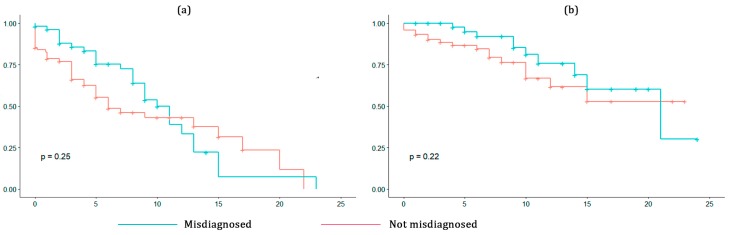
Background and objectives: multiple sclerosis (MS) is a chronic demyelinating disorder of the CNS with a variable course and disability progression. The latter may be prevented with disease-modifying therapy (DMT). Initial misdiagnosis may postpone the use of DMT. There are no studies to explore whether initial misdiagnosis is indeed associated with a higher rate of reaching disability in MS patients. We aimed to investigate the association between initial misdiagnosis and reaching disability milestones in relapsing-remitting MS (RR-MS) patients. Materials and methods: Data from 128 RR-MS patients were retrospectively reviewed. EDSS 4 and EDSS 6 were chosen as disability milestones as those associated with a significant decrease in ambulation. Survival analysis was used, and Kaplan–Meier curves were generated to investigate how initial misdiagnosis affects reaching the defined milestones. Results: 53 patients (41.4%, 31 females, 22 males) were initially misdiagnosed. Initially misdiagnosed patients had a lesser risk of reaching EDSS 4 up to 11 years and EDSS 6 up to 22 years from the onset than non-misdiagnosed patients (p = 0.22 and p = 0.25 correspondingly). Median time to reaching EDSS 4 and 6 was eight years (95% CI 0.0–17.6) and 10 years (95% CI 4.25–20.75) in misdiagnosed and three years (95% CI 0.0–20.0 years) and five years (95% CI 0.0–13.73 years) in non-misdiagnosed patients correspondingly. Conclusions: Initially misdiagnosed RR-MS patients tended to reach disability milestones later than non-misdiagnosed ones, which might reflect an intrinsically milder disease. Individuals presenting with mild or non-specific symptoms suspicious of MS, must be deliberately managed.
Overview
The claims and statistics of this paper haven’t been checked yet.
Run the check — free, no account needed. It reads the open-access text and checks the sources it cites.
Integrity signals
Registry
Cites
Statistics
Figures
Verification
Claims the paper makes
The claims and statistics of this paper haven’t been checked yet.
Run the check — free, no account needed. It reads the open-access text and checks the sources it cites.
Claims other papers make about this one
Each is checked against this paper’s own text: does it say what the citing paper says it does?
The cited source says what the claim attributes to it.
In the citing paper
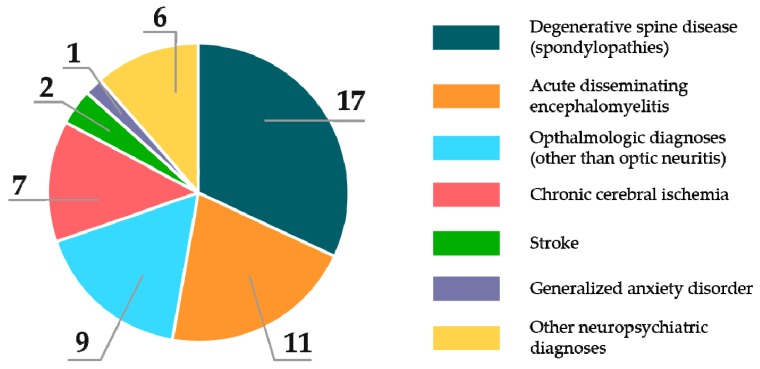
“Similarly, in a 2020 study at a tertiary care center in Ukraine, 53 patients were initially misdiagnosed before receiving the correct diagnosis of MS, including one (2%) with generalized anxiety disorder and six (11%) with “other neuropsychiatric disorders” [16].”
From Functional neurological disorder and multiple sclerosis: a systematic review of misdiagnosis and clinical overlap (2022) · cites this paper as [16]
Self-check
Percentages, sums and reported differences re-computed from the paper’s own numbers.
The self-check needs the paper’s full text.
Citations
Cites
Diagnosis of multiple sclerosis: 2017 revisions of the McDonald criteria
Thompson, A. J., Banwell, B. L., Barkhof, F., Carroll, W. M., Coetzee, T., Comi, G., Correale, J., Fazekas, F., Filippi, M., Freedman, M. S., et al. (2018) · The Lancet Neurology · doi:10.1016/s1474-4422(17)30470-2 · Cited by 8,167
The contemporary spectrum of multiple sclerosis misdiagnosis
Solomon, A. J., Bourdette, D. N., Cross, A. H., Applebee, A., Skidd, P. M., Howard, D. B., Spain, R. I., Cameron, M. H., Kim, E., Mass, M. K., et al. (2016) · Neurology · doi:10.1212/wnl.0000000000003152 · Cited by 334 · cited 5×
“While other disorders are more often initially diagnosed as MS in high-income countries [6], the opposite problem may be particularly relevant to low-income countries, especially for rural sites with limited access to healthcare professionals and corresponding diagnostic procedures.”
BackgroundInfluential
Research works printed but not linked: 6
- Thompson, 2018, Multiple sclerosis, Lancet, 391, 1622, 10.1016/S0140-6736(18)30481-1 · DOI
- Goodin, 2014, The epidemiology of multiple sclerosis: Insights to disease pathogenesis, Handb. Clin. Neurol., 122, 231, 10.1016/B978-0-444-52001-2.00010-8 · DOI
- Lublin, 2014, Defining the clinical course of multiple sclerosis: The 2013 revisions, Neurology, 83, 278, 10.1212/WNL.0000000000000560 · DOI · Paper page
- Jokubaitis, 2016, Predictors of long-term disability accrual in relapse-onset multiple sclerosis, Ann. Neurol., 80, 89, 10.1002/ana.24682 · DOI
- Phua, 2013, Cognitive aspect of diagnostic errors, Ann. Acad. Med. Singapore, 42, 33, 10.47102/annals-acadmedsg.V42N1p33 · DOI
- Hardiman, 2017, Amyotrophic lateral sclerosis, Lancet, 390, 2084, 10.1016/S0140-6736(17)31287-4 · DOI
Cited by
Sorted by citations
Walzl, D., Solomon, A. J., & Stone, J. (2022) · Journal of Neurology · doi:10.1007/s00415-021-10436-6 · Cited by 62
Metadata
- Authors
- Ivaniuk, A., Marusich, T., Solodovnikova, Y., & Son, A.
- Affiliations
- Odessa National Medical University (UA)
- Corresponding author
- Ivaniuk, Alina
- Venue
- Medicina
- Publisher
- MDPI AG
- Published
- 2020-04-10
- Volume
- 56
- Issue
- 4
- Pages
- 170
- ISSN
- 1010-660X (ISSN-L)
- 1648-9144
- PMC
- PMC7230493
- OpenAlex
- W3015776398
- Cited by
- 8
- References
- 2
- Citations by year
- 2026: 1 · 2025: 1 · 2024: 2 · 2023: 2 · 2022: 1 · 2021: 1
- FWCI
- 0.66
- Type
- journal article
- Language
- en
- Open access
- gold
- dx.doi.org
- Licence
- Locations
- Medicina (publishedVersion, cc-by)
- PubMed Central (publishedVersion, cc-by)
- PubMed (publishedVersion)
- DOAJ (DOAJ: Directory of Open Access Journals) (submittedVersion)
- DOAJ (DOAJ: Directory of Open Access Journals) (submittedVersion, cc-by-sa)
- Topics
- Health Sciences › Medicine › Clinical Neurology › Multiple Sclerosis Research Studies
- Health Sciences › Medicine › Family Practice › Clinical Reasoning and Diagnostic Skills
- Health Sciences › Medicine › Clinical Neurology › Peripheral Neuropathies and Disorders
- Keywords
- multiple sclerosis, relapsing-remitting multiple sclerosis, disability progression, Expanded Disability Status Scale, disease-modifying therapy, ambulation, disease severity
- MeSH terms
- Adult, Cross-Sectional Studies, Diagnostic Errors, Disability Evaluation, Female, Humans, Male, Middle Aged, Multiple Sclerosis, Retrospective Studies, Survival Analysis, Disease Progression
About these checks
Registry, retraction, Cites and statistics results are computed, not judged, with one exception: a printed reference that no index lists is read once by a model before it counts as a citation error. Claims are extracted by a model and kept only when their quote appears verbatim in the text; each cited source is then checked, with a model’s help, for whether it says what the claim relies on. Those verdicts can be wrong — read the claim’s quote and the cited source before relying on one.
Statistics and arithmetic are recomputed, not judged.
Confidence bands are shown only for fields calibrated on our annotated test set. None is calibrated yet, so no band is shown.
What counts as a claim ›How we measure confidence ›How we check this ›
Are you an author, or do you see a problem with this page? Request a review
